

Agricultural Irrigation Pipe, Fittings & Pumps 2026: Smart Innovation for Efficient, Sustainable Yields
“By 2026, smart irrigation pipes and pumps are projected to increase agricultural water use efficiency by up to 30%.”
Introduction: Why Agricultural Irrigation Pipe, Fittings & Pumps Matter in 2026
By 2026, agricultural irrigation pipe, agricultural irrigation pipe fittings, and agricultural irrigation pumps have become more than just water delivery tools—they are the backbone of efficient, sustainable farming systems. With increasing pressures from climate change, water scarcity, and the urgent need to boost crop yields, farmers worldwide are turning to advanced infrastructure that leverages technology and innovation. These components—pipes, fittings, and pumps—enable the modern irrigation systems necessary to reduce wastage, optimize water use, and enhance productivity in agriculture.
In this comprehensive guide, we delve into the materials, smart solutions, and global trends that define irrigation infrastructure in 2026. We also explore how satellite-driven platforms like Farmonaut support farmers with real-time, actionable insights—empowering farms of every size to build flexible, future-ready irrigation systems.

Agricultural Irrigation Pipe: Materials and Innovation
Agricultural irrigation pipes serve as the primary conduits for water transfer, making material selection and design critical for system efficiency. As irrigation systems continue evolving, so do the materials and technologies used to construct pipes that must withstand varying environments, pressure changes, and demanding operational cycles.
Advanced Pipe Materials: Moving Beyond Traditional Choices
Traditionally, clay and concrete dominated the construction of agricultural irrigation pipe. In 2026, the market has significantly moved to embrace modern polymers for enhanced durability, flexibility, and ease of installation.
- Polyethylene (PE), especially HDPE: Lightweight, flexible, and resistant to corrosion and abrasion. HDPE pipes deliver excellent performance in high-pressure environments and are easy to transport and install.
- Polyvinyl Chloride (PVC): Offers outstanding corrosion resistance and is suitable for both surface and subsurface installation. PVC pipes maintain consistent flow rates due to low friction losses.
- Polypropylene (PP): Known for chemical resistance and long life. PP pipes can handle aggressive fertilizers and are ideal for drip and sprinkler joints.
- Stainless Steel and Composite Materials: Used in high-pressure and specialty irrigation systems, offering the highest standards of durability and reliability for sensitive field applications.
These materials are selected based on farm requirements such as field size, water flow rate, and crop type. The shift from traditional to advanced polymers not only reduces installation costs but also extends system lifespan, minimizing maintenance and downtime.
Smart Pipe Innovation: Integrated Sensors & Intelligent Infrastructure
In 2026, the trend toward smart irrigation pipes is driven by the integration of sensor technology and digital infrastructure. Smart pipes feature embedded sensors that monitor pressure, leakage, flow rate, and even soil moisture conditions in real-time—paving the way for predictive maintenance and precision water application.
- Pressure Sensors detect abnormal drops, preventing leaks or bursts and ensuring system integrity.
- Flow Rate Monitors report exact water output, enabling field-by-field optimization.
- Leakage Detection using acoustic or satellite technology helps reduce wastage and supports water conservation efforts.
- IoT Integration ensures data from these sensors is remotely accessible 24/7, driving automation of irrigation schedules.
The result: increased water use efficiency (up to 30% as per sector forecasts), lower costs, and more sustainable practice.
Farmers using these intelligent systems can respond directly to crop demands—opening or closing control valves precisely where needed, minimizing runoff and evaporation.

Pipe Sizing and Configuration: Customization for Modern Agriculture
Pipe size and type remain highly customized in 2026, reflecting unique crop and field requirements:
- Drip Irrigation (Micro-Irrigation): Uses narrow tubing fitted with emitters—delivering water directly to the plant root zone. This maximizes efficiency, minimizes evaporation and runoff, and is particularly advantageous for dry regions or high-value crops like vegetables and fruits.
- Sprinkler Systems: Employ larger-diameter, pressure-resistant pipes. They are configured to replicate rainfall—ideal for field crops, lawns, and orchards. Advanced moving sprinklers or center-pivot designs enhance uniformity and reduce labor.
- Center-Pivot and Lateral Move: Utilize robust, corrosion-resistant pipes with modular joints to cover large areas, especially in North America, the Middle East, and Australia.
These systems are often integrated with sensor-based controls, allowing operators to switch between drip, temporary, or semi-permanent configurations based on soil or crop health data.

Agricultural Irrigation Pipe Fittings: Ensuring System Integrity
Elbows, tees, reducers, couplers, and valves—the unsung heroes of agricultural irrigation systems—are more critical than ever in 2026. Agricultural irrigation pipe fittings guarantee system flexibility, leak-proof operation, and robust performance across highly variable farming landscapes.
Types and Roles of Fittings in Efficient Irrigation
- Elbows & Tees: Redirect water flow for complex field layouts. They are crucial when joining different pipe run directions or distributing irrigation across various blocks.
- Reducers: Connect pipes of different sizes, making pressure and flow adjustments seamless—especially in multi-zone or variable demand systems.
- Couplers & Unions: Allow for easy joining, extension, or replacement of pipe sections, especially during maintenance or system scaling.
- Valves (Check, Gate, Control): Enable sectional water control, isolation, or protection from backflow. Smart valves with auto-actuation and remote app connectivity help orchestrate automation of water schedules at the field level.
These fittings ensure system integrity—helping farmers control pressure, flow rate, and isolate problem sections without halting the whole system.
Material Innovation & Anti-Leak Technologies
In 2026, pipe fittings are built from corrosion-resistant polyethylene, PVC, PP, and composite metals. Self-sealing couplers, anti-drip gaskets, and pressure-equalizing joints have become standard, reducing leakage and maintenance costs significantly.
- Modular, Tool-Free Designs: Make installation and reconfiguration easy, ensuring flexibility as crop patterns change or areas expand.
- Automated Locking Systems: Prevent accidental disconnection and cope with higher pressure ranges—essential for automated irrigation platforms.
- High UV and Chemical Resistance: Extends life, maintaining integrity even with repeated exposure to fertilizers, pesticides, and sun.

The Role of Fittings in Smart, Automated Irrigation Systems
Modern agricultural irrigation pipe fittings are increasingly integrated with IoT systems—connecting these components to remote sensors and automated controls. This upgrade isn’t aesthetic; it allows precise shutoff in case of detected leaks, or on-demand rerouting of water flows to address deficits, storms, or crop zones experiencing varied stress.
In many regions, satellite-based monitoring tools even help detect underground leaks by identifying unusual plant stress signatures—supporting prompt repairs that optimize water conservation. For those seeking advanced traceability tools and transparent resource management, Farmonaut’s solutions offer a unique advantage.
“Advanced fittings and sustainable pump systems could boost crop yields by 20% in farms implementing new irrigation tech by 2025.”

Agricultural Irrigation Pumps: Powering Efficient Water Delivery
Pumps form the heart of every irrigation system, handling the crucial task of moving water from sources (like wells, reservoirs, or canals) to fields. Selection of an irrigation pump has a direct impact on energy costs, reliability, and the ultimate efficiency of agricultural irrigation systems.
Key Pump Types and Their Uses in Modern Irrigation
-
Centrifugal Pumps:
Widely used for surface water extraction. Easy to maintain, they are efficient for both sprinkler and drip irrigation systems. In 2026, many centrifugal pumps include energy-saving motors and robust casings for longevity and reliability. -
Submersible Pumps:
Installed deep in wells, these pumps are ideal for drawing groundwater to the surface. Modern versions are built with corrosion-resistant alloys and have integrated anti-clogging features for sandy or sediment-rich water. -
Solar-Powered Pumps:
With rising energy prices and climate mandates, solar pumps are mainstream, especially for remote farms or regions with unreliable grid electricity. The latest models include high-capacity batteries, automated switching, and IoT-enabled performance analytics. -
Variable Frequency Drive (VFD) Pumps:
These smart pumps automatically adjust speed and output based on water demand. This results in optimized energy use, reduced water hammer, and lower operational costs—essential to achieving sustainable irrigation at scale.
All modern pumps are integrated into broader, smart irrigation systems for precise remote control, automated scheduling, and real-time diagnostics. This leads to better water conservation, crop yield optimization, and significant cost savings.

Energy Efficiency and Smart Automation: The Pump Revolution
Energy efficiency is the major focus for agricultural irrigation pumps in 2026. With rising electricity and fuel prices, solar-powered and VFD-driven pumps are now mainstream in sustainable agriculture. Pump automation, linked to IoT devices and satellite-based scheduling apps, is helping farmers precisely control water delivery to multiple zones, reduce labor, and integrate real-time weather forecasts and soil moisture data for further optimization.
Smart pumps are especially impactful in regions with complex topography or unreliable power sources. Modern setup allows farmers to automate entire irrigation cycles, ensuring water is delivered only when and where it’s needed.
- Predictive Maintenance through IoT: Automatic alerts to pump wear and tear, leading to significant reduction in breakdown times and emergency repairs.
- Remote Pump Control: Manage and schedule pumps from anywhere, saving time and effort.
- Energy Cost Reduction: By adjusting pump speed to demand, farms can cut electricity bills by up to 40%—a key factor in overall system sustainability.
For farms seeking even smarter resource and fleet management, integrated digital platforms offer actionable data to enhance water resource allocation, minimize fuel waste, and guarantee the highest system reliability.



Smart Irrigation Systems in 2026: Sensors and IoT Integration
IoT-driven irrigation systems have ushered in a new era where every component—from the pipe to fitting to pump—is a node in a smart infrastructure. This enables real-time monitoring, data collection, and automated decision-making for water delivery, achieving precision agriculture at scale.
- Soil Moisture & Climate Sensors: Monitor zone-by-zone water needs, sending instructions to pumps or valves to increase or decrease flow depending on crop demand.
- Remote Control & Automation: Farmers can manage entire irrigation cycles from a mobile or web app. Smart scheduling means water is delivered at optimal times—reducing evaporation losses and labor requirements.
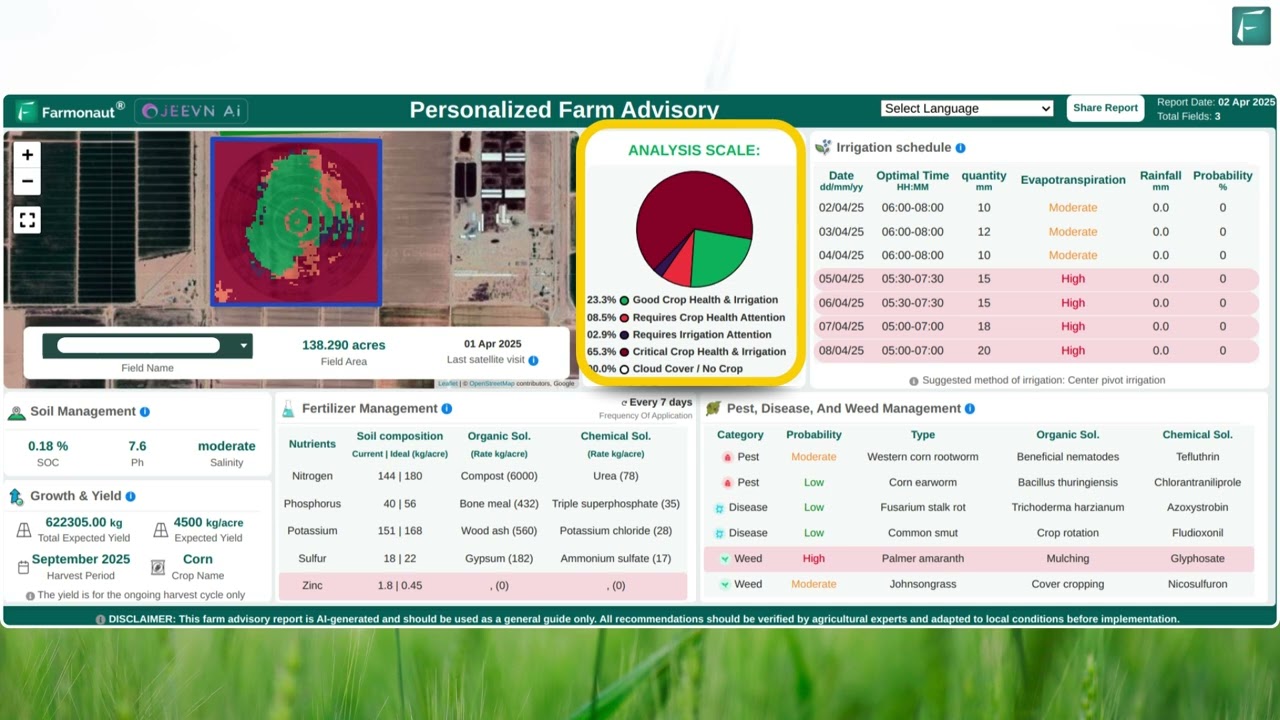
- Satellite-Based Field Monitoring: Platforms like Farmonaut use NDVI and water index imagery to visualize plant health, zooming in on water stress or inefficiencies across large, dispersed areas.
- Blockchain Traceability: Innovative farms seeking to access premium markets or document sustainability can use product traceability solutions to strengthen authenticity and consumer trust.
Advanced irrigation systems have seamlessly integrated these components, ensuring workshops or new installations require less specialized labor. Installation can be completed with modular, plug-and-play parts, making it practical for both smallholders and large agribusinesses.

For developers and enterprise users, Farmonaut’s Satellite & Weather API offers programmatic access to multispectral and weather data, and the API Developer Docs make integration seamless.
Feature & Efficiency Table: Pipes, Fittings, and Pumps in 2026
| Component Type | Material | Smart Technology Features | Est. Water Efficiency Improvement (%) | Est. Crop Yield Increase (%) | Sustainability Rating | 2026 Price Range (USD/Unit) |
|---|---|---|---|---|---|---|
| Irrigation Pipe: HDPE | HDPE (High-Density Polyethylene) | Embedded sensors, IoT-connected, leak detection | 25-30 | 15-18 | ★★★★★ | $1.5 – $4 / meter |
| Irrigation Pipe: UV-Stabilized PVC | PVC (Polyvinyl Chloride) | Pressure/flow monitoring, app integration | 20-25 | 12-15 | ★★★★☆ | $1.2 – $3 / meter |
| Pipe Fittings: Smart Coupler | Composite Polymer & PP | Self-sealing, modular, app alerts for leakage | 22-28 | 14-17 | ★★★★★ | $2 – $6 / unit |
| Pipe Fittings: Auto Valve | PP, Stainless Steel | Remote control, IoT, anti-leak auto shutoff | 25-30 | 16-20 | ★★★★☆ | $4 – $15 / unit |
| Pump: Solar-Powered | Stainless Steel & Polymer | Solar/IoT, remote scheduling, VFD, diagnostics | 30+ | 16-22 | ★★★★★ | $300 – $700 / unit |
| Pump: VFD Centrifugal | Stainless Steel/Alloy | Variable speed, energy analytics, app control | 25-35 | 14-19 | ★★★★★ | $250 – $900 / unit |
| Submersible Pump: IoT Ready | Stainless Steel, Composite | Remote monitoring, eco-mode | 15-22 | 9-14 | ★★★★☆ | $400 – $1200 / unit |
Note: Values based on 2026 estimates; precise savings and yield improvements depend on farm, environment, and system configuration.
Global Trends Shaping Irrigation Infrastructure in 2026
- Climate Change: Erratic rainfall and rising drought risk demand robust, smart irrigation systems—integrating data from carbon footprinting solutions to monitor and manage sustainability goals.
- Digitalization and Automation: From sensor-equipped pipes to fully automatable pumps, digital transformation is the new standard for both large and small farms. Automated reporting supports audits for government incentives and export certification.
- Urban & Peri-Urban Agriculture: Compact, modular irrigation units are powering rooftop and city-edge farming, blending high-yield designs with environmental stewardship.
- Decentralized Water Management: Farmers leverage both surface and groundwater resources, using dynamic scheduling (powered by weather and crop data) to maximize resource allocation.
- Increased Demand for Traceability and Compliance: Export markets penalize water and carbon-heavy produce—traceability tech will keep farms competitive and transparent as supply chain regulations tighten.
How Farmonaut’s Satellite Insights Empower Smart Irrigation
Farmonaut isn’t an equipment provider—but as a satellite technology company, we support farmers and agri-businesses looking to maximize ROI from modern irrigation systems. Our platform offers a suite of satellite-driven tools for real-time monitoring, AI-based advisory, environmental compliance, and traceability—directly accessible through mobile, web and API interfaces.
Major Value Propositions:
- Satellite-Based Monitoring: Access regular satellite images of your fields to identify variations in moisture, crop health, and even irrigation leaks or anomalies—enabling highly targeted maintenance and precision water use.
- AI-Driven Advisory (Jeevn AI): Utilize real-time weather forecasts, NDVI (Normalized Difference Vegetation Index), and NDWI (Normalized Difference Water Index) analytics to optimize irrigation schedules and maximize every drop.
- Blockchain Traceability: Future-proof your compliance with global markets through verified recording of all resource management practices—including irrigation timing and efficiency, using our traceability modules.
- Environmental Impact Tracking: Our carbon footprinting platform offers up-to-date, field-specific emission analysis, helping you track and lower the energy and water impact of all your agricultural irrigation systems.
- Fleet and Resource Management: Minimize operational costs and improve uptime by tracking the status, energy use, and positioning of all farm pumps, vehicles, and equipment via GPS and app-based dashboards.
All these insights help you make data-driven decisions—before droughts, floods, or system breakdowns impact your yields or income.
Accessing Farmonaut Solutions in 2026
Farmonaut’s scalable, subscription-based platform serves everyone from individual smallholders to global agri-businesses and governments. Integrate satellite insights directly into your precision irrigation planning and field operations—access via our app or through the API for advanced automation and reporting. For developers, detailed documentation is available.
Ready to join future-forward agriculture? Explore customizable subscription options and deliver next-gen sustainability to your fields:
Frequently Asked Questions (FAQs)
-
Q: What is the most efficient agricultural irrigation pipe material in 2026?
A: HDPE (High-Density Polyethylene) and UV-stabilized PVC remain top choices for efficiency, flexibility, and durability. Both offer excellent corrosion resistance and compatibility with modern sensor-integrated irrigation systems. -
Q: How do smart irrigation fittings reduce water wastage?
A: Advanced pipe fittings in 2026 feature auto-sealing technology, sensor-based leak detection, and modular, tool-free designs—helping quickly isolate issues and prevent unnecessary water loss. -
Q: Are solar pumps financially viable for farms in 2026?
A: Absolutely. Solar-powered agricultural irrigation pumps have reached mainstream adoption, delivering long-term energy savings, supporting off-grid operations, and driving down operational costs. -
Q: Can I automate my entire irrigation system with these modern components?
A: Yes. With the right combination of smart pipes, fittings, IoT-enabled pumps, and farm management apps, full automation—from water source monitoring to precise delivery at plant root zones—is possible and increasingly affordable. -
Q: How does Farmonaut help in irrigation management?
A: Farmonaut delivers real-time satellite imagery, AI-driven advisory, environmental and resource tracking, and blockchain traceability—all accessible via mobile or API. These insights enhance precise irrigation scheduling and sustainability compliance. -
Q: Where can I learn more about integrating carbon footprinting and traceability in modern agriculture?
A: Visit Farmonaut’s Carbon Footprinting and Traceability Solution pages for detailed info. -
Q: What is the projected impact of smart irrigation technology on yields by 2026?
A: Studies estimate up to a 30% improvement in water efficiency and as much as 20% higher crop yields for farms adopting integrated smart irrigation technologies.
Conclusion
Agricultural irrigation pipe, agricultural irrigation pipe fittings, and agricultural irrigation pumps are the key components underpinning efficient, sustainable, and precision agriculture in 2026. The transition from traditional materials like clay and concrete to robust, smart polymers, and the embrace of IoT-enabled system design, is set to reduce irrigation wastage, lower costs, and boost yields on a global scale. The move toward automation, traceability, and environmental management isn’t a luxury but a necessity in the face of climate change, resource scarcity, and increasing regulatory demands.
We at Farmonaut are proud to empower farmers and agri-enterprises worldwide with satellite-driven insights, AI-based recommendations, and digital tools to optimize irrigation, drive sustainability, and ensure food security for generations to come.
Whether you’re a grower, agronomist, or agri-business leader—investing in advanced irrigation infrastructure and data-driven management in 2026 will be critical for long-term productivity and resilience.
Go further with smart agricultural advisory and risk-insured crop success
Get actionable advisories and easy access to crop loan and insurance verification. Learn more at Crop Loan & Insurance or boost plantation/forest management using Farmonaut’s expertise.

 Liquify Digital
 Ascentya
 CU Foods
 BeyondTech Global
 Rouge VC
 Yutz Automation
 AgroGreen Dynamics
 AgroRisk
 Oath Inc
 Reddane Farming
 Esri North East Africa
 Cresol
 Atur Kuliner
 MDCV UK
 Zerella Group
 Etech Consulting Madagascar
 Vestlandsforsking
 Delicio
 WB Dev
 Sama Premium
 Prochecker
 Tres Valles
 LACOS Geoinformation
 Magrifly
