

Farm finance · Loan guide
Farm Land Loans: Rates, Limits and a Payment Calculator
In November 2026 the USDA Farm Service Agency charges 6.250% on direct Farm Ownership Loans (up to $600,000), while commercial bank fixed farmland rates averaged 6.7% to 7.1% in early 2026 (Chicago and St. Louis Fed districts). Compare lenders, limits and land prices, then test a parcel’s payment.
Key takeaways
- FSA direct Farm Ownership Loans: 6.250% in November 2026, up to $600,000; joint financing 4.250%; down payment loan 2.250% (FSA).
- FSA guaranteed loans go up to $2,558,000, with FSA guaranteeing up to 95% of the lender’s loss (FSA).
- Average fixed farm real estate rates at commercial banks were 6.7% (Chicago Fed district) and 7.1% (St. Louis) in Q1 2026 (farmdoc daily).
- US cropland averaged $6,020 per acre in 2026, from $2,790 in Texas to $10,700 in Iowa (USDA NASS).
- The Farm Credit System made almost half of US farm real estate loans in 2021 (USDA ERS).
In this article
- Farm land loans at a glance
- What a farm land loan is and how it differs from a mortgage
- The three main lenders
- Farm land loan rates: FSA and commercial lenders
- What US farmland costs by state
- Farm land loans in North Carolina
- Ranch land loans and pasture
- Costs beyond the interest rate
- How to qualify for a farm land loan
- Can the land pay for itself? Test your numbers
- Fixed or variable rate on farmland
- Refinancing an existing farm mortgage
- Options for beginning farmers
- Farm land loan types compared in detail
Farm land loans in the US come from three places: the USDA Farm Service Agency (FSA), the Farm Credit System and commercial banks. In November 2026 the FSA charges 6.250% on a direct Farm Ownership Loan, 4.250% on its joint-financing option and 2.250% on its down payment loan, according to the FSA’s November 2026 lending rate announcement. Commercial bank rates on farmland were higher: the average fixed real estate rate at banks was 6.7% in the Chicago Federal Reserve district and 7.1% in the St. Louis district in the first quarter of 2026.
This guide compares loan types, limits and rates, shows what US farmland costs by state, covers North Carolina and ranch land, and gives you a calculator to test whether a parcel can carry its own payment. All figures carry their date and source. Rates change monthly, so treat every number here as a starting point for your own lender quotes.
Farm land loans at a glance
The table sums up the main ways to borrow for farmland in the US. Each row has its own section below.
| Loan type | Who lends | Maximum | Rate (date) | Best for |
|---|---|---|---|---|
| FSA direct ownership | USDA FSA | $600,000 | 6.250% (Nov 2026) | Family farms that cannot get full bank credit |
| FSA joint financing | FSA plus another lender | FSA share up to 50% of cost | 4.250% on the FSA share (Nov 2026) | Buyers who can get part of the loan from a bank |
| FSA down payment | USDA FSA | Up to 45% of price | 2.250% (Nov 2026) | Beginning farmers with a 5% down payment |
| FSA guaranteed | Bank or Farm Credit, FSA guarantees up to 95% | $2,558,000 | Set by lender, capped by FSA | Larger purchases |
| Farm Credit or bank | Farm Credit System, banks | Set by lender | Banks avg 6.7% to 7.1% fixed (Q1 2026) | Established farms with equity |
Sources: FSA November 2026 lending rates; FSA Farm Ownership Loans page; FSA guaranteed farm loans page; farmdoc daily, June 2026. Bank rate figures are averages from Federal Reserve surveys of commercial banks, not quotes; Farm Credit rates are not included.
What a farm land loan is and how it differs from a mortgage
An agricultural land loan is long-term credit secured by farm real estate. You use it to buy farmland, refinance it, or pay for lasting improvements such as drainage, fencing or buildings. It is different from an operating loan, which pays for seed, fertilizer, feed and other costs within a season or two.
A home mortgage lender looks mostly at your salary and the house. A farm lender looks at the land and the farm business together. It asks four questions. What is the land worth? How much income can it produce? How much other debt does the farm carry? How much of the price can you pay up front?
Farm real estate is the largest asset on most US farms. The USDA Economic Research Service forecasts farm real estate assets at $3.72 trillion in 2026, 83% of all farm sector assets. It expects farm real estate debt to reach $399.0 billion in 2026, up 4.6% from 2025 in nominal dollars.
Three practical differences from a house loan matter most:
- Terms are long. FSA direct ownership loans can run up to 40 years. Bank and Farm Credit terms vary by lender.
- Payments can be annual. Many farm lenders set annual or semi-annual payments after harvest, not monthly payments.
- Bare land is fine. You do not need a house on the parcel. A cropland, pasture or timber tract can be the whole collateral.
The three main lenders
1. USDA Farm Service Agency
The FSA lends to family farmers who cannot get enough credit from a commercial lender on reasonable terms. It also guarantees loans that banks make. The FSA Farm Ownership Loans page lists the main limits: direct loans up to $600,000 and guaranteed loans up to $2,558,000. Under joint financing, FSA can cover up to 50% of the purchase cost while another lender covers the rest. The down payment program helps beginning farmers and ranchers who put down only 5%, with FSA lending up to 45% of the price or appraised value.
Best for: beginning farmers, smaller farms and buyers with limited equity.
2. The Farm Credit System
The Farm Credit System is a nationwide network of lending cooperatives owned by their borrowers. It is the largest lender for US farmland. In 2021 it provided almost half of all farm real estate loans and 45% of total farm debt, while commercial banks provided 35%, according to an ERS report on farm debt by lender. Its share of real estate debt rises as farm size grows.
Because associations are owned by borrowers, many pay part of their profit back to members as patronage. Ask each association how it has paid patronage in recent years, and compare the net cost, not just the headline rate.
Best for: established farms buying more land, and buyers who want a lender that only does agriculture.
3. Commercial banks and credit unions
Local and regional banks lend on farmland too, often to customers who already bank with them. They set their own rates and terms. Many banks also make FSA guaranteed loans, which lets them lend more to a borrower than they would on their own, because FSA guarantees up to 95% of losses of principal and interest.
Best for: buyers with an existing bank relationship, or a bank that knows the local land market well.
Other options exist. Some sellers carry the note themselves on a land contract. Life insurance companies lend on large farmland deals. Each has its own terms, and a farm attorney should review any seller-financed contract before you sign.
Farm land loan rates: FSA and commercial lenders
The FSA publishes its farmland loan rates every month, and they apply in every state. Its direct ownership rate rose from 5.750% in April 2026 to 6.250% in October and November 2026, according to the monthly FSA announcements. The operating loan rate moved from 4.750% to 5.625% over the same stretch.
Chart
FSA direct loan rates in 2026
Percent, selected months (March, April, July, September, October, November 2026)
FSA guaranteed loans are different. The rate and payment terms are agreed between the lender and the borrower, but they may not exceed maximum rates that FSA sets.
For bank and Farm Credit loans there is no single national rate sheet. The Federal Reserve district surveys are the best public guide. In the first quarter of 2026, the average fixed real estate rate was 6.7% in the Chicago district, up slightly from 6.6% the quarter before but below 7.1% a year earlier, according to a farmdoc daily analysis of the Chicago and St. Louis Fed surveys. The St. Louis district averaged 7.1%, down from 7.6% a year earlier.
Short-term bank farm credit has eased a little too. The average rate on all non-real estate farm loans at commercial banks fell from 7.11% in the third quarter of 2025 to 6.77% in the third quarter of 2026, per the farmdoc daily review of the Fed’s terms-of-lending survey. In the third quarter of 2020 that average was 3.26%, so borrowing costs remain well above 2020 levels.
How to get a real quote
- Ask at least one Farm Credit association and one bank for a written quote on the same parcel and loan size.
- Ask for a fixed rate and a variable rate, and how long each fixed period lasts.
- Ask about fees, appraisal costs, stock or membership requirements and patronage.
- Check the current FSA rate for your loan type, even if you plan to use a bank. It is a useful yardstick.
- Compare the yearly payment, not just the rate, using the calculator below.
This guide is general information, not financial advice. Get advice from a lender, accountant or farm attorney before you sign a loan.
What US farmland costs by state
Your loan size starts with the price of the land. The USDA NASS Land Values 2026 Summary puts US farm real estate (land and buildings) at $4,500 per acre, up 3.4% from 2025. Cropland averaged $6,020 per acre, up 3.3%. Pasture averaged $2,000 per acre, up 4.2%.
State figures vary a lot. Cropland averaged $10,700 per acre in Iowa and $10,200 in Illinois, but $3,540 in Kansas and $2,790 in Texas. California cropland averaged $18,430. A buyer in Kansas needs about a third of the loan per acre that a buyer in Iowa needs.
Prices have risen steadily. US cropland went from $4,940 per acre in 2022 to $6,020 in 2026, a rise of about 22% in four years (NASS). If you price a deal on sales from a few years ago, you will likely underestimate the loan you need. Lenders also use a fresh appraisal, not your purchase price, to set the loan-to-value.
These are survey averages for all land in a state. One farm can sell well above or below them because of soil quality, drainage, irrigation, location and buildings. Use recent local sales and an appraisal for your own decision.
Chart
Average cropland value by state
US dollars per acre, 2026, selected states
Farm land loans in North Carolina
Many searches for land loans in NC come from buyers looking at rural tracts, not houses. The financing rules are national, but the prices are local.
Prices. North Carolina farm real estate averaged $5,750 per acre in 2026, up 5.1% from 2025. Cropland averaged $5,580 per acre and pasture $6,380 per acre, according to the NASS Land Values 2026 Summary. Pasture in North Carolina is worth more per acre than cropland, which is unusual.
Lenders. Buyers in the state can use the FSA county office network, Farm Credit associations that serve North Carolina, and local or regional banks. FSA limits and eligibility are the same in every state.
Checklist for an NC parcel.
- Check zoning, deed restrictions and any conservation easement with the county register of deeds.
- Ask whether the land is enrolled in present-use value taxation, and what happens to that status if you buy it.
- Get a current appraisal from an appraiser who knows farm sales in the county.
- Look at soils, drainage and flood risk; low-lying land in the eastern counties can flood.
- Compare at least one Farm Credit quote with one bank quote, and check FSA eligibility if you are a beginning farmer.
Local tax and land-use rules change, so confirm each point with the county office and a local attorney.
Ranch land loans and pasture
A ranch land loan finances pasture and range for livestock. The FSA treats it the same way as cropland: the same Farm Ownership Loan, the same $600,000 direct limit and the same $2,558,000 guaranteed limit. The difference is in how the lender values the land and the income.
- Lower value per acre. US pasture averaged $2,000 per acre in 2026 against $6,020 for cropland (NASS). A ranch loan of the same size needs about three times the acres as collateral.
- Slower income. Cow-calf income follows breeding, weaning and sale dates that can stretch over 12 to 24 months. Lenders weigh herd size, carrying capacity and grazing lease income.
- Big regional spread. Pasture averaged $2,400 per acre in Kansas but $6,380 in North Carolina in 2026 (NASS). Rainfall and forage decide how many animals an acre can carry, and so how much debt it can support.
Before you buy, ask the seller for stocking records and grazing lease history. A rangeland specialist from your extension service can help you estimate carrying capacity.
Costs beyond the interest rate
The rate is only part of what a farmland loan costs. Ask every lender for a full list of charges, in writing, before you compare offers.
- Appraisal. The lender orders it, and you usually pay. Large or unusual parcels cost more to appraise.
- Title search and insurance. These protect the lender and you against ownership claims.
- Survey. Needed when boundaries are unclear or the parcel is being split.
- Loan fees. Origination or processing fees vary by lender.
- Stock or membership. Farm Credit associations require borrowers to buy a small amount of stock or participation, often returned when the loan is repaid.
- Environmental review. Some lenders ask for one, especially on land with old fuel tanks, dumps or livestock buildings.
- Property tax and insurance. These are yearly costs of owning the land that the loan does not cover.
Add these costs to the cash you need at closing. A deal that looks fine on rate alone can fall short once fees and reserves are counted.
How to qualify for a farm land loan
Lenders vary, but most look at the same things. Prepare them before you apply.
- Down payment and equity. Banks and Farm Credit often ask for a larger share up front than FSA programs. FSA’s down payment program needs only 5% from eligible beginning farmers.
- Balance sheet. List all assets and debts, with current values.
- Cash-flow plan. Show expected income, costs and the new loan payment for at least one year. Many lenders want three years of tax returns.
- Experience. FSA ownership loans need some farm management experience. Lenders also like a written farm plan.
- Credit history. Pull your credit report and fix errors early.
- The land itself. Have soil maps, aerial images, field boundaries, lease records and crop history ready. A clear record of how the land has produced helps the appraiser and the loan officer.
The FSA farm loan staff at your county office can tell you which program fits and how long approval takes in your area. For a wider list of farm credit options, see our guide to average USDA loan interest rates.
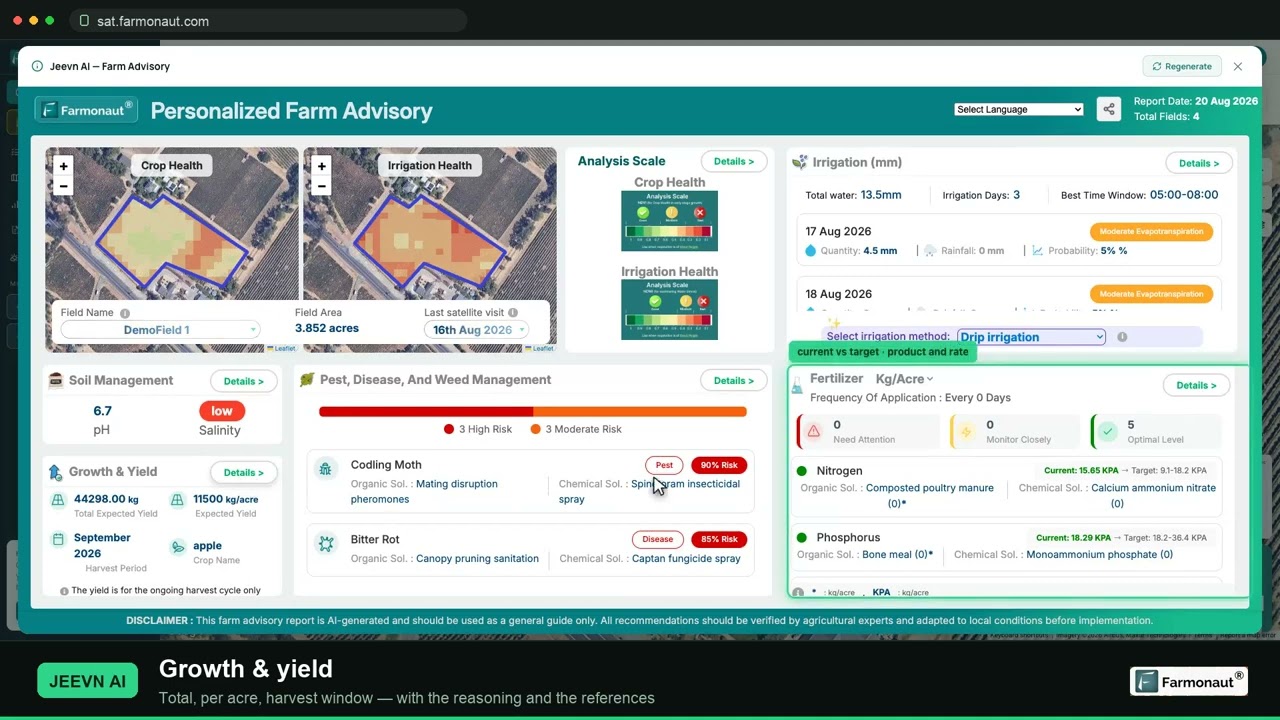
▶ A full walkthrough of satellite crop monitoring, from reading NDVI to pulling a field report. · 19:36
Can the land pay for itself? Test your numbers
The key question in any farmland purchase is simple: will the land earn enough each year to cover the loan payment? Enter your own price, acres, down payment, rate and term, and the net income you expect per acre after all other costs. The calculator shows the yearly payment, the payment per acre and the gap between income and payment.
The defaults are examples only, set close to break-even. The rate is the FSA direct ownership rate for November 2026; replace it with the rate in your own quote.
Try the numbers for your own farm below.
Calculator
Can this parcel carry its own loan payment?
Enter your own price, acres, rate, term and expected net income per acre.
- Loan amount (US$): $384,000
- Payment per acre (US$): $358
- Income minus payment per acre (US$): $2
- Cash at closing for down payment (US$): $96,000
Example values only, not a benchmark, set near break-even. The default rate is the FSA direct Farm Ownership rate for November 2026 (USDA FSA); use the rate in your own quote. Annual payments, fully amortizing; fees and taxes not included.
Fixed or variable rate on farmland
Most lenders offer both. A fixed rate keeps the payment the same for a set period, often 5, 10 or 20 years, or for the whole term. A variable rate moves with a market index, so it starts lower in some periods but can rise.
The choice matters on a long loan. FSA’s own direct ownership rate moved by half a percentage point between April and October 2026. On a $400,000 loan over 30 years, a half-point change adds or removes about $1,600 a year in payments. Run both cases in the calculator before you choose.
- Choose fixed if the land’s income is steady and thin, and a rise in payment would hurt.
- Consider variable if you expect to pay the loan down fast or sell within a few years.
- Ask about penalties. Some fixed-rate loans charge a fee if you repay early.
Refinancing an existing farm mortgage
Farm owners refinance to lower a rate, stretch a term, change a variable loan to fixed, or pull equity out of land to pay down short-term debt. A refinance works like a new loan: the lender orders an appraisal, checks cash flow and sets a rate.
Because US cropland values rose about 22% from 2022 to 2026 (NASS), many owners have more equity than when they bought. That can help a refinance. Higher equity does not change the income the land earns, though, so check that the new payment still fits the farm’s cash flow.
Count the costs. Appraisal, title, legal and lender fees can add up. Divide the total costs by the yearly saving to see how many years it takes to break even on the refinance.
Options for beginning farmers
Buying a first farm is the hardest step. FSA sets aside part of its loan money for beginning farmers and ranchers, and its down payment program is built for them. Under that program the buyer puts in 5%, FSA lends up to 45% at a low rate (2.250% in November 2026) and a bank or Farm Credit lender covers the rest.
Many Farm Credit associations run their own young, beginning and small farmer programs, often with training, lower fees or flexible terms. Ask your local association what it offers.
Other paths can help you start smaller:
- Rent land first and buy later, once you have a yield record and savings.
- Buy a small parcel and rent the rest of your acres.
- Look at land contracts with a retiring owner, with legal advice.
- Ask your state department of agriculture about beginning farmer tax credits or loan programs.

▶ Ten small farm business ideas for people who do not yet own a farm. · 6:03
Farm land loan types compared in detail
| Feature | FSA direct | FSA guaranteed | Farm Credit | Bank |
|---|---|---|---|---|
| Maximum | $600,000 | $2,558,000 | Lender sets | Lender sets |
| Rate | Set monthly by FSA | Negotiated, capped by FSA | Lender sets | Lender sets |
| Longest term | Up to 40 years | Lender sets, within FSA rules | Varies | Varies |
| Down payment | As low as 5% (down payment loan) | Lender sets | Lender sets | Lender sets |
| Who qualifies | Family farmers unable to get full commercial credit | Borrowers of approved lenders | Farmers, ranchers, rural buyers | Bank customers |
| Speed | Slower, set by county office workload | Lender plus FSA review | Usually faster | Usually faster |
Sources: FSA Farm Ownership Loans and Guaranteed Farm Loans pages, accessed November 2026. Approval times vary by office and lender.
Farm land loan challenges and how to handle them
High rates on thin margins. Land returns are often lower than the interest rate on the loan. Many buyers combine owned land with rented land, or make a larger down payment, so the farm as a whole can carry the debt.
Chart
US average cropland value
US dollars per acre, 2022 to 2026
Rising land prices. With US cropland up about 22% since 2022 (NASS), many beginning farmers cannot reach a bank’s equity rules. The FSA down payment and joint financing options exist for this case.
Slow paperwork. FSA loans can take longer than a bank loan. Apply early, and ask the seller for a closing date that allows for it.
Payment shocks. A bad year can make one annual payment hard. Ask lenders about payment timing, reserve accounts and what happens if you need to defer a payment. Keep a cash reserve where you can.
Weak records. Lenders trust what they can check. Good field records, yield history and maps make an application stronger and help at each annual review.
Using satellite records with a land loan
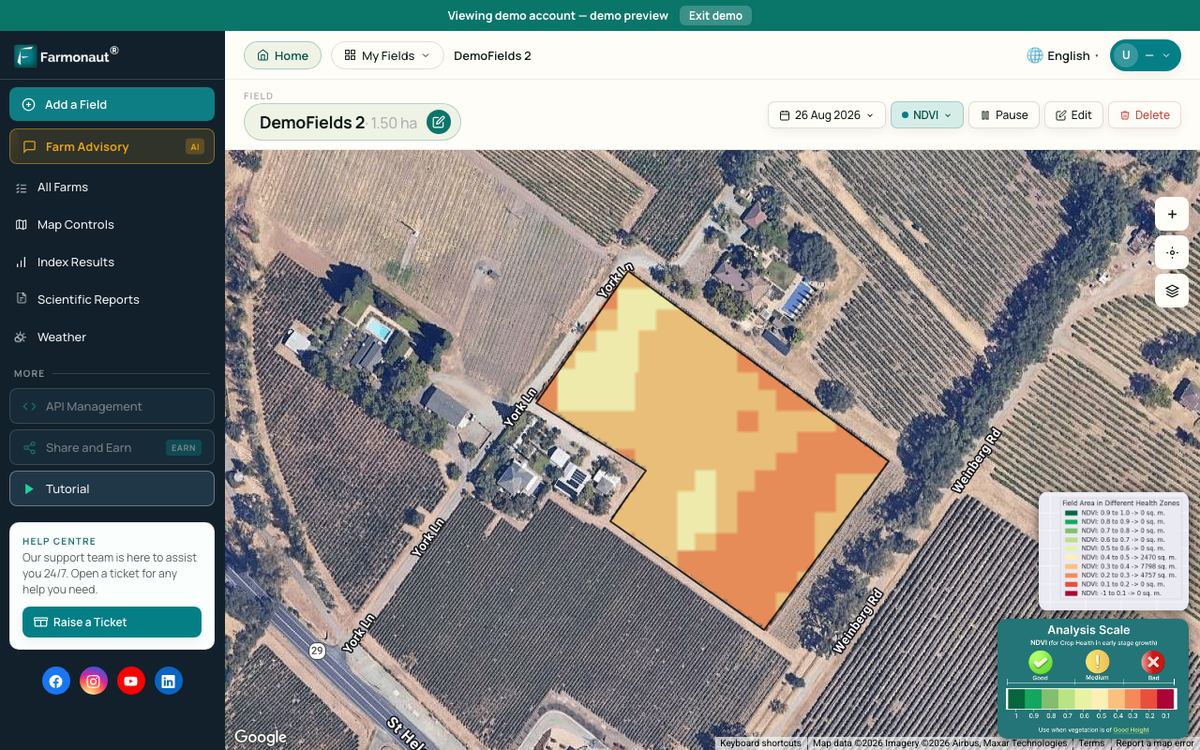
A lender’s appraisal and credit file come first. Field records support them. Satellite images can show how a parcel’s crops have grown over several seasons, where wet or weak spots are, and whether field boundaries match the deed. Buyers can use this before they make an offer, and owners can keep a season-by-season record to share at loan reviews.
The Farmonaut Satellite + AI Farm Monitoring System gives vegetation health maps for each field from Sentinel and other satellite imagery. It does not replace an appraisal or a soil test, but it gives you and your lender a shared view of how the land is performing.
Some lenders now ask about conservation practices such as cover crops or reduced tillage. Records of those practices, kept over time, can help when a lender or buyer asks for them.
Related pages on our site: crop loan and insurance verification, carbon footprint records, product traceability, large-farm management, satellite and weather API docs, web app access, modern farm equipment and new farming techniques.

▶ How to use the Farmonaut web app to monitor fields with satellite imagery and crop health maps. · 8:43
How we checked the numbers
We took FSA rates from the agency’s monthly announcements for March, April, July, September, October and November 2026, and loan limits from the FSA program pages as of November 2026. Land values come from the USDA NASS Land Values 2026 Summary, released in August 2026. Commercial rate averages come from farmdoc daily, University of Illinois, which reports Federal Reserve survey data. Debt and lender shares come from the USDA Economic Research Service. We did not use any lender’s advertised rate, because those change daily and depend on the borrower.
FAQ
What is the interest rate on farm land loans right now?
The FSA direct Farm Ownership Loan rate is 6.250% for November 2026, with 4.250% for joint financing and 2.250% for the down payment loan (FSA). Commercial bank fixed real estate rates averaged 6.7% to 7.1% in the Chicago and St. Louis Fed districts in the first quarter of 2026. Your own quote depends on your equity, credit and the land.
How long are farm land loans?
FSA direct ownership loans can run up to 40 years. Bank and Farm Credit terms vary; ask each lender for its longest term and how long a fixed rate lasts.
How much down payment do I need to buy farmland?
It depends on the lender. Under the FSA down payment program, an eligible beginning farmer puts down 5%, FSA lends up to 45% of the price and another lender covers the rest. Banks and Farm Credit set their own equity rules.
What is the most FSA will lend for farmland?
Up to $600,000 on a direct ownership loan and up to $2,558,000 on a guaranteed loan, according to the FSA program pages in November 2026.
Can I get a loan for rural land with no house?
Yes. Farm lenders and the FSA lend on bare cropland, pasture and timber tracts. A home mortgage lender usually will not, because it expects a house on the parcel.
Are North Carolina farm loans different from other states?
FSA rules and limits are the same nationwide. What differs is land prices, local lenders and county rules. NC farm real estate averaged $5,750 per acre in 2026 (NASS).
Farmonaut crop monitoring
Keep a satellite record of your land
See vegetation health maps for each field, season after season, to share with your lender or buyer.



Sources
- USDA FSA, November 2026 lending rates: fsa.usda.gov
- USDA FSA, October 2026 lending rates: fsa.usda.gov
- USDA FSA, September 2026 lending rates: fsa.usda.gov
- USDA FSA, July 2026 lending rates: fsa.usda.gov
- USDA FSA, April 2026 lending rates: fsa.usda.gov
- USDA FSA, March 2026 lending rates: fsa.usda.gov
- USDA FSA, Farm Ownership Loans: fsa.usda.gov
- USDA FSA, Guaranteed Farm Loans: fsa.usda.gov
- USDA NASS, Land Values 2026 Summary (August 2026): release.nass.usda.gov
- USDA ERS, Assets, Debt, and Wealth (2026 forecast): ers.usda.gov
- USDA ERS, EIB-273, farm debt by lender: ers.usda.gov
- farmdoc daily, University of Illinois, Agricultural credit conditions Q1 2026 (June 2026): farmdocdaily.illinois.edu
- farmdoc daily, University of Illinois, Non-real estate farm lending Q3 2026 (October 2026): farmdocdaily.illinois.edu
Discussion
Questions, corrections or field experience? Share them below. First-time comments are reviewed before they appear, and your email is never published.
No comments yet. Be the first to add a question or your experience.

 Insignito
 Croptimum
 Dalmia Bharat Sugar
 DnCubed
 Pistachio ST
 Field Capacity
 Indosistim Teknologi
 Liquify Digital
 CU Foods
 BeyondTech Global
 Rouge VC
 AgroGreen Dynamics
 AgroRisk
 Oath Inc
 Reddane Farming
 Esri North East Africa
 Cresol
 MDCV UK
 Etech Consulting Madagascar

 Licence holder · Niger · Gold
 Client · Tanzania · Gold
 Client · Somalia · Gold










