

Packaging · Reference guide
Agricultural Packaging: Types, Materials and Waste Data
Agricultural packaging has three layers: primary, secondary and tertiary. US containers and packaging reached 82.2 million tons in 2018 (EPA), and agricultural production used 12.5 million tonnes of plastic in 2019 (FAO). Types, materials, chemical-container rules and a crate calculator.
Key takeaways
- Packaging is grouped as primary (touches the product), secondary (groups packs) and tertiary (pallets and wrap); farm inputs such as pesticide jugs follow separate return rules.
- The EPA counted 82.2 million tons of US container and packaging generation in 2018; paper was 41.9 million tons and plastic 14.5 million tons, of which 13.6% was recycled.
- The FAO estimates that agricultural production (crops, livestock, fisheries and forestry) used 12.5 million tonnes of plastic in 2019, and food packaging a further 37.3 million tonnes.
- Container schemes in about 60 countries collected 30% of empty pesticide packaging in 2019, and about 83% of that was recycled (FAO, citing CropLife).
- Whether reusable crates beat cartons depends on trips per crate, wash and return cost, and loss; the calculator uses your own numbers.
In this article
- Types of agricultural packaging
- Packaging of agricultural products by product type
- Materials used for packaging in agriculture
- Why packaging matters: food loss and shelf life
- Seven packaging innovations that can reduce waste
- Reusable crates or single-use cartons?
- Agricultural chemical packaging: special rules
- Farm plastic waste, bales and collection
- How to choose packaging for your crop: five steps
- Labels, lot codes and traceability on the pack
- Packing fresh produce: practical points
- Packing grain, seed and feed
- Packaging and the farm business
- What happens to farm packaging at end of life
Agricultural packaging is every container, film, sack, crate and wrap that protects a crop or farm input between the field and the end user. It comes in three layers: primary packs that touch the product, secondary packs that group them, and tertiary packs such as pallets and stretch wrap. In the US, all containers and packaging made up 82.2 million tons of municipal solid waste in 2018, per the US EPA. The FAO estimates that agricultural production (crops, livestock, fisheries and forestry) used 12.5 million tonnes of plastic in 2019, and food packaging a further 37.3 million tonnes.
This guide covers the types of packaging in agriculture, which format suits which product, the materials and what happens to them at end of life, and the rules for chemical containers. It also has four charts built from EPA, FAO and CropLife data, and a calculator that compares reusable crates with single-use cartons. We found no single published “agricultural packaging waste” total, so we show the figures that do exist and say what each one covers.
Types of agricultural packaging
Packaging is usually grouped by the job it does in the supply chain, not by the material it is made from. Each layer answers a different question: what touches the crop, what bundles it, and what moves it in bulk.
- Primary packaging touches the produce. Examples are fruit punnets, bags of salad, vacuum pouches, egg cartons and the liner inside a bin. It protects the product and sets how long it stays fresh.
- Secondary packaging groups several primary packs. Examples are corrugated cartons holding eight clamshells, or a crate of bagged produce. It protects during handling and stacking.
- Tertiary packaging is for freight. Examples are pallets, corner boards, strapping and stretch or shrink wrap that hold secondary packs together on a truck or in a container.
The choice is a trade-off between material cost, protection, shelf life and disposal. A berry grower shipping overnight, a grain exporter loading a vessel and a dairy farm wrapping silage each weigh these differently. A fourth group sits outside this chain: farm input packaging, such as pesticide jugs and seed bags. It follows its own rules, covered further down.
Packaging of agricultural products by product type
The right format depends on how the product breathes, bruises and ships. The table shows common choices. It is a guide to usual practice, not a standard; follow your buyer’s specification.
| Product | Common packaging | Why it fits |
|---|---|---|
| Grain, pulses, seed | Woven polypropylene or paper sacks, big bags (FIBCs), bulk containers | Dry goods ship in bulk; sacks keep lots separate |
| Potatoes, onions | Mesh, net or jute sacks | Air flow limits sprouting and rot |
| Berries, soft fruit | Vented clamshells inside corrugated trays | Rigid walls stop crushing |
| Leafy greens | Modified atmosphere bags and film | Slows respiration and wilting |
| Apples, citrus, tomatoes | Corrugated cartons or reusable plastic crates | Stack well on pallets |
| Eggs | Moulded pulp or plastic trays and cartons | Holds each egg apart |
| Silage, hay | Stretch wrap, silage film and bags | Keeps air out so the feed ferments |
| Fertilizer, pesticide | HDPE jugs, drums, bulk containers, lined sacks | Chemical resistance and hazard labels |
Food packaging is the larger plastic stream. The FAO’s 2021 assessment estimates that 37.3 million tonnes of plastic were used in food packaging in 2019, against 12.5 million tonnes in agricultural production: 10.2 million for crops and livestock, 2.1 million for fisheries and aquaculture and 0.2 million for forestry (FAO assessment, 2021).
Materials used for packaging in agriculture
Seven materials are in common use on farms and in packhouses. Each has a clear strength and a clear problem.
- Paper and cardboard. Light, printable and widely accepted by recyclers. Wet strength is the weak point for chilled produce.
- Plastics (PE, PP, PET, PVC). Cheap, light and good barriers to moisture and gas. Mixed polymers and soil contamination make recycling hard, as the FAO and European Commission data below show.
- Jute and burlap. Natural fibre sacks that breathe. Used for some grain and produce sacks.
- Wood. Pallets and crates are strong and reusable. The EPA counts wood pallets and other wood packaging as 11.5 million tons of US packaging generation in 2018.
- Glass, steel and aluminium. Used for processed foods, jars and cans more than for fresh produce.
- Bio-based and compostable materials. Starch films, cellulose, polylactic acid (PLA), bagasse, flax and hemp fibre. They need testing against your own transit and storage conditions, because a film built to break down can also fail early in a warm truck.
- Metal and HDPE for chemicals. Rigid HDPE jugs and drums are the standard for crop inputs, with return schemes in many countries.
The EPA splits US container and packaging waste by material. In 2018 paper and paperboard was the largest category and plastics the second. The chart shows tons generated; it covers every sector, not only farming.
Recovery differs even more than volume. Paper and steel packaging are recycled at high rates, glass and plastic at much lower rates. For plastic, the EPA reports about 13.6% recycled and more than 69% landfilled in 2018. Corrugated boxes of all kinds had a 96.5% recycling rate in the EPA data (all sectors, not only produce cartons).
Chart
US container and packaging generation by material
million tons generated in 2018, all sectors (not only farming)
Chart
Share of packaging recycled, by material
% of generation recycled in the US, 2018
Why packaging matters: food loss and shelf life
Packaging earns its place by cutting loss. The FAO estimates that 13.3% of food produced is lost between harvest and retail, measured for 2023 (FAO SDG 12.3.1a). The regional figure is lowest for Northern America and Europe at 10.0%. Loss depends on the product: fruit and vegetables lose the most because they are perishable and easy to damage.
That is why packaging for fresh produce is built around protection and atmosphere control, and why grain sacks are a different design problem. The FAO’s handbook on fruit and vegetable preservation lists vacuum and modified atmosphere packaging among the packaging methods for minimally processed produce (FAO handbook).
Harvest timing also matters. A packaging format has to cover the shelf life that is left after picking, so growers who know when a block will be ready can book cartons, cold storage and trucks in advance. Satellite crop monitoring, such as the Farmonaut Satellite + AI Farm Monitoring System, shows how vegetation changes through the season. It does not replace checking fruit maturity in the field. The video below walks through reading satellite crop maps.
Chart
Share of food lost after harvest, by commodity group
% lost from production up to retail, global estimate
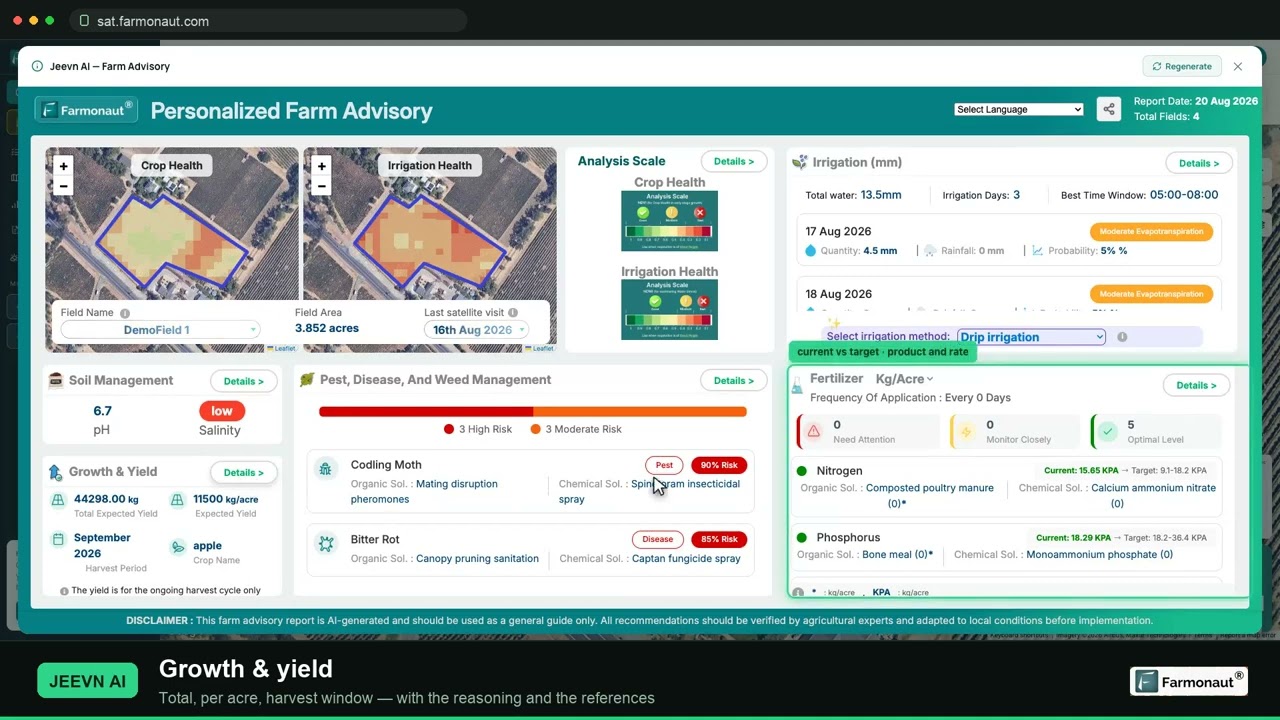
▶ A walkthrough of satellite crop monitoring: reading NDVI crop maps, running an advisory and pulling a field report. · 19:36
Seven packaging innovations that can reduce waste
These formats are all in commercial use. None is a fix for every crop, and the benefit depends on the product and the supply chain.
1. Modified atmosphere packaging (MAP)
MAP changes the gas mix inside the pack, usually less oxygen and more carbon dioxide, to slow respiration and spoilage. It suits leafy greens, berries and fresh-cut fruit. The film must hold its seal through transport, or the gas mix is lost.
2. Modified atmosphere and humidity packaging
This variant also manages moisture inside the pack, to limit both wilting and condensation. Match the film to the product and test it before a full run.
3. Active packaging
Active packs contain materials that act on the pack interior, such as oxygen scavengers or ethylene absorbers. Scavenger additives can complicate recycling, so check with your recycler.
4. Vacuum packing
Vacuum packing removes air before sealing. It is common for meat, cheese and some fresh-cut produce. The multi-layer barrier films it needs are hard to recycle.
5. Biodegradable and edible materials
Starch-based films, cellulose, PLA and edible coatings can replace some single-use plastics. The catch is shelf stability: test the material against your real transit time and temperature before switching a running line. Compostable does not mean it breaks down in a farm field or a home heap; industrial composting may be needed.
6. Reusable packaging systems
Reusable plastic containers (RPCs), wooden crates and sacks shift the cost from single-use material to an asset that goes through a return-and-wash loop. They only pay off if the loop actually runs. The calculator below tests this for your own numbers.
7. Lighter and smarter packs
Using less material through better design and stacking cuts weight and cost. Barcodes, QR codes and RFID labels add tracking without adding much material. Setup costs come before the savings.
| Innovation | Typical products | Main catch |
|---|---|---|
| MAP | Berries, salads, cut fruit | Seal must hold in transit |
| MA/MH | Greens, mushrooms | Film must suit the product |
| Active | Berries, tomatoes, meat | Additives hinder recycling |
| Vacuum | Meat, cheese, cut produce | Multi-layer film |
| Bio-based | Fresh produce, snacks | Test shelf stability |
| Reusable | Bulk produce, exports | Needs return logistics |
| Light and smart | Packed fruit, exports | Setup cost first |
Reusable crates or single-use cartons?
The choice between reusable plastic crates and single-use corrugated cartons is argued by both industries, and the studies disagree. A life-cycle study by Quantis, commissioned by the Corrugated Packaging Alliance and dated 28 February 2019, compared the two for US fresh produce. It concluded that trade-offs exist between the systems and that no overall winner can be declared on environmental grounds (Quantis for the Corrugated Packaging Alliance, 2019). The authors also found that differences of even a few percent in produce loss between the two systems would likely decide the result for most indicators.
So, for a grower or shipper, the money question comes first: how many trips does a crate make before it is lost or worn out, and what does each return trip cost? The calculator below uses your own numbers. All defaults are examples, set close to the break-even point, not benchmarks. Use today’s prices from your supplier.
Try the numbers for your own farm below.
Calculator
Do reusable crates beat cartons on your numbers?
Enter your own volumes and prices to find the break-even number of trips.
- Crate cost per trip: $0
- Carton cost per shipment: $1
- Break-even trips per crate: 22.7 trips
Example values only, not benchmarks or quotes: prices are examples, use today’s price from your supplier. Cost per trip = crate price divided by trips per crate life, plus wash and return cost, plus the share of crates lost on each trip. It ignores storage, damage rates, labour and any carton recycling credit. Saving above zero means crates cost less.
Agricultural chemical packaging: special rules
Containers for pesticide, fertilizer and other regulated inputs follow hazard-labelling and container-return rules, not the shelf-life logic of produce packaging. The product label is the legal instruction for rinsing, storing and disposing of the container. Follow the product label and your state, provincial or national rules, and ask your regulator if the label is unclear.
The FAO reports that at least 330,000 tonnes of primary packaging for pesticides were put on the market in 2019, citing CropLife International. Container-management schemes in almost 60 countries collected about 30% of the global quantity (29.0% in the FAO regional chart), and almost 83% of what they collected was recycled (FAO, 2021). The chart shows collection rates by region for 2019; Asia is left out because the data are limited.
Stewardship programmes in our target markets are industry funded. In the US, the Ag Container Recycling Council accepts rigid HDPE containers of 55 gallons and smaller that held crop protection, animal health, fertilizer and similar products, and reports more than 268 million pounds recycled since 1992 (website, accessed 26 October 2026). In Canada, Cleanfarms reports 58.5 million kg of pesticide and fertilizer containers of 23 litres and smaller since it began, plus 22.12 million kg of grain bags, agricultural film and baler twine (website, accessed 26 October 2026). In Australia, Agsafe says drumMUSTER has recycled more than 47 million containers since 1999, and runs bagMUSTER for single-use bags (website, accessed 26 October 2026).
Programmes set their own rules on rinsing, caps and labels, and containers that are not clean are usually refused. Check the programme page for your area before you drop off a load.
Chart
Empty pesticide packaging collected, by region
% of packaging sent to market that was collected, 2019, countries with CropLife schemes
Farm plastic waste, bales and collection
Film, twine and bags from silage, mulch and greenhouses are the farm-side packaging problem. The FAO expects global demand for greenhouse, mulching and silage films to rise 50%, from 6.1 million tonnes in 2018 to 9.5 million tonnes in 2030, based on industry experts (FAO, 2021).
The European Commission’s 2021 report on agricultural plastics shows why collection is hard. It counts agri-plastics as non-packaging items such as films, twine and nets. About 63% of that waste was reported collected in the EU in 2019, and only about 24% of what was placed on the market was recycled. Soil and plant residue make up roughly 40% of the weight of the waste. Mulch film is 12% of the market by mass but brings 166 kilotonnes of the 467 kilotonnes of soil contamination a year (European Commission, 2021).
In Canada, Cleanfarms reported collecting 5,000 tons of crop-input and agricultural film plastic in 2022, and its executive director said this was about 10% of the agricultural plastic used on Canadian farms (Modern Farmer, 2024). Several provinces now require recycling of some farm plastics through producer-responsibility rules, the same article reports.
Farms that generate cardboard, film and feed bags often use a baler to cut the volume they haul. A baler does not reduce how much packaging you buy. A mid-size baler such as the V8 from LSM Engineering is listed with a 33-second cycle, up to 8 tonnes of compaction force and bales of 100 to 180 kg (LSM Engineering specification), while an Australian dealer lists 120 to 150 kg bales (Smart Waste Solutions). These are manufacturer or dealer specifications, not test results. Ask a recycler what bale weight and cleanliness it will pay for before you buy a machine.
How to choose packaging for your crop: five steps
Use this order. It keeps the decision tied to what the product needs, not to what a supplier has in stock.
- Write down the route and the time. Note the days from picking to the shelf, the temperature along the way, and how many times the pack is handled. A pack for a two-day local run is a different pack from one for a two-week export.
- Name the main risk. For berries it is crushing and mould. For leafy greens it is wilting. For potatoes it is greening and rot. For grain it is moisture and pests. For silage it is air. Pick the pack that answers that one risk first.
- Check what your buyer requires. Retailers and packers often fix the crate size, pallet pattern and label layout. Ask for the specification in writing before you buy a single pack.
- Count the end-of-life cost. Add what it costs to dispose of, return or recycle the pack. A cheap film that must go to landfill can cost more than a dearer one that a local scheme takes back.
- Run a small trial. Send one pallet in the new format with a data logger or a simple loss count, and compare it with your usual pack. Keep the result for the next season.
Labels, lot codes and traceability on the pack
The pack is also where the label goes. In the US, the FDA’s food traceability rule (FSMA section 204) applies to foods on its Food Traceability List, which includes fresh-cut produce. The rule requires a traceability lot code to be assigned when a raw agricultural commodity on the list is first packed, according to the GS1 US guideline that explains how to apply barcodes to the rule (GS1 US, release 3.0, December 2025). In practice that means the lot code must be printed or attached at the packing stage, so the choice of label area, film and printing method matters when you pick a pack. Check the current list and dates on the FDA’s own pages, and ask your legal adviser or compliance team how the rule applies to your business.
Labels must also survive the pack. Wet cartons, condensation inside MAP bags and cold storage all lift glued labels. Test the label on the real pack before you print a season’s supply.
Packing fresh produce: practical points
Many packing losses come from simple faults rather than from the choice of material. These points apply to crates, cartons and clamshells alike.
- Do not overfill. A bulging pack is crushed when stacked. Fill to the line the pack was designed for.
- Keep the vents clear. Cartons and crates have vent holes so cold air can reach the fruit. Line up the holes on stacked packs and do not block them with liners or wrap.
- Match the pack to the pallet. A carton that overhangs the pallet edge can lose stacking strength. Check the pallet pattern with your packer.
- Cool first, then close. Sealing warm produce inside film traps heat and moisture, and condensation then feeds mould. Follow your crop’s recommended cooling method.
- Keep reusable crates clean. Wash and dry them between trips, and keep them off the soil. A dirty crate defeats its purpose.
Your buyer, packhouse or extension service can give crop-specific guidance on cooling, humidity and pack sizes. State and university extension offices publish postharvest guides for most commercial fruit and vegetable crops.
Packing grain, seed and feed
Dry products are judged on moisture, pests and strength. Woven polypropylene sacks and paper sacks hold smaller lots of seed and feed. Big bags (FIBCs) move a tonne or more. Silo bags and grain bags store large volumes in the field and need to be checked for holes and rodent damage during the storage season.
Grain bags are now a recycling target in Canada. Saskatchewan was the first Canadian province to set a producer-responsibility rule for grain bags, and recycling of the bags doubled from 1,257 tons a year in 2016 to 2,536 tons in 2020, according to Modern Farmer. Where no scheme exists, roll up used bags dry and clean, and ask your dealer or co-op where they can go.
Seed bags and treated-seed sacks are often subject to label instructions of their own. Follow the label for storage and disposal, because treated seed is a regulated product in most markets.
Packaging and the farm business
For small producers, packaging is a real part of the cost per unit sold. It also changes what a buyer will pay: a consistent, clean, well-labelled pack can open doors at a farm shop, a cooperative or a regional retailer. Before ordering large volumes, ask three questions. What does one finished pack cost, including labels and any liner? How many do you need per week at peak? And can you store them dry and clean? Order a sample run first, and keep a record of how much produce is rejected or downgraded in each pack type.
Record keeping helps here. A simple log of lot, field, pack date and destination supports both a buyer’s questions and, where it applies, traceability rules. Satellite field records can show which block a lot came from and how it grew through the season, but the lot record itself still needs to be kept at the packing stage.
What happens to farm packaging at end of life
End-of-life routes differ by material and by place. Most routes below come from the sources in this guide; the plastic crate line is general practice.
- Corrugated cartons: recycled at 96.5% in the US in 2018 (EPA; all corrugated boxes, not only produce cartons). Recyclers generally want them dry and free from food and chemical residue.
- Wood pallets: the EPA reports 3.1 million tons recycled in 2018, usually chipped for mulch or bedding, out of 11.5 million tons generated. Pallets can also be repaired and reused before that.
- Plastic crates and RPCs: designed for many trips and then recycled as clean HDPE or polypropylene where a recycler takes them.
- Silage film, twine and bags: collected by stewardship schemes in some regions, for example Cleanfarms in Canada. Dirt and plant residue make up a large share of the weight, so shake out and keep material dry.
- Pesticide and fertilizer containers: rinsed as the label says, then returned through the programme in your area. Do not burn or bury them; check local rules.
The EU report notes that countries with well-established national collection schemes, among them Ireland, Iceland, Norway, Sweden, France and Spain, reached collection rates above 70% for non-packaging agri-plastics. The lesson is practical: a clear, easy-to-reach collection point near the farm changes behaviour more than any material choice does. Ask your co-op, dealer or regional recycler what is available before you plan your own system.
Packaging rules by region
Rules for packaging in agriculture change by country and, in the US and Canada, by state or province. Some points that stay the same:
United States. Pesticide container rules sit alongside the product label and state pesticide agencies. The Ag Container Recycling Council runs the main industry collection, and each state agriculture department can tell you which collection sites are active. Food-contact packaging for produce and food is regulated separately by the FDA.
Canada. Several provinces have producer-responsibility rules for some farm plastics, as Modern Farmer reports, and Cleanfarms runs collection programmes for containers, bags and film in the provinces listed on its site. Programme rules differ, so use the Cleanfarms site for your province.
Europe. The European Commission’s report defines agri-plastics as non-packaging items and tracks them separately from packaging. Collection is high where national schemes exist and low where they do not.
Australia. Agsafe’s drumMUSTER collects clean agricultural chemical containers, and bagMUSTER covers single-use bags. Collection sites are listed on the programme’s website.
Nothing here is legal advice. Pesticide, fertilizer, food-safety and waste rules change, so confirm the current requirement with your regulator or a qualified adviser.
Agricultural packaging market size and suppliers
Market research firms size the global agriculture packaging market, but we found no government statistics agency publishing the same number. Towards Packaging puts it at US$9.68 billion in 2026, growing to US$15.68 billion by 2035, a compound annual growth rate of 5.5% (Towards Packaging page, read 26 October 2026). Treat it as a forecast from one commercial publisher, and note that definitions differ between report providers.
Mordor Intelligence lists Sonoco, Mondi, Greif, Pactiv and Amcor as top agricultural packaging companies, and states that the list is in no particular order (Mordor Intelligence list). Its wider list adds LC Packaging International, ProAmpac, Smurfit WestRock, Silgan, RKW Group and others. Large groups sell through distributors, and a regional distributor stocking bags, cartons and crates from several makers is often easier to deal with for small orders. Ask for food-contact certificates and tested shelf-life data for your crop.
▶ Ten small agriculture business ideas, useful for thinking about what packaging a small producer needs. · 6:03
Checklist for choosing packaging and suppliers
- Match the pack to shelf time. A berry that reaches the shelf in three days and one that needs ten need different films. Ask for tested shelf-life data under your transit time.
- Get degradation limits in writing for bio-based films before switching a running line.
- Check that reuse works. Reusable crates only win if your chain can run the return-and-wash loop. Confirm collection logistics before buying crates.
- For chemical containers, confirm the return programme and the rinsing steps on the product label. Rules differ by country, state and province.
- Check the date of any waste or market figure before quoting it. The EPA’s packaging data on this topic are for 2018.
- Weigh the transport leg. Heavier packs raise freight cost, and long transit raises the shelf-life needed.
Related pages on our site: product traceability, fleet management, carbon footprint tracking, farm admin app, mobile app, satellite weather API docs and satellite farm data API.
FAQ
What is agricultural packaging?
It is the containers, films, sacks, crates and wraps used to hold, protect and move crops, livestock products and farm inputs. It is grouped as primary (touches the product), secondary (groups packs) and tertiary (pallets and wrap for freight).
What are the main types of packaging in agriculture?
Primary, secondary and tertiary packaging, plus a separate group for farm inputs such as pesticide jugs and seed bags. Common materials are paper and cardboard, plastics, jute, wood and bio-based films.
How much agricultural packaging waste is there?
We found no single published total. The EPA reports 82.2 million tons of all US container and packaging generation in 2018. The FAO estimates 12.5 million tonnes of plastic used in agricultural production worldwide in 2019, and 37.3 million tonnes in food packaging. These cover different things and should not be added together.
Can pesticide containers be recycled?
In many places, yes, if they are empty and rinsed as the product label says. Programmes such as the Ag Container Recycling Council in the US, Cleanfarms in Canada and drumMUSTER in Australia run collections. Each has its own rules, so check your local programme.
Are biodegradable packs better for farms?
Not always. They can cut plastic use, but shelf stability and disposal route matter. A pack that breaks down in compost may also fail in a warm truck. Test it on your own supply chain first.
Are reusable crates cheaper than cartons?
It depends on the number of trips a crate makes, the cost of washing and return freight, and the loss rate. Use the calculator on this page with your own prices to find your break-even number of trips.
Farmonaut crop monitoring
See your own fields from space
Draw your fields once and see satellite vegetation maps through the season on web, Android or iOS, to help plan harvest and packing.




Keep reading

Sources
- US EPA, Containers and Packaging: Product-Specific Data (2018 data): epa.gov
- FAO, Plastics in agrifood systems: the good, the bad and the ugly (2021): fao.org
- FAO, Assessment of agricultural plastics and their sustainability: a call for action (2021): fao.org
- FAO, SDG 12.3.1a Global food losses, Food Loss Index: fao.org
- FAO, Handling and preservation of fruits and vegetables by combined methods: fao.org
- European Commission DG Environment, Conventional and biodegradable plastics in agriculture (2021): environment.ec.europa.eu
- Quantis for the Corrugated Packaging Alliance, LCA of corrugated and reusable plastic containers for produce (28 February 2019): fibrebox.org
- Ag Container Recycling Council (ACRC): agrecycling.org
- Cleanfarms (Canada): cleanfarms.ca
- Agsafe, drumMUSTER and bagMUSTER (Australia): drummuster.org.au
- Modern Farmer, Plastic farms and plasticulture (2024): modernfarmer.com
- Towards Packaging, Agriculture packaging market size: towardspackaging.com
- Mordor Intelligence, Agricultural packaging companies: mordorintelligence.com
- LSM Engineering, V8 mid-size baler: lsmltd.com
- Smart Waste Solutions, V8 mid-size baler: smartwaste.net.au
- GS1 US, Application of the GS1 System of Standards to support FSMA 204 (release 3.0, December 2025): documents.gs1us.org
Discussion
Questions, corrections or field experience? Share them below. First-time comments are reviewed before they appear, and your email is never published.
No comments yet. Be the first to add a question or your experience.

 Tucor
 Saraswati Agro
 Geno
 Hayleys Agriculture
 Linx Agritech
 Adinet
 Save Your Soils
 Grandstream Algérie
 XOS Realty
 Geospatial Lab Africa
 Agro La Gándara
 HIPSAC
 ZOL Zimbabwe
 Juligerm
 MISE Maroc
 NWNS

 Licence holder · Niger · Gold










