

Agriculture ESG Scores: Core Regenerative Ratings 2025
*”Over 70% of global agriculture firms now report ESG scores, promoting transparency and sustainable farming practices worldwide.”*

Introduction: Why Agriculture ESG Scores Matter in 2025
In 2025, agriculture ESG scores and agriculture ESG ratings are no longer niche metrics—they are transformative levers dictating success, reputation, and investment in farming, forestry, and global food supply chains. As the demand for sustainable food production intensifies, integrating ESG frameworks—which stand for Environmental, Social, and Governance—into agricultural operations has become pivotal and essential.
This comprehensive guide explores how agriculture ESG scores, agriculture ESG ratings, and ESG reporting agriculture are driving transparency, regenerative farming practices, and strong environmental outcomes, shaping a responsible outlook for core agriculture and regenerative systems on a global scale.
The reporting and board-level side behind these scores is explained in how ESG governance works in agriculture.
We will analyze sector-specific standards, leading reporting frameworks, the evolving role of technology (including blockchain and satellite-based platforms), and how Farmonaut brings digital transformation to agriculture ESG. Let’s journey toward the future of sustainable agriculture, one score and report at a time.
Defining ESG: Environmental, Social, and Governance in Agriculture
ESG as a concept originated in responsible investing, and now in 2025, it touches nearly every agricultural operation across the globe.
- Environmental pillar: Measures how farming operations impact natural systems. Key components include soil health, water usage, energy efficiency, biodiversity preservation, chemical input management (fertilizers, pesticide application), and greenhouse gas emissions.
- Social pillar: Assesses labor conditions, worker safety, community engagement, local food security, and farm-level fairness. Includes gender equity, child labor prevention, and the well-being of surrounding populations.
- Governance pillar: Reflects leadership responsibility, data transparency, anti-corruption controls, board activity, and ethical decision-making. Good governance is crucial where agriculture forms the economic backbone.
Together, these pillars create the framework for evaluating agriculture ESG scores and ensuring that sustainable outcomes—both environmental and social—are delivered with transparent oversight.
ESG standards are not static; in 2025, they increase in complexity and stringency as global regulators, supply chain partners, and investors seek accountability for how food is grown—from seed to shelf.
Understanding Agriculture ESG Scores and Ratings
What are Agriculture ESG Scores?
ESG scores are numerical or categorical evaluations that measure how well a farming operation or agribusiness aligns with sustainability standards. They offer a comparative view of performance on environmental, social, and governance metrics.
How Are ESG Ratings Calculated?
Specialized agencies and data providers have developed tailored frameworks to assess agriculture-specific risks and opportunities. This sector-specific approach helps differentiate conventional, organic, and regenerative agriculture, offering a nuanced understanding of sustainability outcomes.
-
Farmland metrics typically considered in ESG assessments:
- Soil health: Measures such as organic matter, erosion rates, and nutrient balance
- Water usage & efficiency: Total withdrawal, irrigation technologies, recycling, and conservation methods
- Pesticide and fertilizer application: Volume used, type (synthetic/organic), and reduction strategies
- Biodiversity preservation: Plant/animal species counts and preservation of natural habitats
- Labor practices: Workers’ rights, fair wages, inclusive hiring, and safety records
- Community engagement: Participation in local initiatives and impact on food sovereignty
- Governance transparency: Data disclosure, documentation of processes, and anti-corruption measures
ESG scores help regulators, investors, supply chain partners, and consumers:
- Evaluate farm performance and align investment with sustainable goals
- Mitigate risks by identifying weaknesses in production systems
- Measure progress toward stewardship and responsible farming
- Differentiate between progressive and conventional operations
- Example: A farm implementing precision agriculture technologies (e.g., satellite monitoring, AI-based input optimization) reduces chemical inputs, saves water, and improves overall farm efficiency. Such farms often receive a higher ESG score in the environmental pillar.
- Another example: Farms that promote fair labor standards—living wages, safe working conditions, community investment—score highly on the social pillar.
As ESG considerations become pivotal, reporting and actionable scoring drive continuous improvement and promote accountability across all types of agriculture.
ESG Reporting in Agriculture: Frameworks and Global Standards
As sustainability transparency gains traction, esg reporting agriculture is now considered a critical tool. Farmers, cooperatives, and agribusinesses are adopting standardized reporting frameworks to disclose metrics such as:
- Greenhouse gas emissions (CO2, methane, nitrous oxide)
- Water conservation strategies and usage per yield unit
- Land use changes, deforestation, and habitat preservation
- Biodiversity impacts and restoration initiatives
- Worker conditions and social relations (e.g., living wage, healthcare, and housing)
- Community engagement
The most commonly used reporting frameworks and regulations in 2025:
- Global Reporting Initiative (GRI): Universal and sectoral sustainability disclosures
- Sustainability Accounting Standards Board (SASB): Financially material ESG factors per sector
- EU Sustainable Finance Disclosure Regulation (SFDR): Mandates transparent sustainability disclosures for financial market participants
Reporting is no longer a box-ticking exercise. Investors, supply chain partners, and regulatory agencies now demand granular, verified data—preferably real-time—on all aspects of the agricultural system you operate in.
- Example: Grain exporters must now disclose their emissions, water usage, and social standards before they can participate in international supply chains.




Key Benefits of Standardized ESG Reporting:
- Transparency: Builds trust with investors and community
- Accountability: Makes improvement measurable and public
- Risk mitigation: Identifies and rectifies social, governance, or environmental threats before they escalate
- Market access: Satisfies food and textile companies’ sustainability sourcing criteria
- Financing: Enables access to green loans or investment (with higher ESG scores)

In short, robust ESG reporting agriculture is a core requirement in global supply chains and will continue to grow in importance as regulatory standards tighten.
Core Agriculture and ESG Integration
Core agriculture refers to traditional farming focused on staple crops and livestock. The integration of ESG principles in these systems remains fundamental for driving sector-wide transformation toward sustainability.
How Does ESG Work Within Core Agriculture?
- Minimizing negative impacts: Reducing nutrient runoff, stopping soil degradation, halting deforestation.
- Promoting efficient use of inputs: Optimizing chemical and water usage with precision farming technologies.
- Maintaining sound governance: Ensuring transparency, clear record keeping, and stakeholder engagement.
- Improving social performance: Adhering to fair labor standards, supporting livelihoods, and investing in community.
The careful adoption of ESG frameworks, crop rotation, integrated pest management, and responsible land stewardship improves every performance dimension. Agro-industrial operations deploying satellite-based monitoring and blockchain traceability increase their ESG rating by demonstrating not just intent, but measurable progress.
A key focus is adapting legacy operations to meet new environmental and social demands—where “business as usual” is not an option for accessing capital or maintaining reputation in 2025.
In line with evolving governance requirements, platforms such as Farmonaut’s blockchain-based product traceability solution empower agricultural companies to achieve transparency across the supply chain, reassuring both corporate clients and end consumers about the provenance and sustainability credentials of their food and textile products.

Governance in Core Agriculture: Why It’s Critical
- Promotes transparency internally and externally
- Prevents corruption and fraud in subsidy/insurance schemes
- Ensures responsiveness to stakeholder concerns and global sustainability goals
By using digital platforms for farm records and data collection—such as Farmonaut’s large-scale farm management tools—agricultural producers are able to enhance governance, resource management, and benchmarking against sector standards, all of which form the backbone of robust ESG scoring.
Regenerative Agriculture ESG: Synergy for the Future
Regenerative agriculture moves beyond sustainability, actively rebuilding soil health, increasing biodiversity, and restoring ecosystem functionality. In 2025, these regenerative systems align closely with ESG principles—and are rapidly being recognized by raters and investors alike.
What Makes Regenerative Agriculture Boost ESG Scores?
- Soil carbon sequestration: Practices such as cover cropping, reduced tillage, and agroforestry lock carbon in the ground, lowering farm emissions.
- Diversified cropping and habitat restoration: Enhancing on-farm biodiversity preserves pollinators, beneficial insects, and native flora/fauna.
- Reduced chemical inputs: Intervention with natural solutions rather than synthetics minimizes runoff and ecosystem harm.
- Holistic land use: Prioritizing long-term productivity and resilience over short-term yields.
- Community and labor inclusion: Engaging smallholders, ensuring gender equity, and promoting food sovereignty.
Examples of how this impacts ESG ratings:
- A regenerative farm can improve its ESG score by 20-30% by drastically lowering emissions, conserving water, and building social capital locally.
- Operations adopting blockchain-enabled traceability can prove provenance and regenerative farming credentials to buyers and investors.
Farmonaut’s real-time carbon footprint tracking empowers producers to monitor and reduce environmental impacts, seamlessly reporting key metrics such as soil carbon content, emissions, and resource optimization to fulfill the requirements of leading agriculture ESG rating frameworks.

How Are Regenerative Criteria Weighted in 2025 ESG Ratings?
- Heavily weighted toward environmental outcomes: Soil health, carbon drawdown, and water efficiency now score as much as 40-50% of environmental pillar ratings in many frameworks.
- Inclusion of social indicators: Gender, smallholder engagement, and community investment are prioritized.
- Traceability and digital verification: Technology enables auditable, tamper-proof reporting for buyers and regulators.
Overall, regenerative agriculture ESG is the gold standard for responsible farming and is increasingly a prerequisite for accessing “green” financing and preferential market access.
Comparative Table: ESG Score Ranges and Regenerative Criteria in Key Rating Frameworks (2025)
| Framework / Case Study | Estimated ESG Score Range (2025) | Environmental Pillar Focus | Reporting Transparency Level | Core Regenerative Practices Included |
|---|---|---|---|---|
| Farmonaut ESG | 75–95 / 100 | Satellite-based soil & crop health, real-time carbon, water, chemical reduction | Digital, blockchain-verified, API-enabled; near real-time transparency | Cover cropping, AI-advised input minimization, carbon tracking, traceability |
| GRI (Global Reporting Initiative) | 60–90 / 100 | Emissions GHG, biodiversity, water, land use changes | High; third-party assurance often required | Regenerative when voluntarily disclosed, focus on continuous improvement |
| SASB (Sustainability Accounting Standards Board) | 65–88 / 100 | Water use, energy efficiency, GM & pesticide management, labor metrics | Medium-High; sector-based disclosures, output-oriented | Integration of precision, regenerative if reported as material |
| Custom Sector Benchmarks (ESG Raters) | 55–80 / 100 | Defined per organization; soil, biodiversity, chemical and water, labor | Variable (self-reported to full audit) | Typical core regenerative: cover crops, minimal till, habitat, community inclusion |
| Sample Regenerative Farm (Anonymized) | 85–98 / 100 | High: carbon, water, pesticide reduction, full traceability | Third-party certified, digital data streams | Comprehensive: soil health, smallholder inclusion, AI-driven advisory |
As shown, the agriculture ESG scores landscape is increasingly favoring frameworks and operations with transparent, digitally verified, and regenerative-focused practices.

Farmonaut: Empowering Transparent and Sustainable Agriculture
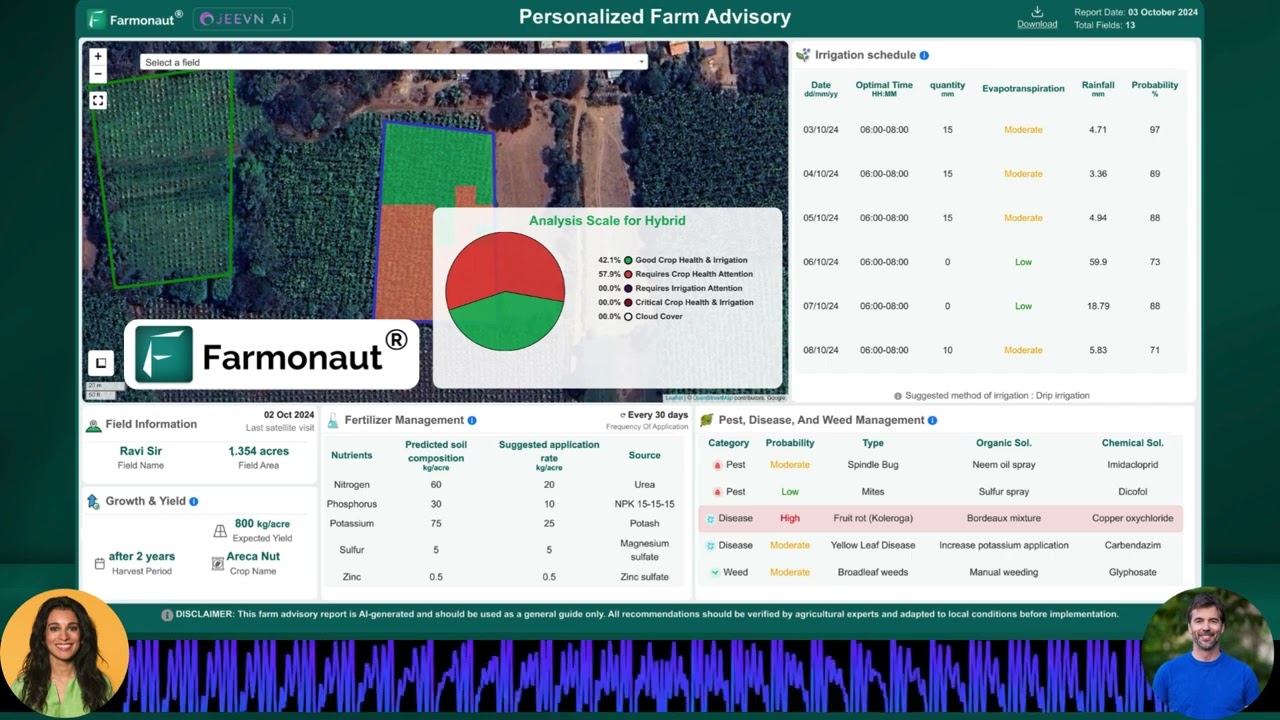
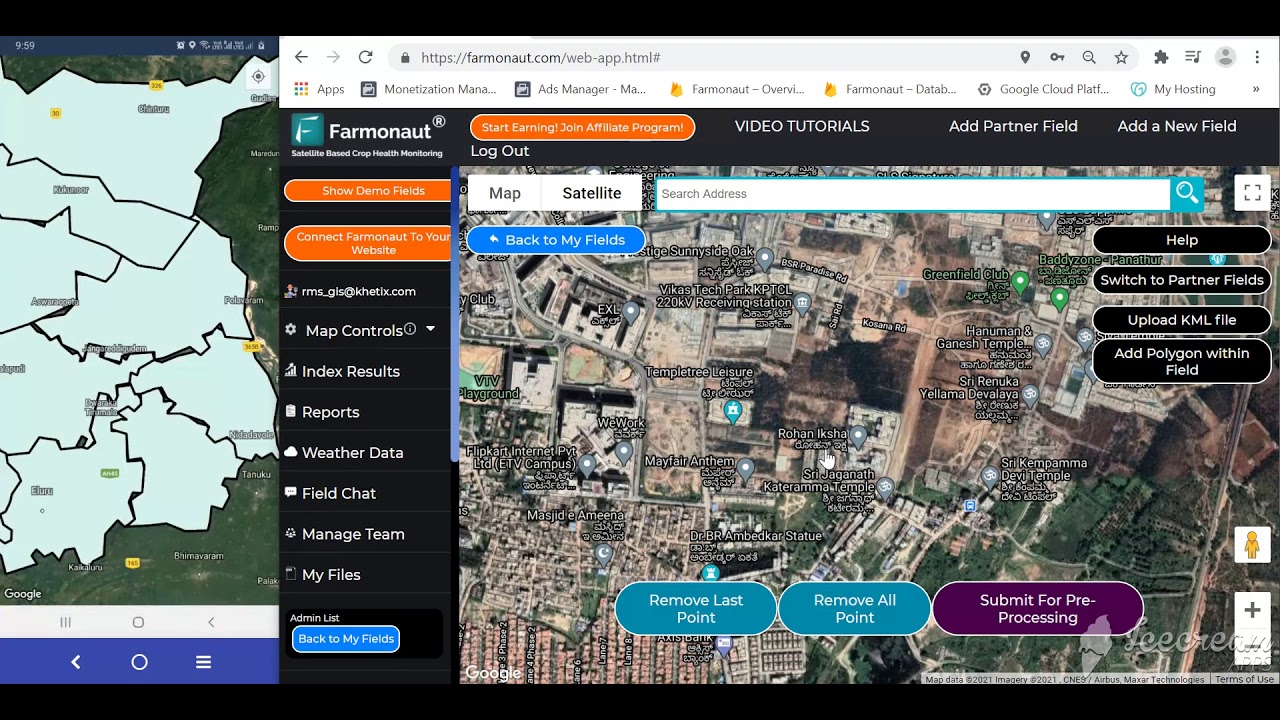
At Farmonaut, we bridge the gap between traditional farming and the digital future by offering satellite-based crop health monitoring, AI-driven advisory, and advanced resource management tools to farms, agribusinesses, and government agencies globally.
- Real-Time Crop Health Monitoring: We leverage multispectral satellite imagery to analyze NDVI (vegetation health), soil moisture, and key metrics, allowing users to optimize water, fertilizer, and pesticide usage for better ESG performance.
- Jeevn AI Advisory System: Delivers real-time recommendations to farmers, integrating weather, satellite data, and crop models for smarter farm decisions and improved sustainability metrics.
- Blockchain-Based Traceability: We enable tamper-proof traceability so supply chain stakeholders can verify environmentally responsible practices and origin—empowering end-to-end ESG reporting for agriculture.
- Carbon Footprinting: Accurate, continuous greenhouse gas monitoring lets customers track emissions and report progress per international frameworks.
- Fleet and Resource Management: Digitally manage field equipment for reduced emissions, optimized input delivery, and cost-effective production—further enhancing esg performance.
Our solutions integrate seamlessly via Farmonaut’s robust Agriculture Satellite API and API Developer Documentation, making them accessible for independent developers and agritech companies.
With our crop loan and insurance verification solutions, both financial institutions and farmers gain transparency, reducing fraud and ensuring timely access to financial support—which strengthens the governance pillar of ESG.
Farmonaut Solutions: Core Use Cases
- Smallholder farms: Democratize access to precision tools, reporting, and ESG guidance.
- Large agribusiness: Support for fleet management, carbon tracking at scale, and full regenerative benchmarking.
- Corporate supply chains: Blockchain traceability for traceable, transparent reporting in food and textile supply chains.
- Government and NGOs: Area-based monitoring, satellite-enabled policy support, and region-wide ESG compliance.
By integrating data streams and leveraging AI, Farmonaut helps make sustainable farming the new global standard for both core and regenerative agriculture.
Digital Platforms, Blockchain, and Verified Data Collection in ESG Reporting
By 2025, digital transformation is shaping how agriculture ESG reporting and scoring are conducted:
- Digital platforms: Cloud-based systems streamline ESG data collection, automate satellite monitoring, and sync records for every farm plot.
- Blockchain technology: Decentralized ledgers allow security, traceability, and tamper-proof recording of key metrics—essential for global food traceability regulations and investor confidence.
- AI and IoT: Connect sensors, weather data, and satellite feeds to automate reporting and early warning for ESG risks.
Platforms like Farmonaut facilitate near real-time monitoring and reporting for regenerative agriculture ESG by integrating all of the above, making robust performance measurement and third-party verification practical and cost-effective worldwide.
With new regulations on the horizon, the ability to verify farm-level data—be it emissions, water conservation, or labor conditions—will be a non-negotiable in 2025 and beyond.
Key Benefits of ESG Adoption in Agriculture
- For Producers: Secure access to premium markets and financing, improve resource efficiency, and future-proof against regulations.
- For Investors: De-risk portfolios, track real-time impact on climate change, and direct capital to proven sustainable operations.
- For Consumers: Receive clear, verified information about their food and textiles—for better choices and healthy lives.
- For Communities: Benefit from healthier environments, higher quality livelihoods, and resilient food systems.
Farmonaut: Supporting ESG Across the Value Chain
- Product Traceability: Enables brands and supply chains to verify farming practices, fair labor, and environmental sustainability
- Fleet Management: Optimizes machinery, reduces extra fuel use, and streamlines on-farm logistics—improving overall ESG profiles
- Carbon Accounting: Helps users accurately measure and report greenhouse gas performance
Frequently Asked Questions: Agriculture ESG Scores and Regenerative Ratings
-
Q: What are agriculture ESG scores and why are they important?
A: Agriculture ESG scores measure the environmental, social, and governance performance of farming operations. They help investors, supply chain partners, and regulators evaluate sustainability, transparency, and responsibility, driving continuous improvement and access to markets in 2025. -
Q: How can farmers improve their ESG scores in 2025?
A: Adopt precision agriculture technologies, minimize chemical and water usage, promote fair labor, engage the community, adopt regenerative farming practices, and use digital tools for transparent ESG reporting. -
Q: What’s the difference between conventional and regenerative agriculture ESG ratings?
A: Regenerative farming inherently scores higher on the environmental and social pillars by focusing on restoring soil health, increasing biodiversity, and supporting community welfare, whereas conventional ratings may have higher environmental risks and lower social metrics. -
Q: Which frameworks are widely used for ESG reporting in agriculture?
A: Leading frameworks include GRI, SASB, EU SFDR, and sector-specific benchmarks. Digital platforms and blockchain technology support verification and real-time data collection. -
Q: How does Farmonaut support ESG adoption?
A: We provide satellite-based crop and soil monitoring, AI advisory, carbon footprint tracking, blockchain-enabled traceability, and digital reporting—empowering all users to measure, improve, and communicate their ESG outcomes cost-effectively.
The Future of Sustainable Agriculture ESG—2025 and Beyond
As sustainable farming becomes the norm rather than the exception, the role of agriculture ESG scores, agriculture ESG ratings, and esg reporting agriculture will only intensify. Transparent, digital, and verifiable data is the “new oil” of agriculture—enabling global supply chains, financiers, and communities to monitor performance, reward stewardship, and accelerate climate and social progress.
- Technology integration—from satellite analytics to blockchain—will be a staple across all segments, large and small, from core to regenerative systems.
- Stakeholder demand for fair, just, and environmentally responsible production will shape governance, labor, and reporting requirements for every farm.
- Regenerative agriculture ESG is expected to outpace conventional models, driving superior environmental and social outcomes, and becoming key to market differentiation and financing options.
- Farmonaut aims to remain at the forefront of these changes, empowering users worldwide with actionable insights, verifiable reporting, and affordable access to the tools needed for a transparent and thriving agriculture sector.
In summary: By thoughtfully integrating ESG considerations—from field to finance—agriculture is shifting toward not just a more profitable future, but one that sustains nature, communities, and food systems for generations to come.
Ready to make your agriculture operation ESG-ready in 2025?
Explore our Farmonaut platform and app for comprehensive, verified, and real-time ESG solutions for all your sustainable and regenerative agriculture needs.

 Grandstream Algérie
 XOS Realty
 Geospatial Lab Africa
 KhetiBuddy
 Agro La Gándara
 HIPSAC
 ZOL Zimbabwe
 Juligerm
 AdBio
AdBio MISE Maroc
 NWNS
NWNS Red August Group
 Farm Inc
 WeMe Global
 Agrotoken
 Blue BearX
 Insignito
 Croptimum
 DnCubed
 Field Capacity
 Indosistim Teknologi
