
Farm finance · Rate benchmarks
Farm Credit Interest Rates: How They Compare With USDA
Farm Credit associations quote each loan themselves, so no national rate exists. Public yardsticks: 6.250% on USDA direct ownership loans (November 2026) and a 7.46% Dallas Fed bank average on fixed farm real estate loans (Q3 2026).
Key takeaways
- No single Farm Credit rate exists: each customer-owned lender quotes its own loans.
- FSA direct ownership was 6.250% and direct operating 5.625% in November 2026 (USDA FSA).
- Fixed real estate survey averages were 7.07% in the Minneapolis district (Q2 2026) and 7.46% in the Dallas district (Q3 2026); these surveys cover bank lenders.
- US cropland averaged $6,020 per acre in 2026, and Iowa $10,700 (USDA NASS).
- Compare APRs first, then count patronage separately, because it is not guaranteed.
In this article
- Farm credit interest rates at a glance
- Why Farm Credit has no single published rate
- What patronage does to the rate you really pay
- USDA FSA rates by program
- How bank survey rates compare with Farm Credit quotes
- Why farm loan rates have risen in recent months
- What moves the rate on your loan
- Which lender fits which borrower
- Land values and what they mean for your loan
- Tractor and equipment loan rates
- Timber and rural land loans
- Compare two land loan quotes
- Seven questions to ask before you sign
- Check farm credit interest rates each month
Farm Credit interest rates have no single national figure, because Farm Credit is a network of separate customer-owned lenders that quote their own loans. The nearest public yardsticks: USDA charged 6.250% on direct Farm Ownership Loans in November 2026 (USDA Farm Service Agency, November 2026), and banks surveyed by the Dallas Fed averaged 7.46% on fixed long-term farm real estate loans in the third quarter of 2026 (Dallas Fed Agricultural Survey).
This guide shows what those numbers measure and how far they have moved. It also explains what to ask a Farm Credit loan officer, and gives you a calculator to compare two land loan quotes, including any patronage refund. It covers US lenders. Farm Credit Canada is a separate lender, and its rates are not part of these figures.
Farm credit interest rates at a glance
The table lists public benchmarks with their dates. None of them is a quote for your farm. Read the “What it measures” column first, because these figures come from different kinds of lender.
| Benchmark | Rate | Date | What it measures |
|---|---|---|---|
| FSA direct ownership | 6.250% | Nov 2026 | USDA loan for land and improvements, for eligible borrowers |
| FSA direct operating | 5.625% | Nov 2026 | USDA loan for inputs, livestock and equipment |
| FSA down payment | 2.250% | Nov 2026 | USDA share of a beginning farmer purchase |
| Fixed real estate, Dallas | 7.46% | Q3 2026 | Average reported by banks in the Dallas Fed district |
| Fixed real estate, Minneapolis | 7.07% | Q2 2026 | Average from the Minneapolis Fed lender survey |
| Real estate, Chicago | 6.79% | Q2 2026 | Average from the Chicago Fed lender survey |
| Bank prime rate | 7.00% | 3 Nov 2026 | Federal Reserve H.15 series, a base for many variable loans |
| Farm Credit association | Ask lender | Your quote | Set on your loan, before any patronage refund |
The Minneapolis and Chicago lines come from Progressive Dairy’s review of the Fed lender surveys, published in September 2026. The prime rate comes from the Federal Reserve H.15 release, which showed 7.00% for each day from 28 October to 3 November 2026.
Why Farm Credit has no single published rate
The Farm Credit System is made up of customer-owned institutions, each with a board elected by its customers. It reported more than 615,000 customers and $456.9 billion in loans at the end of 2025. It is regulated by the Farm Credit Administration, a federal agency, but it is not a government loan program like FSA.
Your quote depends on your association, the loan purpose, the term, the collateral and your finances. So a rate from a neighbouring state tells you little about your own loan. The practical way to get a figure is to ask the association that serves your county for a written quote.
Some associations give borrowers planning tools. Texas Farm Credit, for example, offers a land loan calculator along with its patronage program. Farm Credit lenders also return part of their earnings to customers. The system reports returning $3.1 billion to farmers and ranchers in 2024. Payouts differ by association and year, and none is promised, so ask for the history in writing.
What patronage does to the rate you really pay
Patronage is a share of profits paid back to members. It can lower your net cost, but it does not change your note rate or your monthly payment. It usually arrives after the year closes, and part may be paid in a form other than cash. Ask three questions:
- What share of average loan balance was paid in each of the last five years?
- How much was cash, and how much was held as allocated equity?
- Does my loan type qualify, and from which date?
Then compare quotes on two lines: the note rate with fees, and the same figure after the patronage you think is realistic. Treat the second line as a hope, not a promise. Past payouts do not guarantee future ones.
USDA FSA rates by program
FSA publishes its rates each month, which makes them the easiest public benchmark to follow. The table shows the November 2026 notice, effective 1 November, next to the December 2024 notice for comparison.
Chart
FSA rates: December 2024 and November 2026
Percent, selected programs
| FSA loan | Dec 2024 | Nov 2026 | Main use |
|---|---|---|---|
| Direct ownership | 5.250% | 6.250% | Buy or improve farm property |
| Joint financing | 3.250% | 4.250% | FSA shares a purchase with another lender |
| Down payment | 1.500% | 2.250% | Beginning farmer purchase |
| Direct operating | 4.750% | 5.625% | Inputs, livestock, equipment |
| Emergency (actual loss) | 3.750% | 3.750% | Recovery from disaster losses |
| Commodity (under 1 yr) | 5.250% | 5.500% | Short-term finance on stored crops |
| Storage, 3-year | 4.125% | 4.875% | On-farm storage and handling |
| Storage, 12-year | 4.375% | 5.250% | On-farm storage and handling |
The limits matter as much as the rate. Direct ownership loans go up to $600,000, with terms of up to 40 years. Direct operating loans go up to $400,000, typically over one to seven years, and applicants must show they cannot get credit elsewhere at reasonable rates and terms. Operating microloans go up to $50,000, emergency loans are capped at $500,000, and storage facility loans also reach $500,000, with terms from 3 to 12 years.
Direct versus guaranteed loans
The rates above apply to direct loans. On a guaranteed FSA loan, a commercial lender makes the loan and FSA guarantees up to 95% against loss. The rate is negotiated with the lender, up to the maximum FSA allows. Guaranteed loans can reach $2,558,000. This route can matter to you if your lender takes part, so ask whether the guarantee would change your terms.
How bank survey rates compare with Farm Credit quotes
Several regional Federal Reserve banks publish quarterly surveys of farm lenders. Examples include the Dallas Fed survey and the Chicago Fed AgLetter. They ask agricultural bankers what they charge, so they measure banks rather than Farm Credit associations. They are still useful, because banks and associations compete for many of the same borrowers.
In the third quarter of 2026, the Dallas Fed average for fixed long-term real estate loans was 7.46%, up from a revised 7.41% a quarter earlier and below the 7.84% of a year before. Its variable real estate average was 7.54%. Rates reported across the Chicago, Dallas, Kansas City and Minneapolis surveys for the second quarter ran from 6.79% on real estate loans in Chicago to 7.9% on variable operating loans in Dallas. Earlier, Purdue economists reported fixed farm mortgage rates of 6.80% in the Chicago district and 7.41% in the St. Louis district for the third quarter of 2025.
The gaps between districts show why a single national number misleads. A borrower in Texas and one in Minnesota may face different averages in the same quarter.
Chart
Dallas Fed: fixed farm real estate loan rates
Average rate reported by banks, percent, Eleventh District
Why farm loan rates have risen in recent months
Rates turned up during 2026. FSA direct ownership rose from 5.625% in January to 6.250% in November, and direct operating rose from 4.625% to 5.625%. The Federal Reserve raised its target range by a quarter point to 3.75%-4% in September 2026, its first increase since 2023, according to a Progressive Dairy report on the Fed decision. The 10-year Treasury yield stood at 4.95% on 3 November 2026.
Chart
FSA direct loan rates through 2026
Percent, selected monthly notices, January to November 2026
Larger loans add to the cost. Sarah Atkinson of USDA reports in farmdoc daily that average guaranteed ownership loans grew from $321,000 in 2005 to $673,000 in 2025, and direct ownership loans from $126,000 to $306,000. Her second article shows average first-year interest on guaranteed ownership loans rising from $28,000 to $50,000 over that period.
The whole sector carries more debt. USDA Economic Research Service forecasts farm debt of $605.1 billion in 2026, up 4.6%, of which $399.0 billion is real estate debt. Those are forecasts and may be revised.
▶ How farm technology affects money, jobs and internet in rural towns. · 3:50
What moves the rate on your loan
Lenders build a quote from several parts. Knowing them helps you see which ones you can change.
- Base rate: variable loans often follow an index such as prime. Lenders add a margin to their own cost of funds.
- Term and repricing: a longer fixed period adds certainty, and the lender may price that in. Compare the same term from each lender.
- Collateral: irrigated cropland, dry pasture and timber are different risks. Ask how your land will be appraised.
- Equity: a larger down payment reduces the lender’s exposure. Ask whether it changes the rate, not only the loan size.
- Cash flow and credit: tax returns, balance sheets and yield history can all affect the margin.
- Loan purpose: land, machinery and yearly operating costs are usually priced as separate products.
You can do little about the base rate. You can often improve the others before you apply, by tidying your records, paying down short-term debt or putting more money down. Lenders differ in how much weight they give each factor, so a weak point at one lender may matter less at another.
Which lender fits which borrower
The right lender depends on your situation as much as on the rate. This comparison is a starting point, not advice for your farm.
| Lender | Often suits | Check first |
|---|---|---|
| Farm Credit | Land buyers and full-time or part-time farmers who want an ag lender | Patronage record, stock or participation rules, fees |
| Community bank | Borrowers who want all farm and personal banking in one place | Repricing dates and how long the rate stays fixed |
| FSA direct | Eligible borrowers who cannot get credit elsewhere on reasonable terms | Eligibility, loan limits and processing time |
| FSA guaranteed | Borrowers whose lender wants added security | Whether your lender takes part, guarantee fees |
| Dealer finance | New machinery with a promotional offer | Lost cash discount and the terms after any promotion |
Land values and what they mean for your loan
Your rate is only one part of the bill. The land price sets the size of the loan. USDA NASS put US cropland at $6,020 per acre and pasture at $2,000 per acre in Land Values 2026, up 3.3% and 4.2% from 2025. Farm real estate overall averaged $4,500 per acre. Two years earlier, the 2024 summary showed $5,570 for cropland.
Chart
Cropland value by state
US$ per acre, 2026, selected states and US average
State differences are large. At 7.46%, one year of interest on a fully financed acre at the Iowa average of $10,700 would be about $798. On the Texas average of $2,790, it would be about $208. Those are simple examples. Most buyers put money down, and actual land prices vary widely within a state.
Lenders also look at how much you borrow against the land. More equity can mean a better offer, so ask each lender what rate applies at different down payments.
Tractor and equipment loan rates
Tractor loans do not have a national published average rate either. Dealers and manufacturer finance arms set their own terms by model, season and credit. The closest public benchmarks are the FSA direct operating rate of 5.625% and intermediate-term bank loans, which averaged 7.81% fixed and 7.93% variable in the Dallas district in the third quarter of 2026.
Promotional dealer rates may come with a higher price or a lost cash discount. So compare the total cost of each deal, not only the rate. Get at least one quote from a dealer and one from a Farm Credit association or bank.

▶ Ten small agriculture business ideas for people without a farm, useful if you are sizing a first loan. · 6:03
Timber and rural land loans
Associations also lend on timber and rural land, and terms depend on the property and how you plan to use it. Timber loans have no public rate series of their own. Use the survey rates above as a rough guide, then get a written quote. Ask how the lender treats harvest income, because timber pays out unevenly. Match the payment schedule to the cash the land can produce.
Compare two land loan quotes
Enter two rates, your loan amount and term. The calculator shows the monthly payment for each, the gap in total interest, and a first-year patronage estimate on the second quote.
A worked example
Take a $500,000 loan over 30 years with level monthly payments and no fees. At 6.25%, the payment is about $3,079. At 7.46%, it is about $3,482. That gap of about $404 a month adds up to about $145,000 over the full term. Most loans are repaid, refinanced or repriced before 30 years, so read that total as a measure of scale. These rates are examples, and the first is open only to eligible FSA borrowers, within the $600,000 limit.
The example also shows how far patronage would need to go. A refund of 0.5% on the full $500,000 would be $2,500 for the year, against about $4,850 in extra payments at the higher rate. A refund can narrow a gap, but it may not close it. Use your own numbers, and note that the loan balance, and so any refund based on it, falls over time.
Fixed or variable?
A fixed rate gives you a known payment, which helps when margins are tight. A variable rate may start lower, but it can rise when the prime rate does. In the Dallas survey for the third quarter of 2026, the variable real estate average of 7.54% was slightly above the fixed average of 7.46%. Before you accept a variable or repricing loan, run the calculator at a rate one or two points higher and see whether your cash flow still works.
Try the numbers for your own farm below.
Calculator
Which land loan quote costs less?
Enter your own loan amount, term and quoted rates.
- Quote A monthly payment: $3,079
- Quote B monthly payment: $3,527
- Extra paid on Quote B over the term: $161,407
- First-year patronage on Quote B, if paid: $2,500
Example values only, not a benchmark or a loan offer; replace them with your own quotes. The first rate matches the FSA direct ownership rate for November 2026 and the second the Dallas Fed Q3 2026 fixed real estate average, used only as examples. The patronage share is an example input, and payouts are not guaranteed. Assumes a fixed rate and level monthly payments, with no fees. Check figures with your lender and get professional advice.
Seven questions to ask before you sign
- What is the APR? It includes certain fees, so it compares better than the note rate.
- Is the rate fixed for the whole term? Many land loans reprice after some years.
- What is the index and margin? On a variable loan, ask how often it can move.
- What fees apply? Ask about origination, appraisal, title and stock or participation costs.
- What is the prepayment rule? Fixed loans may charge a fee if you pay early.
- What would one point more cost? Test your cash flow at a higher rate before you commit.
- What patronage has been paid? Get the record for your loan type.
The repricing question matters. The farmdoc daily article notes that five-year adjustable farmland loans are common at commercial banks, and those borrowers can reset at higher rates sooner. Loan terms can have legal and tax effects, so get advice from a qualified lender, accountant or lawyer.
Check farm credit interest rates each month
- FSA rates: a monthly notice in the FSA news releases.
- Fed lender surveys: quarterly, from the Chicago, Dallas, Kansas City and Minneapolis banks.
- Land values: NASS Land Values, published each year in summer.
- Prime and Treasury yields: the Federal Reserve H.15 release.
- Farm Credit quotes: the association that serves your county.
Good records also help when you apply, since lenders ask for yield history and financial statements. Field-level satellite records from the Farmonaut Satellite + AI Farm Monitoring System can sit alongside your own farm records, though a lender decides what evidence it accepts.
Related pages on our site: USDA loan rate guide; land loans in Texas; satellite mineral detection; mining site mapping; project quote form; contact page.
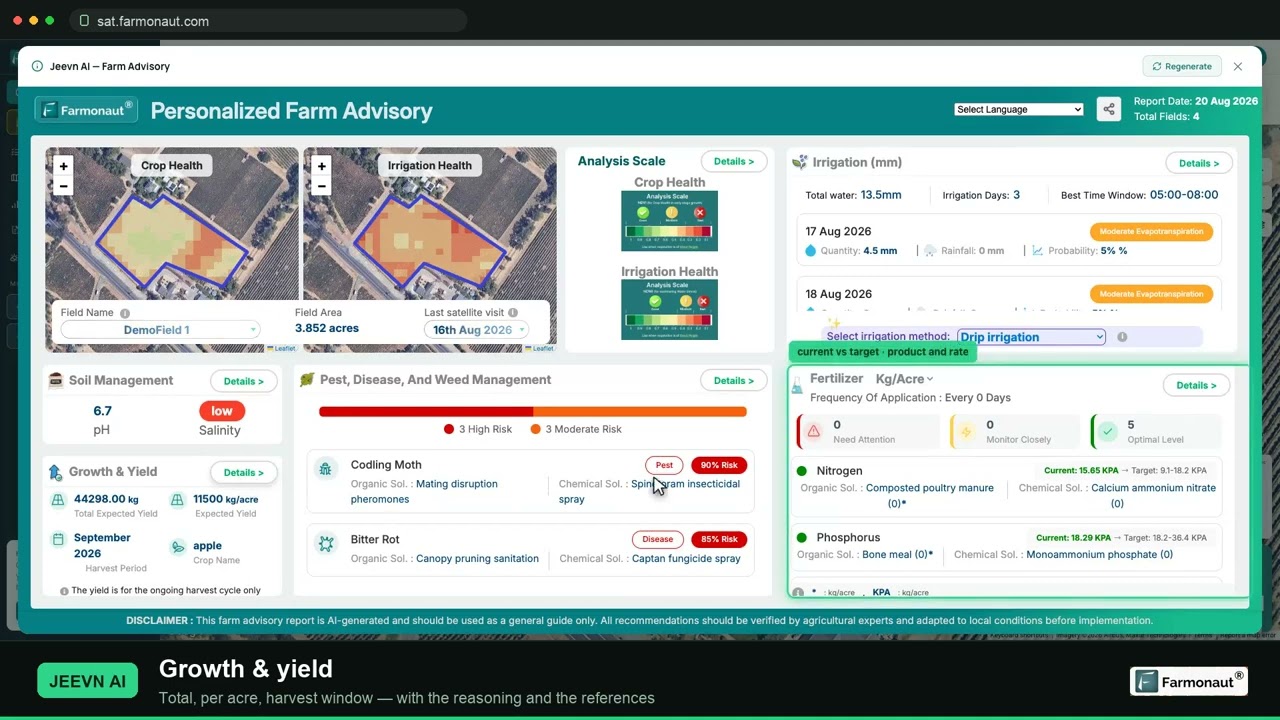
▶ A walkthrough of satellite crop monitoring and field reports. · 19:36
FAQ
What are Farm Credit interest rates right now?
No national rate exists, as each association quotes its own loans. As a guide, bank surveys showed fixed real estate averages of 7.07% in Minneapolis (second quarter of 2026) and 7.46% in Dallas (third quarter of 2026). Get a written quote for your loan.
Is Farm Credit cheaper than a bank?
It depends on the loan and the year. Compare APRs, then consider patronage separately. Patronage can lower the net cost, but it is not guaranteed and some of it may not be paid in cash.
What is the USDA farm loan interest rate this month?
For November 2026, FSA set 6.250% for direct ownership, 5.625% for direct operating and 2.250% for down payment loans. FSA updates its notice monthly, so check for a newer one.
Can I use FSA instead of Farm Credit?
Direct operating loan applicants must show they cannot get credit elsewhere at reasonable rates and terms, and direct loans have limits and eligibility rules. Your local USDA Service Center can tell you what applies to you.
Are farm land loan rates fixed or variable?
Both exist, and Fed surveys report averages for each. Some loans are fixed for a set period and then reprice. Ask for the full schedule, and test the payment at a higher rate.
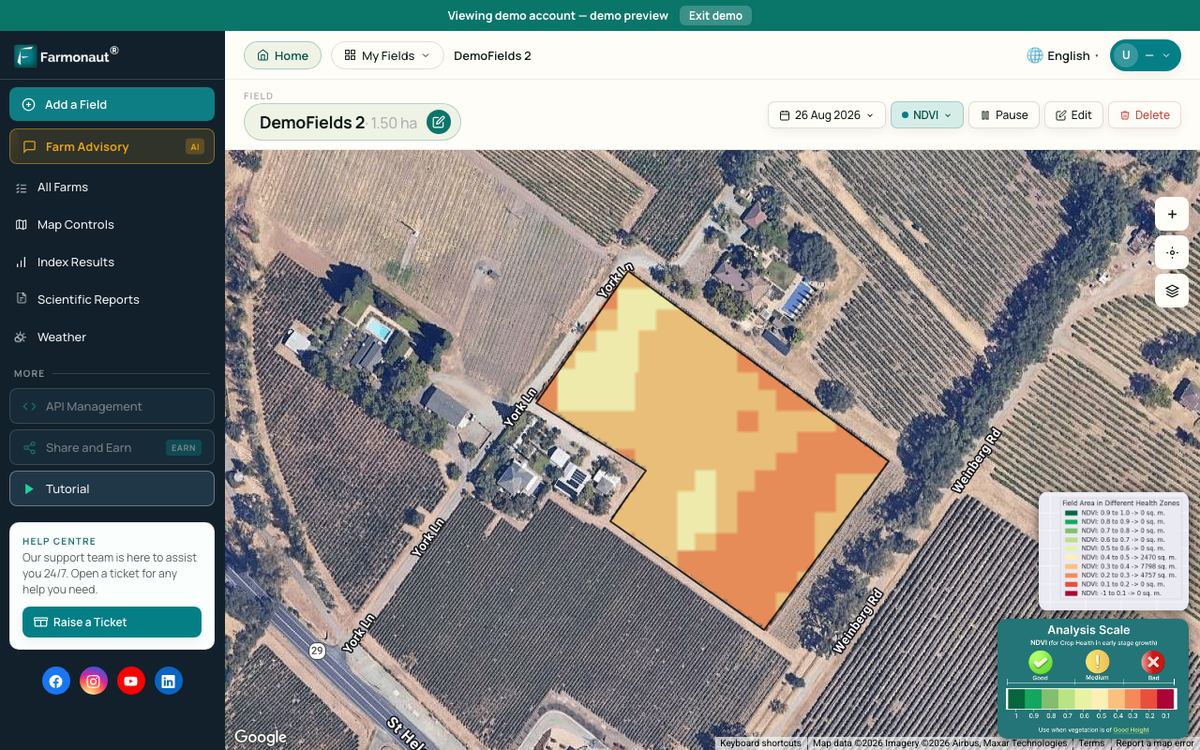
Farmonaut crop monitoring
See your own fields from space
Draw your fields once and Farmonaut shows satellite vegetation maps for them through the season, on web, Android or iOS.



Keep reading


Sources
- USDA FSA, November 2026 lending rates: fsa.usda.gov
- USDA FSA, December 2024 lending rates: fsa.usda.gov
- USDA FSA, September 2026 lending rates: fsa.usda.gov
- USDA FSA, October 2026 lending rates: fsa.usda.gov
- USDA FSA, July 2026 lending rates: fsa.usda.gov
- USDA FSA, June 2026 lending rates: fsa.usda.gov
- USDA FSA, May 2026 lending rates: fsa.usda.gov
- USDA FSA, March 2026 lending rates: fsa.usda.gov
- USDA FSA, January 2026 lending rates: fsa.usda.gov
- USDA FSA news releases: fsa.usda.gov
- Federal Reserve Bank of Dallas, Agricultural Survey, Q3 2026: dallasfed.org
- Progressive Dairy, Interest rates largely unchanged in Q2 reports (Sept 2026): agproud.com
- Federal Reserve, H.15 Selected Interest Rates (4 Nov 2026): federalreserve.gov
- Farm Credit, system overview: farmcredit.com
- Farm Credit Administration, About us: fca.gov
- USDA NASS, Land Values 2026 Summary: release.nass.usda.gov
- USDA NASS, 2024 Land Values and Cash Rents: nass.usda.gov
- USDA FSA, Farm Ownership Loans: fsa.usda.gov
- USDA FSA, Farm Operating Loans: fsa.usda.gov
- USDA FSA, Guaranteed Farm Loans: fsa.usda.gov
- USDA FSA, Farm Storage Facility Loan Program: fsa.usda.gov
- USDA FSA, Emergency Farm Loans: fsa.usda.gov
- USDA FSA, Operating Microloan: fsa.usda.gov
- Purdue University, Agricultural Credit Outlook (2026): ag.purdue.edu
- farmdoc daily, Double Trouble Part 1 (Jan 2026): farmdocdaily.illinois.edu
- farmdoc daily, Double Trouble Part 2 (Feb 2026): farmdocdaily.illinois.edu
- USDA ERS, Assets, Debt, and Wealth (2026 forecast): ers.usda.gov
- Texas Farm Credit, Land loans: texasfcs.com
- Federal Reserve Bank of Chicago, AgLetter: chicagofed.org
Discussion
Questions, corrections or field experience? Share them below. First-time comments are reviewed before they appear, and your email is never published.
No comments yet. Be the first to add a question or your experience.

 Cazlv
 HIPSAC
 ZOL Zimbabwe
 Juligerm
 AdBio
 MISE Maroc
 Drift-Sense
 NWNS
 Red August Group
 Farm Inc
 WeMe Global
 Agrotoken
 Blue BearX
 Insignito
 Croptimum
 DnCubed
 Field Capacity
 Indosistim Teknologi
 Licence holder · Niger · Gold
 Licence holder · Nigeria · Gold + lithium