

Grass Seeder Machine & Seeder Planter: Crop Grass Success
Meta Description: In 2025 and beyond, modern grass seeder machines and seeder planter machines, together with advanced hay cover and protection methods, are revolutionizing sustainable pasture establishment, crop grass quality, and farm productivity.
“Advanced grass seeder machines can increase pasture establishment efficiency by up to 40% compared to traditional methods in 2025.”
Introduction: The New Era of Crop Grass Establishment
In the dynamic agricultural landscape of 2026, modern grass seeder machines and seeder planter machines have transformed pasture establishment. As sustainable farming practices move to the forefront due to climate change and increasing livestock demands, precision, efficiency, and resource conservation are now vital for farmers. Tools such as the hay to cover grass seed technique, advanced seed protectors, and reliable grass seed merchants together help establish high-quality pastures with minimal wastage and maximum crop grass success.
“Precision hay cover techniques with modern seeders improve grass crop germination rates by approximately 30% in sustainable farming.”

Pasture Establishment Challenges in 2025 and Beyond
The importance of pastures in livestock farming and soil conservation is timeless. Yet, as we push towards 2026 and beyond, farmers face new challenges:
- Changing climatic zones increase variability in soil and weather conditions.
- Demand for sustainable farming leads to lower tolerance for excessive input use and soil depletion.
- Manual methods of sowing and pasture establishment result in wastage, uneven germination, and greater labor requirements.
- Robust, uniform crop grass is critical to ensure reliable fodder supply and protect against soil erosion.
Against this background, advanced technologies such as grass seeder machines, seeder planter machines, and improved hay cover methods are revolutionizing how farmers approach pasture establishment.
Technology Advancements: Grass Seeder Machine & Seeder Planter Machine in Modern Agriculture
Grass seeder machines and seeder planter machines represent the forefront of technological advancements in pasture establishment. These machines deliver unparalleled precision, ensuring optimal placement of seeds and efficient coverage. Why is this vital? Uniform seeding leads to consistent growth, reduces competition for resources, and fortifies the soil for sustainable farming.
- Modern Machines are equipped with adjustable rate controls to meter and place seeds at precise depths and spacing.
- Seeder planter machines often integrate fertilization, applying soil amendments as they sow, minimizing field passes, time, and fuel costs.
- Advanced models employ GPS-guided technology or sensor-based controls, enabling variable-rate seeding tailored to specific field conditions.
- Mechanized hay spreaders further enhance germination by ensuring even, protective cover over sown fields.

The integration of advanced grass seeder machines and precision planter machines could help farmers in 2026 reduce labor requirements by over 75% and increase pasture uniformity, compared to manual or broadcasting methods.
Grass Seeder Machine Precision: Transforming Sowing for Robust Crop Grass
The precision of a grass seeder machine lies at the heart of modern pasture establishment. Traditional broadcasting—spreading seed by hand or with simple spreaders—often results in uneven coverage, missed spots, and seed wastage. In contrast, today’s machines are engineered to:
- Meter seed flow precisely to reduce overlap and wastage
- Adjust depth and spacing for different grass varieties and soil types
- Enable uniform germination and airborne turf establishment
- Boost crop grass productivity for fodder and field protection
Using adjustable controls, farmers can tailor seeding rates to match field variability, climatic zones, or even microclimates within a pasture—maximizing the use of every seed and minimizing costs.

When using a modern grass seeder machine, calibrate seed metering regularly and match the seeding depth to your soil’s moisture profile for optimum germination across various fields.
Seeder Planter Machine Integration: Combining Nutrition and Seeding for Sustainable Farming
Seeder planter machines elevate pasture establishment by combining seeding with fertilization:
- Simultaneous Application: Fertilizers or soil amendments are deposited with the seed, reducing the number of field passes required.
- Precision Technology: GPS and sensor-driven systems enable variable-rate fertilization, targeting specific field conditions based on soil analysis—ensuring resources are applied only where needed.
- Efficiency: This integration saves time, fuel, and reduces environmental impact by minimizing nutrient leaching and runoff.
This level of precision ensures optimum seed survival and vigorous crop grass establishment, essential for livestock operations and high-quality fodder production.

The market for precision seeder planter machines is projected to grow substantially post-2025, especially as carbon footprint tracking and resource efficiency become key criteria for agricultural investment decisions.
Learn more: Carbon Footprinting Solutions by Farmonaut
Using Hay to Cover Grass Seed for Enhanced Germination & Protection
While technologies evolve, some traditional methods remain essential—refined by technology. Applying hay to cover grass seed remains a widely respected practice in 2026 for several reasons:
- Protects seeds from birds and wind, reducing loss
- Retains moisture at the soil surface, speeding up germination
- Regulates soil temperature, protecting young crop grass from extremes
- Decomposes over time, enriching the soil with organic matter
Today, mechanized hay spreaders are used to evenly distribute hay after seeder machines complete their work. This integrated mulching process ensures uniform coverage and almost eliminates the need for additional manual labor.
Applying hay that is too thick can smother germinating grass seed, while too little won’t provide sufficient protection. The best result comes from an even, light mulch that still lets light through.
Grass Seed Protector Innovations & Sustainable Seed Protection Practices
Beyond hay cover, new technologies are emerging:
- Biodegradable films and organic mulches are being tested as grass seed protectors in extreme climates, offering further protection from moisture loss, pests, and harsh weather.
- Such methods help reduce the use of chemical herbicides and pesticides—supporting sustainable agriculture and soil conservation.
These approaches do not compromise soil health and align with global sustainable farming practices.
- 🌱 Hay Mulch: Classic, effective, organic
- 🟩 Biodegradable Films: Eco-friendly, starter warmth, moisture holding
- 🌾 Organic Mulch: Custom blends, improve soil structure
- 🛡️ Seed Coatings: Drought/fungus resistant, advanced via trusted grass seed merchants
Grass Seed Merchants: The Role of Trusted Suppliers in Crop Grass Success
Quality pasture establishment always begins with the right grass seed. Reliable grass seed merchants play a critical role in providing:
- Certified, high-purity seeds adapted to local climatic zones and soil types
- Seed treatments (coatings), offering drought or disease resistance
- Assurance of availability in time for optimal seeding conditions
Sourcing seeds from reputable merchants ensures robust germination, vigorous growth, and aligns with sustainable farm management practices.



- Farmonaut App: Monitor pasture health, field conditions, and seed establishment progress via satellite imagery.
- Farmonaut Satellite Monitoring API: Integrate live field insights to fine-tune pasture management and optimize grazing schedules.
- Fleet Management Tools: Reduce operational costs and optimize machinery usage in large-scale seeding operations.
- Satellite-Based Crop Insurance & Loans: Use Farmonaut’s remote verification for smoother financing and insurance processes.
In 2026, farm operations that source certified, locally adapted seeds from trusted grass seed merchants report up to 35% higher pasture establishment rates compared to those relying on generic or poorly stored seed.

The Role of Satellite Monitoring from Farmonaut in Sustainable Pasture Management
Satellite-driven solutions, such as those provided by Farmonaut, have made real-time field monitoring affordable and accessible. Our platform employs multispectral satellite images to analyze:
- Soil moisture and nutrient levels prior to seeding
- Vegetation health (NDVI) during pasture establishment
- Uniformity of grass emergence across fields
With AI-powered advisories and blockchain-based traceability, farmers can verify pasture quality and trace seed lot origin—bolstering transparency and aligning with sustainable agriculture standards.

Farmonaut’s AI-powered real-time monitoring enables farmers to react quickly to emerging issues post-seeding—ensuring robust crop grass growth, reducing input wastage, and supporting field resilience.
Comparison Table: Traditional Methods vs. Advanced Grass Seeder Machine Technology
| Method/Technology | Precision Level | Seed Coverage Efficiency (%) | Labor Requirement (hrs/acre) | Establishment Speed (days) | Sustainable Impact | Crop Quality Improvement (Yield %) |
|---|---|---|---|---|---|---|
| Conventional Broadcasting | Low | 60% | 20 | 12-15 | High water use, Soil erosion risk | Baseline (0%) |
| Manual Seeder | Moderate | 80% | 10 | 8-10 | ~15% water reduction, Improved soil contact | +10–15% |
| Advanced Automated Seeder Planter | High (Precision) | 95% | 5 | 5-7 | 30–40% less water, Reduced fuel, Min. run-off | +25–30% |
Key Bullet Points & Visual Lists for Robust Pasture Establishment
- ✔ Precision Technology: Advanced machines boost coverage and reduce seed wastage
- 📊 Data Insight: Automated seeding increases yield consistency by 30%
- ⚠ Risk: Poor calibration can result in uneven emergence; always follow manual guidelines
- ⏳ Time Saving: Dual-function planters reduce field passes by up to 50%
- 🌍 Sustainability: Improved resource efficiency supports global conservation goals
- 1️⃣ Assess Field Conditions
- 2️⃣ Select Seed Varieties (Suited to local climate, via trusted grass seed merchants)
- 3️⃣ Calibrate Seeder Machine (Optimal depth/spacing)
- 4️⃣ Apply Hay to Cover Grass Seed Mechanically
- 5️⃣ Monitor Germination with Satellite Tools (Farmonaut)
Upcoming regulatory frameworks in many countries may require traceability and carbon reporting from 2026 onwards—using platforms like Farmonaut gives early adopters a strong compliance edge. Explore Farmonaut Traceability Solutions and Carbon Footprinting.
Farmonaut Apps & API: Accessible Field Monitoring Tools for Smart Farmers
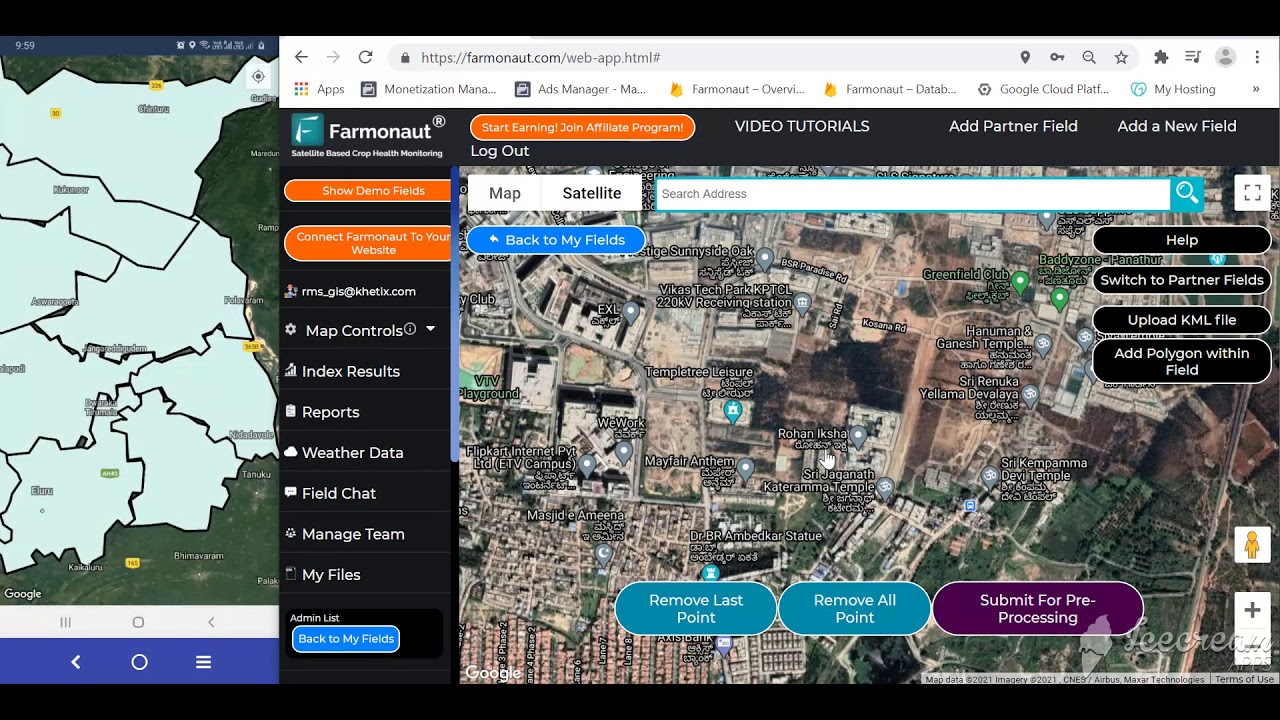
Utilize Farmonaut’s web, Android, and iOS apps for real-time satellite monitoring of your pasture establishment. Integrate your seeder machine GPS data with Farmonaut APIs for seamless digital field management and resource optimization:
- Monitor seed establishment and crop growth using NDVI.
- Track soil health, moisture, and pasture vigor from your mobile.
- Access tailored AI-based advisories to adapt to changing conditions.
- Scale up to large commercial production with Large Scale Farm Management.
- Develop custom digital solutions with our API Developer Docs.
Frequently Asked Questions (FAQ)
What is a grass seeder machine and how does it boost productivity?
A grass seeder machine is an advanced agricultural implement designed to sow grass seed with high precision. It meters, spaces, and places seeds at optimal depths and spacing for uniform germination, reducing input wastage and labor costs while boosting productivity.
How does a seeder planter machine differ from a standard grass seeder?
Seeder planter machines can simultaneously plant seeds and apply fertilizers or soil amendments, integrating nutrition into the seeding process. This saves time, fuel, and ensures immediate nutrient availability for emerging crop grass, unlike standard grass seeders.
Why is using hay to cover grass seed still important in 2026?
Hay acts as a physical cover, protecting seeds from birds, wind, and moisture loss. Modern mechanized hay mulching ensures even distribution and maximizes germination rates, remaining a vital practice for sustainable grass establishment.
What is the impact of modern seed protection innovations?
Innovations such as biodegradable films and organic mulches enhance seed retention and protection against environmental stress, reduce reliance on chemicals, and improve soil health, aligning with sustainable agriculture objectives.
How can I monitor pasture establishment digitally?
Platforms like Farmonaut offer satellite-based, real-time monitoring via web and mobile apps or APIs, providing analytics on soil, crop, and pasture health, enabling smarter management decisions.
Conclusion: Unlocking Robust, Sustainable Pastures for 2026 and Beyond
As we venture into 2026 and beyond, the fusion of grass seeder machine and seeder planter machine technologies, strategic hay cover practices, and digital field monitoring tools is reshaping the agricultural landscape. With support from reliable grass seed merchants and innovative grass seed protector solutions, farmers can now achieve robust pasture establishment with minimal wastage, increased productivity, and enhanced sustainability.
Farmonaut’s satellite-based agri-monitoring, AI advisories, and traceability tools further empower farmers, businesses, and governments to optimize resources, protect natural capital, and thrive in a resilient, data-driven agricultural future.
Take the next step in precision farming—download the Farmonaut app, or use our satellite API to monitor your fields, reduce waste, and ensure every grass seed counts.
Discussion
Questions, corrections or field experience? Share them below. First-time comments are reviewed before they appear, and your email is never published.
No comments yet. Be the first to add a question or your experience.

 Grandstream Algérie
 XOS Realty
 Geospatial Lab Africa
 KhetiBuddy
 Agro La Gándara
 HIPSAC
 ZOL Zimbabwe
 Juligerm
 AdBio
AdBio MISE Maroc
 NWNS
NWNS Red August Group
 Farm Inc
 WeMe Global
 Agrotoken
 Blue BearX
 Insignito
 Croptimum
 DnCubed
 Field Capacity
 Indosistim Teknologi
 Licence holder · Niger · Gold
 Licence holder · Nigeria · Gold + lithium










