

“By 2025, CSRD expands sustainability reporting to ~50,000 EU companies, including agri-coops tracking soil carbon and water use., ISO 14064 enables farm GHG inventories; regenerative fields can sequester 1–3 tCO2e per hectare annually under favorable conditions.”



APIs: Explore Farmonaut API and API Developer Docs for satellite, weather, and ESG data integration.
ESG Standards in Agriculture 2025: ISO + EU Essentials
ESG standards in agriculture are no longer a niche topic. In 2025, they are central to agricultural competitiveness, risk management, and market access across global supply chains. Practically applied, ESG in agriculture means measurable reduction of greenhouse gas emissions and biodiversity loss, protection of soil and water, fair labor and community relations, and transparent governance across chains. Farmers, cooperatives, buyers, and financiers navigate a patchwork of overlapping standards and regulations that together shape farm decisions and corporate reporting.
This guide clarifies core international frameworks such as the Taskforce on Nature-related Financial Disclosures (TNFD) and the International Sustainability Standards Board (ISSB) guidance under IFRS S2, the EU’s Corporate Sustainability Reporting Directive (CSRD) and ESRS standards, the iso agriculture standards for environmental and social management, and sector schemes from GLOBALG.A.P. to SAI Platform’s Farm Sustainability Assessment (FSA). We map regenerative agriculture standards, standards of organic farming, and forestry standards to concrete indicators—carbon, soil organic carbon, water efficiency, biodiversity habitats—offering 2025-aligned metrics and verification pathways. Along the way, we show how digital tools, remote sensing (NDVI), LCA, and blockchain traceability advance transparent, robust reporting and reduce audit costs.
As an expert ESG and satellite technology representative, we at Farmonaut focus on making satellite-driven insights affordable and accessible to agriculture and related sectors. Where relevant, we explain how our platform helps organizations integrate nature and climate data into management, reporting, and verified certifications—without turning this article into a product brochure. We also list resources to explore when you are ready.
Why ESG Standards in Agriculture Are Central in 2025
Several forces have converged to make esg standards in agriculture a board-level issue. These drivers are global, national, and international, and they affect actors across the supply chain—from farm to food companies, distributors, and financiers.
- Regulatory pressure in the EU: CSRD and related ESRS are imposing robust disclosure and due diligence requirements on entities operating in and sourcing from the EU. Agriculture and food sectors must demonstrate credible environmental and social data, including emissions, water, soil, and biodiversity indicators.
- Investor and lender expectations: The TNFD and ISSB IFRS S2 frameworks drive disclosure of climate- and nature-related risks and opportunities. Financiers look for practicable, measurable metrics and transparent governance to assess risk and allocate capital.
- Market access and buyer requirements: Buyers increasingly require certifications (GLOBALG.A.P., FSA, Rainforest Alliance) and verified outcome metrics to ensure supply resilience and to avoid greenwashing. They prioritize chains that can demonstrate compliance across geographies.
- Consumer demand for sustainable food: Consumers expect reduced greenhouse gas emissions, fair labor, organic and regenerative practices, and assurance that products protect water and biodiversity.
- Nature and climate risks: Soil degradation, water scarcity, biodiversity loss, and extreme weather threaten yields, quality, and farmer livelihoods. Managing these risks through structured standards is practical and financially relevant.
In short, esg standards in agriculture become central because they reduce risk, maintain market access, and improve competitiveness. They drive continual improvement in management systems and provide a transparent language for cross-chain performance.
Core ESG Frameworks: TNFD, ISSB IFRS S2, and EU CSRD/ESRS
Understanding the core frameworks and how they relate is essential to navigate overlapping regulations. Here are the essentials.
Taskforce on Nature-related Financial Disclosures (TNFD)
TNFD provides guidance for nature-related risk and opportunity management and disclosures. For agriculture, nature is integral: soils, water systems, biodiversity, pollination, and forest and agroforestry landscapes. TNFD encourages companies to identify dependencies and impacts on nature, set indicators and targets, and report transparently. It complements climate reporting by bringing nature into risk assessment and strategy. It also aligns with the push toward outcome-based metrics—such as soil organic carbon change, watershed health, and habitats conserved.
ISSB Climate Disclosures: IFRS S2
ISSB’s IFRS S2 standardizes climate-related reporting. Agricultural entities and food buyers use it to disclose governance, strategy, risk management, and metrics and targets related to climate risks and opportunities. IFRS S2 connects to emissions reporting (Scopes 1–3), energy management, and climate transition planning. It sits alongside TNFD, ensuring that climate and nature disclosures can be integrated in a coherent reporting system.
EU Corporate Sustainability Reporting Directive (CSRD) and ESRS
CSRD significantly expands sustainability reporting in the EU and for non-EU entities that operate or source within the EU. ESRS (European Sustainability Reporting Standards) provide detailed environmental and social disclosure requirements. For agriculture, ESRS E1–E5 environmental topics and social standards push for quantification of carbon emissions, water use, biodiversity, pollution, and resource circularity, as well as worker health, safety, and community relations. These requirements push companies and farms toward robust management systems, verifiable metrics, and digital traceability across the chain.

ISO Agriculture Standards and Management Systems
ISO frameworks help agricultural businesses implement systemic ways to manage impacts, demonstrate continual improvement, and integrate esg reporting. While not agriculture-only, the following iso agriculture standards are widely applied in farms, cooperatives, processors, and buyers:
- ISO 14001 (environmental management): Provides a structure to manage environmental impacts, set objectives (e.g., emissions, water, waste), and demonstrate improvement with internal audits and management reviews.
- ISO 50001 (energy management): Focuses on energy performance, efficiency, and reduction strategies, linking to emissions and energy transition planning.
- ISO 22000 (food safety management): Ensures food safety and quality processes across the chain, aligning with good agricultural practices and supplier assurance.
- ISO 14067 (carbon footprint of products): Guides product-level footprinting and enables claims on low-carbon products when supported by robust data and verification.
- ISO 26000 (social responsibility guidance): Provides guidance on social responsibility topics like labor, community relations, fair practices, and governance.
These systems, combined with sector certifications, help demonstrate recognized performance to buyers while building an internal culture of continual improvement. They also provide audit trails that support EU CSRD/ESRS and IFRS S2 disclosures.

Farm-Level Schemes and Certifications: GLOBALG.A.P., FSA, Rainforest Alliance
To demonstrate field-level environmental and social performance, agricultural producers and supply chains often rely on recognized schemes. Widely used certifications and assessment tools include:
- GLOBALG.A.P. and Good Agricultural Practices: Focus on safe, responsible, and sustainable production, covering topics like pesticide use, water stewardship, worker safety, and traceability.
- SAI Platform’s Farm Sustainability Assessment (FSA): A flexible tool that helps buyers and farmers assess sustainability performance across environmental, social, and economic criteria. It supports alignment across diverse suppliers and regions.
- Rainforest Alliance: Combines environmental criteria (forest and biodiversity protection), social standards (worker rights, fair practices), and traceability to recognize sustainable production.
These schemes increasingly interface with esg reporting by providing structured audits, documented practices, and data points that feed into metrics. They complement iso systems and help translate policy expectations into on-farm practices and measurable indicators.

Organic, Regenerative Agriculture Standards, and Forestry Standards
Organic standards—including USDA NOP, EU Organic Regulation, and JAS—remain the benchmark for ecologically based production that avoids synthetic inputs. Standards of organic farming are increasingly recognized within esg reporting as environmental assurance, particularly for reduced chemical risk, improved agroecology, and soil and biodiversity protection. Organic certification is not a substitute for outcome metrics, but it provides credible, audited practices and data.
Regenerative agriculture standards emphasize outcomes such as soil health, carbon sequestration, and biodiversity. Programs like Regenerative Organic Certified and Land to Market (Savory) have grown, and several protocols converge toward outcome-based indicators. While there is no single global regenerative standard yet, the trend is toward measurable indicators—soil organic carbon change, water infiltration, habitat set-asides—rather than static practice lists. These indicators fit well with TNFD and CSRD/ESRS, supporting nature and climate disclosures.
Forestry standards such as FSC and PEFC remain critical for sustainable timber and agroforestry, especially for supply chains linking agriculture to landscape-scale biodiversity goals. In regions where agriculture and forestry intersect—coffee or cocoa agroforestry, shelterbelts, riparian buffers—credible forestry standards validate conservation and sustainable wood products, complementing farm esg outcomes.

“By 2025, CSRD expands sustainability reporting to ~50,000 EU companies, including agri-coops tracking soil carbon and water use., ISO 14064 enables farm GHG inventories; regenerative fields can sequester 1–3 tCO2e per hectare annually under favorable conditions.”
Metrics, Tools, and Verification: Digital, Remote Sensing, LCA
Credible esg reporting depends on robust metrics and verification. Agricultural systems must quantify emissions, soil carbon, water use, and biodiversity outcomes using recognized methods. Below are the key tools and approaches used across farms and buyers in 2025.
Key Metrics and Indicators
- Carbon and greenhouse gas emissions: Farm and product carbon footprints, often aligned to IPCC and ISO 14067/14064 guidance, with Scopes 1–3 in corporate contexts.
- Soil health and soil organic carbon (SOC): SOC stock and annual change are central indicators for regenerative outcomes and TNFD-relevant nature metrics.
- Water use intensity and water quality: m³ per ton, water stress mapping, and nutrient runoff risks, aligned with ISO 14046 water footprinting where relevant.
- Biodiversity and habitat: Percent of farm area reserved for habitats, agroforestry coverage, and landscape connectivity.
- Input risk indices: Pesticide risk indices, nitrogen surplus, and nutrient balance to demonstrate pollution reduction.
- Social and governance: Worker training hours, health and safety, fair labor indicators, community relations, grievance mechanisms, traceability coverage.
Tools and Data Sources
- Cool Farm Tool and IPCC-aligned GHG calculators for emissions estimation.
- Life Cycle Assessment (LCA) for product-level footprinting linked to ISO 14067 and used in eco-design and buyer communications.
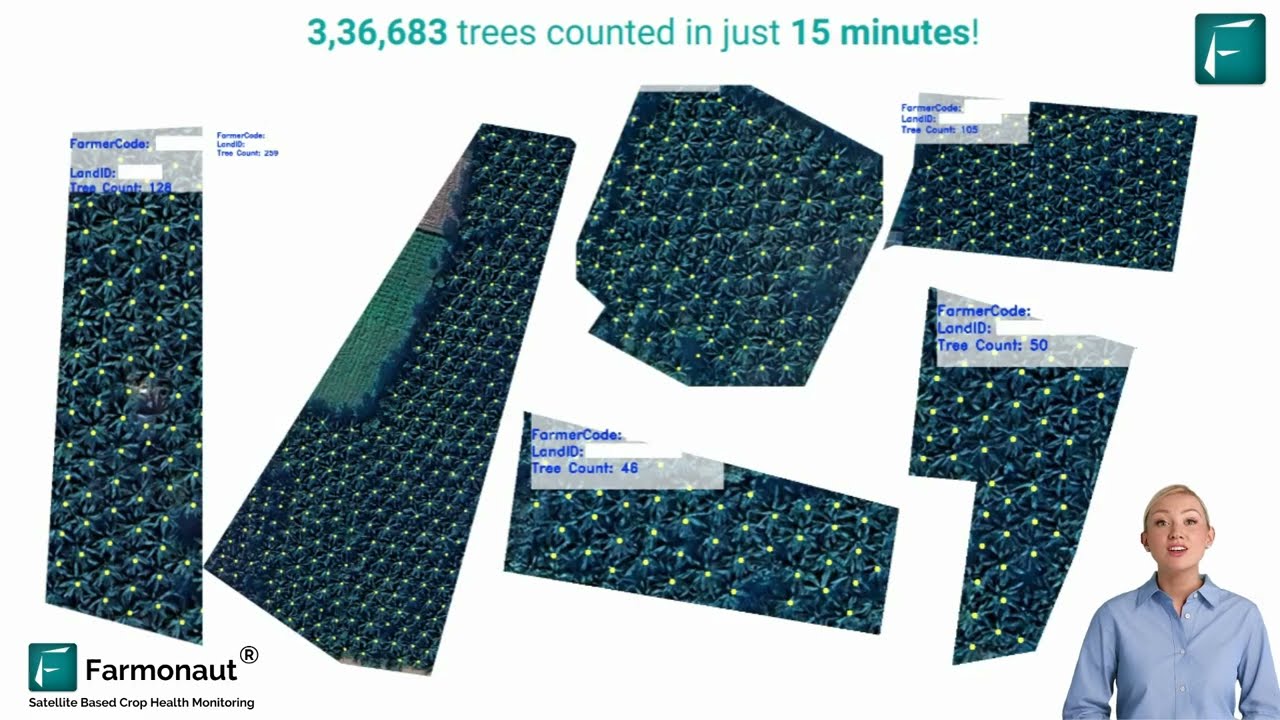
- Remote sensing/NDVI satellite analytics for biomass vigor, land cover, and habitat change monitoring.
- IoT and lab tests for soil, water, and input measurements; digital traceability and blockchain to secure data across the chain.
Verification can be managed through a combination of third-party audits and digital evidence. The goals are to reduce costs, prevent greenwashing, and generate audited data that align with ESRS and IFRS S2. Smallholder inclusion is a priority, as costs and data gaps remain sizable. Outcome indicators enable performance-based incentives and payments for ecosystem services.
We at Farmonaut support these processes with satellite-based monitoring, AI advisory, and blockchain traceability, helping users collect, verify, and report esg metrics with transparency. Our platform provides:
- Multispectral satellite images and NDVI for vegetation health and land-use assessment.
- Environmental impact tracking, including carbon footprint monitoring for agriculture.
- Blockchain-based traceability to enhance chain transparency and verification.
- APIs and mobile/web apps for integrating esg data streams, reporting, and analytics.
Explore solutions relevant to esg standards in agriculture:
- Farmonaut Carbon Footprinting — estimate and track farm and product footprints, align with ISO 14067 and IFRS S2, and prepare data for CSRD reporting.
- Farmonaut Traceability — blockchain-based lot-level traceability that supports verified claims and buyer audits across chains.
- Crop Loan & Insurance Verification — satellite-based verification that reduces fraud and improves access to financing for farmers and cooperatives.
- Fleet Management — monitor energy use and logistics to improve fuel efficiency and reduce emissions across operations.
- Large-Scale Farm Management — manage fields, teams, and esg metrics in one dashboard with satellite insights and AI advisory.
- Crop Plantation & Forest Advisory — plan tree planting, agroforestry, and monitor forestry standards implementation with satellite and AI guidance.
Farmonaut Subscriptions
We offer modular subscriptions so farms, cooperatives, buyers, and governments can scale esg, remote sensing, and traceability tools as they grow.
Implementation Roadmap and Strategic Responses
Fragmentation, inconsistent metrics, and certification costs can be daunting. The following practical steps help agricultural actors integrate standards and drive measurable outcomes across 2025 and beyond.
1) Map Material Risks and Align to Frameworks
- Identify environmental and social topics material to your operations and supply chains: carbon, water, soil, biodiversity, labor practices, governance.
- Align disclosures to TNFD (nature), IFRS S2 (climate), and CSRD/ESRS (EU reporting), using the same internal data streams.
- Use iso management systems (14001, 50001, 22000) to provide a systemic backbone and to demonstrate continual improvement.
2) Combine Recognized Schemes With Outcomes
- Pair GLOBALG.A.P. and FSA with organic or regenerative agriculture standards to build both practice-based assurance and outcome indicators.
- In agroforestry regions, add forestry standards (FSC, PEFC) to validate landscape-scale biodiversity and carbon benefits.
3) Prioritize Outcome-Based Indicators
- Carbon intensity (tCO2e/ton), SOC change (t C/ha/yr), water use intensity (m³/ton), nitrogen surplus (kg N/ha), habitat set-asides (% area), pesticide risk index, waste diversion (%), worker training (hours/worker/year), and lot traceability (% coverage).
- Set 2025 targets toward science-aligned ranges and ensure consistent measurement methods.
4) Digitize Monitoring and Reduce Verification Costs
- Use remote sensing (NDVI) for crop vigor, land cover, and habitat tracking; integrate IoT for soil moisture and water metering.
- Adopt blockchain traceability to secure data, prevent tampering, and simplify audits.
- Deploy LCA where product-level carbon claims matter to buyers.
5) Support Smallholders and Ensure Fair Value
- Build capacity for recordkeeping and digital tools; simplify data collection with mobile apps.
- Offer premiums for verified sustainable produce and link outcomes to incentives, including payments for ecosystem services.
- Ensure fair labor practices and community relations are integrated, not sidelined.
6) Strengthen Governance and Data Integrity
- Create clear governance for esg data, with roles for verification and sign-off.
- Document data sources, uncertainty, and calculation boundaries (e.g., farm gate vs. distribution).
- Use third-party audits strategically: focus on high-risk metrics and leverage digital evidence to reduce costs.
We support this roadmap by providing accessible satellite monitoring, AI advisory, and blockchain traceability across web, Android, iOS, and API. We are not a regulatory body, an online marketplace, or a manufacturer of inputs or machinery. Our role is to equip you with the tools to demonstrate recognized, verified sustainability performance.
ESG Metric-to-Standard Mapping Matrix (Agriculture, 2025, ISO + EU Essentials)
This matrix aligns outcome-oriented esg indicators with iso references and EU/TNFD tags, helping farms, cooperatives, and buyers prepare 2025 reports. Values are indicative and should be tailored to context and crop type.
| ESG pillar | Priority metric (unit, per ha/ton) | 2025 estimated benchmark range (est.) | ISO alignment | EU/ESRS/TNFD tag | Practice relevance (Regenerative, Organic) | Data source/method | Reporting frequency | Verification/audit |
|---|---|---|---|---|---|---|---|---|
| Environmental (Climate) | Carbon intensity (tCO2e/ton) | 0.8–1.8 tCO2e/ton (est.) | ISO 14067, ISO 14064-1 | CSRD ESRS E1; IFRS S2 | Regenerative: Yes; Organic: Yes | Farmonaut remote sensing + GHG calculators (IPCC); LCA | Annual | Third-party verification of footprint; digital traceability |
| Environmental (Soil) | Soil organic carbon change (t C/ha/yr) | +0.2–1.0 t C/ha/yr (est.) | ISO 14064-1 (project accounting alignment) | CSRD ESRS E2/E4; TNFD | Regenerative: Strong; Organic: Strong | Soil sampling (lab tests), Farmonaut spatial sampling support | Annual with 3–5 yr baselining | Audit of sampling plan; lab QA/QC |
| Environmental (Water) | Water use intensity (m³/ton) | 200–500 m³/ton (est.) | ISO 14046 | CSRD ESRS E2 | Regenerative: Yes; Organic: Yes | IoT meters, Farmonaut remote sensing for crop water status | Seasonal/annual | Meter calibration; data review |
| Environmental (Nutrients) | Nitrogen surplus (kg N/ha) | 10–40 kg N/ha (est.) | ISO 14001 (management), 14067 (indirect) | CSRD ESRS E2/E5 | Regenerative: Yes; Organic: Yes | Farm records, soil tests, agronomic models | Annual | Farm audit; agronomic review |
| Environmental (Biodiversity) | Biodiversity habitat set-aside (% of area) | 3–7% area (est.) | ISO 14001 (objectives/targets) | CSRD ESRS E4; TNFD | Regenerative: Strong; Organic: Supportive | Farmonaut land-cover mapping; field verification | Annual | Geospatial audit; sampling |
| Environmental (Chemicals) | Pesticide risk index (YoY) | −30% YoY (est.) | ISO 14001 (impact reduction) | CSRD ESRS E5 | Regenerative: Yes; Organic: Inherent | Input records; risk models | Annual | Document audit; random checks |
| Environmental (Waste) | Waste diversion (% of total) | 60–90% (est.) | ISO 14001 | CSRD ESRS E5 | Regenerative/Organic: Applicable | Facility records; weighbridge data | Quarterly/annual | Site audit; documentation |
| Social | Worker training (hours/worker/year) | 8–20 hours (est.) | ISO 26000 (guidance) | CSRD social standards | Relevant across practices | HR records; training logs | Annual | HR audit |
| Governance/Chain | Lot traceability coverage (%) | 80–100% (est.) | ISO 22000 (traceability); ISO 14067 (product) | CSRD ESRS cross-cutting | Enables all claims | Blockchain and ERP; Farmonaut traceability | Continuous | System audit; data integrity checks |
Outlook: 2025 and Beyond
The trend is toward harmonization around outcome-based, science-aligned metrics; integration of nature disclosures (TNFD); and regulatory pressure for transparent esg reporting. For agriculture, success depends on translating high-level standards into affordable, locally relevant practices that deliver verified environmental and social benefits across landscapes. Expect:
- Convergence on indicators: SOC change, water intensity, biodiversity habitats, and risk indices will anchor reporting across frameworks.
- Digital verification: Remote sensing, automated data capture, and blockchain traceability will reduce costs—essential for smallholders and diversified chains.
- Outcome-linked incentives: Buyers, investors, and governments will link premiums, finance, and public procurement to verified outcomes.
- Deeper integration of forestry and agriculture: Agroforestry and nature-positive land management will scale, supported by FSC/PEFC and TNFD-aligned disclosures.
We will continue to focus on affordable satellite-based monitoring, AI advisory, and secure traceability to support iso, EU, and international frameworks. Our goal is to help users demonstrate recognized, measurable sustainability performance without adding unnecessary complexity.
FAQ: ESG, ISO, TNFD, CSRD in Agriculture
What are the most important esg standards in agriculture in 2025?
Core frameworks include TNFD (nature), ISSB IFRS S2 (climate), and EU CSRD/ESRS (comprehensive reporting). ISO 14001/50001/22000/14067/26000 provide management system alignment. On-farm, GLOBALG.A.P., FSA, Rainforest Alliance, organic, regenerative, and forestry standards (FSC/PEFC) are widely used.
How do I select indicators that satisfy multiple frameworks?
Choose outcome-based metrics: carbon intensity, SOC change, water use intensity, habitat area, nitrogen surplus, and traceability coverage. These indicators map to ISO and CSRD/ESRS, support IFRS S2 and TNFD, and are recognized by buyers.
What tools reduce verification costs?
Remote sensing (e.g., NDVI), IoT metering, and blockchain traceability cut audit time and improve data integrity. Digital reporting consolidates data for multiple standards and reduces duplication.
How do organic and regenerative certifications fit into esg reporting?
They provide practice-based assurance and recognized audits. Pair them with outcome metrics (SOC, water, biodiversity) to align with TNFD and CSRD/ESRS. Organic remains a benchmark for ecologically based production; regenerative emphasizes measurable outcomes.
How do forestry standards link to agricultural supply chains?
FSC and PEFC validate sustainable timber and agroforestry. They help demonstrate landscape-scale biodiversity and carbon benefits, important for TNFD-aligned nature disclosures and EU reporting.
What about smallholders and data gaps?
Prioritize mobile-first data capture, satellite evidence, and simple, outcome-based monitoring. Provide training and fair premiums for verified outcomes. Encourage shared infrastructure through cooperatives to reduce costs.
Can Farmonaut help with esg compliance?
We provide satellite monitoring, AI advisory, environmental impact tracking, and blockchain-based traceability via web and mobile apps and API. These tools support iso-aligned management, EU/ESRS reporting, and TNFD/IFRS S2-aligned disclosures. We are not a regulatory body or a marketplace; we supply data-driven solutions to manage impacts and demonstrate performance.
Key Takeaways
- esg standards in agriculture have become central by 2025 for competitiveness, risk, and market access.
- Harmonize around outcome indicators: carbon, SOC, water, biodiversity, and traceability.
- Use iso management systems and recognized certifications to demonstrate systemic performance.
- Leverage digital tools to reduce verification costs and support smallholders.
- Integrate TNFD, IFRS S2, and CSRD/ESRS using consistent data streams.
Get started:
- Open the Farmonaut Web App for satellite-based monitoring and esg tracking.
- Use the API to integrate remote sensing and weather into your systems. See the Developer Docs.
Discussion
Questions, corrections or field experience? Share them below. First-time comments are reviewed before they appear, and your email is never published.
No comments yet. Be the first to add a question or your experience.

 Exurbia Geospatial
 MWS Research Centre
 FieldZero
 Indico Company
 Kubota
 FFBS
FFBS Jontra
 Kalustyan
 Tucor
Tucor Geno
Geno Hayleys Agriculture
 Linx Agritech
 Adinet
 Save Your Soils
 Licence holder · Niger · Gold










