

Crop pests · Ranked guide
Japanese Beetle Control: 8 Methods Ranked by Evidence
Treat adults and grubs separately. Pyrethroids protect leaves for about two to three weeks and carbaryl for one to two (University of Kentucky); a neem (azadirachtin) plus pyrethrin spray cut beetle numbers by 85% at two days in trials, with less effect by day four. Skip home traps: they draw in more beetles than they catch.
Key takeaways
- Pyrethroids give about 2 to 3 weeks of leaf protection and carbaryl about 1 to 2 weeks (University of Kentucky); both can harm bees and natural enemies.
- In basil and marigold trials, an azadirachtin plus pyrethrin product cut beetle numbers by 85.2% at two days, falling to about 57% by day four (Insects, 2020).
- Maryland Extension uses about 15% leaves damaged as the usual spray threshold in grapes.
- Home lure traps attract more beetles than they catch; grub control in turf does not stop adults flying in.
- Washington offers treatments in Benton, Franklin, King and Yakima counties and runs a quarantine in the infested areas; British Columbia is managed as pest-free.
In this article
- Japanese beetle control at a glance
- How we chose and ranked these methods
- Know the pest before you treat
- The 8 Japanese beetle control methods, ranked
- Insecticide results compared
- Is spraying worth it? A break-even check
- Washington's Japanese beetle eradication program
- Integrated pest management for Japanese beetles
- Flea beetle control: a different pest
- Using satellite monitoring alongside scouting
- FAQ
Japanese beetle control works best when you treat the two life stages separately: protect leaves and fruit from the adults in early summer, and manage the grubs in turf and pasture in late summer. For adults, extension services list pyrethroids, carbaryl, chlorantraniliprole, Btg and neem-based products, and the length of protection ranges from a few days to about three weeks. Traps are not advised, because they draw in more beetles than they catch.
This guide ranks eight methods by the evidence behind them, with field-trial results, a spray break-even calculator for growers and the rules that apply in Washington State, British Columbia and other areas that are still trying to keep the pest out. It also covers flea beetles, a different pest that growers often search for at the same time.
Japanese beetle control at a glance
The table sums up the eight methods. Each has its own section below with the source behind it. “Best for” is a plain guide, not a promise: results depend on beetle numbers, the crop and the weather.
| Method | Life stage | Best for | Evidence |
|---|---|---|---|
| 1. Pyrethroid sprays | Adults | Heavy pressure on fruit, vines, ornamentals | About 2 to 3 weeks of leaf protection (University of Kentucky) |
| 2. Carbaryl | Adults | Short protection on labeled crops | About 1 to 2 weeks (University of Kentucky) |
| 3. Chlorantraniliprole | Adults and grubs | Professional landscape work near pollinators | Reduced-risk product (Wisconsin Extension) |
| 4. Neem and azadirachtin | Adults | Organic crops, low to moderate pressure | 85% fewer beetles at 2 days in basil and marigold trials (Insects, 2020) |
| 5. Btg (Bt galleriae) | Adults | Organic fruit and vegetables | Organic-approved, low impact on beneficials (Wisconsin Extension) |
| 6. Hand picking | Adults | Small plots and early season | Practical only at low numbers |
| 7. Grub management | Grubs | Turf, pasture edges, nurseries | Does not stop adults flying in (Kentucky, Wisconsin) |
| 8. Quarantine and trapping by agencies | Both | New infestations (Washington, BC) | Used for detection and eradication programs |
How we chose and ranked these methods
We ranked methods by how well a published source measured them, then by how practical they are on a farm or orchard. We used extension fact sheets from the University of Kentucky, the University of Wisconsin and the University of Maryland, a peer-reviewed field-trial review, and pages from state and federal plant-health agencies in the US and Canada. Where a source gives a range, we show the range. Where no source gives a number, we say so.
Product names are examples that extension services list. They are not endorsements. Always check the product label and local rules before you spray, and get advice from your extension office or a licensed crop adviser for your crop.
Know the pest before you treat
The Japanese beetle (Popillia japonica) is a metallic green beetle about half an inch long with copper-brown wing covers and small white tufts of hair along each side. It was first found in the US in New Jersey in 1916, according to the University of Kentucky fact sheet on Japanese beetles. Canada’s food inspection agency says it reached Canada in 1939.
The beetle has one generation a year. In Wisconsin, adults usually start to emerge in late June or early July at about 1,000 growing degree days and can be found into September, says Wisconsin Horticulture Extension. Kentucky reports that each adult lives about 30 to 45 days and that feeding is most intense over four to six weeks from late June.
What adults damage
Adults feed on leaves, flowers and ripe or wounded fruit. They chew the tissue between leaf veins and leave a lace-like skeleton. Kentucky lists about 300 host species; Wisconsin says more than 350, including fruits, vegetables, field and forage crops. Beetles feed in groups, start near the top of a plant and work down, and are most active on warm, sunny afternoons.
In vineyards, the University of Maryland Extension grape guide says the usual threshold for a spray is about 15% of leaves damaged. Young vines tolerate less, because losing leaf area can lead to winter injury.
What grubs damage
Females lay eggs two to four inches deep in moist soil, often under turf. Kentucky says each female lays 40 to 60 eggs in her life. The C-shaped grubs feed on grass roots through late summer and autumn, move deeper when the soil cools and come back up in spring when the soil passes about 50°F. Heavy grub feeding causes dead patches of turf that can be rolled back like a carpet.
One key point for planning: adults fly in from other areas. Wisconsin and Kentucky both note that controlling grubs in your lawn or pasture edge will not stop adult damage on nearby crops.
The 8 Japanese beetle control methods, ranked
The first five methods target adults on the crop. Method 7 targets grubs. Method 8 is what agencies use when the pest is new to an area.
1. Pyrethroid sprays
Best for: heavy beetle pressure on fruit, grapes and ornamentals where a longer gap between sprays matters.
Kentucky lists bifenthrin, cyfluthrin, deltamethrin, lambda-cyhalothrin, esfenvalerate and permethrin as examples. It says pyrethroids generally protect foliage for two to three weeks. Wisconsin gives about two weeks. The downside is that they are broad-spectrum and can kill bees, predators and other beneficial insects. Do not spray when bees are foraging.
2. Carbaryl
Best for: short protection on crops where it is labeled.
Kentucky says carbaryl gives one to two weeks of protection. Maryland warns that frequent carbaryl sprays in vineyards can kill mite predators and lead to mite outbreaks, mainly in hot, dry weather. Check the pre-harvest interval on the label for food crops.
3. Chlorantraniliprole
Best for: landscape and nursery work where pollinators are a concern.
Wisconsin describes chlorantraniliprole as a reduced-risk insecticide with minimal impact on non-target organisms. The product it names is mainly sold to professional applicators. It can be used on trees, shrubs and perennials, and some labels also cover grubs in turf.
4. Neem and azadirachtin products
Best for: organic vegetables, herbs and flowers at low to moderate pressure.
A review of 153 field trials in the journal Insects (2020) included eight Japanese beetle trials that tested single sprays on basil and marigold. Two days after spraying, an azadirachtin plus pyrethrin product cut beetle numbers by 85.2% compared with untreated plants, a neem product by 77.5% and a pyrethrin-only product by 62.1%. By day four the effect fell: the two azadirachtin products averaged 57.1% control and the pyrethrin product 30.1%. At higher rates, the azadirachtin plus pyrethrin product gave more than 90% control at two days and 71% to 88% at four days. Kentucky gives neem products about three to four days of feeding deterrence.
5. Btg (Bacillus thuringiensis galleriae)
Best for: organic fruit and vegetable growers who want low impact on beneficial insects.
Wisconsin says Btg is based on a naturally occurring bacterium, can be used on a wide range of plants and is approved for organic production. Like azadirachtin, apply it in the late evening after pollinators stop flying.
6. Hand picking and physical barriers
Best for: small plots, high tunnels and the first days of the flight.
Knocking beetles into a bucket of soapy water in the early morning, when they are slow, removes them without chemicals. Fine netting can protect high-value plants such as young vines or berries. Neither has a published efficacy figure in our sources, so treat them as practical options for small areas, not field-scale control.
7. Grub management in turf and pasture
Best for: turf, golf courses, nurseries and grassy field margins.
Grub control needs a soil insecticide timed to young grubs, or cultural steps. Wisconsin suggests not watering turf from July to mid-August, because drier soil may discourage egg laying and kill young grubs. Many grub products can harm pollinators, so read the label. Remember that this protects turf, not your crop from flying adults.
8. Quarantine, survey traps and eradication programs
Best for: regions where the beetle is new.
Agencies use lure traps to find and track new populations, and quarantines to stop beetles moving in soil, plants and yard waste. This is different from putting a trap in your garden. Kentucky research found that home traps attract many more beetles than they catch, so plants near the trap can suffer more damage. Wisconsin also advises against them.
Insecticide results compared
The charts below show how long sprays protect leaves and how organic products performed in field trials. Shorter protection means more sprays across a four to six week flight.
Chart
How long sprays protect leaves from adult beetles
Days of foliage protection or feeding deterrence, low and high end of the range given
When you compare products, look at three things: how long they protect the crop, their effect on bees and natural enemies, and the pre-harvest interval for food crops. Rotate between chemical groups where the label allows, to slow resistance.
Chart
Organic sprays: Japanese beetle control two days after one spray
Mean % fewer beetles than untreated plants, 5 basil and 3 marigold trials
Is spraying worth it? A break-even check
Whether a spray pays depends on crop value, how much damage the beetles would do and how many sprays you need. Use the calculator below with your own numbers. The Maryland 15% leaf damage threshold for grapes is one example of a trigger point used by extension.
Try the numbers for your own farm below.
Calculator
Does a beetle spray program pay for itself?
Enter your own crop value, expected damage and spray costs.
- Crop value saved: $1,200
- Spray program cost: $1,200
- Break-even expected loss: 5.0 %
Example values only, not a benchmark or a forecast; every number is your input. The defaults are set near break-even on purpose. Control % should come from the label or extension trials for your product; Insects (2020) gives 57% to 85% for organic products in short trials.
Washington’s Japanese beetle eradication program
Washington State is one of the western areas still trying to remove the pest. The Washington Invasive Species Council says the state agriculture department (WSDA) found two beetles near Grandview and one near Sunnyside in 2020. The infestation grew fast and beetles have since been found in Pasco and Wapato. The council says tens of thousands of beetles are trapped each year in south central Washington, and in 2024 the department caught 32 beetles in King County near Seattle-Tacoma International Airport.
The WSDA Japanese beetle program page says sign-up for 2026 treatments in Benton, Franklin, King and Yakima counties closed on August 16. The program treats properties with the owner’s consent. A quarantine limits moving plants, soil and yard debris out of the area; soil-free yard waste may leave the quarantine area from October 15 to May 15, and WSDA runs yard-waste drop-off sites from May 1.
For growers in the Yakima Valley and Columbia Basin, the main risks are feeding on fruit, hops and grapes and the cost of shipping nursery and farm products out of a regulated area. WSDA says a quarantine makes moving agricultural and nursery products difficult and expensive. If you see a beetle outside the known areas, report it to WSDA.
What other regions do
The Canadian Food Inspection Agency says the beetle is established in Ontario, Quebec, New Brunswick, Nova Scotia and Prince Edward Island. British Columbia is managed as a pest-free area, with movement certificates for regulated goods. In the US, the Minnesota Department of Agriculture runs its own monitoring and nursery rules. Check your state or provincial plant-health agency before moving plants or soil.
Integrated pest management for Japanese beetles
IPM means you combine methods and spray only when needed. For this beetle, a simple plan looks like this:
- Scout from late June. Check the tops of favored plants on warm afternoons.
- Set a trigger. In grapes, Maryland uses about 15% leaf damage.
- Start soft. At low numbers use hand picking, netting, neem or Btg.
- Escalate if needed. Use a labeled pyrethroid, carbaryl or other product and repeat only as the label allows.
- Protect pollinators. Spray in the evening and never on open bloom where bees forage.
- Manage grubs in turf and grassy margins, and do not water turf in July and early August if you can avoid it.
Choosing less attractive plants helps in landscapes. Kentucky lists roses, grapes, lindens, Norway and Japanese maple and many flowering crabapples among the plants most often damaged. Broad-spectrum sprays also kill pollinators, predators and other beneficial insects, which is one more reason to hold off when numbers are low.

▶ Scouting and threshold-based control for soybean aphids, the same scout-then-decide approach used for beetles. · 22:28
Flea beetle control: a different pest
Flea beetles are small jumping beetles, not relatives in the same group as the Japanese beetle. They chew many small holes in the leaves of seedlings and transplants, mainly in cabbage-family and nightshade crops such as eggplant. Heavy feeding can stunt or kill young plants.
The same Insects review found that standard rates of three organic products cut flea beetle numbers on eggplant by 73.6% (azadirachtin plus pyrethrin), 76.6% (pyrethrin) and 77.4% (spinosad) across 11 trials with weekly sprays. The authors note that azadirachtin products alone gave limited control in other studies. Row covers at planting, later planting dates and trap crops are common non-chemical steps. As always, follow the product label and local rules.
Chart
Organic sprays against flea beetles on eggplant
Mean % control at standard rates with weekly sprays, 11 trials
Using satellite monitoring alongside scouting
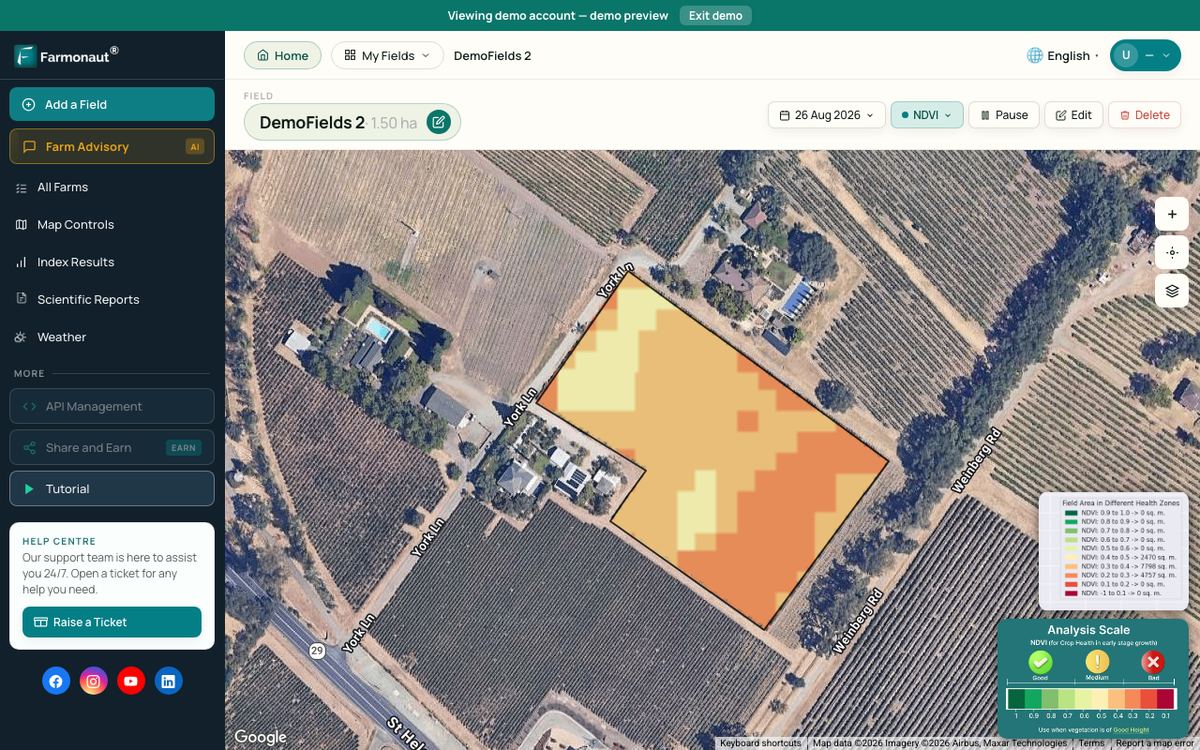
Satellites cannot see a beetle. What they can show is a change in plant vigor across a field or orchard block. Farmonaut Satellite + AI Farm Monitoring System maps vegetation indices for each field through the season, which can help you decide which blocks to scout first. A drop in vigor can have many causes, so always confirm in the field before you spray.
Related pages on our site: web and mobile apps, the satellite data API and API developer docs, the agro admin app for large farms, product traceability, carbon footprinting, fleet management and our guide to cow breeds.

▶ How satellite crop maps can guide organic pest control and where to scout. · 12:30
FAQ
What is the best insecticide for Japanese beetles?
There is no single best one. Kentucky says pyrethroids protect leaves for two to three weeks and carbaryl for one to two weeks. For organic crops, azadirachtin products cut beetle numbers by 77% to 85% at two days in field trials, but the effect fades within days. Choose by crop, bee risk and label.
Do Japanese beetle traps work?
Traps catch many beetles but attract even more. University of Kentucky research found plants near traps can suffer more damage than with no trap. Wisconsin does not recommend them for control. Agencies use traps only to detect and track populations.
When should I spray for Japanese beetles?
Spray when adults are feeding and damage nears your threshold, often from late June into July. In grapes, Maryland uses about 15% of leaves damaged. Spray in the evening to protect bees, and repeat only as the label allows.
Will killing grubs stop the adult beetles?
No. Adults fly in from nearby areas, so grub control in your lawn or field margin will not protect crops from adults. It does protect the turf.
Is Washington still treating for Japanese beetles?
Yes. WSDA runs treatments in Benton, Franklin, King and Yakima counties with owner consent, and a quarantine limits moving plants, soil and yard waste. Check the WSDA page for current dates.
How do I control flea beetles organically?
Use row covers at planting and, if needed, an organic product listed for your crop. In eggplant trials, pyrethrin and spinosad products cut flea beetle numbers by about 77% with weekly sprays. Follow the label and local rules.
Farmonaut crop monitoring
See which blocks to scout first
Draw your fields once and Farmonaut shows satellite vegetation maps for them through the season, on web, Android or iOS.



Sources
- University of Kentucky Entomology, ENTFACT-451 Japanese Beetles in the Urban Landscape (revised 2026): entomology.ca.uky.edu
- University of Wisconsin Horticulture Extension, Japanese Beetle (revised 2026): hort.extension.wisc.edu
- Insects (MDPI), Comparative Efficacy of Common Active Ingredients in Organic Insecticides Against Difficult to Control Insect Pests (2020): pmc.ncbi.nlm.nih.gov
- University of Maryland Extension, Japanese Beetles (grapes): extension.umd.edu
- Washington State Department of Agriculture, Japanese beetle program: agr.wa.gov
- Washington Invasive Species Council, Japanese beetle: invasivespecies.wa.gov
- Canadian Food Inspection Agency, Japanese beetle: inspection.gc.ca
- Minnesota Department of Agriculture, Japanese Beetle: mda.state.mn.us
- Purdue Extension, E-75 Japanese Beetles in the Urban Landscape: extension.entm.purdue.edu
- University of Illinois Extension, Japanese Beetle: extension.illinois.edu
Discussion
Questions, corrections or field experience? Share them below. First-time comments are reviewed before they appear, and your email is never published.
No comments yet. Be the first to add a question or your experience.

 Vestlandsforsking
 Global Launch Base
 Elders
 Agritein
 Delicio
 WB Dev
 Sama Premium
 Prochecker
 Tres Valles
 LACOS Geoinformation
 Magrifly
 LatConnect 60
 WebsEdge
 Blickwinkel
 Agricultural Credit Policy Council
 Marei Nursery
 eKGIS
eKGIS Mostas Tech
 Andex
Andex
 Exploration consultancy · South Africa · Gold
 Licence holder · Niger · Gold
 Licence holder · Nigeria · Gold + lithium










