

Kinsenda Copper Company · Owner and output guide
Kinsenda Copper Company: Owner, Output and Status
Kinsenda Copper Company SA operates an underground copper mine in Haut-Katanga, DRC, owned through Jinchuan Group. It produced 30,483 tonnes of copper in concentrate in 2025 (Jinchuan, April 2026).
Key takeaways
- Owner: Metorex holds 77% of the operator and the DRC state company Sodimico 23% (AidData, February 2025); Jinchuan Group is the ultimate parent.
- Output: 30,483 tonnes of copper in sulphide concentrate in 2025, against 30,498 in 2024 (Jinchuan annual results, April 2026).
- Mid-2026 change: a 5% transfer of KICC shares to the DRC State was approved on 29 June 2026 and was not complete at 30 June 2026 (Jinchuan interim results).
- Ore: AidData gives an average reserve grade of 5.8% copper and a minimum 12-year life; the USGS gives 2.20% to 2.59% for Copperbelt deposits in general.
- Nevada: Pumpkin Hollow is owned by Kinterra’s Southwest Critical Materials, not by Kinsenda’s owners (Nevada Appeal, June 2026).
In this article
- Kinsenda Copper Company at a glance
- Who owns the Kinsenda mine?
- Is the Kinsenda mine operating and how much copper does it produce?
- Where is the Kinsenda mine and how rich is the ore?
- Kinsenda mine timeline from Metorex to Jinchuan
- Where Kinsenda copper goes and what a tonne of concentrate is worth
- Kinsenda against its sister mines Ruashi and Musonoi
- Copper mining industry trends that matter to Kinsenda
- Nevada: what happened to Pumpkin Hollow
- How to check a DRC mining title before you deal
- Where satellite data fits
- Frequently asked questions
Kinsenda Copper Company SA (KICC) runs the Kinsenda underground copper mine in Haut-Katanga, in the south-east of the Democratic Republic of the Congo (DRC). It is an indirect subsidiary of Jinchuan Group International Resources, a Hong Kong-listed company controlled by the Chinese state-owned Jinchuan Group, and the mine produced 30,483 tonnes of copper in sulphide concentrate in 2025, almost the same as the 30,498 tonnes of 2024.
This page answers the questions that licence owners, consultants and investors ask about the company: who owns it, whether the mine is running, how much it makes, how rich the ore is, where the concentrate goes and what changed in mid-2026. Each figure carries its source and date. It also explains how the Nevada mine Pumpkin Hollow relates to Kinsenda, and it ends with a short guide to checking a DRC mining title. A calculator lets you test the value of a copper concentrate with your own numbers.
Kinsenda Copper Company at a glance
The table below collects the facts that other sources repeat most often. A sulphide concentrate is the product of crushing ore and floating the copper minerals away from waste rock; it is a powder that holds far more copper per tonne than the ore it came from.
| Item | Detail | Source and date |
|---|---|---|
| Operator | Kinsenda Copper Company SA (KICC), DRC | Jinchuan annual results, 1 April 2026 |
| Ultimate parent | Jinchuan Group Co., Ltd, a Chinese state-owned enterprise, through Jinchuan Group International Resources (Hong Kong stock code 2362) | Jinchuan interim results, 2026 |
| Shareholders in KICC | Metorex 77%, Sodimico (a DRC state company) 23% | AidData profile, February 2025 |
| Ownership change in progress | 5% of KICC to pass to the DRC State; approved 29 June 2026 but not completed at 30 June 2026 | Jinchuan interim results, 2026 |
| Location | Haut-Katanga, about 90 km south-east of Lubumbashi and within 5 km of the Zambian border | AidData profile, February 2025 |
| Mine type | Underground, with sulphide and oxide ore bodies | AidData profile, February 2025 |
| Output in 2025 | 30,483 tonnes of copper in sulphide concentrate (2024: 30,498) | Jinchuan annual results, 1 April 2026 |
| Output in the first half of 2026 | 14,684 tonnes of copper (first half of 2025: 15,139) | Jinchuan interim results, 2026 |
| Ore reserves | About 0.3 million tonnes of contained copper; average reserve grade 5.8%; minimum 12 years of life | AidData profile, February 2025 |
Who owns the Kinsenda mine?
The mine is held through a chain of companies. At the top is Jinchuan Group Co., Ltd, a state-owned enterprise established in China. Below it sits Jinchuan Group International Resources Co. Ltd, which is incorporated in the Cayman Islands and listed on the Hong Kong exchange under stock code 2362. That company owns Metorex, a South African mining company, and Metorex holds the shares in KICC.
According to AidData’s February 2025 profile, Metorex owns 77% of KICC and Sodimico, the Congolese state mining company, owns the other 23%. Jinchuan took control of Metorex in 2011 and its parent company took the whole indirect interest in 2013. KICC is the operating company, so a contract for the mine is signed with KICC, not with Jinchuan directly.
The 5% transfer to the DRC State
Jinchuan’s interim report for the six months to 30 June 2026 records a change that older web pages do not mention. On 29 June 2026 the company said that the transfer of 5% of Kinsenda’s shares to the DRC State, at no charge, had been approved. The transfer is required by the DRC Mining Code (revised in 2018) in connection with the renewal of the mine’s permit. It was not complete at 30 June 2026 because the articles of association still had to be amended. When it completes, Jinchuan’s effective interest in Kinsenda falls from 77% to 72%.
Jinchuan is a listed group and Kinsenda itself has no shares on any exchange. Anyone who wants exposure to the mine would have to buy the parent’s shares, which also carry the Ruashi and Musonoi mines, so this page gives no view on that.
Is the Kinsenda mine operating and how much copper does it produce?
Yes. Jinchuan’s results show steady output in the years shown below. The chart uses the company’s reported copper content in sulphide concentrate, which is the metal inside the concentrate, not the weight of the powder itself. The 2022 figure comes from the AidData profile. There is no 2023 bar because the group’s 2023 operational update gives only group totals, not Kinsenda alone. The mine ran above its original estimate of about 20,000 tonnes a year.
Chart
Kinsenda copper in concentrate, by year
tonnes of contained copper in sulphide concentrate
In 2025 the mine sold 31,216 tonnes of copper, 4% more than the 30,094 tonnes sold in 2024, because the company ran down copper that had been stored as stock. It also reported higher ore-mining costs at Kinsenda in 2025 because mining had moved deeper underground.
The first half of 2026 was slightly weaker. Kinsenda made 14,684 tonnes of copper against 15,139 tonnes a year earlier, a fall of 3%. The company attributes it to a transformer failure that caused a power outage; the mine had to run extra diesel generators to keep mining and pumping water. Power is a recurring problem across the group’s DRC mines: the Ruashi mine suspended part of its plant in 2025 after unstable grid supply.
Where is the Kinsenda mine and how rich is the ore?
Kinsenda lies in Haut-Katanga. The DRC changed the mine’s provincial address from Katanga Province to Haut-Katanga in 2015, so older pages that say Katanga Province are out of date. It is about 90 km south-east of Lubumbashi, near the border town of Kasumbalesa and within 5 km of Zambia. A paved road links it to the Lubumbashi to Kasumbalesa highway, and there is a dirt airstrip on site, says the same AidData profile.
Chart
Kinsenda reserve grade against reference grades
% copper
Geologically the mine sits in the Central African Copperbelt, the belt of copper and cobalt deposits that straddles the DRC and Zambia. The USGS deposit model for sediment-hosted copper gives average grades for Copperbelt deposits of 2.59% copper for reduced-facies types and 2.20% for sandstone types. Grade means the share of the rock that is metal: a 5% ore carries 5 kg of copper in every 100 kg of rock. AidData puts the average Kinsenda reserve grade at 5.8%, which it describes as the second highest of any active underground copper mine, and says the average grade of copper reserves worldwide is about 0.6%.
A reserve is the part of a deposit that can be mined at a profit under current conditions. AidData lists about 0.3 million tonnes of copper in Kinsenda’s reserves and a minimum life of 12 years. In 2022 the mine began a second decline, a sloping tunnel, to reach a deposit called East Mine, and capital spending that year was US$16.4 million. Some experts cited in the profile expect new deposits to add up to 20 years of life; that remains an expectation, not a reserve.

▶ A Farmonaut video on the DRC’s copper wealth and where its deposits sit. · 13:34
Kinsenda mine timeline from Metorex to Jinchuan
The site has a long and confused ownership history. The dates below come from AidData’s profile unless noted.
| Date | Event |
|---|---|
| 2003 | Sodimico and the Belgian group Malta Forrest form Miniere de Musoshi et Kinsenda SARL to develop the mine |
| August 2007 | Metorex buys a minority stake; it becomes majority holder by March 2009 |
| July 2009 | Metorex and Sodimico form KICC, which replaces the earlier company as operator |
| 2011 | Jinchuan Group takes control of Metorex |
| March to July 2013 | Metorex’s board approves development; construction of underground access and the processing plant starts, with DRA Global as contractor |
| May 2014 | China Development Bank lends US$225 million to KICC for 12 years, guaranteed by Jinchuan |
| 2021 | Main mining licence renewed for 15 years, says AidData |
| 2022 | Mine produces 29,087 tonnes of copper; second decline to East Mine begins |
| 29 June 2026 | 5% transfer of KICC shares to the DRC State approved; not yet complete at 30 June 2026 |
Long lead times are normal for copper. A World Bank working paper from September 2016 found that copper discoveries took 17 years on average to reach production, against 10 years for gold. Kinsenda is an extreme case: AidData says the site has been worked in some capacity since the 1970s.
AidData counts US$526 million of China Development Bank credit between 2013 and 2022 that directly or indirectly supported the mine, in constant 2021 prices. The profile adds that it found few reports linking Kinsenda to environmental or social disputes, and that the company signed development agreements with three local communities in March 2022. The mine employs more than 1,500 staff drawn from nearby communities.
Where Kinsenda copper goes and what a tonne of concentrate is worth
AidData reports that the mine ships sulphide concentrate to Zambia and sends oxide concentrate to Metorex’s Ruashi plant near Lubumbashi for processing. A concentrate is not sold at the copper price on the screen. The smelter pays only for a payable share of the metal, set in the contract, and charges treatment and refining charges (TC/RC) per tonne. The group’s 2025 results show a gap between headline and realised prices: the average LME copper price for 2025 was US$9,939 per tonne, while Jinchuan’s average realised price was US$8,374. The group sells cathode as well as concentrate, so the gap is not all concentrate terms, but it shows why a payable-share input matters.
The calculator turns ore into payable copper and revenue. The grade, recovery, payable share and deductions are examples that you replace with your own assay and contract terms; they are not Kinsenda’s figures.
Calculator
What is a year of copper ore worth after the smelter?
Enter your own ore, grade, recovery and contract terms. Results update as you type.
- Copper contained in the ore (tonnes): 5,500
- Copper in concentrate (tonnes): 4,950
- Gross revenue (US$): $47,520,000
- Revenue after deductions (US$): $40,392,000
Example values only, not Kinsenda’s figures and not benchmarks. The copper price is an input: use today’s price. Recovery is the share of copper in the ore that ends up in concentrate; payable is the share of that metal the smelter pays for; deductions stand for treatment charges, freight and royalties as a share of revenue. Money is in US$.
Kinsenda against its sister mines Ruashi and Musonoi
Jinchuan’s DRC mining arm has three producing mines. In 2025 the group made 61,867 tonnes of copper, of which Kinsenda supplied 30,483 tonnes, Ruashi 26,343 and Musonoi, which started commercial production in November 2025, 5,041. Kinsenda was therefore about half of the group’s copper that year. In the first half of 2026 the picture changed because Musonoi made 17,046 tonnes of copper cathode, while Ruashi fell by almost half as its ore grades declined and power stayed unstable.
Chart
Copper made at Jinchuan’s DRC mines, first half
tonnes of contained copper
The group produced 38,214 tonnes of copper in the first half of 2026 against 27,904 tonnes a year earlier, a rise of about 37%, according to the interim report. Kinsenda is the steady performer in that mix: it moved by only 3%, while its sister mines moved by far more.
Copper mining industry trends that matter to Kinsenda
Four trends show up in the filings and in market data, and each hits a mine like Kinsenda in a specific way.
Chart
Average LME copper price
US$ per tonne, annual average
- High prices. The LME copper price closed at US$14,436 per tonne on 14 October 2026, within about 3% of the record set in September, says the International Copper Association Australia. Jinchuan’s own results show the LME average rose from US$8,483 per tonne in 2023 to US$9,145 in 2024 and US$9,939 in 2025.
- Tight concentrate supply. The same weekly brief reports that the 2026 benchmark for treatment and refining charges, the fee a smelter takes per tonne of concentrate, settled at zero, and that concentrate terms are at record lows. Kinsenda sells concentrate.
- Power. Kinsenda’s first-half 2026 dip came from a transformer failure, and Ruashi’s 2025 suspension followed unstable grid supply. Both mines have added diesel generators.
- Deeper mines. Moving down a decline raises cost per tonne, as Jinchuan’s 2025 results show for Kinsenda.
At country level, the USGS Mineral Commodity Summaries 2026 estimate that the DRC mined 3.2 million tonnes of copper in 2025, up from 2.99 million in 2024. The world total was about 23 million tonnes, so the DRC supplied roughly 14%, second only to Chile at 5.3 million tonnes. Kinsenda’s 30,000 tonnes is under 1% of the DRC total.
▶ Explains why electric cars need more copper than petrol cars and where much of it is mined. · 6:03
Nevada: what happened to Pumpkin Hollow
Kinsenda is often searched together with a Nevada copper company, but the two have no ownership link. The Nevada mine is Pumpkin Hollow, seven miles south-east of Yerington in Lyon County, and our longer guide to the Pumpkin Hollow copper mine covers it in detail.
The short version, per the Nevada Appeal of 14 June 2026: Nevada Copper Corp. filed for Chapter 11 bankruptcy protection in June 2024 after flooding and financing problems in the underground mine, and Kinterra Capital bought the site in October 2024 for US$128 million. Kinterra’s subsidiary Southwest Critical Materials is now preparing a restart. In November 2025 the company announced a non-binding letter of interest for up to US$200 million from the US Export-Import Bank, and it says it expects a producing underground mine within 24 months. It estimates initial output at about 228 million pounds of copper a year, around 103,000 tonnes, which is more than three times Kinsenda’s output. Those are company targets, not production.
How to check a DRC mining title before you deal
If you are a consultant or buyer looking at a DRC copper project, five checks cost little and avoid common mistakes.
- Find the licence in the cadastre. Congo’s mining cadastre agency, CAMI, runs a public map portal where licence data can be viewed on a map; Spatial Dimension, the software supplier, describes it as a public portal for stakeholder access. See also our guide to mining cadastre portals by country.
- Match the holder to the seller. A mine may be operated by one company and owned by another; Kinsenda is a good example, with the operator KICC owned 77% by Metorex.
- Check the permit type and dates. Exploration, exploitation and small-scale permits carry different rights and renewal terms.
- Ask about state participation. The 5% share transfer at Kinsenda shows that a renewal can change the cap table.
- Confirm the neighbouring border. Zambia has its own cadastre; see our guide to the Zambia mining cadastre if the licence sits near the line.
For geology, our guide to copper deposit types and where to explore explains the sediment-hosted and porphyry types, and the porphyry copper guide covers the largest class of copper mines.
Where satellite data fits
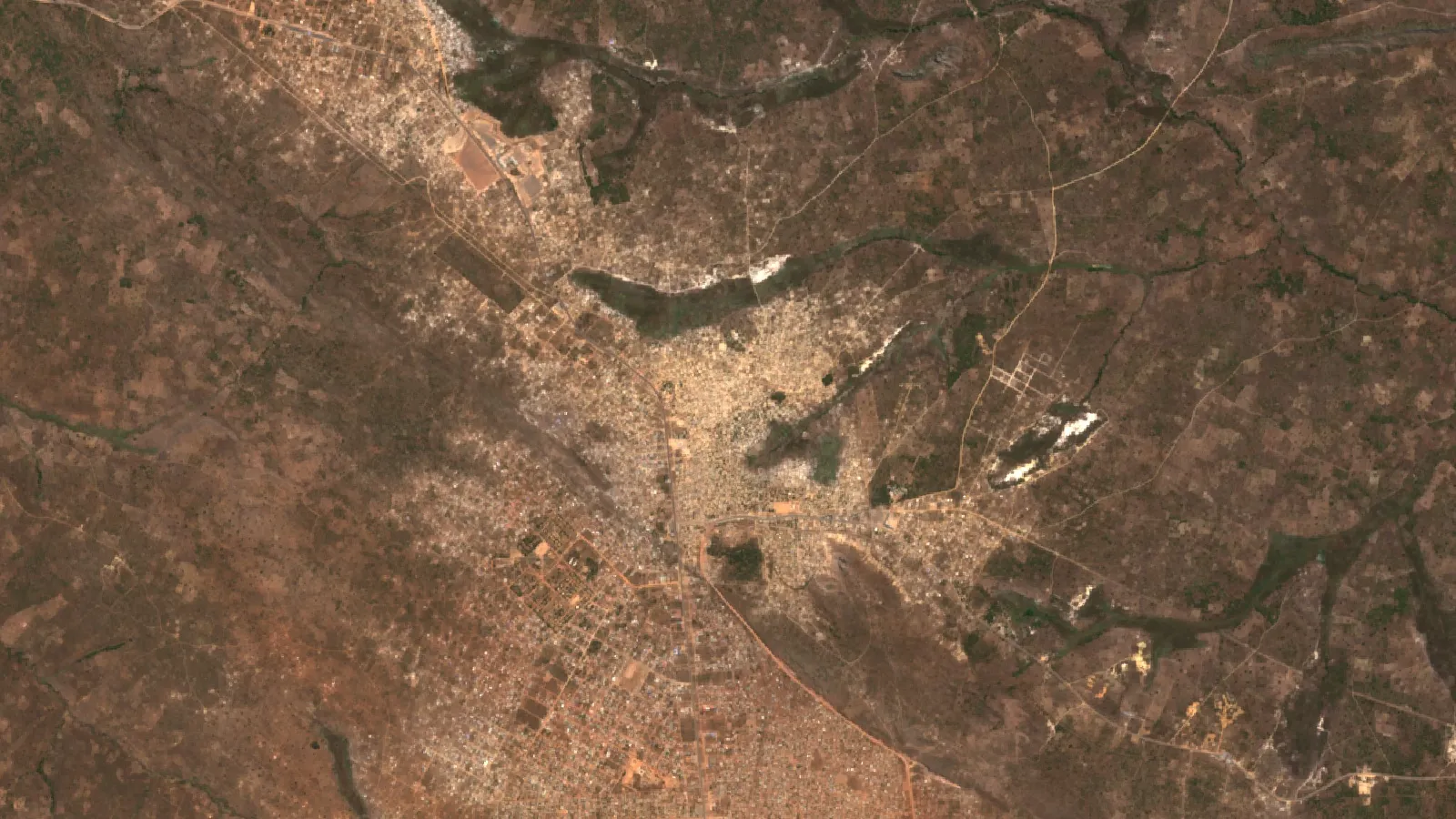
A company deciding where to drill near a producing mine usually starts with maps of rock type, alteration and surface change. Farmonaut screens a licence area from satellite images and returns exploration targets that sit ahead of any resource estimate. The hero image at the top of this page was built the same way, from a Sentinel-2 summer composite centred on the mine. Satellite results do not replace drilling or a mineral resource report.
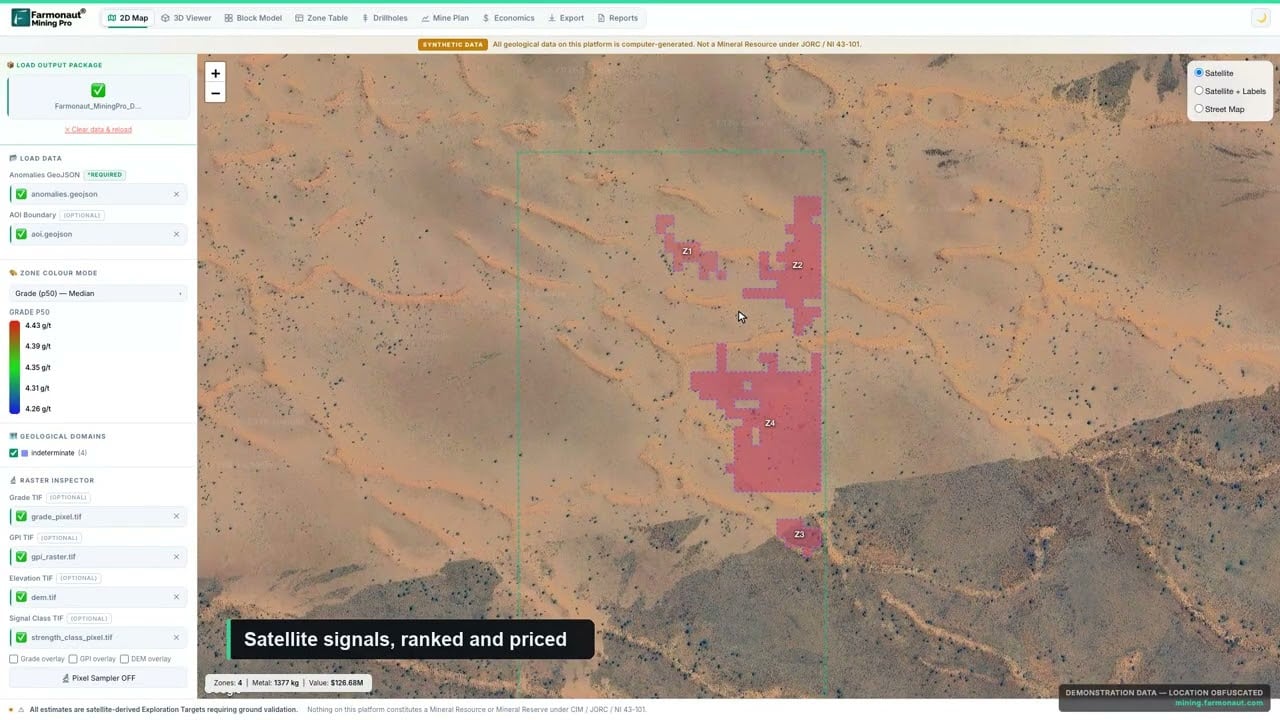
▶ A short look at Farmonaut Mining Pro, which turns a licence boundary into a geological and economic picture. · 4:56
For a closer look at a related question, see our guide: Pumpkin Hollow Mine: Owner, Status and Restart Facts.
If this topic matters to you, read Florida Canyon Mine, Nevada: Owner, Output, Reserves next.
Frequently asked questions
Who owns Kinsenda Copper Company?
Metorex, an indirect subsidiary of Jinchuan Group International Resources, owns 77% and Sodimico, a DRC state company, owns 23%, per AidData’s February 2025 profile. A transfer of 5% to the DRC State was approved on 29 June 2026 and had not completed by 30 June 2026.
Where is the Kinsenda mine?
In Haut-Katanga, DRC, about 90 km south-east of Lubumbashi and within 5 km of the Zambian border, near the town of Kasumbalesa.
Is the Kinsenda mine still operating?
Yes. It produced 30,483 tonnes of copper in sulphide concentrate in 2025 and 14,684 tonnes in the first half of 2026, according to Jinchuan’s results.
How much copper does Kinsenda produce per year?
About 30,000 tonnes of contained copper: 29,087 tonnes in 2022, 30,498 in 2024 and 30,483 in 2025.
Is Kinsenda an open-pit or underground mine?
Underground. It is reached by declines, sloping tunnels, and the company has deepened its workings, which raised ore-mining costs in 2025.
What is the ore grade at Kinsenda?
AidData reports an average reserve grade of 5.8% copper. The USGS gives 2.20% to 2.59% as typical averages for Central African Copperbelt deposits.
Where does Kinsenda’s copper concentrate go?
Sulphide concentrate goes to Zambia and oxide concentrate goes to the Ruashi plant, according to AidData’s profile.
How much copper is left at Kinsenda?
AidData lists about 0.3 million tonnes of copper in reserves and a minimum mine life of 12 years. A second decline to the East Mine deposit started in 2022 and may extend that life.
Can I buy shares in Kinsenda?
Kinsenda itself is not listed. Its parent, Jinchuan Group International Resources, trades in Hong Kong under stock code 2362, with other mines in its portfolio. This is not investment advice.
Is Kinsenda connected to Nevada Copper or Pumpkin Hollow?
No. Pumpkin Hollow in Nevada is owned by Kinterra’s subsidiary Southwest Critical Materials, which bought it from Nevada Copper Corp. in October 2024. Kinsenda is held through Jinchuan’s DRC subsidiaries.
What is Sodimico?
Sodimico is a Congolese state-owned mining company. It formed KICC with Metorex in 2009 and holds the 23% minority stake in the operator.
This page is for information only. It is not investment advice or legal advice. Company and licence details change; confirm them with filings and the DRC mining cadastre.
Farmonaut mining
Map your mining site from space
Send a KML, KMZ or polygon and Farmonaut screens the area from satellite images before ground crews go in.

Mining Pro sample view, synthetic data
Keep reading
Sources
- AidData, Kinsenda Copper Mine: Chinese Financing for Transition Minerals (February 2025): docs.aiddata.org
- Jinchuan Group International Resources, announcement of 2025 annual results (1 April 2026): hkexnews.hk
- Jinchuan Group International Resources, announcement of interim results for the six months ended 30 June 2026: api.aconnect.com.hk
- USGS, Mineral Commodity Summaries 2026: Copper (February 2026): pubs.usgs.gov
- USGS, Sediment-Hosted Stratabound Copper Deposit Model, SIR 2010-5070-M: pubs.usgs.gov
- Nevada Appeal / NNBW, Yerington copper mine to reopen (14 June 2026): nevadaappeal.com
- Kinterra Capital, EXIM letter of interest for Pumpkin Hollow restart (4 November 2025): prnewswire.com
- International Copper Association Australia, Copper Weekly Brief (15 October 2026): copper.com.au
- Spatial Dimension, DRC Mining Cadastre (CAMI) project: spatialdimension.com
- CAMI, DRC mining cadastre map portal: drclicences.cami.cd
- World Bank, From Commodity Discovery to Production, Policy Research Working Paper 7823 (September 2016): documents1.worldbank.org
Discussion
Questions, corrections or field experience? Share them below. First-time comments are reviewed before they appear, and your email is never published.
No comments yet. Be the first to add a question or your experience.

 Sania Corporation
 Sean Mining Limited
 NTS Group (Pty) Ltd
 Mine4Africa
 Lithspo Minerals Limited
 Tintina Mining Group
 Dalgety Minerals Pty Ltd
 Vortex Minerals Pty Ltd
 Faith At Work (Pty) Ltd
 Geotech Mining Solutions plc
 Vulcan International Limited
 Kidepo Associates
 GKY Mining
 Alkimy SARL
 Double A Trading
 GemSprout Metals Limited
 Qader Group
 Ileys General Trading
 SG Gold Mining LLC
 VRV Global Pte Ltd
 Omsri International FZE
 G.I.T.T.
 Jaunita Erss Ltd
 SRK Consulting











