

Mealybug control · Practical guide
Neem Oil for Mealybugs: What It Does, What It Does Not, and How to Use It
Neem oil suppresses young mealybugs it touches, but it is no knockdown cure. Wax, hidden egg sacs and weak drench results mean you need repeat sprays and other controls. Follow the product label and local rules.
Key takeaways
- Neem oil only suppresses mealybugs. UC IPM says it works best on younger nymphs, because the waxy coat repels most contact sprays (UC IPM, 2016).
- In one lab test on cotton mealybug, neem oil killed 56% at 1%, 74% at 2% and 88% at 3% after a week (Badshah et al., 2015). These are lab strengths, not spray rates, so follow the product label.
- Soil drenches work poorly. In 11 greenhouse trials, citrus mealybug mortality stayed under 50% for almost every drench of six products, including azadirachtin (a neem-derived product, not neem oil itself) (Herrick et al., 2018).
- Heat speeds up the cycle: a female needed 73 days from egg to adult at 15 °C and 28 days at 25 °C (Al-Shammari and Al-Zubaidy, 2017), so plan a series of sprays.
- Do not spray in heat above 90 °F or on stressed plants. One EPA-registered label sets that limit, so follow the product label.
In this article
- Introduction: Mealybug Infestations and What Neem Oil Can Do
- Does neem oil kill mealybugs?
- Understanding Mealybugs: Identification, Habits, and Threat to Plant Health
- Neem Oil for Mealybugs: Composition, Mechanism, and Properties
- Advantages & Environmental Safety of Neem Oil Applications
- Potential Drawbacks & Safety Precautions When Using Neem Oil for Mealybug Control
- How to Use Neem Oil Against Mealybugs: Options and Limits
- Integrated Pest Management for Mealybugs: Complementary Measures
- Neem oil compared with other mealybug treatments
- Precision Plant Health & Pest Monitoring with Farmonaut
- Frequently Asked Questions (FAQ) – Neem Oil for Mealybugs
- Conclusion: What Neem Oil Can and Cannot Do Against Mealybugs
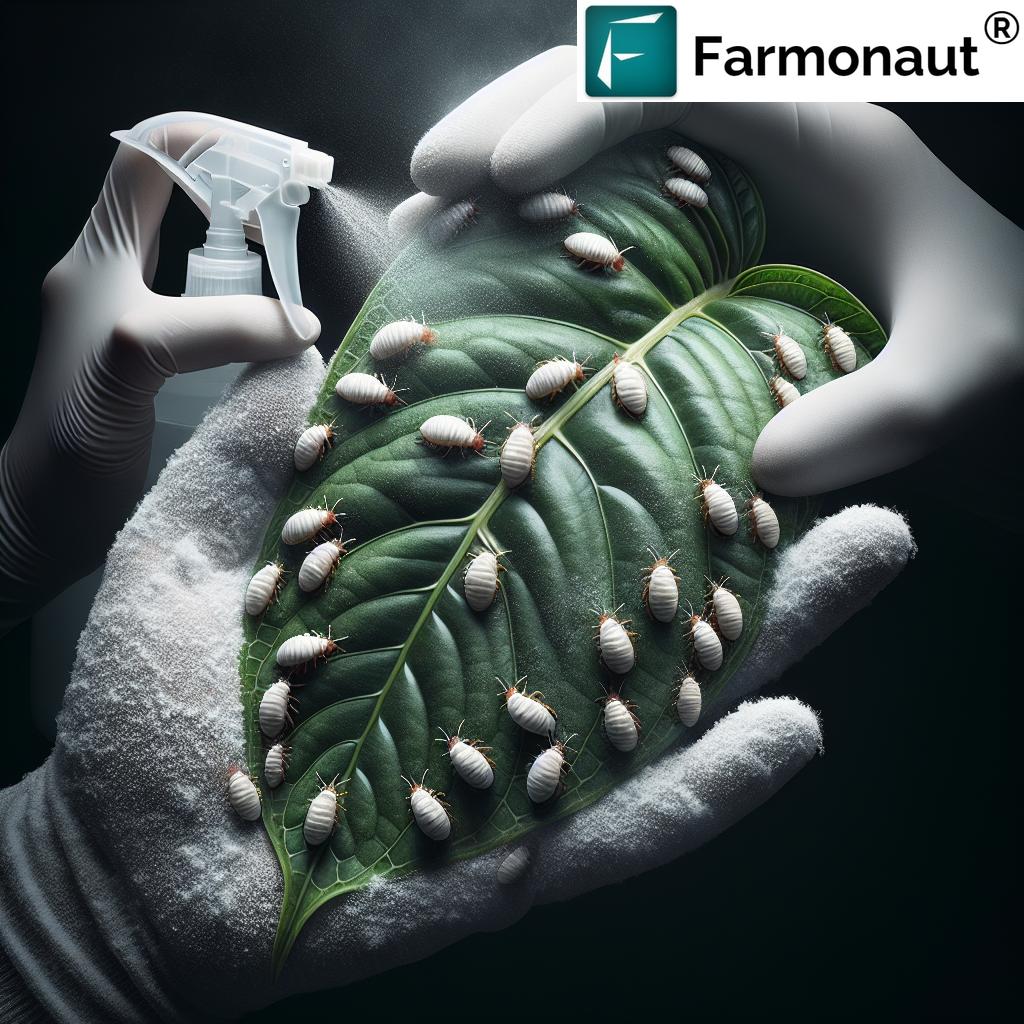
Introduction: Mealybug Infestations and What Neem Oil Can Do
Mealybugs are notorious plant pests capable of causing significant havoc in both ornamental houseplants and vital agricultural crops. As members of the Pseudococcidae family, these sap-sucking insects exploit vulnerable areas such as leaf axils, leaf undersides, and stems, extracting essential nutrients and disrupting plant growth. Left unchecked, a mealybug infestation often results in stunted growth, leaf yellowing, and in severe cases, plant death.
With increasing concern over the negative impacts of chemical pesticides on health and the environment, natural pest control for houseplants and crops is more important than ever. Neem oil is widely used as a botanical option for managing mealybug infestations. In this comprehensive guide, we describe the methods people use with neem oil against mealybugs, rate how well the evidence supports each, review the advantages and precautions, and explain how to fit neem oil into a broader integrated pest management for mealybugs program.
Does neem oil kill mealybugs?
Partly. Neem oil kills or suppresses mealybugs it coats directly, and it works best on young crawlers and nymphs that have not built up much wax. The University of California’s UC IPM pest note says neem oil, horticultural oils and insecticidal soaps sprayed directly on mealybugs “can provide some suppression, especially against younger nymphs”. It also warns that the insects’ waxy coating repels most contact insecticides.
Chart
In one greenhouse test, soap and oil killed few clustered mealybugs
% of 3rd and 4th instar clustering mealybugs killed in one related greenhouse test (soap and oil at 2%, limonene mix at 1%)
Chart
Neem oil kill rises with strength in the lab
% of cotton mealybugs dead after one week, laboratory test of neem oil at three strengths
Azadirachtin, the main active compound, reduces feeding and interferes with insect hormones so they struggle to grow and lay eggs. Other components of neem oil also hinder feeding, and the exact role of each is not known, according to the National Pesticide Information Center. Expect gradual suppression, not a knockdown in a day. The lab test cited below counted dead insects after one week.
What this means in practice:
- Spray to wet the insects themselves, including leaf axils, stem joints and the undersides of leaves.
- Repeat, because eggs inside cottony sacs are protected and hatch later.
- Dab visible mealybugs with a cotton swab dipped in rubbing alcohol.
- Test on a few leaves first and spray in the early morning or late evening, as the label says, to limit leaf burn.
- For heavy infestations on a single houseplant, cutting out the worst stems or discarding the plant is often faster than repeated treatment.
Numbers help here. In a laboratory test on the cotton mealybug (a different species), neem oil killed 56% at 1% strength, 74% at 2% and 88% at 3% after one week (Badshah and colleagues, 2015). In that test, neem oil itself killed at most 88%. The same record reports 100% kill for a neem seed extract made with the solvent n-hexane at 3%, but that is a lab extract, not a neem oil product. These lab strengths are not application rates. Never exceed the label rate: the EPA-registered label we checked allows 0.625 to 1.25% for normal pest pressure and 1.8% for heavy infestations, and stronger mixes can burn leaves. Follow the product label and local rules.
Contact sprays tell a similar story. In greenhouse tests of 2% insecticidal soap and 2% horticultural oil, 89% and 88% of green scale on potted gardenia died. In a related test, only 22.7% and 12.5% of clustering third and fourth instar mealybugs died. In the same paper, a full-strength limonene mix controlled 69 to 100% of mealybugs and scales (Hollingsworth, 2005). Neem oil was not part of that test, but UC IPM says the wax repels most contact insecticides.
Understanding Mealybugs: Identification, Habits, and Threat to Plant Health
Let’s deepen our understanding of the enemy: mealybugs. Recognizing their habits and biology is key to knowing how to control mealybugs on plants effectively.
Chart
Mealybugs develop faster in warmth
Days (egg to adult; nymph stages counted from hatching), citrus mealybug on sprouted potato, laboratory study at four constant temperatures
What Are Mealybugs? Morphology & Life Cycle
- Taxonomy: Belong to the Pseudococcidae family.
- Appearance: Characterized by soft bodies, covered in a white, powdery wax resembling fine cotton.
- Hiding Habits: Typically congregate in hidden plant areas: leaf axils, undersides of leaves, along stems, roots, and sometimes in soil.
- Feeding Habits: Use piercing-sucking mouthparts to extract plant juices (sap), depriving plants of essential nutrients. This weakens plants, commonly causing stunted growth, leaf yellowing, leaf drop, and even death if left unchecked.
- Honeydew & Sooty Mold: Excrete a sticky substance called honeydew. This attracts ants and promotes sooty mold (a fungal growth), which blocks photosynthesis and further compromises plant health.
- Life Cycle: Eggs → Crawlers (nymphs) → Juveniles → Adults.
- Females lay eggs in cottony masses hidden in protected crevices.
- Crawlers spread rapidly across plants in search of feeding sites.
- Damage Potential: High populations can devastate ornamental, houseplants, and agricultural crops such as citrus, grapes, cotton, and vegetables.
Early Signs of Mealybug Infestations
- Clumps of white, waxy cotton substance on leaf joints and stems
- Sticky leaves or surfaces beneath plants (due to honeydew)
- Presence of ants farming mealybugs for honeydew
- Leaf yellowing, curling, stunted shoots, or sudden wilting
- Appearance of blackish sooty mold
By routinely inspecting our plants, especially leaf undersides and hard-to-see crevices, we can detect mealybugs early and implement organic solutions for plant pests before damage escalates.
UC IPM says most species lay 100 to 200 or more eggs in cottony sacs over 10 to 20 days, and a species has two to six generations a year. The longtailed mealybug is the exception: its eggs hatch inside the female, so it leaves no egg sacs (UC IPM, 2016). Speed depends on heat. In a laboratory study of the citrus mealybug on sprouted potatoes, a female took 73 days from egg to adult at 15 °C and 28 days at 25 °C. The insect stopped developing at 35 °C. The same study estimated a growth threshold near 7 °C and a need for about 526 degree-days from egg to adult (Al-Shammari and Al-Zubaidy, 2017).
What this means for timing: in this lab study one generation took about 4 to 6 weeks at 20 to 25 °C (40 days at 20 °C, 28 days at 25 °C), and the egg stage alone took about 5 to 15 days depending on temperature. One spray cannot reach eggs that are still in their sacs, so a short series of sprays is the usual plan. These are results for one species under lab conditions. Other species and plants differ.
Neem Oil for Mealybugs: Composition, Mechanism, and Properties
Neem oil, derived from Azadirachta indica (the neem tree), is a cornerstone of natural pest control for houseplants and crops worldwide. Here’s what makes neem oil so unique in the battle against mealybugs, and how its bioactive compounds disrupt pest life cycles while supporting plant health.
Neem Oil Composition: Bioactive Compounds & Key Ingredients
- Origin: Extracted from the seeds of the neem tree, native to South Asia but cultivated globally.
- Primary Active Ingredient: Azadirachtin—a powerful botanical insecticidal compound
- Other Components: Nimbin, salannin, various fatty acids, and limonoids
- Properties: Insecticide and repellent. Some neem labels also list disease control
How Neem Oil Works: Mechanism of Action Against Mealybugs
- Disrupts Feeding & Digestion: The unique compounds in neem oil reduce feeding. The exact role of each neem compound is not fully known.
- Interrupts Growth & Molting: Azadirachtin interferes with insect hormones, so insects struggle to grow and lay eggs.
- Slows Reproduction: Reduces fecundity, making it harder for infestations to multiply.
- Repellency: NPIC lists azadirachtin as a repellent for insects in general. No source checked shows that it keeps mealybugs off plants.
- Sooty Mold: Sooty mold grows on honeydew, so the lasting fix is to control the mealybugs that make it.
- Soil Drench: In greenhouse trials, growing-medium drenches of azadirachtin (a neem-derived product, not neem oil itself) and five other products gave under 50% mortality of citrus mealybugs in nearly every case, so do not rely on a drench.
Advantages & Environmental Safety of Neem Oil Applications
Neem oil gives some suppression of mealybugs, mainly younger nymphs, and the insects’ wax repels most contact sprays, according to UC IPM. Its main advantage is low toxicity to people, mammals and birds, and it is practically non-toxic to bees when sprayed while they are inactive.
Chart
Azadirachtin breaks down in hours to weeks
Half-life in hours, low and high values reported (24 hours = 1 day). Water low value: 48 minutes (0.8 hours). Soil high value: 44 days (1,056 hours)
What Neem Oil Offers for Mealybug Control
- Best on Young Stages: Neem and azadirachtin work mainly on young nymphs and crawlers and must touch the insect. Eggs inside sacs and waxy adults are harder to reach.
- Environmental Safety: Neem oil is practically non-toxic to birds, mammals and bees, but slightly toxic to fish and can irritate eyes and skin, per the National Pesticide Information Center. Keep it out of ponds and drains.
- Broad Spectrum Utility: Labels list many pests, such as aphids, spider mites and whiteflies, and some also list fungal diseases.
- Soil Drenching: Not recommended against mealybugs, because drench trials gave poor control.
- Breaks Down: Azadirachtin has a half-life of 1 to 2.5 days on leaves, 3 to 44 days in soil and 48 minutes to 4 days in water.
- Food Crops: The label sets the days to wait before harvest. Whether a neem product is allowed in certified organic production depends on the product and your certifier.
Neem oil is still a pesticide. It is slightly toxic to fish, and a wet spray can harm beneficial insects it coats. Follow the product label and local rules.
Neem Oil Compared with Conventional Insecticides
- Short Residue: Azadirachtin breaks down fast on leaves, but follow the product label for the days to wait before harvest.
- Supports Integrated Pest Management (IPM): Can be combined with cultural, biological, and mechanical controls for lasting mealybug management.
- Resistance: UC nursery guidelines advise rotating products with different mode-of-action groups. They list neem oil as unclassified (UNE), so there is no neem-specific rotation rule.
Low toxicity is not the same as no risk. The National Pesticide Information Center lists neem oil as slightly toxic to fish, and azadirachtin as moderately toxic to fish (NPIC, reviewed 2012). Oil sprays kill the beneficial insects they coat while wet, and once dry the residue has little toxic effect (UConn Extension). In one laboratory test, a parasitic wasp of the cotton mealybug was slightly toxic after 24 hours on neem, and the authors suggested releasing it at least a week after spraying (Badshah and colleagues, 2017). In the one lab test cited here that included a conventional insecticide (Confidor 20% SL), the insecticide killed every cotton mealybug within 48 hours, while neem oil reached 88% at 3% after a week (Badshah and colleagues, 2015). Our sources do not rank neem oil against conventional insecticides for mealybugs in the field, and the ratings in the comparison table below differ by source.
Potential Drawbacks & Safety Precautions When Using Neem Oil for Mealybug Control
Neem oil is low in toxicity to people and mammals, but it only suppresses mealybugs, so it’s important to be aware of its potential drawbacks and follow best application practices to protect plant health.
Known Limitations
- Plant Sensitivity & Phytotoxicity: Some sensitive or stressed plants may experience leaf burn, damage, or discoloration after application. Patch test a small section before broader use.
- Repeated Applications Needed: Severe mealybug infestations require several treatments, usually about every 7 to 14 days for sprays (one EPA-registered neem label says every 7 to 10 days, so follow your product label).
- Strong Odor: Neem oil possesses a distinct, pungent smell which can be unpleasant indoors.
- UV Breakdown: Neem oil’s active ingredients degrade quickly in direct sunlight. It’s best to apply in the early morning or late evening, as the label says, to limit leaf burn.
- Direct Harm to Beneficials During Spraying: Freshly sprayed neem oil can harm beneficial insects (bees, ladybugs) if contacted directly. Apply in the early morning or late evening, when bees are inactive, and avoid spraying flowers directly.
Essential Safety Precautions
- Always dilute neem oil as the product label says, and wear gloves and eye protection as the label directs. NPIC says neem oil can irritate eyes and skin.
- Never apply to wilted, drought-stressed, or freshly transplanted plants.
- Patch test: Spray a small leaf section and wait one to two days for signs of sensitivity before broad application.
- Keep neem products and spray solutions away from children and pets during application.
- Store neem oil as the product label directs.
Temperature and plant limits come from the label. One EPA-registered neem oil concentrate label (EPA Reg. No. 88760-15, issued 2024) says not to spray when hot and humid conditions exceed 90 °F (32 °C), to spray in the early morning or late evening, and not to treat wilted or stressed plants. It names poinsettia, impatiens, hibiscus flowers, some carnations and roses, ornamental olive and comice pear as sensitive plants. It bans sulfur sprays within 14 days of a neem application. UConn Extension adds that oil sprays should not go on below 40 °F because the emulsion breaks down, and that drought-stressed plants can get marginal leaf burn (UConn Extension). Other labels differ, so follow the product label and local rules.
How to Use Neem Oil Against Mealybugs: Options and Limits
People apply neem oil in several ways, and the evidence behind them is uneven. Sprays have the most support. Drenches, root pours, alcohol mixes and soap mixes have little or none, so each method below says how well it is supported. Follow the product label and local rules for every method.
Infographic
A neem oil spray series in 5 steps
- 1Confirm the pestLook for white wax, sticky honeydew and egg sacs on leaf joints and undersides.
- 2Remove what you canDab mealybugs with 70% or weaker alcohol on a swab, or prune the worst stems.
- 3Test a few leavesSpray a small area and check for leaf burn after one to two days.
- 4Spray in cool weatherWet the insects in the early morning or late evening, below 90 °F, as the label says.
- 5Repeat and re-checkSpray again at the label interval and inspect the plant each week.
1. Classic Neem Oil Foliar Spray
- Preparation: Follow the product label for the rate. As an example only, 1 teaspoon per quart is about 5 mL per litre (0.5% by volume), below the 0.625% to 1.25% foliar insect rate in the agricultural-use section of one EPA-registered neem label (that label allows 1.8% for heavy infestations). Add a few drops of mild liquid soap only if the label calls for an emulsifier.
- Application: Spray thoroughly, covering all plant parts—especially under leaves, leaf axils, and stems where mealybugs cluster.
- Frequency: Apply about every 7 to 14 days, or as the label says, until the infestation subsides. Follow the product label for any repeat after that.
- Best Practice Tip: Always shake the solution before spraying to keep neem evenly suspended in water.
2. Soil Drench with Neem Products (Weak Evidence)
- Preparation: Dilute the product in water at the rate on its label, and add soap only if the label calls for it.
- Application: Pour around the plant base. The evidence for this method is weak, and it comes from azadirachtin drenches (a neem-derived product, not neem oil itself), not from neem oil. In Kansas State greenhouse trials, drenches of azadirachtin and five other products gave under 50% mortality of citrus mealybugs in nearly every case. Ground mealybugs on roots are hard to control, so UC IPM stresses prevention and removing infested plants.
- Frequency: No proven interval exists, so follow the product label if you try a drench.
3. Targeted Spot Treatment with Cotton Swabs
- Preparation: Dip cotton swabs in a 70% or weaker isopropyl (rubbing) alcohol solution, as UC IPM advises, or in your diluted neem spray. Undiluted neem oil can burn leaves.
- Application: Dab directly onto visible mealybugs and egg sacs on leaves, stems, and leaf undersides. Ideal for minor or early infestations.
- Frequency: Repeat as needed while mealybugs remain, and check the plant every week.
4. Neem Oil with Rubbing Alcohol Spray (Not Recommended)
- Preparation: Not recommended. Some growers add rubbing alcohol to the neem spray, but no extension source we checked tests this mix, and alcohol plus oil on leaves may burn them.
- Application: Instead of a mix, UC IPM suggests 10 to 25% isopropyl alcohol alone in a spray bottle for extensive infestations, repeated weekly. Colorado State gives a stronger 25 to 50% range. Test a few leaves first.
- Caution: Test before wide use: Some plants are alcohol-sensitive, and this method is not for routine long-term treatment.
5. Neem Oil and Horticultural Soap Combo (Not Tested)
- Preparation: Only mix products if both labels allow it. Do a jar compatibility test and a small spray test first, because mixes can damage leaves.
- Application: No source we checked tested a neem and soap mix on mealybugs. Soap alone killed 22.7% of clustered mealybugs in one greenhouse test (Hollingsworth, 2005).
- Note: Monitor plant leaves for sensitivity to soap buildup.
6. Neem Oil Root Zone Pour (Weak Evidence)
- Preparation: Similar to soil drench, but apply the neem solution slowly and directly at the crown so it soaks into roots.
- Application: The evidence is as weak as for the drench above. Ground mealybugs that feed on roots are hard to control by any method, according to UC IPM.
- Frequency: Follow the product label.
7. Preventive Neem Oil Mist for New Arrivals (Not Proven)
- Preparation: Prepare a gentle neem spray.
- Application: Mist all new plants before introducing them to your collection—a spray is not proven to keep mealybugs out, so inspect new plants closely and keep them apart for a few weeks first.
- Frequency: One-time application per imported plant; follow the product label for any repeat.

How often to repeat is where sources differ. The EPA-registered neem label above says every 7 to 10 days for insects. UC IPM says to repeat the alcohol treatment weekly until the mealybugs are gone (UC IPM, 2016). North Carolina State says plants should be treated at weekly intervals at least twice, and probably three times for complete control of citrus mealybug (NC State Extension, reviewed 2023). UConn Extension, writing about horticultural oils, says to leave at least two weeks between summer treatments and warns that oil sprays can pit coleus and wax begonia, and that oils should not go on transplants or open blooms (UConn Extension). Coleus is a common houseplant host of mealybugs (UC IPM), so that interval conflicts with the shorter label interval. If leaves show damage, lengthen the interval. Soil drenches are a weak option. Across 11 greenhouse trials, growing-medium drenches of six products, azadirachtin among them, gave under 50% mortality of citrus mealybug at almost every rate. The one exception was 78% for thiamethoxam at eight times the label rate (Herrick and colleagues, 2018). Azadirachtin is a neem-derived product, and neem oil itself was not the drench tested. A companion study found that no product reached 80% kill, the bar the authors set for control (Herrick and Cloyd, 2017).
Try the numbers for your own farm below.
Calculator
How much neem oil and water do I mix?
Enter the rate from your product label, your spray volume and the number of sprays.
- Water to add per batch: 9.95 L
- Concentrate per batch in teaspoons: 10.1 tsp
- Spray strength (concentrate by volume): 0.50 %
- Concentrate for all sprays: 150.0 mL
- Bottles used across all sprays: 0.60 bottles
Example values only, not a recommendation or a benchmark. Use the rate printed on your product label. Enter the label rate in mL per litre, or in teaspoons per US quart, and leave the other at 0. Fixed in the formula: 1 US teaspoon = 4.928922 mL and 1 US quart = 0.9463529 L (NIST SP 811, Appendix B.8), so 1 tsp per quart = 5.208 mL per litre. The concentrate is assumed to be diluted in the total volume, so water to add is the total volume minus the concentrate. The EPA-registered label we checked lists 0.625 to 1.25% (and 1.8% for heavy infestations) in its agricultural-use section; your product may differ. Follow the product label and local rules.
Integrated Pest Management for Mealybugs: Complementary Measures
Neem oil works best as part of a whole-farm approach. Integrated pest management for mealybugs means using Neem oil treatments together with smart horticultural practices and biological controls for best, lasting results.
Encourage Beneficial Insects for Mealybug Control
- Introduce mealybug destroyer lady beetles (only where egg sacs are present), lacewings, and parasitic wasps—natural enemies of mealybugs (the wasps are parasites, not predators).
- Plant nectar-rich flowers to attract and support beneficial populations in your garden ecosystem.
- Spray neem oil in the early morning or late evening, when bees are inactive, to avoid harming foraging bees.
Cultural Practices to Promote Plant Resilience
- Keep plants well-watered but avoid excess moisture (prevents secondary fungal issues).
- Avoid extra nitrogen fertilizer. With regular watering it pushes tender growth and egg production.
- Clean up plant debris and prune out heavily infested stems for rapid recovery.
- Routinely check plants, especially new arrivals, for early signs of pest presence.
Physical & Mechanical Mealybug Removal Methods
- Use a strong blast of water to dislodge visible mealybugs from leaves and stems.
- Remove mealybugs with cotton swabs dipped in rubbing alcohol for spot treatment.
- Remove and destroy heavily infested plant parts as needed.
By integrating these measures with neem oil, we create a strong, sustainable program for mealybug control in both home gardens and commercial agriculture.
Neem oil compared with other mealybug treatments
Neem oil is one option among several. The table sums up what the UC IPM mealybug pest note says about each.
| Treatment | How it is used | What UC IPM says |
|---|---|---|
| Neem oil, horticultural oil, insecticidal soap | Spray directly on the insects | Some suppression, best against younger nymphs. Test for plant damage first. |
| Rubbing alcohol | Dab a 70% or weaker isopropyl solution on each mealybug with a cotton swab | Kills the mealybugs it touches. Test first to avoid leaf burn. |
| Systemic insecticides (dinotefuran, imidacloprid) | Soil or plant application | May reduce numbers but are less reliable against mealybugs than other sap feeders. Avoid on flowering plants because of pollinators. |
| Mealybug destroyer (Cryptolaemus montrouzieri) and parasitic wasps | Released or encouraged in gardens, greenhouses and orchards | UC IPM calls the mealybug destroyer lady beetle especially important in many areas. It does not tolerate cold winters. |
| Ant control | Keep ants off infested plants | Ants protect mealybugs from natural enemies. |
On houseplants, UC IPM lists alcohol swabs and soap, oil or neem oil sprays among the options. Outdoors, UC IPM recommends relying on biological control, which means protecting natural enemies and keeping ants off plants.
Rating tables from different sources do not fully agree. Colorado State Extension rates neem oil, insecticidal soap and horticultural oil as “may suppress” for mealybugs on houseplants, and rates neem insecticides as not effective (Colorado State Extension, 2025). It rates the systemic imidacloprid as able to give control, while UC IPM calls systemic products less reliable against mealybugs and says to avoid them on flowering plants. The Kansas State greenhouse trials above also found poor results from drenches. Where sources disagree, a weekly inspection of the plant tells you more than any table.
Precision Plant Health & Pest Monitoring with Farmonaut
Strong mealybug management relies on early detection and regular monitoring. Modern technology now supports gardeners and farmers in the battle against pests with data-backed recommendations and actionable insights.
- Farmonaut’s satellite-based crop health monitoring tracks fields for stress, vigor loss, and other changes that can show where to scout first. Satellites cannot identify mealybugs, so confirm what you find on the plant.
- The Farmonaut Satellite + AI Farm Monitoring System also gives advisory reports built from satellite and weather data. Whether to spray neem oil still rests on scouting and the product label.
- Blockchain-based product traceability boosts transparency in agricultural supply chains—ensuring integrity of organic/natural produce from farm to consumer.
- Carbon footprinting tools help manage environmental impact, supporting integrated, sustainable pest management within compliance norms.
- Farmonaut’s fleet management and resource optimization modules ensure timely pesticide, fertilizer, and irrigation delivery, minimizing waste and maximizing yields, especially useful in large-scale or remote operations. For advanced operational needs, large scale farm management helps plantations and agribusinesses with real-time insights and operational oversight across diverse locations.
For developers looking to supercharge their own agri platforms, Farmonaut’s API (API access) and developer docs make it easier to add satellite and weather data to their own tools.
Frequently Asked Questions (FAQ) – Neem Oil for Mealybugs
Q1: How often should I apply neem oil to control mealybugs on plants?
A: For active infestations, apply neem oil spray about every 7 to 14 days, or as the product label says. Soil drenches have not worked well against mealybugs in greenhouse trials, so spray instead. Continue applications until signs of mealybugs disappear and check the plant every week.
Q2: Will neem oil harm my pets or children?
A: Neem oil has low toxicity to people and mammals, but the National Pesticide Information Center records cats reacting with drooling, trembling or twitching after exposure; some cats died, though most recovered within 1 to 5 days. Always store neem oil products out of children’s reach, and keep pets away during active spraying and until plants dry.
Q3: Can neem oil damage my plants?
A: Some plants may show leaf burn or yellowing after neem oil applications, especially if already stressed or if applied in strong sunlight. Always patch test and avoid using on wilted or newly transplanted plants.
Q4: Does neem oil kill beneficial insects?
A: Neem oil is practically non-toxic to bees, according to the National Pesticide Information Center, but a direct spray can harm beneficial insects it coats while wet. Apply during cooler periods (early morning or late evening), and avoid flower surfaces.
Q5: How long does neem oil last after application?
A: Azadirachtin, the main active compound, breaks down quickly. Its half-life on plant leaves is about 1 to 2.5 days, according to the National Pesticide Information Center. This is why repeated application is vital for persistent pests like mealybugs.
Q6: Is neem oil acceptable for organic agriculture?
A: Whether a neem product is allowed in certified organic production depends on the product and your certifier. Check with your certifier before use, and follow the product label.
Q7: Can I use neem oil with other pest management products?
A: Neem oil combines well with cultural and physical controls (pruning, physical removal), and often with insecticidal soaps. Avoid mixing with sulfur-based fungicides or other strong chemicals unless product labels confirm safety.
Q8: Can I use neem oil preemptively to stop mealybug infestations?
A: Inspect new plants closely and keep them apart for at least three weeks before you place them near others, as Colorado State advises. No source we checked shows that a neem spray keeps mealybugs out.
Conclusion: What Neem Oil Can and Cannot Do Against Mealybugs
Neem oil is a widely used, low-toxicity option for mealybug control in homes, gardens and farms. It is not risk-free: it is slightly toxic to fish and can burn leaves. When we apply neem oil using proper methods—whether as foliar sprays or in integrated management plans—it suppresses young mealybugs and slows their feeding and breeding, though repeat treatments are needed. By combining neem oil with the power of beneficial insects, sound cultural practices, and modern digital monitoring tools, we reduce the risks. Neem oil is still a pesticide, so follow the product label and local rules. See also organic solutions for plant pests.
And as precision technology like Farmonaut brings advanced data and real-time crop health monitoring to our fingertips, satellite data can show where to scout, but mealybugs themselves are confirmed on the plant. Whether we are managing houseplants, ornamentals, or vital agricultural crops, neem oil is one useful tool alongside alcohol swabs, natural enemies and ant control.
Farmonaut crop monitoring
See where your fields are under stress
Farmonaut Satellite + AI Farm Monitoring System shows vigor changes from space so you know where to scout first.




Keep reading


Sources
- UC IPM, Pest Notes: Mealybugs, UC ANR Publication 74174 (March 2016): ipm.ucanr.edu
- UC IPM, Pest Management Guidelines: Foliar-feeding mealybugs in floriculture and ornamental nurseries (updated January 2022): ipm.ucanr.edu
- UC IPM, Natural enemies gallery: Mealybug destroyer (Cryptolaemus montrouzieri): ipm.ucanr.edu
- National Pesticide Information Center (Oregon State University), Neem Oil General Fact Sheet (reviewed 2012): npic.orst.edu
- Colorado State University Extension, Managing Houseplant Pests (2025): extension.colostate.edu
- NC State Extension, Citrus Mealybug (reviewed 2023): content.ces.ncsu.edu
- UConn Extension, Horticultural Oils fact sheet: homegarden.cahnr.uconn.edu
- University of Nevada, Reno Extension, Horticultural Oils: What a Gardener Needs to Know (Skelly, 2013): extension.unr.edu
- US EPA, registered label: Neem Oil Concentrate 70, EPA Reg. No. 88760-15 (issued 23 August 2024): www3.epa.gov
- Herrick, Cloyd and Raudenbush, Journal of Economic Entomology 112(1) (2018), via PubMed: pubmed.ncbi.nlm.nih.gov
- Herrick and Cloyd, Journal of Entomological Science 52(2) (2017): bioone.org
- Hollingsworth, Journal of Economic Entomology 98(3) (2005), via PubMed: pubmed.ncbi.nlm.nih.gov
- Badshah et al. (2015), neem seed extracts and neem oil against cotton mealybug, University of Sussex repository record: sro.sussex.ac.uk
- Badshah et al., Environmental Science and Pollution Research (2017), via PubMed: pubmed.ncbi.nlm.nih.gov
- Al-Shammari and Al-Zubaidy, Iraqi Journal of Agricultural Sciences 48(2) (2017): jcoagri.uobaghdad.edu.iq
- NIST, Guide to the SI, Appendix B.8: conversion factors for units listed alphabetically: nist.gov
Discussion
Questions, corrections or field experience? Share them below. First-time comments are reviewed before they appear, and your email is never published.
No comments yet. Be the first to add a question or your experience.

 Oath Inc
 Reddane Farming
 Esri North East Africa
 Farmer Amigo
 Cresol
 Atur Kuliner
 MDCV UK
 Zerella Group
 Etech Consulting Madagascar
 Vestlandsforsking
 Agritein
 Delicio
 WB Dev
 Sama Premium
 Prochecker
 Tres Valles
 LACOS Geoinformation
 Magrifly
 LatConnect 60
 Blickwinkel
 Agricultural Credit Policy Council

 Exploration consultancy · South Africa · Gold
 Licence holder · Niger · Gold
 Licence holder · Nigeria · Gold + lithium










