

Amazon Reforestation: Methods, Costs, and Real Carbon Data
Reviewed September 2026 against World Bank IBRD, Nature journal, and Trillion Trees data.
Amazon Reforestation: The Short Answer
Amazon reforestation combines natural regeneration, agroforestry, and direct native-tree planting, financed increasingly through carbon-credit sales and outcome-based bonds rather than grants alone. The clearest proof that this financing model works at scale is the World Bank’s $225 million Amazon Reforestation-Linked Outcome Bond, a nine-year, principal-protected instrument issued in 2024 that channels investor capital into verified reforestation in the Brazilian Amazon, with returns tied to the carbon credits the restored land generates.1 Global potential is large: Nature journal researchers identified 215 million hectares of tropical forest area suitable for natural regeneration, with the capacity to sequester an estimated 23.4 gigatonnes of carbon above ground over 30 years.2 Below, we break down which restoration method fits which situation, what the carbon and cost math actually looks like in 2024-2025 data, and how US and Canadian landowners, investors, and agencies can use satellite monitoring to verify progress rather than take a project’s word for it.
The Current State of Amazon Deforestation
The Amazon rainforest spans roughly 6.7 million square kilometers across Brazil, Peru, Colombia, Bolivia, and four other countries, and it remains the world’s largest reservoir of natural carbon sequestration potential outside the boreal forests. Nature journal’s 2024 global assessment found 215 million hectares of tropical forest area worldwide with potential for natural regeneration — a figure that includes significant Amazon basin acreage and underpins most current reforestation finance models.2 That regeneration potential is not evenly distributed: it concentrates in areas with intact seed banks, nearby forest fragments, and low fire recurrence, which is exactly why satellite-based site selection has become central to project design rather than a nice-to-have.
Continued pressure comes from agricultural expansion, illegal mining, and infrastructure development, all of which fragment forest cover and reduce the land base available for natural regeneration. The dry season remains the peak window for both intentional land-clearing fires and accidental spread from poorly managed agricultural burns. This is the baseline condition any reforestation strategy has to work against: restoration and deforestation are running simultaneously, and the net outcome depends on which one is better resourced and better monitored in a given basin, year, and jurisdiction.
- Deforestation pressure persists across northern Brazil, Peru, and Colombia, concentrated in agricultural frontier zones.
- Dry-season fire activity remains the dominant proximate driver of new forest loss.
- Forest loss disrupts regional rainfall recycling, a hydrological effect that extends agricultural risk well beyond the Amazon basin itself.
- Try it: Estimated results

Major Drivers Behind Amazon Deforestation
Five forces continue to drive forest loss at a scale that outpaces most restoration programs’ current output:
- Agricultural Expansion:
- Cattle ranching and soybean cultivation occupy millions of hectares of formerly forested land, driven by both domestic and export demand.
- These land uses generate immediate cash flow for landholders, which is why any competing reforestation incentive has to clear a real economic bar, not just an environmental one.
- Illegal Mining
- Unregulated gold and mineral extraction causes soil degradation, mercury contamination, and habitat loss that is far harder to reverse than agricultural clearing.
- Weak on-the-ground enforcement allows these operations to expand into recently restored or newly protected areas.
- Infrastructure Development
- New roads and hydroelectric projects fragment forest tracts and open remote areas to logging, mining, and agricultural conversion.
- Fragmentation lowers the natural regeneration potential Nature journal’s researchers measured, since isolated forest patches lose seed-dispersal connectivity.2
- Fire
- Dry-season fires, both intentional and escaped, remain the fastest mechanism of forest loss and the hardest for reforestation projects to insure against.
- Uneven Policy Enforcement
- Land tenure disputes and inconsistent enforcement mean legally protected or restored areas can still be cleared in practice.
Comprehensive Amazon Reforestation Strategies
Every credible Amazon reforestation program blends the strategies below rather than relying on one alone. Trillion Trees, IBRD-financed bond programs, and independent verification bodies each weight these differently depending on degradation severity and available funding.
1. Assisted Natural Regeneration
Assisted natural regeneration protects degraded land with existing seed banks or root systems, controls invasive species, and manages fire risk so the forest recovers on its own timeline. It is the lowest-cost method per hectare and the one most Amazon regeneration finance is built around, since Nature journal’s 215-million-hectare natural regeneration estimate assumes this approach as the default mechanism.2
- Benefits: lowest cost per hectare, highest long-term biodiversity recovery, minimal ongoing labor once established.
- Challenges: slow in heavily degraded or isolated areas; requires nearby intact forest for seed dispersal.
2. Agroforestry Systems
Agroforestry integrates trees with crops and livestock on the same parcel, generating income for landholders while rebuilding soil, water retention, and canopy cover simultaneously. This is the method with the clearest direct economic case for the landholder, which matters given that agricultural income is the primary driver of clearing in the first place.
- Benefits: ongoing income stream for the landholder, improved soil and water cycles, reduced pressure to re-clear the land.
- Challenges: requires technical training and consistent management; adoption is slower where land tenure is unclear.

3. Direct Tree Planting with Native Species
Where natural regeneration is too slow or seed sources are absent, direct planting of native species is the fallback. Trillion Trees reports 246,696 trees planted through its ReForest Fund in a single year, restoring 367 hectares across 10 landscapes — a useful real-world benchmark for what an actively managed planting program achieves per year at that funding level.3 Trillion Trees separately models that mature native tropical forest restoration can sequester an estimated 4,277 tonnes of CO2-equivalent per hectare over a 20-year period.3
- Benefits: fastest canopy closure where natural regeneration cannot proceed; direct control over species selection.
- Challenges: highest cost and labor intensity of the four methods; dependent on nursery capacity and continuous funding.
4. Sustainable Land Management & Incentives
Rotational grazing, conservation agriculture, and payment-for-ecosystem-services programs let landholders keep production income while maintaining or expanding forest cover. These programs increasingly route through carbon markets: the voluntary carbon market moved roughly 250 million tonnes of CO2-equivalent in demand during 2024, with forestry projects accounting for approximately half of all voluntary trades.4 That forestry share is what makes reforestation-linked payments a realistic income stream for landholders rather than a one-off grant.
- Benefits: combines production income with forest cover retention; increasingly backed by carbon-market revenue.
- Challenges: requires stakeholder coordination and clear land tenure to qualify for most carbon-credit programs.
5. Integrating Restoration with Policy and Legal Frameworks
None of the above holds without enforcement against illegal logging and mining, and without legal protection for land once it is restored. Outcome bonds like the World Bank’s $225 million Amazon instrument build this directly into the financing: payouts to investors depend on verified, sustained forest cover, not just initial planting.1
Read more about how blockchain can bring traceability and transparency to restoration projects with Farmonaut Product Traceability Solutions.
How Amazon Reforestation Is Actually Financed
The financing landscape shifted meaningfully between 2024 and 2025, moving from donor-dependent grants toward market-priced carbon instruments. The World Bank’s Amazon Reforestation-Linked Outcome Bond, issued in 2024, is a nine-year, principal-protected structure sized at $225 million, with its underlying economic analysis assuming a carbon value of $40 per tonne.1 That single project, involving Microsoft and reforestation developer Mombak, has become the reference model that other Amazon-focused funds now cite when structuring similar deals.
Separately, the open voluntary carbon market prices forest credits well below that $40 assumption. Carbon Credits’ 2025 industry tracking put the average voluntary carbon credit price for afforestation and reforestation projects at $24 per credit, while ReGreener’s carbon market analysis found that only the highest-quality, A-through-AAA-rated forest carbon credits averaged $14.80 per tonne in 2024.4,5 That gap between the World Bank bond’s $40/tonne planning assumption and the $14.80-$24 range actually trading in the open market is the single most important number for anyone evaluating whether a reforestation project’s economics will hold up: outcome bonds are structured around a higher assumed price than the spot market currently supports, which is why credit quality rating and buyer type matter as much as the raw price quoted.
For US and Canadian buyers evaluating Amazon-linked carbon credits or considering co-investment in outcome bonds, the practical takeaway is to check the credit rating tier before comparing price, since a $14.80 top-rated credit and a $24 average-rated credit are not interchangeable products despite the narrower headline gap. Monthly voluntary carbon market pricing is tracked at the Carbon Credits industry tracker, which updates as new project data and demand figures come in.4
Innovative Approaches and Technology in Amazon Reforestation
Satellite monitoring, AI-based advisory, and blockchain traceability have moved from pilot projects to standard due-diligence requirements for any Amazon reforestation program seeking outcome-bond or carbon-credit financing, since verification bodies and bond structurers need continuous, independent proof that forest cover is actually holding.
- Remote Sensing and Satellite Monitoring: Near-real-time satellite data tracks both new forest loss and the survival of restoration plantings, giving funders independent verification rather than relying solely on project self-reporting.
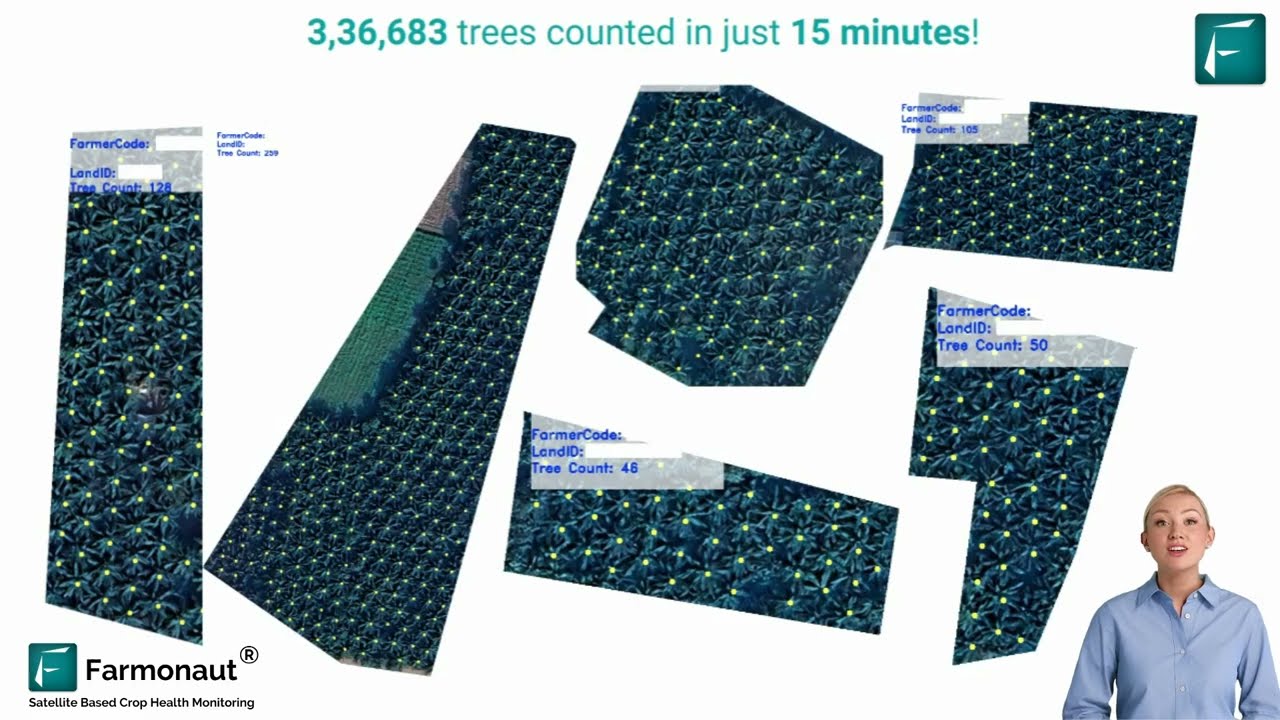
- AI-Powered Advisory Systems: Predictive models suggest optimal restoration sites, track seedling survival, and automate tree counting and biomass estimation at a scale field surveys cannot match.
- Blockchain-Based Traceability: Recording every step from seed sourcing to planting and growth gives outcome-bond investors and carbon-credit buyers an auditable chain of custody.
- Resource and Fleet Management Tools: Logistics software coordinates planting crews and monitoring teams across large, often remote project areas.
- Environmental Impact Monitoring: Quantifying carbon sequestration and water-cycle effects in restored areas is what turns a planting project into a bankable carbon asset.

For organizations and communities engaged in sustainable agriculture and restoration, advanced platforms provide actionable insights into crop health, soil conditions, forest cover, and carbon footprinting. Explore how you can benefit with Farmonaut Carbon Footprinting Solutions.

Comparative Impact Table on Reforestation Strategies
The table below compares the four core Amazon reforestation strategies against the carbon and cost benchmarks available in current published data. Where a program-level figure is not publicly disclosed, we say so directly rather than estimating.
| Strategy | Relative Cost per Hectare | Carbon Sequestration Benchmark | Time to Measurable Canopy Recovery | Best Suited To |
|---|---|---|---|---|
| Assisted Natural Regeneration | Lowest of the four methods | Contributes to the 23.4 Gt C / 30-year global potential across 215M ha (Nature, 2024) | Slowest; multi-year | Land near intact forest with existing seed banks |
| Agroforestry | Moderate; offset by crop/livestock income | Not separately published at Amazon scale; measure via project-level MRV | Moderate; productive within 2-3 years | Working farmland transitioning toward mixed use |
| Direct Native Tree Planting | Highest; global proxy range $500-$3,000/ha depending on region and labor (GAPS note, no Amazon-specific figure published) | 4,277 tCO2e/ha over 20 years, mature native forest (Trillion Trees, 2024) | Fastest canopy closure of the four | Severely degraded land with no natural seed source |
| Sustainable Land Management & Incentives | Variable; often revenue-generating via carbon credits | Indirect; enables forestry’s ~50% share of ~250 Mt CO2e global VCM demand (2024) | Ongoing; not a single restoration event | Landholders seeking carbon-credit or PES income |
Note on the cost figure: no public source discloses per-hectare cost for the Mombak or Biomas Amazon projects specifically. The $500-$3,000/hectare range cited above is a global proxy for native reforestation cost, varying by region and labor rates, not an Amazon-specific number — treat it as a planning range, not a quote.
Reforestation Carbon Value Calculator
Use the calculator below to estimate the potential carbon-credit value of a native reforestation area, based on the 4,277 tCO2e-per-hectare (20-year) sequestration benchmark and current voluntary market pricing.
Estimated results:
Assumptions: scales Trillion Trees' 4,277 tCO2e/hectare native-forest benchmark linearly by horizon length; excludes MRV (measurement, reporting, verification) fees, project registration costs, and buffer-pool deductions that most credit registries require. This is a planning estimate, not a project appraisal.
Socioeconomic & Environmental Impact of Amazon Reforestation
Amazon reforestation's effects extend well beyond the hectares directly replanted.
- Climate and Rainfall Stabilization: Restored forest cover supports the regional hydrological cycle that Amazon basin agriculture depends on, reducing drought exposure for farming operations far from the restoration site itself.
- Carbon Sequestration: Native forest restoration sequesters an estimated 4,277 tCO2e per hectare over 20 years, per Trillion Trees' 2024 modeling — a figure that scales directly with the area under active restoration.3
- Biodiversity and Ecosystem Services: Restoration returns pollinators and pest-control species, supporting gene flow across fragmented forest patches.
- Economic Opportunity: Reforestation programs create jobs in nurseries, planting, monitoring, and sustainable harvest of non-timber forest products.
- Community Involvement: Programs that involve local and indigenous communities directly report stronger long-term forest survival, since stewardship continues after initial funding ends.
What This Means for US and Canadian Landowners, Investors, and Agencies
Amazon reforestation is not just a South American policy question for US and Canadian readers — it is an increasingly investable and monitorable asset class. Three practical entry points exist. First, voluntary carbon credit purchases: US and Canadian corporations buying forestry-linked voluntary credits should check the credit's quality rating before comparing price, given the documented spread between $14.80 top-rated credits and the $24 market average.4,5 Second, outcome-bond co-investment or analogous structures, modeled on the World Bank's $225 million Amazon instrument, which principal-protects investor capital while tying returns to verified forest outcomes.1 Third, direct technical and monitoring partnerships: US and Canadian agricultural technology providers increasingly supply the satellite verification layer that Amazon-based projects need to qualify for credit issuance in the first place.
For US-based agricultural landowners specifically comparing domestic forest carbon programs against Amazon-linked credits, the direct US federal offset protocol guidance (USDA-level sequestration rates and eligible practices under programs like California's or Washington's cap-and-invest frameworks) is not detailed in the sources reviewed for this piece; check USDA and your state's cap-and-invest program administrator directly for current protocol specifics. Canadian landholders should note that a federal Improved Forest Management offset program launched in February 2025, though production-level baseline pricing and projected annual credit issuance were not yet published as of this review — check Environment and Climate Change Canada's offset program page directly for current figures once issuance data is released.
Farmonaut's Contribution to Amazon Reforestation Efforts
As a satellite technology company, Farmonaut supports Amazon reforestation and broader sustainability goals with tools built for the verification challenges described above.
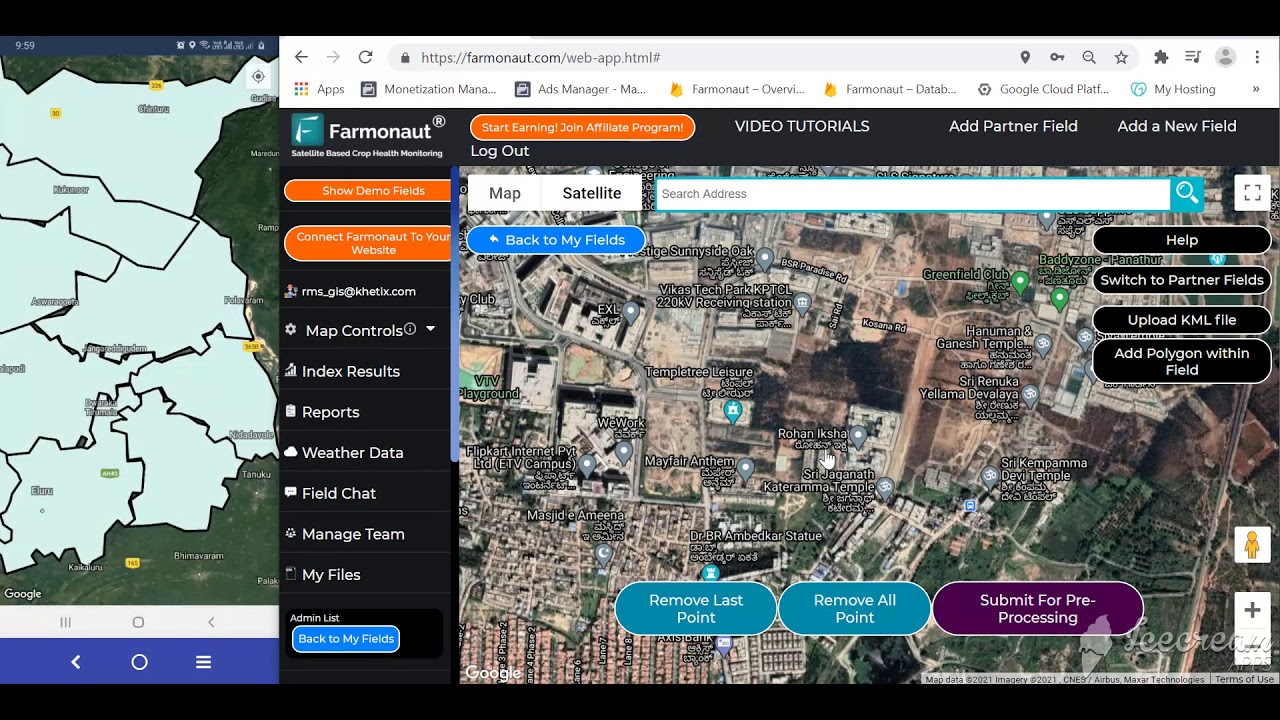
- Satellite-Based Monitoring: Multispectral satellite imagery tracks forest health, soil conditions, and land-use change, giving stakeholders continuous visibility into restoration progress.
- AI-Powered Jeevn Advisory: Our Jeevn AI system delivers actionable advice, weather forecasts, and restoration-specific guidance.
- Blockchain-Based Traceability: We support full traceability for restoration and supply chain activities, supporting the transparency that outcome-bond and carbon-credit financing increasingly requires.
- Environmental Impact Tracking: Our platform provides direct measures of carbon footprint and ecosystem health, helping organizations monitor restoration investment outcomes over time.
- Fleet and Resource Management: Logistics tools support efficient planning across large, decentralized reforestation projects.
- Accessibility Across Devices: Satellite-driven insights are available via Android, iOS, web apps, and APIs.
Curious how satellite and AI tools can support monitoring, productivity, and carbon tracking for your Amazon restoration project?
Start here:
For those managing large-scale farms and restoration areas, our platform supports seamless Large Scale Farm Management — modular tools for area mapping, remote sensing, resource tracking, and team coordination.
Building your own solutions or platforms? Tap into our real-time satellite monitoring and forecasting services with our simple REST API and API Developer Docs.

Challenges in Scaling Up Amazon Reforestation
Several structural challenges limit how fast reforestation can scale, regardless of available technology:
- Continuous Funding: Projects need funding mechanisms that survive past the first 2-3 years; outcome bonds and carbon-credit revenue are designed to address this but are not yet universal.
- Land Tenure & Policy Conflicts: Unclear or disputed land tenure blocks eligibility for most carbon-credit and outcome-bond programs.
- Enforcement Against Illegal Activity: Illegal logging and mining can undo years of restoration progress in a single incursion if enforcement lapses.
- Community Engagement: Projects without active local and indigenous involvement show weaker long-term forest survival.
- Climate Variability: Shifting rainfall and temperature patterns affect seedling survival rates and restoration timelines.
- Fragmented Coordination: Inconsistent cross-border and inter-agency collaboration slows basin-scale reforms.

Looking Ahead: The Future of Amazon Reforestation
Amazon reforestation is best understood as a continuing story shaped by financing innovation, not a single year's campaign. The direction that matters most: carbon-market and outcome-bond financing is scaling faster than grant-based funding, and that shift will keep determining which projects survive past their first funding cycle.
What Would Change This Picture
- Carbon price convergence: If open-market voluntary credit prices rise toward the $40/tonne level assumed in the World Bank's Amazon bond, more projects become bankable at scale. Track this via the Carbon Credits monthly tracker.4
- New national offset protocols: Canada's federal Improved Forest Management program (launched February 2025) and evolving US state cap-and-invest protocols could open new demand channels once issuance data is published.
- Stronger enforcement funding: Enforcement against illegal logging and mining remains the single largest variable determining whether restored hectares stay restored.
- Agroforestry incentive expansion: Wider adoption depends on payment programs reaching individual landholders directly, not just large project developers.
The durable checklist for evaluating any Amazon reforestation claim, whether from a project, a bond prospectus, or a carbon-credit seller: ask which restoration method is used, what the credit's quality rating is, whether land tenure is legally secured, and whether independent satellite verification (not just self-reported photos) backs the claimed hectares. That checklist works regardless of which year you're reading this.
Start planning your restoration with real-time tools: Farmonaut's Crop Plantation and Forest Advisory
FAQ: Amazon Reforestation
-
What is Amazon reforestation and how is it financed today?
Amazon reforestation restores deforested and degraded rainforest land through natural regeneration, agroforestry, and direct native-species planting. Financing has shifted toward carbon-credit sales and outcome-based bonds, exemplified by the World Bank's $225 million, nine-year Amazon Reforestation-Linked Outcome Bond issued in 2024.1
-
What are the main strategies for Amazon reforestation?
Assisted natural regeneration, agroforestry systems, direct native tree planting, and sustainable land management with carbon-credit or payment-for-ecosystem-services incentives, all supported by legal enforcement and satellite verification.
-
How much does Amazon rainforest reforestation cost per hectare?
No public source discloses a project-level per-hectare cost for major Amazon programs like Mombak or Biomas. Global proxy rates for native reforestation range from $500 to $3,000 per hectare depending on region and labor costs — treat this as a planning range and request current, project-specific costing directly from any developer you're evaluating.
-
What does Amazon reforestation carbon credit pricing actually look like?
As of 2024-2025 data, average voluntary market pricing for afforestation/reforestation credits sits at $24 per credit, top-rated A-AAA credits average $14.80 per tonne, and the World Bank's Amazon bond planning assumption uses $40 per tonne — three different figures depending on whether you're looking at market average, top quality tier, or bond-structuring assumption.1,4,5
-
How can I stop deforestation from affecting a specific project or supply chain?
At the project level, the tools that work are continuous satellite monitoring to detect encroachment early, secured land tenure to enable legal enforcement, and blockchain-based traceability so buyers can verify a supply chain isn't linked to newly cleared land.
-
How does technology support Amazon reforestation?
Satellite monitoring, AI-based advisory, and blockchain traceability enable precise site selection, efficient project management, financial transparency, and independent verification for carbon-credit and outcome-bond buyers.
-
What are the main challenges facing Amazon reforestation?
Continuous funding past the first few years, land tenure conflicts, enforcement against illegal logging and mining, community engagement, and climate variability affecting seedling survival.
Get Started with Satellite Monitoring & Reforestation Planning
Whether you are a landowner, a government agency, or an NGO, integrating real-time data into your restoration strategy can transform outcomes. Explore Farmonaut's real-time monitoring and advisory solutions for farming, forestry, and restoration projects.
See how accurate carbon estimation, productivity tracking, and resource management drive sustainability across your operations!
For business and developer integrations, access our Farmonaut Satellite API for automated crop/forest monitoring, or read the Developer Documentation for rapid setup.
If you need crop loan or insurance verification based on real-time satellite observations for agricultural or restoration land, learn more about Farmonaut's Crop Loan and Insurance Solutions.
Integrating agriculture and forestry management on the same parcel remains one of the strongest levers landholders have — see the difference between sustainable forestry and farming agriculture for how the two disciplines combine in agroforestry planning.
Amazon reforestation is not simply an environmental necessity — it's an increasingly investable, verifiable asset class, with carbon-credit pricing and outcome-bond structures now public enough to evaluate directly.
For real-time support, ongoing advice, and the easiest way to track every hectare restored, start with Farmonaut.
Sources: 1. World Bank IBRD, Amazon Reforestation-Linked Outcome Bond, 2024. 2. Nature journal, global tropical forest natural regeneration potential, 2024. 3. Trillion Trees, 2024 Impact Report. 4. Carbon Credits, forest finance market tracker, 2025. 5. ReGreener, forest carbon credit types and pricing, 2024.
Discussion
Questions, corrections or field experience? Share them below. First-time comments are reviewed before they appear, and your email is never published.
No comments yet. Be the first to add a question or your experience.

 Global Agrifood
 Cazlv
Cazlv HIPSAC
 ZOL Zimbabwe
 Juligerm
 AdBio
AdBio MISE Maroc
 Drift-Sense
 NWNS
NWNS Red August Group
 Farm Inc
 WeMe Global
 Agrotoken
 Blue BearX
 Insignito
 Croptimum
 DnCubed
 Field Capacity
 Indosistim Teknologi
 Licence holder · Niger · Gold
 Licence holder · Nigeria · Gold + lithium










