

Hydroponics · NFT design guide
NFT Hydroponic System: Specs, Crops, Costs and Fixes
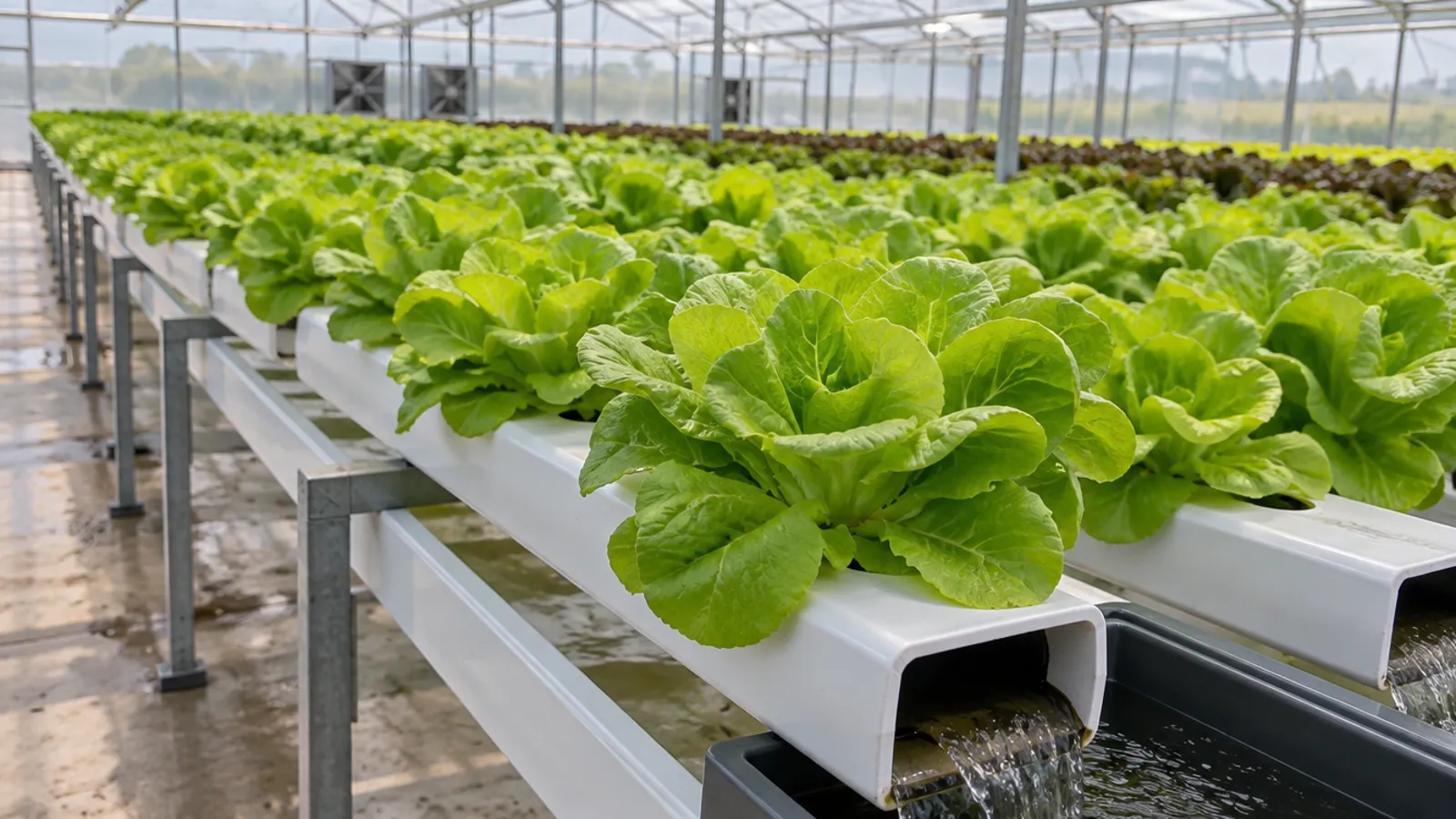
An NFT hydroponic system pumps a thin film of nutrient solution down sloped channels past bare roots and back to a tank. Extension guides suggest about 1-4% slope, 4-12 ft channels and lettuce at 8 in spacing, but disagree on flow rate. Here are the specs side by side, plus crops, costs and the failures to plan for.
Key takeaways
- Slope advice ranges from about 1% (FAO, 2014; Alabama Extension, 2022) to 1-4% (Cornell, 2016); Oregon State (2025) asks for at least 2%.
- Flow advice differs widely: 3-5 gal/h per channel, about 0.2-0.3 L/min (Virginia Extension, 2023), against 1-2 L/min per pipe, which FAO calls standard, and usually under 0.5 gal/min (Alabama).
- Lettuce, salad greens and herbs suit NFT best; Cornell reports 5-6 oz lettuce heads 24 days after transplant under good light.
- The biggest risks are a stopped pump (wilting can be immediate, per Oregon State), root mats that dam the flow, and warm solution: water holds 9.09 mg/L of oxygen at 20 °C but 7.56 mg/L at 30 °C (USGS).
- On 16 October 2026, CropKing’s NFT kits listed at $199 for 8 plant sites to $5,960 for 540, about $25 down to $11 per site (list prices).
In this article
- How an NFT hydroponic system works
- NFT design specs: slope, flow, channel length and spacing
- Crops that suit an NFT hydroponic system
- How to set up an NFT system in 8 steps
- What an NFT hydroponic system costs
- Common NFT failures and how to prevent them
- Heat, low oxygen and root disease
- Is an NFT hydroponic system worth it?
- How we checked the numbers
- FAQ
An NFT hydroponic system grows plants in sloped channels while a pump sends a thin, shallow stream of nutrient solution past their bare roots. The solution drains back to a tank and goes round again. Extension guides give the key numbers: channels sloped at about 1% (FAO’s aquaponics manual) to 1–4% (Cornell’s controlled environment group), runs of 4 to 12 feet, and lettuce spaced about 8 inches apart.
This guide explains how the nutrient film technique (NFT) works, sets out the design specs side by side with the places where the sources disagree, lists the crops that suit it, and walks through a build with dated list prices. It ends with the failures that kill NFT crops (pump stops, root mats and heat) and a calculator that sizes your channels, pump flow, tank and build cost.
How an NFT hydroponic system works
NFT was first described by Allen Cooper, based on his 1960s work at the Glasshouse Crops Research Institute in England, according to Virginia Cooperative Extension’s NFT guide (2023). It is an active, recirculating system. Plants sit in holes along the top of a channel, often in a small plug of rockwool or foam. Their roots hang into the channel. A film of solution runs along the channel floor, so the lower roots stay wet while the upper roots are in moist air.
The flow never stops while plants are in the channels. That is why some sellers call NFT “continuous flow” hydroponics. It is also why NFT depends so much on the pump.
Every NFT system has the same five parts, whatever its size:
- Bench or frame: holds the channels above the tank, at a set slope, strong enough that channels do not sag under weight or heat.
- Reservoir: a plastic tank at the lowest point of the system. Plastic, because metal can corrode in fertilizer solution.
- Pump and feed lines: a submersible pump in small systems, or a pool-type centrifugal pump in larger ones, feeding a manifold and thin delivery tubes, one per channel.
- Channels: also called gullies or troughs. PVC pipe for hobby builds, or flat-bottomed commercial channels with pre-cut plant holes.
- Return line: a larger drain pipe that collects the outflow from every channel and returns it to the tank.
NFT compared with other hydroponic systems
The University of Kentucky crop profile on hydroponic lettuce (2025) compares the main systems. NFT needs no air pump, because the thin film itself supplies oxygen, and it uses a low volume of water. The trade-off is risk: the profile warns that a system failure causes rapid dry-out.
| System | Water held | Oxygen supply | Lettuce density | Main risk |
|---|---|---|---|---|
| NFT | Low volume, thin film | The film itself | About 2 plants/ft² (listed as 30/m²) | Roots dry out fast if flow stops |
| Deep water culture | High (over 1 gal per plant) | Air pump and air stones | 35–40 plants/m² | Waterborne disease spreads in shared tank |
| Drip in substrate | Moderate | Air space in the media | 20–25 plants/m² | Clogged emitters |
| Ebb and flow | Moderate | Air space in the media | About 25 plants/m² | Clogged emitters, more labour to install |
Source: University of Kentucky Center for Crop Diversification, CCD-CP-63 (2025), Table 2. A peer-reviewed meta-analysis of lettuce yields in controlled environments (2023) notes, from earlier studies, that NFT systems tended to yield lower than some other methods, which it links to less root contact with the solution. They are still used because they use water more efficiently.
NFT design specs: slope, flow, channel length and spacing
No single standard exists. The table puts the numbers from six sources side by side. Where they disagree, the reason is usually scale: a hobby kit, a commercial greenhouse and a fish-fed aquaponic unit have different needs.
| Spec | What the sources say | Where they disagree |
|---|---|---|
| Channel slope | About 1 cm per metre, or 1% (FAO, 2014); 1% is often enough (Alabama Extension, 2022); 1–4% (Cornell, 2016) | Oregon State (2025) says keep at least 2% |
| Flow per channel | 3–5 gal/h, about 0.2–0.3 L/min (Virginia, 2023) | FAO gives 1–2 L/min per pipe as standard; Alabama says usually under 0.5 gal/min (about 1.9 L/min) |
| Channel length | 4–12 ft (Virginia); 8–12 ft is standard (Alabama) | FAO allows 1–12 m and warns of nutrient shortfall beyond 12 m |
| Plant spacing | 8 in on centre for leafy greens (Virginia); 7.5–8 in (Alabama) | FAO asks for at least 21 cm (8.3 in) between holes |
| Channel size | About 4 in wide, 1.5–2 in deep (Virginia); 4 in wide, 2–3 in deep (Alabama) | FAO: 10 × 7 cm rectangular, or 7.5 cm pipe for greens and 11 cm for fruiting crops |
| Reservoir | ¼ to 1 gal per plant (Virginia) | Alabama: one 1,000-gal tank can serve a 30 × 96 ft greenhouse |
| EC and pH | EC 1.2–2.0 mS/cm, pH 5.5–6.2 (Virginia) | UF/IFAS gives common NFT practice as EC 1.2 at germination and 1.5–1.8 in production |
Slope
Slope moves the film by gravity. Too flat and solution pools around the roots; too steep and the film runs thin and fast. Alabama Cooperative Extension’s greenhouse lettuce guide (2022) says a 1 percent slope is often sufficient for most trough lengths. The Oregon State University Extension NFT sheet (2025) asks for at least 2% and says to check it regularly. Cornell’s range runs up to 4%.
A practical reading: start at 1–2% for short lettuce channels, and go steeper if you see pooling or if your solution warms up along the channel. Oregon State lists a steeper slope as one way to reduce temperature swings. A 12-ft channel at 1% drops about 1.4 inches from end to end; at 2% it drops about 2.9 inches. FAO suggests setting the slope with shims under the legs.
Flow rate per channel
This is the widest disagreement. Virginia’s figure of 3–5 gallons per hour into each channel is about 0.2–0.3 litres per minute. FAO’s small-scale manual says flow per pipe should be no greater than 1–2 litres per minute, and Alabama says flow is usually less than half a gallon per minute. FAO also calls 1–2 litres per minute the standard for NFT pipes and warns that lower flows do not supply enough nutrients or oxygen, so its figure is a target for its wider pipes, not only a cap. Alabama’s figure describes usual practice. The common ground: the film should be shallow, the roots should never sit in a deep pool, and every channel should get the same flow. Fit a valve on each delivery line so you can balance them, as the Virginia guide suggests.
Channel length
Plants at the top of a long channel take up nutrients and warm the solution before it reaches the far end. FAO says pipes can be 1 to 12 metres long, and that plants towards the end of pipes longer than 12 m can show deficiencies. The US extension guides work with much shorter runs, up to 12 feet (3.7 m). Oregon State lists shorter channels as a second way to limit temperature swings.
Plant spacing and channel size
Virginia gives 8 inches on centre for most leafy greens in 2-inch PVC pipe; commercial channels, usually about 4 inches wide, come with the plant holes already cut. Alabama spaces both holes and troughs at 7.5 to 8 inches on centre. FAO, writing for mixed crops, asks for at least 21 cm between holes and wider 11 cm pipes for fruiting plants with big roots. FAO and Virginia both suggest white pipe or tubing, which reflects heat and keeps the solution cooler.
Reservoir size
Virginia’s rule of thumb is ¼ to 1 gallon of tank per plant, so a 50-plant system might use a 25-gallon tank. It advises oversizing the tank, because more water buffers pH and nutrient swings. Oregon State also lists larger stock tanks as a way to reduce temperature swings.
Nutrient solution targets
Virginia says many leafy greens do well at EC 1.2 to 2.0 mS/cm and pH 5.5 to 6.2, and that EC and pH should be checked two to three times a week. A UF/IFAS study of NFT lettuce (2025) notes that NFT lettuce is commonly held at EC 1.2 dS/m during germination and 1.5–1.8 dS/m in production (1 dS/m equals 1 mS/cm). In its own 35-day trial, keeping EC at 1.2 rather than 1.6 did not reduce lettuce growth. Cornell keeps pH at 5.5 to 6.0 and EC near 1.5. Kentucky advises topping the tank up every few days and replacing all or part of the solution every 3 to 4 weeks. Follow the fertilizer label for mixing rates.
Chart
Longest NFT channel each source works with
Metres; 3.7 m = 12 ft. Upper end of each source’s range.
Crops that suit an NFT hydroponic system
Channels give little rooting space, so NFT suits short-lived, small-rooted crops. Oregon State and Virginia list similar crops. The order below follows how often the sources name each crop, not a yield ranking.

▶ Ten low-cost farm business ideas, including microgreens and hydroponic growing at home. · 8:32
- Lettuce (butterhead, romaine, oakleaf, multi-leaf). Best for: first-time growers and steady weekly sales. Cornell reports 5–6 oz heads 24 days after transplant when light reaches a daily light integral of 17 mol·m⁻²·d⁻¹. Kentucky gives 21 to 35 days after transplant, at 100–210 g per head.
- Other salad greens (arugula, sorrel, tatsoi, mâche, frisée, mustard). Best for: mixed bagged salads. Virginia lists them as working well in NFT.
- Culinary herbs (basil, cilantro, parsley, mint). Best for: restaurant and farmers’ market sales. Watch mint: FAO warns its root mass can clog even large pipes.
- Kale, Swiss chard and spinach. Best for: growers adding variety. Oregon State lists all three. Cornell found baby spinach far more prone to Pythium root rot than its other leafy crops.
- Strawberries. Best for: growers ready for a longer crop. Oregon State says certain varieties can be grown as perennials in NFT.
- Tomatoes, peppers and cucumbers. Best for: few NFT growers. Virginia says these are grown in NFT only occasionally, and FAO warns tomato roots can clog even large pipes.
Lettuce is where hydroponics already dominates protected cropping in the US. The USDA 2024 Census of Horticultural Specialties counted 1,346 operations growing lettuce under protection. Of their 831,022 hundredweight, 710,127 (about 85%) came from hydroponic systems of all kinds, not only NFT.
Chart
Lettuce planting density by hydroponic system
Plants per square metre, low and high end of each range. Values as printed in the guide’s per-m² column; its per-ft² column converts to somewhat lower figures.
How to set up an NFT system in 8 steps
- Choose the site and the crop. A greenhouse, tunnel or indoor room with power, clean water and shade or cooling for summer. Kentucky recommends well or municipal water for its stability. Start with lettuce or herbs.
- Size the system. Decide how many heads you need per week, then work out channels, pump flow and tank size with the calculator below.
- Build or buy the bench. Make it hip height for planting and harvest, strong enough not to sag, and adjustable so you can set the slope.
- Fit the channels. Set the slope (1–2% is a sound start), check it with a level along each channel, and fit end caps so light cannot get in.
- Plumb feed and return lines. Use a pump rated for continuous duty, with enough head to lift solution to the channels and overcome pipe friction. Give each channel its own delivery tube and a valve. Keep a second pump on the shelf.
- Fill and mix. Mix fertilizer stock solutions separately, following the label, then add them to the tank. Check EC and pH before the plants go in.
- Raise seedlings. Sow into rockwool, foam or peat plugs, often with pelleted seed. Kentucky says seedlings are ready to transplant 14 to 21 days after seeding. Make sure roots touch the film on transplant day, because the small plug dries out quickly.
- Run, check and record. Check flow in every channel each day, EC and pH two to three times a week, and solution temperature on hot days. Clean channels between crops.
Harvest and food safety
Alabama Extension notes that NFT troughs are often lifted out of the system for harvest, and heads can be cut at the base or sold with roots attached as living lettuce. It warns against letting nutrient solution splash or drip onto harvested plants, and says lettuce should be refrigerated at 32 °F straight after harvest. Follow your local food safety rules for washing, packing and labelling.
A worked sizing example
Say you want 300 lettuce plants in the system at once, in 8-ft channels with holes 8 inches apart. Each channel holds 12 plants, so you need 25 channels. At an example flow of 1 litre per minute into each channel, the pump must deliver about 1,500 litres (about 400 gallons) per hour to the channels, at the height of the feed manifold. Virginia’s rule of ¼ to 1 gallon per plant gives a tank of 75 to 300 gallons. At 2% slope, each 8-ft channel drops about 1.9 inches. Swap in your own numbers in the calculator below.
Nursery channels and respacing
Some growers start transplants in a nursery channel with holes close together, then move them to finishing channels at full spacing. CropKing’s largest kit, the NFT 10-36, includes a nursery channel for this reason. Kentucky notes that respacing, moving plants further apart as they grow, can improve space use, airflow and yield in liquid systems such as NFT, and advises matching respacing to the labour you have. Cornell respaces lettuce part way through the growing stage for the same reason.
Try the numbers for your own farm below.
Calculator
How many channels, how much flow and what build cost?
Enter your own plant count, layout, flow and quotes.
- Plant sites per channel: 12.0
- Total flow to the channels: 1,500 L/h
- Same flow in US gallons: 396 gal/h
- Tank size, low end (1/4 gal per plant): 75 gal
- Tank size, high end (1 gal per plant): 300 gal
- Drop from top to bottom of each channel: 1.9 in
- Build cost of what you entered: $1,550
- Build cost per plant site: $5
- Full crop cycles to pay back the build: 10.3
Example values only, not a benchmark or forecast; replace every number with your own. Flow per channel is your choice: sources range from about 0.2-0.3 L/min (Virginia Cooperative Extension, 2023) to 1-2 L/min per pipe, which FAO (2014) calls standard. The tank range uses Virginia Extension’s rule of 1/4 to 1 gallon per plant (fixed in the formula). Pump flow is the total delivered to the channels; choose a pump rated for that flow at your lift height. Build cost covers only what you enter. Margin per head is your sale price minus running costs per head.
What an NFT hydroponic system costs
Prices below are list prices on CropKing’s online NFT catalogue, a US supplier, as shown on 16 October 2026. They are not transaction prices or a market average. Shipping on loose channels is quoted separately, and other suppliers will differ.
| Item | Plant sites | List price | What is included |
|---|---|---|---|
| Desktop system | 8 | $199 | Two short channels, for classrooms or kitchens |
| NFT 4-6 | 36 | $584 | Six 4-ft channels, stand, plumbing, 400 GPH pump; no reservoir |
| NFT 8-4 | 48 | $1,100 | Four 8-ft channels, stand, plumbing, pump, 30-gal reservoir |
| NFT 8-25 | 300 | $3,732 | Twenty-five 8-ft channels with fifty 4-ft covers, galvanized table, 1/8 hp pump, 100-gal reservoir |
| NFT 10-36 | 540 | $5,960 | 10-ft nursery channel, thirty-six 10-ft channels with seventy-two 5-ft covers, 1/8 hp pump, 100-gal reservoir |
| 12-ft channel | Not drilled | $23.55 | 4.6-in channel, bottom only |
| 5-ft top cover | 7 or 8 | $9.55 | Lid with 1-in holes on 8-in centres |
Running costs come on top. The pump runs day and night, so its yearly energy use is its power draw times 8,760 hours: an example 100-watt pump would use about 876 kWh a year. Multiply by your own electricity rate. Fertilizer, plugs, seed, water, test-meter calibration fluid and replacement pumps make up the rest of the consumables.
The price per plant site falls as kits get bigger. A kit is only part of the cost of a working farm: Kentucky notes that hydroponic production costs tend to be higher than field production, and Alabama names labour as the main variable cost in greenhouse lettuce. Add your own quotes for the structure, cooling, lights, meters, seed, plugs, fertilizer and power. For loans, grants or tax questions, get professional advice.
Chart
NFT kit list price per plant site
US dollars; list price divided by plant sites; CropKing website, 16 October 2026
Common NFT failures and how to prevent them
NFT holds very little water around the roots. That makes it efficient, and it also means small faults turn into crop losses fast. These are the failures the extension guides warn about most.
Pump or power outage
Oregon State says power loss or pump failure can cause immediate wilting once the film stops, and calls backups for power and pumps crucial. FAO lists NFT as vulnerable to power outages, and Virginia advises keeping a backup pump. Prevention:
- Keep a spare pump of the same model, already fitted with the right connectors.
- Fit a flow or float alarm that texts you when the return line stops running.
- Have backup power for the pump: a generator, or a battery bank sized for the pump’s watts over several hours. Solar panels can charge it, but the pump runs at night too.
- Top the tank up every few days, as Kentucky advises, so the pump intake never draws air.
Root mats, clogs and ponding
As plants grow, roots form a mat on the channel floor. A thick mat can dam the flow, so solution pools behind it and runs short beyond it. FAO warns that plants with big root systems, and older plants, can clog small pipes and cause overflows, and names tomatoes and mint. FAO also notes that water inlet pipes can clog easily. Prevention:
- Use flat-bottomed channels wider than they are deep. FAO says this spreads a wider film across the roots. Oregon State adds that textured floors or woven mats help distribute the film.
- Match channel size to the crop, and harvest on time.
- Filter the solution and check every emitter or delivery tube each day.
- Clean and sanitize channels between crops, as Kentucky advises for disease control.
Algae and light leaks
Light inside a channel feeds algae, which compete with roots and block flow. Keep end caps and top covers on, cover unused plant holes, and use opaque tubing and tanks. CropKing, for example, designs its channel end caps to keep light out for this reason.
Daily and weekly checks
Many NFT faults are cheap to fix if you catch them within hours. A short routine helps. It combines the checks the extension guides recommend with a daily look at every channel:
- Every day: look at the outflow from every channel, look for wilting at the far end of each channel, check the tank level and feel the solution on hot afternoons.
- Two to three times a week: measure EC and pH (Virginia) and adjust with stock solution, acid, base or fresh water.
- Every few days: top up the tank (Kentucky).
- Every 3 to 4 weeks: replace all or part of the solution (Kentucky).
- Between crops: clean and sanitize channels, lines and the tank (Kentucky), and check the slope again (Oregon State).
Heat, low oxygen and root disease
Shallow channels follow air temperature closely. Oregon State says those swings can cause nutrient imbalances and plant stress. Warm water also holds less oxygen. Cornell reports crop failure when dissolved oxygen in the solution falls below 3 ppm, against a target of about 7 to 8 ppm. Kentucky says air for hydroponic lettuce should not exceed 75 °F (24 °C) by day or 65 °F (18 °C) at night, and warns that prolonged heat or big temperature swings make lettuce bolt, which leaves it bitter and unmarketable. Swings can do more harm than steady heat. Prevention:
Chart
Warm water holds less oxygen
Oxygen solubility in fresh water at sea-level pressure (760 mm Hg), mg/L
- Shade or cool the growing space in summer.
- Use white channels and white tubing, and keep the tank out of the sun.
- Shorten channels, steepen the slope a little, or use a larger tank, as Oregon State suggests.
- Measure solution temperature at the far end of the longest channel on the hottest afternoon.
Nutrient drift and root disease
Plants take up water and nutrients at different rates, so EC and pH drift between checks. Kentucky warns that waterborne pathogens can spread through the shared solution in NFT, and that Pythium water moulds can establish in irrigation lines. Symptoms include stunting, wilting and soft brown roots. Check EC and pH two to three times a week, remove sick plants at once, and sanitize between crops. If you use any fungicide or sanitizer, check the label for hydroponic use and follow local rules.
Is an NFT hydroponic system worth it?
NFT is a good fit if you want light, modular channels, low water volume and fast leafy crops, and if you can watch the system every day. It is a poor fit if power is unreliable and you have no backup, or if you want large fruiting crops.
The money depends more on your market than on the hardware. Kentucky says hydroponic growers need buyers willing to pay a premium, or enough scale to compete, and that in Kentucky the best openings are likely direct sales to local, small buyers. Alabama adds that greenhouse lettuce costs significantly more to grow than field lettuce, so small growers often rely on nearby urban direct markets. Test your market with a small system before building big.

▶ Ten small agriculture businesses you can start without a farm, from a shelf of microgreens upward. · 6:03
How we checked the numbers
We compared the design figures in five grower guides: Virginia Cooperative Extension SPES-463 (2023), Alabama Extension ANR-2903 (2022), Oregon State EM 9457 (2025), the University of Kentucky crop profile CCD-CP-63 (2025) and FAO Fisheries and Aquaculture Technical Paper 589 (2014), plus Cornell’s leafy greens article (2016) and a UF/IFAS NFT study (2025). We converted US units to metric where needed and rounded the conversions. Oxygen solubility comes from the USGS DOTABLES program, and US lettuce figures from the USDA 2024 Census of Horticultural Specialties. Kit prices are list prices from one supplier’s website on 16 October 2026.
Farmonaut does not make NFT equipment. Its satellite crop monitoring covers outdoor fields, so it is useful if you also farm open ground alongside a greenhouse. Related pages on our site: web and mobile app, satellite and weather API docs, product traceability, carbon footprinting and fleet management.
Related reading on this site: Vertical Aquaponic System: NFT Methods & Best Fish.
FAQ
What slope does an NFT channel need?
Sources range from about 1% (FAO; Alabama Extension) to 1–4% (Cornell), and Oregon State asks for at least 2%. For short lettuce channels, start at 1–2% and go steeper if solution pools or warms along the channel.
How long can NFT channels be?
US extension guides use 4 to 12 feet. FAO allows up to 12 metres in small aquaponic units, but warns that plants at the far end of longer pipes can run short of nutrients. Shorter channels also stay cooler.
What happens if the pump stops?
The film stops and roots start to dry. Oregon State says wilting can be immediate, and Kentucky warns of rapid dry-out. Keep a spare pump, a flow alarm and backup power.
Is NFT better than deep water culture?
Neither is better for every grower. NFT holds less water, needs no air pump and is lighter. Deep water culture holds a large volume that buffers temperature and pH and survives short power cuts, but it is heavy and needs aeration. A 2023 meta-analysis notes that NFT lettuce tended to yield less in earlier studies, with better water-use efficiency.
Can I run an NFT system on solar power?
Yes, if the system can run the pump around the clock, because NFT flow should not stop at night. That means batteries sized to the pump’s watts over the dark hours, plus a margin for cloudy days. Grid power with a battery or generator backup is the simpler option for most sites.
How many plants fit in an NFT system?
At 8-inch spacing, a 12-ft channel holds 18 plants and an 8-ft channel holds 12. Kentucky gives about 2 lettuce plants per square foot for NFT (about 22 per m²; the profile lists 30 per m²). Use the calculator above to size your own layout.
Farmonaut crop monitoring
Farm open fields too?
If you grow outdoor crops alongside your greenhouse, Farmonaut shows satellite vegetation maps for each field you draw, on web, Android or iOS.



Keep reading

Sources
- Virginia Cooperative Extension, Hydroponic Production of Edible Crops: Nutrient Film Technique (NFT) Systems, SPES-463 (2023): ext.vt.edu
- FAO, Small-scale aquaponic food production, Fisheries and Aquaculture Technical Paper 589 (2014): fao.org
- Cornell CEA (N. Mattson), Hydroponic production of leafy greens, GPN (October 2016): cea.cals.cornell.edu
- Oregon State University Extension, Hydro hints: Nutrient film technique, EM 9457 (May 2025): extension.oregonstate.edu
- Alabama Cooperative Extension System, Greenhouse Lettuce Production, ANR-2903 (2022): aces.edu
- University of Kentucky Center for Crop Diversification, Hydroponic Lettuce Production in Controlled Environments, CCD-CP-63 (2025): ccd.uky.edu
- UF/IFAS EDIS AE610, nutrient use efficiency of hydroponic lettuce production systems (2025): edis.ifas.ufl.edu
- Meta-analysis of factors influencing lettuce yields in controlled-environment agriculture, PMC10385570 (2023): pmc.ncbi.nlm.nih.gov
- USDA NASS, 2024 Census of Horticultural Specialties, Table 15: food crops grown under protection: nass.usda.gov
- USGS, DOTABLES dissolved oxygen solubility tables (version 3.6): water.usgs.gov
- CropKing, NFT systems online catalogue (list prices, accessed 16 October 2026): cropking.com
Discussion
Questions, corrections or field experience? Share them below. First-time comments are reviewed before they appear, and your email is never published.
No comments yet. Be the first to add a question or your experience.

 Marei Nursery
 Sayaji Group
 eKGIS
eKGIS Mostas Tech
 Native Seeds
 Andex
Andex FCF India
 Unifrutti Gulf
 Deluxe Conseil
 TVS Electronics
 BW Pipelines
 WICO
WICO Chimera Innovation
 SkyHarvest
 Polaris Digitech
 Licence holder · Niger · Gold










