

Farming systems · Pros and cons
Intensive Farming: 5 Advantages and 5 Disadvantages
Intensive farming raises output per hectare with more inputs. It can save land and steady supply, but it costs more and can harm water, soil and wildlife. Here are five advantages, five disadvantages, the data behind them and a calculator to test the economics.
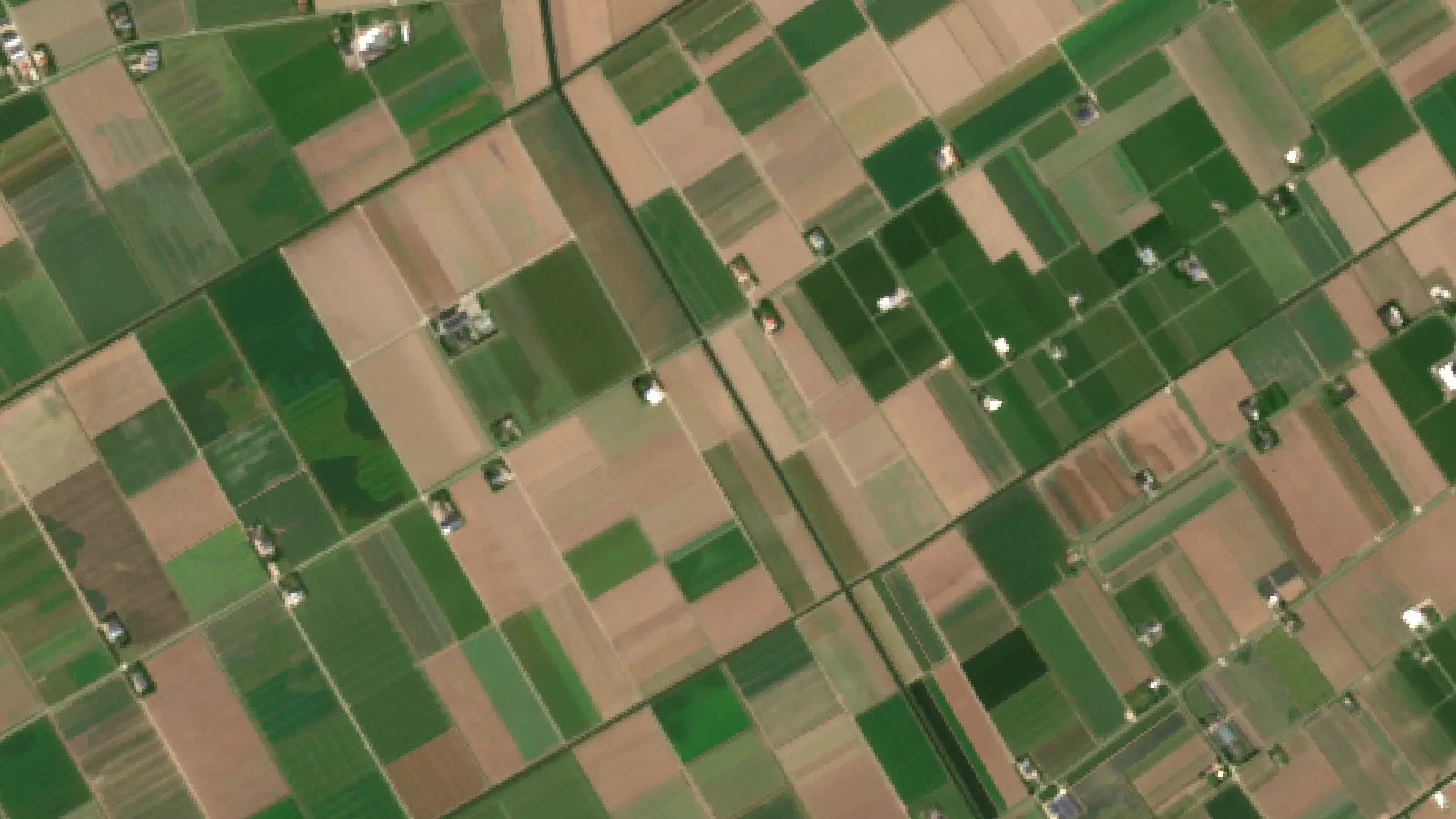
Key takeaways
- US farm output in 2023 was 210% above its 1948 level, while total inputs grew just 0.12% a year (USDA ERS).
- Hydroponic lettuce in a modelled Arizona case gave 11 times the yield and used 13 times less water per kg, but needed 82 times more energy per kg (2015 study).
- Europe: pesticides exceeded effect thresholds at 19% to 27% of reported river water bodies, 2013 to 2023 (EEA, 2025).
- A 28-country study named high-input farming the main pressure behind most European bird declines it measured (PNAS, 2023).
- More inputs pay only if the extra crop value beats the extra cost, so test your break-even price.
In this article
- What is intensive farming?
- 5 advantages of intensive farming
- 5 disadvantages of intensive farming
- Is more fertilizer always better? What the country data show
- Would intensive farming pay on your land?
- Is plantation farming intensive or extensive?
- Hydroponic farming advantages and disadvantages
- Factory farming: advantages and disadvantages
- Intensive farming methods compared
- How to reduce the disadvantages of intensive farming
- FAQ
Intensive farming gets more food from each hectare by adding more inputs: fertilizer, water, machinery, labor, housing or technology. Its main advantages are higher yields, less land per tonne, steady supply, room for high-value crops and shorter production cycles. Its main disadvantages are water and soil damage, high costs, system failures, wildlife loss and animal welfare concerns.
The trade-off is real on both sides. USDA’s Economic Research Service reports that US farm output in 2023 was 210% above its 1948 level, while total inputs grew just 0.12% a year. Yet a study of 170 common bird species in 28 European countries named agricultural intensification, especially pesticides and fertilizer, as the main pressure behind most of the declines it measured. This guide sets out both sides with numbers, and it has a calculator so you can test whether more inputs would pay on your own land.
What is intensive farming?
Intensive farming is any system that puts a lot of inputs on a small area to get high output from that area. Extensive farming does the opposite. It uses more land with fewer inputs per hectare, and it accepts lower output per hectare. Intensity is a scale, not a yes-or-no label. A wheat grower can move along it by changing fertilizer rates, seed rates or irrigation.
Inputs can take several forms, and a system does not need all of them:
- Chemical inputs: synthetic fertilizer and crop protection products, applied to a plan.
- Water: drip or pivot irrigation, and fertigation, which delivers nutrients through the water.
- Plant density: tighter spacing, as in high-density orchards and block plantations.
- Machinery and automation: precision seeders, harvesters and climate control.
- Controlled environments: greenhouses, hydroponics, vertical farms and animal housing.
- Labor: small plots worked by hand can be intensive too, with very little machinery.
Intensive vs extensive farming at a glance
| Feature | Intensive | Extensive |
|---|---|---|
| Land per tonne | Less | More |
| Inputs per hectare | High | Low |
| Output per hectare | High | Low |
| Cost per hectare | High | Low |
| Main risks | Pollution, debt, breakdowns | Drought, low income, more land needed |
| Examples | Greenhouse tomatoes, irrigated corn, housed poultry | Rangeland cattle, dryland wheat |
5 advantages of intensive farming
These are the benefits growers and buyers tend to look for. Each one depends on good management, and each has a cost that appears in the next section.
1. Higher yield per hectare
This is the core benefit. Hydroponic lettuce in Arizona yielded about 41 kg per square meter a year in a modelled comparison published in the International Journal of Environmental Research and Public Health (2015), against 3.9 kg for field lettuce. That is about 11 times more. Open-field comparisons show smaller gaps. A meta-analysis in Nature (2012) found organic yields about 25% below conventional overall, ranging from 5% to 34% below depending on the crop, site and practices.
National cereal figures show how far yields differ between farming systems and climates. The US and the Netherlands stayed near or above 8 tonnes per hectare in most of the years below, while Canada and Australia stayed at about half of that or less. Input use, climate and rainfall all play a part in that gap.
2. Less land for each tonne of food
Higher yields can reduce pressure to clear new land. A study in PNAS (2013) modelled the improved cereal varieties of the Green Revolution from 1965 to 2004. It estimated that they kept 18 to 27 million hectares out of farming. That is a model estimate, and the saving is not automatic: cheaper food and better returns can also pull more land into crops. Land use rules matter as much as yields here.
Soil loss adds another reason to care about where crops expand. A global model in Nature Communications (2017) estimated 35.9 billion tonnes of potential soil erosion in 2012, and it linked a likely overall rise to cropland expansion.
3. Higher output from the same inputs over time
Good intensive systems do not just add inputs. They use them better. USDA’s agricultural productivity data show total factor productivity, a measure of output per unit of all inputs, growing 1.40% a year from 1948 to 2023. That covers all US farming, not intensive farms alone. Drip irrigation, fertigation and variable-rate application follow the same logic: put the input where the crop can use it.
4. Predictable supply and lower cost per unit
Uniform fields, batch harvests and protected growing make volumes and quality easier to plan. That helps growers meet supply contracts, and it spreads fixed costs over more units. Controlled systems also reduce exposure to the weather. USDA notes that most US hog producers use confinement systems, which allow year-round production and protect animals from seasonal weather, predators and some disease exposure.
5. Suits high-value crops and speeds up cash flow
Berries, salad greens, herbs, cut flowers and orchard fruit can justify the extra cost per hectare because each hectare earns more. Protected systems can also fit several crop cycles into a year, which brings income in sooner. The Arizona study notes that shorter harvest cycles in a hydroponic greenhouse allow multiple crops per year. This advantage disappears if a market is small or if prices fall when supply rises.
Chart
Cereal yield in selected farm countries
kg per hectare of harvested land, 2019 to 2023
5 disadvantages of intensive farming
These costs do not fall equally on every farm. Many land on neighbors, rivers or the public, which is why rules and buyer standards deal with them.
▶ Seven simple ways to protect soil and water on a working farm. · 4:34
1. Water pollution from nutrients and pesticides
The European Commission calls excess farm nitrogen one of the main causes of water pollution in Europe. Nitrate leaches into groundwater and runs off into surface water, where nutrients feed algae. In the EU, land draining into waters that exceed or risk exceeding 50 mg/l of nitrate falls under Nitrate Vulnerable Zone rules, which limit fertilizer and manure. The US Geological Survey warns that too much nitrate in drinking water can harm young infants and young livestock.
Pesticides also reach water. The European Environment Agency (published November 2025) found one or more pesticides above thresholds at 19% to 27% of reported river water bodies (effect thresholds) and 11% to 18% of groundwater bodies, across 2013 to 2023. Any fertilizer or pesticide plan should follow the product label and local rules. Get advice from an agronomist or adviser where limits apply.
2. Soil damage and crop disease pressure
Repeating one crop on the same land has a yield cost of its own. SARE’s soil guide explains that rotating one non-legume crop with another gives higher yields than monoculture at recommended fertilizer rates. It also says continuous cropping can hurt root growth, so the crop uses nutrients and fertilizer less well. Heavy machinery on wet soil adds compaction, and tillage without returning residues can draw down organic matter. Those losses build slowly, so a good yield this year can hide them.
3. High capital and running costs
Greenhouses, irrigation, housing and machinery need money up front, and they need energy, skilled staff and repairs every year. More inputs also raise the break-even price, so a price fall hurts more than it does on a low-cost farm. Debt makes this worse. Smaller operators may find entry too costly, and a high-input plan only pays when the extra crop value beats the extra cost. The calculator below tests that for your own numbers. Treat its result as a starting point and speak to a farm finance adviser before borrowing.
4. System failure and concentrated risk
High-density systems leave little margin for error. If a pump, a climate computer or the power supply fails, a hydroponic crop or a housed flock can suffer quickly unless backup is in place. Uniform plants and dense animals also give pests and diseases an easy path. Growing a single crop concentrates market risk as well: one poor price year hits the whole farm’s income. Backups, staff training, insurance and some crop diversity all reduce this risk, but they add cost.
5. Wildlife loss, welfare and antibiotic concerns
The European bird study behind our opening paragraph covered more than 20,000 sites over 37 years. It found that high-input farming was linked to declines, particularly for birds that feed on invertebrates. Large single-crop blocks also leave less habitat for pollinators and natural pest enemies.
In livestock, the debate centers on confinement and health. WHO says misuse and overuse of antimicrobials drive drug-resistant infections, and that bacterial resistance was associated with more than 4.7 million deaths in 2021. That total covers all causes of resistance, not farming alone. The European Medicines Agency promotes prudent use of antimicrobials in animals and collects EU use data. Farmers should work with a veterinarian and follow national rules on these products.
Chart
European waters with pesticides above effect or quality thresholds
Share of reported water bodies, lowest and highest year, 2013 to 2023
Is more fertilizer always better? What the country data show
Not by itself. The chart below sets fertilizer use against cereal yield for six countries in 2023. The Netherlands used about twice as much fertilizer per hectare as the US, but its cereal yield was slightly lower. Fertilizer figures cover all arable land, not only cereals, and climate, crop mix and rainfall all shape yields. Even so, the pattern shows why the rate that pays best is a farm-level question. New Zealand is left out because its figure, 1,289 kg per arable hectare in 2023, sits far off the scale.
Chart
Fertilizer use vs cereal yield, six countries
2023; fertilizer per hectare of arable land, yield per hectare of cereals
Would intensive farming pay on your land?
A higher yield does not always mean a higher profit. Compare two plans for the same field. Enter your expected yield and total cost per hectare for each one. The break-even price tells you the crop price at which the higher-input plan stops earning more than the lower-input plan.
Try the numbers for your own farm below.
Calculator
Does the higher-input plan earn more per hectare?
Enter your own yields, costs and crop price for two plans on the same land.
- Margin, higher-input plan (US$/ha): $400
- Margin, lower-input plan (US$/ha): $380
- Break-even crop price (US$/t): $195
Example values only, near break-even on purpose. They are not benchmarks or forecasts, and every number is your input. Costs should include inputs, machinery, labor and finance. The result ignores risk, tax and long-term soil effects. The break-even line only makes sense when the higher-input yield is above the lower-input yield. Get professional advice before borrowing.
Is plantation farming intensive or extensive?
It can be either. Plantation farming means growing one cash crop, such as oil palm, tea, coffee, rubber or timber, across a large area. What decides the label is the input level per hectare, not the size of the estate.
| Trait | Intensive plantation | Extensive plantation |
|---|---|---|
| Planting | Calculated density, uniform age, clear blocks | Wider spacing, mixed ages |
| Inputs | Planned fertilizer, crop protection, pruning, often irrigation | Low |
| Machinery | Common where crop allows | Limited |
| Yield per hectare | Higher | Lower |
| Main risks | Disease spread, nutrient depletion, market swings | Low income per hectare, more land needed |
Rotational replanting, intercropping and more than one clone or variety can reduce some of the risks of intensive blocks. Our short video below covers how a plantation differs from an ordinary farm.
▶ A plain explanation of plantations vs farms: size, crops, monoculture risk and who does the work. · 4:29
Hydroponic farming advantages and disadvantages
Hydroponics grows crops in a nutrient solution rather than soil. It is one of the most input-heavy forms of crop production, so it shows the trade-off clearly. In the Arizona lettuce study, hydroponics used about 13 times less water per kilogram (20 liters vs 250 liters) and yielded 11 times more per area, but needed 82 times more energy per kilogram. Results are specific to that site and modelled design, so a cool or wet region will differ.
Chart
Hydroponic vs field lettuce in Arizona
How many times greater the hydroponic figure is, or the field figure for water
Advantages of hydroponics
- Water: the 13-fold saving in the study is per kilogram and comes from the much higher yield. Water use per square meter was about the same in both systems.
- Nutrients: feeding can be matched to the species and growth stage.
- Season: controlled spaces can produce out of season and in poor climates.
- Space: crops can be placed on land with no arable soil, including close to city markets.
- Weeds and soil disease: removing soil removes soil-borne weeds and many soil-borne diseases.
Disadvantages of hydroponics
- Energy: heating, cooling, lighting and pumps drive both cost and carbon footprint.
- Inputs: most systems rely on mineral fertilizer salts.
- Disease spread: a pathogen in shared water can reach every plant quickly.
- Skill: pH, nutrient strength and climate need constant checks.
- Start-up cost: structures and equipment can be hard for small producers to fund.
Factory farming: advantages and disadvantages
The term “factory farming” is usually tied to confined animal systems. In the US, the EPA defines an animal feeding operation as a site where animals are confined and fed for 45 days or more in a 12-month period and no crops or forage grow on the lot in the normal season. Sites meeting further regulatory criteria are concentrated animal feeding operations, or CAFOs, which are regulated as point sources of water pollution.
Our World in Data reports an estimate that 99% of US farmed animals, counted by head and including fish, were factory-farmed in 2022. By type, that was more than 98% of hens and pigs, more than 99% of chickens and turkeys, and 75% of cows. It also reports an estimate that 74% of land livestock worldwide are on such farms, with the warning that this figure carries significant uncertainty.
Advantages: high output in a small area, uniform product, year-round supply and lower cost per unit. Disadvantages: welfare concerns over confinement and stress, large volumes of manure in one place, disease risk, and public and regulatory pressure. The same model also appears in crops, in the form of large automated greenhouses and vertical farms. There the issues are energy use, system failure and single-crop risk rather than animal welfare.
Intensive farming methods compared
This table sets out the main methods. It does not give one yield uplift figure for each, because the gain depends on the crop, the site and what you compare it with.
| Method | Main inputs | Advantages | Disadvantages | Best fit |
|---|---|---|---|---|
| Conventional high-input | Fertilizer, crop protection, irrigation, machinery | High yield, scale, steady volumes | Runoff, soil health, input price risk | Grain and row crops on good land |
| Hydroponic or greenhouse | Nutrient solution, energy, climate control | Water saving, year-round output | Energy use, start-up cost, disease in shared water | Salad crops, herbs, tomatoes |
| Intensive plantation | Dense blocks, planned inputs, labor or machinery | Large output, simple management | Disease, habitat loss, market swings | Tree and perennial cash crops |
| Housed livestock | Feed, housing, ventilation, veterinary care | Year-round supply, small footprint | Welfare, manure, antimicrobial concern | Pigs, poultry, feedlot cattle |
| Labor-intensive small plots | Hand labor, manure, multiple crops | High output with little land | Long hours, low income per worker | Small farms, market gardens |
How to reduce the disadvantages of intensive farming
Sustainable intensification means holding high yields while cutting the harm per tonne. No single practice does that on every farm, but these steps target the risks described above.
- Test before you apply. Use soil tests and crop nutrient budgets so that fertilizer matches demand. Follow the label and local limits.
- Rotate crops. Rotations can raise yield and spread labor and market risk, as SARE explains.
- Protect water. Keep buffer strips along ditches and streams, time manure with care, and check whether you are in a regulated zone.
- Keep some habitat. Field margins and hedges give birds and insects food and cover.
- Plan for failure. Add backup power, alarms and spare parts wherever a breakdown can kill a crop or a flock.
- Watch variation inside fields. Find weak zones and investigate them before spending on the whole field.
Satellite vegetation maps can help with step 6. Farmonaut Satellite + AI Farm Monitoring System shows vegetation changes across mapped fields, so you know where to walk first. The map shows that plants are changing, and a field check finds the cause. Related farm guides cover organic farming methods and land use types.
Related pages on our site: carbon footprint tracking, product traceability, fleet logistics, crop loan and insurance checks, large-farm administration, satellite and weather API documentation, API access and web app access.
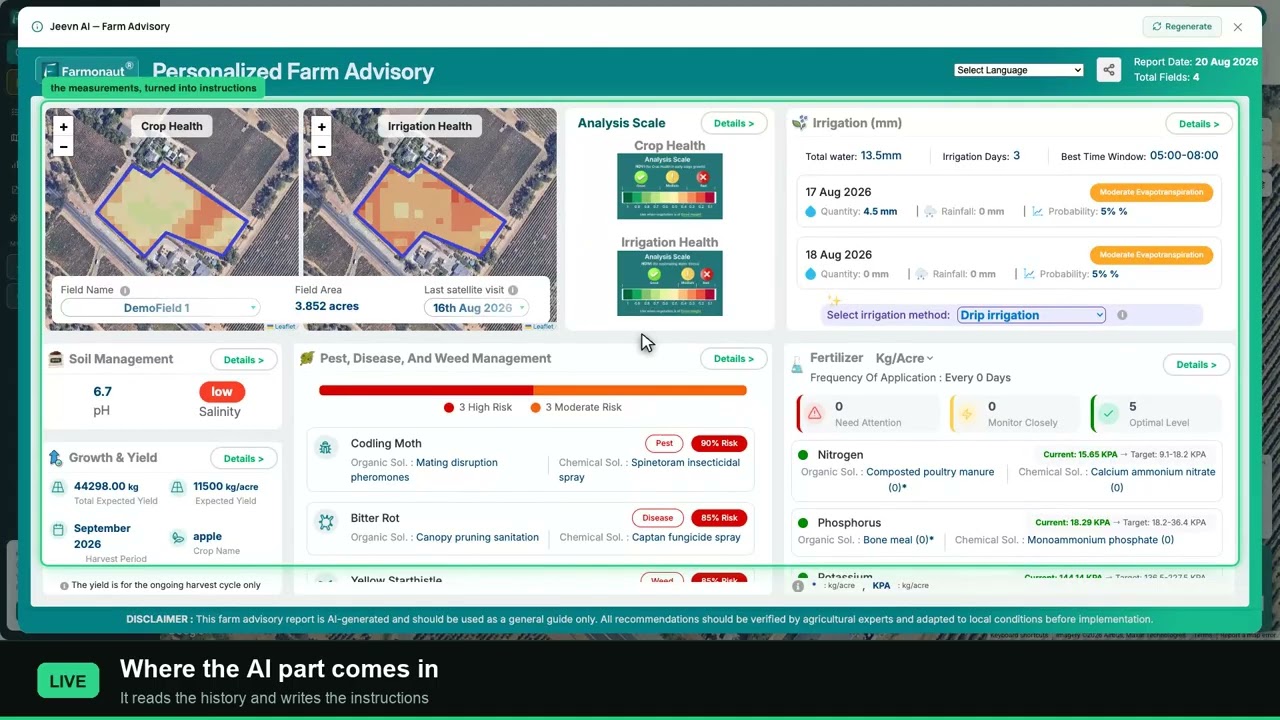
▶ The real advantages and disadvantages of precision agriculture, shown on an actual field. · 2:39
FAQ
What are the advantages and disadvantages of intensive farming?
Advantages: higher yield per hectare, less land per tonne, better use of inputs when well managed, predictable supply, and a good fit for high-value crops. Disadvantages: water pollution, soil and disease pressure, high costs, system failure risk, and harm to wildlife and animal welfare.
What is the main difference between intensive and extensive farming?
Intensive farming uses more inputs per hectare to get more output per hectare. Extensive farming uses more land with fewer inputs. A related labor-heavy form on small plots is explained in our guide to intensive subsistence farming by region.
What crops suit intensive farming?
Crops with high value per hectare suit it well, such as vegetables, salad greens, berries, orchard fruit and flowers. Grain and oilseed crops can also be grown intensively where land, rain or irrigation and prices support the extra input cost.
Is intensive farming bad for the environment?
It can be. European data link high-input farming to water pollution and bird declines. It can also save land by producing more per hectare, as the PNAS estimate shows. The result depends on input rates, management and whether the land saved actually stays out of farming.
Does hydroponics use less water?
Per kilogram of crop, it can use far less. The Arizona lettuce study found about 13 times less water, along with 82 times more energy. Treat those as results for that one modelled case.
Farmonaut crop monitoring
See your own fields from space
Draw your fields once and Farmonaut shows satellite vegetation maps through the season, on web, Android or iOS.




Keep reading

Sources
- USDA ERS, Agricultural Productivity in the US: Summary of Recent Findings (updated August 2026): ers.usda.gov
- USDA ERS, Agricultural Productivity in the United States: ers.usda.gov
- Rigal et al., Farmland practices are driving bird population decline across Europe, PNAS (2023): pmc.ncbi.nlm.nih.gov
- Barbosa et al., Comparison of land, water and energy requirements of lettuce, IJERPH (2015): pmc.ncbi.nlm.nih.gov
- Seufert et al., Comparing the yields of organic and conventional agriculture, Nature (2012): nature.com
- Stevenson et al., Green Revolution research saved an estimated 18 to 27 million hectares, PNAS (2013): pmc.ncbi.nlm.nih.gov
- Borrelli et al., Global impact of land use change on soil erosion, Nature Communications (2017): nature.com
- USDA ERS, Hogs and Pork: Sector at a Glance: ers.usda.gov
- European Commission, Nitrates: environment.ec.europa.eu
- US Geological Survey, Nitrogen and water: usgs.gov
- European Environment Agency, Pesticides in rivers, lakes and groundwater in Europe (2025): eea.europa.eu
- SARE, Building Soils for Better Crops, Ch 11: sare.org
- WHO, Antimicrobial resistance fact sheet: who.int
- European Medicines Agency, Antimicrobial resistance in veterinary medicine: ema.europa.eu
- US EPA, Animal Feeding Operations: epa.gov
- Our World in Data, How many animals are factory-farmed?: ourworldindata.org
- World Bank, Cereal yield (AG.YLD.CREL.KG): data.worldbank.org
- World Bank, Fertilizer consumption (AG.CON.FERT.ZS): data.worldbank.org
Discussion
Questions, corrections or field experience? Share them below. First-time comments are reviewed before they appear, and your email is never published.
No comments yet. Be the first to add a question or your experience.

 Messina Beej
 Dirks Bros Farms
 Red August Group
 Farm Inc
 WeMe Global
 Agrotoken
 Blue BearX
 Insignito
 Croptimum
 DnCubed
 Field Capacity
 Indosistim Teknologi
 Liquify Digital
 CU Foods
 BeyondTech Global
 Rouge VC
 AgroGreen Dynamics
 AgroRisk

 Licence holder · Niger · Gold
 Client · Tanzania · Gold










