

Aquaponics · Setup and fish guide
Vertical Aquaponic System: NFT Setup and 5 Best Fish
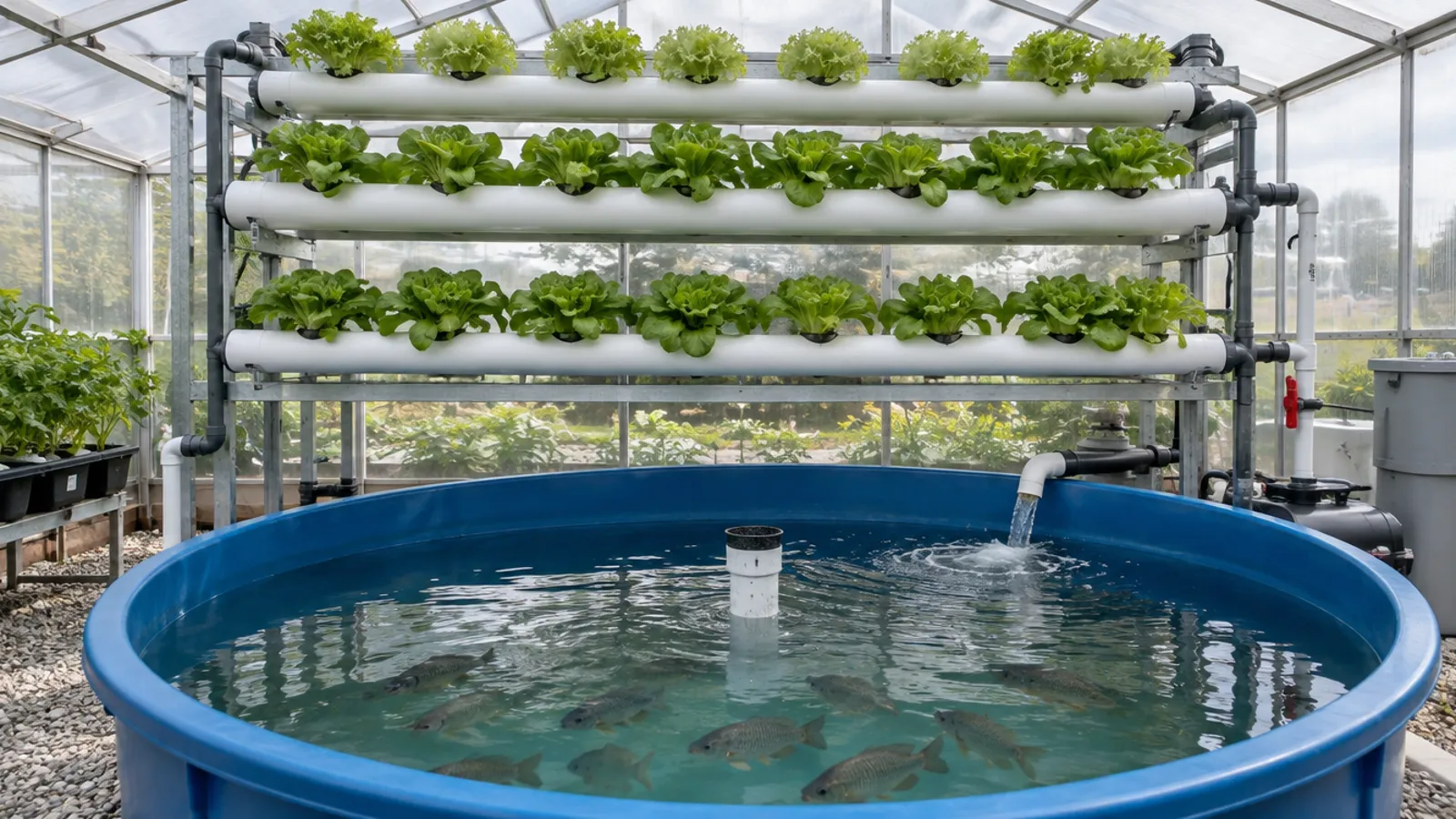
A vertical aquaponic system pumps fish water up through stacked NFT channels and back down. Size it by feed: for NFT, SRAC 454 suggests about 15–25 g of feed per m² of plants per day, a quarter of the raft rate; FAO’s 40–50 g is a raft figure. Tilapia suit warm water, trout cold, catfish beginners, and koi hobby growers.
Key takeaways
- Balance the system by feed: for NFT channels, start at about 15–25 g of feed per m² per day, roughly 25% of the 60–100 g raft rate (SRAC 454). FAO’s 40–50 g for leafy greens and 50–80 g for fruiting crops are raft figures (FAO, 2014).
- Small units should stay at or below 20 kg of fish per m³ of water (FAO); the UVI commercial raft system harvested Nile tilapia at 61.5 kg/m³ with heavy aeration and solids removal.
- NFT pipes need 1–2 litres per minute each, about 1% slope and a length of 12 m or less, plus separate solids and bio-filters (FAO).
- Target water: pH 6–7, 18–30 °C, dissolved oxygen 5–8 mg/L, ammonia and nitrite near zero, nitrate 5–150 mg/L (FAO).
- Tilapia need an exotic species permit in Texas ($263 application fee). Mozambique and spotted tilapia are restricted in Queensland; check the state list before stocking any tilapia, and check your local rules elsewhere.
In this article
- How a vertical aquaponic system works
- NFT system aquaponics: what changes with thin-film channels
- Best fish for a vertical aquaponic system, ranked
- Stocking density: how many fish per tank
- Permits and rules before you buy fish
- Fish-to-plant ratio: size the system by feed
- Water quality ranges for aquaponics
- How to set up a vertical NFT aquaponic system
- Vertical aquaponic system costs: setup and running
- Where satellite monitoring fits, and where it does not
- How we checked the numbers
- FAQ
A vertical aquaponic system stacks plant channels or towers above a fish tank, so one pump moves fish water up through the plants and lets it drain back down. You size it by fish feed, not by fish count: the FAO aquaponics manual (Technical Paper 589) suggests 40–50 g of feed per square metre of leafy greens per day. Tilapia suit warm water, rainbow trout suit cold water, channel catfish forgive mistakes, and koi or goldfish suit growers who do not want to eat their fish.
This guide explains how NFT (nutrient film technique) works in aquaponics, ranks five fish by how easy they are to keep, gives stocking densities from FAO and the University of the Virgin Islands (UVI), lists water quality ranges, and walks through setup steps and dated costs. It also has a calculator that turns your plant area into a daily feed amount, a fish biomass and a tank density, plus permit notes for Texas, Florida and Queensland.
How a vertical aquaponic system works
Aquaponics joins two things: raising fish in tanks (recirculating aquaculture) and growing plants without soil (hydroponics). The water carries nutrients from one to the other in a closed loop.
- Fish eat and excrete. Fish feed is the only real input. Fish release ammonia through their gills and in their waste.
- Solids come out. A mechanical filter or settling tank removes solid waste before it clogs roots.
- Bacteria convert ammonia. Nitrifying bacteria in a biofilter turn ammonia into nitrite and then nitrate, which plants can use.
- Plants take up nitrate. Roots in the channels absorb nitrate and other nutrients, which cleans the water.
- Water returns. The cleaned water flows back to the fish tank and the loop starts again.
The vertical part is about layout. Instead of one wide bed, growers stack NFT pipes on a rack, run zig-zag channels down a wall, or hang towers. The plant area per square metre of floor goes up, but the pump has to lift water higher, and the top and bottom layers get different light.

▶ Why raising animals and crops together pays off: the same idea behind fish waste feeding plants in aquaponics. · 2:55
NFT system aquaponics: what changes with thin-film channels
In NFT, plants sit in holes along a closed pipe or gully. A shallow stream of water runs along the bottom, wets the roots and drains out the low end. The roots get air from the space above the film. NFT is light and holds little water, which is why the FAO manual calls it the best method for rooftops and a good fit for herbs and leafy greens.
NFT also has weak points that matter more in aquaponics than in hydroponics:
- It needs its own filters. NFT pipes have no gravel to trap solids, so a mechanical separator and a separate biofilter are needed. SRAC Publication 454 (Rakocy, Masser and Losordo, 2006) notes that NFT aquaponic systems may need a separate biofilter because the channels give bacteria little surface.
- Roots can block the flow. Dense roots and organic matter can dam the film and create zones with no oxygen. FAO warns that tomatoes and mint can clog even large pipes.
- Small water volume means fast swings. Less water buffers less, so temperature and water quality change faster, and a power cut hurts sooner.
- Lower feed rates. SRAC 454 says the feeding rate ratio for NFT should be cut in proportion to the smaller water volume, and suggests gravel and NFT systems use about 25% of the raft ratio (roughly 15–25 g per m² per day against 60–100 g). Start low and adjust by nitrate tests.
NFT channel settings
FAO gives these working numbers for small NFT aquaponic units:
- Flow of 1–2 litres per minute into each grow pipe.
- Pipe length of 1–12 m. In longer pipes, plants at the far end can run short of nutrients.
- A slope of about 1 cm per metre (1%), set with shims at the end away from the fish tank.
- White pipes, which reflect sun and keep the root zone cooler, or flat hydroponic gullies about 10 cm wide and 7 cm high.
Hydroponic guides allow steeper channels. A Cornell CEA article by Neil Mattson (2016) describes lettuce NFT channels sloped at 1–4% toward a drain.
NFT, raft and media beds compared
| Method | Strengths (FAO) | Weak points (FAO) | Best for |
|---|---|---|---|
| NFT pipes | Light, little evaporation, least water, easy harvest, spacing can change | Needs pumps and separate filters, inlets clog, vulnerable to power cuts | Leafy greens and herbs, rooftops, stacked racks |
| Raft (DWC) | Large water volume damps swings, cost-effective at scale | Very heavy, needs high dissolved oxygen | Commercial lettuce and basil |
| Media bed | Filters solids, simple for beginners, supports tall crops | Heavy, media can clog at high fish density, more evaporation | Home units, fruiting crops |
A peer-reviewed meta-analysis of lettuce yields in controlled environments (2023) found NFT studies tended to yield less than other delivery methods, because roots touch less water, but NFT is still used for its higher water-use efficiency. The same review found stacked vertical systems averaged 6.88 kg of lettuce per m² per crop, against 3.68 kg/m² for all controlled-environment studies.
Best fish for a vertical aquaponic system, ranked
We ranked five fish by how forgiving they are for a small NFT unit: tolerance of poor water, temperature needs, how fast they reach harvest size, and the rules around keeping them. Your climate and local law can change the order.
1. Tilapia
Best for: warm greenhouses, heated indoor rooms and growers who want food fish fast.
FAO lists Nile tilapia reaching 600 g in 6–8 months, with an ideal water temperature of 27–30 °C (81–86 °F). Tilapia resist many diseases and handle stress well. They stop feeding below 17 °C (63 °F) and die below 12 °C (54 °F), so unheated tanks in cold winters will not work. Mixed-sex tilapia breed in the tank from about five months, so FAO advises harvesting females first. The UVI commercial system stocked all-male tilapia (SRAC 454).
Watch out: tilapia are an exotic species in many places and need a permit (see the permits section below).
2. Channel catfish
Best for: beginners who want a hardy warm-water fish.
FAO calls catfish an extremely hardy group that tolerates wide swings in oxygen, temperature and pH. Channel catfish reach about 400 g in 9–10 months, with an optimal temperature of 24–30 °C (75–86 °F). They live near the tank floor, so a wide, shallow tank suits them better than a tall one, and some growers add a species that uses the upper water.
3. Rainbow trout
Best for: cool climates, basements and winter production in the northern US, Canada, the UK and northern Europe.
Trout prefer 10–18 °C (50–64 °F), with an optimum near 15 °C (59 °F). Growth falls sharply above 21 °C (70 °F). FAO lists rainbow trout reaching 1,000 g in 14–16 months on a feed with about 42% protein. That high-protein feed puts more nitrogen into the water per gram, which supports more leafy greens. The trade-off: trout need better water than tilapia or carp, with more than 6 mg/litre of dissolved oxygen and very low ammonia, plus backup air and water pumps.
4. Koi and goldfish (ornamental)
Best for: home growers, schools and anyone who wants vegetables but not fish dinners.
FAO notes that koi and goldfish tolerate a wide range of water conditions and can sell to aquarium stores for more than food fish fetch. FAO lists common carp, the species koi belong to, with an optimal range of 25–30 °C. Koi were the ornamental fish raised on the most farms in the USDA 2023 Census of Aquaculture (138 US farms). Koi are common carp, so Queensland’s carp rules cover them.
5. Barramundi
Best for: warm, well-equipped commercial systems, and Australian growers who cannot keep tilapia.
FAO lists barramundi reaching 400 g in 9–10 months, with an optimal temperature of 26–29 °C and a feed of 38–45% protein.
Fish facts at a glance
| Fish | Optimal water | Grow-out (FAO) | Dissolved oxygen | Feed protein |
|---|---|---|---|---|
| Nile tilapia | 27–30 °C | 600 g in 6–8 months | above 4 mg/L | 28–32% |
| Channel catfish | 24–30 °C | 400 g in 9–10 months | above 3 mg/L | 25–36% |
| Rainbow trout | 14–16 °C | 1,000 g in 14–16 months | above 6 mg/L | 42% |
| Common carp, koi | 25–30 °C | 600 g in 9–11 months | above 4 mg/L | 30–38% |
| Barramundi | 26–29 °C | 400 g in 9–10 months | above 4 mg/L | 38–45% |
Source for every row: FAO Technical Paper 589, Table 7.1 (2014). Growth rates assume good conditions.
Chart
Optimal water temperature by fish
°C, optimal grow-out range for five aquaponic species
Stocking density: how many fish per tank
Stocking density is the weight of fish per cubic metre of tank water. It depends on how well you remove solids and add oxygen, so small and commercial numbers differ a lot.
- Small units (FAO): keep total fish weight at or below 20 kg/m³ (about 0.17 lb per gallon). Above 15 kg/m³, or above 50 g of feed per m² of plants per day, FAO says extra mechanical filtration is needed. Low-density units run at 1–5 kg/m³.
- Commercial raft system (UVI): SRAC 454 reports harvest densities of 61.5 kg/m³ (0.51 lb/gal) for Nile tilapia and 70.7 kg/m³ (0.59 lb/gal) for red tilapia in the UVI system, with strong aeration and solids removal.
- Catfish: FAO says catfish can be held at up to 150 kg/m³, but only with filtration far beyond a small unit.
Chart
Fish density: small units vs a commercial system
kg of fish per m³ of tank water; FAO upper limits for small units vs UVI harvest densities
Permits and rules before you buy fish
Many aquaponic fish are non-native, and states and countries control who may keep them. Check before you order fingerlings. This section is a summary, not legal advice: confirm with the agency named and follow local rules.
- Texas: Texas Parks and Wildlife requires an Exotic Species Aquaculture Permit to culture tilapia. The application (form revised September 2021) lists a $263 fee, must arrive at least 30 days before any activity, needs a copy of a state wastewater discharge permit or water quality authorization, and requires a physical facility ready for inspection. The AgriLife Extension pond guide on tilapia adds that blue and Nile tilapia need the exotic species permit, Mozambique tilapia do not need one for pond stocking, and other tilapia species are not permitted in Texas.
- Florida: a UF/IFAS publication (FA195, 2016) explains that anyone doing aquaculture with any sales needs an Aquaculture Certificate of Registration from the Florida Department of Agriculture and Consumer Services (then $100 a year, expiring each 30 June) and must follow aquaculture best management practices.
- Queensland, Australia: tilapia and carp are restricted noxious fish under the Biosecurity Regulation 2016 (the list names Mozambique and spotted tilapia, and carp, Cyprinus carpio, which includes koi). They must not be kept, given away, sold or released, so Queensland growers use other species.
- Other places: Texas A&M advises checking with a county extension agent in other states. In Canada, the UK and Europe, ask your provincial or national fisheries agency. FAO adds that non-native fish should never be released into local waters.
Fish-to-plant ratio: size the system by feed
The most useful number in aquaponics is the feed rate ratio: grams of fish feed added per day for each square metre of plant growing area. It ties the fish, bacteria and plants together. The FAO manual gives:
Chart
Feed rate ratio by crop and system
grams of fish feed per m² of plant area per day, recommended ranges
- Leafy greens: 40–50 g of feed per m² per day.
- Fruiting crops such as tomatoes and cucumbers: 50–80 g per m² per day, because flowers and fruit need about a third more nutrients.
Those figures assume a standard feed with 32% protein; lower-protein feeds can be fed at higher rates. For commercial raft systems, SRAC 454 gives a higher range of 60–100 g per m² per day. The UVI commercial unit had 2,304 sq ft of plant area and 314 sq ft of fish-tank surface, a ratio of 7.3 to 1.
Once you know the daily feed, you can work out the fish. FAO says grow-out fish eat 1–2% of their body weight per day. So 135 g of feed a day supports about 7–13.5 kg of fish. Water tests then tell you if the balance is right: FAO notes that high ammonia or nitrite means the biofilter is too small, and low nitrate means too many plants or too few fish.
Plants also need nutrients that fish feed does not supply in full. SRAC 454 reports that the UVI system added chelated iron to about 2 mg/litre, and added potassium and calcium as potassium hydroxide and calcium hydroxide, which also raise pH. Follow the product label and local rules for any supplement you add.
Try the numbers for your own farm below.
Calculator
How much feed and fish does your plant area need?
Enter your own plant area, feed rate ratio, tank size and fish harvest weight.
- Fish biomass the feed supports: 4.0 kg
- Tank density: 4.0 kg/m³
- Fish at harvest weight: 8 fish
- Feed per month: 1.8 kg
- Plant area in square feet: 32 ft²
Example values only, not a benchmark or a forecast; the 20 g/m²/day default is an example NFT starting point. Feed rate ratio guide: 40–50 g/m²/day for leafy greens and 50–80 g/m²/day for fruiting crops (FAO Technical Paper 589, 2014, assuming 32% protein feed); SRAC 454 (2006) suggests NFT and gravel systems use about 25% of its 60–100 g/m²/day raft ratio, because they hold less water. Fish eat about 1–2% of body weight per day in grow-out (FAO). FAO suggests staying at or below 20 kg/m³ in small units. The square-foot line uses 1 m² = 10.764 ft².
Water quality ranges for aquaponics
Fish, plants and bacteria each have their own best range, so aquaponics runs at a compromise. These are FAO’s target ranges for the whole system:
| Parameter | Target range (FAO) | What to do if off |
|---|---|---|
| pH | 6–7 | Add a base such as calcium or potassium carbonate if low |
| Water temperature | 18–30 °C (64–86 °F) | Match the fish: trout need 14–16 °C, below this range |
| Dissolved oxygen | 5–8 mg/L | Add air stones, keep a battery backup air pump |
| Ammonia | 0 mg/L (toxic above 1) | Stop feeding, check the biofilter |
| Nitrite | 0 mg/L (harmful from 0.25) | Check the biofilter and oxygen |
| Nitrate | 5–150 mg/L | Exchange some water above 150 mg/L |
| Carbonate hardness | 60–140 mg/L | Buffer to stop pH crashes |
Commercial systems sometimes run at the high end of pH. SRAC 454 says the UVI system kept pH near 7.0 as a balance between nitrification and nutrient uptake, and that biofilters work best at 77–86 °F with a pH of 7.0–9.0. FAO explains that pH is the most important water factor for plants because it controls their access to nutrients, which is one reason it aims for slightly acidic water.
Water use is low once the loop is running. In FAO’s worked example of a 1,500-litre home unit, top-up water averages about 1% of the system volume per day, to replace evaporation, plant uptake and sludge removal.

▶ Seven green farming technologies ranked, including ways to save water and fertilizer. · 2:24
How to set up a vertical NFT aquaponic system
- Check the law first. Confirm which fish you may keep and whether selling fish or vegetables needs a licence.
- Pick the fish for your water temperature. Warm room or greenhouse: tilapia or catfish. Cool basement or northern winter: trout. No food fish: koi or goldfish.
- Decide the plant area. FAO suggests 20–25 leafy plants per m² or 4–8 fruiting plants per m². Count the area of all stacked channels.
- Size the feed and fish. Multiply plant area by 40–50 g per m² per day for greens, then use the calculator below to get fish weight and tank density.
- Build the water path. Fish tank, mechanical filter, biofilter and sump, then a pump to a manifold that feeds each NFT pipe. Support racks and stacked channels must carry the weight of water and plants.
- Set flow and slope. Aim for 1–2 litres per minute per pipe and about 1% slope, and keep pipes 12 m or shorter.
- Cycle the system before adding fish. Add an ammonia source and test until ammonia and nitrite fall to zero and nitrate appears. FAO covers this “cycling” step in its Chapter 5.
- Stock fish and plant seedlings. Start below your target density, test water often, and add backup aeration for power cuts.
Vertical aquaponic system costs: setup and running
Few public sources give costs for a stacked NFT aquaponic unit, so the best dated figures come from FAO’s small media-bed example and the UVI commercial system. Treat them as guides, not quotes.
Chart
US farm sales by fish type
$ million, 2023; food fish species plus all ornamental fish
- Build cost: FAO puts materials for a small unit with 3 m² of plants and a 1,000-litre fish tank at USD 700 (estimated prices in Israel, Technical Paper 589, 2014).
- Running cost: the same unit costs about USD 26.45 a month. The biggest item is 4.5 kg of fish feed at USD 2.50 per kg (USD 11.25), then fingerlings (USD 5), seedlings (USD 3.50), test kits and pH adjusters (USD 3), electricity for a 30 W water pump and a 5 W air pump (25 kWh at USD 0.10, so USD 2.50) and water (USD 1.20). Swap in your local prices.
- Output and payback: FAO estimates 360 lettuce heads, 54 kg of tomatoes and 30 kg of fish a year, worth about USD 758 at 2013 Israeli market prices, for a 19-month payback. FAO says this unit is meant for home food, not income.
- Commercial scale: SRAC 454 reports a break-even price of $1.47 per pound for UVI tilapia in the US Virgin Islands against a sale price of $2.50, from studies there. The UVI unit can produce about 11,000 lb of tilapia and 1,400 cases of lettuce a year.
The plants often carry the business. FAO notes estimates from commercial units, mainly in the West, that up to 90% of the money can come from plants, because vegetables turn over faster than fish. For fish prices in the US, the 2023 Census of Aquaculture reported food-size tilapia sold at an average of $3.19 per pound at the farm (USDA NASS, December 2024).
A vertical layout adds cost for racks, a stronger pump to lift water and, indoors, grow lights. Get local quotes for these before you commit, and check your local power price before you add lights.

▶ Ten low-cost farm business ideas, including hydroponic farming and microgreens. · 8:32
Where satellite monitoring fits, and where it does not
Satellites cannot see inside a fish tank or a stacked rack, so they are not a tool for daily aquaponics checks. Satellite crop maps help if you also farm outdoor fields next to your greenhouse: the Farmonaut Satellite + AI Farm Monitoring System shows vegetation health maps for those fields, and the Farmonaut API and API developer docs let developers add satellite and weather data to their own dashboards.
Related pages on our site: Farmonaut home, large-scale farm management tools, fleet management, carbon footprinting, product traceability, crop loan and insurance, farming infrastructure.
How we checked the numbers
We took design ratios, water quality ranges and fish growth data from FAO Technical Paper 589 (2014) and commercial figures from SRAC Publication 454 (2006), which reports the UVI system. US fish sales and prices come from the USDA NASS 2023 Census of Aquaculture (December 2024). Permit details come from the agencies’ own forms and pages, or from university extension, as dated in each line. We ranked fish by tolerance of poor water, temperature needs, time to harvest and legal limits; we did not test them ourselves. Costs are dated and from the places named, so expect your local prices to differ.
For a closer look at a related question, see our guide: NFT Hydroponic System: Sustainable, Solar & CF Hydroponics.
FAQ
What is the best fish for NFT aquaponics?
For a warm system, tilapia are the usual choice: FAO lists Nile tilapia reaching 600 g in 6–8 months at 27–30 °C. For cold water, rainbow trout. For beginners, channel catfish, which FAO calls extremely hardy. Check your local rules first: tilapia need a permit in places such as Texas, and Mozambique and spotted tilapia are restricted in Queensland; check the state list before stocking any tilapia.
How many fish do I need per square metre of plants?
Size by feed. For NFT, SRAC 454 suggests about 25% of the raft rate, roughly 15–25 g of feed per m² of plants per day; FAO’s 40–50 g per m² for leafy greens is a raft figure. Fish eat 1–2% of their body weight daily, so each m² of NFT channel needs roughly 0.75–2.5 kg of fish. The calculator above does the sum for your own numbers.
What slope should NFT channels have in aquaponics?
FAO uses about 1 cm of drop per metre of pipe (1%) with a flow of 1–2 litres per minute per pipe. Cornell describes hydroponic lettuce channels at 1–4%. Keep pipes no longer than 12 m so plants at the far end still get nutrients.
Can a vertical aquaponic system run indoors?
Yes, with grow lights, steady water temperature for your fish and backup aeration. Trout can suit a cool basement, while tilapia need heated water.
Do I still need to add nutrients?
Often, yes. SRAC 454 reports that the UVI system added chelated iron and also potassium and calcium, which fish feed did not supply in full. Test the water, add only what is short, and follow the product label.
Farmonaut crop monitoring
Watch your outdoor fields from space
If you also farm open fields, Farmonaut shows satellite vegetation maps for each field through the season, on web, Android or iOS.




Keep reading

Sources
- FAO, Small-scale aquaponic food production: Integrated fish and plant farming, Fisheries and Aquaculture Technical Paper 589 (2014): fao.org
- Rakocy, Masser and Losordo, Recirculating Aquaculture Tank Production Systems: Aquaponics, SRAC Publication 454 (2006), Oklahoma Cooperative Extension: pods.okstate.edu
- USDA NASS, 2022 Census of Agriculture Highlights: Results from the 2023 Census of Aquaculture (December 2024): data.nass.usda.gov
- USDA NASS, 2023 Census of Aquaculture, full report (Tables 2 and 13, December 2024): data.nass.usda.gov
- Texas Parks and Wildlife Department, Exotic Species Aquaculture Permit Application, PWD 1026 (rev. 09/21): tpwd.texas.gov
- Texas A&M AgriLife Extension, Grass Carp and Tilapia: fisheries.tamu.edu
- Tuckett et al., Preventing Escape of Non-Native Species from Aquaculture Facilities in Florida, Part 1, UF/IFAS EDIS FA195 (2016): edis.ifas.ufl.edu
- Queensland Government, Your legal obligation for invasive freshwater animals: qld.gov.au
- Mattson, Leafy greens in hydroponics, Greenhouse Product News, Cornell CEA (October 2016): cea.cals.cornell.edu
- Let-Us Investigate: A Meta-Analysis of Influencing Factors on Lettuce Crop Yields within Controlled-Environment Agriculture Systems, Plants (2023): pmc.ncbi.nlm.nih.gov
Discussion
Questions, corrections or field experience? Share them below. First-time comments are reviewed before they appear, and your email is never published.
No comments yet. Be the first to add a question or your experience.

 Oath Inc
 Reddane Farming
 Esri North East Africa
 Farmer Amigo
 Cresol
 Atur Kuliner
 MDCV UK
 Zerella Group
 Etech Consulting Madagascar
 Vestlandsforsking
 Agritein
 Delicio
 WB Dev
 Sama Premium
 Prochecker
 Tres Valles
 LACOS Geoinformation
 Magrifly
 LatConnect 60
 Blickwinkel
 Agricultural Credit Policy Council

 Exploration consultancy · South Africa · Gold
 Licence holder · Niger · Gold
 Licence holder · Nigeria · Gold + lithium










