

Poultry · Equipment buyer guide
Poultry Farming Equipment: List, Costs and How to Choose
A small flock needs a brooder, housing with fans and light, feeders, waterers, fencing and biosecurity gear. Here are dated costs from a 2026 Canadian farm budget and the US NRCS cost list, space rules per bird, and a calculator for one batch of broilers.
Key takeaways
- A 2026 KPU budget for a 500-bird pasture broiler batch in British Columbia priced shelters, brooder gear, fan, netting and waterers at about C$16,240 new.
- NRCS Pennsylvania FY 2026 EQIP payment rates for high-efficiency exhaust fans run from $893.12 (under 36 inches) to $2,055.62 (48 inches or more); these are cost-share rates, not shop prices.
- NMSU Extension suggests 1 sq ft per chick, 2 sq ft per pullet and 2.5 to 3 sq ft per laying hen.
- US table-egg layers lost 151.2 million birds to avian influenza from February 2022 to April 2026, so low-cost biosecurity gear matters.
- A University of Vermont Extension budget, published by Cornell Small Farms, found that each $100 per ton rise in feed price adds about $0.20 per pound to broiler cost.
In this article
- Poultry farming equipment list for a small flock
- How we checked the costs
- Brooding equipment for chicks
- Housing, ventilation and lighting
- Feeders, waterers and space per bird
- Pasture and mobile poultry systems
- What poultry farming equipment costs
- Will poultry equipment pay for itself?
- Biosecurity equipment and rules
- Egg and broiler markets to watch
- Tax, grants and cost-share help
- How to choose affordable poultry equipment
- FAQ
A small poultry farm needs six groups of equipment: a brooder with a heat source, housing with ventilation and light, feeders, waterers, fencing or a mobile shelter, and simple biosecurity gear. In a 2026 budget for a 500-bird pasture broiler batch in British Columbia, the bird shelters, brooder heater, lamp, fan, netting and waterers together cost about C$16,240 new, and the shared brooder house (C$10,000) was the largest single item (KPU Institute for Sustainable Food Systems, 2026).
This guide lists the poultry farming equipment a starter or small commercial flock needs, with dated costs from university budgets and a US government cost list. It also gives space rules per bird, a chart of what fans and heaters are worth under a cost-share program, and a calculator that tests whether one batch of broilers covers its equipment share.
Poultry farming equipment list for a small flock
The list below is ordered by when you need each item. Chicks arrive first, so the brooder comes first. The rest follows as birds grow.
- Brooder and heat source. Keeps chicks warm for the first weeks. Best for: every flock that starts from day-old chicks.
- Brooder guard and thermometer. A low ring that keeps chicks near the heat, and a simple way to check the temperature. Best for: the first week.
- Chick feeders and drinkers. Small, low units that chicks can reach. Best for: weeks one to four.
- Grower feeders and waterers. Larger hanging or trough units; set waterers at shoulder height. Best for: growing and adult birds.
- House or coop. A fixed barn, a converted shed or a movable shelter. Best for: all flocks; the type depends on your system.
- Ventilation fan. Removes moisture, heat and ammonia. Best for: closed houses and warm months.
- Lights. LED fixtures for a light-dark cycle. Best for: laying hens in short winter days and chicks in the brooder.
- Roosts and nest boxes. Best for: laying flocks.
- Fencing. Electric netting with an energizer, or a fenced yard. Best for: pasture and free-range flocks.
- Feed storage. Bins or a dry room that keep rats and mice out. Best for: any flock that buys feed in bulk.
- Biosecurity kit. Boots or boot covers kept for the barn, a foot bath, cleaning tools and a visitor log. Best for: every flock.
A small flock does not need all of this from a store. New Mexico State University notes that anyone who can use a hammer and saw can build feeders, waterers and other gear, and that homemade equipment can be as good as bought equipment (NMSU Extension, Small Poultry Flock Management). The same guide says a separate brooder house is rarely needed for a small flock.

▶ Ten small agriculture businesses, including keeping hens, and what each needs to start. · 6:03
How we checked the costs
We used three types of numbers and kept them apart. First, purchase prices from a published enterprise budget: the pasture-raised poultry budget from Kwantlen Polytechnic University (KPU) and the Small-Scale Meat Producers Association, dated May 2026. Its prices are in Canadian dollars and are budget assumptions, not dealer quotes. Second, the US Natural Resources Conservation Service (NRCS) Pennsylvania cost list for fiscal year 2026. Those numbers are payment rates for the EQIP cost-share program, not shop prices. They show what the agency pays per item, which is usually a share of the real cost. Third, small-flock guidance on space, heat and light from university extension services.
We did not use prices from online shops, because they change each week and differ by country. Treat every number here as a planning guide, and get quotes from local dealers before you buy.
Brooding equipment for chicks
Chicks cannot keep themselves warm at first. A brooder is usually a heat source under a canopy, or hover, that keeps heat close to the chicks. Electric, gas and oil brooders are common, and a small infrared lamp warms only what its light falls on, so it does not waste heat on the whole building (NMSU Extension).
NMSU gives these working rules for a small brooder:
- Start at 90 to 95°F, measured 2 inches above the floor at the edge of the hover, and lower it by about 5°F each week.
- Hang a heat lamp by a chain, never by its cord, and keep it at least 18 inches above the litter.
- Raise the lamp about 2 inches a week until it is about 2 feet above the litter.
- Put a 12-inch brooder guard about 2 feet from the hover for the first five or six days.
- Try the brooder a day or two before chicks arrive, and preheat for two to three days in very cold weather.
Watch the chicks. If they crowd under the heat, they are cold. If they move to the edges, they are too warm. A low-cost “feather brooder” with fabric strips can work for small batches without a heater, but it must sit in a room that stays at 70 to 75°F.
In the KPU budget, a propane brooder heater costs C$300 and an LED brooder lamp C$120, each with a useful life of about ten years. The brooder house in that budget is a repurposed shipping container, shared with other farm uses, so only 15% of its cost is charged to the poultry.
Housing, ventilation and lighting
Housing is often the biggest equipment cost. A fixed house suits layers and year-round flocks. A movable shelter suits pasture broilers that move to fresh grass. A converted shed or barn is often the cheapest start, as long as it is dry, draft-free and can be closed against predators.
Ventilation fans
Birds give off heat and moisture, and litter gives off ammonia. Fans remove both. Fan size depends on the house. The NRCS Pennsylvania cost list for fiscal year 2026 sets payment rates for high-efficiency exhaust fans of $893.12 for fans under 36 inches, $1,440.12 for 36 to 47 inches, and $2,055.62 for fans of 48 inches or more (NRCS Pennsylvania, FY 2026 EQIP cost list). A small pasture budget, in contrast, uses a single C$200 fan.
Heating the house
The same NRCS list pays $563.56 for each radiant brooder and $1,920.04 for each radiant tube or quad heater, and $0.68 per square foot for radiant heating of a poultry house. Radiant heat warms birds and floor, not the air, which is why the program treats it as an energy-saving practice.
Lighting
Laying hens lay less in winter, when days are short. NMSU says added all-night light helps small flocks lay and suggests, as a rough guide, a 60-watt bulb for each 200 square feet of floor. The NRCS list pays $188.31 for each LED fixture of 80 watts or more, and $58.69 for one of 20 to 40 watts.
Feeders, waterers and space per bird
Crowding is one of the worst problems for chicks, NMSU warns, and can lead to pecking and cannibalism. Plan equipment by the number of birds, not by the size of the box it comes in.
| Bird | Floor space | Other space |
|---|---|---|
| Chick | 1 sq ft | 6 sq in under a feather brooder |
| Pullet, 8+ weeks | 2 sq ft | Fenced yard if possible |
| Laying hen | 2.5 to 3 sq ft | 6 in roost, 4 in feeder, 2 in drinker |
Source: NMSU Extension, Circular 477.
Feeders work best when half the chicks can eat at once. After the first two days, fill them no more than half full, because chicks waste feed from a full feeder. Set waterers at the shoulder height of the birds to keep litter dry, and rinse them every day. NMSU also shows a simple layer feeder made from PVC pipe, a good example of affordable poultry equipment you can build from parts you may already own.
Feed is the largest running cost, so feed prices move margins fast. A University of Vermont Extension budget published by Cornell Small Farms worked out that each $100 per ton rise in feed price adds about $0.20 to the cost of each pound of finished broiler meat (Cornell Small Farms, The Finances for a Small Organic Broiler Flock). That study is older and based on Vermont organic flocks, but the link between feed price and cost per pound still holds.
Pasture and mobile poultry systems
Pasture flocks swap a fixed barn for movable housing and fencing. In the KPU budget, the movable housing costs C$4,500 and lasts about five years, electric netting C$800 and its energizer C$300. Birds spend four weeks in the brooder and four weeks on pasture in that model.

▶ The gains and costs of mixing crops and livestock, including using manure as fertilizer. · 2:55
Pasture birds also spread manure on the field, which feeds the grass or the next crop. That is one reason many small farms mix poultry with crops or other livestock. The short video below covers the main gains and costs of mixed farming.
Shared equipment lowers the bill. The KPU budget charges only 10% of a tractor, bucket, mower and forks to the poultry, because the rest of the farm uses them too. If you already own a tractor, a trailer or a freezer, your start-up cost can be much lower than a stand-alone farm’s.
What poultry farming equipment costs
The two charts below show the two kinds of numbers side by side. The first shows US cost-share payment rates per item, the second shows Canadian purchase prices from a small-farm budget. Do not add them together: one is what a program pays, the other is what a farm pays.
Chart
NRCS cost-share payment rates for poultry house equipment
US dollars per item, Pennsylvania EQIP, fiscal year 2026 (payment rates, not purchase prices)
A few points stand out. Fans and house heaters are the costly items in a closed barn. In a pasture system, apart from a shared brooder house, the mobile shelter and feed storage cost the most. Small items such as waterers (C$20 in the KPU budget) and brooder lamps are cheap, which is why they are where a new flock owner can safely save money.
The KPU budget also annualizes each item. It spreads the price, less trade-in value, over its useful life and adds 5% interest. That method gave a yearly equipment and infrastructure cost of C$2,164.74 for the whole flock, compared with gross revenue of C$18,900 and net returns of C$2,826.47.
Chart
Purchase prices in a small pasture poultry budget
Canadian dollars per item, new, KPU pasture-raised poultry enterprise budget (May 2026), selected items
Will poultry equipment pay for itself?
The question for a small flock is not only what the gear costs, but whether each batch of birds covers its share. The University of Vermont Extension study, published by Cornell Small Farms in 2013, found that a first-year organic flock of 1,000 broilers left about $5,116 to $6,616 in net cash income, which the authors called a part-time income. It also found that processing at $5.00 instead of $3.50 a bird cut net income by about $1,425, and that a $0.25 per pound change in price moved net income by about $1,113.
Use the calculator to test your own numbers. Enter the birds you start, your expected survival, dressed weight and price, your cost per bird for chicks, feed and processing, and the share of yearly equipment cost you charge to each batch.
Try the numbers for your own farm below.
Calculator
Does one broiler batch cover its equipment share?
Enter your own flock size, prices and costs.
- Sales: $1,710
- Variable costs: $1,500
- Break-even price: 3.98 $/lb
Example values only, not a benchmark or a forecast; every number is your input. The defaults are set near break-even to show how the sum works. Cost per bird should include chick, feed, bedding, processing and other variable costs for each bird started. Equipment share per batch is your yearly equipment cost divided by the batches you raise; the KPU budget (2026) is one way to work out the yearly cost. Check local rules on flock size and processing before you sell meat.
Biosecurity equipment and rules
Disease is a major risk to any flock, and some of the cheapest gear protects against it. The table-egg layer flock in the United States lost 151.2 million birds to highly pathogenic avian influenza between February 2022 and April 2026, according to a USDA outlook summarised by The Poultry Site.
The Canadian Food Inspection Agency standard for on-farm avian biosecurity explains why: a tiny amount of infected material can ride on equipment, clothing, footwear or hands from one flock to the next (CFIA National Avian On-Farm Biosecurity Standard). It sets out controlled access zones and cleaning of premises, equipment and vehicles. A low-cost kit follows the same idea:
- Boots or boot covers that stay at the barn door.
- A foot bath or boot brush with a disinfectant used as the label directs.
- Separate tools for each house, or tools cleaned between houses.
- A sign and a visitor log at the entry.
- Rodent-proof feed bins.
Rules differ by country. In Great Britain, a keeper or vet must report suspected bird flu straight away, even if signs are mild (GOV.UK, Bird flu guidance). In Ontario, farmers can raise up to 300 meat chickens a year without quota, and a separate Artisanal Chicken program has allowed somewhat larger small flocks since 2015, according to Sustain Ontario. Check the rules with your local animal health agency before you buy equipment or birds.
Egg and broiler markets to watch
Market prices decide how fast equipment pays back. US egg prices rose sharply during the bird flu losses and have since fallen. USDA’s Economic Research Service reported an average retail price of $5.12 a dozen in April 2025, down more than a dollar from its March peak (USDA ERS, Chart of Note). By April 2026 the average had fallen to $2.25, as the flock rebuilt (The Poultry Site, reporting USDA).
USDA also expects more eggs. Its May 2026 outlook projected table egg production of 7,827 million dozen for 2026, up 4.4% from 2025, with each quarter higher than the one before. More supply can mean lower prices, so new egg producers should budget at cautious prices.
Chart
US table egg production, projected by quarter
Million dozen, 2026 (Q1 actual, Q2 to Q4 USDA projections, May 2026)
Tax, grants and cost-share help
Two kinds of help can lower the real cost of new gear. In the US, EQIP cost-share pays part of the cost of practices such as efficient fans, radiant heaters and LED lighting, at rates set by each state. The Pennsylvania list above expired on 30 September 2026, so check your own state’s current list with your local NRCS office.
Tax rules also matter. The IRS Farmer’s Tax Guide explains depreciation and the section 179 deduction for farm equipment, and says the most you can elect to deduct for most section 179 property placed in service in 2025 rose to $2,500,000 (IRS Publication 225). It also covers single-purpose agricultural structures, which can include some poultry houses. Tax law changes often, so get advice from a tax professional before you count on any deduction.
How to choose affordable poultry equipment
Cheap equipment that fails or wastes feed is not affordable. Use these steps before you buy:
- Size the flock first. Work out floor, feeder and drinker space from the table above, then buy for that number.
- Spend on heat and air. Brooders and ventilation protect birds and are hard to fix with homemade parts.
- Build or reuse the simple items. Feeders, roosts and nest boxes are easy to make.
- Share machinery. Charge only the poultry’s share of a tractor or vehicle, as the KPU budget does.
- Check energy use. LED lights and efficient fans cut running costs, and may qualify for cost-share.
- Buy easy-to-clean gear. Smooth plastic and metal surfaces are easier to disinfect than bare wood.
- Ask about parts and service. A dealer who stocks spare parts can matter more than a low price.
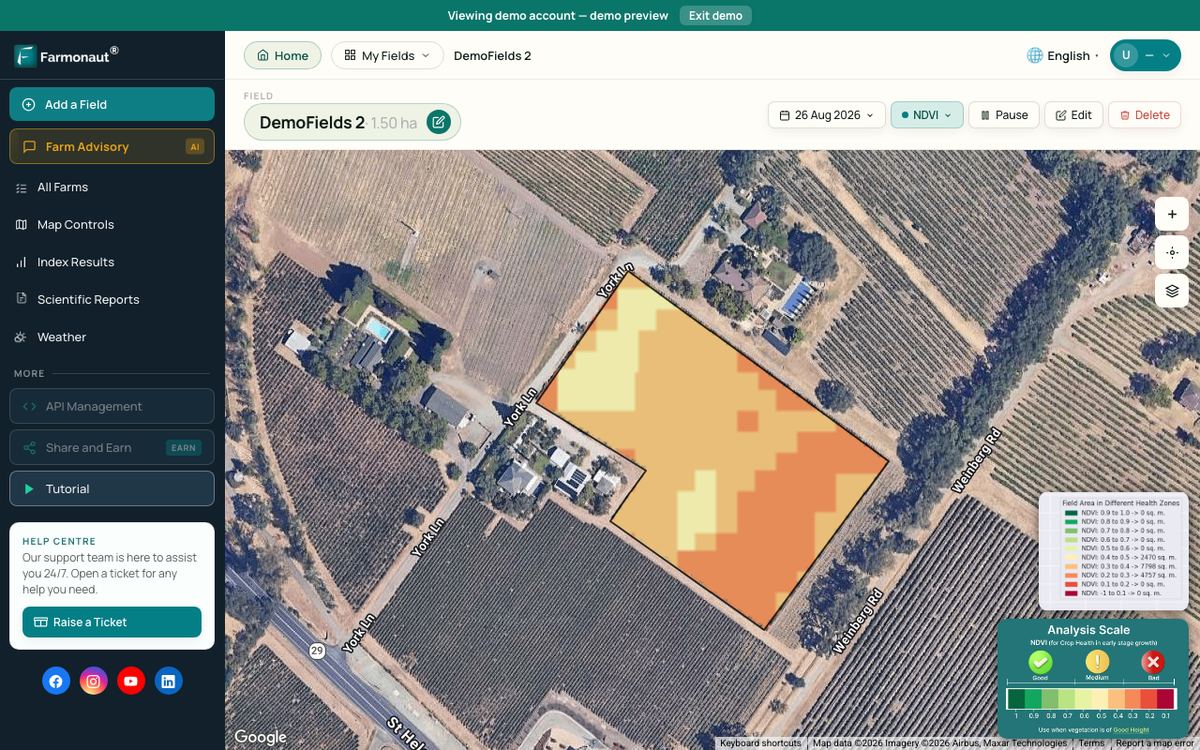
If you grow feed or forage as well as birds, satellite crop maps can show which parts of a field are doing well. Farmonaut gives satellite vegetation maps for fields drawn in its app, which can help plan pasture and feed crops alongside the flock. The video below explains how to start precision farming in simple steps.

▶ Six plain steps to start precision farming, from field maps to satellite monitoring. · 4:18
If this topic matters to you, read Affordable Farm Equipment for Sale by Owner & eBay next.
FAQ
What equipment do I need to start poultry farming?
You need a brooder with a heat source, chick and grower feeders, waterers, a house or movable shelter, a ventilation fan, lights for layers, fencing for pasture flocks, feed storage and basic biosecurity gear. Small flocks can build feeders, roosts and some brooders at home.
How much does poultry equipment cost for a small farm?
It depends on the system and what you already own. A 2026 KPU budget for a 500-bird pasture broiler batch priced the shelters, brooder gear, fan, netting and waterers at about C$16,240 new, mostly for the brooder house and movable housing. Its annualized equipment and infrastructure cost was C$2,164.74 a year.
How much space does each chicken need?
NMSU suggests 1 square foot per chick, 2 square feet per pullet after eight weeks, and 2.5 to 3 square feet per laying hen, plus 6 inches of roost, 4 inches of feeder and 2 inches of drinker space per hen.
Can I get help paying for poultry house equipment?
In the US, the NRCS EQIP program can pay part of the cost of efficient fans, radiant heaters and LED lighting. Rates and rules differ by state and year, so ask your local NRCS office. Tax deductions such as section 179 may also apply; get professional advice.
What is the cheapest way to start a backyard flock?
Start small, reuse a dry shed or garage for brooding, build feeders and roosts, and spend money on a reliable heat source, good fencing and clean water. Check local rules on flock size and registration first.
Related pages on our site: product traceability, carbon footprinting, fleet management, crop loan and insurance, the Agro Admin app and our farm monitoring app.
Farmonaut crop monitoring
See your pasture and feed crops from space
Draw your fields once and Farmonaut shows satellite vegetation maps for them through the season, on web, Android or iOS.



Sources
- Kwantlen Polytechnic University ISFS and Small-Scale Meat Producers Association, Pasture Raised Poultry Enterprise Budget (May 2026): kpu.ca
- USDA NRCS Pennsylvania, Bulletin PA 440-26-06: Published cost list and payment caps for FY 2026 EQIP and CSP: nrcs-prod.azureedge.us
- New Mexico State University Extension, Circular 477: Small Poultry Flock Management: pubs.nmsu.edu
- Cornell Small Farms Program, The Finances for a Small Organic Broiler Flock (2013): smallfarms.cornell.edu
- The Poultry Site, US egg prices fall sharply as flock rebuilds after HPAI losses (June 2026), reporting USDA’s May 2026 Livestock, Dairy, and Poultry Outlook: thepoultrysite.com
- USDA Economic Research Service, Retail egg prices fall, following declining wholesale prices (Chart of Note, June 2025): ers.usda.gov
- Canadian Food Inspection Agency, National Avian On-Farm Biosecurity Standard: inspection.canada.ca
- GOV.UK, Bird flu (avian influenza): how to spot and report it in poultry or other captive birds: gov.uk
- Sustain Ontario, Small Flock Exemptions: sustainontario.com
- Internal Revenue Service, Publication 225 (2025), Farmer’s Tax Guide: irs.gov
Discussion
Questions, corrections or field experience? Share them below. First-time comments are reviewed before they appear, and your email is never published.
No comments yet. Be the first to add a question or your experience.

 Hydenmet
 Dirks Bros Farms
 Red August Group
 Farm Inc
 WeMe Global
 Agrotoken
 Blue BearX
 Insignito
 Croptimum
 DnCubed
 Field Capacity
 Indosistim Teknologi
 Liquify Digital
 CU Foods
 BeyondTech Global
 Rouge VC
 AgroGreen Dynamics
 Licence holder · Niger · Gold










