

Reviewed September 2026 against USDA NASS, USGS, and Nature Communications.
Try it: Run your own numbers →
Sustainable Farming Benefits: The Data Behind 5 Advantages
The advantages of sustainable agriculture are measurable, not just philosophical: USDA data shows organic corn yields run at 65% of conventional corn and organic soybeans at 68%, integrated pest management (IPM) can cut pest-control spending by replacing calendar spraying with threshold-based treatment, and 71% of all U.S. groundwater withdrawn for crops goes to irrigation — a number conservation tillage and cover cropping are built to shrink. Sustainable systems also carry a real cost: a Nature Communications meta-analysis found organic yields are about 15% less stable year-to-year than conventional yields. This article walks through what the benefits actually are, what they cost, and how to check the figures yourself before you act on them.




What Counts as Sustainable Agriculture
Sustainable agriculture is a working definition, not a certification label: it covers any farming approach that meets present food and fiber needs without degrading the soil, water, or biodiversity that future production depends on. That’s distinct from “organic,” which is a specific USDA certification governing which inputs a farm may use. A farm can be highly sustainable — using cover crops, precision irrigation, and IPM — without being certified organic, and a certified-organic farm can still farm unsustainably if it ignores soil erosion or water use. The practical core of sustainable agriculture is:
- Building and protecting soil organic matter instead of depleting it
- Cutting synthetic fertilizer and pesticide dependence where biological alternatives work
- Managing irrigation water against real withdrawal limits, not just crop demand
- Protecting on-farm and adjacent biodiversity — pollinators, beneficial insects, soil microbes
- Keeping the system economically viable for the operator, not just environmentally sound on paper
The reason this matters for U.S. growers specifically: irrigation for crop production accounts for 71% of total U.S. groundwater withdrawals, according to a USGS-linked Nature Scientific Reports analysis of national withdrawal data. That single figure is why conservation tillage, drip irrigation, and cover cropping — all discussed below — are not just environmental talking points in the U.S. Corn Belt and High Plains, they are aquifer-depletion mitigation with a direct line to farm survival in regions drawing on the Ogallala and similar formations.
What is the main purpose of sustainable agriculture?
US federal law gives the working definition. Under 7 U.S. Code § 3103, sustainable agriculture is an integrated system of plant and animal production practices with a site-specific application that will, over the long term:
- satisfy human food and fiber needs;
- enhance environmental quality and the natural resource base that the farm economy depends on;
- make the most efficient use of non-renewable and on-farm resources, and integrate natural biological cycles and controls where appropriate;
- sustain the economic viability of farm operations;
- enhance the quality of life for farmers and society as a whole.
The point of the definition is balance. A practice that protects soil but bankrupts the farm fails goal four, and one that raises yields while draining an aquifer fails goal two. That is why the benefits in this article are always set against their costs.
The Practices Behind the Benefits
“Sustainable agriculture” is an umbrella term. The advantages people search for come from these specific, distinct practices, each with its own mechanism and its own cost:
1. Organic Farming
Organic certification prohibits synthetic fertilizers, synthetic pesticides, and GMOs. The PLOS ONE analysis of 2014 USDA NASS data, covering roughly 773,000 organic hectares on about 11,000 U.S. organic farms, found organic yields across all crops averaged 80% of conventional yields — but that average masks wide variation by crop: corn came in at 65% and soybeans at 68% of conventional yield in the same dataset.
2. Integrated Pest Management (IPM)
IPM replaces routine pesticide spraying with monitoring, biological controls, and targeted intervention only when pest thresholds are crossed. No US agency sets a standard savings figure for IPM; results depend on pest pressure and how fully scouting is adopted. The calculator further down uses 20% as an illustrative assumption you can change.
3. Conservation Tillage and Cover Cropping
Minimal soil disturbance at planting keeps crop residue on the surface, cutting erosion and improving water infiltration. Given that 71% of U.S. groundwater withdrawals go to crop irrigation, any practice that reduces a field’s irrigation demand — including cover cropping’s effect on soil water retention — has a direct line to regional aquifer stress, particularly in Kansas, Nebraska, and Texas counties overlying the Ogallala Aquifer.
4. Agroforestry
Integrating trees with row crops or livestock — windbreaks, alley cropping, silvopasture — diversifies farm income and buffers microclimate extremes. Quantified U.S. carbon-sequestration rates for agroforestry specifically were not available in the sources checked for this article; the honest path is to request the current sequestration estimate directly from the USDA Climate Hubs carbon farming fact sheet, which covers soil carbon co-benefits of sustainable systems more broadly.
5. Crop Rotation and Polyculture
Rotating crop families season to season interrupts pest and disease cycles that build up under continuous monoculture, and it’s one of the lowest-cost sustainable practices available since it requires no new equipment — only a planting-plan change.

Comparative Table: Practice, Benefit, Trade-off
An AI summary can tell you sustainable farming “has benefits.” It can’t hand you this side-by-side, sourced to a specific figure and dataset year, that you can act on:
| Practice | Verified Benefit | Verified Trade-off | Source & Year |
|---|---|---|---|
| Organic farming (all crops) | No synthetic pesticide/fertilizer inputs | Yield averages 80% of conventional | USDA NASS via PLOS ONE, 2014 |
| Organic corn | Same input-free profile as above | Yield averages 65% of conventional corn | USDA NASS via PLOS ONE, 2014 |
| Organic soybeans | Same input-free profile as above | Yield averages 68% of conventional soybeans | USDA NASS via PLOS ONE, 2014 |
| Organic systems, year-to-year | Lower chemical load | Yield stability roughly 15% lower than conventional | Nature Communications meta-analysis, 2018 |
| Integrated Pest Management | Fewer calendar-based pesticide sprays | Requires regular field scouting and monitoring labor | Practice description (savings vary by farm) |
| Conservation tillage / cover crops | Reduces demand on the 71% of U.S. groundwater used for irrigation | Upfront equipment and seed cost for cover crop transition | USGS/Nature Scientific Reports |

Five Benefits of Sustainable Farming, Verified
1. Environmental Protection: Less Runoff, Less Groundwater Pressure
Crop irrigation draws 71% of all U.S. groundwater withdrawals, per the USGS-linked Nature Scientific Reports study — meaning conservation practices that cut a field’s irrigation need are working on the single largest groundwater draw category in the country, not a marginal one. Reduced-tillage systems that preserve residue cover slow evaporation and increase infiltration, directly lowering that demand on High Plains and Corn Belt aquifers. Farmonaut’s Carbon Footprinting satellite solutions let a farm or agribusiness track field-level emissions and land-use change over a season rather than waiting for an annual paper audit.

2. Improved Soil Health — Without a Universal Yield Penalty
The yield gap between organic and conventional systems isn’t uniform, and that unevenness is itself useful data: at 65% of conventional yield, corn is among the largest gaps in the 2014 USDA NASS survey, while the all-crop organic average sits at 80%. Soybeans land in between at 68%. A grower deciding whether to transition a specific field should weigh that crop-specific gap, not the headline 80% figure, against the input-cost savings and any organic price premium available in their local market — premium data the source dataset does not include, so check current organic price spreads through your regional USDA Agricultural Marketing Service office before budgeting a transition.
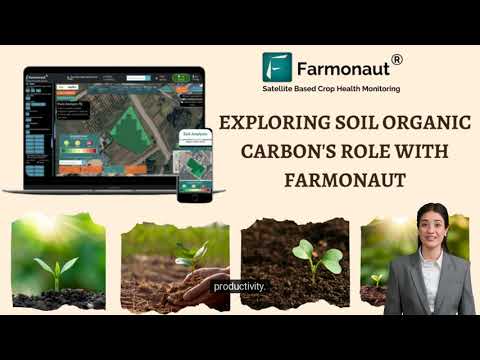
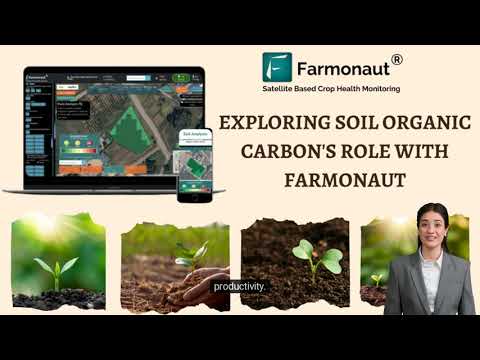
Farmonaut’s satellite-based vegetation indices (NDVI) let a grower track whether soil and canopy health are actually improving season over season during a transition period, rather than relying on visual inspection alone.
3. Climate Resilience — Where the Evidence Is Strong and Where It Isn’t Yet
This is the section where honesty matters most: soil carbon sequestration is frequently cited as a climate benefit of sustainable systems, and the USDA Climate Hubs confirm soil carbon build-up as a real co-benefit of these practices — but a specific, current per-acre or per-hectare sequestration rate for U.S. row-crop agroforestry or reduced tillage was not available in the sources checked for this rewrite. If you need that figure for a grant application or carbon-market contract, request the current published rate directly from a USDA Climate Hub regional office or your state’s NRCS office, since sequestration rates are soil-type and practice-specific and are updated as new field trials complete.
What is measurable today is the trade-off on the other side of the ledger: organic systems’ 15%-lower year-to-year yield stability, from the Nature Communications meta-analysis, means a farm banking on sustainable practices for climate resilience should also budget for a wider yield swing in any single bad year — droughts and pest outbreaks hit a less-buffered system harder in the short term, even if soil health compounds in its favor over a decade. Farmonaut’s Carbon Footprinting product and large-scale farm management tools track the inputs regulators and buyers actually ask for — field boundaries, cropping history, satellite-verified land use — while the sequestration-rate literature itself continues to develop.

4. Economic Benefits — Where IPM Pays for Itself
Of every sustainable practice covered here, IPM has the clearest near-term economic case: savings come from replacing calendar-based spraying with threshold-based, monitored intervention, though no national standard savings figure exists. That’s a cost reduction, not a yield or price assumption — it holds regardless of whether a farm is certified organic. The calculator below turns an assumed percentage cut into a dollar figure for your own pest-control budget.
Longer-term farm profitability comparisons between sustainable and conventional systems over a 3-10 year window were not found in the sources checked for this article. If that comparison is central to a financing or transition decision, the USDA Economic Research Service (ERS) publishes farm financial and commodity cost-of-production data that can be paired with your own input and yield records to build a farm-specific ROI case — a generic published average would understate how much this depends on your soil type, crop mix, and local price basis anyway.
With Farmonaut’s fleet and resource management tools, operations reduce input-application overlap and fuel spend, which compounds with IPM’s spraying reductions rather than duplicating them.
5. Food Security and Nutrition Through Yield Stability Trade-offs
Food security arguments for sustainable agriculture rest on diversification and resilience, but the data above complicates a simple “sustainable is always safer” claim: the Nature Communications meta-analysis found organic production is roughly 15% less stable year-to-year than conventional — meaning a diversified, sustainable farm can still see larger single-year swings even as its long-run soil health improves. The honest read is that sustainable systems buy resilience over a multi-year horizon, in exchange for accepting more variance in any given season. Farmonaut’s blockchain-based traceability solutions help make that resilience story verifiable to buyers rather than just claimed.

6. Social and Community Benefits
Sustainable systems that rely on crop rotation, IPM scouting, and diversified plantings tend to keep more agronomic decision-making — and the knowledge that comes with it — local to the farm rather than outsourced to a single input supplier’s spray schedule. Farmonaut’s agricultural advisory platform supports that by putting satellite-derived field data directly in the grower’s hands rather than gating it behind a consultant visit.

Calculator: Your IPM Pest-Control Cost Savings
Enter your own assumed IPM cost-reduction percentage, then plug in your own acreage and current per-acre pest-control spend below to see what it means in dollars for your farm.
Run your own numbers
Assumptions: the 10% default is a placeholder, not a published figure — no US agency sets a standard IPM savings rate, so enter your own estimate; actual savings depend on current pest pressure, crop, and how fully a scouting/threshold program is implemented. Excludes any additional labor cost for scouting itself and any yield-protection value — it estimates spray-input savings only, not net farm income.
Source: IPM practice definitions from US EPA, Introduction to Integrated Pest Management; savings vary by farm, so the percentage is your own assumption.
The Honest Trade-offs
The single clearest number in this article's evidence base is also the one most often left out of "benefits" articles: organic yields run at 65-80% of conventional yields depending on crop, and organic production overall is about 15% less stable year to year, per the Nature Communications meta-analysis. Those aren't reasons to avoid sustainable practices — they're the actual terms of the trade a farm is making, and they should be weighed crop by crop:
- Yield gap varies by crop: corn's 65%-of-conventional figure is a bigger gap to close than the 80% all-crop average; soybeans at 68% sit close to corn.
- Yield stability, not just yield level: the 15% stability penalty means a transitioning farm should plan cash-flow buffers for a wider range of outcomes in any single season, not just a lower average.
- IPM's cost case stands on its own: its savings don't require organic certification and can be adopted independently of the yield trade-offs above.
- Certification and transition costs are real and farm-specific — check current organic certification fee schedules with your USDA-accredited certifying agent, since these are set by the certifier, not standardized nationally.
Farmonaut's AI-driven crop advisory and monitoring tools don't remove these trade-offs, but they make the yield and soil-health side of the ledger visible in-season rather than only at harvest, so a transition decision can be adjusted with data rather than guesswork.
How Farmonaut Supports the Transition
Farmonaut provides satellite-based monitoring (NDVI and multispectral imaging), AI-powered advisories (Jeevn AI), blockchain traceability, and environmental impact tracking built around the same data gaps this article surfaces — season-over-season soil and canopy trend data that a one-time annual survey can't give a grower. In practice that supports:
- Tracking soil health and crop vigor across a transition period, so a yield dip shows up as a trend, not a surprise at harvest
- Resource-efficient irrigation and input management relevant to reducing pressure on the 71% groundwater-withdrawal figure above
- Food safety and market access via transparent, blockchain-based product traceability
- Optimized fleet and input usage that compounds with IPM's cost savings
- Financial access — satellite insights help lenders and insurers verify claims for crop loan and insurance decisions
Developers and agribusinesses can integrate the same land, weather, and environmental data directly via Farmonaut's APIs and the API developer docs, rather than relying on manual field visits to track a transition.
Access Farmonaut's Web App for Real-Time Sustainable Agriculture Insights
How to Verify These Numbers Yourself
Every figure above has a shelf life, and this page is written so you can outrun it rather than get stuck on a stale number. Use this method whenever you need a current figure this article can't give you:
- Yield comparisons: the 65-80% organic-to-conventional figures above come from the 2014 USDA NASS Organic Survey as analyzed in PLOS ONE. USDA NASS releases an updated Organic Survey periodically — check quickstats.nass.usda.gov's organic section directly for the most recent complete survey year and re-run the crop-by-crop comparison for your state.
- Adoption rates: agricultural survey firms including Statista publish periodic updates on U.S. sustainable-practice adoption; search their agriculture database for the latest survey year rather than relying on any single cited figure, since adoption estimates shift with each new survey wave.
- Groundwater and conservation impact: the USGS Water Resources site publishes updated watershed-level studies on irrigation withdrawals and aquifer depletion; check there for data specific to your state or aquifer rather than the national 71% figure used above.
- Farm-specific ROI: pair your own yield and input records with USDA ERS cost-of-production data to build a transition case specific to your soil type and crop mix.
This checklist is the durable part of this page — the cited figures will age, but the sources and the method for refreshing them will not.





Why sustainable agriculture is important: a short note
Three figures show why the question matters now.
- Food security. About 2.3 billion people faced moderate or severe food insecurity in 2024, and 8.2% of the world's population faced hunger (FAO, SOFI 2025). Farms have to keep producing more without wearing out the soil and water they rely on.
- Emissions. Direct emissions from agriculture were 9.4% of total US greenhouse gas emissions in 2022, with soil management (mostly fertilizer) the largest source (US EPA).
- Low adoption. Cover crops, one of the cheapest soil-protecting practices, were planted on only 4.7% of US cropland in 2022, though acreage grew 17% from 2017 (USDA ERS, 2022 Census of Agriculture).
In short, sustainable agriculture is important because it lets farms keep feeding people over decades, not just this season, while cutting the pollution and soil loss that raise costs for everyone.
FAQs
What are the benefits of sustainable farming?
Benefits include lower pest-control spending under IPM, reduced pressure on the 71% of U.S. groundwater withdrawals used for crop irrigation (USGS/Nature Scientific Reports), and improved soil organic matter under organic and conservation-tillage systems. These come with a documented trade-off: organic yields run 65-80% of conventional depending on crop, and are roughly 15% less stable year to year (Nature Communications, 2018).
What are the advantages of sustainable agriculture over conventional farming?
The clearest advantages are lower chemical input costs under IPM, lower groundwater draw where irrigation-reducing practices are used, and improved long-term soil structure. The advantage is not automatic yield parity — 2014 USDA NASS data shows organic corn and soybean yields at 65% and 68% of conventional, respectively.
What are the health benefits of sustainable farming?
Sustainable systems reduce synthetic pesticide load in the field and in runoff, which is the basis of most health-benefit claims. A quantified reduction in pesticide or fertilizer runoff volume specific to U.S. sustainable farms was not found in the sources checked for this article — for a number specific to your watershed, check USGS Water Resources' regional water-quality studies directly.
What are the pros and cons of sustainable agriculture?
Pros: lower input costs under IPM, reduced groundwater pressure, improved soil health. Cons: yield gaps of 32-35% versus conventional for soybeans and corn specifically, about 15% lower yield stability, and transition costs including certification fees and new equipment for reduced-tillage systems.
How does Farmonaut support sustainable agriculture?
Farmonaut offers satellite-based monitoring, AI-driven advisories, blockchain traceability, and fleet/resource management tools that let growers track soil health, water use, and input efficiency in-season — turning a multi-year transition into a set of visible, trackable trends rather than a bet made on faith.

 Global Agrifood
 Cazlv
Cazlv HIPSAC
 ZOL Zimbabwe
 Juligerm
 AdBio
AdBio MISE Maroc
 Drift-Sense
 NWNS
NWNS Red August Group
 Farm Inc
 WeMe Global
 Agrotoken
 Blue BearX
 Insignito
 Croptimum
 DnCubed
 Field Capacity
 Indosistim Teknologi
