

Phosphate fertilizer · Price and use guide
Superphosphate Fertilizer Price: Chart and Drivers
Triple superphosphate cost $690 per metric ton at the US Gulf in September 2026 (World Bank), and Ontario farm stores quoted it at C$1,106 per tonne in April 2026 (Ridgetown Campus survey). Single superphosphate holds less than half the phosphate, so compare products on cost per pound of P2O5.
Key takeaways
- Triple superphosphate (TSP) was $690 per metric ton at the US Gulf in September 2026, up from $664.40 a year earlier (World Bank Pink Sheet).
- Ontario farm stores quoted TSP at an average of C$1,106 per tonne in April 2026 (Ridgetown Campus). US distributors asked $936 to $967 per short ton for MAP in Illinois, Iowa and Pennsylvania (USDA AMS, week ending 2 October 2026).
- Single superphosphate has 16 to 22% P2O5 plus about 12% sulfur; triple superphosphate has 44 to 53% P2O5 (University of Maryland Extension).
- You need about 2.3 tons of single superphosphate to supply the phosphate in one ton of triple superphosphate, so compare cost per pound of P2O5, not per ton.
- Set the rate from a soil test and crop removal. Ohio State measured about 0.35 lb P2O5 removed per bushel of corn and 0.79 lb per bushel of soybeans (2019).
In this article
- Superphosphate fertilizer price in the US, UK and Canada
- Price history and what moves superphosphate costs
- What superphosphate fertilizer is: single vs triple
- Cost per pound of phosphate, not per ton
- Single or triple superphosphate: which to buy
- How to use superphosphate fertilizer
- Superphosphate vs MAP, DAP and rock phosphate
- Can organic farms use superphosphate?
- Keeping phosphorus on the field
- Buying checklist
- How we checked the numbers
- Where satellite crop monitoring fits
- FAQ
Triple superphosphate (0-46-0) imported at the US Gulf cost $690 per metric ton in September 2026, according to the World Bank Pink Sheet (October 2026). In Great Britain, delivered farm prices averaged about £643 per tonne in the week to 2 October 2026 (AHDB). Single superphosphate (about 0-20-0) carries less than half as much phosphate per ton, so the fair way to compare a superphosphate fertilizer price with MAP or DAP is the cost per pound of P2O5. The calculator below does that sum with your own quotes.
This guide is written for farm owners and managers in the US, Canada, the UK and Australia. It covers dated prices from public sources, what moves them, what single and triple superphosphate contain, how much to apply, and when another phosphate product is the better buy.
Superphosphate fertilizer price in the US, UK and Canada
Public price reports quote triple superphosphate (TSP) more often than single superphosphate (SSP). Retail reports in the US, such as the USDA AMS state reports, list MAP and DAP but not TSP. Here is what each public source showed at its latest date.
- World market (US Gulf): TSP $690 per metric ton (import price) and DAP $800.60 (f.o.b. export price) in September 2026. A year earlier, in September 2025, TSP was $664.40 (World Bank Pink Sheet).
- Great Britain (delivered to farm): TSP averaged about £643 per tonne in the week ending 2 October 2026, according to AHDB GB fertiliser prices, which also lists other products.
- United States (distributor asking price): MAP averaged $936 per short ton and DAP $929.29 in the USDA AMS Illinois Production Cost Report for the week ending 2 October 2026. TSP is not listed in that report.
- Canada (Ontario retail): triple superphosphate (0-46-0) averaged C$1,106 per tonne, with a range of C$1,029 to C$1,370, and MAP averaged C$1,309 per tonne, in the University of Guelph Ridgetown Campus survey of 15 April 2026. These are cash prices at farm supply stores, without delivery or application.
Prices are quoted in different units. A metric ton (tonne) is 2,205 lb. A US short ton is 2,000 lb. A world import price does not include freight inland, the dealer margin or spreading, so the farm price is higher.
Single superphosphate is not listed in any of these reports. Its use has fallen as higher-analysis products became available at lower cost, as the University of Nebraska notes in its plant and soil sciences lesson on phosphorus fertilizers. In Australia, Victorian soil advice still gives pasture and crop rates in kilograms of single super (see the rates below). Ask your dealer for a written price per ton with the grade on the label, then compare it on a cost-per-pound-of-phosphate basis.
US distributor prices by state
USDA Agricultural Marketing Service publishes state production cost reports. For the week ending 2 October 2026, the average distributor asking price for MAP was $963.50 per ton in Iowa and $967.20 in Pennsylvania. DAP averaged $985.50 in North Carolina and $893.33 delivered in South Carolina (South Carolina report of 29 September 2026). Within one state the spread between the lowest and highest quote can be large: South Carolina DAP ranged from $700 to $1,055 per ton.
Chart
Ontario farm-store fertilizer prices, selected products
Average cash retail price, C$ per tonne, 15 April 2026; delivery, application and GST excluded
Chart
US distributor prices for MAP and DAP by state
Average distributor asking price, $ per ton (US short ton), F.O.B., week ending 2 October 2026; South Carolina delivered, report of 29 September; TSP is not listed
Price history and what moves superphosphate costs
World phosphate prices more than doubled from 2020 to 2022. On the World Bank annual series, TSP averaged $265 per metric ton in 2020 and $716.10 in 2022, then fell to $474.60 in 2024. It rose again to $577.60 in 2025. DAP moved in a similar way at a higher level.
Chart
World phosphate fertilizer prices
Annual average, US $ per metric ton, nominal; TSP import US Gulf, DAP f.o.b. US Gulf, rock f.o.b. North Africa
Several things push the price up or down:
- Phosphate rock. All superphosphates are made from mined rock. The World Bank rock price (North Africa) was $152.50 per ton in every month of 2025 and $170 from July to September 2026.
- Sulfuric and phosphoric acid. Single superphosphate is made by treating ground rock with sulfuric acid. Triple superphosphate uses phosphoric acid. The cost of sulfur and acid can feed through to the product.
- Energy and conflict. In April 2026 the World Bank forecast fertilizer prices to rise 31% in 2026, led by a 60% jump in urea, as the war in the Middle East shook commodity markets. It said affordability would be the worst since 2022.
- Freight. Low-analysis products such as single superphosphate cost more to move per unit of phosphate.
- Currency. World prices are set in US dollars, so a weaker pound, Canadian dollar or Australian dollar raises the local price.
No one can say where prices will go next. If you buy ahead, compare a fixed-price offer with the latest public series rather than with last year’s invoice.
What superphosphate fertilizer is: single vs triple
Superphosphate is rock phosphate treated with acid so that most of its phosphorus dissolves in water and plants can use it. There are two main kinds.
- Single (normal or ordinary) superphosphate, SSP: made with sulfuric acid. The University of Maryland Extension table of fertilizer materials lists it at 16 to 22% P2O5, with about 20% calcium and 12% sulfur. The sulfur comes from gypsum formed in the reaction.
- Triple (concentrated) superphosphate, TSP: made with phosphoric acid. The same table lists 44 to 53% P2O5 and 14% calcium; the National Corn Handbook notes it contains very little sulfur. Nebraska lists concentrated (triple) superphosphate as 85 to 95% water soluble.
Labels in the US, Canada and the UK give phosphate as P2O5. Australian labels give elemental P. To convert, multiply P by 2.29. The Victorian soil health Brown Book chapter on superphosphate lists single super at 8.8% P (about 20% P2O5) and triple super at 20.7% P (about 47% P2O5).
The main reason to choose single superphosphate is the sulfur. A National Corn Handbook paper (NCH-13, revised 1991) calls it an excellent phosphorus source with about 12% sulfur, and says its low analysis raises transport cost per unit of P2O5. The same paper says triple superphosphate is usually preferred when the field does not need sulfur.
Chart
How much phosphate each product contains
% P2O5, low and high end of the range listed (single values where only one is given)
Cost per pound of phosphate, not per ton
A ton of single superphosphate holds about 400 lb of P2O5 (20%). A ton of triple superphosphate holds about 920 lb (46%). You need 2.3 tons of SSP to supply the phosphate in one ton of TSP. So a low price per ton can still be the dearer source of phosphate.
The sum is simple: price per ton divided by pounds of P2O5 in a ton. Three examples from the prices above:
- TSP at the US Gulf, $690 per metric ton at 46%: about $1.50 per kg of P2O5, or $0.68 per lb, before freight and margin.
- TSP in Ontario farm stores, C$1,106 per tonne at 46%: about C$2.41 per kg of P2O5.
- MAP in Illinois, $936 per short ton at 52%: about $0.90 per lb of P2O5, without any credit for its 11% nitrogen.
Give a value to the other nutrients too. MAP and DAP carry nitrogen. Single superphosphate carries sulfur and calcium. If your crop needs that sulfur anyway, SSP saves a separate sulfur product.
Try the numbers for your own farm below.
Calculator
Which phosphate fertilizer is cheaper per pound of P2O5?
Enter two dealer quotes, their grades, your rate and your area.
- Product A cost per lb of P2O5: $1.25
- Product B cost per lb of P2O5: $0.98
- Product A needed per acre: 200 lb
- Product B needed per acre: 87 lb
- Product A cost for the area: $5,000
- Product B cost for the area: $3,913
Example values only, not price quotes or benchmarks; the defaults show a low-analysis versus a high-analysis product. Prices are per US short ton (2,000 lb); the formula uses 20 lb of product per percentage point of grade per ton. If you enter a price per metric tonne, divide every money result by 1.1; the pounds-of-product lines stay correct. The sum does not credit nitrogen in MAP or DAP or sulfur in single superphosphate, and it leaves out freight and spreading.
Single or triple superphosphate: which to buy
Use this short check before you order. It sets the nutrients you need first and the price second.
- Your soil or crop also needs sulfur: price single superphosphate against TSP plus a separate sulfur product. SSP supplies about 12% sulfur, so 200 lb of it also delivers about 24 lb of sulfur.
- You need phosphorus only and haul a long way: triple superphosphate puts more than twice as much P2O5 on each truck, which lowers freight and spreading passes per pound of phosphate.
- Your crop also needs nitrogen: MAP or DAP supply nitrogen with the phosphate. Count that nitrogen as a saving on your nitrogen bill when you compare.
- You farm organically: superphosphate is not allowed under most organic standards. Ask your certifier about rock phosphate or other approved sources.
- Your soil test is already high: you may not need phosphate this season. Spend the money where the test is low.
Whatever you choose, keep the soil test, the product grade and the rate you applied in your field records. The next soil test then tells you whether the rate was right.
How to use superphosphate fertilizer
Start with a soil test
Apply phosphorus only where a recent soil test says the field is low, or to replace what the crop removes. Ohio State’s fact sheet ANR-74 (2019) measured grain removal of about 0.35 lb P2O5 per bushel of corn, 0.79 lb per bushel of soybeans and 0.49 lb per bushel of wheat. Once a soil tests in the maintenance range, it suggests rates roughly equal to that removal. A 200-bushel corn crop removes about 70 lb of P2O5 per acre on that basis.
Infographic
From soil test to spreader in 5 steps
- 1Test the soilGet a recent soil test for each field.
- 2Set the P2O5 rateMatch the rate to the test band and expected crop removal.
- 3Price the optionsConvert each quote to cost per pound of P2O5.
- 4Convert to productDivide the P2O5 rate by the grade on the label.
- 5Apply and recordApply at or before planting and keep records for the next test.
Turn the P2O5 rate into product
Divide the P2O5 rate by the grade. For 40 lb of P2O5 per acre you need about 200 lb of single superphosphate (20%) or about 87 lb of triple superphosphate (46%). The calculator above does this for any grade.
Pasture and crop rates in Australia
The Victorian Brown Book (updated 2013) gives these examples: about 10 kg P per hectare, or 100 kg/ha of single super, for grazing at 10 to 15 dry sheep equivalents per hectare, and about 20 kg P per hectare (about 250 kg/ha of single super) as an optimum for cropping. It also notes that less than 5% of the phosphorus applied may be taken up in the year it is applied. Use the soil test bands for your district.
Timing and placement
Apply phosphorus before or at planting, banded or worked into the soil, as your soil test lab or adviser recommends. Keep DAP away from the seed: Cornell’s crop adviser notes and the National Corn Handbook both say it can release free ammonia that damages seedlings when high rates touch the seed. Follow the product label and local rules on rates and placement.
Superphosphate vs MAP, DAP and rock phosphate
| Product | Typical analysis | Other nutrients | Best fit |
|---|---|---|---|
| Single super (SSP) | 16 to 22% P2O5 | About 12% S, 20% Ca | Fields that need sulfur too; pasture where it is sold locally |
| Triple super (TSP) | 44 to 53% P2O5 | About 14% Ca, little S | Fields that need phosphorus but not extra nitrogen or sulfur |
| MAP | 11-52-0 | 11% N | General dry phosphorus source; quoted in USDA AMS distributor reports |
| DAP | 18-46-0 | 18% N | Crops that also need nitrogen; keep away from seed |
| Rock phosphate | 30 to 36% total P2O5 | About 33% Ca | Acid soils and organic farms; releases phosphorus slowly |
Analysis ranges are from the University of Maryland Extension Table B-5, and MAP and DAP grades from Cornell’s crop adviser study notes. Rock phosphate’s P2O5 is total, not water soluble. The National Corn Handbook says finely ground rock works only on acid soils, and only at very high rates.
Can organic farms use superphosphate?
No, in most cases. A 2001 technical review for the USDA National Organic Standards Board found triple superphosphate to be synthetic and recommended against allowing it. The review reports that the codes it checked, including Canada, the EU and IFOAM, did not allow it at that time. OMRI (updated 2021) says monocalcium phosphate, the active part of superphosphate, is always synthetic and prohibited in organic production, while calcium phosphate from rock phosphate or bone meal is usually allowed. Check any product with your certifier before you buy.
Keeping phosphorus on the field
Too much phosphorus, or phosphorus applied at the wrong time, can wash into streams and lakes. The US EPA (page updated February 2026) says excess nitrogen and phosphorus can leave fields with rain and snowmelt. It recommends applying the right amount at the right time with the right method and placement, and planted buffers along field edges. In practice that means:
- Right amount: set the rate from a soil test and crop removal, not from habit.
- Right time: avoid spreading when rain or snowmelt is likely to carry fertilizer off the field.
- Right method and placement: band or work the fertilizer into the soil where your system allows.
- Buffers: keep planted strips of grass, shrubs or trees along streams and ditches.

▶ Seven soil-protecting practices, from cover crops to no-till, explained in a short cartoon · 4:34
Buying checklist
- Get a current soil test and set the P2O5 rate per acre.
- Ask two or three dealers for a written price per ton, the grade and the delivery or spreading charge.
- Convert every quote to cost per pound (or kg) of P2O5 with the calculator.
- Give a value to the sulfur in SSP or the nitrogen in MAP and DAP if your crop needs them.
- Check the latest World Bank, AHDB or USDA AMS figure, so you know whether a quote is high or low for the date.
- Book storage and timing so the product is on the field before planting.
How we checked the numbers
Every price here comes from a public report with a date: the World Bank Pink Sheet (October 2026 edition, monthly and annual data), one AHDB GB fertiliser price (week ending 2 October 2026), USDA AMS state production cost reports (week ending 2 October 2026) and the Ridgetown Campus Ontario farm-store survey (15 April 2026, the latest survey posted when we checked on 15 October 2026). Nutrient contents come from university extension tables. Cost per pound of P2O5 is our own arithmetic from those prices. We found no public, dated single superphosphate price series for the US, UK or Canada, so we do not quote one.
Where satellite crop monitoring fits
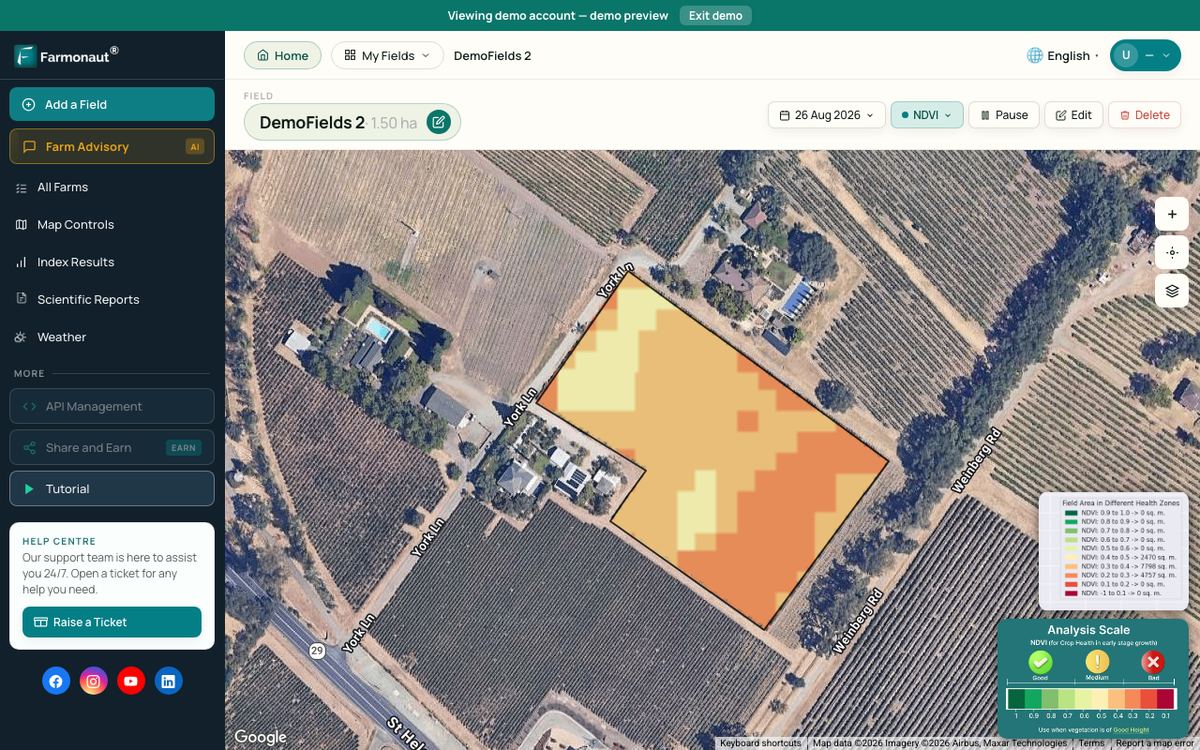
A satellite cannot measure soil phosphorus. A soil test does that. What satellite images can show is where crop growth lags across a field over the season, which helps you decide where to take extra soil samples or check a fertilizer plan. You can view fields in the Farmonaut app. Larger farms can use the agro-admin app to organise field tasks, and software teams can pull data through the satellite and weather API. Farmonaut also has modules for carbon footprinting, product traceability and crop loan and insurance; they do not measure soil phosphorus.

▶ How NDVI turns satellite readings of plant color into a map of crop vigor across a field · 14:37
FAQ
How much does superphosphate cost per ton?
Triple superphosphate cost $690 per metric ton at the US Gulf in September 2026 (World Bank) and about £643 per tonne delivered to farms in Great Britain in the week to 2 October 2026 (AHDB). In Ontario, farm stores quoted TSP at an average of C$1,106 per tonne in April 2026 (Ridgetown Campus survey). Single superphosphate is not in these public series; ask local dealers, and compare quotes on cost per pound of P2O5.
What is the difference between single and triple superphosphate?
Single superphosphate is made with sulfuric acid and contains about 16 to 22% P2O5 plus about 12% sulfur. Triple superphosphate is made with phosphoric acid and contains about 44 to 53% P2O5 with little sulfur (University of Maryland Extension).
Is superphosphate better than DAP?
Neither is better in every case. DAP (18-46-0) supplies nitrogen as well as phosphate, but it can injure seedlings if high rates touch the seed. Single superphosphate is useful where the crop also needs sulfur. Compare the cost per pound of each nutrient you actually need.
How much superphosphate per acre?
It depends on your soil test and crop. Work out the P2O5 rate first, then divide by the grade: 40 lb of P2O5 per acre takes about 200 lb of 0-20-0 or about 87 lb of 0-46-0. Follow the product label and local rules.
Does superphosphate change soil pH?
Cornell’s crop adviser notes list triple superphosphate as an acidifying material. Check pH with a soil test and lime as advised for your crop; do not rely on a phosphate fertilizer to correct pH.
Can I use superphosphate in an organic garden or farm?
Not under most organic standards. Superphosphate is a synthetic product. Rock phosphate and bone meal are usually allowed, but check with your certifier (OMRI, 2021).
Farmonaut crop monitoring
See which parts of your fields lag behind
Satellite crop maps show where growth differs across a field, so you know where to sample soil or check a fertilizer plan.



Keep reading
Sources
- World Bank, Pink Sheet, October 2026: thedocs.worldbank.org
- World Bank, Commodity Price Data, annual prices (October 2026 release): thedocs.worldbank.org
- World Bank, Commodity Price Data, monthly prices (October 2026 release): thedocs.worldbank.org
- World Bank, Commodity Markets Outlook press release (28 April 2026): worldbank.org
- AHDB, GB fertiliser prices (October 2026): ahdb.org.uk
- AHDB, GB fertiliser price series workbook (updated 9 October 2026): projectblue.blob.core.windows.net
- USDA AMS, Illinois Production Cost Report (week ending 2 October 2026): ams.usda.gov
- USDA AMS, Iowa Production Cost Report (week ending 2 October 2026): ams.usda.gov
- USDA AMS, Pennsylvania Production Cost Report (week ending 2 October 2026): ams.usda.gov
- USDA AMS, North Carolina Production Cost Report (week ending 2 October 2026): ams.usda.gov
- USDA AMS, South Carolina Crop Production Report (29 September 2026): ams.usda.gov
- University of Guelph Ridgetown Campus, Ontario Farm Input Monitoring Project, Survey 1 (15 April 2026): ridgetownc.com
- University of Nebraska, Plant and Soil Sciences eLibrary, Phosphorus fertilizers lesson: passel2.unl.edu
- University of Maryland Extension, Table B-5 Composition of Principal Macronutrient Fertilizer Materials: extension.umd.edu
- Cornell University, NRCCA study resources, nutrient sources (PO 27): nrcca.cals.cornell.edu
- National Corn Handbook NCH-13, Phosphorus Sources for Corn Fertilization (revised 1991): corn.aae.wisc.edu
- Corangamite CMA Brown Book, Superphosphate chapter (updated September 2013): soilhealth.ccmaknowledgebase.vic.gov.au
- Ohio State University Extension, ANR-74 Nutrients Removed with Harvested Corn, Soybean, and Wheat Grain (2019): ohioline.osu.edu
- USDA NOSB TAP Review, Triple Superphosphate (June 2001): ams.usda.gov
- OMRI, Calcium Phosphate (updated August 2021): omri.org
- US EPA, Sources and Solutions: Agriculture (updated February 2026): epa.gov
Discussion
Questions, corrections or field experience? Share them below. First-time comments are reviewed before they appear, and your email is never published.
No comments yet. Be the first to add a question or your experience.

 Deluxe Conseil
 Krishify
 TVS Electronics
 BW Pipelines
 WICO
WICO Gen Chayat
 Chimera Innovation
 SkyHarvest
 Polaris Digitech
 Teledarbas
 Wild Oak Farm
 SFX
SFX BACF Africa
 Doodlakine
 Exurbia Geospatial
 Licence holder · Niger · Gold










