

Table of Contents
- Introduction: What Is Vertical Urban Agriculture?
- The Historical Context and Evolution of Vertical Farming
- Technological Foundations in Vertical Urban Agriculture
- 7 Shocking Urban Vertical Farming Innovations
- Comparison Table: Urban Vertical Farming Innovations
- Environmental & Economic Benefits of Vertical Farming
- Challenges and Key Considerations
- Farmonaut: Pioneering Urban Agriculture Through Smart Technology
- The Future of Vertical Urban Agriculture
- FAQ: Frequently Asked Questions about Vertical Urban Agriculture
“Vertical farms can yield up to 10 times more crops per square foot than traditional farming methods.”
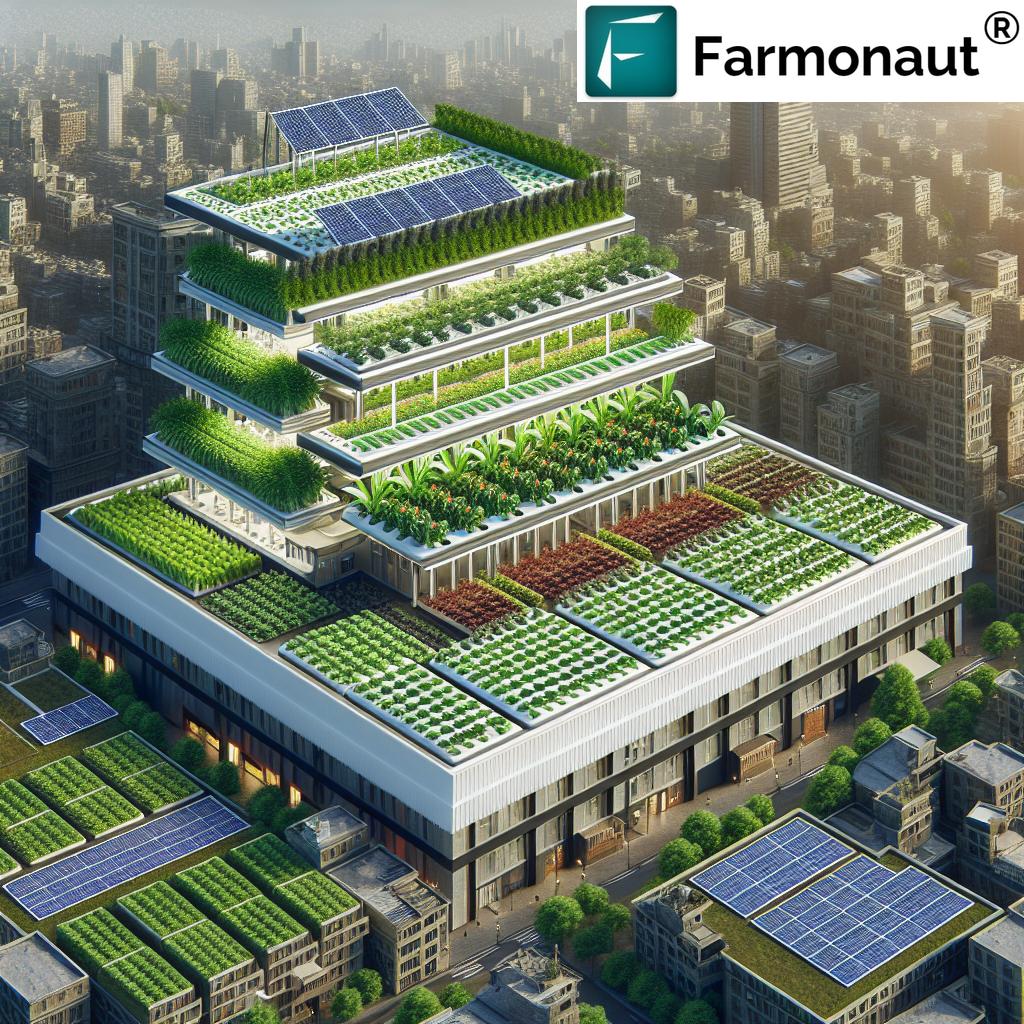
Vertical Urban Agriculture: 7 Shocking City Farm Innovations
Welcome to the era of vertical urban agriculture, where technology meets sustainability to revolutionize how we produce food in city environments. As the world’s urban population continues to soar, we face the dual challenges of limited land and the urgent need to reduce our environmental impact from traditional agriculture.
In this comprehensive guide, we delve into the most innovative strategies that are transforming how we cultivate crops indoors—leveraging vertically stacked layers, controlled environments, and advanced technologies like hydroponics, aeroponics, and aquaponics. Through these methods, vertical farming is emerging as a sustainable solution—one that offers increased yield, remarkable resource efficiency, and significant reductions in waste, water, and energy use.
We invite you to explore these shocking innovations and understand why indoor vertical farms are at the forefront of the future of urban farming. We’ll also shed light on the benefits, remaining hurdles, and showcase how technology solution providers like Farmonaut are advancing sustainability, efficiency, and transparency in modern agriculture.
The Historical Context and Evolution of Vertical Farming
The concept of vertical farming is not as new as it might seem. As early as the turn of the millennium, visionaries like Dr. Dickson Despommier began discussing the idea of vertically stacked farms, ideal for urban centers where space is at a premium. The goal: to use technology to bring agriculture into cityscapes, making food production more efficient, sustainable, and local.
Throughout the past twenty years, enormous advancements have propelled this idea—transforming it from theory into a global movement. Innovations in lighting (especially LEDs), soilless growing techniques, climate management, and digital monitoring technologies have made it possible to grow crops indoors, independent of external weather conditions and natural soil.
- Early Proponents: Led by experts envisioning skyscraper farms and integrating agriculture into the urban fabric.
- Evolving Methods: From rooftop gardening to highly automated controlled environment agriculture (CEA).
- Technology Integration: Enhanced management of water, nutrients, and energy through AI and IoT.
Today, with global urbanization on the rise and arable land shrinking, urban agriculture is advocating for the future of sustainable food production.

Technological Foundations in Vertical Urban Agriculture
At the core of vertical farming technology are soilless cultivation techniques and sophisticated environmental controls that offer precision over every aspect of plant growth.
Soilless Growing Techniques: Hydroponics, Aeroponics & Aquaponics
-
Hydroponics:
This approach utilizes water-based nutrient solutions, with roots suspended in controlled trays or channels. With hydroponic farming systems, we gain precise control over nutrient delivery, water usage, and environmental factors—suited for indoor vertical farms in dense city centers.
Key advantages: Optimal resource efficiency, up to 95% less water than soil based farming, and minimal waste. -
Aeroponics:
Roots are suspended in air and regularly misted with nutrient solutions. This method promotes rapid growth by facilitating optimal oxygenation and efficient nutrient uptake, while significantly reducing water usage.
Perfect for: Urban environments seeking high yields in compact spaces. -
Aquaponics:
A symbiotic system that combines hydroponics with aquaculture (fish farming). Here, fish waste is recycled as a natural fertilizer, creating a balanced, closed-loop environment for growing plants and fish together.
Sustainability: Drastically reduces waste, closes nutrient cycles, and minimizes resource inputs, making it a truly sustainable food production approach in urban settings.
These methods, paired with intelligent climate, light, and CO2 control systems, enable year-round cultivation, increased yields, and innovative use of abandoned buildings, warehouses, and urban rooftops.
“Over 30% of Singapore’s leafy vegetables are now produced using advanced vertical farming technology.”
7 Shocking Urban Vertical Farming Innovations
Let’s delve into the seven most impressive breakthroughs that have redefined vertical and urban agriculture worldwide—boosting yield, minimizing resource consumption, and reshaping the environmental impact of food production in cities.
-
1. Automated Climate-Controlled Indoor Farms
Modern indoor vertical farms utilize sophisticated automation and climate control systems to maintain optimal plant growth conditions. Through a blend of real-time sensors, AI-driven environmental modulation, and dynamic irrigation, these farms ensure precise temperature, humidity, light cycles, and nutrient delivery. This innovation allows for year-round cultivation of greens, herbs, and vegetables regardless of external climate—effectively decoupling production from unpredictable weather patterns.
Key highlight: Maximized energy efficiency in agriculture through targeted use of resources.
-
2. Energy-Efficient LED Lighting & Lighting Recipes
Energy consumption is one of the main challenges for controlled environment agriculture. The integration of next-generation, spectrum-tunable LEDs has revolutionized vertical farming technology. Modern farms use custom ‘lighting recipes’ tailored for each plant, optimizing wavelengths for growth stages and minimizing wasted energy.
Studies have shown energy-efficient LEDs can cut electricity use by up to 70% compared to legacy lighting, while delivering superior growth outcomes.Bonus: Advances in solar integration and off-grid renewable energy use further reduce carbon footprints.
-
3. Modular, Scalable Urban Farm Systems
Vertical farms are now being designed with modularity in mind. Movable racks, stackable units, and plug-and-play cultivation systems are making it feasible to transform unused city spaces—such as rooftops, parking lots, or industrial buildings—into thriving farms. This approach allows farmers and businesses to scale up or down quickly, adapt to new crops, and maximize the use of compact urban spaces.
Key benefit: Resource efficiency and business scalability.
-
4. Advanced Hydroponic & Aeroponic Techniques
Building on traditional hydroponics, new systems feature fully recirculated water loops, ultra-low flow aeroponic misting, and continuous real-time monitoring of nutrient concentrations. These methods drastically minimize water use and eliminate fertilizer runoff. Some commercial systems now boast up to 98% less water usage compared to open-field farms, and up to 2x faster plant growth cycles.
SEO Focus: Hydroponic farming systems provide controlled and rapid urban crop growth with almost zero waste.
-
5. Urban Aquaponics – Closing the Resource Loop
Urban aquaponics systems are integrating food production on two levels: cultivating leafy greens and herbs atop tanks that house fish. Fish waste naturally fertilizes plants, which in turn purify the water for the fish—creating a closed ecological cycle.
Example Feature: This sustainable method is gaining ground in Asian and European cities, reducing both resource use and environmental waste.
-
6. Data-Driven & Remote Farm Management Solutions
The emergence of integrated IoT sensors, satellite data, and AI-powered dashboards (like those offered by Farmonaut) is transforming how urban farms are managed. These technologies enable real-time remote monitoring of crop health, water and nutrient status, and operational efficiencies—helping reduce waste, improve yields, and enhance response to changing growing conditions.
Use Case: From mobile apps to large-scale urban operations, data-driven insights ensure precision agriculture becomes practical and affordable for all.

Explore more: Farmonaut provides Fleet Management Tools for agribusinesses – track vehicles, optimize logistics, and reduce transportation costs in urban farming environments.
-
7. Blockchain-Based Traceability in Urban Vertical Farms
Traceability and consumer trust are critical in food systems. Blockchain technology is now empowering urban vertical farms to offer transparent records of every stage in food production and distribution. From seed to shelf, stakeholders can track batch origin, nutrient inputs, and even the carbon footprint of their produce—which boosts accountability and reduces fraud.
Discover Farmonaut’s solution: Our Product Traceability Platform ensures transparency and authenticity in urban farming supply chains, securing the integrity of locally produced greens and vegetables.
Comparison of 7 Urban Vertical Farming Innovations
| Innovation Name | Main Technology Used | Estimated Yield Increase (%) | Resource Savings (Water/Energy) | Sustainability Impact | Example City |
|---|---|---|---|---|---|
| Automated Climate-Controlled Indoor Farms | AI-driven sensors, climate systems | 150–200 | Up to 95% less water, 60% less energy use | Continuous production, minimal resource waste | Newark (USA) |
| Energy-Efficient LED Lighting | Full-spectrum, tunable LEDs | 100–150 | Up to 70% lower energy | Lower carbon impact, year-round crops | Montreal (Canada) |
| Modular Urban Farm Systems | Stacked racks, scalable units | 100 | 65% water, 50% energy savings | Space optimization, urban renewal | London (UK) |
| Advanced Hydroponic & Aeroponic | Hydroponics/aeroponics equipment | 120 | 98% less water, 80% less land | Clean production, reduced runoff | Singapore |
| Urban Aquaponics | Aquaculture + Hydroponics | 90 | 75% less water | Closed nutrient loop, reduced emissions | Tokyo (Japan) |
| Data-Driven Remote Monitoring | IoT, Satellite, AI Analytics | Up to 130 | Up to 30% saved resources | Improved efficiency, less input waste | Singapore |
| Blockchain-Based Traceability | Blockchain, digital records | Variable | Enhanced transparency | Fraud prevention, safety assurance | Montreal (Canada) |
Environmental & Economic Benefits of Vertical Farming
One of the most compelling arguments for vertical urban agriculture is its potential to address both environmental and economic challenges in food production. Let’s break down the key benefits of vertical farming:
-
Radical Resource Efficiency
Vertical farming technology slashes water usage by up to 95% and can reduce fertilizer and pesticide needs significantly. With closed loop systems that recycle water and nutrients, waste is minimized and runoff is virtually eliminated—protecting local environments from pollution.
-
Land Conservation & Urban Renewal
By producing high yields in small, vertically stacked setups, urban farms drastically reduce the need for farmland, helping preserve forests and wildlands from conversion.
-
Transport and Carbon Reduction
Locally produced crops mean less transportation is required. This cuts fuel use and reduces the carbon footprint associated with bringing fresh produce from distant rural farms to urban consumers.
-
Continuous, Resilient Food Production
Urban vertical farms operate year-round, providing consistent, reliable food production that is resilient to climate change, extreme weather, and disruptions to traditional supply chains.
-
Economic Opportunity and Sustainable Jobs
Urban agriculture creates jobs in cities and offers new economic avenues in technology, logistics, and sustainable food systems—all while promoting local food security.
Find out how Farmonaut’s real-time crop health monitoring helps you reduce vital resource waste while maximizing yields: Large-Scale Farm Management Platform
Challenges and Key Considerations in Vertical Urban Agriculture
Despite its vast promise, vertical urban agriculture still faces several hurdles on the road to mainstream adoption.
-
High Initial Investment Requirements
Setting up an indoor vertical farm typically involves significant upfront costs for infrastructure, lighting, automation, and environmental controls. Payback periods depend on energy efficiency and local market conditions.
-
Ongoing Energy Demands
Maintaining optimal growth conditions indoors means constant electricity use—especially for lighting and climate systems. Although today’s energy-efficient LEDs and renewable energy integrations have helped, energy consumption remains a major cost driver.
Tip: Regular energy audits are essential for any vertical farming business plan.
-
Competitive Market Economics
Production costs per kilogram can be higher than traditional farming, especially when local energy prices are elevated, or scale is limited. Achieving price parity will require further reductions in energy costs and ongoing innovation.
-
Technical and Skills Barriers
Operating high-tech urban farms demands specialized skills in horticulture, IT, and engineering—a talent pool that must be continually developed.
The solution? Strategic investments, policy support, and continual upgrades to technology and processes. Vertical farming, just like any advanced field, is on a learning curve—but the pace of progress is encouraging.
Many urban growers now turn to Farmonaut for AI-based solutions and
carbon footprinting tools—empowering businesses to monitor, manage, and reduce their environmental impact cost-effectively.

Farmonaut: Pioneering Urban Agriculture Through Smart Technology
While vertical urban agriculture is all about growing food upwards, achieving its full potential requires looking outwards—leveraging data, technology, and smart management tools to make farming more efficient, profitable, and sustainable.
Farmonaut is at the forefront of this revolution, transforming how growers, agribusinesses, and even city planners approach agriculture in the digital age.
Here’s how we help:
- Satellite-Based Crop Monitoring: Access real-time insights into vegetation health, soil moisture, and crop status directly from intuitive web and mobile dashboards—enabling better decisions on irrigation, nutrient management, and pest control.
- AI-Powered Jeevn Advisory System: Personalized guidance, weather forecasts, and expert farming strategies are delivered to your phone or desktop, tailored to your location and current field status.
- Blockchain Traceability: With farm-to-consumer tracking, gain in-depth transparency and trust for every crop batch.
- Resource & Fleet Management: Use mobile and browser-app tools (or API) to manage logistics, coordinate urban deliveries, and reduce per-mile operations cost in food delivery and input management.
Looking for affordable, scalable, and easy-to-use technology for your urban or peri-urban farm?
Download the Farmonaut App now and start tracking your fields with the latest agricultural intelligence.


Sustainable finance for farmers: Learn why satellite-based field verification by Farmonaut makes crop loans and insurance faster and safer—visit our Crop Loan & Insurance Page.
Read our Carbon Footprinting Guide to learn why environmental impact tracking is crucial for grant approvals, business sustainability, and compliance in the evolving landscape of modern urban agriculture.
Want to implement the world’s best data-driven, scalable farm management for your urban vertical agriculture project? Explore our Large Scale Farm Management App.
The Future of Vertical Urban Agriculture
Given accelerating urbanization, climate volatility, and a growing demand for local, traceable food, vertical farming and urban agriculture are set to become central solutions for sustainable food production in the Next Decade. Let’s examine what’s next for the industry:
-
Greater Energy Efficiency and Renewables
We expect broader adoption of solar panels, wind microturbines, and even on-site energy storage—further shrinking the environmental cost of urban vertical farms.
-
AI-Powered Automation & Predictive Analytics
Tomorrow’s farm management will harness AI and machine learning not only to fine-tune growth conditions, but also predict issues before they occur, driving reliability and profitability higher.
-
Hyper-Localization of Food Production
Rooftop farms, abandoned warehouses, and micro-farms integrated into apartment complexes—expect food deserts to shrink as urban agriculture is built directly into city infrastructure.
-
Enhanced Traceability and Compliance
Demand for safe, transparent, and authentically ‘local’ food will increase, making blockchain and real-time monitoring indispensable for both regulators and customers alike.
-
City & Community Engagement
Urban food production will spur community gardens, vertical rooftop green spaces, and education projects—driving healthier, more resilient urban populations.
With constant advancements, the future of urban farming is bright, bold, and green. Innovative, scalable approaches powered by data and smart technology (like Farmonaut) will make sustainability, efficiency, and high-yield production achievable even in the heart of our cities.
FAQ: Frequently Asked Questions About Vertical Urban Agriculture
What is vertical urban agriculture?
Vertical urban agriculture, also known as vertical farming, is a method of growing crops in vertically stacked layers or structures inside city environments. It relies on advanced hydroponics, aeroponics, or aquaponics techniques and offers controlled environment agriculture for year-round sustainable food production.
How does vertical farming save water and resources?
By using closed-loop systems that recirculate water and nutrients and by controlling every aspect of the indoor environment, vertical farms can reduce water usage by up to 95% compared to traditional methods while minimizing fertilizer and energy waste.
Is vertical farming profitable?
Profitability depends on energy costs, scale, location, and crop selection. While initial investments can be high, improved energy efficiency, modular scalability, data automation, and minimized transportation costs increasingly make vertical farming economically viable, especially in dense cities with high fresh produce demand.
Are vertical farms environmentally friendly?
Yes. By using less land, reducing carbon emissions from food transport, and minimizing waste, indoor vertical farms provide a more sustainable solution to modern food system challenges.
Which crops are best suited for vertical urban agriculture?
Leafy greens (lettuce, spinach, kale), herbs (basil, mint), microgreens, and some fruiting crops (strawberries, tomatoes) thrive in vertical farming systems due to their rapid growth cycles and ability to flourish under controlled LED lighting and soilless conditions.
How does Farmonaut contribute to vertical urban farming?
Farmonaut provides technology solutions such as real-time satellite-based crop health monitoring, AI-powered farm advisory, blockchain-based traceability, resource management, and carbon footprint tracking—enabling urban and vertical farm operators to maximize efficiency, minimize waste, and embrace sustainability.
How can I get started with Farmonaut’s precision agriculture solutions?
Simply download the Farmonaut App on your preferred device (Android/iOS/Web), or access their API Platform to integrate advanced satellite monitoring into your vertical farm operation.
Summary: The Promise of Vertical Urban Agriculture
Vertical urban agriculture is no passing trend—it is a powerful, increasingly essential method for sustainable food production in our cities, driven by science, technology, and necessity. By combining vertically stacked layers, controlled environments, and innovative technologies like hydroponics, aeroponics, and data-driven management, urban vertical farms are rewriting the future of agriculture.
By leveraging solutions like Farmonaut, urban farmers and agribusinesses can overcome operational and environmental challenges, making high-efficiency, transparent, and scalable food production a reality amidst modern city landscapes.
Join the revolution and help build a greener, smarter, and more resilient future—one city farm at a time.

 Farmitopia
 TVS Electronics
 BW Pipelines
 WICO
WICO Gen Chayat
 Chimera Innovation
 SkyHarvest
 Polaris Digitech
 Teledarbas
 Wild Oak Farm
 SFX
SFX BACF Africa
 Doodlakine
 Exurbia Geospatial
 FieldZero
 Indico Company
