

Hydroponics · Types, benefits and costs
Vertical Hydroponic System: Types, Benefits and Real Costs
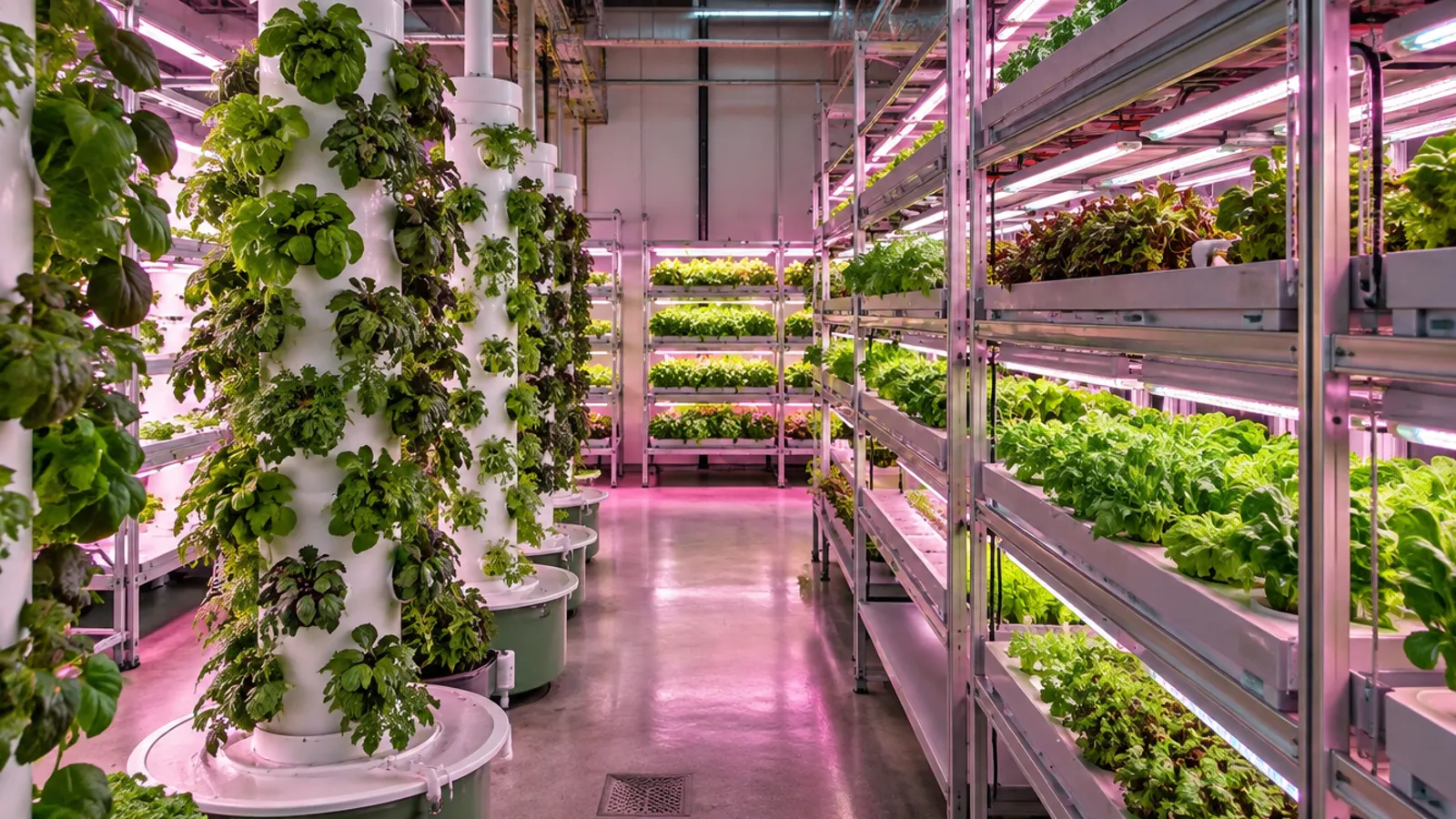
A vertical hydroponic system grows plants without soil in towers, stacked NFT racks, A-frames or trays. Lettuce studies in vertical systems averaged 6.88 kg per m² per crop, against 1.88 kg in the field (meta-analysis, 2023), but one commercial indoor farm used about 10 kWh of electricity per kilogram.
Key takeaways
- Four main types: towers, stacked NFT racks, A-frames and stacked trays; towers and A-frames can use sunlight, indoor racks need LEDs on every layer.
- Vertical lettuce studies averaged 6.88 kg per m² per crop (about 1.4 lb per sq ft), against 3.68 kg in the main controlled-environment analysis and 1.88 kg in the field (meta-analysis, 2023).
- A model for Arizona put hydroponic lettuce at 20 litres of water per kg against 250 litres in the field (2015).
- Energy is a major limit for lit indoor farms: about 10 kWh per kg of lettuce at one commercial farm (2025 analysis); a 2026 Dutch model ranged from 7.83 down to 2.31 kWh per kg, against 3.81 for a greenhouse.
- Several large US and UK vertical farms, including Bowery, Plenty, AeroFarms, Jones Food Company and GrowUp, closed, restructured or entered administration between 2023 and 2025.
In this article
- What is a vertical hydroponic system?
- Types of vertical hydroponic systems
- Benefits of a vertical hydroponic system
- Limits of vertical hydroponics: energy, labour and light cost
- Urban vertical farms: who grew and who closed
- Vertical hydroponic yield per square foot and cost calculator
- How to choose a vertical hydroponic system
- Where satellite monitoring fits
- How we checked the numbers
- FAQ
A vertical hydroponic system grows plants without soil in towers, stacked shelves or A-frames, with nutrient water pumped to the roots and drained back to a tank. Its main benefit is more crop per square foot of floor: a 2023 meta-analysis of lettuce studies found an average of 6.88 kg per m² per crop in vertical systems, against 1.88 kg per m² in the field. The price is electricity, labour and light: one commercial vertical farm used about 10 kWh of power for each kilogram of lettuce.
This guide compares the four main types, sets out the real benefits and the honest limits, and looks at urban vertical farms in the US, Canada, the UK and Australia that have grown or closed. It ends with a yield-per-square-foot and cost calculator, so you can test your own numbers before you buy racks and lights.
What is a vertical hydroponic system?
Hydroponics means growing plants in water that carries dissolved mineral nutrients, with or without an inert medium such as perlite, coir or rockwool. A vertical system turns the growing area on its side or stacks it. Oklahoma State University Extension describes vertical hydroponics as a gravity-fed system: nutrient solution is pumped to the top, runs down past the roots and is collected at the bottom.
The USDA Agricultural Research Service puts it simply: vertical farming moves crops indoors, grows them in stacked layers and uses soilless methods such as hydroponics or aquaponics. Indoors, growers control light, temperature, humidity and carbon dioxide. Outdoors or in a greenhouse, a tower can also use sunlight, which cuts the power bill but brings back the seasons.
Every design has the same core parts:
- Reservoir: a tank that holds the nutrient solution.
- Pump and timer: they lift the solution to the top of each tower or channel.
- Growing structure: towers, gutters, shelves or frames that hold the plants in net pots or slots.
- Return path: drains or gutters that bring the solution back to the tank.
- Light: the sun, LED fixtures, or both.
- Monitoring: meters for pH and electrical conductivity (EC), and sensors for air temperature and humidity.
Nutrient strength matters as much as the frame. UF/IFAS Extension notes that lettuce in NFT is held at an EC of 1.2 dS/m at germination and 1.5 to 1.8 dS/m in production. Our guide to hydroponic nutrients explains the main elements and how growers mix them.
▶ Ten small farm businesses you can start without land, beginning with a shelf of microgreens. · 6:03
Types of vertical hydroponic systems
Four designs cover nearly every vertical setup you will see for sale or in a research paper. The table sums them up, and each one has its own section below.
| Type | How water moves | Best for | Main weak point |
|---|---|---|---|
| Towers | Pumped to the top, drips down inside a column | Home growers, rooftops, strawberries, herbs | Lower plants get less light |
| Stacked NFT racks | Thin film flows along sloped gutters on each shelf | Commercial leafy greens under LEDs | Power for lights and cooling |
| A-frames | NFT gutters on two sloped sides of a frame | Greenhouses and sunny yards | Shading between the two faces |
| Stacked trays | Shallow flood or deep-water trays on shelves | Microgreens and baby greens | Labour for seeding and harvest |
1. Vertical towers
A tower is a column with planting holes on its sides. Solution is pumped to the top and trickles down through a medium or as a mist. Oklahoma State’s build guide uses a 5-inch square fence post, a 45-gallon tank and a 400-gallon-per-hour pump. Each tower holds 28 plants, and two towers fit in a 5-foot by 5-foot space, which gives 56 plants at one time. The same guide says bought tower gardens can cost around $500 or more (Oklahoma State, February 2021), and that a homemade tower costs much less.
Spacing depends on the crop. The Oklahoma State guide gives 12 inches for strawberries and head lettuce and 6 to 8 inches for thin-leaf lettuce. It suggests a tower height of 5 to 6 feet so most people can reach the top. Lettuce can be watered continuously, while strawberries are watered several times a day on a timer.
Best for: home growers, schools, restaurant rooftops and small greenhouse plots. Watch for: plants near the base grow less because they get less light.
2. Stacked NFT racks
The nutrient film technique (NFT) runs a thin stream of solution along shallow gutters. In a vertical farm these gutters sit on shelves, one above the other, each shelf with its own LED bar. Cornell horticulturist Neil Mattson notes that NFT channels are sloped at 1 to 4 percent so the solution drains back to the tank. The FAO’s small-scale aquaponics manual gives a slope of about 1 cm per metre for NFT pipes.
Stacked racks are what large indoor farms use for lettuce and herbs. The rack itself is simple; the cost sits in the lights, the air handling that removes the heat those lights make, and the staff who move trays.
Best for: commercial leafy greens and herbs close to city buyers. Watch for: the electricity bill and pump failure, because NFT roots have little water around them if flow stops.
3. A-frame systems
An A-frame leans NFT gutters on two sloped sides of a triangle-shaped frame. It packs more gutter length into a greenhouse bay than a flat bench and lets sunlight reach both faces. A 2016 study in the journal Food and Energy Security lists A-frame designs among example vertical layouts, next to columns, hanging grow bags and conveyor systems.
Best for: greenhouse growers who want more plants per bay without full LED lighting. Watch for: one face can shade the other, so the frame is often set north to south.
4. Stacked trays for microgreens
Microgreens grow in shallow trays on shelves and are cut young. Trays may be flooded and drained, or set on a thin mat with nutrient water. This is the simplest vertical setup to start and needs little plumbing, but every tray is seeded, moved and cut by hand.
A 2025 study of two microgreens vertical farms in northern Italy found that labour was 41% to 46% of total cost per tray, while energy was only 3% to 4%. Packaging cost more than power at both farms.
Best for: small urban businesses that sell to restaurants and farmers markets. Watch for: labour hours and packaging costs.
Chart
Where the money goes in two microgreens vertical farms
Share of total cost per tray, %, two farms in northern Italy
Benefits of a vertical hydroponic system
The benefits are real, but each one has a size and a condition attached. Here they are with the numbers behind them.
Chart
Lettuce yield per crop by growing system
kg of fresh lettuce per m² per crop cycle, mean of published studies (field value from FAO)
More crop per square foot of floor
This is the main reason to go vertical. The 2023 meta-analysis pooled 979 observations from lettuce studies. Lettuce in the main controlled-environment analysis averaged 3.68 kg per m² per crop, about twice the FAO field figure of 1.88 kg per m². Studies that grew lettuce vertically averaged 6.88 kg per m², which is about 1.4 lb per square foot per crop. The same review found an average of 40 days to harvest, against 60 to 120 days in the field.
A direct comparison makes the point clearer. In the Food and Energy Security study, lettuce in vertical columns gave 13.8 times more crop per unit of floor area than a horizontal hydroponic system, likely because the columns held 20 times more plants per unit of floor. The authors note that this did not count the space needed between columns. The USDA ARS feature on vertical farming quotes a research horticulturist who says that, for some crops, vertical farms get 10 to 20 times the yield per acre of open fields.
Yield per plant can still fall. In the same column study, plant weight dropped from the top of each column to the base as light faded. More plants per square foot is not the same as more crop per plant.
Less water per kilogram
Closed systems reuse the nutrient solution, so little water is lost to runoff. A modelling study of lettuce for Yuma, Arizona, estimated 20 litres of water per kilogram in a hydroponic greenhouse against 250 litres per kilogram in the field. That is about 92% less water per kilogram, though the study was a model, not a measured farm, and the hydroponic case was a greenhouse rather than a stacked indoor farm.
In the Italian microgreens farms, water was well under 1% of total cost. The saving matters most in dry places and where water is priced high. It does not pay the power bill.
Year-round, local supply
Indoor farms are not exposed to frost, hail or heat waves. The USDA ARS researchers say vertical farms let growers produce regional or seasonal crops indoors all year, and put fresh produce closer to people in cities, including in shipping containers, warehouses and parking lots. Several harvests a year from the same floor are possible because each crop cycle is short. If you already plan several crops a year outdoors, our article on multiple cropping covers the field version of the same idea.
Fewer pests and less pesticide
Closed rooms keep out many insects and soil-borne diseases. The ARS researchers say vertical-farm crops can often be grown without pesticides and are much less likely to carry human pathogens such as E. coli. That is a possibility, not a guarantee: aphids, thrips and root diseases such as Pythium can still enter on people, seed or water. If you do treat a crop, check that the product label allows use in an enclosed hydroponic crop, and follow the label and local rules.
Which crops fit
The ARS feature says lettuce and other leafy greens are the most popular vertical-farm crops, because they are short, grow fast and are sold whole. Researchers are testing strawberries, tomatoes and peppers. Corn, rice, wheat and soybeans still belong in fields.
US census data shows where the protected-crop market sits today. The 2024 Census of Horticultural Specialties counted 1,346 US operations selling lettuce grown under protection, with $238.3 million in sales. Of the 831,022 hundredweight of lettuce they sold, 710,127 hundredweight, or about 85%, came from hydroponic systems. These figures cover greenhouses and indoor farms together, not vertical farms alone.
Chart
US sales of food crops grown under protection
$ million, 2024, greenhouses and indoor farms combined, selected crops
Limits of vertical hydroponics: energy, labour and light cost
A fair guide has to show the costs as clearly as the gains. Indoor vertical farms swap free sunlight for bought electricity, and that changes the whole business.
Chart
Electricity use vs total cost for lettuce
Modelled Dutch vertical farm (weakest and best scenarios) against a Dutch greenhouse reference; kWh and € per kg fresh weight
Energy per kilogram
A 2025 peer-reviewed analysis cites one commercial vertical farm that used about 5 million kWh of electricity to grow about 500,000 kg of lettuce a year, or about 10 kWh per kilogram. The same paper estimates that only about 1% of that electrical energy ends up stored in the edible crop. At the US average retail electricity price of 12.94 cents per kWh in 2024 (EIA, all sectors), 10 kWh per kilogram costs about $1.29 per kilogram, or about $0.59 per pound, before any other cost.
Better lighting and plants can lower that number. A 2026 model for the Netherlands put vertical-farm lettuce at 7.83 kWh per kilogram in its weakest scenario and 2.31 kWh per kilogram in its best, against 3.81 kWh per kilogram for a Dutch greenhouse. Total modelled cost ran from €3.26 to €1.67 per kilogram, against a greenhouse reference of €2.35. In other words, the better scenarios beat the greenhouse on lettuce in the model, while the scenarios with the lowest light-use efficiency did not. The model used a Dutch electricity price of €0.111 per kWh and labour at €22.50 per hour.
The USDA ARS researchers make the same point in plain words: the major drawback is giving up the sun, and the heating, ventilation and air conditioning needed to control humidity is expensive and energy-hungry.
Labour
Seeding, transplanting, moving trays, harvesting, packing and cleaning all take hours. In the Italian microgreens study, labour was the largest single cost at both farms. Large indoor farms cut labour with robots and conveyors, but that shifts the money into equipment and loans.
Light falls off down the tower
The column study measured light and plant weight from the top of each column to the bottom. Both fell, and the lower plants were smaller. The authors suggest side lighting between plants to even out growth. On a home tower in the sun, turning the tower or using a reflective wall can help.
Upfront cost and failure risk
Racks, LEDs, air handling, pumps, controllers and backup power cost money before the first harvest. A pump failure can damage an NFT crop quickly, because the roots sit in only a thin film of water. Cornell notes that lettuce in deep water is at risk when dissolved oxygen drops below 3 ppm. Plan for alarms, a spare pump and a power backup.
Urban vertical farms: who grew and who closed
Company news is not a controlled study, but it shows how the economics play out at full scale. These are dated reports from our target markets.
| Farm | Where | What was reported | Date |
|---|---|---|---|
| GoodLeaf Farms | Guelph, Calgary, Montreal (Canada) | Two new 100,000 sq ft farms, each planned for about 2 million lb of leafy greens a year; $78 million debt from CIBC and Farm Credit Canada | June 2023 |
| Stacked Farm | Arundel, Queensland (Australia) | 6,588 m² site with 2,144 m² farm footprint and 20 growing levels; company says it is built for over 400 tonnes a year with six staff to run and maintain it | June 2024 |
| Plenty | Richmond, Virginia (US) | Filed for Chapter 11 in March 2025 after raising nearly $1 billion; emerged in May 2025 to focus on strawberries | Mar to May 2025 |
| Bowery Farming | New York area (US) | Reported to be shutting down after raising more than $700 million | Nov 2024 |
| AeroFarms | Danville, Virginia (US) | Filed for Chapter 11 and exited bankruptcy in September 2023; nearly closed in December 2025 and was sold to a Palm Ventures affiliate in April 2026 | June 2023 to Apr 2026 |
| Jones Food Company | Lydney, England (UK) | Entered administration; 61 staff made redundant | April 2025 |
| GrowUp | Kent, England (UK) | Owed creditors almost £120 million at administration; farm business sold for £1.9 million | Dec 2024 |
| Infarm | UK and Europe | Cut about 500 staff and planned to downsize in the UK, citing high energy prices | Dec 2022 |
Several farms that raised large sums and built fast closed or restructured, and Infarm named energy prices as one reason for its cuts. These reports do not prove why each farm failed, but they show that scale alone did not protect them. GoodLeaf’s planned figures work out to about 20 lb of greens per square foot of production space per year. Stacked Farm’s design figure works out to about 38 lb per square foot of farm footprint per year, though that is the company’s own target, not an audited result.
For comparison, the 2024 US census figures give about 8.8 lb of lettuce per square foot of protected growing area per year across all US lettuce growers under cover, greenhouses and indoor farms together. Stacking is how indoor farms reach higher numbers per square foot; whether it pays depends on the power and labour each extra layer needs.
Vertical hydroponic yield per square foot and cost calculator
Use the calculator to estimate how much a vertical hydroponic setup could grow on your floor area, and what it would cost to run per pound. Enter your own numbers. The defaults are round examples set close to break-even, not benchmarks or forecasts.
Some reference points from the sources above can help you choose inputs. Vertical lettuce studies averaged about 1.4 lb per square foot per crop; many of those studies used two-shelf growth chambers, so this is not a per-layer figure. Published electricity figures for vertical-farm lettuce run from about 1 kWh per pound (best modelled case) to about 4.5 kWh per pound (one commercial farm). The US census average sale value for lettuce grown under protection worked out to about $2.87 per pound in 2024. “Other costs” should include labour, seed, media, packaging, rent and the yearly cost of your equipment.
Try the numbers for your own farm below.
Calculator
How much could your vertical system grow, and does it pay?
Enter your own floor area, layers, yields and prices.
- Crop per year: 9,600 lb
- Crop per sq ft of floor per year: 19.2 lb
- Electricity used per year: 28,800 kWh
- Electricity cost per pound: $0.39
- Total cost per pound: $2.79
- Sales per year: $27,840
Example values only, set near break-even; they are not benchmarks or forecasts. Every number is your input. Reference points: vertical lettuce studies averaged about 1.4 lb per sq ft per crop (meta-analysis, 2023; many used two-shelf chambers, so not a per-layer figure); published electricity figures run from about 1 kWh per lb (best modelled case, Frontiers 2026) to about 4.5 kWh per lb (one commercial farm, 2025 analysis); the 2024 US average retail electricity price was 12.94 cents per kWh (EIA, all sectors); lettuce grown under protection sold for about $2.87 per lb on average in 2024 (USDA NASS census, sales divided by quantity). ‘Other costs’ should cover labour, seed, media, packaging, rent and yearly equipment cost. The result ignores taxes and crop losses.
How to choose a vertical hydroponic system
Work through these questions in order. Each one narrows the choice.
- Where will it stand? Outdoors or in a greenhouse, use towers or A-frames and let the sun do the work. Indoors with no windows, you need LED lights on every layer, and the power bill becomes a major cost.
- What will you grow? Lettuce, herbs and leafy greens suit every type. Strawberries suit towers. Microgreens suit stacked trays. Vine crops need height and support that most racks lack.
- Who will buy it? Find buyers and a price before you build. Restaurants and grocers want a steady weekly supply, not a big harvest once a month.
- What does power cost you? Get your real price per kWh from your bill or utility tariff, then run the calculator at that price.
- How many hours can you give? Count the time to seed, transplant, harvest, pack and clean each week.
- What happens when something fails? Budget for a spare pump, an alarm on the tank and a backup power supply.
- Start small. One or two towers, or one rack, will teach you EC, pH and timing before you buy at scale.
Check local rules too. Building permits, electrical work, food safety and business licensing differ by city and state or province, and an indoor farm in a warehouse may need fire and electrical inspections. Get professional advice on wiring, structural loads and finance before you sign a lease.

▶ Low-cost farm business ideas, including microgreens and hydroponic growing at home. · 8:32
Where satellite monitoring fits
Satellites cannot see inside a warehouse, so they do not help with an indoor rack. They are useful for growers who run vertical units next to outdoor fields, or who supply city buyers from both. Farmonaut provides satellite crop-health maps for outdoor fields on the web and in the mobile app, which can sit next to the sensor data from an indoor system.
Related pages on our site: home page, types of agriculture and farming methods, large-scale farm management, carbon footprinting, product traceability, fleet management, satellite and weather API and the API developer docs.
▶ Seven green farming technologies that save water, fuel and fertilizer, explained in plain English. · 2:24
How we checked the numbers
We used peer-reviewed studies for yields, water and energy, and kept each figure on its own basis: per crop cycle or per year, per floor area or per growing area, modelled or measured. Lettuce yields come from a 2023 meta-analysis and a 2016 column study. Water figures come from a 2015 model for Arizona. Energy figures come from a 2025 analysis of commercial farms and a 2026 Dutch model, and costs from that model and a 2025 study of two Italian farms. US market data comes from the USDA NASS 2024 Census of Horticultural Specialties and the electricity price from the US Energy Information Administration. Company figures come from dated news reports and are labelled as company plans or claims. All sources are listed at the end.
We cover a connected topic in NFT Hydroponic System: Sustainable, Solar & CF Hydroponics.
For a closer look at a related question, see our guide: Vertical Aquaponic System: NFT Methods & Best Fish.
FAQ
What is the best vertical hydroponic system for beginners?
A single tower in a sunny spot is the easiest start. Oklahoma State Extension shows how to build one that holds 28 plants with a 45-gallon tank and one pump. Lettuce, herbs and strawberries all grow well in towers.
How much can a vertical hydroponic system grow per square foot?
Lettuce studies in vertical systems averaged 6.88 kg per m² per crop, about 1.4 lb per square foot per crop (many of the studies used two-shelf growth chambers). With several crops a year, that adds up to many pounds per square foot. Planned commercial farms report about 20 to 38 lb per square foot per year, but those are company figures.
Do vertical hydroponic systems save water?
Yes. A model of lettuce in Arizona estimated 20 litres per kilogram in hydroponics against 250 litres in the field, about 92% less. Real savings depend on leaks, cooling and how often you change the solution.
Why do vertical farms fail?
Electricity, labour and financing are common pressures. One commercial farm used about 10 kWh per kilogram of lettuce, and several large US and UK vertical farms entered bankruptcy or administration between 2023 and 2025. Run your own power price and labour hours through the calculator before you invest.
Is vertical hydroponic produce pesticide-free?
Often, but not always. Closed rooms keep out many pests, and USDA researchers say crops can often be grown without pesticides. Pests can still get in. If you treat a crop, use only products whose label allows it, and follow local rules.
Farmonaut crop monitoring
Watch your outdoor fields from space
If you grow outdoors as well as indoors, draw your fields once and Farmonaut shows satellite crop-health maps for them through the season, on web, Android or iOS.




Keep reading
Sources
- Gargaro, Murphy and Harris (University of Surrey), Let-Us Investigate: a meta-analysis of influencing factors on lettuce crop yields within controlled-environment agriculture systems, Plants (2023): pmc.ncbi.nlm.nih.gov
- Oklahoma Cooperative Extension Service, Building a Vertical Hydroponic Tower, HLA-6724 (February 2021): pods.okstate.edu
- USDA Agricultural Research Service, Vertical Farming: No Longer a Futuristic Concept (Under the Microscope feature): ars.usda.gov
- UF/IFAS Extension, EDIS AE610, nutrient management for hydroponic lettuce (February 2025): edis.ifas.ufl.edu
- Mattson, N., Cornell CEA, Hydroponic production of leafy greens, GPN (October 2016): cea.cals.cornell.edu
- FAO, Small-scale aquaponic food production, Fisheries and Aquaculture Technical Paper 589 (2014): fao.org
- Touliatos, Dodd and McAinsh, Vertical farming increases lettuce yield per unit area compared to conventional horizontal hydroponics, Food and Energy Security (2016): pmc.ncbi.nlm.nih.gov
- Frontiers in Sustainable Food Systems, From seed to profit: a comparative economic study of two Italian vertical farms (2025): frontiersin.org
- Barbosa et al., Comparison of land, water, and energy requirements of lettuce grown using hydroponic vs. conventional agricultural methods, IJERPH 12:6879 (2015): pmc.ncbi.nlm.nih.gov
- USDA NASS, 2024 Census of Horticultural Specialties, Table 15: food crops grown under protection (2026): nass.usda.gov
- Vertical farming limitations and potential demonstrated by back-of-the-envelope calculations, Plant Physiology (2025): pmc.ncbi.nlm.nih.gov
- US Energy Information Administration, State Electricity Profiles: average retail price 2024: eia.gov
- Frontiers in Sustainable Food Systems, Vertical farming economics: crop performance targets for cost-competitive vertical farming (2026): frontiersin.org
- Sustainable Business News (SBIZ), GoodLeaf receives $78M in debt financing for expansion plans (9 June 2023): sustainablebiz.ca
- Forbes Australia, Inside Stacked Farm’s robotic vertical farm (6 June 2024): forbes.com.au
- TechCrunch, Vertical farming company Plenty files for bankruptcy after raising nearly $1B (24 March 2025): techcrunch.com
- Plenty, Plenty completes restructuring, emerges from chapter 11 (30 May 2025): plenty.ag
- TechCrunch, Bowery Farming is ceasing operations (4 November 2024): techcrunch.com
- Food Dive, AeroFarms files for Chapter 11 bankruptcy protection (12 June 2023): fooddive.com
- The Grocer, Vertical farming giant Jones Food Company appoints administrators (10 April 2025): thegrocer.co.uk
- Vertical Farm Daily, GrowUp creditors owed £120m in vertical farming administration (2025): verticalfarmdaily.com
- The Grocer, Infarm halves workforce and plans to downsize UK operations (7 December 2022): thegrocer.co.uk
- Virginia Business, AeroFarms Danville gets new owners after near shutdown (2 August 2026): virginiabusiness.com
Discussion
Questions, corrections or field experience? Share them below. First-time comments are reviewed before they appear, and your email is never published.
No comments yet. Be the first to add a question or your experience.

 Hayleys Agriculture
 Linx Agritech
 Adinet
 Save Your Soils
 YelloSkye
 GalaxEye Space
 Grandstream Algérie
 XOS Realty
 Geospatial Lab Africa
 Agro La Gándara
 HIPSAC
 ZOL Zimbabwe
 Juligerm
 AdBio
 MISE Maroc
 NWNS
 Red August Group
 Farm Inc
 WeMe Global
 Agrotoken

 Licence holder · Niger · Gold










