

What is Crop Rotation in Agriculture? 7 Key Benefits
“Crop rotation can increase soil organic matter by up to 20% in just five years.”
“Rotating crops can reduce pest populations by as much as 50% compared to monoculture farming.”
Table of Contents
- Overview: What is Crop Rotation in Agriculture?
- Historical Evolution – What Was Crop Rotation?
- What is Crop Rotation in Hindi (फसल परिसंचरण)?
- Understanding What is Crop in Agriculture
- 7 Key Benefits of Crop Rotation
- Crop Rotation vs Continuous Cropping: Comparison Table
- Relevance of Crop Rotation in 2025 & Beyond
- Implementation Basics for Effective Crop Rotation
- How Farmonaut Empowers Modern Crop Rotations
- Key Insights, Pro Tips & Callout Boxes
- FAQ: What is Crop Rotation in Agriculture?
- Farmonaut Subscription Table



Overview: What is Crop Rotation in Agriculture?
What is crop rotation in agriculture? At its core, this fundamental agricultural practice involves growing different crops in a planned sequence on the same land across seasons or years. Unlike monoculture (planting the same crop repeatedly), rotation means not planting the same species consecutively, but alternating crops based on a strategic crop rotation plan. A typical sequence may be corn–soybean–wheat, or legumes followed by cereals, interspersed with cover crops or green manures for enhanced soil health.
The primary aim of crop rotation is to improve soil health, optimize nutrient cycling, manage pests and diseases, and sustain yields without relying heavily on synthetic inputs.
- ✔ Rotation breaks pest and disease cycles
- ✔ Balances soil fertility and nutrient use
- ✔ Improves organic matter and soil structure
- ✔ Boosts yield stability and sustainability
- ✔ Reduces need for chemical fertilizers and pesticides
This cornerstone of sustainable production remains relevant in modern farming—across specialty crops, staples, and even agroforestry and tree nursery operations.

Alternating between legumes (which fix atmospheric nitrogen) and cereals or oilseeds enhances soil health and reduces fertilizer dependency—core to sustainable agriculture today and in the future.
Crop Rotation: A Structured, Strategic Practice
Crop rotation is not random; it’s a structured plan. Farmers alternate crops based on species, season, nutritional needs, root structure, and pest or disease profiles. Instead of planting the same crop in a field for consecutive seasons, they follow a designed sequence. For example:
- 🌾 Cereal Crops (like wheat, maize, rice) followed by 🌱 Legumes (soybeans, lentils, chickpeas)
- 🌿 Green Manures (like clover or vetch) incorporated between cash crops
- 🌻 Oilseeds (such as sunflower) rotated with vegetables or pulses
This careful planning is essential for maximizing soil fertility, disrupting pest cycles, and sustaining yields over years.
Soil Nutrient Management and Nitrogen Fixation
Different crops have varying nutrient needs and uptake patterns:
- ✔ Legumes fix atmospheric nitrogen, enriching the soil for subsequent crops
- ✔ Deep-rooted crops (like alfalfa) access subsoil nutrients, pulling them to the upper soil layers
- ✔ Cereals utilize nutrients left after biological nitrogen fixation

By alternating nitrogen-fixing crops and heavy feeders, we balance the essential nutrients in the soil—helping to maintain soil fertility year after year.
Use Farmonaut’s Carbon Footprinting service to monitor how your crop rotation strategy boosts soil organic carbon—key for reward programs and soil health.
Historical Evolution – What Was Crop Rotation?
What was crop rotation? Historically, crop rotation is the backbone of agricultural systems and has deep roots in farming history. Medieval and early European systems deployed three- or four-field rotations:
- ⚡ Year 1: Cereal (e.g., wheat or rye)
- ⚡ Year 2: Legume or root crop (peas, vetch, beans, beets)
- ⚡ Year 3: Fallow (rest period to restore soil fertility)
- ⚡ Later: Inclusion of oilseeds, forage grasses, and cover crops for more advanced rotations
These systems evolved as researchers discovered nitrogen fixation by legumes, leading to reduced fallow periods and more continuous biological improvement of soils. Today, advanced rotations are designed not just to rest land but to actively restore soil health, reduce inputs, and conserve natural resources.

Throughout history, these agricultural practices have helped farming communities—across regions from Europe to the Indian subcontinent—conserve soil, manage pests, and ensure food security.
What is Crop Rotation in Hindi (फसल परिसंचरण)?
In India, the practice of crop rotation is widely known and referred to as फसल परिसंचरण (Fasal Parisanchar) or फसल परिवर्तन (Fasal Parivartan). The term broadly means alternating (परिसंचरण/परिवर्तन) the types of crops (फसल/fasal) in a given field over seasons (मौसम) or years to maintain soil fertility, manage pests, and maximize yields.
Crop Rotation Across Indian Agriculture
- ✔ गेहूँ-चना-धान (Wheat–Chickpea–Rice) जैसे पारंपरिक चक्र
- ✔ कपास–गेहूँ–मूंगफली (Cotton–Wheat–Groundnut) की विविधता
- ✔ हरे खाद (Green manure) या ढैंचा (Sesbania) को रबी-खरीफ सीजन में शामिल करना
Indian farmers have relied on scientific crop rotation (वैज्ञानिक फसल परिसंचरण) to conserve organic matter, reduce erosion, and improve soil—an integral part of sustainable farming in the subcontinent.

Understanding What is Crop in Agriculture
The definition of crop in agriculture is broad—referring to any cultivated plant grown and harvested for economic value. Crops include:
- 🌾 Cereals: Wheat, rice, maize
- 🌱 Pulses: Lentils, chickpeas, kidney beans
- 🍅 Vegetables: Tomato, potato, onion, carrot
- 🍇 Fruit Trees: Mango, banana, guava, citrus
- 🌻 Industrial/Oilseed Crops: Cotton, mustard, sunflower
- 🌲 Tree Crops & Timber: In agroforestry systems (e.g., teak, eucalyptus)
Different crops have varying nutrient demands, rooting depths, and biomass characteristics. A planned crop rotation sequence aligns these differences for better soil management, yield, and pest control, optimizing the performance of each field across seasons and years.
Thinking “more fertilizer” can solve soil decline under monoculture. In reality, continuous cropping exhausts structure, organic matter, and encourages pest buildup. Well-planned rotations yield more with fewer synthetic inputs.
7 Key Benefits of Crop Rotation in Agriculture
Rotating crops creates synergistic effects that offer powerful, sustainable advantages. Let’s explore the seven core benefits of crop rotation—reinforced by decades of research and on-ground results.
1. Improved Soil Health and Structure
- ✔ Increases organic matter: Legumes, cover crops, and plant residues enhance soil carbon, stimulate microbial activity, and improve porosity.
- ✔ Enhanced water infiltration: Deep-rooted species break up compacted layers, while residue cover reduces surface crusting and evaporation.
Soil with high organic content and diverse root architecture is more resilient to erosion, drought, and climate extremes—ensuring stable production year-to-year.
2. Nutrient Cycling and Reduced Need for Synthetic Fertilizer
- ✔ Biological nitrogen fixation by legumes reduces synthetic nitrogen use by 30–50%.
- ✔ Improved nutrient balance and availability for subsequent crops.
This is a key principle in organic and low-input systems. For carbon footprinting or sustainability audits, using Farmonaut’s Carbon Footprinting can tangibly showcase these reductions.
3. Pest and Disease Management by Breaking Cycles
- ✔ Reduces pest and pathogen buildup by interrupting their life cycles.
- ✔ Promotes beneficial insect populations and reduces chemical reliance for pest control.
Rotation is the foundation of Integrated Pest Management (IPM), making pesticide use more strategic and preventing resistance development in pests and diseases.

4. Yield Improvement and Stability
- ✔ Higher overall yields (up to +20%) compared to continuous cropping or monoculture.
- ✔ Reduces yield fluctuations: More resilience to climate stress or disease outbreaks.
Farmonaut’s satellite monitoring & AI systems help visualize yield trends across rotation cycles and optimize future crop sequences for higher returns. Learn about large-scale farm management here.
5. Weed Suppression and Reduced Herbicide Use
- ✔ Disrupts weed life cycles by varying planting and harvest dates, and residue cover.
- ✔ Supports mechanical or cultural weed control (less chemical reliance).
Fields under diversified, well-managed rotations often have lower weed pressure and reduced costs for management.
6. Water Use Efficiency and Drought Resilience
- ✔ Varied rooting depths and organic matter improve rainwater capture and reduce runoff.
- ✔ Cover crop residues protect against evaporation losses in drylands.
This is increasingly essential as climate variability grows—in India, Africa, Europe, and other water-stressed regions.
7. Sustainability Impact & Ecosystem Services
- ✔ Enhances biodiversity: Supports pollinators, natural predators, and soil life.
- ✔ Improves carbon sequestration, soil resilience, and contributes to sustainability certifications.
- ✔ Reduces greenhouse gas emissions and chemical leaching.
Crop rotations are foundational for meeting emerging sustainability metrics, carbon goals, and environmental compliance in 2026 and beyond.
Visual List: Core Advantages of Crop Rotation
- 🌱 Regenerates Soil: Increases fertility, structure, and microbial life
- 🐜 Breaks Pest Cycles: Lowers pest and disease risk naturally
- 💧 Retains Water: Boosts infiltration, reduces drought stress
- ♻ Reduces Chemicals: Minimizes synthetic fertilizer and pesticide use
- 🌎 Builds Sustainability: Aligns with green certifications and resilient food systems
“Rotating crops can reduce pest populations by as much as 50% compared to monoculture farming.”
Crop Rotation vs Continuous Cropping: Comparison Table
| Benefit Category | Crop Rotation: Estimated Impact | Continuous Cropping: Estimated Impact |
|---|---|---|
| Soil Health | High – Organic matter up +20%, improved structure, microbial activity | Low – Declining organic matter, compacted soil, reduced resilience |
| Pest Management | High – Pest/disease incidence reduced by 35–50% | Low – Increased pest/disease buildup, greater outbreaks |
| Yield Improvement | +15–20% overall yield stability | Variable/Flat – Yields often decline with time |
| Nutrient Cycling | Optimized – Legume fixation, balanced uptake | Imbalanced – Nutrient mining, higher fertilizer cost |
| Water Use Efficiency | High – 10–25% more water retained | Low – Less infiltration, more runoff and drought sensitivity |
| Weed Suppression | Strong – Weed pressure reduced by 30%, less herbicide needed | Weak – High weed persistence, more herbicide required |
| Sustainability Impact | Major – Increased resilience, improved biodiversity, climate adaptation | Minimal – Unsustainable, environmental degradation risk |
Relevance of Crop Rotation in 2025 & Beyond
- 💡 Soil Health and Climate Resilience: Rotations help soils maintain organic matter, conserve water, and resist erosion, safeguarding yields during unpredictable weather and drought.
- 💡 Integrated Nutrient Use: Including legumes means less reliance on synthetic nitrogen, supporting both environmental and economic goals.
- 💡 Non-Chemical Pest Management: Crop rotations form a cornerstone for IPM (Integrated Pest Management), slowing resistance and reducing chemical load.
- 💡 Agroforestry and Rehabilitation: On mining-impacted or degraded lands, adding tree and legume rotations restores fertility, stabilizes soils, and creates new outputs like timber or non-timber forest products. (Learn more about crop plantation/forest advisory)
- 💡 Certification and Compliance: Crop rotation is increasingly required for sustainability certifications, carbon audits, and government support programs.

Implementation Basics for Effective Crop Rotation
- 🧪 Assess Soil Health: Test for nutrients, organic matter, and pH. Base your rotation strategy on these data points for tailored results.
- 📋 Plan a Multi-Year Sequence: Use a mix of cereals, legumes, and cover crops; adjust for market priorities, climate, and water availability.
- 🌱 Include Cover Crops: Vetch, clover, rye, or other covers boost nitrogen, prevent erosion, and build biomass.
- 🔄 Manage Residues: Return crop residues wherever possible to maintain soil carbon and suppress weeds.
- 🔬 Adapt to Constraints: Be flexible—mechanize residue management, choose crop families that best fit market and climate realities.
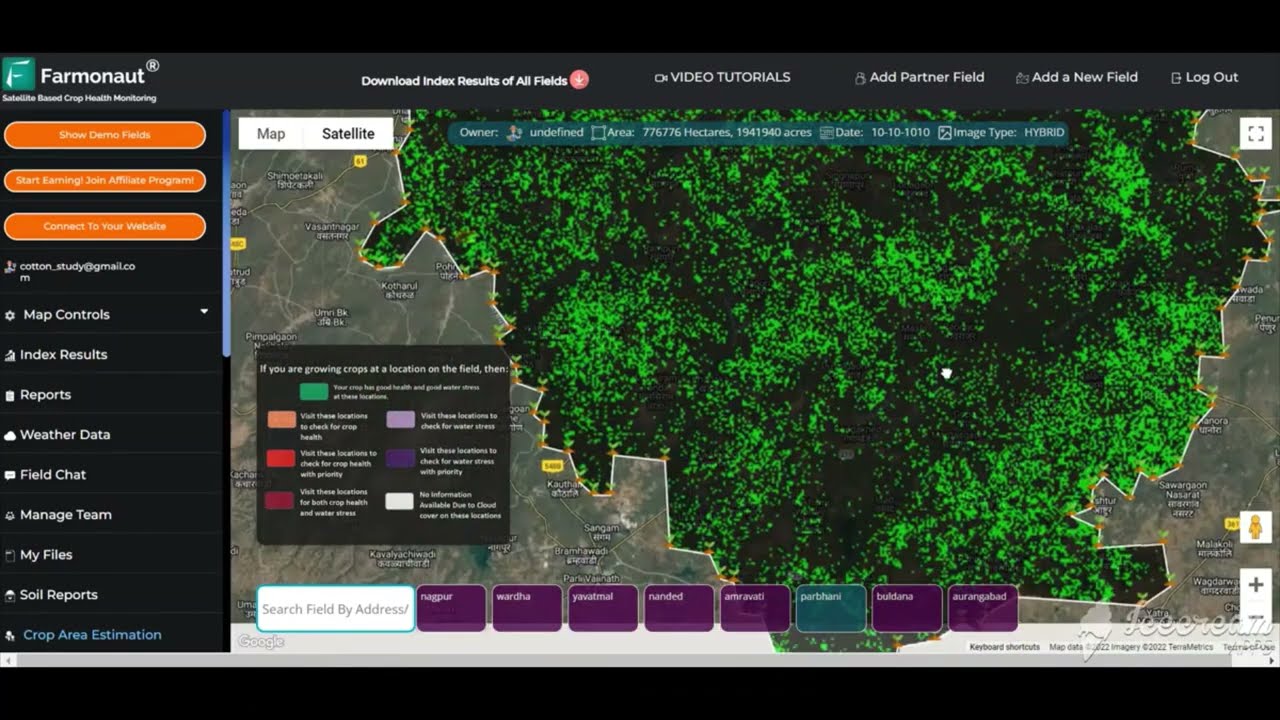
Our satellite-driven monitoring and AI advisory system at Farmonaut empowers farmers and agribusinesses to map fields, monitor residue return, and quantify crop rotation impacts—maximizing yield and sustainability.
Crop rotation isn’t just smart for land—it’s a sustainability metric for agricultural investors, land rehabilitation (mining), and forestry-linked projects. Monitor and verify with Farmonaut’s blockchain traceability.

How Farmonaut Empowers Modern Crop Rotations
At Farmonaut, we provide affordable satellite-based solutions and advanced AI-driven tools to support every aspect of the crop rotation cycle—from field mapping, vegetation/soil health monitoring (NDVI), to blockchain-based traceability and fleet/resource management. Our platform supports:
- 🚜 Large-scale farm management – plan fields, optimize crop sequences, monitor growth, and manage logistics. (Learn about our Agro-Admin App)
- 🌱 Field-level crop health tracking – see how different rotation strategies affect biomass, soil, and yield remotely.
- ⛏ Sustainable mining & land rehabilitation – verify vegetation cover, soil restoration, and resource use on mining-impacted lands.
- ⏱ Timely crop advisory & weather forecasts – get daily AI recommendations for the current season’s crop, powered by Jeevn AI.
- 💼 API and developer access for integrating rotation tracking directly into your own agricultural platforms or records. (API Access, Developer Docs)
We make resource management, sustainability tracking, and decision support accessible—so any farmer, business, or land manager can implement truly modern, profitable crop rotations.
- 🛰 Satellite data reveals spatial trends in soil health and crop biomass
- 🤖 AI-based advisories recommend optimal rotation sequences by zone/market
- 💻 Blockchains build supply chain trust for sustainable farming certifications
- 🌳 Specialty support for tree nurseries, forest plantations, and mining rehabilitation
- 🛠 Integrated tools for resource and fleet management in large operations
Key Callouts & Tips for Efficient Crop Rotations
“Crop rotation can increase soil organic matter by up to 20% in just five years.”
FAQ: What is Crop Rotation in Agriculture?
Q1: Why is crop rotation considered a cornerstone practice in sustainable agriculture?
A: Crop rotation improves soil health, balances nutrition through varying nutrient demands, suppresses pests/diseases, supports organic matter buildup, and boosts yields with fewer synthetic inputs—making it essential for climate resilience and productivity.
Q2: How many years should a typical crop rotation sequence span?
A: Most effective sequences run 3–5 years but can extend to 7 years or more. The best rotation length depends on farm size, market needs, and climate.
Q3: Can crop rotation work for both large and small farms?
A: Yes—rotations can be adapted for all scales. Digital platforms like Farmonaut help even smallholders develop practical, data-backed plans for their specific conditions.
Q4: What’s the role of cover crops in rotation?
A: Cover crops prevent erosion, fix atmospheric nitrogen (legumes), and add organic matter. They’re key for effective soil restoration and resilience.
Q5: Is crop rotation required by sustainability standards?
A: Increasingly, yes. Crop rotation is recognized in environmental compliance, sustainability certifications, and carbon audits—as a verifiable, science-backed best practice.
Farmonaut Subscription Table
Conclusion
Crop rotation is a time-tested, agronomically sound strategy that balances soil fertility, pest management, and ecosystem health. Its relevance is growing in 2026 and beyond, not only for conventional farming systems but also for sustainable forestry, mining land rehabilitation, and certified agricultural production. With digital tools like Farmonaut’s satellite-based monitoring & AI solutions, implementing, tracking, and optimizing crop rotations becomes accessible for all. The result? Higher yields, healthier lands, lower input costs, and verified sustainability for future generations.
Discussion
Questions, corrections or field experience? Share them below. First-time comments are reviewed before they appear, and your email is never published.
No comments yet. Be the first to add a question or your experience.

 Fair Climate Fund
 TVS Electronics
 BW Pipelines
 WICO
WICO Gen Chayat
 Chimera Innovation
 SkyHarvest
 Polaris Digitech
 Teledarbas
 Wild Oak Farm
 SFX
SFX BACF Africa
 Doodlakine
 Exurbia Geospatial
 FieldZero
 Indico Company
 Licence holder · Niger · Gold










