

Farmland leasing · US and Canada comparison
Crop Share vs Cash Rent: Splits, Rents and a Calculator
With cash rent the tenant pays a fixed amount per acre and carries all the risk; with a crop share the landowner takes part of the crop, often 50% in Iowa or 25-33% on the Prairies, and shares some input costs. US cropland rent averaged $160 per acre in 2026 (USDA NASS).
Key takeaways
- Cash rent: a fixed payment per acre, all yield and price risk on the tenant. Crop share: the owner takes a part of the crop and often pays the same part of seed, fertilizer and chemicals.
- Common splits: 50-50 in Iowa (Iowa State University); 75/25 tenant/landlord in Alberta, or about 66/33 when fertilizer and chemicals are shared (Alberta Agriculture, 2019).
- US cropland cash rent averaged $160 per acre in 2026, from $331 in California to about $41 in Oklahoma and Montana (USDA NASS via the American Farm Bureau Federation).
- Crop share leases covered 7% of Iowa farmland in 2022, down from 9% in 2017, while fixed cash rent rose from 35% to 42% (Iowa State University tenure survey).
- Farm Credit Canada’s Saskatchewan simulation found cash rent paid the producer more in good years and a crop share cut producer losses by 40% on average in loss years (2024).
In this article
- Crop share vs cash rent at a glance
- What is crop sharing?
- What is cash rent?
- What farmland rents cost now
- Who still uses crop share leases?
- Crop share vs cash rent: who carries the risk?
- How to compare a crop share and cash rent on your farm
- Pros and cons of a crop share lease
- Pros and cons of cash rent
- Which lease fits which farm?
- What to put in a crop share lease
- Records both sides need
- How we checked the numbers
- FAQ
Crop share vs cash rent comes down to who carries the risk. With cash rent, the tenant pays a fixed amount per acre and keeps the whole crop. With a crop share, the landowner takes a part of the crop instead, often half in Iowa and a quarter or a third on the Canadian Prairies, and often pays the same part of some input costs.
US cropland rented for an average of $160 per acre in 2026, according to the USDA figures summarized by the American Farm Bureau Federation. This guide explains how crop sharing works in the US and Canada, shows what cash rents cost now, and gives you a calculator to compare the two leases with your own yields, prices and costs.
Crop share vs cash rent at a glance
The table sums up the main differences. Each point is explained further down, with the source behind it.
| Point | Cash rent | Crop share |
|---|---|---|
| What the owner gets | A fixed dollar amount per acre | A set part of the crop, or of crop sales |
| Usual split | Not split | 50-50 in Iowa; 25/75 or 33/67 on the Prairies |
| Input costs | Tenant pays all | Often shared in the same proportion as the crop |
| Yield and price risk | Tenant carries it | Shared by both |
| When rent is paid | Often spring and fall, before the crop is sold | When the crop is sold |
| Records needed | Few | Yields and input costs for each field |
| Owner’s say in farming | Little | More |
| Best for | Owners who want steady income; tenants with cash and appetite for risk | Owners who want to share the upside; tenants short of working capital |
What is crop sharing?
Crop sharing is a lease in which the rent is a share of the harvest, not a cash payment. The landowner supplies the land. The tenant supplies the machinery, fuel and labour. The two then split the crop, and often some of the costs, by an agreed ratio.
In Iowa, the usual form is a 50-50 lease. Iowa State University’s Ag Decision Maker guide to share leases (updated 2015) describes the owner and tenant splitting seed, fertilizer and pesticide costs 50-50, splitting the crop 50-50, and each receiving half of any government payments. Each party handles and sells its own share of the grain.
On the Canadian Prairies, the landowner’s share is smaller because the owner usually pays fewer costs. Alberta Agriculture says crop share leases are typically 75% tenant and 25% landlord, moving to about 66/33 when fertilizer and chemical costs are shared (Alberta Agriculture and Forestry, 2019). Farm Credit Canada describes the traditional splits as one-third/two-thirds or one-quarter/three-quarters of crop revenue, with the landowner paying the same fraction of seed, fertilizer, chemicals and crop insurance.
Common crop share splits
- 50-50 (US Corn Belt): owner pays half of seed, fertilizer and chemicals and gets half the crop. Iowa State says this division is reasonably fair in a conventional corn-soybean rotation, but may not be fair for other systems such as organic farming, where the tenant tends to carry more of the costs.
- One-third/two-thirds: the older Prairie norm. The owner may pay one-third of fertilizer and chemicals.
- One-quarter/three-quarters: the owner pays few or no inputs and gets 25% of the crop. This is the most common form Alberta Agriculture describes.
The usual principle is to divide the crop in the same proportion as each party’s share of total costs, land included. When land values rise, the owner’s share of total costs rises too, which is why the split is worth checking every few years.
What is cash rent?
Under cash rent, the tenant pays a fixed dollar amount per acre, keeps the whole crop and pays all the costs. Manitoba Agriculture’s sample crop share lease guide notes that cash leases suit absentee owners and owners who want a stable income. The tenant gets more independence and keeps the reward for better farming, but also carries all of the production and marketing risk.
Rent may be paid in full at the start of the season or in two parts, in spring before seeding and in fall after harvest, so part of it is due before any grain is sold. The Law Society of Saskatchewan’s farm lease checklist gives a 50% spring and 50% fall split as one example.
Flexible cash rent
A flexible cash lease sits in between. The rent moves each year with grain prices, or with prices and yields, so the owner shares some of the market risk without taking part in farming decisions. In Manitoba’s guide, the base is an expected yield of a common crop with an allowance for crop failure, multiplied by an agreed price, such as a 30-day average before the payment date.
What farmland rents cost now
US cash rents rose quickly from 2021 to 2024 and have been flat since. The national average for cropland was $141 per acre in 2021 and $148 in 2022, according to the USDA NASS 2022 land values and cash rents highlights. It reached $160 in 2024, $5 more than in 2023, and was $160 again in 2026 after $161 in 2025.
Chart
Average US cropland cash rent
US dollars per acre, all cropland (irrigated and non-irrigated), 2021 to 2026
The 2026 rent was 15% above the 2020 level, while cropland values rose 48% over the same years. The NASS Land Values 2026 Summary puts the average value of US cropland at $6,020 per acre, up 3.3% on 2025. Irrigated cropland rented for $244 per acre and non-irrigated cropland for $146 in 2026.
Rents differ a lot between states. California had the highest average cropland rent in 2026 at $331 per acre, then Hawaii, Iowa and Illinois. Oklahoma and Montana were lowest at about $41.
In Illinois, the average was $261 per acre in 2026, down from $264 in 2025 and $269 in 2024, according to farmdoc daily at the University of Illinois. Professional farm managers in the state reported average rents from $227 per acre on fair land to $384 on excellent land in their 2026 mid-year survey. In Iowa, the Iowa State University Extension survey, a different survey from the USDA figure of $271 in the chart, put the 2026 average at $270 per acre, down $1 from 2025 and $9 below the 2023 and 2024 high (as reported by Pro Farmer).
In Canada, there is no recent province-wide government rent survey for Saskatchewan or Alberta, so local rates are harder to pin down. Alberta Agriculture’s rule of thumb is that cash rent is about 20 to 24% of gross crop returns in many areas (2019). For Saskatchewan prices by area, see our page on farmland rental rates in Saskatchewan.
Chart
Cropland cash rent in selected states
US dollars per acre, 2026: the four highest and four lowest states named by AFBF, plus the US average
Who still uses crop share leases?
Crop share leases are losing ground to cash rent in Iowa and Alberta. In Iowa, the 2022 Iowa Farmland Ownership and Tenure Survey found that crop share leases covered 7% of the state’s farmland, down from 9% in 2017. Fixed cash rent rose from 35% to 42% of farmland over the same five years, and the share of all farmland that was leased rose from 53% to 58%.
Chart
How Iowa farmland is controlled
Percent of all Iowa farmland, selected categories, 2017 and 2022 surveys
Iowa State researchers link the decline in landowner involvement partly to non-residency: the share of Iowa farmland owned by full-time Iowa residents fell from 80% in 2017 to 75% in 2022. An owner who lives far away is less able to take part in decisions on inputs, harvest and grain sales, which a crop share lease needs.
Alberta Agriculture reports the same trend in Alberta: crop share rentals are becoming less common because many landowners do not want the price or yield risk. Farm Credit Canada argues the other way for some farms: when margins are thin, a crop share can protect young and beginning farmers, who have the most to gain from steadier cash flow.
Crop share vs cash rent: who carries the risk?
Under cash rent, the tenant’s rent is the same in a drought year and a bumper year. Under a crop share, the owner’s income falls in a bad year and rises in a good one. So which lease pays the tenant more depends on the year.
Farm Credit Canada simulated both leases for a Saskatchewan canola-wheat rotation and an Ontario corn-soybean rotation (October 2024). In Saskatchewan, the producer earned more under cash rent in years with good margins, while crop sharing did better when margins were close to zero or negative. In Ontario, the 3/4 crop share usually gave the highest producer return, and a 2/3 share helped in the tight years 2023 and 2024. In the Saskatchewan example, crop sharing cut the producer’s losses by 40% on average in loss years.
The same logic shows in Illinois. farmdoc daily’s 2027 crop budgets project corn returns of $28 to $36 per acre after all costs, including cash rent, in northern and central Illinois, and a loss of $61 per acre in the south. A $0.50 change in the corn price shifts returns by more than $100 per acre. With returns that close to zero, a fixed rent can turn a small profit into a loss. A share lease spreads that swing between owner and tenant.
Risk spreading also works inside the farm. Mixing enterprises, crops or livestock, is another way to smooth a bad year, as this short video explains.

▶ How mixing crops and livestock on one farm spreads risk across bad and good years. · 2:55
How to compare a crop share and cash rent on your farm
The fair way to compare the two leases is to price a typical crop share in cash, then compare that “crop share equivalent” with the cash rent on offer. Use these steps.
- Pick long-term yields. Alberta Agriculture suggests crop insurance yields, which are averages over many years, not last year’s yield.
- Pick prices. Use insurable prices or harvest futures for the coming crop, adjusted for local basis.
- List the inputs the owner would share. Usually seed, fertilizer and chemicals, sometimes crop insurance, drying and hauling.
- Work out the owner’s net share. Owner’s share of crop value minus the owner’s share of inputs.
- Allow for risk. Under cash rent the tenant takes all the risk, so Alberta Agriculture applies a 25% discount to the yield for weather, yield and price variability in its crop share equivalent formula.
- Compare and negotiate. Repeat for the main crops in your rotation and take the average. Then add land quality, location, drainage and how well you get along.
The calculator below does steps 4 and 6 for one crop. It shows the tenant’s net return under each lease and the yield at which both leases leave the tenant with the same money.
Try the numbers for your own farm below.
Pros and cons of a crop share lease
Advantages
- Shared risk: in a poor year, the owner’s rent falls with the crop. The tenant’s cash costs fall too, because the owner pays part of the inputs.
- Less cash up front: there is no spring rent payment, which helps beginning farmers with little working capital.
- Shared upside: the owner gains from high yields and prices.
- Longer leases: Manitoba’s guide notes that crop share and flexible leases can run longer because the rent does not need to be renegotiated when grain prices change.
- Crop insurance for the owner: in Manitoba, the owner can insure their share under AgriInsurance only if the rent is paid entirely as a share of the crop.
Disadvantages
- More records: yields and input costs must be kept for each field and crop.
- More decisions together: inputs, delivery and sale of grain all need agreement.
- Uneven owner income: the owner’s income changes from year to year with yield and price.
- Fairness drifts: as land values and input prices change, a split that was fair ten years ago may no longer match each side’s costs.
Best for: owners who live near the farm and want to stay involved, retired farmers who want to keep a link to the land, and tenants with good yields but limited cash.
Pros and cons of cash rent
Advantages
- Simple: one number per acre, few records, little ongoing management for the owner.
- Steady owner income: the owner does not feel extreme swings in yields and prices right away.
- Tenant control: the tenant makes all cropping and marketing decisions and keeps the reward for farming well.
- Easy budgeting: both sides know the rent in advance.
Disadvantages
- All risk on the tenant: a fixed rent must be paid in a bad year.
- Slow to adjust: the Farm Bureau notes that rents adjust more slowly than land values and grain prices because many leases are agreed before the season.
- Short terms: cash leases are often short so rent can follow grain prices, and Manitoba’s guide warns that soil conservation and other long-term practices may be skipped on short leases. That concern applies to any farm that is worked hard for short-term yield; see our overview of intensive farming advantages and disadvantages.
- GST in Canada: a cash lease of farmland is a taxable supply for GST purposes, while a crop share lease is not, according to the Law Society of Saskatchewan’s checklist.
Best for: absentee or non-farming owners who want a known income, and tenants with enough working capital to carry the risk.
Which lease fits which farm?
- Fixed cash rent. Best for: owners who want no farming decisions and tenants with strong cash flow. Watch: rent due before harvest.
- Flexible cash rent. Best for: owners who want cash but accept some price risk. Watch: write the price and yield formula down clearly.
- 50-50 crop share. Best for: corn-soybean farms in the US Midwest with an owner who is close by. Watch: owner pays half of the big input bills.
- One-third or one-quarter crop share. Best for: Prairie grain farms where the owner pays few inputs. Watch: check that the split still matches each side’s costs.
- Cash rent plus a bonus. Best for: owners and tenants who want a base rent plus a share of unusually good years. Watch: write down a clear trigger, such as gross revenue per acre, and how the bonus is worked out.
What to put in a crop share lease
Alberta Agriculture’s advice is to calculate, negotiate and then put the agreement in writing, which it says would prevent most disagreements. The Law Society of Saskatchewan’s farm lease checklist and Manitoba’s sample lease list the points a crop share lease should settle:
- The share of the crop paid as rent, and whether it is the same on all acres (irrigated land sometimes differs).
- Which inputs the owner pays, in what proportion, and who decides the amounts.
- Where the owner’s share is delivered, and who sells it.
- Whether the tenant may remove straw, and how the owner is paid for it.
- How government payments are split. Iowa’s 50-50 leases split them like the crop. For US programs, see our guide to farm subsidies by state.
- Crop insurance and hail cover for each party.
- Rotation and soil rules, such as the crops allowed. Our page on what crop rotation is and why it matters covers the basics.
- The lease length, how it ends, and what happens if the land is sold.
Some points depend on provincial law. In Manitoba, a tenant should register a caveat on the land title to keep the lease in force if the land is sold, and a spouse must consent in writing to a lease of homestead land. Rules differ in each state and province, so check local rules and get legal and tax advice before you sign.
Tax points to raise with an adviser
Leasing can change how a landowner is taxed. Manitoba’s guide warns that an owner who rents land to someone other than a spouse or child may lose the capital gains rollover when passing land to a child. The Saskatchewan checklist adds that a lease may affect the owner’s status as a farmer for rollovers and the capital gains exemption, and that cash rent may need GST to be collected. In the US, the tax treatment of share rent and cash rent also differs. This guide is not tax advice; ask an accountant who works with farm clients.
Records both sides need
A crop share lease runs on trust and records. Both sides need yields by field, input bills, delivery tickets and grain sales. Cash rent needs fewer records, but yield history still decides what rent the land can carry when the lease is renewed.
Field maps that both parties can see help. Satellite crop maps show where plant growth was weaker during the season and which parts of a field lag behind year after year, which gives the owner and tenant a shared picture before they talk about rent. The Farmonaut Satellite + AI Farm Monitoring System is one tool that shows these vegetation maps for each field. Our walkthrough video in this section shows how to read them.
Weather is a major reason yields swing from year to year, so a lease should say what happens after a crop failure. For practical steps, see our page on climate resilience in agriculture.
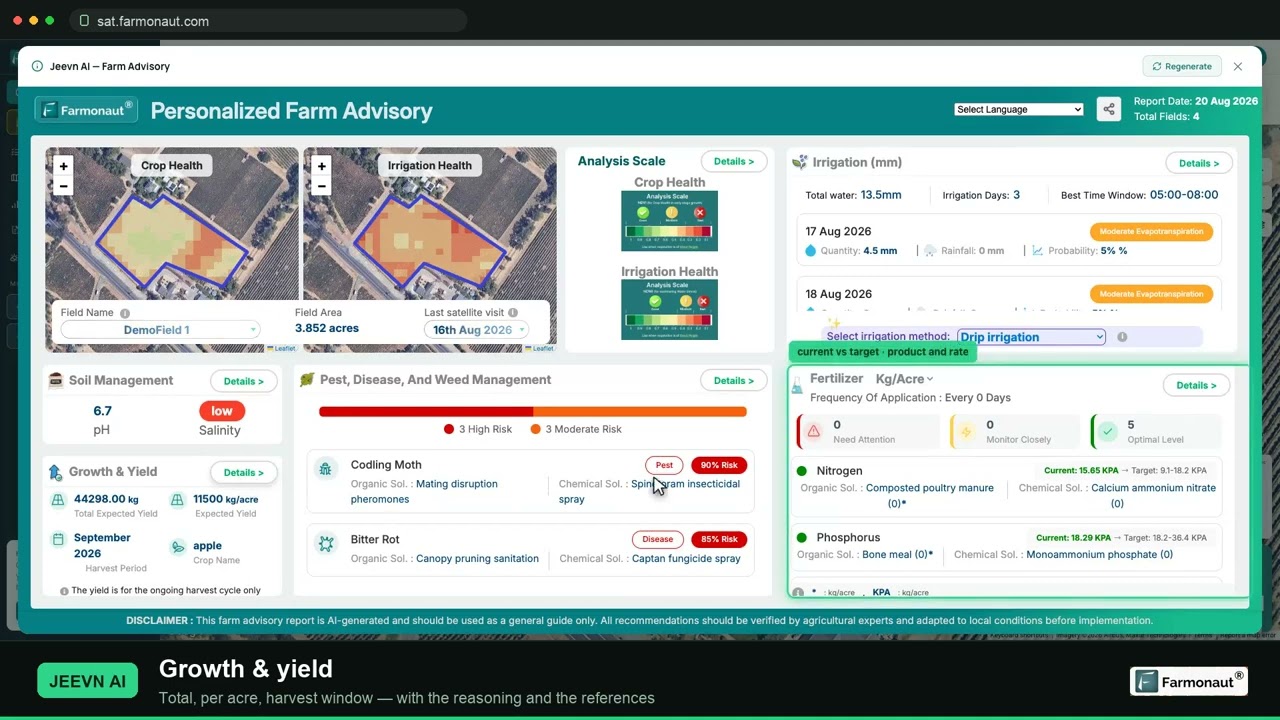
▶ A walkthrough of satellite crop monitoring: reading NDVI maps and pulling a field report for your own land. · 19:36
How we checked the numbers
US rents come from USDA NASS (2022 and 2024 highlights, Land Values 2026 Summary) and the American Farm Bureau Federation’s summary of the 2026 NASS cash rent estimates. These are survey averages of rent paid, not asking prices. Illinois figures come from farmdoc daily (September 2026), Iowa figures from Iowa State University. Canadian lease splits come from Alberta Agriculture (2019), Manitoba Agriculture, the Law Society of Saskatchewan and Farm Credit Canada (2024). The earlier version of this page had a five-year table of yields, prices and profits; it had no source, so it is not repeated here. The calculator uses only the numbers you type.
Related pages on our site: Saskatchewan rental rates, farmland for sale, satellite data API, API developer docs.
FAQ
What is a fair crop share split?
A fair split divides the crop in the same proportion as each side’s share of total costs, land included. In Iowa that is usually 50-50 with shared inputs. In Alberta it is usually 25% to the landlord with no shared inputs, or about 33% when fertilizer and chemicals are shared.
Is crop share or cash rent better for the tenant?
It depends on the year. Cash rent pays the tenant more when yields and prices are high. A crop share pays more when margins are thin or negative. Farm Credit Canada’s Saskatchewan simulation found crop sharing cut producer losses by 40% on average in loss years.
How do I turn a crop share into a cash rent?
Multiply a long-term yield by a realistic price and by the owner’s share, then subtract the owner’s share of inputs. Alberta Agriculture also discounts the yield by 25% because the cash tenant takes all the risk. Repeat for each main crop and average the results.
Can we switch from cash rent to a crop share mid-lease?
Only if both sides agree and sign a new or amended lease. It is simpler to change at renewal, and many cash leases are reviewed in the fall, before the next crop year.
What is the average cash rent per acre in the US?
US cropland averaged $160 per acre in 2026, according to USDA NASS estimates reported by the American Farm Bureau Federation. Irrigated cropland averaged $244 and non-irrigated cropland $146.
Farmonaut crop monitoring
See your rented fields from space
Draw your fields once and Farmonaut shows satellite vegetation maps for them through the season, so owner and tenant can look at the same picture.




Keep reading
Sources
- American Farm Bureau Federation, Market Intel: Farmland Values Climb to New Highs as Cash Rents Hold Near Records (2026): fb.org
- USDA NASS, Land Values 2026 Summary (July 2026): release.nass.usda.gov
- USDA NASS, 2024 Land Values and Cash Rents highlights (2024): nass.usda.gov
- USDA NASS, 2022 Land Values and Cash Rents highlights (October 2022): nass.usda.gov
- Paulson, Schnitkey, Tsay and Zulauf, Illinois Cash Rents in 2026 and Outlook for 2027, farmdoc daily, University of Illinois (September 2026): farmdocdaily.illinois.edu
- Paulson, Schnitkey, Zulauf and Zwilling, Illinois Crop Budgets for 2027, farmdoc daily, University of Illinois (September 2026): farmdocdaily.illinois.edu
- Iowa State University Extension, Ag Decision Maker File C2-31: Share Leases (updated May 2015): extension.iastate.edu
- Hart, Tong and Zhang, Continuing Evolution of Iowa Farmland Ownership and Tenure: Results from the 2022 Survey, Agricultural Policy Review, Iowa State University (spring 2023): agpolicyreview.card.iastate.edu
- Pro Farmer, 2026 Average Iowa Cash Rent Eases (reporting the Iowa State University Extension survey, 2026): profarmer.com
- Farm Credit Canada, Crop sharing an alternative to high priced farmland (October 2024): fcc-fac.ca
- Alberta Agriculture and Forestry, Agri-News: Determining a reasonable crop land rental rate (February 2019): www1.agric.gov.ab.ca
- Manitoba Agriculture, Sample Crop Share Lease Agreement: gov.mb.ca
- Law Society of Saskatchewan, Practice Checklist: Farm Leases (current to September 2022): lawsociety.sk.ca
Discussion
Questions, corrections or field experience? Share them below. First-time comments are reviewed before they appear, and your email is never published.
No comments yet. Be the first to add a question or your experience.

 Kubota
 Grow Indigo
 FFBS
 Jontra
 Kalustyan
 Tucor
 Geno
 Hayleys Agriculture
 Linx Agritech
 Adinet
 Save Your Soils
 Grandstream Algérie
 XOS Realty
 Geospatial Lab Africa
 Agro La Gándara
 HIPSAC
 ZOL Zimbabwe
 Juligerm

 Licence holder · Niger · Gold










