

Reviewed August 2026 against Farm Credit Canada’s 2025 mid-year farmland values report and USDA NASS land value data.
Try it: Run your own numbers →
Manitoba Farms for Sale: Land Prices & Investment Guide
Manitoba farmland averaged $6,400 per acre in the Central Plains-Pembina Valley region and $5,700 per acre in the Eastman region in the first half of 2025, according to Farm Credit Canada’s mid-year farmland values update. That compares with a US average farm real estate value of $4,350 per acre in 2025, per USDA’s National Agricultural Statistics Service. If you’re evaluating a Manitoba farm for sale as an investment rather than an operating purchase, those two numbers — and the gap between them — are where the analysis starts.
This guide walks through what farms and farmland in Manitoba actually cost by region, how that stacks up against US cropland, what the land produces, and how to size up a specific listing before you make an offer. It closes with a calculator that turns a price-per-acre and a few of your own assumptions into a projected return, so you’re not relying on a seller’s pitch to tell you whether a number makes sense.
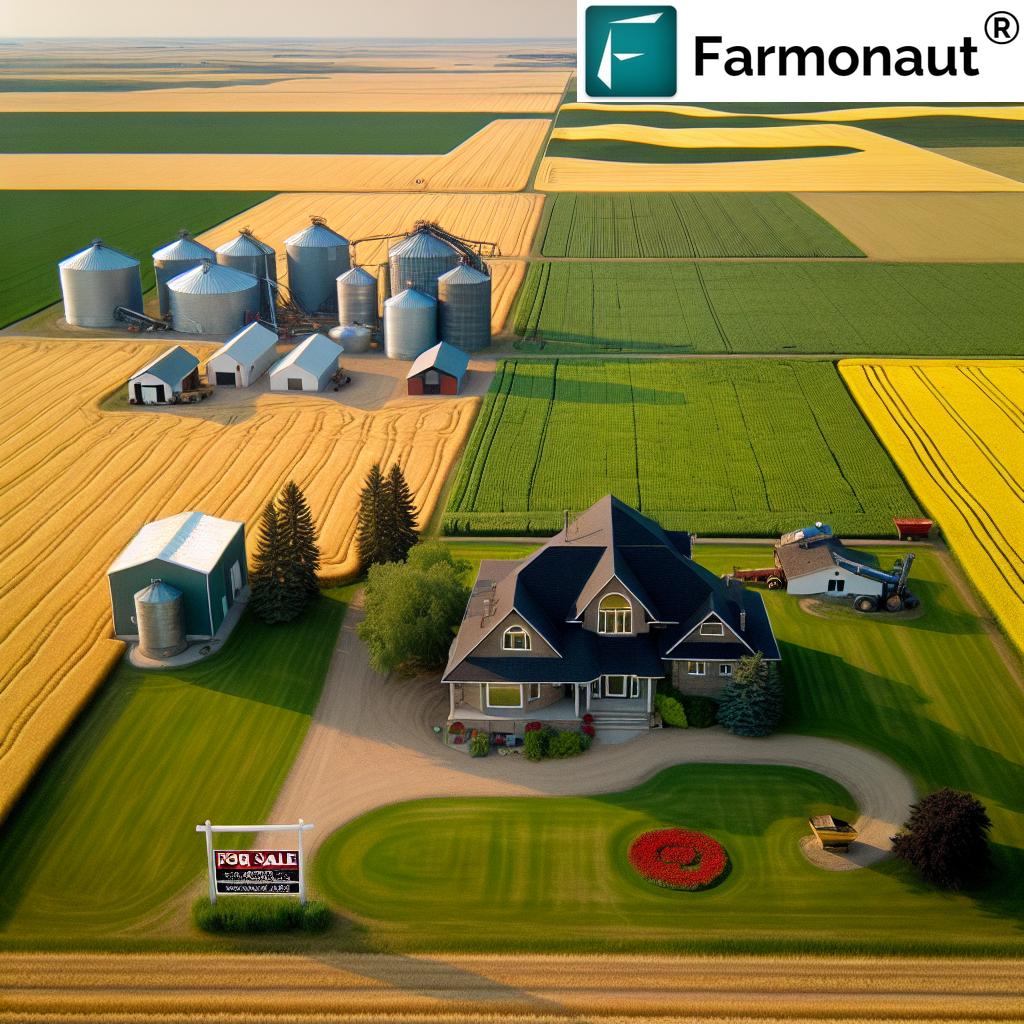
Table of Contents
- Manitoba Farmland Prices by Region
- How Manitoba Compares to US Farmland
- What Manitoba Farmland Produces
- Types of Farms for Sale in Manitoba
- Due Diligence Checklist Before You Buy
- Farmland Return Calculator
- Verifying a Listing’s Land Condition Remotely
- Financing a Manitoba Farm Purchase
- FAQ
- Try it: Run your own numbers
Manitoba Farmland Prices by Region
Farm Credit Canada tracks Manitoba farmland values by sub-region twice a year, and the spread between regions is wide enough that a single “Manitoba average” is close to useless for anyone actually comparing a specific farm for sale. In the first half of 2025:
- Central Plains-Pembina Valley: $6,400 per acre for dryland cultivated farmland.
- Eastman: $5,700 per acre for dryland cultivated farmland.
- Westman and Central Plains-Pembina Valley, irrigated land: $15,100 per acre — roughly 2.4 times the dryland Central Plains price, which is the single clearest number for judging whether an irrigated listing’s asking price reflects the irrigation infrastructure or is simply marked up.
Provincially, Canadian cultivated farmland values rose 10.4% over the twelve months from July 2024 to June 2025, per the same FCC report. That’s the number to compare against a decade-old listing price or a neighbor’s anecdote about “what land used to sell for” — if you’re told a figure from more than a year or two ago, apply this appreciation rate as a starting adjustment, not the final word.
FCC publishes this report semi-annually — a mid-year update and a year-end update. Before you make an offer on any farm for sale in Manitoba, check the current FCC farmland values report for the region the listing sits in; the figures above are a 2025 mid-year snapshot and will have a newer edition by the time you’re reading this.
How Manitoba Compares to US Farmland
If you’re searching for a farm land investment strategy and comparing Manitoba against US options, the USDA NASS numbers are the direct benchmark. In 2025, the US average farm real estate value was $4,350 per acre, and US cropland specifically averaged $5,830 per acre — both published in USDA’s annual Land Values summary. US cropland value rose 4.7% from 2024 to 2025, per the same source.
Set side by side with the FCC figures:
| Market | Land Type | Value per Acre | Recent Appreciation | Source |
|---|---|---|---|---|
| US (national average) | All farm real estate | $4,350 | — | USDA NASS, 2025 |
| US (national average) | Cropland | $5,830 | 4.7% (2024–2025) | USDA NASS, 2025 |
| Manitoba, Eastman region | Dryland cultivated | $5,700 CAD | 10.4% (Canada, Jul 2024–Jun 2025) | Farm Credit Canada, 2025 |
| Manitoba, Central Plains-Pembina Valley | Dryland cultivated | $6,400 CAD | 10.4% (Canada, Jul 2024–Jun 2025) | Farm Credit Canada, 2025 |
| Manitoba, Westman / Central Plains-Pembina | Irrigated | $15,100 CAD | 10.4% (Canada, Jul 2024–Jun 2025) | Farm Credit Canada, 2025 |
Two things stand out. First, Canadian cultivated farmland appreciated more than twice as fast as US cropland over the comparable period (10.4% versus 4.7%), even though the CAD/USD figures above are not currency-adjusted — treat the appreciation-rate comparison as the meaningful one, not a direct price comparison, since $5,700 CAD and $5,830 USD are not the same purchasing power. Second, both dryland Manitoba regions land close to the US cropland average once you account for exchange rate, which is one reason cross-border interest in Manitoba farms for sale has held up: the land isn’t cheap relative to US cropland, but it isn’t a premium either, and it’s appreciating faster.
For a broader read on how these trends are shaping the market, see our piece on agricultural real estate trends in farming land.
What Manitoba Farmland Produces
Price per acre only tells you what you’d pay. What the land actually produces is the other half of the underwriting, and here Statistics Canada is the authoritative source. In 2024, Manitoba produced 5.5 million tonnes of wheat at an average yield of 62.8 bushels per acre, per Statistics Canada’s December 2024 field crop production release.
That yield figure is useful as a baseline for cash-flow modeling on a specific parcel, but it’s a single-year number — Statistics Canada re-publishes provincial crop production data annually, typically each December, covering the harvest just completed. Before you rely on a yield assumption for a farm you’re evaluating, pull the current Statistics Canada field crop report and compare the province-wide figure against whatever yield history the seller or their agent provides for the specific quarter-sections in the listing. A seller quoting yields well above the provincial average for the crop and year in question should be able to show combine yield-map data to back it up.
Farmland as an Asset Class: Return Benchmarks
For investors weighing a Manitoba farm for sale against other asset classes, the NCREIF Farmland Index — the standard US benchmark tracked by the National Council of Real Estate Investment Fiduciaries — posted an 8.2% total annual return for the year ended June 30, 2023, combining income and appreciation. Over the longer run, the index has averaged a 10.15% annual return from 1992 to the present, per NCREIF data cited by Peoples Company. Those are US farmland benchmarks rather than Manitoba-specific figures, but they’re the closest published apples-to-apples return series available, and they explain part of why institutional capital has been moving into North American farmland generally: a multi-decade average north of 10% with low correlation to equities is a hard combination to find elsewhere.
Two things this benchmark can’t tell you, and where the brief’s evidence runs out: Manitoba-specific cash rental rates (the annual per-acre lease income a landlord could expect, separate from land appreciation) and a multi-year Manitoba yield trend for wheat and canola beyond the single 2024 data point above. Neither figure is published in the sources reviewed for this guide. For rental rates, ask the listing agent for the parcel’s current lease agreement and cross-check it against Manitoba Agriculture’s farm management data; for a longer yield trend, request the seller’s Statistics Canada or crop insurance yield history for the specific municipality going back at least five years.
Types of Farms for Sale in Manitoba
Manitoba’s agricultural real estate market spans several distinct property categories, each with a different valuation logic:
- Crop Farms: Wheat, canola, soybean, and corn operations, typically the largest acreage listings and the category most directly priced against the FCC dryland cultivated figures above.
- Dairy Farms: Properties with barns, milking parlors, and quota considerations — Canadian dairy quota adds a cost layer that has no equivalent in US cropland comparisons.
- Livestock Farms: Cattle, hog, or poultry operations with grazing land and purpose-built facilities.
- Mixed-Use Farms: Combined crop and livestock operations, offering diversified income but requiring due diligence on two operating models at once.
- Specialty Farms: Orchards, market gardens, and organic operations, usually smaller acreage with higher per-acre revenue potential and correspondingly higher scrutiny needed on market access.
- Recreational Land: Parcels combining limited agricultural use with hunting, fishing, or eco-tourism value — priced more on amenity than yield.
Related reading on land utilization and productivity assessment: our guide to land utilisation, suitability, and productivity covers the framework for scoring a parcel’s agricultural potential independent of its current use.

Due Diligence Checklist Before You Buy
This is the durable part of this guide — the checklist below doesn’t expire when FCC or USDA publish their next update. Work through it for any Manitoba farm land for sale before making an offer:
- Confirm the region-specific price benchmark. Pull the current FCC farmland values report for the specific sub-region (Eastman, Central Plains-Pembina Valley, Westman, etc.) — not a provincial average — and compare it to the asking price per acre.
- Separate irrigated from dryland pricing. The 2025 gap between the two ($15,100 versus $5,700–$6,400 per acre) is large enough that misclassifying a parcel’s irrigation status will materially distort your valuation.
- Request multi-year yield history. A single strong year proves little; ask for at least five years of yield data for the specific quarter-sections, cross-referenced against Statistics Canada’s provincial averages for the same years.
- Verify water rights and drainage. Confirm any irrigation license, water source, and drainage easements are registered and transferable.
- Check zoning and municipal assessment. Rural municipality property tax rates and assessment practices vary; request the current tax bill and assessment notice, not an estimate.
- Review foreign ownership rules if applicable. Manitoba has restrictions on non-resident and non-Canadian ownership of farmland; confirm your eligibility status with a local real estate lawyer before making an offer.
- Inspect soil test results. Request recent soil test data (organic matter, pH, nutrient levels) rather than relying on a general “high quality soil” description in the listing.
- Confirm equipment and building inclusions in writing. Verify exactly what stays with the land versus what the seller retains.
For real estate context outside Manitoba, see our related coverage on agricultural land for sale and, for buyers weighing input-supply resilience, our overview of how natural ore resources sustain long-term wealth.

Farmland Return Calculator
Use your own numbers for a specific listing — price per acre, acreage, expected annual yield, and crop price — to project a per-acre and total return before you factor in financing costs.
Run your own numbers
Assumptions and exclusions: this calculator uses simple (non-compounding) single-year projections and ignores financing costs, interest, property tax, insurance, and transaction costs (legal, land transfer tax, brokerage). The default yield (62.8 bu/acre) reflects Manitoba's provincial 2024 wheat average per Statistics Canada; the default appreciation rate (10.4%) reflects Canada's 2024–2025 cultivated farmland appreciation per FCC. Replace every default with figures specific to your target parcel and crop before relying on the output.
Verifying a Listing's Land Condition Remotely
Before you travel to inspect a Manitoba farm for sale in person, satellite-based tools can screen out unsuitable parcels or flag questions to raise with the seller. Farmonaut's platform applies this to specific parcels:
- Satellite-Based Crop Monitoring: Historical vegetation health imagery for a specific parcel can corroborate or contradict a seller's yield claims before you commit to a site visit.
- AI-Driven Advisory: Soil moisture and crop stress data support independent verification of a parcel's productive history.
- Drone and Field Mapping Integration: Useful for the kind of pre-purchase field scouting that flags drainage or weed-pressure issues a listing photo won't show.
- Blockchain-Based Traceability: Relevant if you're buying a farm with existing supply contracts — see our overview of blockchain traceability's supply chain benefits.
For farm management technology adoption more broadly, our review of modern farming innovations and eco-friendly farming methods covers techniques increasingly used to assess and improve a parcel's long-term productivity, regardless of where the farm is located.

Explore Farmonaut's solutions:




Financing a Manitoba Farm Purchase
Financing sources for a Manitoba farmland purchase generally fall into five categories:
- Farm Credit Canada (FCC): The dominant specialized agricultural lender in Canada, and also the primary published source for the regional price benchmarks in this guide — worth engaging early since their lending criteria are built around the same regional data.
- Traditional Bank Loans: Canadian chartered banks offer agricultural loan products, generally requiring a larger down payment than FCC financing for non-operator buyers.
- Provincial and Federal Programs: Manitoba Agricultural Services Corporation and federal programs offer support for qualifying farm purchases; eligibility and terms change, so confirm current criteria directly with the agency rather than relying on a secondary source.
- Private Lenders: An option for buyers who don't qualify under conventional agricultural lending criteria, typically at a higher rate.
- Vendor Financing: Some sellers, particularly on larger or harder-to-finance parcels, will carry part of the purchase price directly.

Manitoba Farm Property Comparison by Type
| Property Type | Price Benchmark | Primary Crops/Livestock | Irrigation | Key Valuation Driver |
|---|---|---|---|---|
| Crop Farm (dryland) | $5,700–$6,400/acre (Eastman, Central Plains-Pembina Valley) | Wheat, Canola, Soybeans | No | Multi-year yield history vs. Statistics Canada provincial average |
| Crop Farm (irrigated) | $15,100/acre (Westman, Central Plains-Pembina Valley) | Wheat, Canola, Potatoes | Yes | Water license validity and irrigation infrastructure condition |
| Dairy Farm | Benchmarked against regional dryland rate plus quota and facility value | Dairy Cattle | Partial | Quota transferability and facility condition |
| Recreational Land | Below regional dryland cultivated rate; priced on amenity, not yield | Mixed Use | No | Access, water frontage, wildlife habitat |
Conclusion
The two most decision-useful numbers in this guide are the regional split — $5,700 to $6,400 per acre for dryland cultivated land depending on whether you're looking at Eastman or Central Plains-Pembina Valley, versus $15,100 for irrigated land in Westman and Central Plains-Pembina Valley — and the appreciation gap between Canadian cultivated farmland (10.4% over the year to mid-2025) and US cropland (4.7% over 2024–2025). Neither number is static: FCC and USDA both republish on a fixed schedule, and the checklist in this guide is built to outlast any single edition of either report. Run the calculator above against the specific listing you're evaluating, verify the seller's yield claims against Statistics Canada's provincial figures, and confirm irrigation and water rights status before treating any asking price as a fair one.
FAQ
Q: What is Manitoba farmland worth per acre right now?
A: Per Farm Credit Canada's 2025 mid-year update, dryland cultivated farmland averaged $5,700/acre in the Eastman region and $6,400/acre in Central Plains-Pembina Valley; irrigated land in Westman and Central Plains-Pembina Valley averaged $15,100/acre. FCC republishes these figures twice yearly — check the latest FCC report for the current figure.
Q: How does Manitoba farmland compare in price to US farmland?
A: US cropland averaged $5,830/acre in 2025 and all US farm real estate averaged $4,350/acre, per USDA NASS. Manitoba's dryland cultivated figures ($5,700–$6,400 CAD/acre) sit close to the US cropland average once currency is accounted for, but Canadian cultivated farmland appreciated faster (10.4% vs. 4.7%) over the comparable recent period.
Q: What return can I expect from Manitoba farmland as an investment?
A: Manitoba-specific total-return data isn't published in the sources reviewed for this guide. The closest published benchmark is the NCREIF Farmland Index (a US series): 8.2% total annual return for the year ended June 30, 2023, and a 10.15% long-term average from 1992 to the present. Use the calculator above with your target parcel's actual price, yield, and cost assumptions for a property-specific estimate.
Q: What crops does Manitoba farmland typically produce, and at what yield?
A: Manitoba produced 5.5 million tonnes of wheat in 2024 at an average yield of 62.8 bushels per acre, per Statistics Canada. Canola and soybeans are also major crops in the province; check Statistics Canada's annual field crop release for current-year figures on each.
Q: Are there restrictions on buying farmland in Manitoba as a non-resident?
A: Manitoba has rules restricting non-resident and non-Canadian ownership of agricultural land. Confirm your specific eligibility with a Manitoba real estate lawyer before making an offer, as rules and thresholds are set provincially and can change.
Q: How can I verify a listing's yield claims before visiting in person?
A: Request the seller's multi-year yield history for the specific parcel and cross-check it against Statistics Canada's provincial average for the same crop and years. Satellite crop-monitoring tools like Farmonaut can also provide independent historical vegetation-health data for a specific parcel.
For more information on Farmonaut's agricultural solutions, visit our API page or check out our API Developer Docs.

 Coromandel International
 Hayleys Agriculture
 Linx Agritech
 Adinet
 Save Your Soils
 GalaxEye Space
 Grandstream Algérie
 XOS Realty
 Geospatial Lab Africa
 Agro La Gándara
 HIPSAC
 ZOL Zimbabwe
 Juligerm
 AdBio
AdBio MISE Maroc
 NWNS
NWNS Red August Group
 Farm Inc
 WeMe Global
