

Rare Earth Elements in Defense: 7 Key Advantages 2025
Meta Description: Rare earth elements in defense applications are indispensable for technological superiority, precision weaponry, and sustainable supply chains in 2025.
Table of Contents
- Summary: Rare Earth Elements in Defense Applications—A Critical Pillar for Modern Security
- Trivia: Military Electronics & Rare Earth Elements
- Introduction: The Strategic Value of Rare Earth Elements in Defense
- Key Properties and Relevance in Defense Systems
- Rare Earth Elements in Modern Defense Applications
- The 7 Key Advantages of Rare Earth Elements in Defense (2025)
- Rare Earth Elements in Defense: Element, Application, and Strategic Advantage Table
- Geopolitical Impacts and Supply Chain Resilience
- Sustainability and Environmental Concerns in REE Supply
- Satellite-Based Insights, Defense Technology, and Farmonaut’s Contributions
- Conclusion: Rare Earths—Enduring Pillars of Defense Superiority in 2025 & Beyond
- FAQ: Rare Earth Elements in Defense Applications
Summary: Rare Earth Elements in Defense Applications—A Critical Pillar for Modern Security
Rare earth elements in defense applications have emerged as indispensable materials that underpin the technological edge and operational efficiency of modern militaries worldwide. By 2025, the strategic significance of these 17 chemically similar elements—including neodymium, dysprosium, terbium, and others—has further intensified due to their unique magnetic, luminescent, and electrochemical properties. These characteristics make rare earth elements vital for a wide range of defense systems: powering advanced weaponry, communication platforms, aerospace components, and surveillance equipment.
While not truly “rare,” these elements are seldom found in concentrated, economically extractable forms, making their supply chains highly strategic. Their use in applications such as precision-guided munition actuators, night-vision technologies, and military aircraft engines cements their role as a key pillar of modern security. With the defense sector heavily reliant on these materials and facing supply chain vulnerabilities, sustainability and environmental responsibility are becoming paramount.
Introduction: The Strategic Value of Rare Earth Elements in Defense
In the transformative landscape of defense technology, rare earth elements in defense applications represent a silent yet indispensable backbone of innovation, precision, and operational superiority. As the military sector advances toward integrated, network-centric, and unmanned platforms in 2025, the reliance on high-performance materials—particularly rare earth elements—comprehensively underpins strategic capabilities.
The evolution of defense—from World War-era hardware to today’s AI-enabled surveillance, autonomous drones, and hypersonic missiles—has reshaped not only battlefield tactics but also the very materials that enable these technological leaps. The unique properties of rare earth elements—most notably their exceptional magnetic strength, resistance to heat, and outstanding electrochemical behavior—are critical for everything from stealth aircraft to encrypted communication systems.
As we examine the advantages of rare earths in modern defense, it becomes clear: mastery of these elements and their supply chain equates to mastery of military power. This blog explores seven key advantages, current challenges, and how we, at Farmonaut, support sustainable, technology-driven progress for defense readiness.

Key Properties of Rare Earth Elements in Defense Applications (2025)
The 17 rare earth elements—comprising lanthanides and two additional outliers (scandium and yttrium)—are foundational to the technological superiority of military systems worldwide. But what makes these elements so uniquely suited to defense applications in 2025?
1. Magnetic Strength and Miniaturization
- Neodymium, samarium, and dysprosium produce the strongest permanent magnets known, enabling the miniaturizing and enhancement of motors, actuators, and sensors for precision-guided munitions, advanced drones, and military aircraft systems.
- Miniaturization is essential for maximizing payload efficiency and improving the maneuverability and range of military vehicles.
2. Luminescent and Electrochemical Properties
- Europium, yttrium, and terbium serve as phosphors indispensable for night-vision goggles, display technologies, and advanced communication devices, providing soldiers with enhanced situational awareness in low-light or hostile conditions.
- Cerium and lanthanum aid in the production of optical lenses, contributing to the clarity and range of reconnaissance and surveillance devices.
3. Resistance to Heat and Harsh Environments
- Dysprosium and terbium are added to magnets to improve performance at elevated temperatures, crucial for defense equipment exposed to harsh operational environments.
- Such properties enable military systems to function reliably in extreme climates, ensuring mission readiness regardless of geographic deployment.
Summary Table of Properties:
- Magnetic: For motors, actuators, rotors, stealth technology
- Luminescent: For displays, guidance, night vision
- Electrochemical: For batteries, targeting systems, lasers
- Thermal Stability: For jet engines, propulsion units, missile systems

Rare Earth Elements in Modern Defense Applications: From Missiles to Unmanned Systems
Let’s examine exactly how rare earth elements in defense applications transform military systems in 2025:
A. Precision-Guided Munitions & Weaponry
- Neodymium and samarium magnets fuel miniaturized, high-performance actuators in missile guidance systems and smart bombs, enabling unparalleled precision and hit probability.
- High-temperature-resistant magnets (dysprosium, terbium) ensure stable operation of electronic controls exposed to intense heat and vibration.
B. Electronic Warfare, Radar & Communication Systems
- Rare earth phosphors (europium, yttrium, terbium) and permanent magnets enhance radar sensitivity, frequency agility, and anti-jamming capabilities, crucial for survivability and targeting.
- REEs in high-performance filters, circulators, and amplifiers ensure secure, encrypted communications and reliable data processing even under electronic attack.
C. Military Aircraft & Aerospace Technology
- Jet engines, power units, and electric subsystems rely on neodymium, samarium, and dysprosium magnets for efficiency, power density, and thermal stability—reducing weight and enhancing operational range.
- Lanthanum and cerium are used in polishing compounds and catalytic converters, ensuring durability and reducing environmental impact of propulsion systems.
D. Unmanned Systems & Robotics
- Small, energy-dense magnets and advanced phosphors support the development of drones and autonomous ground vehicles, powering flight control, reconnaissance optics, and efficient motors.
- The lightweight, high-strength characteristics of these elements enable longer mission endurance and more rapid deployment of robotic platforms.

The 7 Key Advantages of Rare Earth Elements in Defense Applications: 2025 Analysis
The integration of rare earth elements across advanced defense systems underpins seven distinct advantages:
-
1. Enhanced Operational Superiority
Rare earth elements propel military technologies beyond conventional limits. With neodymium and dysprosium magnets powering motors and actuators, platforms such as stealth aircraft and guided missiles achieve peak agility, precision, and endurance, outmatching comparable adversarial systems. -
2. Precision and Miniaturization
The miniaturization of components, enabled by the exceptional strength and magnetic properties of certain rare earths, allows the creation of lightweight, compact targeting systems, high-speed actuators, and agile drones. These factors enhance mobility, survivability, and versatile deployment, from urban warfare to remote surveillance. -
3. Greater Power Density and Efficiency
REEs in advanced magnets facilitate the construction of high-output motors and generators with minimal space or weight penalty—crucial for military vehicles, aircraft, and unmanned platforms seeking maximum mission duration with limited onboard energy resources. -
4. Improved Environmental Adaptability
The unique resistance to heat and corrosion displayed by dysprosium-, terbium-, and samarium-based materials ensures robust performance of defense systems in extreme climates or combat conditions, providing global force projection capabilities. -
5. Enhanced Surveillance and Reconnaissance
Rare earth phosphors, such as europium and yttrium, power night-vision goggles, infrared displays, and advanced optical sensors. This enables soldiers to maintain situational awareness during low-visibility missions and strengthens the intelligence, surveillance, and reconnaissance (ISR) chain. -
6. Reliable Electronic Warfare and Communication
Enhanced signal integrity stems from the use of rare earth elements in high-frequency devices, radar, and magnetic shielding. This reliability is indispensable for secure communications, electronic warfare (EW), and cyber operations. -
7. Strategic Supply Chain Security
The strategic importance of rare earth materials is not just technical but also geopolitical. Nations with protected or diversified REE supply chains maintain consistent access to these critical resources—buffering against trade interruptions, diplomatic crises, or tactical embargoes.

Rare Earth Elements in Defense: Element, Application, and Strategic Advantage Table
| Rare Earth Element | Estimated 2025 Global Defense Consumption (Metric Tons) | Key Defense Applications | Strategic Advantage |
|---|---|---|---|
| Neodymium (Nd) | 300–350 | Permanent magnets for missile guidance, aircraft motors, actuators | Enhanced efficiency, miniaturization, extended operational range |
| Samarium (Sm) | 60–80 | High-temp magnets, radar equipment, missile actuators | Performance at extreme temperatures, durability |
| Dysprosium (Dy) | 50–60 | Magnet alloying (NdFeB), armored vehicle drives | High-temp resistance, resilience in harsh conditions |
| Terbium (Tb) | 22–28 | Magnet alloying, night vision and sensors | Magnetic & luminescent enhancement, sensor precision |
| Europium (Eu) | 12–15 | Phosphors in displays, guidance panels, night vision | Enhanced visibility, situational awareness |
| Yttrium (Y) | 40–50 | Phosphors for displays, lasers, optics | Clarity for reconnaissance, IR precision |
| Lanthanum (La) | 65–80 | Camera lenses, optical sensors, batteries | Wider reconnaissance, dependable surveillance |
| Cerium (Ce) | 100–120 | Catalytic converters, propulsion, aerospace polishing | Durability, lower emissions, eco-compliance |



Geopolitical Impacts and Supply Chain Resilience in Rare Earth Defense Applications
With defense applications so heavily reliant on rare earth supply, global power dynamics and technological security hinge on economically extractable sources and robust supply chains. As of 2025:
- China commands nearly 65% of rare earth mining and more than 80% of processing, leaving other countries vulnerable to disruptions during trade conflicts or diplomatic standoffs.
- Countries like the United States, Australia, Japan, Canada, and the European Union are actively seeking to diversify rare earth sourcing through domestic mining initiatives, recycling, and strategic alliances to counteract overreliance and enhance national security.
- Farmonaut’s satellite-based monitoring and traceability solutions can play a role in supporting rare earth mining, ensuring ethical sourcing, and mapping environmental impacts—making mining more transparent and traceable with blockchain technology.
Resilience in supply chains is no longer optional—it’s a strategic imperative with direct consequences for military readiness. Key international policies are moving toward:
- Stockpiling of critical materials
- Incentivizing rare earth recycling and closed-loop manufacturing
- Accelerating research on REE substitutes for certain applications
- Enhanced oversight and satellite-based environmental monitoring for new mining operations
To keep strategic advantage, defense industries must anticipate and navigate these geopolitical supply chain uncertainties using breakthrough technology and global cooperation.

Sustainability and Environmental Concerns for Defense Sector Rare Earth Elements
As we modernize our defense systems, sustainability is a fundamental responsibility, not an afterthought. Extracting rare earth elements can result in significant environmental impact:
- Toxic waste and radioactive byproducts
- Disruption of local ecosystems
- CO₂ and greenhouse gas emissions from ore processing
The defense sector increasingly supports:
- Greener extraction technologies and remediation
- Efficient rare earth recycling and closed-loop manufacturing processes to minimize new mining
- Satellite-based environmental monitoring and carbon footprint tracking to measure and mitigate mining’s impact, as can be supported by Farmonaut’s solutions
- Adoption of blockchain-based traceability in rare earth and defense supply chains for better accountability
For the future, circular resource utilization isn’t only good business; it’s integral to long-term defense material security and environmental stewardship.

Satellite-Based Insights, Defense Technology, and Farmonaut’s Contributions
The intersection of rare earth elements in defense applications with digital technology, satellite data, and AI-driven intelligence is shaping the future of both material procurement and operational efficiency. At Farmonaut, we are dedicated to delivering high-impact, satellite-derived solutions not just for agriculture and mining, but also for advanced defense strategies and intelligence.
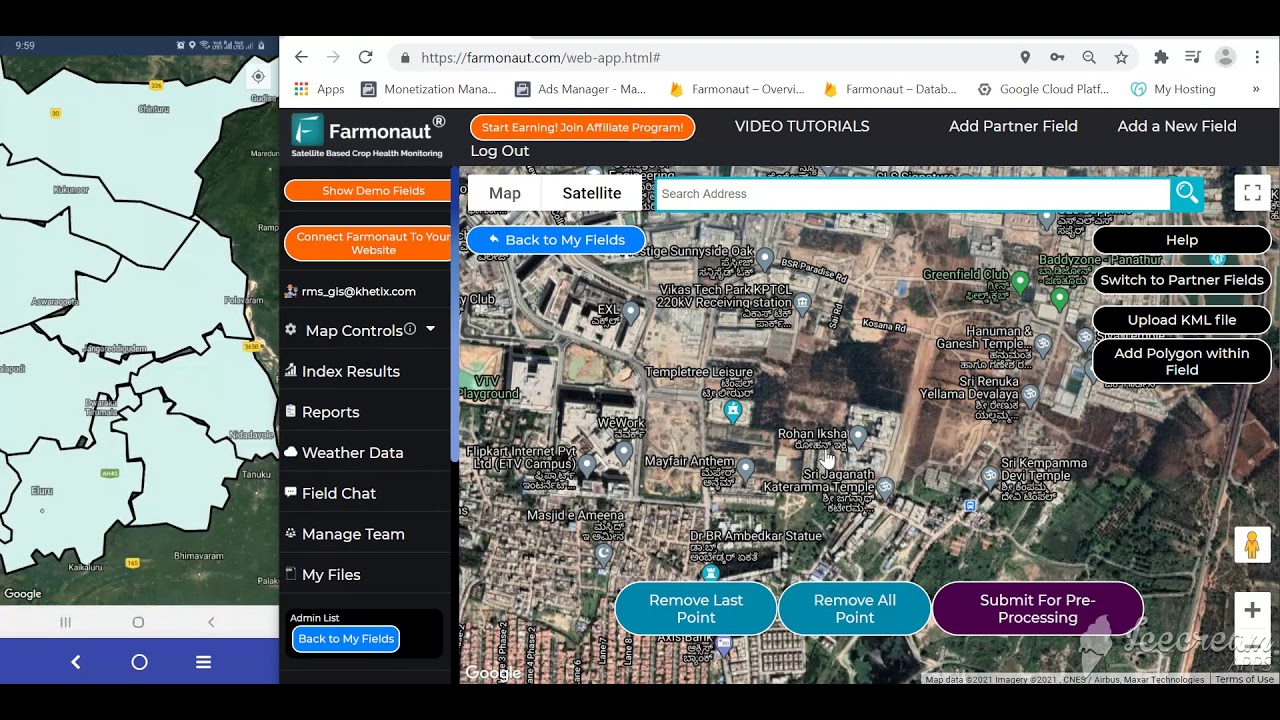
- Real-Time Environmental and Mining Monitoring: Farmonaut uses high-resolution satellite imagery to monitor mine site health, operational efficiency, and environmental impact—offering real-time inputs for resource management and regulatory compliance in rare earth mining.
- Blockchain-Based Traceability: Our platform supports supply chain transparency through blockchain, so defense and mining stakeholders can verify the ethical sourcing of rare earths for core military applications.
- AI-Powered Intelligence: Farmonaut’s Jeevn AI advisory system analyzes satellite data to support both strategic and tactical defense planning, integrating with fleet management and resource allocation tools for military and industrial sectors.
- Environmental Impact Tracking: Our carbon footprinting solution enables defense agencies and mining operators to track, report, and optimize environmental performance in accordance with global standards.
We are committed to lowering the cost barriers to satellite technology, facilitating sustainable scaling for businesses, governments, and the defense sector worldwide. Whether you need integrated monitoring for resource mining, transparency across the rare earth supply chain, or decision intelligence for defense mission planning—Farmonaut’s tools support your organizational goals with actionable, data-driven insights.
Get Started with Farmonaut
Choose the Farmonaut subscription package that fits your operational scale. Access real-time monitoring, AI-driven intelligence, and blockchain-enabled traceability for defense, mining, and resource management.
Conclusion: Rare Earths—Enduring Pillars of Defense Superiority in 2025 & Beyond
Rare earth elements in defense applications are, and will continue to be, a non-negotiable foundation for technological edge, operational superiority, and global military security as we progress beyond 2025. Their unique properties—magnetic, luminescent, electrochemical, and thermal—make them vital across every layer of advanced defense technologies, from stealth jets and hypersonic munitions to encrypted communications and unmanned warfare systems.
But this edge is not without challenges. Geopolitical supply chain risks, environmental concerns, and the ethical management of rare earth mining require ongoing innovation and transparent monitoring—from the mine to mission deployment. Embracing sustainability, responsible sourcing, and robust traceability—from satellite-based platforms like Farmonaut—will be at the heart of securing these critical materials for generations.
The future of military power will belong to those who master not just new technologies but also the strategic stewardship of rare earths—balancing readiness, sustainability, and security on a rapidly evolving global stage.
Unlock Next-Gen Monitoring and Traceability for Rare Earth Supply Chains
Utilize Farmonaut’s large-scale monitoring and blockchain traceability to track rare earth origin and movement in real-time—ensuring compliance, ethical sourcing, and operational efficiency for the defense sector.
Explore our satellite-based verification for crop loans and insurance, driving accountability and transparency in resource-rich regions.
FAQ: Rare Earth Elements in Defense Applications
Q1. Why are rare earth elements considered indispensable in defense technology?
Rare earth elements in defense applications provide properties like exceptional magnetic strength, miniaturization capability, luminescent output for night vision, and heat resistance—enabling advanced weaponry, communication, surveillance, and propulsion systems unmatched by alternative materials.
Q2. Which rare earth elements are most critical for the defense sector in 2025?
As of 2025, neodymium, samarium, dysprosium, terbium, europium, yttrium, lanthanum, and cerium are key due to their use in permanent magnets, optics, phosphors, and catalytic converters for a wide range of military systems.
Q3. How do supply chain vulnerabilities affect defense operations?
Location-dependent production creates a risk of supply disruptions. Defense industries rely on uninterrupted access to rare earth materials to maintain readiness, develop new technologies, and respond to emerging threats. Strategic reserves, recycling, and transparent supply chains mitigate this risk.
Q4. Can rare earth mining and material use in defense be sustainable?
Yes. Through the incorporation of advanced environmental monitoring, traceability, recycling, and greener extraction technologies—supported by platforms like Farmonaut—defense and mining sectors can minimize environmental impact while securing rare earth supply.
Q5. How does Farmonaut support rare earth applications in defense?
Farmonaut provides satellite-based monitoring, AI-driven analytics, blockchain-enabled traceability, and environmental impact tracking for the mining and defense sectors—empowering organizations to maintain secure, compliant, and sustainable rare earth supply chains.
Discussion
Questions, corrections or field experience? Share them below. First-time comments are reviewed before they appear, and your email is never published.
No comments yet. Be the first to add a question or your experience.

 GemSprout Metals Limited
 Qader Group
 Ileys General Trading
 SG Gold Mining LLC
 VRV Global Pte Ltd
 Omsri International FZE
 G.I.T.T.
 Jaunita Erss Ltd
 Almosi SARL
 SRK Consulting
 Berks Gold Limited
 Mwerezi Minerals Company Limited
 Mining SARL
 SenGold Invest SAS
 Sean Mining Limited
 NTS Group (Pty) Ltd
 Mine4Africa
 Lithspo Minerals Limited
