
Mining finance · Funds and investors
Mining Private Equity and VC: How Funds Pick Projects
Specialist funds buy large stakes in advanced projects and exit within the fund’s life. Here is how venture capital differs, what funds check, and the exit your project needs.
Key takeaways
- Specialist mining funds mostly back advanced or near-production assets; Denham’s stated limit is two years from first production (Denham Capital, 2026).
- Typical fund terms are about 2% a year in fees, about 20% carry and an 8% hurdle (Corporate Finance Institute); the calculator turns them into a minimum exit value.
- Orion Resource Partners closed a US$2.2bn mine finance fund, reported in March 2026, and says its assets above US$9bn (Miningmx, 17 March 2026).
- In Canada, flow-through shares let explorers renounce 100% of eligible spending, with a 15% federal credit, 30% for critical minerals (AME, 2025).
In this article
- How mining private equity works
- Examples of mining private equity firms and what they target
- Mining venture capital: funding exploration and technology
- Mining investment banks: what they do and when you need one
- Mining private equity versus other sources of capital
- Mining private equity by region: Canada, the United States and Africa
- What a mining private equity fund checks, and the terms it asks for
- How satellite analysis helps you attract mining private equity and VC
- Frequently asked questions
Specialist funds are one of the main sources of capital for mining projects that are too advanced for angels and too risky for banks. Here is how private equity and venture capital firms in mining work, which stage they invest in, the terms they ask for, how investment banks fit in, and what a project must show before a fund will engage.
Also covers VC & investment banks
Audience Juniors, developers, founders
Format General information
Mining private equity is capital from specialist funds that buy significant stakes in mining companies or projects, work closely with management, and aim to sell at a profit within a set period. Mining venture capital works on the same model but earlier and smaller, backing exploration companies and mining technology. Together they fill a gap: projects that have outgrown angel money but are not ready for bank debt or a large public raise.
Founders, exploration juniors and developers in Canada, the United States and Southern and Central Africa who are weighing an approach to a fund will find the mechanics below. We explain how these firms are structured, what they look for, the terms to expect and how mining investment banks fit into the picture. We also show how satellite mineral detection helps an early project present the evidence a fund needs. Funds are one route among several; our overview of gold mining investment routes and the checks to run compares the rest.
This article explains how private equity and venture capital generally work in mining. It is not financial, legal or investment advice. Firms named below are examples drawn from their own public descriptions, included for illustration only; they are not recommendations, and Farmonaut has no relationship with them. Farmonaut is a satellite data-analytics company, not a broker, fund-raiser or investment adviser.
“The TSX and TSX Venture exchanges list around 40% of the world’s public mining companies.”
How mining private equity works
Most private equity funds are limited partnerships. A general partner (GP), the fund manager, raises money from limited partners (LPs) such as pension funds, endowments, sovereign funds and wealthy families. The GP invests that money over several years and then sells, or “exits”, each investment. According to Carta’s guide to PE fund structures, the GP earns a management fee and carried interest. The Corporate Finance Institute puts typical terms at about 2% a year in fees and about 20% carry above a hurdle rate usually around 8%. Those are market conventions rather than rules, and each fund’s limited partnership agreement sets its own.
That structure shapes everything a specialist fund does. The fund has a finite life, so it needs a route to exit within a few years of investing. It earns carry only on profits, so it concentrates on projects where it can add value through capital, technical expertise, board oversight or combining assets. And because LPs expect returns above public markets, it needs a meaningful share of the upside.
Private equity versus venture capital in mining
- Private equity: larger cheques, usually for advanced exploration, development or production assets. Often takes a controlling or significant minority stake, with board seats and approval rights.
- Mining venture capital: smaller cheques, higher risk, earlier stage: exploration companies and, more and more, exploration and processing technology. Expects many failures and a few large wins.
- 📊 Hybrid and credit strategies: some of these funds also offer debt, preferred equity, royalties or streams, so they can tailor the instrument to the project.
A fund doesn’t only ask “is this a good deposit?” It asks “can we add value and sell this within our fund’s life?” A project with a clear, fundable next step and a credible buyer at the end beats a larger project with no obvious exit.
Examples of mining private equity firms and what they target
The specialist mining fund universe is small next to generalist private equity. Firms differ mainly in the stage they target and the instruments they use. The examples come from the firms’ own public descriptions and illustrate the range only. They are not recommendations, and many other firms operate in this space.
Chart
Capital figures stated by specialist mining funds
US$ billion; different measures, see caption
| Example firm | How it describes its focus | Stage it says it targets | Figures it publishes |
|---|---|---|---|
| Resource Capital Funds (RCF) | Mining-focused alternative investments; says it pioneered the model in 1998 | Late-stage assets approaching cash flow, in strong jurisdictions | US$4.9bn invested across 225 deals; 140+ exits |
| Appian Capital Advisory | Operating value investor in metals, mining and adjacent companies | Assets it can build and bring into production | ~US$5bn AUM; 40 investments; 12 mines into production |
| Denham Capital (mining) | Private equity and credit for critical-minerals platforms | At most two years from first production, or in construction, ramp-up or production | Capital from ordinary equity to preferred equity and debt |
| Kinterra Capital | Private equity for critical minerals and supply chains | Critical-minerals projects, mainly in North America and Australia (as reported) | US$565m first fund (as reported by PitchBook) |
The pattern is clear. Most large specialist funds favour late-stage assets close to or in production, where their capital pays for construction or expansion. RCF’s own strategy page describes that late-stage focus, and Denham’s mining page sets a limit of two years from first production. Firms update these figures on their websites, so check them before quoting any. Earlier-stage projects are more often funded by venture-style investors, strategic miners, flow-through and retail investors, and earn-in partners.
Why the late-stage bias? Run the fund’s arithmetic backwards. A fund that must return its LPs’ money plus the hurdle, after its own fees and carry, needs a specific minimum exit value from every deal that works, before counting the ones that fail. The tool below does that sum.
Add two years to the holding period and the required exit value climbs noticeably. That is the whole reason a grassroots licence with a ten-year path to production struggles to interest a fund with a five-year clock.
Check a fund’s stated stage and commodity focus before approaching it. Sending a grassroots gold licence to a fund that invests only in near-production critical minerals wastes both sides’ time, and the firm’s own website usually tells you which it is in a minute.
Top mining private equity firms: what the public figures show
People searching for the top firms usually want a ranking, but the firms publish different measures, so a single ranked list would mislead. The chart below puts the figures each firm states side by side and labels the measure. Read it as a size guide, not a league table.
Orion Resource Partners closed its Mine Finance Fund IV at about US$2.2bn (reported 17 March 2026) and said its total assets under management had passed US$9bn, according to Miningmx (17 March 2026). The same report says the fund will back projects producing metals such as copper and lithium, and that it had put about 61% of its capital to work across North and South America, Europe, Australasia and Africa.
Resource Capital Funds describes itself on its homepage as having made 240+ portfolio company investments, 190+ of them fully realised, in 55+ countries (checked 5 November 2026). Its private equity strategy page counts US$4.9bn invested across 225 deals; the two pages count different things, so quote the page you mean. Appian’s website lists 40 investments, 19 exits and 12 mines brought into production. Denham, in its mining strategy, can use ordinary equity, preferred equity and debt. None of these pages states a typical cheque size, so ask a fund directly before you assume your project fits.
On fund terms, the Corporate Finance Institute gives about 2% a year, about 20% carry and a hurdle around 8% as the usual figures.
Calculator
What exit does a fund need from your project?
Enter your own deal terms; the result is the minimum sale value of the whole company.
- Minimum proceeds for the fund stake (US$ m): 33.0
- Multiple of the investment: 1.65
Example values only, not a fund target. Fee about 2%, carry about 20% and hurdle about 8% are the usual figures per the Corporate Finance Institute. Simplified: fees and hurdle are not compounded, and losses on other deals are ignored, so real funds aim higher.
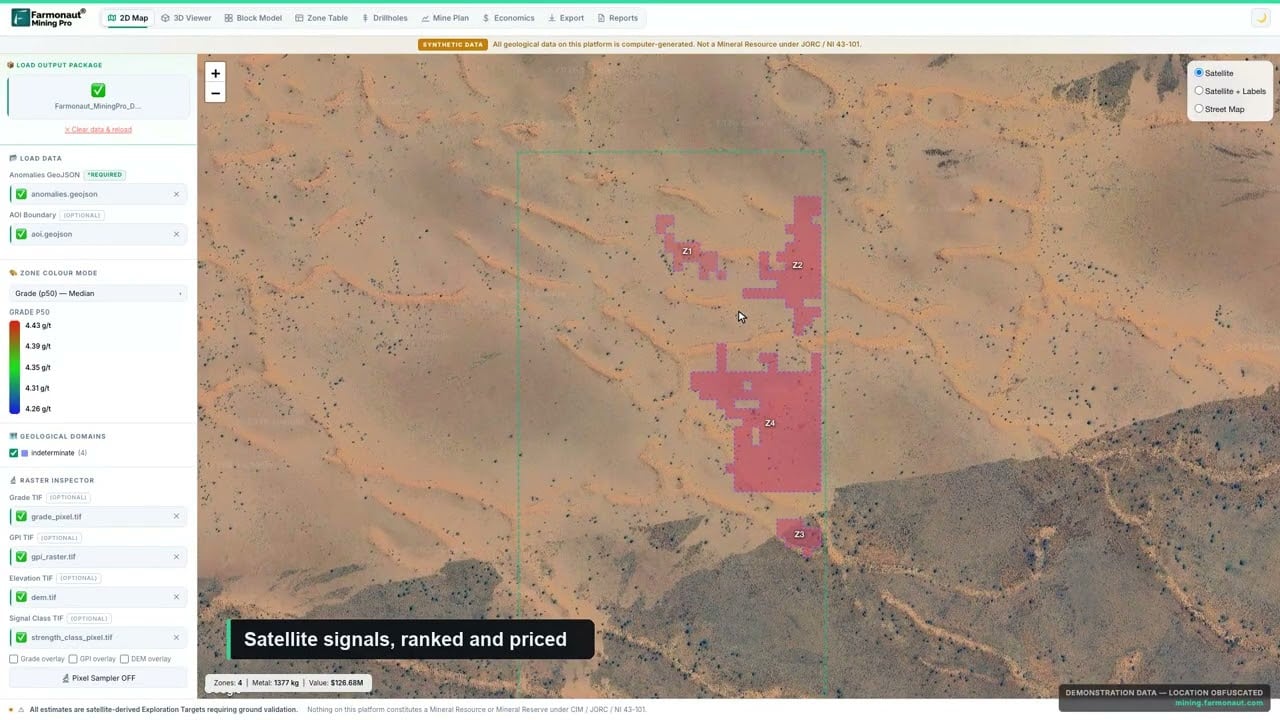
▶ What Farmonaut Mining Pro does: a licence boundary turned into a geological and economic picture. · 4:56
Mining venture capital: funding exploration and technology
Mining venture capital sits at the high-risk end of the market. Classic venture investors expect most investments to fail and a few to return the fund, which suits exploration: most licences never become mines, but a genuine discovery can re-rate a company many times over. Much early-stage exploration capital behaves like venture capital even when it comes through public markets, for example through placements on venture exchanges.
Chart
Minimum exit value a fund needs, by years held
US$ million for the whole company; US$20m cheque, 35% stake
Venture investors also back mining technology: exploration tools, processing methods, automation and data. For founders seeking venture capital for mining projects, the case must show how a relatively small investment can create a large increase in value, usually by proving a discovery or a technology milestone. Some specialist mining venture capital firms do both.
- What VCs want to see: a big target, a clear first milestone, a capable team and a route to a much larger follow-on raise or sale.
- Typical instruments: equity, often with warrants or preferred rights, sometimes convertible notes.
- 📊 Where it overlaps with public markets: in Canada, flow-through shares let explorers renounce 100% of eligible exploration expenses to investors, with a 15% federal credit (30% for critical minerals) according to the AME guide to Canadian Exploration Expenses (2025 update). It is a large source of venture-style money for grassroots work.
- ⚠ The catch: early money is expensive. A project that raises too much too early gives away a large share of the company before value is proven.
The cheapest way to reduce that dilution is to spend less proving the first targets. Map your licence on mining.farmonaut.com: Map Your Mining Site, or request a quote through our mining query form, and bring ranked targets to your first fund conversation.
“One specialist fund reports US$4.9 billion invested across 225 mining deals since it began in 1998.”
Flow-through shares versus ordinary equity
Early-stage mining investors in Canada often choose between flow-through shares and ordinary (traditional) equity. The difference is who gets the tax benefit. With flow-through shares, the company renounces eligible exploration spending to the investor, who claims the deduction. The AME guide says eligible exploration expenses can be renounced to flow-through investors, and individual investors may claim a 15% federal credit (30% for listed critical minerals) on agreements signed before 1 April 2027. Flow-through money must be spent on eligible exploration, not on a mill or general overheads. Ordinary equity has no spending restriction, but it carries no tax benefit for the investor. Take tax advice before you structure a raise.
Mining investment banks: what they do and when you need one
Mining investment banks are banks and brokers with dedicated mining teams. They don’t usually put their own money into projects the way funds do. They help companies raise capital and do deals. Their main roles:
- Equity raising: underwriting or placing shares in IPOs, follow-on offerings and private placements, often with their institutional and retail clients.
- M&A advisory: advising on mergers, acquisitions, joint ventures and asset sales, including sales of companies to larger miners.
- Debt advisory and arranging: helping structure and arrange project finance packages with lenders. Our guide to how mine projects are funded from licence to mill shows what those packages contain.
- Research and distribution: analyst coverage that helps listed companies reach investors.
For listed juniors, the choice of exchange matters as much as the choice of bank. TMX Group’s mining sector profile says around 40% of the world’s public mining companies list on TSX and TSXV. Over the five years to 31 December 2025, those companies completed more than 6,400 financings raising $52 billion, which TMX puts at 45% of the world’s public mining financings by number and 32% of mining equity raised. TMX refreshes these figures each year. They explain why Canadian brokers and banks are so prominent in exploration finance.
Other exchanges with large mining sectors, in Australia, London and Johannesburg, have their own specialist bank and broker communities. Banks and funds often work together. A fund may anchor a raise that a bank then completes with other investors, or a bank may run a sale process in which funds and strategic miners bid against each other. Knowing which role each party plays tells you whose interests each adviser represents, and how its fees are earned.
A bank that mostly advises on large mergers may not prioritise a small placement, while a boutique broker focused on juniors may have exactly the investor network you need. Ask for the last five deals it closed at your stage.

▶ What an AI mining app does and who makes one. · 3:52
Mining private equity versus other sources of capital
Private equity is one option, and not always the best. The right choice depends on your project’s stage, how much control you want to keep and how quickly you need the money. Most developers compare several routes side by side.
Private equity
Large, flexible cheques and hands-on support from people who have built mines before. The trade-off is ownership and control: funds usually want a significant stake, board seats and exit rights. It suits projects that need a big step of capital, for construction or a major study, and a partner who can help deliver it. Funds are only one of the investor types covered in where to meet mining investors and what they check.
Public markets
Listing and raising on an exchange keeps ownership widely spread and gives shareholders liquidity. It also brings disclosure obligations, listing costs and exposure to market sentiment. For exploration juniors, public markets remain the main source of risk capital, especially on venture exchanges.
Strategic investors and earn-ins
A larger mining company may take a stake or fund an earn-in. You gain technical expertise and a likely future buyer. The cost is that the strategic partner may gain control over key decisions, or a right of first refusal that limits other offers.
Royalties and streams
A royalty or stream gives cash upfront for a share of future revenue or metal, without issuing shares. It avoids dilution and board interference, but it permanently reduces the project’s margin, and later investors and lenders will price that in.
Gold mining venture capital and angel money
For early gold projects, gold mining venture capital and angel investors can move fast and accept high geological risk. The price is a large share of the company for a relatively small amount. Raising only what the next milestone needs, then raising again at a higher value, usually costs founders less equity overall.
Institutional investment in mining: who sits behind the funds
Institutional money reaches mining mostly through funds. Institutions commit capital as limited partners and the general partner invests it over several years (see Carta on the limited partnership structure). Miningmx notes that Orion also runs vehicles with government-linked partners, including a consortium formed with the US government and a joint venture with Abu Dhabi’s ADQ. Institutions also buy listed mining shares directly, which is why a stock-exchange listing and a fund stake often work as two stages of the same plan.
Fund money from development banks comes with conditions. The IFC Performance Standards set the environmental and social terms many such investors apply, and national ownership rules also shape deal structure; UNCTAD records how Zimbabwe changed its indigenisation threshold in 2020.
Mining private equity by region: Canada, the United States and Africa
Where a project sits affects which funds will look at it, how a deal is structured and how the fund expects to exit. These are general notes, not legal guidance; take local advice on ownership and securities rules.
Canada
Canada is the centre of public mining finance. With around 40% of the world’s public mining companies on TSX and TSXV, and 54 new mining listings there in 2025 according to TMX, a Canadian listing is a common exit route for private equity-backed projects, and many funds invest alongside public shareholders. Flow-through shares mean early Canadian exploration is often funded by retail money before private equity arrives.
United States
US-listed mining companies report resources and reserves under the SEC’s S-K 1300 rules, which are aligned with JORC, NI 43-101 and SAMREC under the CRIRSCO template. For a fund, that alignment makes US projects easier to compare with those elsewhere. Critical-minerals policy has also drawn specialist funds into North America; Kinterra Capital was reported by PitchBook to have raised US$565 million for its first fund focused on critical minerals.
Southern and Central Africa
Africa offers large, often under-explored mineral endowments, but ownership rules shape how a fund can invest. In South Africa, the 2018 Mining Charter requires a minimum 30% black economic ownership shareholding for new mining rights, so a fund’s stake must be structured around it. In Zimbabwe, the 2020 Finance Act removed the remaining indigenisation requirement for diamonds and platinum, as recorded by UNCTAD’s Investment Policy Monitor, while regulations issued in 2025 (SI 215 of 2025) list small-scale mining among sectors reserved for citizens. Rules like these change, so funds rely on up-to-date local legal opinions.
Many African mining deals also involve development finance institutions, which apply environmental and social standards such as the IFC Performance Standards. A fund investing alongside them will expect the project to meet those standards too. Strategic investors are active as well: the Africa Center for Strategic Studies reports more than 600 Chinese firms have invested over US$3.5 billion in Zambia’s Copperbelt, which gives a sense of the competition for good projects.
In every region, the first thing a fund checks is whether the licence is real and in good standing. A dated printout from the official cadastre, matched to your boundary and samples, answers that before anyone asks.

▶ Whether foreigners can get a small-scale mining licence in Africa. · 5:16
What a mining private equity fund checks, and the terms it asks for
Due diligence is deep. Funds usually hire independent geologists, engineers, lawyers and environmental consultants. The first screen, though, looks much like any sophisticated investor’s.
The first screen
- Title and jurisdiction: valid licences, checked on the official cadastre, in a country whose rules the fund accepts. Our mining cadastre portal guide by country lists the official registers.
- Geology and data: a credible deposit model and trustworthy data. Any resource must be reported under a recognised code such as JORC, NI 43-101, SAMREC or S-K 1300.
- Value-creation plan: what the fund’s money will achieve (drilling, a scoping, pre-feasibility or bankable study, permits or construction) and how that raises the project’s value.
- Team: management that can deliver the plan, and whom the fund is willing to back.
- Exit: who would buy the project or company, and when.
- ESG: environmental and social risks that could block permits or deter buyers.
Terms to expect from these funds
- Significant ownership: often a large minority or a controlling stake, sometimes with rights to increase it.
- Governance rights: board seats, approval over budgets, major contracts and new financings.
- Structured instruments: preferred equity, convertible debt or royalties that give the fund priority or downside protection.
- Tranches and milestones: money released in stages as the project hits agreed targets.
- ⚠ Exit rights: drag-along, tag-along and registration rights that let the fund sell on its timetable.
Governance rights, preferred returns and exit clauses can matter more to founders than the price. Have a lawyer experienced in mining transactions review the full term sheet before you sign.
How a fund’s investment process usually runs
- Introduction and teaser: a short, non-confidential summary of the project goes to the fund, often through an adviser.
- Confidentiality agreement: signed before any detailed data is shared.
- Data room access: the fund reviews title, geology, data, studies, permits and financials.
- Management presentation: the team presents the plan and answers questions.
- Site visit: the fund and its technical advisers inspect the project, check sample sites and meet local stakeholders.
- Term sheet: the fund sets out price, structure and key rights, usually non-binding at this stage.
- Confirmatory due diligence and documents: detailed legal, technical and ESG review, then final agreements.
- Closing and first drawdown: money is released, sometimes in tranches tied to milestones.
The process can take months. Projects that arrive with a clean data room and independent evidence tend to move faster, because the fund spends less time chasing basic information. Seen from the fund’s side, your project is one step inside a longer cycle.
Ask a geologist and a lawyer who don’t work for you to go through the data room as if they were the fund’s advisers. Every gap they find is one the fund won’t.
Questions to ask a fund before you accept its money
Due diligence runs both ways. A fund will be a major shareholder for years, so check it as carefully as it checks you.
- Track record: which comparable projects has the fund backed, and what happened to them? Ask to speak to founders of past investments.
- Fund timing: how far into its life is the fund? One near the end of its investment period may push for a faster exit than your project can deliver.
- Follow-on capacity: can the fund support later raises, or will you need new investors soon after closing?
- Technical depth: does the team include geologists and mining engineers who can really help?
- ⚠ Alignment: how do its preferred returns, fees and exit rights affect what founders and other shareholders receive?
How satellite analysis helps you attract mining private equity and VC
Funds commit large sums only after extensive due diligence, but they decide whether to begin that work in a first screen. An early-stage project that can show independent, well-presented geological evidence gets past that screen more often. That is where our satellite-based mineral detection fits.
- ✔ Independent evidence: we analyse multispectral and hyperspectral imagery for the spectral signatures of minerals and alteration, and flag likely mineralised zones, alteration halos and structures.
- ✔ Fast and low-cost: timelines from months to days, up to 80–85% lower early-exploration cost, and delivery in 5–20 business days.
- 📊 Data-room ready: high-potential zones, prospectivity heatmaps, estimated location and depth ranges, geological interpretation, and PDF plus georeferenced GIS files.
- Premium+: TargetMax™ Drilling Intelligence with drilling-angle recommendations and interactive 3D subsurface models, useful when a fund asks how its money will be spent.
- ⚠ Clear framing: satellite targets are exploration targets, not a resource. Present them to funds that way.
Many funds’ limited partners apply environmental and social standards. Satellite screening involves no ground disturbance, so you can show a fund a focused, low-footprint work plan before any fieldwork begins.
See a typical deliverable in our satellite-driven 3D mineral prospectivity mapping overview. We have scanned 100,000+ hectares for 20+ mineral types across 25+ countries. We don’t introduce funds or raise capital; we provide independent evidence you can take to them.
Preparing to pitch a fund? Lead with evidence.
Send us your licence boundary as coordinates, KML/KMZ or a polygon, with the country and target mineral. We’ll return ranked target zones and GIS files you can put straight into your data room.
Frequently asked questions
What is mining private equity?
Capital from specialist funds that take significant stakes in mining companies or projects, work closely with management, and aim to sell at a profit within the fund’s life. Most large specialist funds favour advanced or near-production assets.
How are these funds structured?
Most are limited partnerships. A general partner manages the fund and invests money committed by limited partners such as pension funds and endowments. The manager typically earns a management fee of about 2% plus carried interest, a share of profits of about 20% above a hurdle rate that is often 8%.
Is there venture capital for mining projects?
Yes, though it is a smaller market than private equity. Venture-style investors back exploration companies and mining technology, accepting high risk for large potential upside. In Canada, flow-through shares are a major source of venture-style exploration funding.
What do mining investment banks do?
They help companies raise equity and debt, advise on mergers, acquisitions and joint ventures, arrange project finance, and provide research. They generally advise and distribute rather than invest their own capital in projects.
What stage of project do these firms invest in?
It varies by firm, so check each fund’s own stated focus. Several well-known specialists describe a focus on late-stage assets close to or in production. Earlier-stage projects are more often funded by venture-style investors, strategic miners, placements and earn-in partners.
Does Farmonaut invest in or introduce mining projects to funds?
No. We are not a fund, broker or investment adviser. We provide satellite-based mineral detection, an independent analysis of a licence area, which project owners can include in the evidence they present to investors.
This article is general information about private equity, venture capital and investment banking. It is not financial, legal or investment advice. The calculator is illustrative arithmetic on your own inputs. Firm descriptions and figures are taken from each firm’s own website or from published reporting and are included for illustration only, not as recommendations or endorsements. Farmonaut has no partnership with any firm named. Satellite results are exploration targets, not Mineral Resources or Reserves.
This page is for information only. It is not investment advice. Firm figures come from each firm’s own website or published reporting.
Farmonaut mining
Bring ranked targets to your first fund meeting
Send your licence boundary and we will return satellite-screened target zones for your data room.
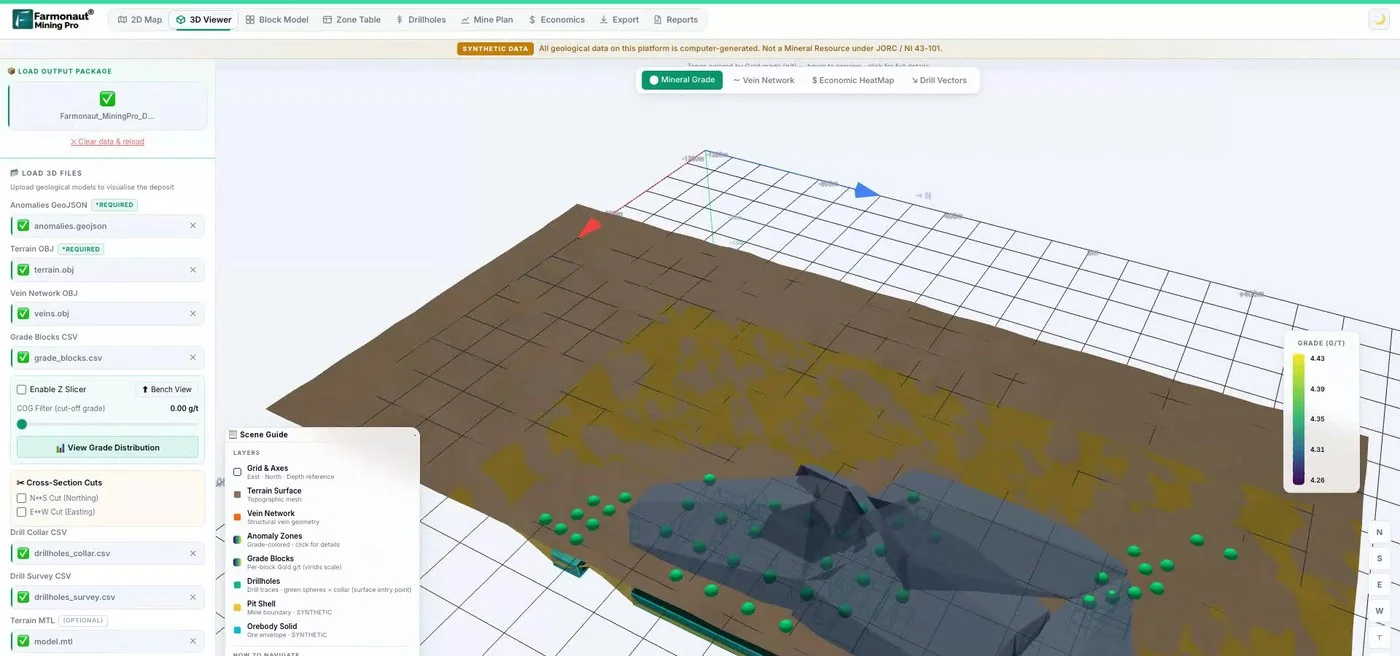
Mining Pro sample view, synthetic data
Keep reading
Sources
- Miningmx, Orion raises US$2.2bn for critical minerals fund (March 2026): miningmx.com
- Resource Capital Funds, homepage: resourcecapitalfunds.com
- Resource Capital Funds, private equity strategy: resourcecapitalfunds.com
- Appian Capital Advisory, website: appiancapitaladvisory.com
- Denham Capital, mining strategy: denhamcapital.com
- PitchBook, Kinterra Capital critical minerals fund: pitchbook.com
- Carta, private equity fund structures (limited partnership structure): carta.com
- TMX Group, TSX and TSXV mining sector profile: tsx.com
- AME, guide to Canadian Exploration Expenses (2025 update): amebc.ca
- UNCTAD, Investment Policy Monitor: Zimbabwe indigenisation: investmentpolicy.unctad.org
- IFC, Performance Standards: ifc.org
- Corporate Finance Institute, carried interest: corporatefinanceinstitute.com
Discussion
Questions, corrections or field experience? Share them below. First-time comments are reviewed before they appear, and your email is never published.
No comments yet. Be the first to add a question or your experience.

 SG Gold Mining LLC
 VRV Global Pte Ltd
 Omsri International FZE
 G.I.T.T.
 Jaunita Erss Ltd
 Almosi SARL
 SRK Consulting
 Berks Gold Limited
 Mwerezi Minerals Company Limited
 Mining SARL
 SenGold Invest SAS
 Sean Mining Limited
 NTS Group (Pty) Ltd
 Mine4Africa
 Lithspo Minerals Limited
 Tintina Mining Group
 Licence holder · Nigeria · Gold + lithium