

Crop protection · Cost guide
Affordable Pest Control for Farms: 7 Low-Cost Steps
The cheapest pest control on a farm is the spray you never need. Scout, use economic thresholds, and lean on rotation, field hygiene and natural enemies, then spray only where it pays. Dated custom spraying rates, threshold tables and a break-even calculator.
Key takeaways
- Pests and pathogens cut global yields by an estimated 21.5% for wheat, 30.0% for rice, 22.5% for maize, 17.2% for potato and 21.4% for soybean (Savary et al., Nature Ecology & Evolution, 2019).
- Texas custom operators charged an average $9.98 an acre for ground and $10.46 for aerial insecticide or fungicide application in the 2026 survey, excluding product (Texas A&M AgriLife Extension).
- Economic thresholds move with crop value: for potato leafhopper in short alfalfa, the threshold falls from 0.34 per sweep with $120/ton hay to 0.13 with $400/ton hay at a $12/acre control cost (Iowa State Extension).
- IPM order: set thresholds, monitor and identify, prevent, then control with the least risky option that works (US EPA).
- Always follow the product label and local rules, and get advice from a licensed adviser before choosing a product.
In this article
- Affordable pest control for farms: the short answer
- What does farm pest control cost per acre?
- 7 low-cost steps for affordable pest control on farms
- How do economic thresholds save money?
- Where crop losses to pests are highest
- Is a local pest control service worth it for a farm?
- Spray or wait? Check the break-even
- How we checked the numbers
- FAQ
Affordable pest control for farms comes from spending less on sprays you do not need, not from finding the cheapest product. Scout first, spray only when pests pass an economic threshold, and use cheap cultural and biological steps to keep numbers down. In Texas, hiring a ground rig to apply insecticide or fungicide averaged $9.98 an acre in 2026, before the cost of the product (Texas A&M AgriLife Extension custom rates survey).
This guide is for farm owners, managers and crop advisers in the US, Canada, the UK, Europe and Australia. If you searched for a cheap exterminator for your house, this is not that page: it covers pests in fields, orchards and pasture. You will find seven low-cost steps, what custom spraying costs per acre, how thresholds work, and a calculator that tells you if a spray pays on your own numbers.
Affordable pest control for farms: the short answer
The cheapest spray is the one you never need. Pests and diseases cut global yields of the five main food crops by roughly 17% to 30%, according to a study of 137 pests and pathogens in Nature Ecology & Evolution by Savary and colleagues (2019). That loss is real, but so is the cost of treating fields that would not have lost money. The aim is to treat only when the yield you save is worth more than the cost of treatment.
Integrated pest management (IPM) is the method built around that idea. The US EPA describes IPM in four tiers: set action thresholds, monitor and identify pests, prevent problems, and then control them with the least risky option that works. The FAO defines IPM as the careful use of all available control methods, combining biological, chemical, physical and cultural steps to grow healthy crops.
| Method | Main cost | Best for | Watch out for |
|---|---|---|---|
| Scouting | Labor time, a sweep net, traps | Every farm, every crop | Skipped visits in busy weeks |
| Thresholds | Time to learn the local tables | Field crops, hay, orchards | Thresholds change with crop price |
| Crop rotation | Planning; may change crop mix | Pests that stay in one field | Pests that fly in from outside |
| Field hygiene | Tillage or residue work | Pests that overwinter in residue | Soil erosion on bare ground |
| Natural enemies | Lower spray use, habitat strips | Aphids, mites, caterpillars | Broad-spectrum sprays kill them |
| Targeted spraying | Product plus application | Pests above threshold | Resistance and label limits |
| Satellite maps | A subscription per area | Large or far-apart fields | It shows stress, not the pest |
Note: the old version of this page listed cost ranges and yield gains for each method. We could not find a source for those numbers, so we removed them. The costs below are dated and sourced.
What does farm pest control cost per acre?
Pest control on a farm has two cost parts: the product and the application. Product prices vary too much by crop, pest and region to quote one figure, so check your dealer’s current list price. Application costs are easier to compare, because extension services survey custom operators each year.
The Texas A&M AgriLife Extension custom rates survey for 2026 asked operators what they charge per acre, including the operator, machine and fuel but not the product. Statewide averages were $10.46 an acre for aerial insecticide and fungicide work and $9.98 for ground application. Herbicides averaged $12.64 by air and $11.27 by ground. These are survey averages of what operators said they charge, not invoices, and the range was wide: ground insecticide jobs ran from $5 to $40 an acre.
Owning a sprayer changes the sum. Provincial guides such as the Manitoba farm machinery custom and rental guide estimate ownership and operating costs per acre for sprayers. The guide assumes an average field efficiency of 64% for sprayers, because time goes on filling, turning, moving between fields and cleaning. For a small acreage, hiring a custom operator can be cheaper than owning, while large farms usually spread the machine cost over more acres.
Where the money goes
- Product: can be the largest part of a spray bill, and the part a threshold decision saves.
- Application: the custom rate, or your own fuel, labor and machine wear.
- Scouting: hours in the field, or a crop consultant’s fee.
- Hidden costs: lost natural enemies, faster resistance, and crop damage from wheel tracks in late passes.
Chart
Custom spraying rates in Texas
Statewide average $ per acre, operator, machine and fuel, excluding product; insecticide rows include fungicides; 2026 survey
7 low-cost steps for affordable pest control on farms
These steps follow the IPM order. The first four cost little more than time. The last three cost money, so use them when the first four tell you it pays.
1. Scout on a schedule
Walk each field on a fixed day each week in the risk period. Record what you see: pest counts, eggs, damage and beneficial insects. Use the right method for each pest. For potato leafhopper in alfalfa, University of Wisconsin-Madison IPM staff say to use a 15-inch sweep net and take 20 sweeps in each of five areas, 100 sweeps in total, and to stay away from field edges because edge counts do not match the field.
Best for: every farm. Cost: labor time and simple tools such as sweep nets, sticky cards and pheromone traps.
2. Use economic thresholds before you spray
An economic threshold is the pest level at which treatment pays for itself. It moves with crop value and control cost. Iowa State University Extension publishes dynamic thresholds for potato leafhopper in alfalfa: as the value of hay rises, the threshold falls; as control cost rises, the threshold rises. For alfalfa under four inches tall, the threshold is 0.34 leafhoppers per sweep with hay at $120 a ton and a $12-an-acre control cost, but 0.13 per sweep with hay at $400 a ton.
Best for: field crops, hay and orchards with published thresholds. Ask your local extension office for the tables that fit your crop and region.
3. Rotate crops and break pest cycles
Many pests feed on one crop family and stay in the same field from year to year. Rotating to a non-host crop starves them. EPA lists rotation, resistant varieties and pest-free rootstock as preventive methods that can be “very effective and cost-efficient” with little risk to people or the environment.
Best for: soil pests and diseases that do not travel far. Less useful for pests that fly or blow in each season.
4. Keep fields and edges clean
Crop residue, volunteer plants and weedy borders can shelter pests over winter. Removing or burying residue after harvest, controlling volunteers and managing field margins can lower the starting population next season. Weigh this against soil cover: bare soil erodes, so pick the practice that fits your tillage system.
Best for: pests that overwinter in residue or weeds. Cost: a field pass or extra labor.
5. Protect the natural enemies you already have
Lady beetles, lacewings, parasitic wasps and predatory mites eat many pests for nothing. Broad-spectrum sprays kill them too, which can let a pest bounce back faster than before. Choose more selective products when you must spray, spray only the fields above threshold, and leave flowering strips or hedges where they fit. Buying and releasing beneficial insects can work in greenhouses and some high-value crops, but it costs money, so ask an adviser if it suits your crop.
Best for: aphids, mites and caterpillars in crops where natural enemies are active.
6. Spray right: target, calibrate and rotate modes of action
When you do spray, make each pass count. Calibrate the sprayer, use the right nozzles and water volume, and spray in suitable weather. The University of Florida citrus guide on pesticide application technology notes that drift potential and uneven coverage within the canopy rise as spray volume falls, so the lowest volume is not always the best choice. Rotate products with different modes of action to slow resistance, and keep spray records.
Always read and follow the product label, which is legally binding in the US and sets legal conditions of use in Canada, the UK, the EU and Australia. Check local rules on buffer zones, re-entry and pre-harvest intervals, and get advice from a licensed adviser or your extension office before you choose a product. This page is general information, not a spray recommendation.
7. Use maps to decide where to walk first
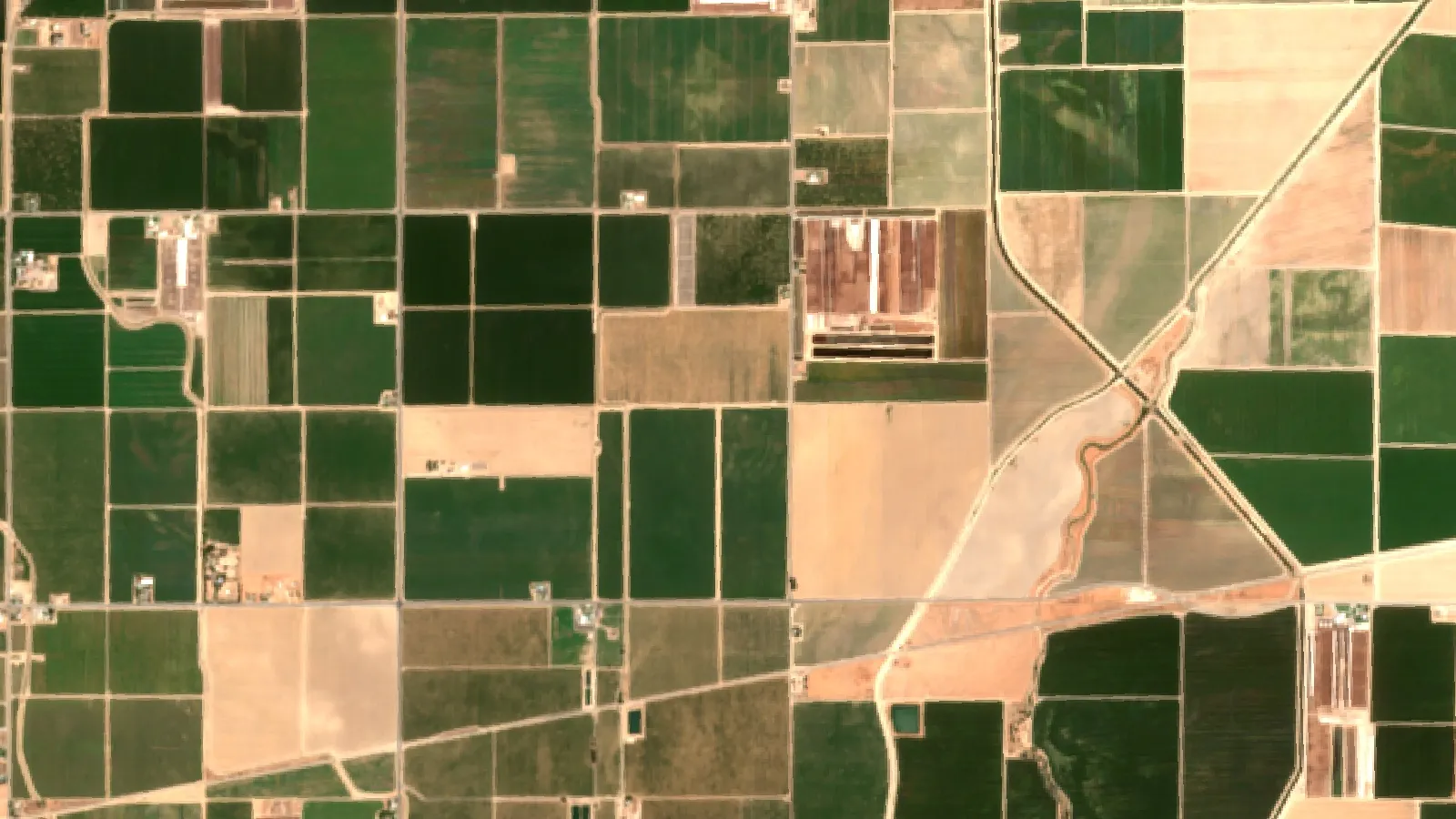
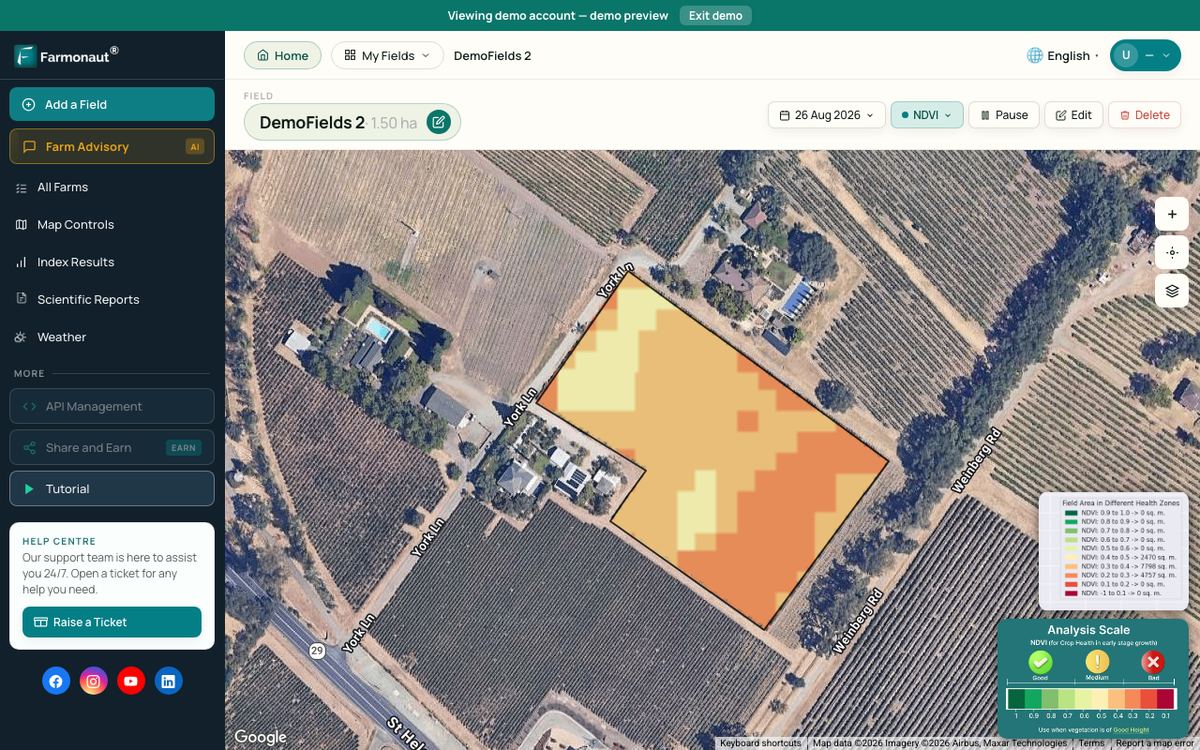
On large or scattered farms, the costly part of scouting is getting to every field. Satellite vegetation maps can show which fields or zones are losing vigor, so you walk those first. A map cannot tell you if the cause is insects, disease, drought or nutrients; you still need to look at the plants. Tools such as the Farmonaut Satellite + AI Farm Monitoring System give these maps for each field you draw. Drones are another option for close-up checks, and some farms now use them to apply products; Ohio State University Extension reports that about 30% of farm spraying in South Korea is done by drone, while drone spraying in the US is still in its early days.
Best for: farms with many fields, or fields far from the yard. Cost: a subscription or drone time.
▶ Can AI and remote sensing spot crop pests early? A short look at the four ways pests are detected. · 6:32
How do economic thresholds save money?
A threshold turns “I saw a pest” into a yes-or-no spending decision. Before spraying, you compare two numbers: the value of the yield the spray would save, and the cost of the spray. If the first is bigger, spray. If not, keep scouting.
Chart
Leafhopper threshold falls as hay value rises
Potato leafhoppers per sweep that justify treatment, alfalfa under 4 inches tall
The Iowa State tables show why a fixed rule can waste money. With cheap hay, you can tolerate far more leafhoppers before treatment pays. With expensive hay, the same count can justify a spray. A University of Missouri IPM note on leafhopper numbers makes the same point for alfalfa growers: sweep the field, and treatment is justified only when the average count per sweep reaches the threshold, which depends on plant height and whether the variety is leafhopper resistant.
Thresholds also guard against the opposite mistake. Waiting too long, past the point where a pest causes economic damage, costs yield that no later spray can recover. Regular scouting is what lets you act on time.
▶ Aphid control strategies on farms, from monitoring to targeted treatment. · 12:44
Where crop losses to pests are highest
Savary and colleagues used an online survey of crop health experts to estimate losses from pests and pathogens. Their global estimates were 21.5% for wheat, 30.0% for rice, 22.5% for maize, 17.2% for potato and 21.4% for soybean. They found that the highest losses were often in food-deficit regions and linked to new or returning pests and diseases.
Chart
Estimated global yield loss to pests and pathogens
Percent of attainable yield lost, global estimate per crop (expert survey)
These numbers are averages across many farms and pests. They do not mean every field loses that much, or that every loss can be prevented at a profit. They show why skipping pest control is not the cheap choice either.
Is a local pest control service worth it for a farm?
Some farms hire help for scouting and spraying instead of doing it in-house. Three types of local help are common:
- Custom applicators: they bring the sprayer, operator and fuel. Compare their per-acre rate with your own machine costs.
- Crop consultants and agronomists: they scout, identify pests and write recommendations. A good consultant can save more in avoided sprays than the fee, so compare the fee with what you spend on sprays now.
- Extension offices: they publish thresholds, pest alerts and spray guides for your region, usually at no charge for the advice.
Local knowledge matters because pest pressure, timing and approved products differ by region. Ask any service provider for their license, their insurance and the label of every product they plan to use. Ask for written records of what they applied, where, and when.
When you compare quotes, check what each one covers. One rate may include the product, another may be application only. Ask if there is a minimum charge for small fields, a fee for travel, or an extra charge for aerial work near houses or water.
▶ Six plain steps to start precision farming, from field maps to satellite monitoring. · 4:18
Spray or wait? Check the break-even
Use the calculator below with your own numbers. It compares the value of the yield a treatment would save with what the treatment costs per acre. The example values are set close to break-even on purpose; replace them with your own crop value, the loss you expect without treatment, and your real product and application costs.
Try the numbers for your own farm below.
Calculator
Does a spray pay on your field?
Enter your crop value, expected loss and treatment costs.
- Yield value saved per acre: $24 $/acre
- Treatment cost per acre: $24 $/acre
- Net for the whole field: $0 $
Example values only, set near break-even; they are not a benchmark or a forecast. Use your own crop value, a loss estimate from your scouting and local thresholds, and current product and application quotes. Always follow the product label and local rules, and get advice from a licensed adviser or extension office.
How we checked the numbers
We used extension service publications, a peer-reviewed study and agency guidance. Custom rates come from the Texas A&M AgriLife Extension 2026 survey and are averages of what operators reported, not market prices. Threshold values come from Iowa State University Extension’s tables for potato leafhopper in alfalfa, adapted from Tooker (2013). Crop loss figures come from Savary et al. (2019). We removed cost and yield-gain figures from the old page that had no source.
Related pages on our site: large-scale farm management platform, farm fleet management, carbon footprint tracking, satellite checks for crop loans and insurance, product traceability, satellite and weather API docs and the web and mobile apps.
For a closer look at a related question, see our guide: Poultry Farming: Affordable Poultry Equipment Trends.
If this topic matters to you, read Ag Lime Near Me: 7 Powerful Ways to Boost Soil & Yields next.
FAQ
What is the cheapest way to control pests on a farm?
Scouting and thresholds. They cost mostly time, and they stop you paying for sprays that would not have paid back. Rotation, field hygiene and protecting natural enemies come next. Spray when counts pass the threshold for your crop.
How much does crop spraying cost per acre?
In the Texas A&M 2026 custom rates survey, ground application of insecticides and fungicides averaged $9.98 an acre and aerial application $10.46, not counting the product. Rates ranged widely, so get local quotes.
What is an economic threshold?
It is the pest level at which the value of the yield you save equals the cost of control. Extension services publish thresholds by crop and pest, and some, like Iowa State’s alfalfa tables, change with crop price and control cost.
Can satellite images find pests?
Not directly. Satellite vegetation maps show where crops are stressed. The cause may be pests, disease, water or nutrients, so you still need to walk those spots and identify the problem.
Is organic or biological pest control cheaper?
It depends on the crop and pest. Natural enemies already in your field cost nothing if you avoid killing them. Bought biological products and released insects have a price, and results vary, so compare them with other options using your own numbers.
Farmonaut crop monitoring
See which fields to scout first
Draw your fields once and Farmonaut shows satellite vegetation maps for them through the season, on web, Android or iOS, so you can walk the stressed zones first.



Sources
- Savary S. et al., The global burden of pathogens and pests on major food crops, Nature Ecology & Evolution (2019): nature.com
- US EPA, Integrated Pest Management (IPM) Principles: epa.gov
- FAO, Integrated Pest Management (IPM): fao.org
- Texas A&M AgriLife Extension, Texas Custom Rates Statewide Survey 2026: agecoext.tamu.edu
- Manitoba Agriculture, Farm Machinery Custom and Rental Rate Guide: manitoba.ca
- University of Wisconsin-Madison IPCM, Potato Leafhopper in Alfalfa (2020): ipcm.wisc.edu
- Iowa State University Extension, Potato Leafhopper (Integrated Crop Management encyclopedia): crops.extension.iastate.edu
- University of Florida IFAS EDIS, Florida Citrus Production Guide: Pesticide Application Technology (CG024): edis.ifas.ufl.edu
- Ohio State University Extension, Drones for Spraying Pesticides (FABE-540): pested.osu.edu
- University of Missouri IPM, Potato Leafhopper Numbers Increasing in Alfalfa Fields (2008): ipm.missouri.edu
Discussion
Questions, corrections or field experience? Share them below. First-time comments are reviewed before they appear, and your email is never published.
No comments yet. Be the first to add a question or your experience.

 Marei Nursery
 Sayaji Group
 eKGIS
eKGIS Mostas Tech
 Native Seeds
 Andex
Andex FCF India
 Unifrutti Gulf
 Deluxe Conseil
 TVS Electronics
 BW Pipelines
 WICO
WICO Chimera Innovation
 SkyHarvest
 Polaris Digitech
 Licence holder · Niger · Gold










