

Reviewed September 2026 against pvrack.com installed-cost data, the University of Pennsylvania Kleinman Center’s agrivoltaics research, and Purdue University’s Vegetable Crops Hotline.
Try it: Run your own numbers →
Agricultural Farmland Mounting System: Costs & Buying Guide
An agricultural farmland mounting system is the structural hardware — racking, frames, clamps, and anchoring — that holds solar arrays, high tunnels, curtain/shade structures, sensors, and irrigation lines above US farmland. Installed costs run from roughly $0.80 to $2.33 per watt for solar mounting depending on system type, and $2 to $7 per square foot for high tunnel framing, according to industry cost trackers cited below. This page breaks down what drives that spread, what a “cheap” system actually sacrifices, and how to verify current pricing before you buy.
If your search brought you here looking for an agricultural curtain system, a high quality agricultural farmland mounting system, or specifically where to buy an agricultural farmland mounting system at a discount with fast delivery, the sections below cover each of those angles with real cost ranges — not vendor marketing copy.
Table of Contents
- What Counts as an Agricultural Farmland Mounting System
- Real Cost Breakdown: What Drives the Price
- Agricultural Curtain Systems: Where They Fit
- Material Choices: Balancing Cost and Durability
- Comparison Table: Mounting System Types by Cost, Lifespan, and Lead Time
- Calculator: Estimate Your Mounting System Budget
- Buying in Bulk: Discount Structure and Delivery Lead Times
- Design Essentials for Outdoor Conditions
- Installation Best Practices
- Farmonaut: Monitoring the Land Under Your Mounting System
- Choosing the Right System: A Buyer’s Checklist
- FAQ
- Try it: Run your own numbers

What Counts as an Agricultural Farmland Mounting System
The category covers any structural hardware that holds equipment above or across farmland: solar racking for agrivoltaic arrays, high tunnel and greenhouse frames, shade or curtain structures for crop protection, and mounting hardware for weather stations, sensors, and irrigation manifolds. What they share is the same buying problem — balancing upfront cost, installation speed, and multi-year durability against a farm budget that has to answer to machinery costs elsewhere on the operation.
For scale: the University of Illinois farmdoc daily tracker put average US farm machinery and equipment costs at $171 per acre in 2024, a figure that has been rising year over year according to the same report — farmdoc daily, University of Illinois. A mounting system purchase competes against that same capital budget, so the per-unit and per-acre math below matters more than a headline “cheap” price.
A low-price agricultural farmland mounting system is not automatically a false economy — but the industry data shows the cheapest materials (recycled HDPE, unstabilized PVC) trade off 3–6 years of service life against systems built from galvanized steel or aluminum that last 10–15 years. Run the cost-per-year-of-service math, not just the sticker price.
Real Cost Breakdown: What Drives the Price
Solar-carrying agricultural mounting (agrivoltaics) is the segment with the most granular US cost data available. Per pvrack.com’s 2024–2025 installed-cost tracking, agrivoltaic mounting systems cost $1.50–$2.33 per watt installed in the US — a 20–50% premium over standard utility-scale ground-mount racking, which runs $0.80–$1.20 per watt including foundation and labor (pvrack.com, agrivoltaic systems). The premium exists because agrivoltaic structures need greater ground clearance and wider row spacing to keep farm equipment and crops workable underneath.
Within any mounting system’s total cost, pvrack.com’s 2025 cost breakdown attributes 30–45% of hardware spend to structural aluminum or steel members — the racking itself, not the fasteners, foundations, or electronics. For residential-scale solar, mounting hardware overall represents 6–12% of total project cost (pvrack.com, cost breakdown). Labor is the other major swing factor: the same source puts US installation labor at $25–$65 per hour, varying by region — a range wide enough that a bulk installation crew quote from one state can differ by more than double from another.
For non-solar structures — high tunnels, curtain frames, shade systems — Purdue University’s Vegetable Crops Hotline puts mounting frame costs at $2.00–$7.00 per square foot, with the spread driven by tunnel size, automation (roll-up sides, motorized curtains), and regional labor (Purdue Vegetable Crops Hotline). A 30×96-foot tunnel frame (2,880 sq ft) at that range lands anywhere from roughly $5,760 to $20,160 in frame cost alone, before covering material, endwalls, or ventilation hardware.
Adoption context: agrivoltaic systems now cover 66,000 acres across US farms, spread over roughly 600 projects nationally, per the University of Pennsylvania’s Kleinman Center for Energy Policy and the USDA/DOE joint solar-and-farming initiative (Kleinman Center, University of Pennsylvania). That 66,000-acre figure is a snapshot from the cited 2024 publication — for a current count, the Kleinman Center periodically updates its agrivoltaics research page, and USDA’s collaboration with DOE tracks project counts through the Department of Energy’s CMEI systems database.
Agricultural Curtain Systems: Where They Fit
An agricultural curtain system — retractable fabric or polyethylene panels mounted on a frame to control light, wind, and temperature over crops or livestock housing — sits structurally closer to the high tunnel category than to solar racking. The mounting frame is the cost driver in the same way: Purdue’s $2.00–$7.00 per square foot range for high tunnel and greenhouse frames applies directly, since curtain systems typically ride on the same galvanized steel or aluminum hoop-and-purlin structures used for tunnel covers, with the added mechanism of a motorized or hand-crank curtain track.
The added mechanism is the line item that most often gets underestimated: a manual crank curtain system adds hardware cost at the lower end of that per-square-foot range, while a motorized, sensor-triggered curtain (opening automatically above a temperature threshold) pushes a project toward the $7.00 per square foot ceiling and beyond, since Purdue’s range covers frame cost specifically and automation is called out separately as a cost factor in the same source.
Material Choices: Balancing Cost and Durability in Mounting Systems
Material selection is where most of the “cheap vs. durable” tradeoff actually happens. The five materials most commonly used in US agricultural mounting hardware:
- Galvanized Steel
Pros: High strength, strong corrosion resistance, cost-effective at bulk order volumes. Cons: Heavier; often requires machinery for installation on uneven terrain. - Aluminum Alloys
Pros: Lightweight, rust-resistant, suited to mobile or seasonal setups. Cons: Higher per-unit cost than steel; can flex under high wind load if anchoring is undersized. - UV-Stabilized Polymers (PVC, HDPE)
Pros: Lower cost, flexible, fast to deploy. Cons: Not rated for high structural loads; degrades faster under continuous UV exposure without stabilizer additives. - Composite Materials
Pros: Hybrid strength-to-weight ratio, mid-range price, can be customized to load spec. Cons: Regional supply availability is inconsistent across US vendors. - Recycled Plastics
Pros: Lower material cost, resistant to rot and insect damage, suited to temporary or lightweight mounting. Cons: Shorter service life under sustained structural load.
None of the sources in this review publish an ASTM wind-load or weather-durability standard specific to agricultural mounting hardware — general structural testing frameworks exist, but an ag-specific rating comparable to, say, a UL rating for electrical hardware was not found in this research pass. If a vendor cites a wind-load rating, ask them to name the specific ASTM or engineering standard it was tested against, and get that in writing before bulk order.

Comparison Table: Mounting System Types by Cost, Lifespan, and Lead Time
This table combines the two data sources this article draws on — solar mounting per-watt figures from pvrack.com and frame per-square-foot figures from Purdue — normalized to a representative per-unit cost so you can compare across categories. Treat the “per unit” column as directional: a “unit” for solar is one mounting post/rail segment, for tunnel/curtain frames it is one structural bay.
| System Type | Primary Material | Cost Basis | Typical Service Life | Best Fit |
|---|---|---|---|---|
| Agrivoltaic solar mount | Galvanized steel / aluminum | $1.50–$2.33/watt installed | 20–25 yrs (racking) | Dual-use crop + solar land |
| Utility ground-mount (non-ag) | Galvanized steel | $0.80–$1.20/watt installed | 20–25 yrs (racking) | Dedicated solar acreage |
| High tunnel frame | Galvanized steel hoops | $2.00–$7.00/sq ft | 10–15 yrs | Season-extension cropping |
| Motorized curtain system | Steel/aluminum frame + fabric track | Upper end of $2–$7/sq ft range | 10–15 yrs (frame); track mechanism shorter | Climate control, livestock housing |
Cost figures per pvrack.com (solar, 2024–2025) and Purdue Vegetable Crops Hotline (tunnel/curtain frames, 2024–2025). Service-life figures for tunnel/curtain frames reflect the general galvanized-steel-frame range cited by Purdue; a manufacturer-published warranty term for your specific product is the figure to request in writing, since no US-wide failure-rate or warranty dataset was found in this research pass — ask vendors directly and compare terms across at least three bids.
Calculator: Estimate Your Mounting System Budget
Enter your project size and system type to get a cost range based on the per-watt and per-square-foot figures cited above.
Run your own numbers
Assumptions: uses the low and high figures cited in this article’s sources (pvrack.com for solar, Purdue Vegetable Crops Hotline for tunnel/curtain frames). Excludes site prep, permitting, foundation work beyond what those sources include, and regional labor variation of $25-$65/hour, which can shift the total independently of the ranges shown.
Buying in Bulk: Discount Structure and Delivery Lead Times
Buyers searching for a discount agricultural farmland mounting system or fast delivery agricultural farmland mounting system are usually weighing a bulk order against a single-unit purchase. The mechanics that actually move price in this category:
- Structural hardware is the leverage point. Since structural aluminum/steel members account for 30–45% of total mounting hardware cost per pvrack.com’s 2025 breakdown, bulk pricing on raw steel and aluminum stock is where volume discounts land hardest — negotiate that line item specifically rather than asking for a flat percentage off the whole quote.
- Labor is regional, not fixed. With installation labor ranging $25–$65/hour across US regions, a bulk order installed by a local crew in a lower-labor-cost region can beat a “discount” hardware price installed by an out-of-state crew.
- Lead time is a separate negotiation from price. Neither pvrack.com nor Purdue publish a standard US lead-time benchmark for bulk mounting orders in the sources reviewed here — request a written lead-time commitment with penalty terms for late delivery before seasonal planting or curtain-system installation windows, rather than relying on a verbal estimate.
Get itemized quotes that separate structural hardware, fasteners/clamps, and labor. Since structural members alone are 30–45% of hardware cost, a vendor quoting one bundled number is hiding where your negotiating room actually is.

Design Essentials for Outdoor Conditions
Whether you’re mounting solar arrays, curtain frames, weather stations, or irrigation lines, US outdoor conditions test the same structural fundamentals. Prioritize:
- Load capacity for wind, snow (in northern states), and crop or panel weight
- Corrosion resistance for humidity, fertilizer residue, and chemical exposure
- UV resistance for exposed plastics, polymers, and curtain fabric
- Soil anchoring suited to your terrain — loamy, sandy, or clay
- Thermal cycling resilience for freeze/thaw regions
- Reinforced bracing on sloped ground
On wind and weather load specifically: no US ag-specific ASTM standard for mounting hardware was found in the sources reviewed for this article. If durability under load is a purchase criterion, ask each vendor for their internal test data or third-party engineering certification and compare like-for-like — do not accept a marketing claim of “weather-resistant” without a number and a testing method behind it.

Mounting system spend competes directly against the $171/acre average US farm machinery cost reported by farmdoc daily. Treat a mounting purchase as part of that same capital budget line, not a separate discretionary spend — it changes how a lender or partner will evaluate the request.
Installation Best Practices: Modular and Scalable Mounting System Approach
Installation efficiency is where a bulk-ordered system either pays off or creates a labor bottleneck. Practices that keep large installs on schedule:
- ✔ Pre-Assembly — Kits with pre-drilled, labeled, or snap-in parts cut field labor hours, which matters directly against the $25–$65/hour regional labor range.
- ✔ Standardized Tools — Common wrenches and drivers across the whole order avoid crew downtime waiting on specialty tooling.
- ✔ Repeatable Layout Templates — Consistent spacing and anchor patterns across large plots reduce rework.
- ✔ Documentation — Diagrams and video walkthroughs let crews self-organize on large multi-acre installs.

Farmonaut: Monitoring the Land Under Your Mounting System
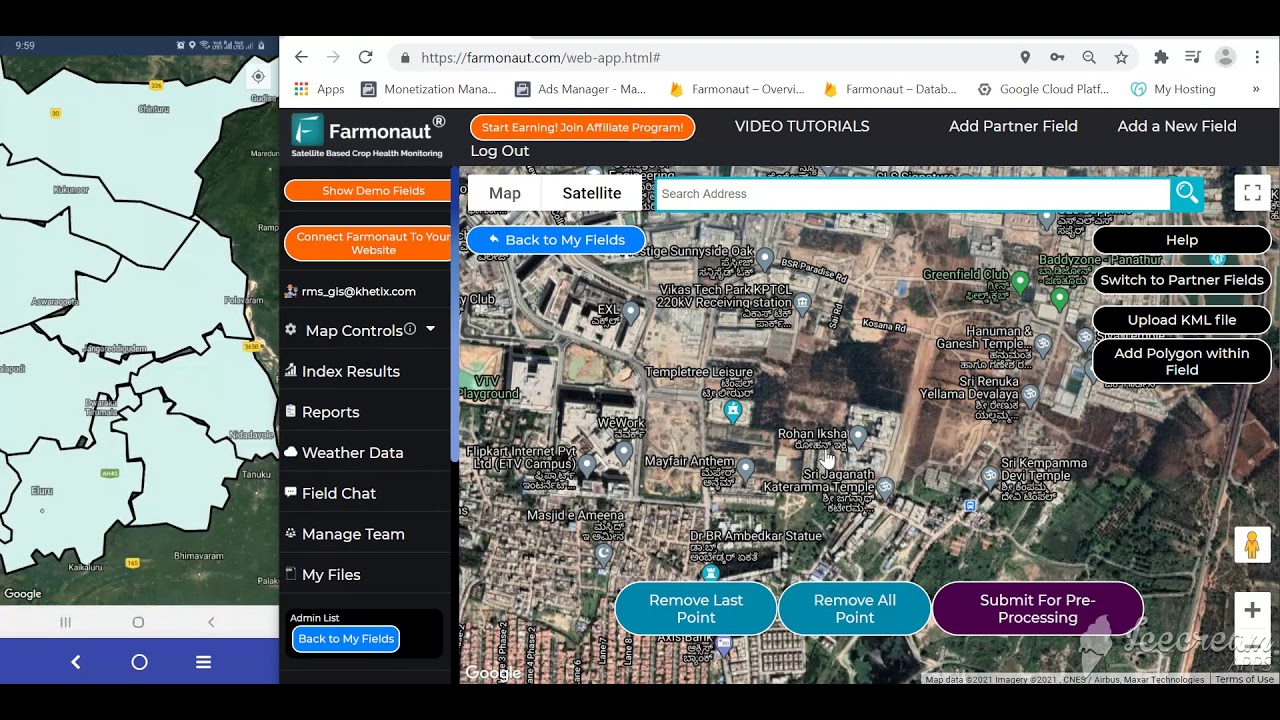
Choosing and installing a mounting system is a one-time structural decision — but the land underneath keeps changing. Farmonaut gives farmers, agribusinesses, and land managers satellite-based tools to track how a field performs before and after a mounting installation, whether that’s agrivoltaic panels, curtain-system tunnels, or sensor arrays.
- 📡 Satellite Monitoring: Multispectral imagery tracks soil and vegetation condition around your mounted infrastructure, helping you spot drainage or shading issues a new structure introduces.
- 🧠 Jeevn AI Advisory System: Site-selection and weather-preparedness guidance for where to place mounted equipment relative to crop rows and drainage.
- 🔗 Blockchain Traceability: Track the full lifecycle of farm infrastructure investments. Learn more about Farmonaut’s Traceability platform here.
- 💼 Resource Management: Coordinate bulk deliveries and installation crews against field schedules with Fleet Management tools.
- 🌱 Carbon Footprint Monitoring: Measure how a mounting choice — solar, shade, or tunnel — shifts your field’s environmental profile. Explore how carbon footprint tracking works.
- 🛡️ Satellite-Based Crop Insurance Verification: Speed up financing decisions for mounting upgrades with Farmonaut’s Crop Loan & Insurance services.
- 🌳 Large-Scale Farm, Orchard & Forestry Operations: Coordinate multi-site mounting installations with the Large Scale Farm Management platform.
Automating monitoring around a large mounting installation?
Get API access here, or view integration documentation in the Developer Docs.




Choosing the Right System: A Buyer’s Checklist
- 🚩 Define your application: Solar, high tunnel, curtain, or sensor/irrigation mounting each have different cost bases — don’t compare a per-watt quote against a per-square-foot one.
- 🔍 Assess environmental risk: Wind, snow load, and soil type specific to your region and crop.
- 🛠️ Evaluate modularity: Systems with standardized, replaceable parts cost less to maintain over a 10–20 year ownership cycle — though no US-wide maintenance-cost dataset over that period was found in this research; request a manufacturer’s projected maintenance schedule in writing.
- 📦 Get itemized bulk quotes: Separate structural hardware (30–45% of cost), fasteners, and labor ($25–$65/hour) so you know where a “discount” is actually coming from.
- 💡 Request field performance data: Ask for load, corrosion, and UV test results — not just a price sheet.
Before buying:
- Get a written wind-load and corrosion test method from the vendor, not just a rating claim ✔
- Request an itemized quote: structural hardware / fasteners / labor 📖
- Confirm written lead-time commitment for bulk orders 🕒
- Check warranty term and spare-part availability in writing 🔐
- Confirm compatibility with any precision-ag sensors or irrigation controls you already run ⚙️

FAQ: Agricultural Farmland Mounting Systems
An agricultural farmland mounting system purchase is a structural decision measured in decades, not seasons — the $171/acre average US farm machinery cost reported by farmdoc daily is the budget line it competes against, and the 20–25 year service life of galvanized steel or aluminum racking is the return you’re buying against that spend. Price alone, divorced from material, load rating, and itemized labor cost, tells you almost nothing about what you’re actually getting.
Before committing to a vendor, request the itemized breakdown this article uses as its own framework: structural hardware cost, fastener cost, labor cost per hour, and a written lead-time commitment. Then verify the vendor’s numbers against the current pvrack.com and Purdue Extension figures cited above — both update on a rolling basis and will be more current than this page a year from now.
Discussion
Questions, corrections or field experience? Share them below. First-time comments are reviewed before they appear, and your email is never published.
No comments yet. Be the first to add a question or your experience.

 MISE Maroc
 Drift-Sense
 NWNS
NWNS Hydenmet
 Dirks Bros Farms
 Red August Group
 Farm Inc
 WeMe Global
 Agrotoken
 Blue BearX
 Insignito
 Croptimum
 DnCubed
 Field Capacity
 Indosistim Teknologi
 Liquify Digital
 CU Foods
 BeyondTech Global
