

Brazil · Climate and farming guide
Is Brazil's Climate Suitable for Agriculture? Zone by Zone
Yes, for most of the country. About 81% of Brazil is tropical, 14% humid subtropical and 5% dry (Alvares et al., 2013). The Cerrado and South grow record grain once acid soils are limed; the semi-arid Northeast, with 800 mm of rain or less a year, needs irrigation.
Key takeaways
- Brazil’s climate is about 81% tropical, 14% humid subtropical and 5% dry by area (Köppen map, Alvares et al., 2013).
- Brazil harvested a record 350.2 million tonnes of grain in 2024/25; the Centre-West grew 178.0 million tonnes of it (Conab, September 2025).
- Grain yields in semi-arid Northeast states were very low in 2024/25: 442 kg/ha in Ceará against 5,020 kg/ha in Mato Grosso (Conab).
- Most Cerrado soils are acid and need lime; one Embrapa-led trial saw soybean yield rise with lime up to 6 t/ha on new land (2022 season).
- Agribusiness exports reached US$169.2 billion in 2025, 48.5% of Brazil’s exports (Ministry of Agriculture).
In this article
- Is Brazil's climate suitable for agriculture? The short answer
- Fact 1: Brazil has three broad climate groups, not one
- Fact 2: Rain and heat set the farming calendar
- Fact 3: Which soil is suitable for agriculture in Brazil?
- Fact 4: Climate-smart practices close most of the gap
- Fact 5: Regional differences in Brazil agriculture are large
- Fact 6: Water management decides yields in dry areas
- Fact 7: Trees and forests add income in every climate
- Region-by-region suitability table
- What the export numbers say about Brazil agriculture
- Tool: estimate lime need and cost for acid soils
- How satellite monitoring fits a mixed climate
- FAQ
- Summary: Brazil's climate and agriculture
Yes. Brazil’s climate is suitable for agriculture across most of the country, but not everywhere in the same way. About 81% of Brazil has a tropical climate, 14% a humid subtropical one and 5% a dry, semi-arid one, according to the Köppen climate map for Brazil by Alvares and colleagues (2013). The warm, wet savanna of the centre and the mild South grow record grain crops. The semi-arid Northeast needs irrigation to farm reliably.
The results show it. Brazil harvested a record 350.2 million tonnes of grain in the 2024/25 season, according to the national supply agency Conab’s final survey for 2024/25. Farm exports reached US$169.2 billion in 2025. This guide walks through the seven facts that decide whether Brazil’s climate is suitable for agriculture in a given place: climate zones, rain and heat, soils, farm practices, regions, water and trees. It has region and state charts and a lime cost calculator for acid tropical soils.
Is Brazil’s climate suitable for agriculture? The short answer
Brazil is huge: 851 million hectares, larger than the 48 contiguous US states. Its farm land covered about 237 million hectares in 2023, or 28.3% of its land area, in World Bank data on agricultural land. That figure includes pasture as well as crops. Here is the answer, zone by zone:
- Cerrado (centre-west savanna): highly suitable for rain-fed soy, corn and cotton once the acid soil is corrected. Best for large grain farms.
- South: suitable for grain, rice, wheat, grapes and dairy. Frost in winter and dry spells in some summers are the main risks.
- Southeast and Atlantic coast: suitable for coffee, sugarcane, oranges, vegetables and planted forest.
- Amazon (north): warm and wet all year. Suitable for tree crops, cocoa, açaí, cassava and pasture, with high pest and disease pressure and strict forest rules.
- Semi-arid Northeast: suitable only with irrigation or drought-tolerant crops. Rain-fed grain yields there are a small fraction of the national average.
So the honest answer to “is Brazil’s climate suitable for agriculture, yes or no” is “yes in most regions, with work”. Lime, fertilizer, water and the right varieties close most of the gap. The rest of this page shows where the gap is small and where it is large.
Fact 1: Brazil has three broad climate groups, not one
Most of Brazil sits in the tropics, so heat is rarely the limit for crops. Rain and soil matter more. The Köppen system splits the country into three broad groups:
- Tropical (A): the Amazon, the Cerrado, the Pantanal and most of the coast. Warm all year. Some parts are wet all year; most have a wet summer and a dry winter.
- Humid subtropical (C): the southern states of Paraná, Santa Catarina and Rio Grande do Sul, plus high ground in the Southeast. Four seasons, cool winters and frost in places.
- Dry (B): the semi-arid interior of the Northeast, often called the Sertão or Caatinga. Hot, with short and irregular rains.
Alvares and colleagues built their map from monthly temperature and rain data at 2,950 weather stations. Their figures put about 81% of the country in tropical climates, 14% in humid subtropical and 5% in dry climates. That mix is a strength for Brazil as a whole. Regions rarely all fail in the same season, so farmers and traders can spread weather risk across the country.
Practical points for each group:
- Warm temperatures in most regions allow two crops a year on the same field, often soy followed by corn or cotton.
- A clear wet season lets farmers sow rain-fed crops on a fixed calendar, with little or no irrigation in the wetter zones.
- Day length near the equator changes little through the year, so crop varieties must be bred for short-day conditions. This is one reason Brazil runs its own breeding programmes.
Chart
Share of Brazil’s area by Köppen climate group
% of national territory
Fact 2: Rain and heat set the farming calendar
For the Cerrado, the main farming belt, the numbers are clear. About 86% of the region gets 1,000 to 2,000 mm of rain a year, and 65% gets 1,200 to 1,600 mm, where most crops grow, according to an FAO appendix on the Cerrado. A dry season usually runs from about April to September. Mean monthly temperatures range from 20 to 26 °C, and the core of the region rarely sees frost.
That pattern shapes every decision:
- Soy is planted when the rains start, often from late September to November, and harvested from January.
- A second crop, often corn, goes in straight after soy and races the end of the rains. A late start or an early dry season can cut its yield.
- Cattle need stored feed or deferred pasture for the dry months.
- Humid areas in the Amazon and on the Atlantic coast suit tree crops but face more fungal disease and insect pressure.
- The South gets rain all year but has frost risk in winter, which limits tropical crops and favours wheat, barley and grapes.
The semi-arid Northeast is the clear exception. Brazil’s development agency for the region, Sudene, defines the semi-arid zone by three tests: average yearly rain of 800 mm or less, a Thornthwaite aridity index of 0.50 or less, or a daily water deficit of 60% or more, under Sudene Resolution 150 of December 2021. Below that line, rain-fed grain is a gamble in most years.
Compared with the US Midwest, where summer rain falls during the growing season on deep, fertile soils, Brazil’s tropical farms depend more on soil correction, timing and drought-tolerant varieties. The trade-off is a longer season and two harvests a year on the same land.
Fact 3: Which soil is suitable for agriculture in Brazil?
Almost every major soil group in Brazil can be farmed, but most need work first. The soils fall into four broad groups:
- Oxisols and ultisols (tropical): deep, well drained and easy to work, common in the Cerrado and the Amazon. They are naturally acid, low in nutrients and often high in toxic aluminium.
- Alfisols and ultisols (South): more fertile in many places. They carry grain, legumes and pasture under no-till.
- Sandy coastal soils (Atlantic coast): drain fast and hold few nutrients. They need lime, fertilizer and careful water use for fruit, coffee and vegetables.
- Alluvial soils (river plains): smaller areas, well suited to irrigated rice and vegetables.
The Cerrado story shows what soil correction can do. The region covers about 204 million hectares, and its grain farming depends on lime, fertilizer and adapted varieties, the FAO appendix explains. Lime raises soil pH, removes aluminium toxicity and supplies calcium and magnesium so roots can grow deep enough to reach stored water.
How much lime? On a newly cleared Cerrado field in Maranhão with a starting pH (CaCl2) of 4.5, soybean yield rose with lime rates up to 6 t/ha in a single 2022 season, in an Embrapa-led field trial in the MATOPIBA frontier. The authors note that lime has little time to react on new land, because it starts working when the rains start, which is also the sowing window. That is one trial on one farm, so a soil test should set the rate on your own land.
The four main ways to improve Brazil’s tropical soils:
- Lime: corrects acidity and helps nutrient uptake.
- Cover crops and no-till: build organic matter and protect the soil from heavy rain.
- Drainage and controlled traffic: keep fields workable in the wet season.
- Targeted irrigation: helps on sandy or fast-draining soils.
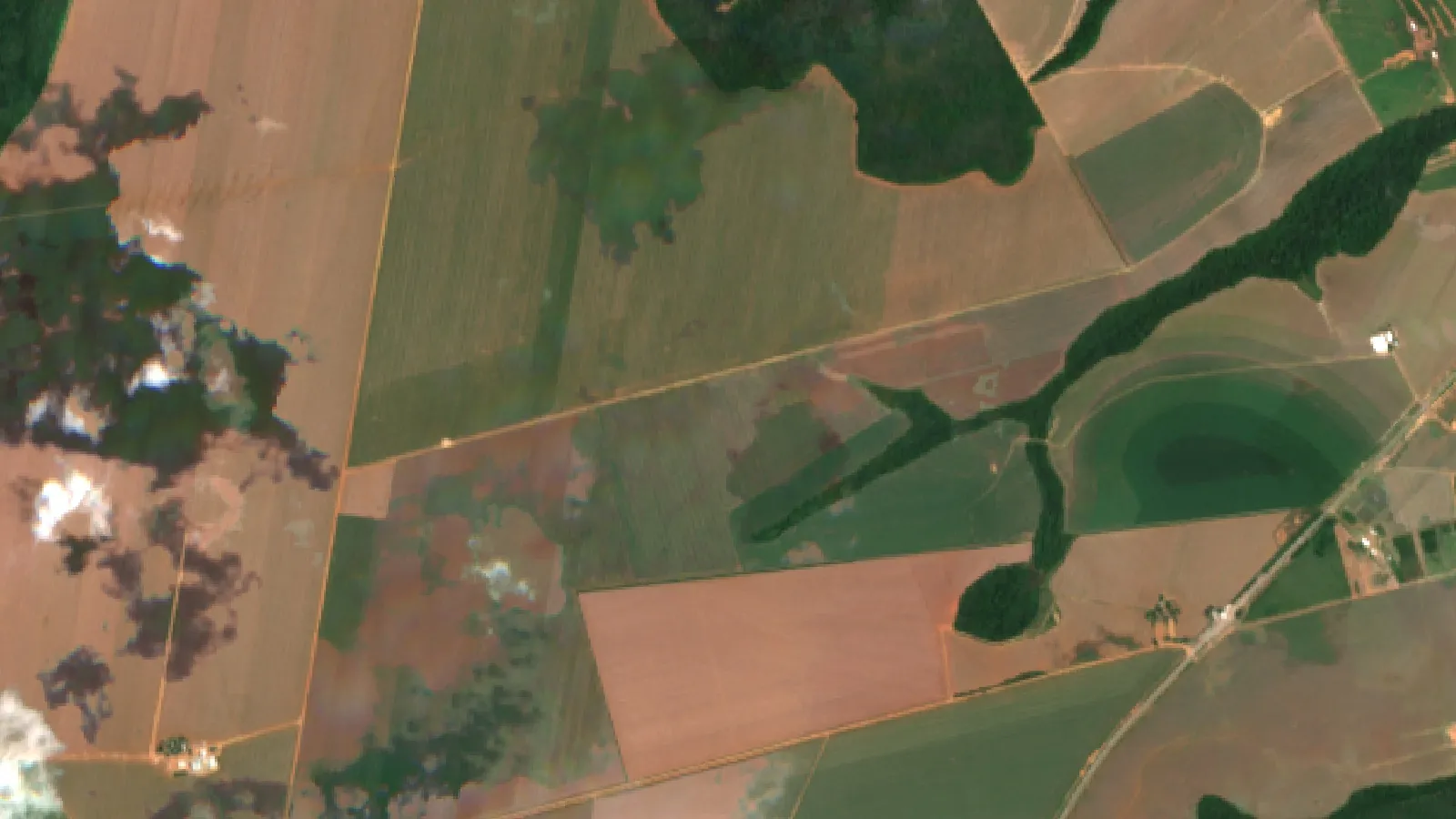
Fields that span two soil types should not get one flat rate of lime or fertilizer. Zone maps from soil sampling, yield maps or satellite crop images help split the field.
▶ Seven simple sustainable farming practices that protect soil and water, such as cover crops and less tillage. · 4:34
Fact 4: Climate-smart practices close most of the gap
Brazil’s output has grown faster than its climate alone would suggest because farmers changed how they farm. These practices adapt production to each region’s rain and soil rather than one national playbook:
- Soil first: regular soil tests, lime and gypsum where needed, no-till and cover crops to hold water.
- Irrigation: centre pivots and drip lines extend farming into dry areas and steady yields in a dry spell.
- Rotation and two crops a year: soy followed by corn, cotton, sorghum or millet spreads risk and breaks pest cycles.
- Adapted varieties: soy, corn and cotton bred for tropical day length and acid soils.
- Integrated crop, livestock and forest systems: crops, pasture and trees in rotation on the same land.
- Field monitoring: satellite images, weather data and field scouting to time sowing, spraying and harvest.
Brazil’s cereal yield shows the result. It rose from 2,883 kg/ha in 2005 to 5,336 kg/ha in 2023, according to World Bank cereal yield data. Over the same years the US average went from 6,451 to 8,330 kg/ha. The gap narrowed but has not closed, and Brazil’s line is bumpier, with dips in 2016 and 2021.
The risks that remain:
- Soil turns acid again without a regular liming plan.
- Water stress in the semi-arid Northeast can wipe out rain-fed crops in a dry year.
- Pests and diseases build up in humid areas with one crop on large blocks.
- Roads, storage and ports lag behind production on new frontier land.
Chart
Cereal yield: Brazil vs United States
kg per hectare, selected years
Fact 5: Regional differences in Brazil agriculture are large
Climate and soil split Brazil into very different farm economies. The Centre-West produced 178.0 million tonnes of grain in 2024/25, more than half the national total, while the North and Northeast together produced 53.8 million tonnes, according to the Conab 12th grain survey for 2024/25. Mato Grosso alone grew 111.9 million tonnes.
Chart
Grain production by region of Brazil
million tonnes, 2024/25 season
Cerrado and Centre-West: the grain belt
- Savanna climate with a long dry season.
- Main area for soy, second-crop corn and cotton. Mato Grosso’s grain yield averaged 5,020 kg/ha in 2024/25 (Conab).
- Decades of liming and fertilizer turned acid oxisols into productive farmland.
- Pivots and farm reservoirs help through the dry season.
- Cattle and crops share the same landscape, often in rotation.
Atlantic coast and Southeast
- Humid climate with plenty of rain, cooler on high ground.
- Soils need lime and fertilizer but support coffee, sugarcane, oranges, fruit and vegetables.
- Home to large planted forests of eucalyptus and pine.
Semi-arid Northeast
- Hot and dry, with high evaporation and irregular rain.
- Grain yields are very low. In 2024/25, Ceará averaged 442 kg/ha and Rio Grande do Norte 274 kg/ha (Conab), against a national average above 4,000 kg/ha.
- Irrigated valleys, such as those along the São Francisco River, grow mangoes, grapes and other fruit for export.
- Goats, sheep, cassava, beans and forage crops suit the dry interior better than soy.
South
- Humid subtropical climate with cool winters and frost risk.
- Soy, corn, wheat, rice, grapes, tobacco and dairy.
- Rio Grande do Sul is Brazil’s main rice state, with most rice grown under irrigation (Conab). Its grain yield fell from 3,662 to 3,383 kg/ha between 2023/24 and 2024/25, while Paraná’s rose from 3,630 to 4,442 kg/ha, a reminder that weather can vary sharply even within one region.
For a crop-by-crop view of the warm regions, see our guide to top crops in Brazil’s warm tropical climate.
Chart
Grain yield by state, two seasons
kg per hectare, all grains, selected states
Fact 6: Water management decides yields in dry areas
Brazil’s rise as a farm exporter has gone hand in hand with better water use. Where rain is short or unreliable, irrigation changes the answer to whether the climate is suitable for agriculture:
- Centre pivots let Cerrado farms grow a third crop, such as beans or vegetables, in the dry season.
- Drip and micro-sprinklers carry fruit and vegetables in the semi-arid Northeast.
- Flooded paddies grow most of the rice in Rio Grande do Sul.
- Soil moisture and crop monitoring help avoid over- or under-watering, which wastes water and power.
Irrigation has limits. Water rights, power costs and river flows in dry years all cap how far it can spread. For most of the Cerrado, the bigger gains still come from timing: sowing as soon as soil moisture allows and choosing a second crop that fits the rain left in the season.
Field data helps here. Satellite vegetation maps show which parts of a field are stressed, so scouts can check them first. Farmonaut is one of several services that provide these maps for fields drawn on a phone or computer.

▶ Six plain steps to start precision farming, from field maps to satellite monitoring. · 4:18
Fact 7: Trees and forests add income in every climate
Agroforestry means growing trees with crops or livestock on the same land. It suits Brazil’s warm, wet regions well:
- Planted forests: fast-growing eucalyptus and pine on deep, well-drained soils supply pulp, timber and charcoal.
- Silvopasture: cattle graze between rows of trees that give shade and a later timber income.
- Tree crops in the Amazon: cocoa, açaí, rubber and Brazil nuts can grow with other crops in mixed systems.
Trees spread income over more years and over more products, and they can buffer a farm in a dry year. They also take longer to pay back than annual crops, so they suit owners who can wait. Any clearing or planting near forest must follow Brazil’s Forest Code and state rules; check local requirements before you start.
Region-by-region suitability table
The table sums up each region. Crops listed are common ones, not a full list.
| Region | Climate | Common farm uses | Main limit | Main fixes |
|---|---|---|---|---|
| Centre-West (Cerrado) | Tropical savanna, wet summer and dry winter | Soy, corn, cotton, cattle, millet | Long dry season, acid oxisols | Lime, no-till, rotation, pivots in places |
| Semi-arid Northeast | Hot and dry, 800 mm of rain or less a year | Irrigated fruit, cassava, beans, goats, forage | Low, irregular rain | Drip irrigation, drought-tolerant crops, water harvesting |
| South | Humid subtropical, cool winters | Soy, corn, wheat, rice, grapes, dairy | Winter frost, some dry summers | No-till, cold-tolerant varieties, cover crops |
| Amazon (North) | Equatorial, hot and wet | Cassava, açaí, cocoa, fruit, pasture | Humidity, pests, forest rules | Agroforestry, pest control, legal compliance |
| Southeast and coast | Tropical to humid subtropical | Coffee, sugarcane, oranges, vegetables, forestry | Acid and sandy soils | Lime, fertilizer, organic matter, pest control |
Season figures change every month. Conab publishes a grain survey each month, and the USDA Foreign Agricultural Service publishes Oilseeds: World Markets and Trade monthly, with Brazil soybean estimates. Use them for the current season rather than any fixed table.
What the export numbers say about Brazil agriculture
Brazil’s farm exports reached a record US$169.2 billion in 2025, up 3.0% from US$164.3 billion in 2024, and made up 48.5% of all Brazil’s exports, according to the Ministry of Agriculture’s 2025 export release. The figure is the value of agribusiness exports, which includes processed goods such as meat, sugar and pulp.
- Soybeans earned US$43.5 billion, with a record 108.2 million tonnes shipped.
- Beef earned US$17.9 billion, up 39.9%.
- Coffee earned US$16.0 billion, up 30.3% on high world prices.
- China bought US$55.3 billion, or 32.7% of the total.
Each of these products comes from a different climate zone: soy from the Cerrado and South, beef from pasture across the country, and coffee from the cooler highlands of the Southeast. The spread of zones is part of why the totals hold up when one region has a bad year.
Tool: estimate lime need and cost for acid soils
Brazil’s acid oxisols and ultisols need lime before they reach their potential. The calculator uses the base saturation method that Embrapa sets out for Cerrado soils: lime (t/ha) = (target base saturation − current base saturation) × CEC ÷ 100 × (100 ÷ ECCE). The Embrapa technical circular on liming cotton in the Cerrado gives this formula and a 60% target for cotton in the top 20 cm. Enter the values from your own soil test. ECCE is the effective calcium carbonate equivalent of your lime, called PRNT in Brazil.
The calculator also shows how much extra crop the lime must pay for. Use it to rough out a budget, then check it against a soil test report and local advice before you buy.
Try the numbers for your own farm below.
Calculator
How much lime does your acid soil need, and what must it pay back?
Enter values from your own soil test and local prices.
- Lime rate: 2.25 t/ha
- Lime for the field: 225.0 t
- Lime cost per hectare (US$): $90
- Extra crop needed to pay for the lime: 225 kg/ha
Example values only, not a recommendation or a benchmark. The formula is the base saturation method in Embrapa Technical Circular 92 on liming cotton in the Cerrado: lime (t/ha) = (target V% − current V%) × CEC ÷ 100 × (100 ÷ ECCE); Embrapa gives 60% as the target for cotton in the top 20 cm. Prices are examples, use today’s price. Follow a soil test report and local advice.
How satellite monitoring fits a mixed climate
Large Brazilian farms often span different soils and rain patterns. Satellite vegetation maps show where a crop is growing more slowly than the rest of the field, which helps target soil sampling, scouting and variable-rate lime or fertilizer. They show plant vigour, not the cause, so a field visit is still needed. The Farmonaut Satellite + AI Farm Monitoring System offers these maps on web, Android and iOS.
Related pages on our site: farm monitoring app, satellite data API, supply chain traceability, product traceability, crop loans and insurance, carbon footprinting and farm fleet management.

▶ A walk-through of the Farmonaut web app for monitoring crops with satellite images and crop health indices. · 8:43
FAQ
Is Brazil’s climate suitable for agriculture, yes or no?
Yes for most of the country. The Cerrado, the South and the Southeast are well suited to crops, pasture and forestry once acid soils are corrected. The semi-arid Northeast, with 800 mm of rain or less a year, needs irrigation or drought-tolerant crops to farm reliably.
What are Brazil’s main climate zones?
Brazil has three broad climate groups: tropical (about 81% of the country), humid subtropical (about 14%) and dry semi-arid (about 5%), according to the Köppen map by Alvares and colleagues (2013). The tropical group covers the Amazon, the Cerrado and most of the coast; the subtropical group covers the South.
Which soil is best for agriculture in Brazil?
The more fertile soils are alluvial river plains and some southern soils. In practice the largest farmed areas are on acid oxisols and ultisols in the Cerrado, which become productive with lime, fertilizer and no-till. A soil test sets the lime rate for each field.
What crops grow best in each region of Brazil?
Soy, corn and cotton in the Cerrado; soy, corn, wheat, rice, grapes and dairy in the South; coffee, sugarcane, oranges and vegetables in the Southeast; cocoa, açaí, cassava and fruit in the Amazon; and irrigated fruit, cassava, beans and goats in the semi-arid Northeast.
How big is Brazil agriculture?
Brazil harvested 350.2 million tonnes of grain in 2024/25 (Conab), and agribusiness exports reached US$169.2 billion in 2025, 48.5% of the country’s exports (Ministry of Agriculture). Farm land, including pasture, covered about 237 million hectares in 2023 (World Bank).
Does climate change affect farming in Brazil?
Weather already swings yields from year to year. Conab data show Rio Grande do Sul’s grain yield fell between 2023/24 and 2024/25 while Paraná’s rose sharply, and Northeast states such as Ceará saw yields drop. Farmers manage the risk with timing, rotation, adapted varieties, irrigation where water allows, and crop insurance.
Summary: Brazil’s climate and agriculture
Brazil’s climate is suitable for agriculture across most of its land, and record harvests and exports show it. The limits are local: a long dry season and acid soils in the Cerrado, frost in the South, humidity and forest rules in the Amazon, and too little rain in the semi-arid Northeast. Each has known fixes, from lime and no-till to irrigation and agroforestry. Before you judge a specific farm, check its climate zone, its rainfall, a soil test and the current Conab or USDA season report.
Farmonaut crop monitoring
See your own fields from space
Draw your fields once and Farmonaut shows satellite vegetation maps for them through the season, on web, Android or iOS.




Keep reading

Sources
- Alvares et al., Köppen’s climate classification map for Brazil, Meteorologische Zeitschrift (2013): doi.org
- Conab, Produção de grãos atinge novo recorde com 350,2 milhões de toneladas na safra 2024/25 (2025): gov.br
- Conab, Acompanhamento da Safra Brasileira de Grãos, 12º levantamento 2024/25 (September 2025): gov.br
- World Bank, Agricultural land (% of land area), Brazil (2023 data): data.worldbank.org
- World Bank, Agricultural land (sq. km), Brazil (2023 data): data.worldbank.org
- World Bank, Cereal yield (kg per hectare), Brazil and United States: data.worldbank.org
- FAO, Zero tillage development in tropical Brazil, Appendix 1: The Cerrado: fao.org
- Embrapa Mid-North et al., High rates of lime can improve soybean-millet performance in the MATOPIBA frontier (2024): alice.cnptia.embrapa.br
- Embrapa Algodão, Calagem e adubação do algodoeiro no Cerrado, Circular Técnica 92: infoteca.cnptia.embrapa.br
- Sudene, Resolução Condel/Sudene nº 150 (December 2021): gov.br
- Ministry of Agriculture and Livestock (MAPA), Agronegócio brasileiro fecha 2025 com recorde em exportações (January 2026): gov.br
- USDA Foreign Agricultural Service, Oilseeds: World Markets and Trade (October 2026): apps.fas.usda.gov
Discussion
Questions, corrections or field experience? Share them below. First-time comments are reviewed before they appear, and your email is never published.
No comments yet. Be the first to add a question or your experience.

 Dreamz Tech
 Wild Oak Farm
 SFX
 BACF Africa
 Doodlakine
 Exurbia Geospatial
 FieldZero
 Indico Company
 Kubota
 FFBS
 Jontra
 Tucor

 Licence holder · Niger · Gold
 Licence holder · Nigeria · Gold + lithium
 Client · Tanzania · Gold
 Client · Somalia · Gold
 Client & affiliate partner · Ghana · Gold










