

AI in gold mining · Guide
AI Gold Mining: Uses, Resource Estimates, Costs
AI gold mining uses machine learning to rank drill targets, estimate grade and run equipment. Here are the documented uses, an eight-step AI resource estimate, a validation warning from a 2026 study and a payback calculator.
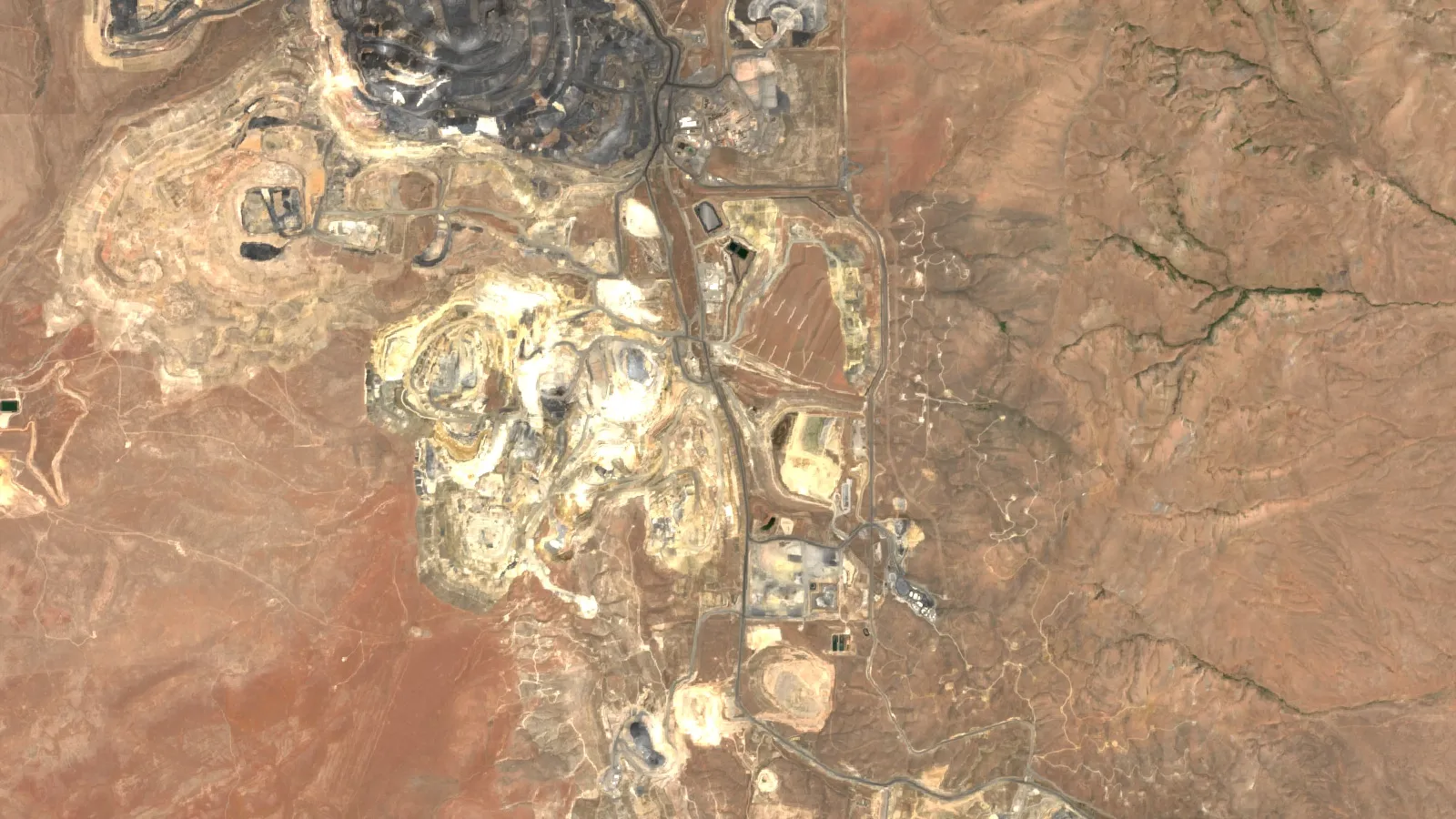
Key takeaways
- A 21 April 2026 release from Gold Hunter Resources reported 40 AI-generated targets (9 + 31, 5 flagged by both models) ; by 28 September 2026 the company had drilled 13 holes (2,879 m) and said assays were pending.
- A 2026 SAIMM study found machine-learning grade models looked best (R-squared 0.92 for k-nearest neighbours) under ordinary validation, but often fell below zero under spatial block cross-validation.
- Newmont approved US$150 million for autonomous haulage at Boddington in February 2020, forecasting an internal rate of return above 35%; its 2025 annual report lists 41 autonomous trucks there.
- Global average gold all-in sustaining cost was US$1,785 per ounce in Q1 2026 (World Gold Council); Kitco spot was about US$4,100 on 5 November 2026 (intraday).
- Public resource estimates still need a named Competent Person (JORC) or Qualified Person (NI 43-101); AI cannot take that role.
In this article
- What AI does in gold mining
- Where AI is used across a gold project
- AI gold exploration: how targets are found and ranked
- How to do a resource estimate with AI for a gold deposit
- AI in gold mining operations: haulage, drilling and processing
- Safety, environment and reporting
- AI gold mining costs and what it can pay back
- Risks and limits of AI in gold mining
- AI and gold mining companies: what investors can check
- Where satellite screening fits in an AI gold workflow
- Frequently asked questions
What AI does in gold mining
AI gold mining means using machine-learning software on geological, drilling, sensor and satellite data to make better decisions at each stage of a gold project: choosing where to drill, estimating how much gold is in the ground, running the plant and keeping people safe. It does not find gold by itself. It ranks options for geologists and engineers, who still decide and who still sign the reports.
The three jobs that matter most to licence owners, consultants and investors are finding targets, estimating the resource and running the mine. Each has a different level of proof behind it. Autonomous haul trucks have a documented track record at a large open pit. AI targeting is newer and the published results are mostly “targets generated”, not “mines found”. AI resource estimation is a research topic that is being tested against classical geostatistics, with mixed results that we explain below.
Gold is measured in troy ounces (1 troy ounce = 31.1035 grams) and in grams per tonne (g/t), the grade of the rock. A deposit of 1 million tonnes at 2 g/t holds 2 million grams, or about 64,300 troy ounces, before any losses in mining and processing. Every AI claim in this guide is easier to judge if you convert it back to ounces and dollars. At a spot price of about US$4,100 per troy ounce (Kitco and Reuters feeds, early on 5 November 2026), those 64,300 ounces would be worth roughly US$264 million before costs, which is why small percentage gains from better decisions can pay for software.
This page covers the main uses first, then a step-by-step method for an AI-assisted resource estimate, then operations, satellite data, costs, limits and a calculator you can fill in with your own numbers. Readers who are new to the commodity may also want our guide on how to start gold mining, and the history of how prospectors worked before any of this software, such as the 1896 Canadian gold rush.
▶ What an AI mining app does, the three jobs it can do and who builds one · 3:52
Where AI is used across a gold project
The table lists the stages of a gold project, the job AI is given and how well that use is documented. “Documented” means we found a company or regulator statement or a peer-reviewed study that we opened; it does not mean the method works on every deposit.
Chart
Where US gold is mined
Share of 2025 estimated US mine production, per cent
| Stage | What AI is asked to do | Evidence we could check |
|---|---|---|
| Regional targeting | Find areas that resemble known gold occurrences in geology, geophysics and geochemistry | Company releases list target counts, not discoveries (example below) |
| Drill planning | Rank holes by expected information value | Method papers; few public cost-saving figures |
| Resource estimate | Predict grade between drill holes | Peer-reviewed comparisons with kriging, with mixed results |
| Mining | Drive haul trucks and drills without an operator in the cab | Newmont Boddington, Western Australia: US$150 million approved in 2020; 41 autonomous trucks listed in its 2025 annual report |
| Processing | Adjust plant settings to ore variation | Mostly vendor and company claims; ask for before-and-after data |
| Environment and safety | Watch tailings, vegetation and water by satellite; flag equipment faults | Satellite data are public (ESA Sentinel-2); site results are project specific |
A useful rule: the further a use is from the rock, the easier it is to prove. A truck either drives itself or it does not. A grade model has to be checked against the metal that actually comes out of the mill, which can take years.
For readers who want a plain-English overview first, the Farmonaut video below explains the three jobs an “AI mining app” can do and what to ask a vendor.
AI gold exploration: how targets are found and ranked
Exploration is where most AI gold projects start, because the data already exist: government geology maps, geophysical surveys, soil and stream samples, old drill logs and satellite images. A model is trained on the places where gold is known and then scores every cell of a map by how closely it matches. The output is a ranked list of targets, meaning small areas worth a geologist’s visit or a drill hole. Our guide to how drill targets get ranked covers the non-AI version of the same job, and the two approaches are usually combined.
Chart
AI targets at one Newfoundland project
Number of targets; two models run by Windfall Geotek for Gold Hunter Resources
A recent public example shows what “AI targeting” delivers. On 21 April 2026, Gold Hunter Resources reported that Windfall Geotek had applied its AI system to the Great Northern project in Newfoundland. One model produced 9 targets at a 90% similarity threshold over 864 km², a second produced 31 targets at 70% over 286 km², and 5 areas were flagged by both models. The company said the results would help choose collars for a planned drill program of up to 10,000 metres; its 28 September 2026 release said the 2026 program ended at 2,879 metres in 13 holes, well short of 10,000 metres, with assays pending. No drill result from these targets was public in that release (company release, 21 April 2026; company release, 28 September 2026). That is the honest state of the art: a shorter list to test, not proof of ounces.
Questions to ask before paying for AI targeting
- What was the training set? A model trained on 20 known occurrences can overfit; ask how many known deposits and how many control points were used.
- How was it tested? The fair test hides some known gold from the model and checks whether it is found again.
- What is the threshold? A 90% similarity cut gives few targets; 70% gives many. The Gold Hunter numbers above show how much the cut changes the list.
- Who owns the land? A target on ground you cannot hold is not a target. Check the claim or licence position first.
Satellite data feed these models as one input among many. Sentinel-2, operated for the Copernicus programme, carries a 13-band imager with 10 m resolution and a 5-day revisit with its satellites, according to the European Space Agency. Satellites do not see gold itself. They map clues such as iron-oxide staining, clay minerals and fault lines, and that is where a satellite screening of a licence belongs in an AI workflow.

▶ How AI is used in mineral exploration, where it fails and how to check a claim · 4:37
How to do a resource estimate with AI for a gold deposit
A mineral resource is the part of a deposit that could be mined economically in the future, stated with a tonnage, a grade and a confidence class. Public reports must follow a code: JORC in Australia, NI 43-101 in Canada. Both rely on a named expert, called a Competent Person under the JORC Code and a Qualified Person under NI 43-101. Software, including AI, never takes that role. The steps below show where machine learning fits and where it does not.
Infographic
AI-assisted resource estimate at a glance
- 1Clean dataVerify collars, surveys, assays and QA/QC.
- 2Model geologyBuild domains with a geologist.
- 3TrainFit models on coordinates plus geology.
- 4ValidateUse spatial cross-validation.
- 5CompareRun kriging side by side.
- 6Sign offA named expert classifies and signs.
Step 1: Set the purpose and the reporting code
Decide whether the estimate is for internal ranking, a financing, or a public report. For a public report, the CIM best-practice guidelines say at least one QP must take responsibility for each part of the estimation process when results are publicly disclosed (CIM Estimation of Mineral Resources and Mineral Reserves Best Practice Guidelines, 2019). Agree in writing which parts will use machine learning.
Step 2: Clean and verify the drill database
Collect collar positions, downhole surveys, assays, lithology and density, plus quality-control results from standards, blanks and duplicates. Fix unit errors and duplicate samples. AI cannot repair a bad database, and it will copy its errors into a smooth-looking model.
Step 3: Build geology and estimation domains
Draw the mineralised zones and split them into domains with similar grade behaviour. The CIM guidelines say domains must be evaluated independently. This is where AI can help in a supporting role, for example by classifying rock type or alteration from logs and images, as long as a geologist checks the result.
Step 4: Treat extreme grades and the nugget effect
Gold deposits often contain a few very high assays. The CIM guidelines flag the geological nugget effect as a major concern for precious-metal deposits. Decide on a cap for outliers and document it. Machine-learning models tend to smooth high grades, so a cap choice affects them as well.
Step 5: Train a model, and keep kriging as the benchmark
Kriging is the classical geostatistical method: it predicts grade at a point from nearby samples, weighted by how quickly grade changes with distance. A review of the machine-learning literature by Dumakor-Dupey and Arya at the University of Alaska Fairbanks found that gold was the third most evaluated deposit type, after iron ore and copper, and that the studies reported machine-learning models handling several geological variables and non-linear relationships better than conventional methods. The same paper lists overfitting, longer computing time and a smoothing effect as weaknesses (Energies, July 2021). Train the model on coordinates plus geology (domain, alteration, distance to a structure), not on coordinates alone.
Step 6: Validate with spatial cross-validation
This is the step that decides whether to trust the model. A 2026 study in the Journal of the Southern African Institute of Mining and Metallurgy compared ordinary kriging with linear regression, support vector regression, decision trees, random forests and k-nearest neighbours on platinum grades in the Bushveld Complex, using only X and Y coordinates. Ordinary validation made k-nearest neighbours (R² 0.92) and random forests (R² 0.86) look best. Under spatial block cross-validation, which hides whole neighbourhoods rather than random samples, the R² often fell below zero, while kriging stayed stable if modest (Akpabio and Minnitt, SAIMM, March 2026). The deposit is platinum, not gold, but the lesson carries: random validation flatters machine-learning grade models on clustered drill data.
Step 7: Compare, reconcile and classify
CIM says innovation is acceptable, but comparisons and validations with established methods are essential before a resource estimated by a novel method is disclosed publicly. In practice, run kriging and the model side by side, compare tonnes and grade by domain, and reconcile against any production or bulk-sample data. The Competent or Qualified Person then assigns Measured, Indicated or Inferred classes.
Step 8: Document and update
Record the code, the settings, the training data and the test results so another expert can repeat the run. Update the model when new holes arrive and re-run the validation, not just the prediction.
A worked example of the arithmetic at the end: 1,000,000 tonnes at 2.0 g/t gives 2,000,000 g, or 64,301 troy ounces; at 88% recovery that is about 56,600 recovered ounces. If an AI-assisted model moved the average grade of a domain from 2.0 to 2.1 g/t, contained metal would change by about 3,200 ounces, which is why the validation in Step 6 matters more than the choice of algorithm.
AI in gold mining operations: haulage, drilling and processing
The best-documented operational use is autonomous haulage. In February 2020, Newmont approved US$150 million for an autonomous haulage system at Boddington in Western Australia, and its chief executive said the investment would generate an internal rate of return above 35%, and the article said the system was expected to bring a two-year mine-life extension (Canadian Mining Journal, 19 February 2020). When first production was delivered in April 2021, Newmont said it was the first gold mining company to use autonomous haulage in an open pit. The plan was 29 new Cat 793F trucks plus 7 existing 793F trucks converted (iTnews, 19 April 2021). By October 2021 all 36 autonomous trucks were running, and the fleet had hauled more than 100 million tonnes by October 2022 (International Mining, 14 December 2022). Newmont’s annual report for 2025 lists 41 production autonomous haulage trucks at Boddington and a capacity of about 200,000 to 250,000 tonnes of material a day (Newmont Form 10-K, 2025). The 35% return and the two-year life extension were 2020 forecasts; this page has no measured result for them, so check Newmont’s reports before using them as a benchmark.
Other operational uses are less well documented in public, so ask suppliers for data on your own ore:
- Drilling and blasting: software that links hole data to rock hardness and to the size of the broken rock.
- Grade control: models that sort mined blocks into ore and waste using blast-hole assays and sensor readings. Compare against the mill result.
- Processing: controllers that adjust grind size, reagent dosing and carbon circuit settings as ore changes. Gold plants dissolve the metal in cyanide solution and catch it on carbon; see our guide on gold extraction by the cyanide process.
- Maintenance: vibration, temperature and oil-sample data used to predict which pump or conveyor fails next.
Small and artisanal operators work differently. For them, the first gains from data come from simple methods: sampling, mapping and choosing a method that suits the ground, covered in our guide to surface mining methods for gold.
The video below follows gold through the real process, from rock to ring, which helps place each of these AI tools on the flow sheet.
▶ How gold is mined and refined, from rock to ring · 5:27
Safety, environment and reporting
Autonomous equipment keeps operators out of the pit. In February 2020 the Canadian Mining Journal reported that no injuries had been recorded to that date from autonomous haulage use at mines. That is a 2020 statement, not a current safety record. Newmont expected safety and productivity gains from the system. Satellite imagery and machine learning also help with monitoring: land cover change around a tailings facility, vegetation stress downstream, or new disturbance on a licence boundary. These checks support environmental reporting but do not replace field sampling or regulator approval.
Investors and lenders read environmental and governance records. Our overview of ESG factors in mining explains what investors look for.
AI gold mining costs and what it can pay back
Gold is priced high compared with costs, which is why miners look for any gain in recovery or productivity. The World Gold Council reported that the global average all-in sustaining cost (AISC) of gold producers rose 5% on the quarter and 16% on the year to US$1,785 per ounce in the first quarter of 2026 (World Gold Council). AISC is the cost per ounce of mining, processing, administration and the capital needed to sustain the operation. Against a spot price of about US$4,100 per ounce on 5 November 2026 (Kitco, intraday), the gap is wide, but cost inflation is the pressure that makes productivity software attractive.
Chart
Average US gold price, 2021 to 2025
US$ per troy ounce, annual average (2025 estimate)
The US Geological Survey estimates the average US price at US$3,300 per troy ounce for 2025, up from US$1,801 in 2021 (USGS Mineral Commodity Summaries 2026). USGS also reports that domestic gold mine output fell from 187 tonnes in 2021 to an estimated 160 tonnes in 2025, with the top 25 operations producing about 94% of it.
AI projects tend to be paid for in three ways: a software licence per year, a one-off data preparation and modelling cost, and staff time. The calculator below converts a small uplift in recovered gold into dollars and shows the uplift needed to cover the annual cost. All inputs are examples; replace them with your own plant data and today’s price.
For small projects, the better comparison is not a full AI platform but the cost of the next sample or drill hole. The cost, timing and permits for getting a small project started are set out in our steps and costs guide.
Calculator
Would an AI project pay for itself?
Enter your own plant numbers; defaults are round examples.
- Value of extra gold (US$): $848,779
- Net of AI cost (US$): $448,779
- Gain needed to break even (%): 0.47
Example values only, not benchmarks or a forecast. Extra ounces = tonnes x grade / 31.1035 x recovery x uplift. Gold price is an input (example, use today’s price). Money in US$.
Risks and limits of AI in gold mining
- Small data. Gold occurrences are rare, so training sets are small. Models then overfit, as the Dumakor-Dupey review and the 2026 SAIMM study both warn.
- Clustered samples. Drill holes cluster along the best ground, so random validation overstates accuracy.
- Nugget effect. A few coarse gold grains can dominate a sample. No algorithm removes that variability.
- Black boxes. A regulator or auditor must be able to follow how a number was made. Keep a record of inputs, settings and tests.
- Not a resource. A target list or a satellite screening result is an exploration target, which comes before any resource estimate under JORC or NI 43-101.
- Vendor claims. Ask for a blind test on a deposit you know, with the answer withheld from the vendor.
AI and gold mining companies: what investors can check
Investors cannot see a company’s models, but they can check what the company discloses: whether a named Qualified Person or Competent Person signed the resource, whether AI results are tied to drill holes, and whether the operating cost per ounce moved after a technology rollout. Facts from filings and results releases are more useful than technology slogans. Our overview of gold mining stocks shows how to read operator filings. This page is information only and is not investment advice.
Where satellite screening fits in an AI gold workflow
For licence owners and consultants, the cheapest data are often the ones already in orbit. Farmonaut offers satellite mineral screening of a licence area, supplied as an exploration target map from a polygon, KML or KMZ file in 5 to 20 business days rather than months. It shows alteration and structure clues, not gold. Ask for a quote on your own ground before planning a drill program. For a wider view of deposit styles that AI models try to recognise, see types of ore deposits.
Frequently asked questions
What is AI gold mining?
It is the use of machine-learning software at stages of a gold project: ranking exploration targets, estimating grade, driving equipment and tuning processing. People still make the decisions and sign the reports.
How is AI used to find gold?
Models learn from known gold occurrences and score every part of a map by similarity. In a 21 April 2026 release, Gold Hunter Resources reported 40 targets in total from two models at Great Northern in Newfoundland, with 5 flagged by both.
How do you do a resource estimate with AI for a gold deposit?
Clean the drill database, build geological domains, treat extreme grades, train a model on coordinates plus geology, validate with spatial cross-validation, compare with kriging and let a Qualified or Competent Person classify and sign the result.
Is AI more accurate than kriging for gold grade?
Reviews report machine learning outperforming conventional methods in many studies, but a 2026 SAIMM study found that apparent gains disappeared under spatial cross-validation when only coordinates were used. Test both on your own data.
Can AI replace a Competent Person or Qualified Person?
No. JORC and NI 43-101 require a named person to take responsibility for a public resource estimate. AI can only be one of the tools they use.
Which gold mine uses autonomous trucks?
Newmont’s Boddington mine in Western Australia was said by Newmont in April 2021 to be the first gold open pit to use an autonomous haulage system, after a US$150 million approval in February 2020. Its 2025 annual report lists 41 autonomous production trucks there.
Can a satellite or AI see gold from space?
No. Satellites map surface clues such as iron-oxide stains, clay minerals and faults. AI ranks those clues; only drilling and assays confirm gold.
How much does AI cost for a gold project?
It depends on scale. Costs usually include a licence, data preparation and staff time. Use the calculator on this page to find the extra recovered gold needed to cover your own annual cost.
Can small-scale miners use AI?
Yes, mostly through low-cost tools such as satellite screening, public geology maps and simple sampling records. A full mine-planning platform is rarely justified for a small claim.
What data do I need to start with AI on my licence?
Collect geology maps, any assay results, drill logs, geophysical surveys, a boundary file and a list of known workings. The more consistent the records, the more useful the model.
What are the main risks?
Small training data, overfitting, clustered drill holes, the nugget effect and unclear methods. Insist on a blind test and written documentation.
This page is for information only. It is not investment advice or legal advice. Satellite and AI results are exploration targets that sit ahead of a resource estimate under JORC or NI 43-101. Get permission and any licence before prospecting, follow local mining rules and safety requirements, and never use mercury.
Farmonaut mining
Get a quote to screen your licence from space
Request a quote for a satellite mineral screening of your licence area before you plan drilling.

Mining Pro sample view, synthetic data
Keep reading
Sources
- Gold Hunter Resources, AI-assisted targeting at Great Northern (21 April 2026): goldhunterresources.com
- ESA, Copernicus Sentinel-2 mission: esa.int
- JORC Code (2012): jorc.org
- CIM, Estimation of Mineral Resources and Mineral Reserves Best Practice Guidelines (2019): mrmr.cim.org
- Dumakor-Dupey and Arya, Machine Learning: A Review of Applications in Mineral Resource Estimation, Energies (2021): mdpi.com
- Akpabio and Minnitt, Improving grade estimation using machine learning, SAIMM (March 2026): onemine.org
- Canadian Mining Journal, Newmont invests in autonomous fleet at Boddington (19 February 2020): canadianminingjournal.com
- iTnews, Newmont begins robot truck ops at Boddington mine: itnews.com.au
- World Gold Council, Record gold prices outpace rising mining costs in Q1’26: gold.org
- USGS, Mineral Commodity Summaries 2026: Gold: pubs.usgs.gov
- Kitco, gold spot price (5 November 2026): kitco.com
- Gold Hunter Resources, Concludes 2026 Drill Program at Great Northern (28 September 2026): goldhunterresources.com
- International Mining, Newmont hits 100 Mt automation milestone at Boddington (14 December 2022): im-mining.com
- Newmont Corporation, Form 10-K for 2025 (SEC EDGAR): sec.gov
Discussion
Questions, corrections or field experience? Share them below. First-time comments are reviewed before they appear, and your email is never published.
No comments yet. Be the first to add a question or your experience.

 Omsri International FZE
 G.I.T.T.
 Jaunita Erss Ltd
 Almosi SARL
 SRK Consulting
 Berks Gold Limited
 Mwerezi Minerals Company Limited
 Mining SARL
 SenGold Invest SAS
 Sean Mining Limited
 NTS Group (Pty) Ltd
 Mine4Africa
 Lithspo Minerals Limited
 Tintina Mining Group
 Dalgety Minerals Pty Ltd

 Licence holder · Nigeria · Gold + lithium










