

Alumina · Grades, price and red mud guide
Alumina Powder Grades, Uses and Red Mud Solutions
Alumina powder is aluminium oxide made from bauxite; about 70% of US output goes to smelters (USGS, 2026). Each tonne leaves 1.23 tonnes of red mud on average. Grades, price basis, a residue calculator and 7 tailings options below.
Key takeaways
- World alumina output was an estimated 150 million tonnes in 2025, of which China made 93 million and Australia 17 million (USGS, 2026).
- About 70% of US alumina goes to aluminium smelters; the rest goes to abrasives, ceramics, chemicals and refractories (USGS, 2026).
- Fastmarkets put the fob Australia alumina index at US$365.94 per tonne on 2 October 2026; the average US import value was an estimated US$590 in 2025 (USGS, 2026).
- A refinery leaves 1.23 tonnes of dry red mud per tonne of alumina on average, with a range of 0.55 to 2.21 (International Aluminium Institute, 2022).
- Hydro’s Alunorte press filters give a residue of about 78% solids and 22% moisture, against 36% with drum filters (Hydro, company-reported).
In this article
- What alumina is and where it goes
- Alumina powder grades compared
- How alumina powder is made from bauxite
- Which countries make the most alumina
- Alumina price per tonne: how to read the quotes
- Alumina tailings (red mud): how much a refinery leaves behind
- 7 ways to manage alumina tailings, compared
- Ajka red sludge spill: what it shows
- How to check a tailings site and a bauxite licence from space
- Frequently asked questions
Alumina powder is aluminium oxide (Al₂O₃), a white powder made by refining bauxite. About 70% of the alumina made in the United States goes to primary aluminium smelters, and the rest to abrasives, ceramics, chemicals and refractories (USGS, 2026). Each tonne of it leaves behind, on average, 1.23 tonnes of alkaline residue called red mud, with a range of 0.55 to 2.21 (International Aluminium Institute, 2022). This guide covers both sides: the grades and uses of the powder, and seven ways to manage the alumina tailings.
It is written for mining business owners, refinery suppliers and consultants who need numbers rather than slogans. You will find a grade table, a ranking of producing countries, dated price quotes, the red mud ratio, a calculator for residue volume, and a comparison of storage and reuse options with the evidence behind each.
What alumina is and where it goes
Alumina is the common name for aluminium oxide. Refineries make it from bauxite, a rock rich in aluminium minerals, using the Bayer process (explained below). The output is a fine white powder, usually shipped by ship in bulk to smelters. A smelter dissolves it in molten salt and uses electricity to split it into aluminium metal. The International Aluminium Institute gives the mass balance as 4 to 6 tonnes of bauxite for 2 tonnes of alumina and 1 tonne of aluminium.
Chart
US alumina balance, 2021 against 2025
Thousand metric tons
Most alumina is therefore a bulk commodity, not a chemical product. A smaller share is sold for other uses. In the United States, USGS estimates that alumina production in 2025 was about 710,000 tons and imports were 1.9 million tons, so the country depends on foreign refineries for most of its supply (net import reliance of 71%). The chart shows how the US balance moved between 2021 and 2025.
Alumina powder grades compared
Buyers use the word “alumina powder” for several different products. The right grade depends on the end use, and price rises with purity and processing. The table separates the main families. The first column says what the product is and the last says what the evidence behind it covers.
| Grade | How it is made | Main uses | What the source shows |
|---|---|---|---|
| Smelter-grade (metallurgical) alumina | Bayer process, then calcining | Feed for aluminium smelters | About 134 million tonnes a year worldwide (IAI estimate for 2020); about 70% of US alumina (USGS, 2026) |
| Calcined alumina for industry | Bayer alumina fired and ground to a set particle size | Abrasives, ceramics, chemicals, refractories | USGS lists these as the non-metallurgical uses of alumina (2026) |
| Tabular alumina | Calcined alumina formed into balls and sintered just under the 2,040°C melting point | Dense, hard, shock-resistant material for high-temperature products | Sintered just under the 2,040°C melting point; supplier lists hardness and thermal-shock resistance (AluChem) |
| High-purity alumina (HPA) | Further chemical purification of an aluminium source | Synthetic sapphire, LED substrates, coatings on lithium-ion battery separators, technical ceramics | Uses listed by the Australian producer Alpha HPA (2023) |
Two points help when you read a quote. First, the grade names are not fully standardised, so ask for a data sheet that lists alumina content, soda (Na₂O) content and particle size. Second, small specialty grades are not priced like smelter-grade material. The price benchmarks in this guide refer only to the smelter-grade trade. In 2023 Alpha HPA listed synthetic sapphire, LED lighting, battery separator coatings, ceramics and medical devices among the uses of high-purity alumina.
Substitutes exist for some non-metallurgical uses. USGS notes that silicon carbide and alumina-zirconia can replace alumina and bauxite in abrasives, but at a higher cost (2026).
How alumina powder is made from bauxite
The Bayer process is a chemical route used in almost every refinery. Bauxite is digested in hot caustic soda, the alumina dissolves, and impurity oxides of iron and titanium are discarded as red mud (AusIMM Monograph 20). The alumina is then recovered by cooling and precipitation. The steps are shown in the flow diagram.
Infographic
The Bayer process in 5 steps
- 1Mine and crushBauxite is dug and ground; about 2.13 tonnes of dried ore make a tonne of alumina in the US.
- 2Digest in caustic sodaHot sodium hydroxide dissolves the alumina.
- 3Remove the residueIron and titanium oxides are separated as red mud.
- 4PrecipitateCooling the liquor drops out aluminium hydroxide.
- 5CalcineHeating dries it into white alumina powder.
The raw material need is large. USGS reported that about 2.13 tonnes of dried bauxite were needed to make 1 tonne of alumina in the United States (USGS Minerals Yearbook, 2022). Ore with more reactive silica or more iron means more residue and more caustic lost. This is why refiners test a bauxite in a laboratory digestion before they buy it, and why the bauxite grade on a licence matters. For ore prices and mine costs see our bauxite price guide, and for the refining chain see alumina mining and refining.
Which countries make the most alumina
Alumina production is concentrated in a few countries. USGS estimates world refinery output at 150 million tonnes in 2025, of which China made 93 million, Australia 17 million and Brazil 11 million. The ore comes from different places: Guinea mined 150 million tonnes of bauxite in the same estimate, more than any other country. Our guide to bauxite producing countries covers the mining side.
Chart
Alumina refinery output, selected countries
Million tonnes, 2025 estimate; selected countries, not the full ranking
For a business owner this split matters in two ways. A refinery with no local bauxite pays to ship the ore in, so freight and fuel feed through to its costs. A refinery next to its mine must store its own residue close by.
Alumina price per tonne: how to read the quotes
There is no single price. The benchmark most contracts refer to is the FOB Australia alumina index. Fastmarkets published a corrected value of US$365.94 per tonne for 2 October 2026 (index MB-ALU-0002, fob Australia). FOB is the trade term where the seller loads the ship and the buyer pays the ocean freight. Check the same index on the day you negotiate, because this is a single dated reading, not a forecast.
Chart
Average unit value of US alumina imports
US$ per metric ton, free alongside ship; 2025 is an estimate
USGS tracks a different measure, the average unit value of US imports, valued at the dock before ocean freight (f.a.s.), shown in the chart. The 2025 estimate was US$590 per tonne, up from US$462 in 2021. It is a yearly average for all alumina imported into the United States, while the Fastmarkets figure is one day’s index for Australian smelter-grade cargoes. Do not compare the two directly.
When you quote or buy, write down five things: the grade and soda content, the basis (FOB, CIF or delivered), the unit (metric tonne or short ton), the currency, and the date of the index. A short ton is 0.9072 of a tonne, so US$365.94 per tonne is about US$332 per short ton. Prices of specialty grades are set by the supplier, not by an index, so ask for a written quote.
Alumina tailings (red mud): how much a refinery leaves behind
Alumina tailings are the solid waste of the Bayer process. The industry calls them bauxite residue or red mud, for the iron oxides that colour them. The International Aluminium Institute’s ratio is 1.23 tonnes of dry residue per tonne of alumina on a global average, but real refineries range from 0.55 to 2.21 depending on the bauxite. In the same guidance, the Institute counts about 100 operating refineries, producing roughly 134 million tonnes of alumina (a 2020 estimate) and about 150 million tonnes of residue a year. A single large refinery typically makes more than a million tonnes of red mud each year (AusIMM).
Chart
Red mud per tonne of alumina
Tonnes of dry residue per tonne of alumina
Red mud is alkaline. The Institute notes it must be held in storage that is safe and physically stable until it is closed and rehabilitated into a landform that can carry vegetation. The pH, water content and particle size vary from one refinery to another. Fine particles can behave like powder when dry and like clay when wet.
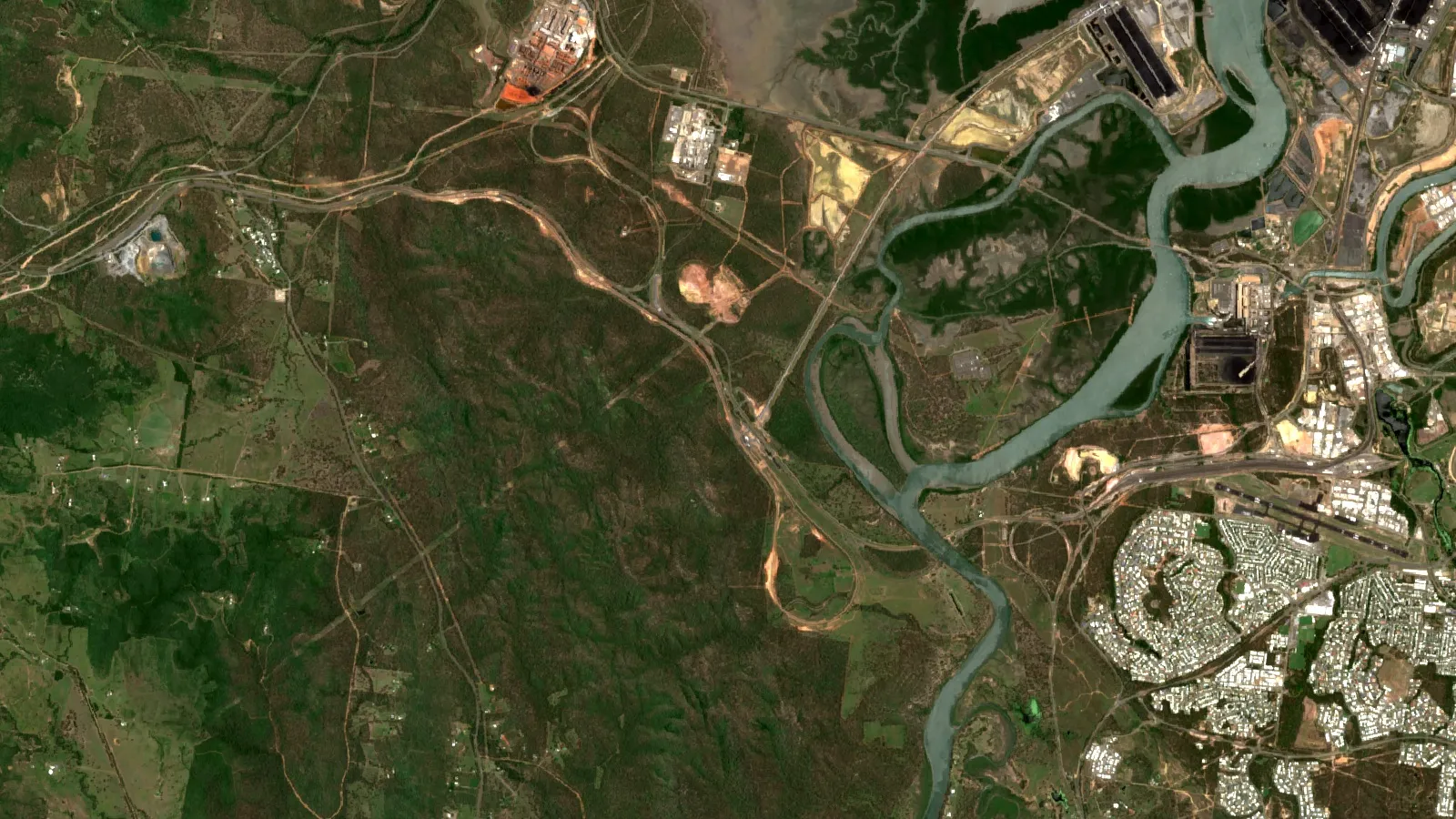
A real example: Queensland Alumina Limited in Gladstone, Australia, was producing 3.95 million tonnes of alumina and 3.5 to 3.8 million tonnes of residue a year when the IAI wrote its 2022 guidance. Because it neutralises the residue and stacks it, the stored dry density rose from 0.7 to 1.3 tonnes per cubic metre after 2007 (IAI, 2022). Density is what decides how much land a storage facility needs. The calculator below turns your own refinery output, residue ratio and density into residue tonnes and storage volume.
Calculator
How much red mud and ore does your alumina output mean?
Enter your own refinery numbers. Results update as you type.
- Storage volume needed per year (m3): 946,154
- Dry bauxite needed per year (tonnes): 2,130,000
- Alumina sales value per year (US$): $365,000,000
Example values only, not benchmarks. The residue ratio default is the global average of 1.23 (IAI, 2022); the range is 0.55 to 2.21. The density default of 1.3 tonnes per cubic metre is the stored dry density reported for Queensland Alumina after 2007 (IAI, 2022). The bauxite factor default of 2.13 is the US figure (USGS, 2022). The alumina price is an input: use today’s price.
7 ways to manage alumina tailings, compared
How we chose: these are the options described in the International Aluminium Institute guidance and in operator reports, listed here in the order the guidance and reports treat them, not ranked by cost or effect. No option removes the need for a safe storage facility, since reuse of bauxite residue was low, about 2% of output, in a 2019 journal review (Cusack et al., Journal of Cleaner Production). The Institute adds that reuse is extensively studied, but remains a minor part of all residue produced.
| Option | Best for | What the evidence shows | Limit |
|---|---|---|---|
| 1. Press filtering and dry stacking | New or expanded storage where land is short | At Hydro Alunorte in Brazil, press filters give a residue of about 78% solids, 22% moisture against 36% with drum filters; the company says four to five times more residue fits in a given area | Needs filter plant and energy; figures are company-reported |
| 2. Neutralising the caustic | Coastal refineries and sites planning closure | Seawater can lower the pH to between 8 and 8.5 (IAI); Queensland Alumina has used it since the early 1970s | Needs access to seawater or acid; results vary with the residue |
| 3. Carbon dioxide from air (carbonation) | Sites with space and low cost priority | Residue absorbs carbon dioxide and its pH falls; Aughinish Alumina in Ireland ploughs residue repeatedly to speed this up (IAI) | Slow; needs land and care |
| 4. Cement and construction reuse | Refineries near cement plants | The IAI guidance has a chapter on residue in Portland cement | IAI: reuse remains a minor part of all residue produced |
| 5. Recovering metals | Residue with high iron, titanium or scandium | IAI says studies continue on rare earths and precious metals; the 2019 review names vanadium, gallium and scandium as potential targets | Economics and volume limit it, says IAI |
| 6. Rehabilitation and soil use | Closed storage areas | IAI case studies cover in-situ remediation at Alcoa in Australia and a Rio Tinto and University of Queensland soil technology | Needs long monitoring; each site is different |
| 7. Monitoring the site | Any operating or closed facility | Regular surveys of dam walls, ponds and vegetation, using ground and satellite data, support inspections | Shows change on the surface; does not replace engineering checks |
Press filtering and dry stacking
Wet storage keeps red mud as a slurry behind a dam. Dry stacking removes most of the water first. Hydro reports that its Alunorte press filters give a residue of about 78% solid content by pressing it through 74 plates with filter fabric. Per tonne of alumina, the residue occupies one-fourth of the area in the new deposit than in the old one. Hydro also states that press filters cut moisture from 36% to 22% and allow stacking at about 20 degrees. These are the company’s own figures, but the Institute features the plant in its guidance.
Neutralising, carbonation and rehabilitation
Neutralising the caustic makes a storage area safer while it runs and easier to close. Choices include seawater, acids and carbon dioxide gas. Natural carbonation by air lowers pH over time. How well each measure works depends on local conditions, so test your own residue first.
Reuse and metal recovery
Residue contains iron oxides, alumina, silica, titanium and calcium minerals, and in some cases small amounts of scandium and rare earths. Researchers study cement, ceramics and metal recovery, but the quantities used remain small. If you are considering a reuse project, ask for a mass balance: tonnes of residue taken per year against tonnes produced, and a buyer under contract. A pilot that takes a few thousand tonnes does not change a storage plan for a refinery making a million.
Ajka red sludge spill: what it shows
On 4 October 2010 the dam of a red sludge reservoir at Ajka in Hungary collapsed. Nearly one million cubic metres of red sludge and caustic water flooded 40 square kilometres, killed 10 people and injured more than 100 (EGU General Assembly abstract, 2011). The authors note that red sludge was not classed as dangerous under Hungarian and EU law at the time, so its storage did not get special supervision, and they point to a gap in regulation. The lesson for owners is practical: whatever the legal class of the material, treat the alkaline slurry and its dam as a high-consequence structure, with freeboard checks, inspection records and insurance.
For a wider view of surface mining effects, a short clay-animation video explains seven environmental impacts in plain words.
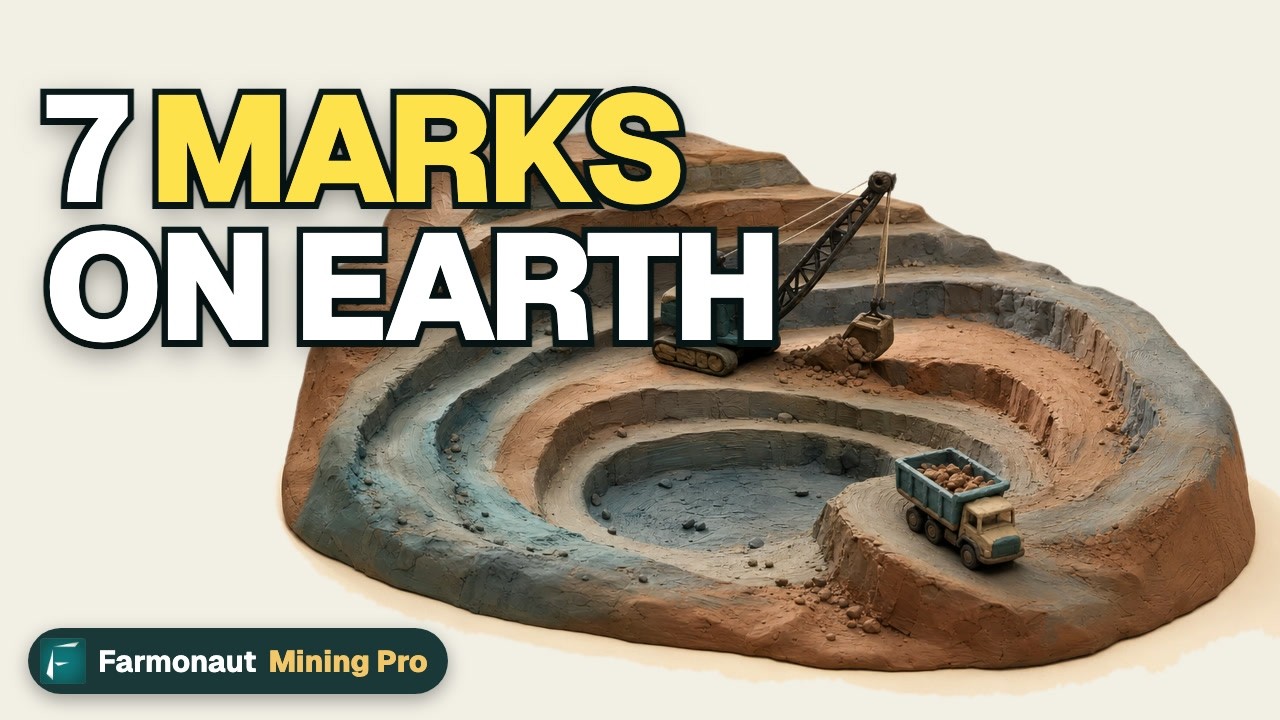
▶ Explains seven environmental impacts of mining in plain words, using clay models. · 2:31
How to check a tailings site and a bauxite licence from space
Satellite images can answer a few useful questions before a site visit: how large a storage area or pond is, whether its edge has moved between seasons, whether vegetation is establishing on a rehabilitated surface, and how bauxite-bearing ground sits within a licence area. They do not show dam stability, water chemistry or the grade of ore. Those need ground surveys, drilling and laboratory work.
Farmonaut’s mineral service screens a licence polygon (KML, KMZ or a boundary) from satellite data. For bauxite, iron and other bulk deposits, our guide to iron ore, bauxite, phosphate and potash exploration explains how such deposits are found and tested.
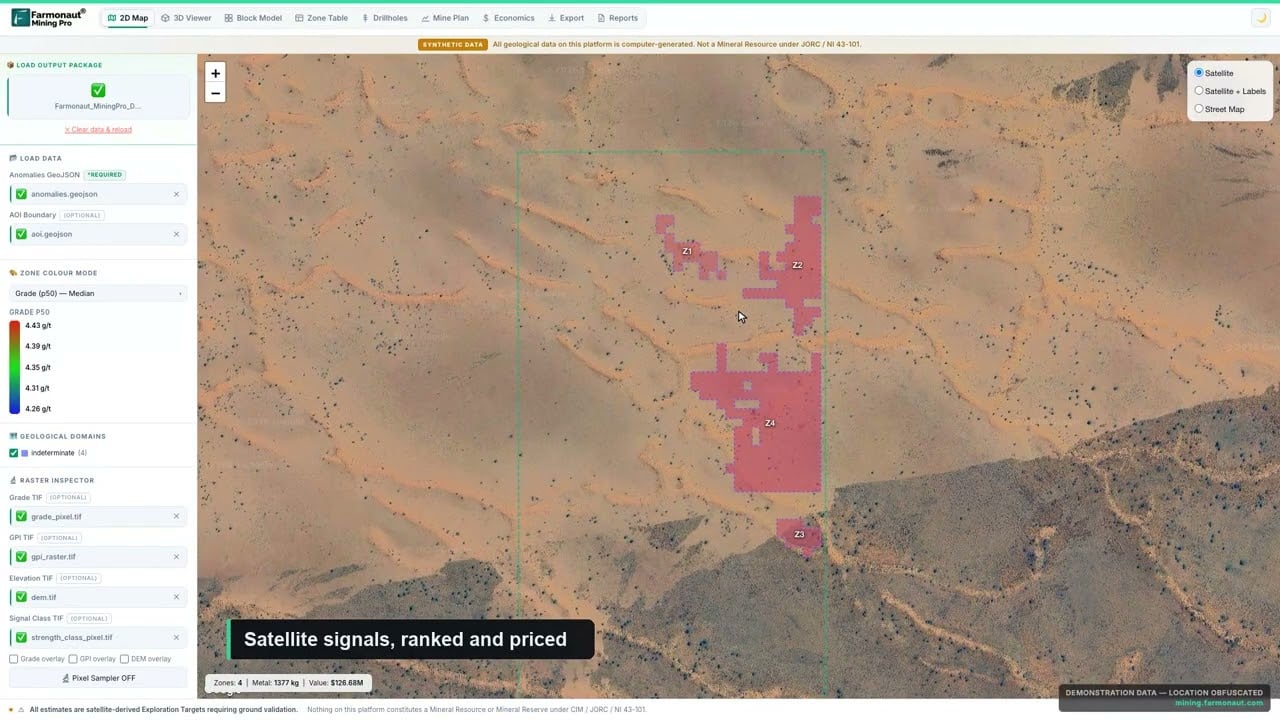
▶ A short look at Farmonaut Mining Pro, the satellite platform that turns a licence boundary into a geological and economic picture. · 4:56
Frequently asked questions
What is alumina powder used for?
Most of it is melted and split into aluminium metal at smelters. In the United States, USGS puts that share at about 70% of alumina produced (2026). The rest goes into abrasives, ceramics, chemicals and refractories, and a small amount of purified material goes into sapphire and battery parts.
Is alumina powder the same as aluminium oxide?
Yes. Alumina is the trade name for aluminium oxide, Al₂O₃. Grades differ by purity, soda content, crystal form and particle size, so a data sheet matters more than the name.
How is alumina powder made?
Bauxite is crushed, digested in hot caustic soda, separated from the red mud, cooled so aluminium hydroxide precipitates, and then calcined (heated) to turn it into dry alumina powder. About 2 tonnes of alumina are made from 4 to 6 tonnes of bauxite, according to the International Aluminium Institute.
How much does alumina powder cost per tonne?
The Fastmarkets fob Australia index was US$365.94 per tonne on 2 October 2026 for smelter-grade material. USGS puts the average US import value at US$590 per tonne for 2025 (estimate). High-purity and tabular grades are priced by supplier quote, not by this index.
What are alumina tailings?
They are the solid by-product of refining bauxite, also called red mud or bauxite residue. They are alkaline and rich in iron oxides, and they must be stored safely until the site is closed and rehabilitated.
How much red mud does one tonne of alumina make?
The global average is 1.23 tonnes of dry residue, with a range of 0.55 to 2.21 across refineries (International Aluminium Institute, 2022). Higher iron and silica in the bauxite generally mean more residue.
Can red mud be reused?
Yes, in small amounts so far. Cement, ceramics, soil work and metal recovery have all been studied. A 2019 review put reuse near 2% of output, and the Institute still describes it as a minor part of all residue produced.
Why is dry stacking used for red mud?
Press filtering removes most of the water, so the residue can be stacked on slopes and takes up less land. The Hydro Alunorte plant reports about 78% solids and a fourth of the area per tonne of alumina compared with its old deposit.
Which countries make the most alumina?
China leads with about 93 million tonnes in 2025, followed by Australia at 17 million and Brazil at 11 million, in a world total of 150 million tonnes (USGS estimates, 2026).
Is red mud dangerous?
Red mud is strongly alkaline and can harm land and water if it escapes. The Ajka spill in Hungary in 2010 killed 10 people. Properly stored and neutralised residue is lower risk, but classification varies by country, so follow the local regulator.
This page is for information only. It is not investment advice. Prices are dated examples; check the live index before you trade. Rules for storing and disposing of residue differ by country, so confirm them with your regulator.
Farmonaut mining
Get a quote to map your licence area from space
Send a KML, KMZ or polygon and Farmonaut screens the area from satellite images before ground crews go in.
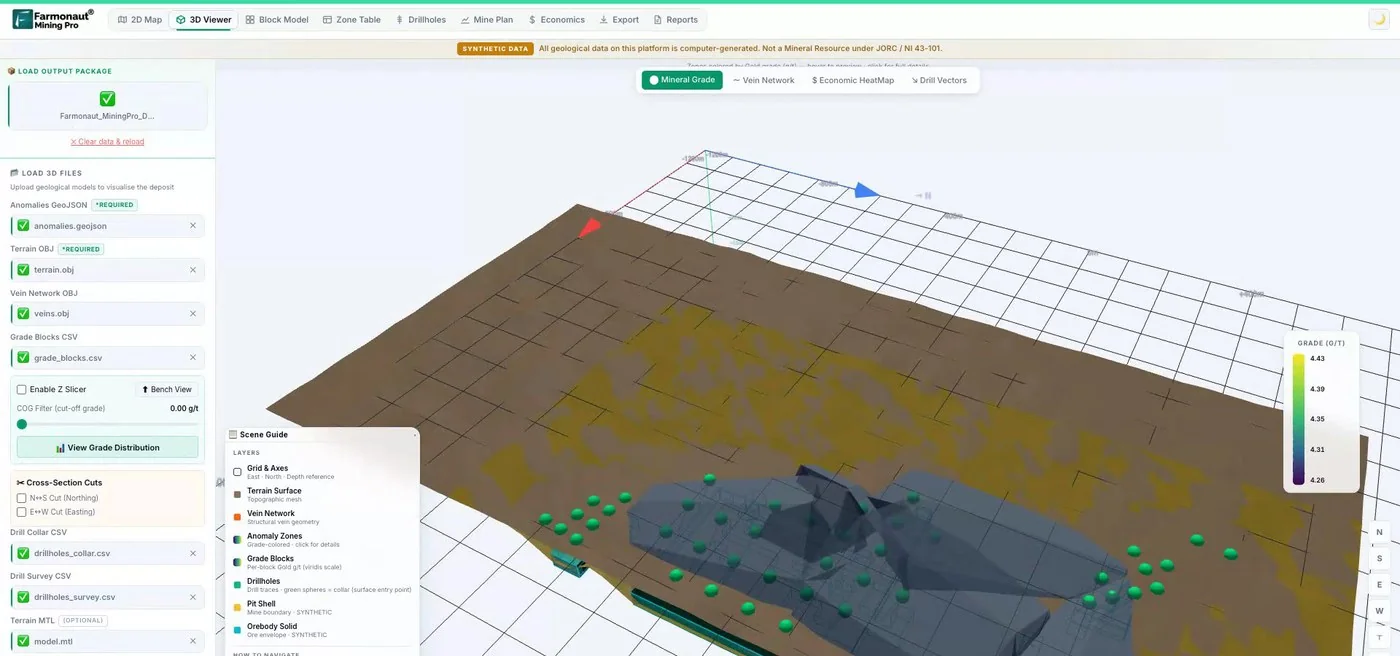
Mining Pro sample view, synthetic data
Keep reading
Sources
- USGS, Mineral Commodity Summaries 2026: Bauxite and Alumina (February 2026): pubs.usgs.gov
- USGS, 2022 Minerals Yearbook: Bauxite and Alumina: pubs.usgs.gov
- International Aluminium Institute, Sustainable Bauxite Residue Management Guidance (2022): international-aluminium.org
- Hydro, Hydro’s more-sustainable bauxite process highlighted by IAI (2022): hydro.com
- Hydro, Embargos following the rainfall (Alunorte timeline): hydro.com
- Lipovics, Czako and Kelemen, Lessons learnt from the red sludge accident of 4 October 2010 in Ajka, EGU General Assembly (2011): meetingorganizer.copernicus.org
- Cusack et al., Bauxite residue over twelve years, Journal of Cleaner Production 208 (2019): universityofgalway.ie
- Fastmarkets, Correction to fob Australia alumina index (5 October 2026): fastmarkets.com
- Alpha HPA, What is high purity alumina used for (2023): alphahpa.com.au
- AusIMM, Monograph 20: Industrial minerals and bauxite assessment: ausimm.com
- AluChem, Tabular alumina: aluchem.com
Discussion
Questions, corrections or field experience? Share them below. First-time comments are reviewed before they appear, and your email is never published.
No comments yet. Be the first to add a question or your experience.

 GemSprout Metals Limited
 Qader Group
 Ileys General Trading
 SG Gold Mining LLC
 VRV Global Pte Ltd
 Omsri International FZE
 G.I.T.T.
 Jaunita Erss Ltd
 Almosi SARL
 SRK Consulting
 Berks Gold Limited
 Mwerezi Minerals Company Limited
 Mining SARL
 SenGold Invest SAS
 Sean Mining Limited
 NTS Group (Pty) Ltd
 Mine4Africa
 Lithspo Minerals Limited










