

Mining technology · Buyer guide
Digital Transformation in Mining: 10 Providers Compared
Komatsu, Caterpillar, Sandvik, Hexagon and six others compared by the job they do, with spending forecasts from ABI Research and a payback calculator.
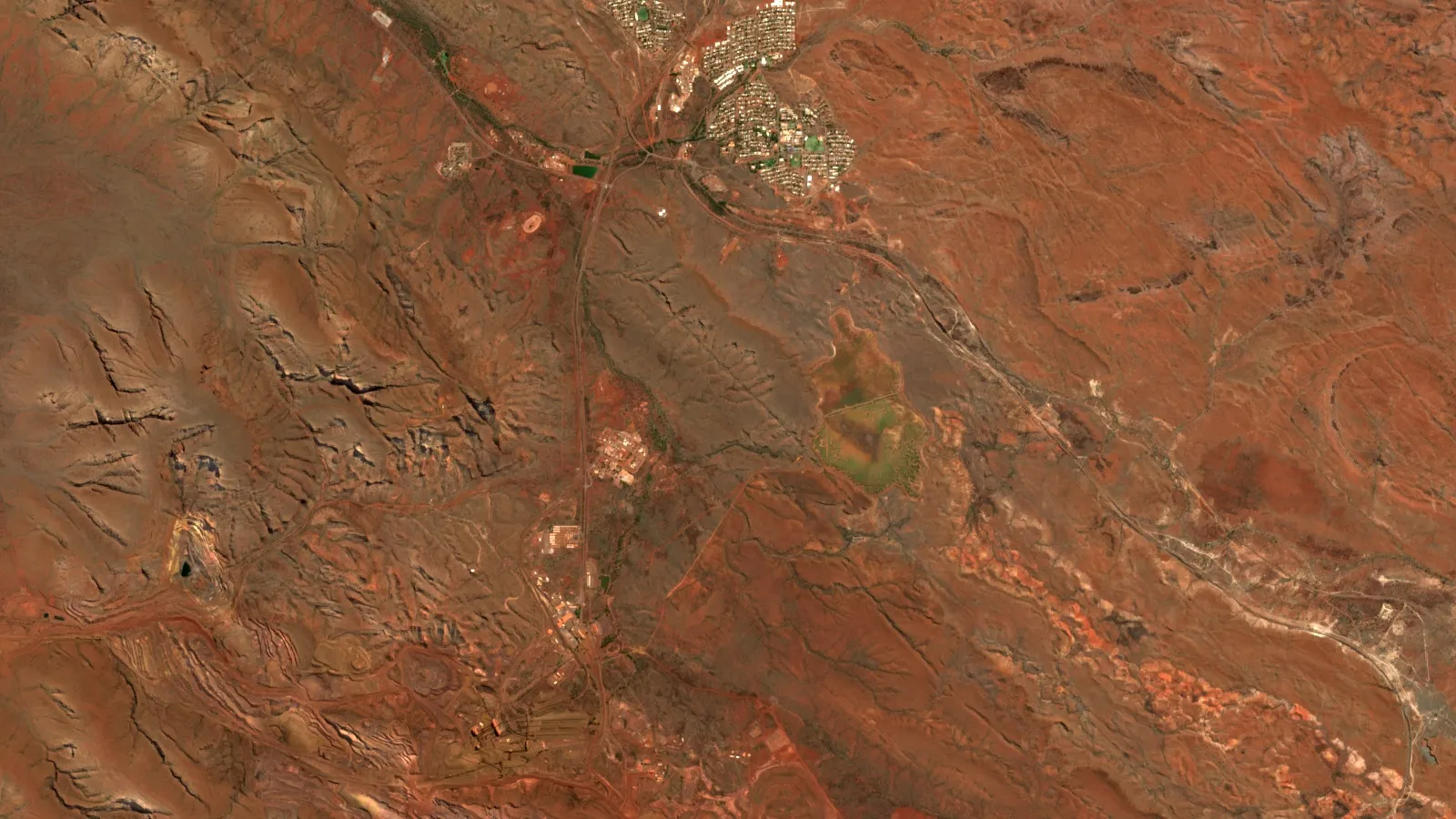
Key takeaways
- ABI Research forecasts mining’s digital spend rising from about US$5 billion in 2025 to US$9.7 billion in 2030.
- Komatsu reported 1,000 ultra-class autonomous trucks and over 11.5 billion tonnes moved (April 2026).
- A 2026 trade report puts Caterpillar’s autonomous total above 13 billion tonnes.
- Caterpillar now owns RPMGlobal, Sandvik owns Deswik and Bentley owns Seequent, so check data-export terms.
- Start with your costliest problem and a measured baseline, not with the biggest vendor.
In this article
- How mining companies use digital transformation to improve efficiency and safety
- Where mining's digital spending is going
- Digital mining solutions: the six main types
- 10 digital transformation providers in mining compared
- Top providers of autonomous mining solutions
- How to choose a provider: seven steps
- What can go wrong
- Where satellite data fits
- Frequently asked questions
Digital transformation in mining means connecting machines, sensors and software so that a mine is planned, run and maintained from shared data. ABI Research forecasts that mining firms will raise this spending from US$5 billion in 2025 to US$9.7 billion in 2030. This guide compares 10 providers by the job each one does, shows where that money is going, and gives you a calculator to test the payback on your own numbers.
If you own or run a mine, the useful question is not which vendor is biggest. It is which problem costs you the most today, and who solves that problem on the equipment you already own. This technology push has wider causes, traced in what is driving mining industry trends.
How mining companies use digital transformation to improve efficiency and safety
The clearest results so far come from automation at large operations. Each example below is reported by the company involved, so treat it as a claim from the operator or maker, not as an independent audit.
Driverless heavy-haul rail. Rio Tinto says its AutoHaul network in the Pilbara, Western Australia, became fully operational in June 2019. It describes this as the world’s first fully autonomous, long-distance, heavy-haul rail network. Its trains are 2.4 km long. The first autonomous delivery carried about 28,000 tonnes of iron ore over more than 280 km, and was monitored from Perth, more than 1,500 km away.
Autonomous haul trucks. Komatsu’s FrontRunner system entered commercial use in 2008. In April 2026 Komatsu said it had commissioned its 1,000th ultra-class autonomous truck and that customers had moved more than 11.5 billion tonnes with the system. Caterpillar reported 8.6 billion tonnes hauled by September 2024 with no reported injuries, and a 2026 trade report puts its figure at more than 13 billion tonnes.
A dated investment case. When Newmont approved autonomous trucks at Boddington, Australia, in 2020, it budgeted US$150 million and forecast a return above 35%, plus a two-year extension to mine life. Those were forecasts made at approval, not measured results, but they show the size of the decision.
Smaller sites. Autonomy is no longer limited to giant pits. Luck Stone has run autonomous trucks at its Bull Run quarry in Virginia since November 2024 and has hauled more than 3.5 million tons there, according to the same report. On the equipment side of these changes, our look at driverless trucks and drones in mining covers what is already running.
Safety gains come mainly from taking people out of the riskiest places: the cab of a haul truck, the face of an underground heading, the edge of a pit wall. Efficiency gains come from fewer stops, steadier truck cycles and repairs made before a failure. In the US, the Mine Safety and Health Administration publishes fatality reports searchable by accident type, including powered haulage and machinery, which helps you see where your own risk sits before you buy. Neither gain arrives on its own. Both depend on reliable data and a site network that stays up.
Where mining’s digital spending is going
ABI Research splits the forecast into six groups. Software and automation are the largest today, at about US$1.8 billion and US$1.6 billion in 2025. Devices and hardware grow fastest, at a forecast 23.1% a year, as more sensors and machines get connected. Cybersecurity is the slowest growing line at 5.5% a year, even though every connected truck adds another possible way in.
Chart
Spend by technology, 2025 and 2030
US$ millions a year, forecast
Chart
Mining digital transformation spend, forecast
US$ millions a year, all mining firms
For a buyer, this has two meanings. First, expect vendors to sell software on a recurring fee, so judge a deal over several years and not on the first invoice. Second, budget separately for network and security work, because a low line in an industry forecast does not make it optional at your site.
These are one research firm’s forecasts from its own market model. Use them to see direction and proportions, not as a measure of what any single mine should spend.
Digital mining solutions: the six main types
1. Automation and autonomous equipment
Autonomous haul trucks, drill rigs and loaders run with no one in the cab, or are controlled from a remote room. This suits long, repetitive routes and hazardous work. It also has the highest entry cost, and needs site rules, a strong network and retrained staff.
2. Fleet management
Fleet management systems assign trucks to shovels, record each cycle and show controllers what is happening in real time. This is often a sensible first purchase to consider, because lost truck time is easy to see and to price.
3. Sensors and the Internet of Things
Sensors on machines report vibration, pressure and temperature. Environmental sensors report dust, air and water quality. The Internet of Things (IoT) simply means these devices send their readings over a network without anyone collecting them by hand.
4. AI and predictive maintenance
Machine learning looks for patterns in equipment data that come before a failure, so that a part can be changed during planned downtime. It only works when there is enough clean history, which is why many projects start with data clean-up.
5. Planning software and digital twins
Geological modelling and mine planning software turn drill data into 3D models and schedules. A digital twin is a virtual copy of an operation, fed with live data, used to test a change before making it on site. Drill and blast is one narrow area with its own tools, compared in our guide to drill and blast monitoring software.
6. Satellite and remote monitoring
Satellite images show land disturbance, vegetation change and surface water over a whole lease, and they need no equipment on site. This makes them a low-effort first step for remote or spread-out ground, and for exploration screening before any drilling. They do not replace on-site sensors, ground surveys or legal compliance reporting. For emissions work, ICMM has a sector baseline of scope 1 and 2 greenhouse gases built from about 1,700 facilities, which gives context for your own numbers.
▶ Six kinds of AI geology tools and what each one does · 3:18
10 digital transformation providers in mining compared
How we chose: each company below sells a named product for mining or for heavy industry that mines use, and its current product page or a dated company statement confirms what it offers. They are grouped by job and not ranked, because vendors do not publish audited results that can be compared like for like. Facts are from company pages as of November 2026.
| Provider | Main job | Best for |
|---|---|---|
| Komatsu (with Modular) | Autonomous haulage, fleet dispatch | Large open pits buying ultra-class trucks |
| Caterpillar (with RPMGlobal) | Autonomous haulage, mine planning software | Cat fleets; quarries as well as big pits |
| Hitachi Construction Machinery (Wenco) | Fleet management | Sites that want an open fleet system |
| Sandvik (AutoMine, Deswik) | Underground automation, mine planning | Underground mines |
| Hexagon | Fleet management, collision avoidance, planning | One platform across surface and underground |
| Dassault Systèmes (GEOVIA) | Geology models, mine planning, virtual twins | Technical teams planning long-life mines |
| Seequent (Bentley Systems) | 3D geological modelling | Exploration and resource geologists |
| Maptek | Mine planning, laser scanning, drill and blast | Survey and planning teams |
| IBM (Maximo) | Asset management, predictive maintenance | Maintenance teams across mixed assets |
| Siemens (XHQ) | Plant data in one view | Processing plants with many control systems |
Komatsu and Modular: autonomous haulage and dispatch
Best for: large open pits buying ultra-class trucks. Komatsu says it is the first maker to commission 1,000 autonomous ultra-class trucks; the 1,000th, a 290-tonne-payload 930E, went to Nevada Gold Mines. Its Modular business sells the DISPATCH system and says the platform works with mixed fleets through open APIs. An API is a standard way for two software systems to exchange data. Watch for: confirm in writing which non-Komatsu machines and third-party tools are supported at your site.
Caterpillar and RPMGlobal: autonomy plus planning software
Best for: operations already on Cat fleets. MineStar Command for hauling is Caterpillar’s autonomy system. Caterpillar has also completed its purchase of RPMGlobal, the Australian mine planning and scheduling software company, which now sits in its Resource Industries segment. RPMGlobal was listed on the ASX before the deal. Watch for: if you run RPMGlobal software on non-Cat fleets, ask how support and data access will work under the new owner.
Hitachi Construction Machinery and Wenco: fleet management
Best for: sites that want a fleet system with an open approach to other vendors’ tools. Wenco, based in Vancouver, is a wholly owned subsidiary of Hitachi Construction Machinery and describes open interoperability as a core aim. Watch for: test the connection to your existing maintenance system before signing.
Sandvik: underground automation and Deswik planning
Best for: underground mines. The AutoMine product group covers autonomous and remote-controlled mobile equipment, and lets a customer begin with a tele-remote setup and scale up over time. Sandvik also bought the mine planning firm Deswik in 2022. Watch for: underground networks are costly to install, so price the communications work alongside the machines.
Hexagon: one fleet platform for surface and underground
Best for: mines that want fleet management, equipment health and safety on one platform. Hexagon pairs fleet management with a collision avoidance system for surface and underground sites, and also sells MinePlan engineering tools. Watch for: ask which modules are bundled and which are priced separately.
Dassault Systèmes: GEOVIA planning and virtual twins
Best for: technical teams on long-life projects. Its GEOVIA mining software is being moved onto the 3DEXPERIENCE platform, a shift the company announced at PDAC, the Toronto mining convention, in 2024. Watch for: if your team relies on older desktop GEOVIA tools, ask for the migration timetable and training cost.
Seequent: 3D geological modelling
Best for: exploration and resource geologists. Seequent makes the Leapfrog modelling software and was acquired by Bentley Systems in 2021. It serves geology work, not fleet or plant operations, so it complements the systems above and does not replace them.
Maptek: planning, scanning, drill and blast
Best for: survey and planning teams. Maptek’s range includes Vulcan for mine planning and geological modelling, BlastLogic for drill and blast management, and laser scanners. Watch for: check file exchange with your other planning and fleet tools.
IBM: Maximo for asset management
Best for: maintenance teams with many asset types. IBM’s Maximo Application Suite is a general asset lifecycle product used across industries and not one built only for mining. Watch for: ask for references from a mine of your size, as the examples IBM promotes may come from other sectors.
Siemens: XHQ operations data
Best for: processing plants with many separate control systems. XHQ brings data from different sources into one real-time view, and Siemens says it has more than 25 years of use behind it. Like Maximo, it is general industrial software. Watch for: value depends on how much integration work your plant needs, so get that quoted up front.
▶ What an AI mining app does and who makes one · 3:52
Top providers of autonomous mining solutions
For surface haulage, the two largest track records we found in reported tonnes are Komatsu and Caterpillar, by the tonnes each company reports. The figures below come from the companies and from a trade report, were counted on different dates, and are not independently audited. Tonnes moved also do not tell you about availability, unit cost or productivity at any one mine.
Chart
Tonnes moved by autonomous trucks
Billion tonnes, cumulative, company-reported
For underground loading and hauling, look at Sandvik’s AutoMine range. For integration with existing equipment, ask each vendor one blunt question: which other makers’ machines are running on your system today, at which named sites? Modular and Wenco both promote open or interoperable systems, but a named reference tells you more than a brochure.
The right measures to compare are the ones the Skillings report lists: how often autonomous trucks stay available after network and software downtime, how consistent truck cycles become, tonnes per operating hour and how often people must step in.
How to choose a provider: seven steps
- Name the costliest problem. Put a dollar figure on lost truck hours, unplanned failures, rehandling or reporting time.
- Audit your data and network. List the systems you own, what they export, and where the site has no coverage.
- Ask for named references. Choose sites with a similar size and commodity, and ask what baseline each result was measured against.
- Check data ownership. Get it in writing that you can export your data in a usable format if you change vendor.
- Run a limited pilot. Use one fleet, one plant area or one pit, with a success measure agreed before it begins.
- Price the whole project. Include integration, training, network, security and annual fees, not only the licence.
- Plan the people side. Decide who owns the system on site, who is retrained, and how operators will be involved.
Infographic
A low-risk route to a digital rollout
- 1Price the problemPut a dollar figure on the biggest loss.
- 2Record a baselineMeasure it before any vendor arrives.
- 3Pilot one areaAgree the success measure first.
- 4Scale or stopRoll out only if the measure was met.
Payback also depends on the mine’s margins. Our guide to mining profitability gives wider context on what drives earnings.
Calculator
How long would a digital project take to pay back?
Enter your own downtime, fuel and vendor figures.
- Downtime value per year (US$): $200,000
- Fuel saving per year (US$): $20,000
- Net benefit per year after fee (US$): $120,000
Example values only, not a benchmark or a forecast. All figures are your inputs and no industry constants are used. Costs are in US$; use today’s prices.
What can go wrong
Cyber risk. More connected equipment means more ways in. ABI Research lists an August 2023 attack on Freeport-McMoRan among the recent cases that show this risk. Ask each vendor how its product is patched, who holds remote access, and how the site runs if the link goes down. The NIST Cybersecurity Framework from the US standards agency is a common checklist for those questions.
Chart
Forecast yearly growth by technology
Compound annual growth, 2025 to 2030, %
Vendor lock-in. Ownership is shifting: Caterpillar now owns RPMGlobal, Sandvik owns Deswik and Bentley owns Seequent. That can bring tighter product links, but it also means a software choice may tie you closer to one larger group. Review change-of-control and data-export terms in each contract.
Pilots that never scale. A trial with a vendor’s team on site can look far better than daily use with your own staff. Agree in advance what must be true for a full rollout, and who will pay for it.
Weak baselines. A claimed saving means little without a before figure from the same pit, fleet and season. Collect your own baseline before the vendor arrives.
Where satellite data fits
Satellite data works on ground with no network, no sensors and no site crew. Licence owners and investors use it to screen an area and focus later fieldwork. Farmonaut, a US-based company, offers satellite mineral screening from a licence boundary in KML, KMZ or polygon form, typically delivered within 5-20 business days. Results are exploration targets that sit ahead of a resource estimate. They do not replace drilling.
▶ Remote sensing for mining, explained without jargon · 2:01
Frequently asked questions
What is digital transformation in the mining industry?
It is the move from manual, paper-based and operator-dependent work to connected machines, sensor data and software that help plan and control a mine. Typical tools include fleet management, predictive maintenance, planning software and autonomous equipment.
How much do mining companies spend on digital transformation?
ABI Research estimates about US$5 billion across mining firms in 2025, rising to US$9.7 billion in 2030. That is a forecast from a market model, and spending at a single mine varies widely.
What are the top providers of autonomous solutions for the mining industry?
For surface haul trucks, Komatsu (FrontRunner) and Caterpillar (MineStar Command) report the largest tonnages we found. For underground equipment, Sandvik sells the AutoMine range.
Which autonomous mining solutions integrate best with existing equipment?
No independent ranking settles this. Modular says its platform works with mixed fleets through open APIs, and Wenco promotes open interoperability. Ask each one for named sites running your machine makes.
How does automation improve mine safety?
It takes people out of haul truck cabs and hazardous work areas. Caterpillar reports no injuries in autonomous operation across its reported tonnage, though this is a company figure. Mixed traffic and maintenance access still need strict site rules.
Who owns RPMGlobal now?
Caterpillar. It agreed the purchase in October 2025 and RPMGlobal has confirmed that the deal has closed. It now sits in Caterpillar’s Resource Industries segment.
What is a digital twin in mining?
It is a virtual copy of a mine, plant or fleet that is updated with real data. Teams use it to test a schedule or equipment change before making it on site.
Can a small mine benefit from digital tools?
Yes, if it starts with a single priced problem. Fleet tracking on the most expensive machines, condition monitoring or satellite monitoring usually cost less than autonomous fleets. Use the calculator on this page to test the payback before you commit.
What digital tools monitor mining operations in real time?
Fleet management systems track machines and cycles, sensors report on equipment condition, and plant data tools such as Siemens XHQ pull many readings into one view. Satellite images update less often, so they suit land and water change over time and not minute-by-minute control.
How long does payback take?
There is no reliable industry figure, as it depends on the mine and on what is being bought. Newmont forecast an internal rate of return above 35% for its Boddington trucks at approval in 2020, but that is one large project. Build the case from your own downtime, fuel and fee numbers.
More from Farmonaut: agro admin app, carbon footprinting, crop loan and insurance, farmonaut satellite weather api developer docs, fleet management, product traceability.
This page is for information only. It is not investment advice. Company figures come from their own statements.
Farmonaut mining
Get a quote for satellite screening of your licence
Send your licence boundary and we will quote for satellite mineral screening of the area.

Mining Pro sample view, synthetic data
Keep reading
Sources
- ABI Research, Digital transformation in the mining industry: abiresearch.com
- Komatsu, 1,000th autonomous ultra-class truck (April 2026): komatsu.com
- Caterpillar, MineStar Command for hauling (September 2024): cat.com
- Skillings, Caterpillar autonomous haulage on Cat 775 trucks (2026): skillings.net
- Rio Tinto, AutoHaul story: riotinto.com
- Canadian Mining Journal, Newmont autonomous fleet at Boddington (February 2020): canadianminingjournal.com
- RPMGlobal, Caterpillar completes acquisition: rpmglobal.com
- Modular, a Komatsu business: modularmining.com
- Wenco Mining Systems: wencomine.com
- Sandvik, AutoMine automation: rocktechnology.sandvik
- Sandvik, Deswik acquisition (2022): home.sandvik
- Hexagon, Load and Haul: hexagon.com
- Dassault Systèmes, GEOVIA on 3DEXPERIENCE (PDAC 2024): 3ds.com
- Seequent, About us: seequent.com
- Maptek, Vulcan: maptek.com
- IBM, Maximo Application Suite: ibm.com
- Siemens, XHQ Operations Intelligence: siemens.com
- NIST, Cybersecurity Framework: nist.gov
- MSHA, Fatality Reports: msha.gov
- ICMM, GHG emissions dataset: icmm.com
Discussion
Questions, corrections or field experience? Share them below. First-time comments are reviewed before they appear, and your email is never published.
No comments yet. Be the first to add a question or your experience.

 Energy and Resources Ltd
 Mwerezi Minerals Company Limited
 Congo Mining Solutions
 Mining SARL
 SenGold Invest SAS
 Sania Corporation
 Sean Mining Limited
 NTS Group (Pty) Ltd
 Mine4Africa
 Lithspo Minerals Limited
 Tintina Mining Group
 Dalgety Minerals Pty Ltd
 Vortex Minerals Pty Ltd
 Faith At Work (Pty) Ltd
 Geotech Mining Solutions plc
 Vulcan International Limited
 Kidepo Associates
 GKY Mining
 Alkimy SARL

 Licence holder · Nigeria · Gold + lithium










