

New Mexico copper · Mine guide
New Mexico Copper Mines: Chino, Tyrone, Copper King
Two open-pit mines, Chino and Tyrone, make all of New Mexico’s copper: 182 million pounds in 2025. The Copper King near Red River is a historic mine from 1867, and Copper Flat is still awaiting a permit.
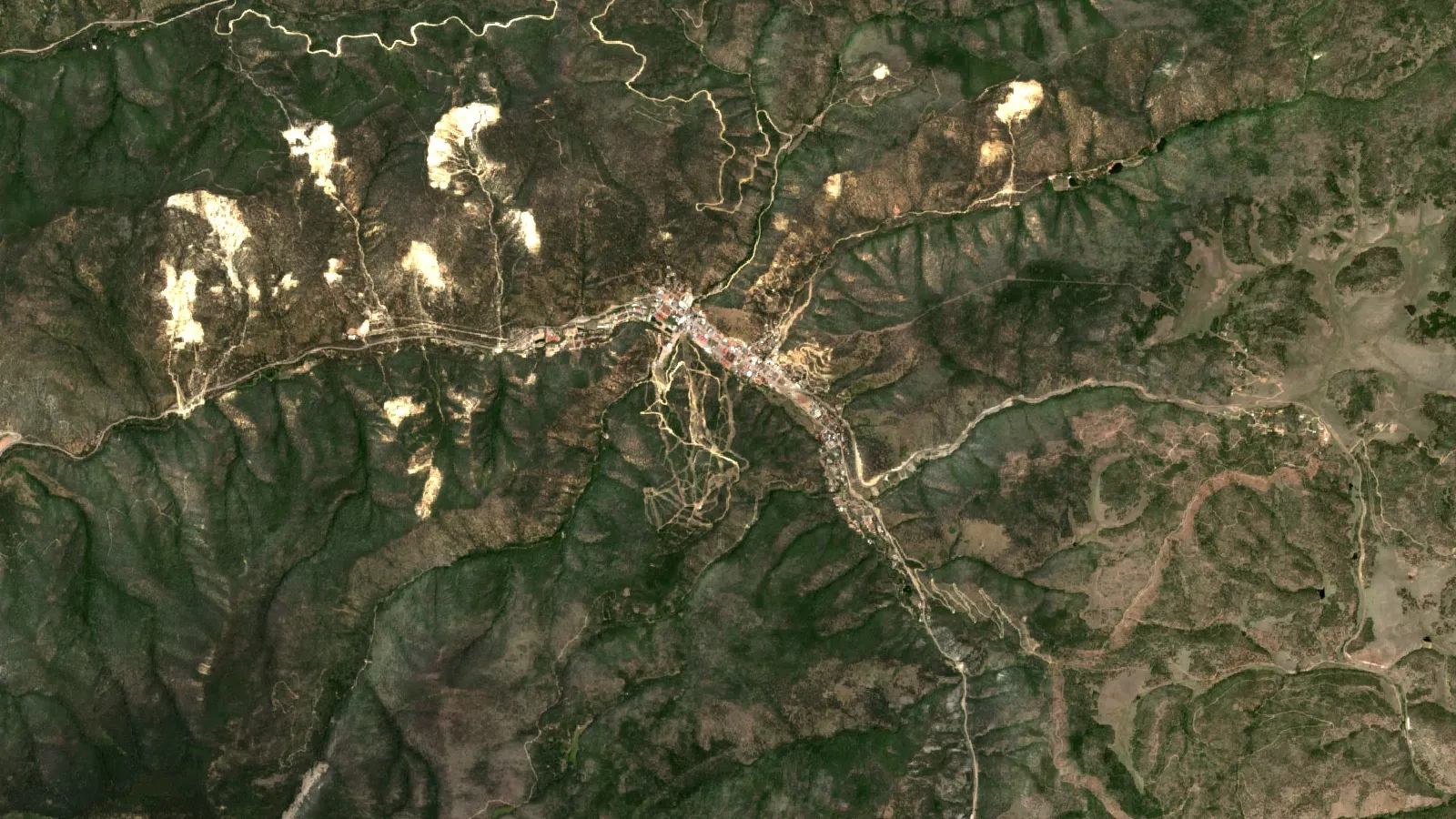
Key takeaways
- Chino made 150 million lb of copper and Tyrone 32 million lb in 2025 (Freeport-McMoRan annual report, 2025).
- New Mexico Tech reports copper production elsewhere in the state has not occurred since the 1990s (Open-File Report 649, June 2026).
- The Copper King near Red River was first worked in 1867; the USGS record lists it as a past producer (Red River Historical Society; USGS MRDS).
- Copper Flat is proposed, not operating: its state permit was still under review on 16 October 2026 (NM Mining and Minerals Division).
- Arizona made about 70% of U.S. copper in 2025; U.S. mine output was an estimated 1.0 million tonnes (USGS, 2026).
In this article
- New Mexico copper mines at a glance
- Chino and Tyrone: the two working copper mines
- Reading reserve grades: what the numbers mean
- Copper King near Red River: what the record shows
- Red River's mining history from 1867 to 1905
- Questa: the molybdenum mine in the Red River valley
- Copper Flat and other New Mexico copper projects
- Why New Mexico makes little copper compared with Arizona
- Permits, reclamation and the cost of closing a mine
- How to check the status of a New Mexico mine yourself
- Frequently asked questions
Two copper mines produce in New Mexico: Chino and Tyrone, both open pits in Grant County owned by Freeport-McMoRan. Together they made 182 million pounds of copper in 2025 (Freeport-McMoRan annual report, 2025), and New Mexico Tech reports that no copper has come from elsewhere in the state since the 1990s (New Mexico Bureau of Geology Open-File Report 649, June 2026). The Copper King near Red River is a different kind of place: a small mine in the Sangre de Cristo Mountains whose workings date to 1867 and whose record shows a past producer, not an operating mine.
This page lists every New Mexico copper site worth knowing, says what each is doing today, and gives the numbers for the two working mines. It also corrects a common mix-up: the molybdenum mine at Questa, in the same Red River valley, is not a copper mine and has been closed since 2014.
New Mexico copper mines at a glance
The table covers the operating mines, the one large proposed project, and the two Taos County sites people often confuse. Status is as of 16 October 2026, from the sources in the last column.
| Site | County | Main metal | Status | Source |
|---|---|---|---|---|
| Chino (also called Santa Rita) | Grant | Copper, with some molybdenum, gold and silver | Operating open pit since 1910; 150 million lb copper in 2025 | Freeport-McMoRan annual report, 2025 |
| Tyrone | Grant | Copper | Operating open pit since 1967; 32 million lb copper in 2025 | Freeport-McMoRan annual report, 2025 |
| Copper Flat | Sierra | Copper, molybdenum, gold, silver | Proposed; state permit under review, not yet approved | NM Mining and Minerals Division, Oct 2026 |
| Questa | Taos | Molybdenum | Closed 2014; cleanup under way | EPA notice, June 2026 |
| Copper King | Taos | Copper, some molybdenum | Historic past producer near Red River | USGS MRDS record via Western Mining History |
Cobre (the Continental pit), a name you may see in older lists, is part of the Santa Rita district with Chino. Freeport reports its reserves as “Chino, including Cobre”, so it is not a separate operation today.
Chino and Tyrone: the two working copper mines
Chino is an open-pit complex about 15 miles east of Silver City. It has run since 1910 and mines a porphyry copper deposit (a large body of low-grade copper in a cooled magma intrusion) with copper skarn deposits beside it (copper formed where hot fluids met limestone). The ore includes oxide copper that is leached with acid, secondary sulfide, and primary sulfide that is milled. A concentrator can process 36,000 metric tons of ore a day, and a solvent-extraction and electrowinning (SX/EW) plant makes up to 150 million pounds of copper cathode a year from leach solution (Freeport-McMoRan annual report, 2025). SX/EW means copper is dissolved from crushed rock with acid, pulled out of the liquid with a solvent, and plated onto sheets of pure copper.
Chart
Chino and Tyrone copper production, 2023 to 2025
Million pounds of recoverable copper per year, 100% basis
Tyrone has operated since 1967, about 10 miles south of Silver City. Its ore is mostly secondary sulfide, chalcocite, with some oxide, and all of it is processed by leaching at an SX/EW plant with a maximum capacity of about 100 million pounds a year. Both mines hold land partly as fee land and partly as unpatented mining claims on public land, and the Bureau of Land Management lists them among New Mexico’s notable operations that involve public land (BLM New Mexico locatable minerals).
Production, to
Chino rose to 150 million pounds in 2025 from 133 million in 2024. Tyrone has fallen each year, to 32 million pounds in 2025 from 51 million in 2023. Combined, the two mines made 192 million pounds in 2023, 176 million in 2024 and 182 million in 2025. The 2025 total is about 14% of the 1,304 million pounds Freeport reports for all its U.S. mines, and about 83,000 metric tons in the units USGS uses (Farmonaut calculation from the company figures).
Size, equipment and land
The company reports a mining fleet of twenty-two 240-metric-ton haul trucks at Chino and five at Tyrone. Chino’s operation covers about 132,700 acres and Tyrone’s about 78,500 acres, including fee land and unpatented claims. Both mines are in desert country with about 16 inches of rain a year, and both buy power from the Luna Energy facility and the open market.
Reserves in plain terms
Freeport’s reserves at the end of 2025 were set with a long-term price assumption of US$3.25 a pound for copper. A reserve is ore that a company expects to mine at a profit under stated prices and costs, so it can change when the price assumption changes. On that basis Chino holds about 276 million metric tons of mill ore at 0.51% copper and 46 million tons of leach ore at 0.25% copper (100% basis). Tyrone holds 59 million tons of leach ore at 0.19% copper. Freeport estimates recoverable copper at about 2.6 billion pounds for Chino and 0.1 billion pounds for Tyrone, after recoveries of about 80% for Chino mill ore, 37% for Chino leach ore and 57% for Tyrone leach ore.
Reading reserve grades: what the numbers mean
Grade is the share of copper in the rock. A grade of 0.5% means five kilograms of copper in each tonne of ore. That sounds small, but large open pits make money from low grades because they move huge tonnages. The chart compares the average reserve grade at the New Mexico sites that publish one, and the calculator below turns a tonnage, grade and recovery into pounds of copper and a rough gross margin.
Chart
Average copper grade of reserves at New Mexico sites
Per cent copper. FCX = Freeport proven and probable reserves at US$3.25/lb copper, 31 Dec 2025; Copper Flat = 2020 estimate, different price and cut-off, not like-for-like
Two cautions apply. Grades from different companies use different cut-offs and price assumptions, and a leach operation recovers far less of the copper in the rock than a mill does. A low-grade leach pile can still pay if the cost per tonne is low.
Calculator
How much copper does a deposit hold, and what is it worth?
Enter your own tonnage, grade, recovery, price and cost.
- Gross value at your price (US$ million): $2,822
- Operating cost (US$ million): $1,500
- Margin before capital and tax (US$ million): $1,322
Example values only, not a forecast and not figures for any New Mexico mine. Price is an input: example, use today’s price (US$ per pound). Conversion fixed in the formula: 1 metric tonne = 2,204.62 lb. Margin excludes capital, tax and royalties.
Copper King near Red River: what the record shows
The Copper King is in Taos County at about 9,000 feet, close to the town of Red River. The USGS Mineral Resources Data System (MRDS) record, shown by Western Mining History, lists copper as the main commodity and molybdenum as secondary. It gives other names for the site: Anaconda Group, Paxton, Waterbury Adit and Red River Mine. It classes the site as a past producer worked from both the surface and underground, with patented claims and an ownership entry dated 1957 (Western Mining History, Copper King Mine). The same record cautions that locations have not been verified and that every mine should be treated as private property.
The Red River Historical Society says the Copper King was first worked in 1867 and was the first known mine developed in Taos County (Red River Historical Society, 1867 to 1905 mining days). The MRDS references add that the claims belong to the Anaconda group and that a smelter built at the mouth of Pioneer Canyon was given up after two trial runs.
The record gives no production figure, reserve or current operator. Nothing in it shows the Copper King as an operating mine today, and Freeport’s filings show that the state’s copper output comes from Chino and Tyrone.
The Butte, Montana mine of the same name is a different place; see our page on the Copper King mine in Montana if that is the one you want.
Red River’s mining history from 1867 to 1905
Serious prospecting in this part of New Mexico began after rich gold placers were found at Elizabethtown in 1866. The Copper King came first, in 1867. A Red River Mining Company smelter built around 1879-80 was not cost efficient, and it was another ten to twelve years before real effort resumed (Red River Historical Society).
The rush came in spring 1895, when Red River City grew from tents and log cabins into a camp of an estimated 1,500 to 3,000 people. Claims carried names such as Gilt Edge Placer, Silver Queen and Black Copper. The Black Copper officially produced US$200,000 of pay ore, but at heavy cost to its investors, who later abandoned it. Low-grade ore, the cost of shipping it to Pueblo, Colorado, and groundwater flooding the tunnels ended the boom quickly. By 1897 many miners had left for Cripple Creek and the Klondike, and by 1905 the population was about 150. A smaller revival before World War I centred on the Buffalo Mine and the Caribel and did not outlast the war.
What remains of the old mines is mostly traces in the canyons. If you want to see the gold side of the story, our guide to gold mining in New Mexico, its districts and the Mining Act covers the nearby districts.
Questa: the molybdenum mine in the Red River valley
The big mine of the Red River valley is Chevron’s Questa mine, which is about molybdenum, not copper. EPA describes it as a mine and mill that produced molybdenum disulfide, intermittently from 1920 until 2014, 3.5 miles east of Questa on State Road 38. Closeout work continues, with phased demolition at the mill, mine and tailing areas, and its discharges go to the Red River (EPA public notice, permit NM0022306, June 2026).
The state Mining and Minerals Division reports that Questa is a federal Superfund site. A Record of Decision was signed in December 2010, Chevron announced permanent closure in 2014, and a partial consent decree in August 2016 covered about 25% of the permitted area. Reclamation of the former tailing impoundment ran from 2019 through 2024, and much work remains (NM Mining and Minerals Division, 2024 annual report). If a source tells you a “Red River mine” is producing, check whether it means Questa, the historic Copper King or the old district claims.
▶ A claymation explainer of seven ways mining changes the land, with satellite maps. · 2:31
Copper Flat and other New Mexico copper projects
Copper Flat is the best-known new copper mine in New Mexico’s permitting process. It is a proposed open pit four miles east of Hillsboro in Sierra County, and its developer, New Mexico Copper Corporation, has sought a state permit since 2012 (KRWG, 7 October 2026). The company changed its plan to dry-stack tailings (waste rock paste stacked as a solid rather than held in a pond), and the state held a public hearing on the revised plan on 17 September 2026. The state’s page says the hearing record closes on 16 October 2026. The state’s chronology lists these steps as still to be completed: approval of the financial assurance proposal and instrument, a written determination from the New Mexico Environment Department, BLM approval of the mine plan of operations, and the director’s permit decision (NM Mining and Minerals Division, Copper Flat Mine permitting chronology).
New Mexico Tech summarises the deposit’s reserves, from a 2020 estimate, as 78.9 million short tons at 0.32% copper (proven) and 34.1 million short tons at 0.25% copper (probable). The deposit was briefly mined in 1982. Water is the central issue in the permitting; the company says dry stacking keeps use under 1,050 acre-feet of fresh water a year, and local residents at the hearing were mostly critical.
Other New Mexico copper ground is at the exploration stage. New Mexico Tech’s June 2026 report maps exploration projects in 2025 and 2026, mainly aimed at critical minerals in the same porphyry copper belt that holds Chino and Tyrone.
Why New Mexico makes little copper compared with Arizona
Arizona produced about 70% of U.S. copper in 2025, and copper was also mined in Alaska, Michigan, Missouri, Montana, Nevada, New Mexico and Utah (USGS Mineral Commodity Summaries 2026, copper). USGS estimates U.S. mine output at 1.0 million metric tons of recoverable copper in 2025, down 5% from 2024, from 26 mines, of which 17 gave more than 99% of production. New Mexico’s two mines are therefore a small but real share of a national total that has slipped since 2021.
Chart
U.S. mine copper production, 2021 to 2025
Thousand metric tons of recoverable copper; 2025 is an estimate
The U.S. also imports a large share of the copper it uses: USGS puts net import reliance at 57% of apparent consumption in 2025 (estimate). That gap is one reason new projects like Copper Flat draw attention, and also why they face long permitting.
▶ Explains why electric vehicles use more copper than petrol cars and how mined copper travels from a pit to the car. · 6:03
Permits, reclamation and the cost of closing a mine
New Mexico regulates hard-rock mines under the 1993 New Mexico Mining Act and the Water Quality Act. Freeport reports that Chino’s permit was renewed in 2020 and Tyrone’s in 2021, and that it had accrued about US$573 million for reclamation and closure of its New Mexico operations at the end of 2025 (Freeport-McMoRan annual report, 2025). Closure bills can be large, and the state’s reclamation staff have spent a lot of time on Questa in particular (NM Mining and Minerals Division, 2024 annual report).
The state also runs an Abandoned Mine Land Program for old workings. If you visit old mines near Red River, treat shafts and adits as unsafe, stay out of them, and ask the landowner or the Forest Service before you go onto any claim. Never use mercury if you pan for gold.
How to check the status of a New Mexico mine yourself
- Find the USGS MRDS entry (through Western Mining History or Mindat) and note its commodity, status and the date of the last owner entry. A “past producer” tag means it is not a current operation.
- Search the Mining and Minerals Division’s lists of pending and approved mine applications. A working hard-rock mine needs a permit under the Mining Act.
- Check land status with the Bureau of Land Management or the Forest Service. Patented claims are private land; unpatented claims sit on public land.
- Read the operator’s annual report. Freeport’s report states each mine’s production, reserves and price assumptions with a date.
- Look at recent satellite imagery. Fresh pit walls, haul roads and leach pads show an active site; vegetation on dumps shows an old one.
For step five, Farmonaut’s satellite mineral detection maps alteration and other surface signs on a licence area as exploration targets, ahead of any resource estimate. A quote is available through the mining quote form. For background on the rock type behind Chino and Tyrone, see our guides to porphyry copper deposits and copper deposits and where to explore.
▶ Explains how remote sensing measures ground from a distance and why several instruments agreeing matters. · 2:01
We cover a connected topic in Cameco McArthur River Mine: Output, Reserves, Status.
Frequently asked questions
What copper mines are operating in New Mexico?
Two: Chino and Tyrone, both open-pit mines in Grant County run by Freeport-McMoRan. They made 150 and 32 million pounds of copper in 2025 (Freeport-McMoRan annual report, 2025).
Is the Copper King mine at Red River still operating?
The public record shows a historic past producer worked since 1867, with no current operator or production figure. Do not treat it as an operating mine.
Where is the Copper King mine in New Mexico?
The USGS MRDS record places it in Taos County at about 9,000 feet near Red River, at roughly 36.70 degrees north, 105.41 degrees west. Locations in that database have not been verified.
Is there a copper mine in Red River, New Mexico?
No operating copper mine. The valley’s last big mine was the Questa molybdenum mine, which closed in 2014 and is in cleanup.
Which is the biggest copper mine in New Mexico?
Chino, by production: 150 million pounds in 2025 against 32 million at Tyrone (Freeport-McMoRan annual report, 2025).
Is Copper Flat open?
No. As of 16 October 2026 the state permit is still under review and several approvals are listed as not yet complete.
How much copper does New Mexico produce compared with Arizona?
Arizona makes about 70% of U.S. copper (USGS, 2026). New Mexico’s two mines made about 182 million pounds in 2025, roughly 83,000 metric tons.
What is a past producer in a mine database?
It is a site with recorded production that is no longer operating. The tag says nothing about how much was produced or whether metal remains.
Can I visit or prospect the old Red River mines?
Many sites are patented private land or inside National Forest. Get permission first, stay out of shafts, and follow state and federal rules.
Why does leach ore have a lower recovery than mill ore?
Leaching dissolves copper from rock in place or in piles and recovers less, here 37% to 57% in Freeport’s reserves, against about 80% for Chino’s mill ore. The cost per tonne is much lower, so low-grade rock can still pay.
Not investment advice. For a list of nearby deposits, see our copper deposits guide.
This page is for information only. It is not investment advice and not legal advice. Confirm mine status, land ownership and claim rules with the regulator and the landowner before visiting or staking. Ask permission, stay out of old workings and never use mercury.
Farmonaut mining
Map your licence area from space
A consultant can screen a licence area with satellite data to rank exploration targets ahead of a resource estimate.

Mining Pro sample view, synthetic data
Keep reading
Sources
- Freeport-McMoRan, Form 10-K for 2025 (Chino, Tyrone, reserves, New Mexico reclamation): s22.q4cdn.com
- USGS, Mineral Commodity Summaries 2026: Copper: pubs.usgs.gov
- New Mexico Bureau of Geology, Open-File Report 649 (June 2026): geoinfo.nmt.edu
- NM Mining and Minerals Division, 2024 Annual Report to the Mining Commission: emnrd.nm.gov
- US EPA, public notice for NPDES permit NM0022306, Questa mine (June 2026): epa.gov
- BLM, New Mexico locatable minerals: blm.gov
- Western Mining History, Copper King Mine (USGS MRDS record): westernmininghistory.com
- Red River Historical Society, 1867 to 1905 mining days: redrivernmhistoricalsociety.org
- NM Mining and Minerals Division, Copper Flat Mine permitting chronology: emnrd.nm.gov
- KRWG Public Media, Copper Flat hearing report (7 October 2026): krwg.org
Discussion
Questions, corrections or field experience? Share them below. First-time comments are reviewed before they appear, and your email is never published.
No comments yet. Be the first to add a question or your experience.

 Viahara Mining
 Mining SARL
 SenGold Invest SAS
 Sania Corporation
 Sean Mining Limited
 NTS Group (Pty) Ltd
 Mine4Africa
 Lithspo Minerals Limited
 Tintina Mining Group
 Dalgety Minerals Pty Ltd
 Vortex Minerals Pty Ltd
 Faith At Work (Pty) Ltd
 Geotech Mining Solutions plc
 Vulcan International Limited
 Kidepo Associates
 GKY Mining
 Alkimy SARL
 Double A Trading
 GemSprout Metals Limited
 Qader Group
 Ileys General Trading
 SG Gold Mining LLC
 VRV Global Pte Ltd
 Omsri International FZE











