

Alaska copper · Project comparison
Alaska Copper Mines: Kennecott, Pebble, Ambler Compared
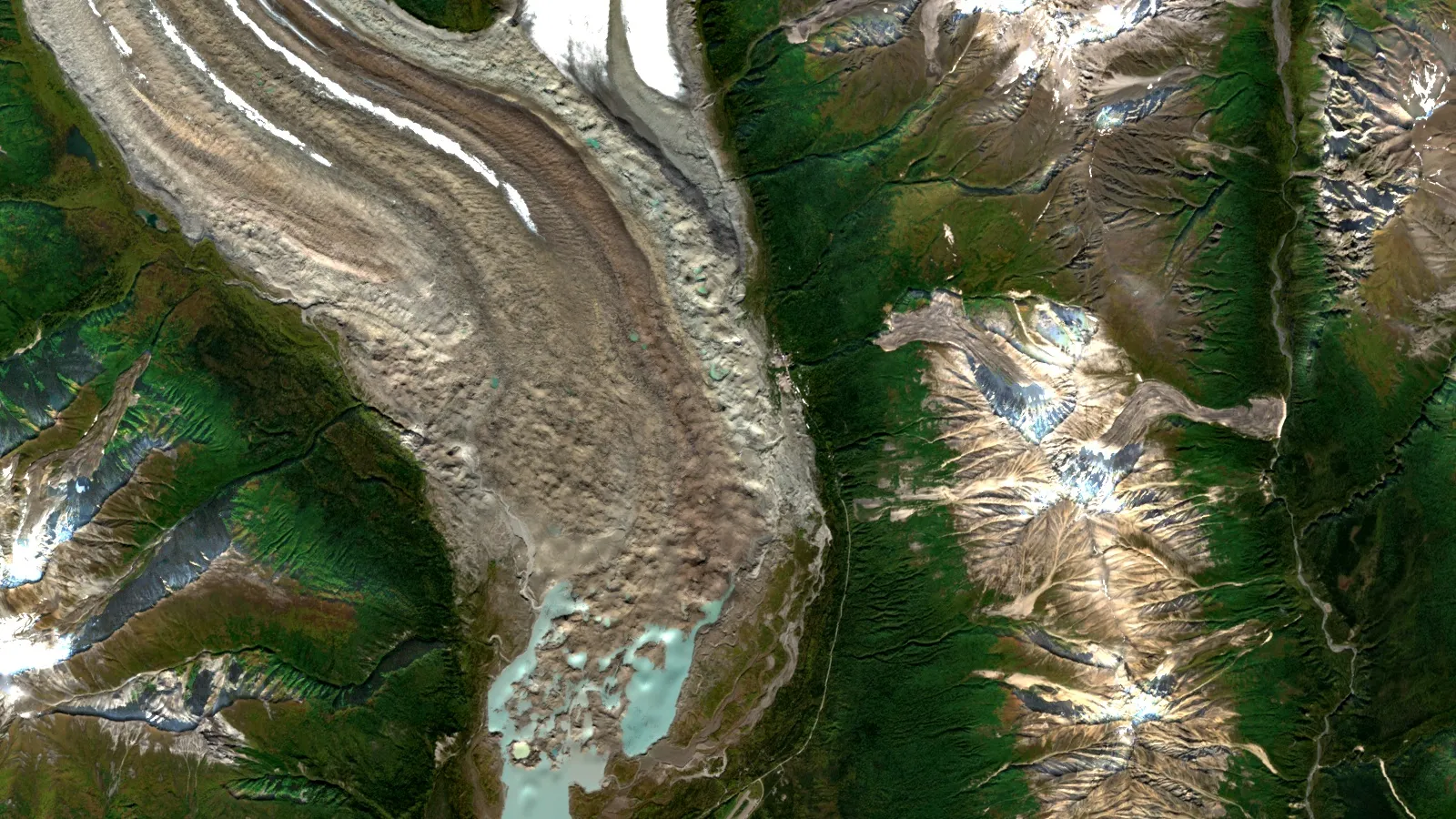
Alaska has no large copper mine in production: the state made an estimated 1,400-1,800 tonnes in 2025, mostly as a by-product. Kennecott closed in 1938; Pebble, Arctic and Johnson Tract are still undeveloped.
Key takeaways
- DGGS estimates Alaska mines made 1,400-1,800 tonnes of copper in 2025, about 0.14-0.18% of the US estimate of 1.0 million tonnes (DGGS, 2026; USGS, 2026).
- Kennecott, in the Copper River region, produced about 1.2 billion pounds of copper from 1911 to 1938 and is now a National Historic Landmark (Mining History Association; NPS).
- Pebble holds 10,910 million tonnes at 0.34% Cu (August 2023 resource) but is blocked by an EPA veto that is under court challenge (DGGS, 2026; Harvard EELP).
- Arctic has the highest grade: 46.7 million tonnes at 2.11% Cu in probable reserves, and needs the 211-mile Ambler Road, permitted on 6 October 2025 (Trilogy Metals, 2023 and 2025).
- LME official cash copper was US$14,751 a tonne on 14 October 2026 (KME, LME official prices); the calculator uses your own price.
In this article
- Is there an operating copper mine in Alaska?
- Alaska copper projects compared
- Kennecott: the Copper River mine that made the region famous
- Pebble: Alaska's biggest copper resource and why it is not a mine
- Arctic and the Ambler district: high grade, but no road
- Johnson Tract, Palmer and Nikolai: the smaller projects
- Grade versus size: how the projects differ
- What a copper project is worth: contained metal calculator
- Copper demand and price context
- Environment, subsistence and permitting
- How to check an Alaska copper project before you rely on it
- Where satellite data fits in early-stage copper exploration
- Frequently asked questions
Alaska has no large copper mine in production today. The state’s own geologists estimate that all Alaska mines together made 1,400 to 1,800 tonnes of copper in 2025, almost all of it as a by-product of zinc, lead and silver mining (Alaska Division of Geological & Geophysical Surveys, January 2026). The United States as a whole mined an estimated 1.0 million tonnes in 2025, so Alaska supplied roughly 0.14% to 0.18% of it (USGS, Mineral Commodity Summaries 2026). The famous Copper River mine, Kennecott, closed in 1938. What Alaska has now is a short list of large projects that are still at the study or permitting stage. This page compares them on size, grade, status and the main obstacle, and ends with a calculator for contained copper.
Is there an operating copper mine in Alaska?
Not a dedicated one. In its 2025 review, the state geological survey lists Alaska’s mineral output as zinc from the Red Dog mine, gold from Fort Knox, Pogo and Kensington, silver and zinc from the Greens Creek mine, and only a small amount of copper that comes out with those metals. It gives about 1.6 thousand tonnes of copper for Greens Creek, which is operated by Hecla Mining, in a total of 1,400 to 1,800 tonnes for the state (DGGS, 2026). A by-product is a metal that is sold along with the main product but does not pay for the mine on its own. Copper that is mined as a main product comes from Arizona, which the USGS says gave about 70% of US output in 2025, and copper is also mined in Alaska and six other states.
Chart
US copper mine production
Thousand tonnes of recoverable copper per year
US mine output has drifted down. The USGS series below shows the recoverable copper in US mine production falling from 1.23 million tonnes in 2021 to an estimated 1.0 million tonnes in 2025, while net import reliance rose to 57% of apparent consumption (USGS, 2026). For the wider picture of copper and iron ore supply, see our review of copper and iron ore supply and demand.
Alaska copper projects compared
The table lists the projects that have a published resource or reserve and a public development plan. It is not a ranking of quality. A resource is the part of a deposit that could be mined in principle; a reserve is the smaller part that a feasibility study shows can be mined at a profit. Grade is the share of copper in the rock, in per cent. Figures are the latest ones in the sources named, and the stage describes where the project was in the period shown.
| Project | Where | Deposit type | Copper figure | Stage |
|---|---|---|---|---|
| Pebble | Bristol Bay, south-west Alaska | Porphyry copper-gold-molybdenum | 10,910 million tonnes at 0.34% Cu (resource, August 2023) | Federal permit denied; EPA veto under court challenge |
| Arctic | Ambler district, north-west Alaska | Volcanogenic copper-zinc-lead-silver-gold | 46.7 million tonnes at 2.11% Cu (probable reserve, 2023 feasibility study) | Feasibility study done; federal review under way; needs a road |
| Johnson Tract | Alaska Peninsula, Lake Clark area | Volcanogenic gold-copper-zinc-silver-lead | 4.195 million tonnes at 0.57% Cu (resource, July 2022) | Initial assessment (May 2025); permitting |
| Palmer | Southeast Alaska | Volcanogenic copper-zinc-barite | 14.3 million tonnes at 0.89% Cu (resource, December 2018) | Exploration; sold to Vizsla Copper (December 2025) |
| Nikolai (Eureka) | South-central Alaska | Nickel-copper-cobalt-platinum group | 4.198 billion pounds of copper contained in nickel-led resource (2025) | Exploration; on federal FAST-41 list |
| Kennecott | Copper River region, Wrangell-St. Elias | High-grade copper sulphide (chalcocite) | About 1.2 billion pounds mined, 1911-1938 | Closed; national historic landmark |
Sources for the table: DGGS (2026) for Pebble, Johnson Tract, Palmer and Nikolai; the Trilogy Metals 2023 feasibility study for Arctic; the Mining History Association for Kennecott. Each is linked in the sections below.
Kennecott: the Copper River mine that made the region famous
The Copper River basin is known for one mine group, not for a district of modern mines. The Kennecott mines sit high above the town of the same name, in what is now Wrangell-St. Elias National Park. The Mining History Association says the mines produced about 1.2 billion pounds of copper between 1911 and 1938 (Mining History Association). The ore came from five mines, Bonanza, Jumbo, Mother Lode, Glacier and Erie, about 4,000 feet above the mill town. The main ore mineral was chalcocite, a copper sulphide, and the ore also carried a silver by-product. In some parts of the orebodies, large masses of pure chalcocite were mined.
Ore left the area by rail. The Copper River and Northwestern Railway, 196 miles long, ran down to the port of Cordova, and routine production could not begin until it was built (Mining History Association). The mines closed in 1938. The National Park Service bought many of the buildings and lands in June 1998, and the site has been a National Historic Landmark since 1986; the NPS calls it the best remaining example of early 20th-century copper mining (National Park Service).
One correction to a common claim: Pebble, Alaska’s big porphyry copper deposit, is not in the Copper River region. Porphyry copper is a large, low-grade deposit formed around an igneous intrusion, and Pebble is in Bristol Bay, in the south-west of the state. Kennecott was a different kind of deposit, small and very rich, which is why a mine on a mountainside, 196 miles from a port, could pay for itself. The newer projects in the table that are copper-led grade between 0.34% and 2.11% copper; Nikolai is far lower, about 0.06% copper in a nickel-led resource.
Pebble: Alaska’s biggest copper resource and why it is not a mine
Pebble is a porphyry copper-gold-molybdenum deposit near Bristol Bay. DGGS shows a total resource of 10,910 million tonnes at 0.34% copper, 0.30 g/t gold and 235 ppm molybdenum, and the source states 75.65 billion pounds of contained copper for that total of measured, indicated and inferred resources (August 2023 figures supplied by the Pebble Limited Partnership; resource category, not reserves). The measured and indicated classes, which are the better-defined ones, hold about 53 billion pounds of that. A 2021 preliminary economic assessment described an open pit running 20 years at 180,000 tonnes a day (DGGS, 2026).
Chart
Pebble contained copper by confidence class
Billion pounds of copper, August 2023 resource
The obstacle is water and fish, not rock. On 30 January 2023 the US Environmental Protection Agency issued a final determination under Section 404(c) of the Clean Water Act that effectively blocks the mine, finding that it would have unacceptable adverse effects on salmon fishery areas in the Bristol Bay watershed (Harvard Environmental & Energy Law Program tracker). Northern Dynasty Minerals and its Pebble Limited Partnership are challenging that decision in the District of Alaska, and two Alaska Native village corporations have brought a separate challenge. The Trump administration said in July 2025 that it would defend the decision in court, and the court heard oral argument on the competing motions on 25 June 2026 (Harvard tracker; KDLG, 26 June 2026). The case is Northern Dynasty Minerals v. EPA, number 3:24-cv-00059, before Judge Sharon Gleason; the public docket showed its last filing dated 6 August 2026 when we checked on 15 October 2026 (CourtListener docket). As of that check no ruling had been entered, so the veto still stands.
Arctic and the Ambler district: high grade, but no road
Arctic is the highest-grade large copper project in Alaska. Its 2023 feasibility study, prepared by Trilogy Metals for the Ambler Metals joint venture (owned equally by Trilogy and a South32 subsidiary), reports 46.7 million tonnes of probable reserves at 2.11% copper, 2.90% zinc, 0.56% lead, 0.42 g/t gold and 31.8 g/t silver. The plan is a 10,000-tonne-a-day open pit with a mine life of at least 13 years, and the study put the pre-tax net present value (NPV, the value today of future cash flows) at US$1.5 billion at its long-term copper price of US$3.65 a pound (Trilogy Metals, February 2023). At the spot prices of that month, which included US$4.02 a pound for copper, the same study gave US$2.1 billion pre-tax. The company’s own numbers are the only published economics, and they use 2022 cost levels. The Army Corps of Engineers published its Notice of Intent for the project’s environmental impact statement in September 2026, and the federal schedule targets a Record of Decision in September 2028 (Trilogy Metals, third quarter fiscal 2026).
Chart
Arctic project value at two price sets
US$ billion, 100% project basis, 2023 feasibility study
The constraint is access. Arctic and the nearby Bornite deposit lie in north-west Alaska, and the proposed Ambler Road is a private, industrial-use-only road of 211 miles to the Dalton Highway. On 6 October 2025 the President issued a decision under Section 1106 of the Alaska National Interest Lands Conservation Act that granted the permits and reversed a June 2024 decision against the road (Trilogy Metals, October 2025). The White House announcement also said the US government would take a 10% stake in Trilogy. Trilogy signed the definitive agreements with the US Department of War on 28 August 2026 for about US$35.6 million and closed the investment on 11 September 2026; after closing the Department holds about 9.1% of Trilogy’s shares, with warrants and a call option on a further 7.5% that can be used once the first phase of the Ambler Road is complete or the company changes hands (Trilogy Metals, third quarter fiscal 2026; Trilogy Metals, August 2026). Alaska Public Media reported in December 2025 that opposition from Alaska Native villages and subsistence hunters and fishermen remains substantial (Alaska Public Media, December 2025).
Johnson Tract, Palmer and Nikolai: the smaller projects
Three more projects appear in the state’s 2025 review, and each is a different kind of deposit.
- Johnson Tract is a volcanogenic massive sulphide (VMS) deposit, a metal-rich body formed on an ancient sea floor. Its 2022 resource is 4.195 million tonnes at 4.66 g/t gold, 0.57% copper and 5.04% zinc. It lies on Native-owned land inside Lake Clark National Park. The operator, Contango ORE, released an initial assessment in May 2025 that showed a post-tax NPV (at a 5% discount rate) of US$224.5 million, a 30.2% internal rate of return and a 7-year mine life, and the project was added to the federal FAST-41 permitting list on 2 December 2025 (DGGS, 2026). Gold and zinc make a large part of its value, so it is not a pure copper play.
- Palmer in Southeast Alaska is a VMS deposit with a December 2018 resource of 14.3 million tonnes at 0.89% copper, 5.04% zinc and 26.5% barite. Vizsla Copper agreed on 13 November 2025 to acquire it from American Pacific Mining, and the sale closed on 4 December 2025 (DGGS, 2026). The resource is old, and 9.6 of its 14.3 million tonnes are in the inferred class, the least certain.
- Nikolai, held by Alaska Energy Metals, is a nickel-copper-cobalt-platinum group project in an igneous intrusion. The 2025 Eureka resource is 1.189 billion tonnes indicated and 2.085 billion tonnes inferred, both at 0.20% nickel equivalent, and contains 12.447 billion pounds of nickel and 4.198 billion pounds of copper. It is a nickel project first, with copper as a secondary metal, and it was added to the FAST-41 list (DGGS, 2026).
Grade versus size: how the projects differ
Size and grade pull in opposite directions in Alaska. Pebble has by far the most copper, but at 0.34% it is a low-grade bulk-mining case that needs very large equipment, a big tailings facility and a permit that is currently blocked. Arctic has the highest grade but a small tonnage by comparison and needs a 211-mile road. The chart plots four of the five newer projects on a log scale; Nikolai is left out because it is a nickel-led resource with very low copper grade. Compare like with like with care: Arctic is a reserve from a feasibility study, while the others are resources from earlier-stage work, and a reserve is always the more reliable number.
Chart
Grade versus size, Alaska copper projects
Million tonnes against copper grade; Arctic is a reserve, the rest are resources
Grade also decides what a tonne of ore is worth. At 2.11% copper, one tonne of Arctic ore holds about 21 kilograms of copper. At 0.34%, a tonne of Pebble ore holds about 3.4 kilograms. That is why Pebble depends on moving 180,000 tonnes a day and recovering gold and molybdenum alongside the copper.
What a copper project is worth: contained metal calculator
Contained metal is the copper in the ground before any losses; recovered metal is what the plant actually saves; value is recovered metal times the price. The calculator below applies those three steps to any tonnage and grade you enter, for example a resource figure from the table. It is a screening number, not a project valuation, because it ignores mining cost, capital, royalties, tax and the by-products. The LME official cash price for copper was US$14,751 a tonne on 14 October 2026 (KME, LME official prices page), about US$6.69 a pound, but the default in the calculator is a round example and you should enter today’s price.
Calculator
How much copper is in your deposit, and what is it worth?
Enter a tonnage and grade from a resource table, plus your own recovery and price.
- Contained copper (billion lb): 1.10
- Recovered copper (tonnes): 425,000
- Value of recovered copper (US$): $5,950,000,000
Example values only, not a benchmark. Contained metal = tonnes x grade; 1 tonne = 2,204.62 lb. Recovery and price are inputs: example, use today’s price. Money is in US$. This ignores mining cost, capital, royalties and tax.
Copper demand and price context
The US relies on imports for much of its copper. The USGS counts net import reliance at 57% of apparent consumption in 2025 and gives the annual average London Metal Exchange (LME) grade A cash price as an estimated 440 cents a pound for 2025, against 414.7 cents in 2024 (USGS, 2026). The Copper Development Association split of US use, quoted by the USGS, is building construction 42%, electrical and electronic products 23%, transportation 18%, consumer and general products 10% and industrial machinery 7%. The video below explains why electric vehicles use so much copper.
▶ Why electric vehicles need so much copper, and where it is mined. · 6:03
Environment, subsistence and permitting
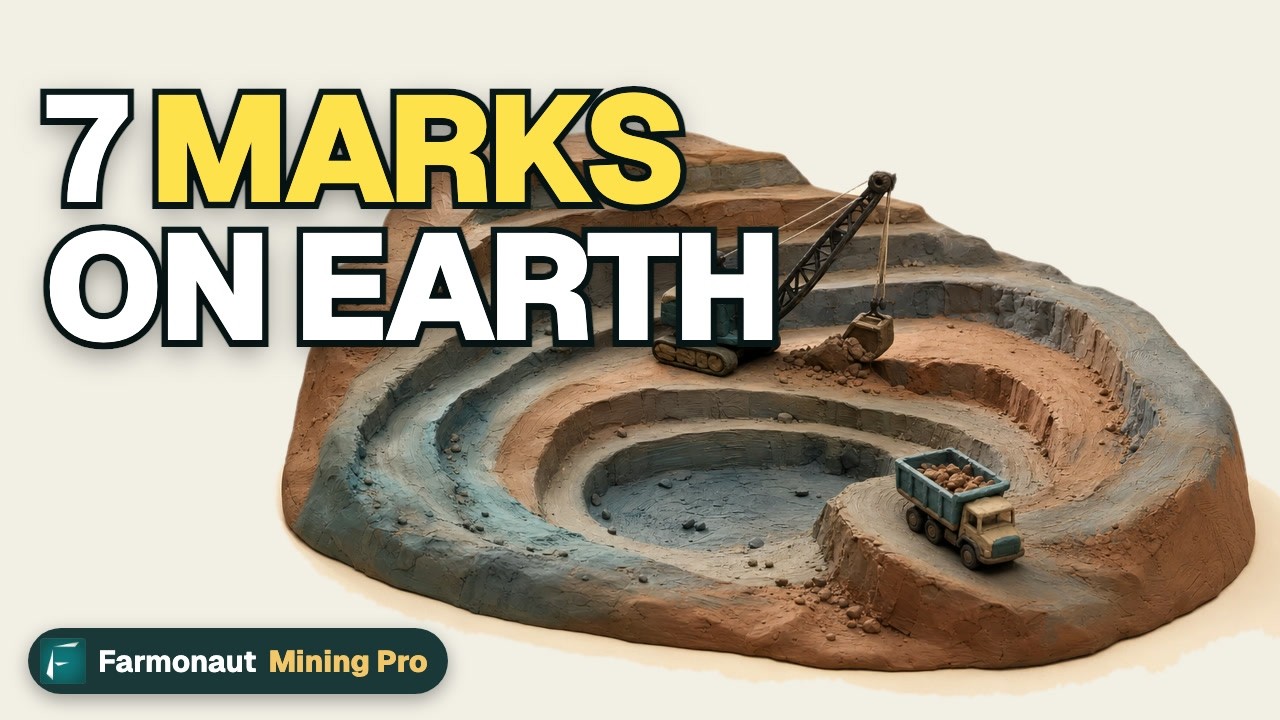
Each Alaska copper project has been shaped by one local issue. At Pebble it is the salmon fishery of Bristol Bay. At Ambler it is subsistence hunting and fishing by nearby Alaska Native communities, and the company says its design addresses this with a private road and protections for caribou migration routes and fish habitat (Trilogy Metals, October 2025). At Johnson Tract the land is inside a national park, so access depended on an easement across it. At Kennecott the question is heritage: the NPS now manages the site for visitors.
The federal government has also changed its role. Alaska Public Media quoted a political economist and Senator Lisa Murkowski on whether a government that owns shares in a mining company can still act as an impartial permit regulator (Alaska Public Media, December 2025). For anyone assessing a project, that makes the permit record, not the press release, the thing to read. When you read a project’s permit documents, look for the items below rather than assuming they are in place.
- Water quality monitoring of streams below the site, with results published to the regulator.
- Tailings design and closure bonding, which decide the long-term risk to a river.
- Agreements with nearby Native corporations and villages on jobs, land and subsistence access.
- Reclamation plans that cover roads and camps as well as the pit.
▶ The seven environmental impacts of mining, explained in clay. · 2:31
How to check an Alaska copper project before you rely on it
Company news releases are written to raise money. Use this order when you need a project’s real position.
- Start with the state geological survey’s annual mining review, which lists every active project and links to the company data (Alaska DGGS mineral publications).
- Find the latest technical report on SEDAR+ (Canada) or EDGAR (US). Check the effective date; many Alaska resources above are three to eight years old.
- Read the class table. Count how much of the tonnage is measured and indicated, and how much is only inferred.
- Check the land status: state, federal, Native corporation, or inside a national park or preserve. It decides which permits apply.
- Look for the access plan and who pays for it, and for the court docket if the project has a permit dispute.
- Compare the metal price in the study with a dated current price. Studies are sensitive to it, as the Arctic figures above show.
Our own guides to copper deposit types and where to explore and to porphyry copper alteration and grades explain the deposit types in the table in more detail.
Where satellite data fits in early-stage copper exploration
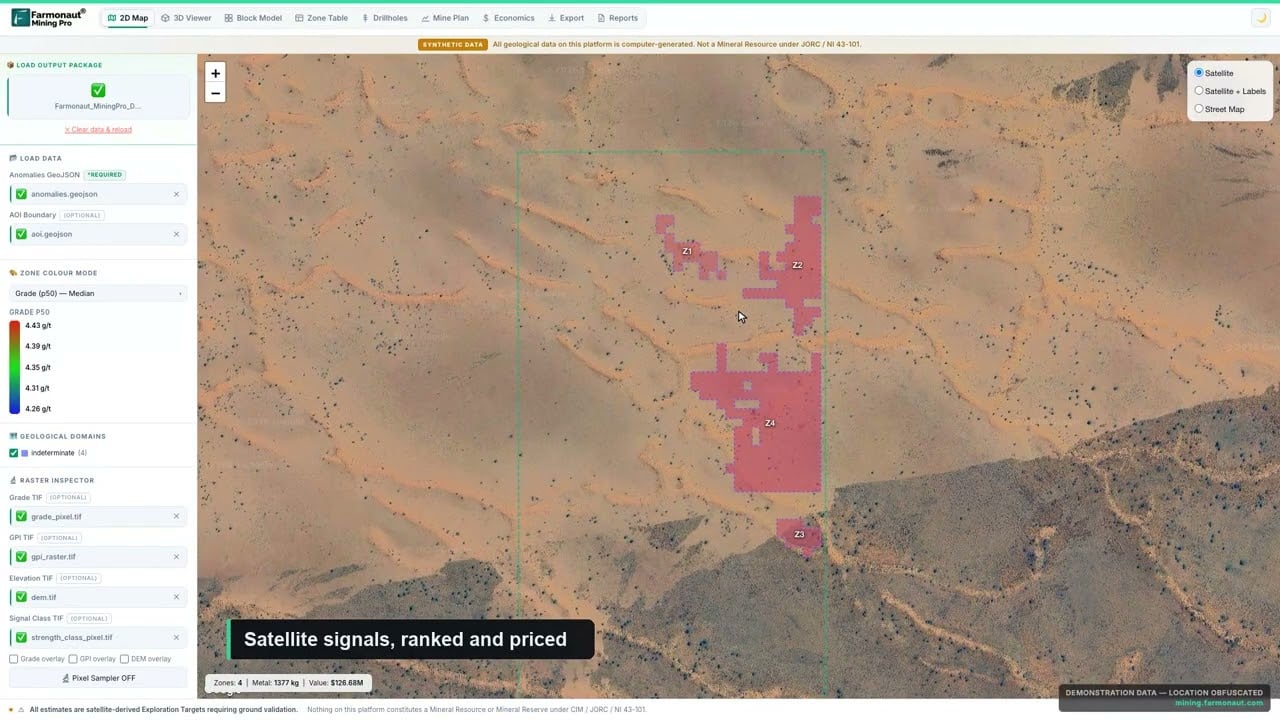
Satellite data does not replace drilling, and it does not produce a resource. It can help a licence owner or consultant rank ground before spending on a field programme. Farmonaut’s satellite-based mineral detection service reads multispectral imagery and other satellite data to screen a licence area for alteration patterns and structures that point to copper, and the reports are delivered in 5 to 20 business days from a KML, KMZ or polygon file. The company states that early-stage satellite screening can cost up to 80-85% less than traditional first-pass surveying. The output is an exploration target ahead of any resource estimate, not a JORC or NI 43-101 figure. In Alaska, snow, vegetation and a short summer limit what optical data can show, so a screen is a way to choose where to send a geologist first. To describe your area, use the mining query form or contact us.
▶ A quick look at Farmonaut Mining Pro, which turns a licence boundary into a geological and economic picture. · 4:56
Related reading on this site: Copper Mining Training Programs: 8 Options Compared.
We cover a connected topic in New Mexico Copper Mines: Chino, Tyrone, Copper King.
Frequently asked questions
Where are the copper mines in Alaska?
There is no large operating copper mine. The only copper now produced comes with other metals from mines such as Greens Creek, and the state estimates 1,400 to 1,800 tonnes in 2025 (DGGS, 2026). The large copper deposits, such as Pebble, Arctic and Johnson Tract, are all undeveloped.
What was the largest copper mine in Alaska?
Kennecott in the Copper River region, which produced about 1.2 billion pounds of copper between 1911 and 1938 (Mining History Association). Pebble is the largest known copper resource in the state (DGGS, 2026), but it has never been built.
Is Kennecott, Alaska still mining copper?
No. The mines closed in 1938 and the site is a National Historic Landmark managed by the National Park Service. The company that took the Kennecott name still exists, as part of Rio Tinto, but it has no mine at the Alaska site.
Why was Pebble blocked?
The US Environmental Protection Agency used Section 404(c) of the Clean Water Act in January 2023 to prohibit the discharge of mine fill into waters in the Bristol Bay watershed, finding unacceptable adverse effects on salmon fishery areas. The project owner is challenging the decision in federal court.
What is the Ambler Road?
A proposed 211-mile industrial road from the Ambler mining district to the Dalton Highway. Permits were granted by presidential decision on 6 October 2025. It would give access to the Arctic and Bornite copper deposits.
How much copper is in the Pebble deposit?
The August 2023 resource is 10,910 million tonnes at 0.34% copper, with about 75.65 billion pounds of contained copper across the measured, indicated and inferred classes (DGGS, 2026).
Which Alaska copper project has the highest grade?
Among the projects above, Arctic: 2.11% copper in the probable reserve of the 2023 feasibility study. Johnson Tract (0.57%), Palmer (0.89%) and Pebble (0.34%) are lower.
How is copper found in Alaska?
Through geological mapping, stream-sediment and soil sampling, geophysics and drilling, often guided by satellite and airborne data. Remote sensing is used early to rank ground; it does not prove a deposit.
How much copper does the United States mine?
The USGS estimates 1.0 million tonnes of recoverable copper from US mines in 2025, down from 1.23 million tonnes in 2021. Arizona accounts for about 70% (USGS, 2026).
This page is for information only. It is not investment advice and it names no company as a recommendation.
This page is for information only. It is not investment advice or legal advice. It names no company as a recommendation, and permit and court outcomes can change; confirm the current position with the regulator. Field work in Alaska needs the landowner’s permission and careful safety planning for remote, cold and wildlife country.
Farmonaut mining
Screen your licence area from space first
Consultants can see how satellite data screens a licence area for copper as an exploration target, ahead of any resource estimate.
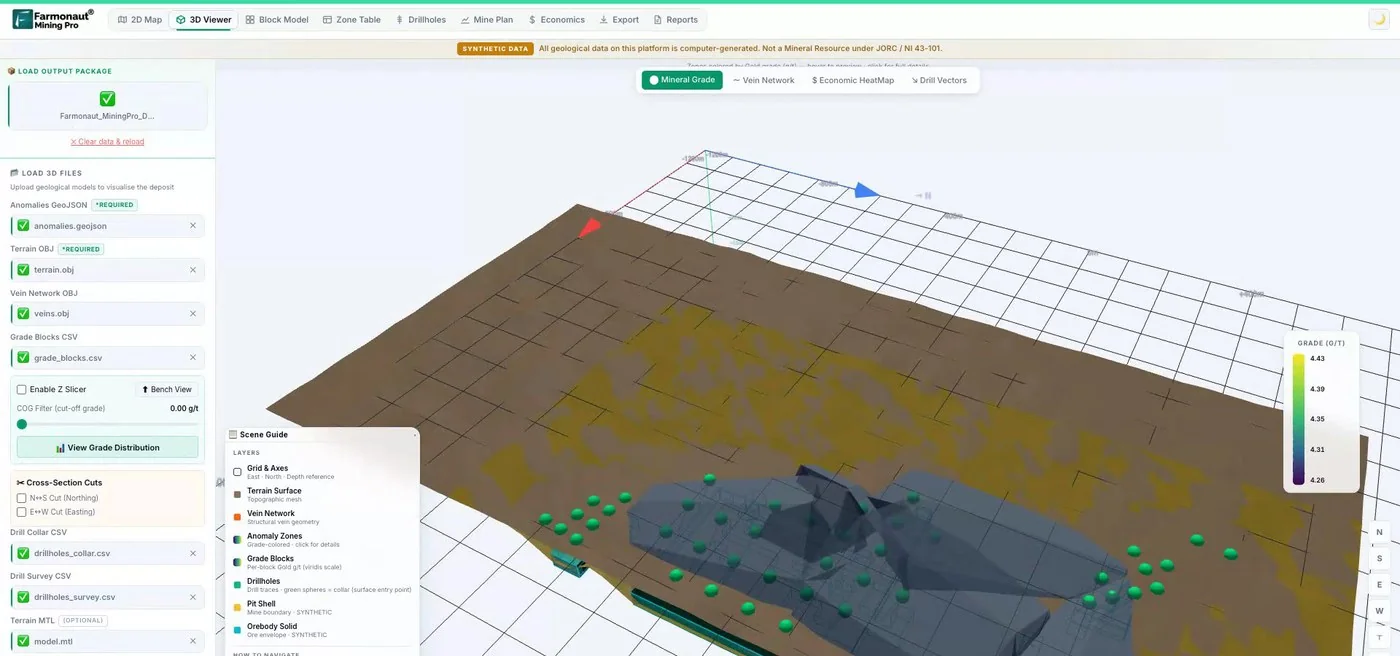
Mining Pro sample view, synthetic data
Keep reading
Sources
- DGGS, 2025 Alaska Mining Industry Overview, AME Roundup (January 2026): dggs.alaska.gov
- USGS, Mineral Commodity Summaries 2026: Copper: pubs.usgs.gov
- National Park Service, Kennecott Mines National Historic Landmark: nps.gov
- Mining History Association, Kennecott Mines: mininghistoryassociation.org
- Harvard Environmental and Energy Law Program, Bristol Bay and the Pebble Mine: eelp.law.harvard.edu
- CourtListener, Northern Dynasty Minerals v. EPA, 3:24-cv-00059 (docket): courtlistener.com
- Trilogy Metals, updated Arctic feasibility study results (14 February 2023): trilogymetals.com
- Trilogy Metals, Ambler Access Project permits (6 October 2025): trilogymetals.com
- Alaska Public Media, U.S. government is both investor and regulator (11 December 2025): alaskapublic.org
- KME, LME official metal prices (14 October 2026): kme.com
- Alaska DGGS, mineral publications: dggs.alaska.gov
- KDLG, Federal judge hears oral arguments in Pebble Mine case (26 June 2026): kdlg.org
- Trilogy Metals, third quarter fiscal 2026 financial results: trilogymetals.com
- Trilogy Metals, definitive agreements for U.S. Department of War equity investment: trilogymetals.com
Discussion
Questions, corrections or field experience? Share them below. First-time comments are reviewed before they appear, and your email is never published.
No comments yet. Be the first to add a question or your experience.

 Alkimy SARL
 Double A Trading
 GemSprout Metals Limited
 Qader Group
 Ileys General Trading
 SG Gold Mining LLC
 VRV Global Pte Ltd
 Omsri International FZE
 G.I.T.T.
 Jaunita Erss Ltd
 Almosi SARL
 SRK Consulting
 Berks Gold Limited
 Mwerezi Minerals Company Limited
 Mining SARL
 SenGold Invest SAS
 Sean Mining Limited
 NTS Group (Pty) Ltd










