

Mineral tenure · Ontario
MLAS Ontario: 6 Steps From Licence to Drill Permit
MLAS Ontario is the province’s online Mining Lands Administration System: you open an account, take the Mining Act Awareness Program, buy a C$40 five-year prospector’s licence, register grid cells at C$50 each, then keep them with C$400 of assessment work per cell per year and file a plan or permit before mechanized work.
Key takeaways
- Anyone can view active claims in the public MLAS Ontario Map Viewer; registering a claim needs an MLAS account and a valid prospector’s licence (C$40 for five years).
- Cells are 15 seconds of latitude by 22.5 seconds of longitude, roughly 24 ha in the far south and 19 ha near 52°N; up to 25 adjoining cells make one multi-cell claim, at C$50 per cell.
- No work is due in the first year; from then on each cell needs C$400 of approved work a year, and credits can cover the current year plus five more.
- Small drills, generator geophysics and minor stripping need an exploration plan (effective 30 days after circulation); heavier work needs a permit (decision within 50 days, valid up to three years).
- OJEP pays 50% of eligible costs up to C$200,000 per junior-company project or C$50,000 per prospector project, plus up to C$15,000 at 100% for Indigenous participation.
In this article
- What MLAS Ontario does, and what you can see without an account
- Step 1 and 2: an MLAS account, the MAAP course and a prospector's licence
- Step 3: registering cells in MLAS Ontario
- Assessment work in MLAS Ontario: what counts, credits and payment in place
- Step 4: exploration plans vs permits under O. Reg. 308/12
- Paying for the work: the Ontario Junior Exploration Program
- MLAS Ontario vs GESTIM Quebec for a two-province land manager
- Choosing cells before you register in MLAS Ontario
- Frequently asked questions about MLAS Ontario
MLAS Ontario is where a claim in Ontario starts and where almost every obligation that follows is recorded. The Mining Lands Administration System took over claim registration on 10 April 2018, when legacy claims were converted to cells on a provincial grid, and it now handles licences, claims, assessment work reports, credit distribution and early exploration plans and permits in one login. This page walks through the system in the order a junior meets it, with the fees, deadlines and ratios that drive a land budget, plus two calculators for the numbers people most often get wrong.
This guide stays with the registry, the rules and the money. For the gold camps, mines and production figures, read our guide to gold deposits in Ontario, from Timmins to Red Lake. For how Ontario compares with the other provinces and territories, see the overview of gold exploration across Canada, and for registries outside Canada, our mining cadastre guide by country.
Prospecting labour reported within 24 months earns assessment credit at 200% of what it cost.
What MLAS Ontario does, and what you can see without an account
Start with the free part. The province’s Mining Lands Administration System page (updated 25 September 2026) says non-registered users can use the MLAS Ontario Map Viewer to see active unpatented mining claims. A geologist checking whether a target is open, or an investor checking the ground under a news release, can do that in minutes without logging in.
Registered users get the rest. The same page lists four jobs: viewing active claims, registering a new claim, managing claims, and buying or renewing a prospector’s licence. Plan and permit submissions, assessment work reports and credit distributions also run through the MLAS Ontario menus, which is why the ministry’s guides keep pointing back to the same account.
Ontario also publishes the underlying mining lands data. The MLAS Ontario page says claims, alienations, tenures, the cell grid, mining divisions and legacy claims can be downloaded as shapefiles from OGSEarth. For anyone building a land map in GIS, that download is the cleanest way to overlay your own targets on open and taken ground.
Three public checks to run in MLAS Ontario before you plan anything
- ✔ Open or taken. The Map Viewer shows active claims and, since the plan and permit guide was updated, circulated, active and expired exploration plans and permits too.
- 📊 Withdrawn ground. The Minister can withdraw areas from prospecting and claim registration by order; the ministry keeps a list of land notices, withdrawals and reopenings.
- The June 1 open list. Each year Ontario publishes, in one issue of the Ontario Gazette, lands or mining rights open for registration as of June 1, and a second list of lands in arrears of mining land taxes.
- ⚠ Hazards. The MLAS page warns that some lands on the June 1 list may contain mine hazards. The Abandoned Mines Information System shows known sites.
How busy is the register? The Ministry of Energy and Mines reports in its mineral exploration values page that Ontario had more than 379,000 active mining claims as of 31 December 2025. The same page puts 2025 exploration spending at C$1,080 million, C$328 million of it by junior companies, with gold taking C$807 million, or 75%.

▶ How satellite data and soil science are used on Canadian critical-mineral ground, the kind of target the OJEP critical minerals stream ranks first. · 2:25
Step 1 and 2: an MLAS account, the MAAP course and a prospector’s licence
Everything in MLAS Ontario hangs off a client profile. The registration steps on the MLAS page are short: create an Ontario.ca Login (the page also calls it Public Secure) with your email as the username, activate it from the verification email, then fill in your MLAS Ontario client profile. Once confirmed, you receive an MLAS client ID by email. Older directives from 2018 describe the same flow through the previous ONe-key login, so expect some screenshots in ministry PDFs to look different.
Who must enrol? Directive 2 says claim holders, lessees, patent holders and prospector licensees must enrol in MLAS Ontario and set up a profile as an individual or an organization, and that land managers and agents representing a claim holder must register too. You must be 18 or older to enrol.
The licence comes next, and it has a prerequisite. Directive 2 says you must have completed the Mining Act Awareness Program within 60 days before the day you obtain the licence. The ministry’s Mining Act resources page describes MAAP as an online course covering the Act and its regulations, Aboriginal and treaty rights, the rights of private landowners and other land users, and the rules for early exploration. It must be completed by anyone applying for or renewing a prospector’s licence, anyone holding a lifetime licence, and anyone named as a qualified supervisor on an exploration plan or permit.
The cost is low. The administrative fee schedule for mining lands, updated 1 April 2026, lists C$40 for a prospector’s licence or a renewal, for a five-year term. MLAS Ontario sends a renewal reminder 60 days before expiry, and Directive 2 reminds holders that keeping the licence in good standing is their own responsibility.
Step 3: registering cells in MLAS Ontario
Ontario’s claims sit on a fixed grid. The ministry’s mining lands glossary defines the provincial grid as unique cells measuring 15 seconds of latitude by 22.5 seconds of longitude. Because lines of longitude converge northward, a cell gets narrower as you go north. We worked out the areas below from that definition; MLAS Ontario shows the exact area of each cell, so treat these as planning figures.
| Latitude (example area) | Cell size, N-S x E-W | Area per cell | Acres per cell |
|---|---|---|---|
| 42°N (Lake Erie shore) | 463 m x 518 m | 24.0 ha | 59 |
| 45°N (Bancroft area) | 463 m x 493 m | 22.8 ha | 56 |
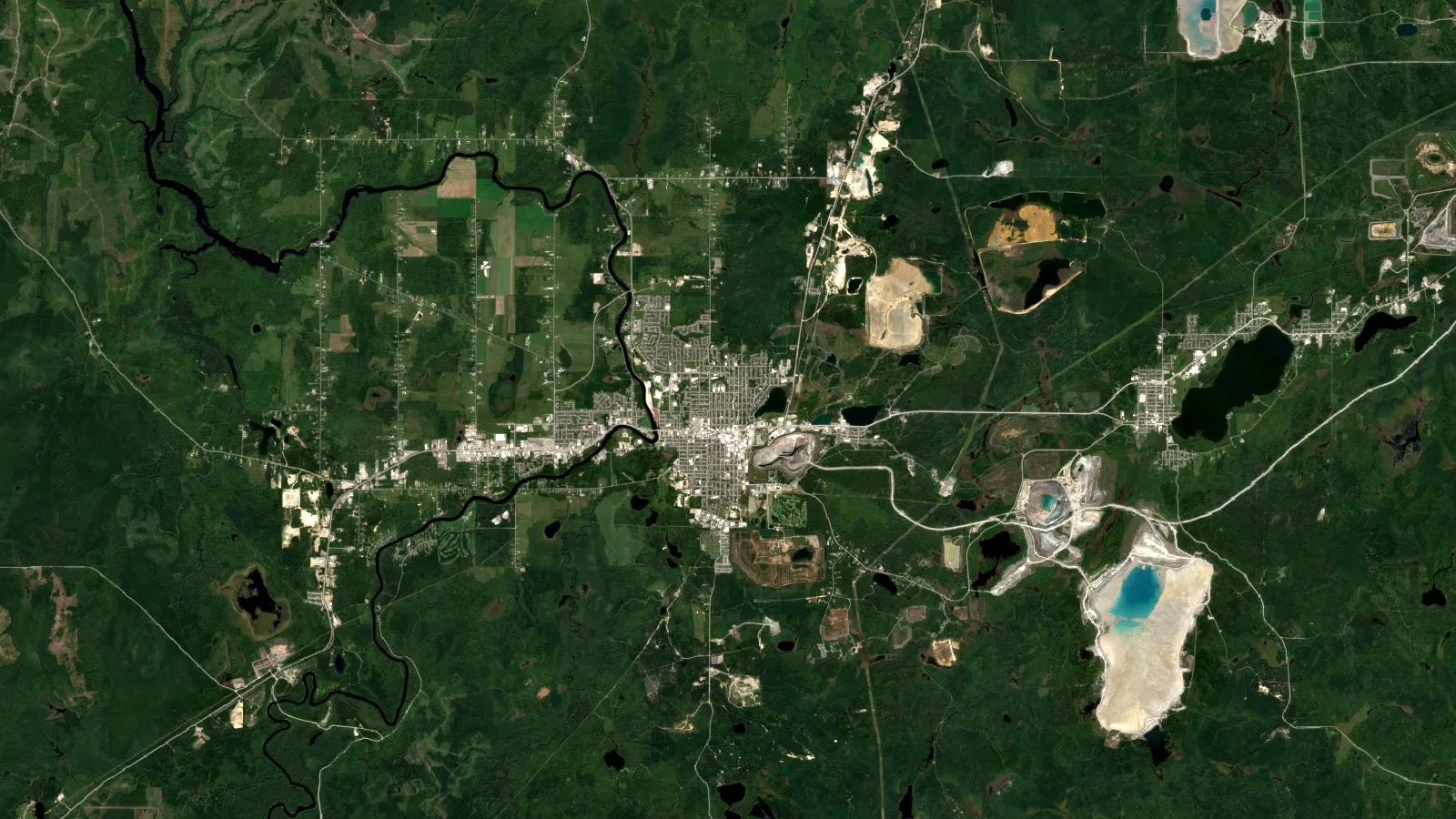
| 48°N (Kirkland Lake, Timmins) | 463 m x 466 m | 21.6 ha | 53 |
| 50°N (Red Lake, Pickle Lake) | 463 m x 448 m | 20.8 ha | 51 |
| 52°N (Ring of Fire latitude) | 464 m x 429 m | 19.9 ha | 49 |
| 55°N (Far North) | 464 m x 400 m | 18.6 ha | 46 |
Farmonaut calculation from the provincial grid definition (15″ x 22.5″) on the WGS84 ellipsoid. Confirm each cell’s area in MLAS before budgeting.
The registration screen is strict. Directive 3 (version 1.2, February 2023) sets the limits: at most 50 single cells in one transaction, at most 25 cells in a multi-cell claim, and cells must share a common side. You select cells by typing their numbers or drawing a rectangle, polygon or freehand line on the map, pass a CAPTCHA, and then a 10-minute timer starts and the cells lock while you enter claim type and ownership shares. Payment runs through a third-party gateway; the MLAS release 2.5.29.2 fact sheet says it moved from Worldline to Shift4, with no change to the process.
Two details matter for strategy. First, the registration fee is per cell, not per claim, so a 25-cell claim costs the same C$1,250 whether you file it as one multi-cell claim or 25 singles. Second, Directive 3 says MLAS Ontario sends an automatic notification to any impacted Aboriginal community when a claim is registered. Registration is the first moment communities hear of your interest, not the permit stage.
Before you register, decide which cells deserve the C$50 and the C$400 a year that follows. That is the job our satellite-based mineral detection service does: it ranks alteration, structure and spectral anomalies across a wider area so the cells you register are the ones with the strongest exploration targets. You can Map Your Mining Site at mining.farmonaut.com by drawing or uploading the boundary you are considering.
Fees and holding costs for an MLAS Ontario claim
Ontario’s fees are small; its work requirement is not. The fee schedule lists C$50 per cell to register, C$40 for the five-year licence, C$20 per claim to request more time to perform and file assessment work, C$80 per claim to submit a dispute, and C$90 for a lease application (raised from C$85 on 1 April 2026, according to the ministry’s March 2026 fee adjustment notice). Relief from forfeiture costs C$1,200 per application.
The real cost is the work. Section 4 of O. Reg. 65/18, the Assessment Work regulation, sets annual units of assessment work at C$400 for each cell in a cell claim and C$200 for a boundary claim. Section 3 says the work, or a payment in its place, is required in every year after registration except the first. A 16-cell claim therefore costs C$800 to register and C$6,400 a year to keep from the second anniversary onward.
The calculator below turns a cell count into the upfront cheque and the work bill for the years you plan to hold the ground. It uses the cell area for your latitude from the table above.
Calculator
What will an MLAS Ontario claim cost to register and hold?
Enter the cells, the cell area at your latitude, the years you plan to hold the ground and your licence fee. Amounts in Canadian dollars (C$).
- Due at registration (C$): $840
- Claim area: 346 ha
- Claim area in acres: 854 acres
- Work each year from 2nd anniversary (C$): $6,400
- Work over the holding period (C$): $12,800
- Most credit applied at once (C$): $38,400
Canadian dollars (C$). C$50 per cell and C$40 for a five-year prospector’s licence (mining lands fee schedule, updated 1 April 2026). C$400 of assessment work per cell per year, none in the first year after registration (O. Reg. 65/18, ss. 3 and 4). Credits can be distributed for the current assessment year plus five (s. 19). Cell area from the provincial grid (15 by 22.5 seconds); MLAS shows the exact figure. Excludes plan or permit preparation, field costs, Crown land permits and the C$20 extension fee. General information, not legal advice; confirm with the Provincial Mining Recording Office.
With the defaults, 16 cells at about 21.6 hectares each make roughly 346 hectares (854 acres) near Timmins’ latitude. You pay C$840 on day one, nothing more for work in the first year, then C$6,400 of approved work in each later year. Hold it three years and the total is C$13,640, of which 94% is fieldwork rather than fees. That ratio is why ground selection matters more in Ontario than in provinces with higher registration fees.
Ontario had more than 379,000 active mining claims at the end of 2025.
Assessment work in MLAS Ontario: what counts, credits and payment in place
What counts as work? Section 2 of O. Reg. 65/18 lists 15 types, from grass roots prospecting, trenching and stripping through geological, geochemical and ground or airborne geophysical surveys, line cutting, drilling, petrography, environmental baseline studies and required rehabilitation. It also lists remote sensing imagery and the modelling or reprocessing of existing data to identify a new exploration target. Eligible costs include labour and supervision, contractors and consultants, supplies, food and lodging, transport within Ontario, sample shipping, assays, trail building and consultations with Aboriginal communities about the exploration.
Credit is not automatic. Section 12 says the ministry may refuse work that was not carried out as described, a report that misses the Technical Standards, duplicated work, or a report made up mostly of opinion or of compilations of previously published material. A satellite study that only repackages public imagery would struggle on that last test; one that produces a new, documented target is a different matter. Whether any given report qualifies, and for how much, is the ministry’s decision.
Timing changes the value of every dollar. Section 13 credits most work at 100% of cost if the report is filed within 24 months of doing it, and 50% if filed between 24 and 60 months. Labour for grass roots prospecting is credited at 200% and 100% on the same clock. Work older than 60 months earns nothing. Prospecting and regional surveys done on Crown land up to 12 months before you register the claim can count too, at 100% for prospecting labour and 50% for other costs, if the report is filed within a year of registration; a regional survey must cover at least 100 square kilometres.
Chart
How much assessment credit each dollar earns
Credit as a share of the amount spent, by type of cost and when the report is filed
Once approved, credits go into a reserve for the claim, and you distribute them in MLAS Ontario. Section 19 caps what one distribution can cover at the current assessment year plus the five that follow. It also caps how much a claim’s reserve can push to contiguous claims in one assessment year: C$50,000 from a one- or two-cell claim, C$100,000 from three to five cells, and C$150,000 from six to 25 cells. The ministry deems a report approved if it sends no notice of determination within 90 days.
Ontario also allows cash instead of work, with three limits in section 5. You cannot pay in place of the first annual unit due by the second anniversary; a year’s payment cannot exceed that year’s requirement; and you cannot pay in two consecutive years. Directive 5.6 adds that a payment applies only to the current assessment year and cannot be carried forward. If neither work nor payment can be in place by the anniversary date, the C$20 extension request in the fee schedule is the tool to look at.

▶ A Canadian soil, induced-polarization and lidar program: all work types listed as assessment work in O. Reg. 65/18 when done on Ontario claims. · 2:47
Step 4: exploration plans vs permits under O. Reg. 308/12
A claim lets you hold ground, not disturb it. O. Reg. 308/12, the Exploration Plans and Exploration Permits regulation (consolidated from 1 April 2024, e-Laws currency 12 October 2026), sorts early exploration into two tiers. Schedule 2 lists plan activities; Schedule 3 lists permit activities. Hand prospecting, mapping and sampling that fall outside both schedules need neither, though the Provincial Standards for Early Exploration and other laws still apply.
| Activity | Exploration plan (Schedule 2) | Exploration permit (Schedule 3) |
|---|---|---|
| Drilling | Drill plus equipment 150 kg or less | Over 150 kg (rods, casing, bits excluded) |
| Line cutting | Lines 1.5 m wide or less | Lines wider than 1.5 m |
| Mechanized stripping | Up to 100 m² (sites within 200 m added) | Over 100 m², below advanced exploration |
| Pits and trenches in bedrock | Over 1 m³ up to 3 m³ within 200 m | Over 3 m³ within 200 m |
| Ground geophysics | Surveys that need a generator | Not listed |
| Starts | 30 days after circulation | After the Director issues the permit |
| Valid for | Up to 2 years | Up to 3 years |
Source: O. Reg. 308/12, ss. 9, 12 and 15 and Schedules 2 and 3; ministry exploration plan and permit activity sheets.
The process runs through the same login. The province’s exploration plan and permit guide (updated 24 September 2026) sets the pre-conditions: you must be enrolled in MLAS Ontario, your qualified supervisor must have completed MAAP within five years, and where surface rights owners exist you must send them a notice of intent with a copy of the draft submission. A company claim holder, or anyone filing for someone else, must be designated as an agent.
Maps decide most delays. The guide asks for an activity details report plus regional maps at 1:50,000 to 1:250,000 and project maps generally at 1:5,000 to 1:50,000, in PDF, with the whole package under 10 MB. Activities are shown as points with a 200-metre buffer or as polygons with no buffer, and only one drill pad is allowed per polygon. If a drill trace will pass under a neighbouring cell, that cell must be in the application. Common rejections, according to the guide, are missing maps, poor labelling and claims that differ between the form and the map.
Then come the clocks. The ministry circulates a valid submission to potentially affected Aboriginal communities. A plan can start 30 days after the circulation date, and you may withdraw or adjust it within those 30 days. A permit application is also posted on the Environmental Registry of Ontario for 30 days, and the Director decides within 50 days of circulation, unless the file is put on hold to consider community concerns. The guide asks for start dates more than 35 days out for a plan and 55 days for a permit, and for renewals at least 60 days before a permit expires.
Infographic
From an MLAS account to a drill permit in Ontario
- 1MLAS accountOntario.ca Login, then an MLAS client profile and client ID.
- 2MAAP and licenceOnline Mining Act Awareness Program, then a C$40 licence for five years.
- 3Register cellsC$50 per cell; up to 25 adjoining cells per multi-cell claim.
- 4Plan or permitA plan can start 30 days after circulation; a permit is decided within 50 days.
- 5Do the workC$400 per cell a year, due from the second anniversary.
- 6Report and distributeFile within 24 months for 100% credit, then distribute it to the claim.
Which tier do juniors actually use? We counted the ministry’s table of active exploration plans and permits, dated June 2025, which lists 782 unique plan and permit numbers. Permits outnumbered plans by about nine to one: 701 against 81. Part of that gap is the longer life of a permit, three years against two, but it also reflects how much Ontario work needs a drill heavier than 150 kilograms.
Chart
Active exploration plans and permits, by year filed
Count of plan (PL) and permit (PR) numbers in the ministry’s table of active files, June 2025
Plans and permits are not the only approvals. The guide’s appendix lists Crown land work permits for roads, water crossings and buildings, Fisheries and Oceans approvals for fish habitat, NRCan explosives permits, a Notice of Operation of a Test Drill before diamond drilling, and permits to take water. For drill program design and costs, see our guide to exploration drilling methods and how to plan holes; for the ground surveys that often come first, our geophysical survey methods guide.

▶ Satellite screening combined with soil geochemistry on Canadian ground, a common first season before any permit-level work. · 3:11
Paying for the work: the Ontario Junior Exploration Program
The Ontario Junior Exploration Program page (updated 29 June 2026) sets out who qualifies and for how much. Eligible junior companies can receive up to C$200,000 per project covering 50% of eligible costs, plus up to C$15,000 covering 100% of costs that support Indigenous employment and business opportunities. Prospectors can receive up to C$50,000 per project at 50%, with the same C$15,000 Indigenous participation top-up.
The company streams are split by mineral. Projects whose primary target is on Ontario’s critical minerals list are considered first, then projects with a critical mineral as a secondary target, then everything else in the exploration stream, all first come, first served. The page says the 2026-27 intake period has closed, so check it for the next window.
Ontario junior exploration program eligibility, in short
- ✔ Companies: a non-producing junior with market capitalization up to C$100 million at the intake opening, on the Ontario Business Registry, proposing grassroots exploration in Ontario.
- 📊 Money and cover: proof of funds for 100% of project costs, and general liability insurance of at least C$2 million per occurrence.
- Land and approvals: enrolled in MLAS Ontario, holding the needed tenure, with a valid exploration plan or permit before work starts where one is required.
- Prospectors: an Ontario prospector’s licence held for at least one year, claims in good standing with the first year of assessment work filed and approved, and at least 25% interest in the claim.
- ⚠ Limits: a prospector may file one project per intake and must not be associated with a junior company for claims receiving OJEP funding.
How much has actually gone out? The program page lists every recipient of the first five intakes. Summing those lists, approved amounts grew from about C$2.0 million across 12 recipients in the first intake to C$10.4 million across 77 in the fifth. In every intake many recipients sat at the C$200,000 ceiling: 32 of 77 in the fifth. We report totals only and do not single out any recipient.
Chart
OJEP funding approved per intake
C$ million approved across all listed recipients in each intake
The calculator below applies the 50% share and the caps to your budget, adds the Indigenous participation top-up, and shows how many years of assessment work the same spend could cover if the ministry accepts it for credit.
Calculator
How much OJEP funding could your project get?
Enter your eligible costs, the stream cap, any Indigenous participation costs and the cells the work will hold. Amounts in Canadian dollars (C$).
- Base grant at 50%, capped (C$): $150,000
- Indigenous participation top-up (C$): $10,000
- Your share of total costs (C$): $150,000
- Years of C$400/cell work covered (max 6): 6 years
Canadian dollars (C$). OJEP pays 50% of eligible costs up to C$200,000 per junior-company project or C$50,000 per prospector project, plus up to C$15,000 at 100% for costs supporting Indigenous employment and business opportunities (ontario.ca OJEP page, updated 29 June 2026). Funding is first come, first served and not guaranteed. The credit line assumes all exploration costs are accepted as assessment work and reported within 24 months at 100%, capped at the current year plus five (O. Reg. 65/18, ss. 13 and 19). Confirm eligible costs in the OJEP program guidelines. General information, not tax, legal or investment advice; confirm with your advisers and the ministry.
On the defaults, a C$300,000 program earns a C$150,000 base grant, because half the cost sits below the C$200,000 cap, plus C$10,000 for Indigenous participation. The company still funds C$150,000. The same C$300,000 of approved work would cover 40 cells for far more than six years, but the regulation lets one distribution reach only the current year plus five, so the rest stays in the reserve.

▶ A Canadian Shield critical-mineral soil program next door to Ontario, the kind of grassroots work OJEP's critical minerals stream is built for. · 2:38
MLAS Ontario vs GESTIM Quebec for a two-province land manager
Land managers with ground on both sides of the Ontario-Quebec border, for example in the Abitibi greenstone belt, work in two systems. Quebec’s equivalent of MLAS Ontario is GESTIM, the mining title management system. GESTIM members apply for a map designation of an exclusive exploration right (EER), renew it, pay fees and file the annual report of work. Quebec’s EER procedure page says the EER, formerly known as a claim, is the only exploration title in Quebec, with a first term of three years and renewals of two years.
The fee logic differs. Ontario charges a flat C$50 per cell. Quebec charges per right by size band and latitude, and, according to the province’s tariff page (tariffs as of 15 July 2026), five times more per right when one holder designates more than 40 rights south of the 52nd parallel, or more than 150 north of it, on the same day.
Chart
GESTIM map designation fee per right in Quebec
C$ per exclusive exploration right: normal volume vs. bulk filings on the same day
The work side differs too. In Ontario the requirement is a fixed C$400 per cell per year, with credits banked in a reserve. Quebec requires exploration work as a condition of renewal, with its nature and minimum amounts set by regulation; its tariffs are indexed every 1 January (2.05% for 2026) and were updated again when an amended Mining Regulation came into force on 15 July 2026. Check the current Quebec schedule before comparing the two directly.
Choosing cells before you register in MLAS Ontario
The MLAS Ontario cost structure rewards precision. Registration is cheap, so the temptation is to take a wide block, but every extra cell adds C$400 a year from the second anniversary. Dropping cells later is free; carrying the wrong ones for three years is not. The better habit is to rank ground first, then register only the cells holding the strongest targets plus a structural buffer.
Satellite data helps at that ranking step, with limits that matter in the Canadian Shield. Multispectral and shortwave-infrared bands can map iron oxide and clay alteration where bedrock or thin soil is exposed; elevation models and radar trace faults, shear zones and glacial landforms. Optical images cannot see through snow, dense boreal forest or thick glacial till, and the useful window is the short snow-free season. Results are exploration indicators that guide till sampling, geophysics and drilling; they are not deposits or resources.
Farmonaut analyses an area of interest supplied as coordinates, a KML/KMZ file or a polygon, and delivers prospectivity heatmaps, alteration and structural interpretation and georeferenced GIS files in 5 to 20 business days, depending on size and mineral. We have mapped more than 100,000 hectares for 20+ minerals in 25+ countries, and the approach cuts screening from months to days and lowers early-exploration cost by up to 80 to 85%. Results are exploration targets ahead of any resource estimate, not an NI 43-101 disclosure; our NI 43-101 explainer covers what that standard requires.
Frequently asked questions about MLAS Ontario
What is MLAS in Ontario?
MLAS is the Mining Lands Administration System, Ontario’s online system for registering and managing mining claims, buying or renewing prospector’s licences, reporting assessment work and submitting exploration plans and permits. It replaced ground staking in April 2018.
How do I register for an MLAS Ontario account?
Create an Ontario.ca Login with your email, activate it from the verification email, then complete your MLAS Ontario client profile. You receive an MLAS client ID by email. You must be 18 or older.
How much is a prospector’s licence in Ontario?
C$40 for a five-year licence or renewal, under the mining lands fee schedule updated 1 April 2026. You must complete the Mining Act Awareness Program within 60 days before you obtain the licence.
How much does it cost to stake a claim in Ontario?
C$50 per cell to register. Each cell then needs C$400 of assessment work a year, starting from the second anniversary. A 16-cell claim costs C$800 to register and C$6,400 a year to hold.
How big is a mining claim cell in Ontario?
Each cell is 15 seconds of latitude by 22.5 seconds of longitude: about 24 ha in the far south, 21.6 ha near Timmins and 19.9 ha near 52°N. A multi-cell claim can hold up to 25 adjoining cells.
Can I pay instead of doing assessment work in Ontario?
Yes, with limits: not for the first unit due by the second anniversary, not more than that year’s requirement, and not in two consecutive years. The payment applies to the current assessment year only.
Do I need an exploration plan or a permit?
A plan covers generator-powered ground geophysics, drills of 150 kg or less, line cutting up to 1.5 m wide and small stripping, pits and trenches. Heavier drills, wider lines and larger stripping or trenches need a permit.
How long does an exploration permit take in Ontario?
The Director decides within 50 days of the circulation date, unless the file is put on hold. Permits are valid for up to three years. Plans take effect 30 days after circulation and last up to two years.
What is the Ontario Junior Exploration Program?
OJEP is a provincial cost-share program for grassroots exploration. Junior companies can receive 50% of eligible costs up to C$200,000 per project, prospectors up to C$50,000, plus up to C$15,000 at 100% for Indigenous participation.
What is GESTIM in Quebec?
GESTIM is Quebec’s mining title management system, where members designate and renew exclusive exploration rights (formerly claims), pay fees and file annual work reports. It is Quebec’s counterpart to MLAS.
Can satellite data count as assessment work in Ontario?
O. Reg. 65/18 lists remote sensing imagery and the reprocessing of existing data to find a new target as assessment work types. The ministry decides whether a given report qualifies and can refuse compilations of published material.
General information, not legal, tax or investment advice. Claim rules, fees and program terms change; confirm with the Provincial Mining Recording Office, the Ministry of Energy and Mines and your advisers. Farmonaut is not a licensing agent, land-title adviser, broker or investment adviser. Farmonaut results are exploration targets ahead of any resource estimate.
Farmonaut mineral detection
Rank your Ontario cells before you register
Send the area you are considering as KML, KMZ or a polygon. Farmonaut returns ranked satellite exploration targets for it, usually in 5 to 20 business days, so you register and carry only the cells that matter.

Keep reading
Sources
- Government of Ontario, MLAS: Mining Lands Administration System (updated 25 September 2026): ontario.ca
- Ministry of Energy and Mines, Administrative fees for mining lands (updated 1 April 2026): geologyontario.mndm.gov.on.ca
- Ministry of Energy and Mines, Adjustments to the mining lands administrative fees (March 2026): geologyontario.mines.gov.on.ca
- Ministry of Energy and Mines, MLAS Release 2.5.29.2 fact sheet (2026): geologyontario.mines.gov.on.ca
- Ministry, MLAS Directive 2: Obtain or renew a prospector's licence (2018): geologyontario.mndm.gov.on.ca
- Ministry, MLAS Directive 3: Register a mining claim (2023): geologyontario.mndm.gov.on.ca
- Ministry, MLAS Directive 5.6: Payment in place for new claims (2018): geologyontario.mndm.gov.on.ca
- Ministry, Mining lands glossary, provincial grid definition (2018): geologyontario.mndm.gov.on.ca
- Government of Ontario, Mining Act resources and Mining Act Awareness Program (2026): ontario.ca
- O. Reg. 65/18, Assessment Work, Ontario e-Laws (current to 12 October 2026): ontario.ca
- O. Reg. 308/12, Exploration Plans and Exploration Permits, Ontario e-Laws (current to 12 October 2026): ontario.ca
- Government of Ontario, Exploration plan submission and permit application guide (updated 24 September 2026): ontario.ca
- Ministry of Energy and Mines, Exploration plans and permits table (June 2025): geologyontario.mndm.gov.on.ca
- Government of Ontario, Consultation framework for mineral exploration (2026): ontario.ca
- Government of Ontario, Ontario Junior Exploration Program (updated 29 June 2026): ontario.ca
- Government of Ontario, Ontario's critical minerals list (2026): ontario.ca
- Ministry of Energy and Mines, Mineral exploration and production values (2026): ontario.ca
- Gouvernement du Québec, Mining Title Management System GESTIM (2026): quebec.ca
- Gouvernement du Québec, Procedure to obtain an exclusive exploration right (2026): quebec.ca
- Gouvernement du Québec, Exploration tariffs and indexation (15 July 2026): quebec.ca
Discussion
Questions, corrections or field experience? Share them below. First-time comments are reviewed before they appear, and your email is never published.
No comments yet. Be the first to add a question or your experience.

 Nanita Company Limited
 Mwerezi Minerals Company Limited
 Congo Mining Solutions
 Mining SARL
 SenGold Invest SAS
 Sania Corporation
 Sean Mining Limited
 NTS Group (Pty) Ltd
 Mine4Africa
 Lithspo Minerals Limited
 Tintina Mining Group
 Dalgety Minerals Pty Ltd
 Vortex Minerals Pty Ltd
 Faith At Work (Pty) Ltd
 Geotech Mining Solutions plc
 Vulcan International Limited
 Kidepo Associates
 GKY Mining
