

Arizona claims · Buyer guide
Gold Mining Claims for Sale in AZ: 5 Checks Before You Buy
An Arizona gold claim is a right to mine about 20 acres of public land, not a deed. Run five checks, know the BLM fees, and price the claim on data, not on the seller’s story.
Key takeaways
- A new lode claim costs US$274 in federal fees: US$25 processing, US$49 location and US$200 maintenance (BLM schedule, 9 February 2026).
- The Arizona Geological Survey says patenting is under a moratorium, so no surface title can be obtained.
- BLM records more than 55,000 mining claims on Arizona public lands; check the serial number in its records before paying.
- Only about 32% of Arizona is BLM or National Forest land; tribal, private and State Trust land follow other rules (AZGFD table, 2010 data).
- Hand panning and metal detecting are casual use on BLM land, but exploration disturbing 5 acres or less needs a notice 15 days ahead.
In this article
- What you are actually buying with an Arizona gold claim
- Which Arizona land can you claim, and which land needs another route
- Five checks before you pay for a claim
- What it costs to buy and hold Arizona claims
- What the gold price tells you, and what it does not
- Land use and water when a claim sits on farm, ranch or forest ground
- Permits: what you can do on a claim without telling the BLM
- Prospecting safety and rules on the ground
- Where to find claims and how to read a listing
- Screening a claim from space before you pay
- Frequently asked questions
Most Arizona gold claims for sale are not land for sale. When a seller lists one, you are buying the right to look for and mine gold on a plot of public land of about 20 acres, and you are taking over the paperwork and fees that go with it. The Arizona Geological Survey notes that there is a moratorium on patenting mining claims, so no title to the surface can be obtained. This guide gives five checks to run before you pay, the federal fees to expect, and a calculator for the cost of holding claims.
What you are actually buying with an Arizona gold claim
An unpatented mining claim is a right to the minerals on federal land that is open to mineral entry. It is not a deed. The land still belongs to the public, and the Bureau of Land Management (BLM) keeps the record. In Arizona the BLM states that it records more than 55,000 mining claims on the state’s public lands, so there is a large stock of claims that change hands.
Two kinds of claim matter for gold. A lode claim covers hard rock, such as a quartz vein. A placer claim covers loose gold in gravel and stream beds. The BLM Arizona permitting guide says a lode claim may be up to 1,500 feet long and 600 feet wide, which is about 20 acres, and a placer claim may be up to 20 acres per locator, so a listing of “five claims” means roughly 100 acres or more of ground.
What a claim does not give you is just as important:
- It does not give you the surface. The Arizona Geological Survey says mining claims cannot be used as a residence or home site.
- It does not guarantee gold. Claims are sold by the claimant, not certified by a geologist, so a price says little about grade or tonnage.
- It does not move the clean-up risk to someone else. The Arizona permitting guide warns that merely obtaining an interest in mined land can make you liable under CERCLA, the federal clean-up law, if the site discharges hazardous substances.
Our video below explains the same point in three minutes: owning a claim is not owning the land.
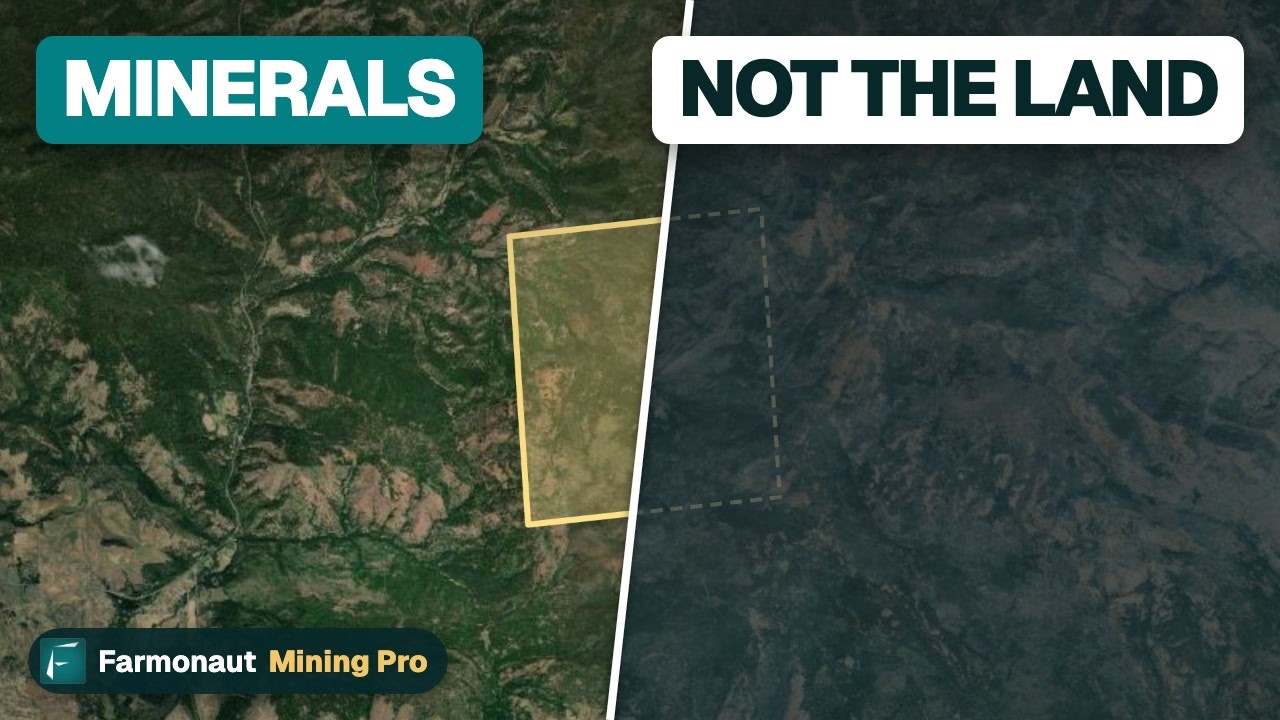
▶ Owning a gold claim is not owning the land, and how to check the ground first · 3:19
Which Arizona land can you claim, and which land needs another route
Land status is the first thing to check, because the route to mineral rights differs by who manages the ground. The Arizona Geological Survey explains that mining claims and leases apply to federal land, while exploration permits and mineral leases apply to Arizona State Trust Land. Private land needs the owner’s agreement, and tribal land has its own rules.
Chart
Who manages Arizona’s land
Per cent of state acreage (2010 State Land Department table)
The Arizona Game and Fish Department table, built on State Land Department data from 2010, shows why a map check matters. Federal land is about 41% of the state, but that includes parks, military land and wildlife refuges, which are generally not where hobby claims are staked. Always confirm with the BLM that a specific section is open to mineral entry.
| Land manager | Share of Arizona (2010 table) | Usual route to minerals |
|---|---|---|
| Tribal lands | 27.6% | Tribal consent and rules; not open claim land |
| Private | 17.5% | Owner’s permission or lease |
| Bureau of Land Management | 16.7% | Federal mining claim, if open to entry |
| National Forest | 15.3% | Federal claim plus Forest Service operating rules |
| State Trust Land | 12.7% | State exploration permit or lease |
Source for the table: the Arizona Wildlife Conservation Strategy. The shares are 2010 figures and may have moved a little since.
Five checks before you pay for a claim
These checks take a few hours and cost little. Run them in this order, and stop if any one fails.
Infographic
Five checks in order
- 1Claim aliveLook up the BLM serial number and fee status.
- 2BoundariesMatch the legal description to the map and monuments.
- 3SurfaceFind who manages the land and any leases.
- 4HistoryRead old mine files and clean-up risks.
- 5PriceAsk for assays and price on data.
Check 1: Is the claim still alive in BLM records?
Ask the seller for the BLM serial number, then look it up in the BLM Mineral and Land Records System (MLRS). The Arizona Geological Survey points researchers to BLM’s LR2000 and Navigator map viewer for claim records. A claim that shows as closed, or one whose maintenance fee was not paid, cannot be sold as a live claim. The BLM warns that failure to pay the fee or file the waiver on time subjects claims to forfeiture by law.
Check 2: Do the boundaries match the ground?
Compare the legal description (township, range, section) with a map and with the monuments on the ground. The location notice must carry a map. Claims that overlap an older claim, a withdrawn area or a private parcel are a common cause of disputes.
Check 3: Who manages the surface, and are there leases on it?
Use the State Land Department parcel viewer and the BLM land status maps to see if the ground is BLM, Forest Service, State Trust or private. Then ask about grazing leases, water rights and roads. A claim over a rancher’s allotment is possible, but you will share the land with the lease holder.
Check 4: What is the history of work and clean-up on it?
Old shafts, adits and waste dumps come with the claim. The Arizona Geological Survey hosts more than 20,000 unpublished mine files and more than 6,800 geologic and mine maps that you can search by district. Read what earlier owners found before you rely on a seller’s story.
Check 5: Does the price match what is known about the ground?
Ask for assay certificates, sample locations and dates. Treat verbal grades as unverified. If there is no data, price the claim as land access plus paperwork, not as a gold deposit.
What it costs to buy and hold Arizona claims
The seller’s asking price is only part of the cost. The BLM filing schedule updated on 9 February 2026 lists, for a new claim, a US$25 processing fee, a US$49 location fee and a US$200 maintenance fee per lode claim. Placer claims pay US$200 for each 20 acres or part of that. The same schedule lists US$15 per claim per transferee to record a transfer of interest, which is the fee that applies when you buy an existing claim by quitclaim deed or bill of sale. The BLM says requirements can change, so check the current schedule on its site before you pay.
Chart
Federal BLM fees per claim
US$ per claim. New lode claim: processing, location, maintenance. Small miner waiver: affidavit. Buying a claim: transfer, per transferee.
After the first year the main cost is the maintenance fee, due by 1 September. The BLM explains that a claimant with 10 or fewer claims nationwide can file a small miner’s waiver, but must then do at least US$100 of work on each claim and record proof by 30 December, with a US$15 processing fee per claim. The Arizona recording step with the county adds its own small fee, which you should confirm with the county recorder.
The calculator below adds these federal figures to the price you are quoted. The example numbers are placeholders; use the real asking price and the number of claims in your deal.
Calculator
What will my claims cost to buy and hold?
Enter the number of claims, the asking price and how long you will hold them.
- Purchase price: $5,000
- BLM transfer filing: $75
- Maintenance fees over the years held: $3,000
- Total on the small miner waiver route (10 or fewer claims): $6,800
Example numbers only. Federal constants (US$15 transfer filing, US$200 maintenance, US$100 work and US$15 affidavit under the small miner waiver) are from BLM, 9 February 2026; county recording fees are not included. Use the real asking price.
What the gold price tells you, and what it does not
Rising prices bring more claims onto the market and raise asking prices, but price alone does not make a claim valuable. The USGS estimates that the average gold price was US$3,300 per troy ounce in 2025, up from US$2,388 in 2024. Kitco showed spot gold near US$4,147 per troy ounce on 15 October 2026, and the price moves every day.
Chart
US average gold price per troy ounce
US$ per troy ounce, 2021 to 2025 (2025 estimated)
A troy ounce is 31.1035 grams. To turn a rumour into a number, ask what the claim could contain: tonnes of rock times grade in grams per tonne (g/t) divided by 31.1035 gives ounces. Without drill or channel-sample data, the tonnes and the grade are guesses. Most small Arizona claims host exploration targets, not a mineral resource.
Land use and water when a claim sits on farm, ranch or forest ground
Many Arizona claims are on grazing allotments or national forest, so plan how mining will share the land. Check seasonal access, stock water, fences and roads before you buy, and write notice periods into the sale agreement where the seller has leases.
- Water: claims near springs, washes or wells need a water plan. The Arizona permitting guide lists separate state permits for surface water, groundwater wells and dams, so ask the Arizona Department of Water Resources what applies before you drill or divert.
- Disturbance: trenches, roads and pads change soil and drainage. Keep the footprint small and record it with dated photos.
- Cover and habitat: use bare ground for access where you can, and plan reclamation as you go.
Access can also decide the value of good ground. Our video on land access shows a survey where most anomalous ground sat under a town, so the rock was good and the site was unmineable.
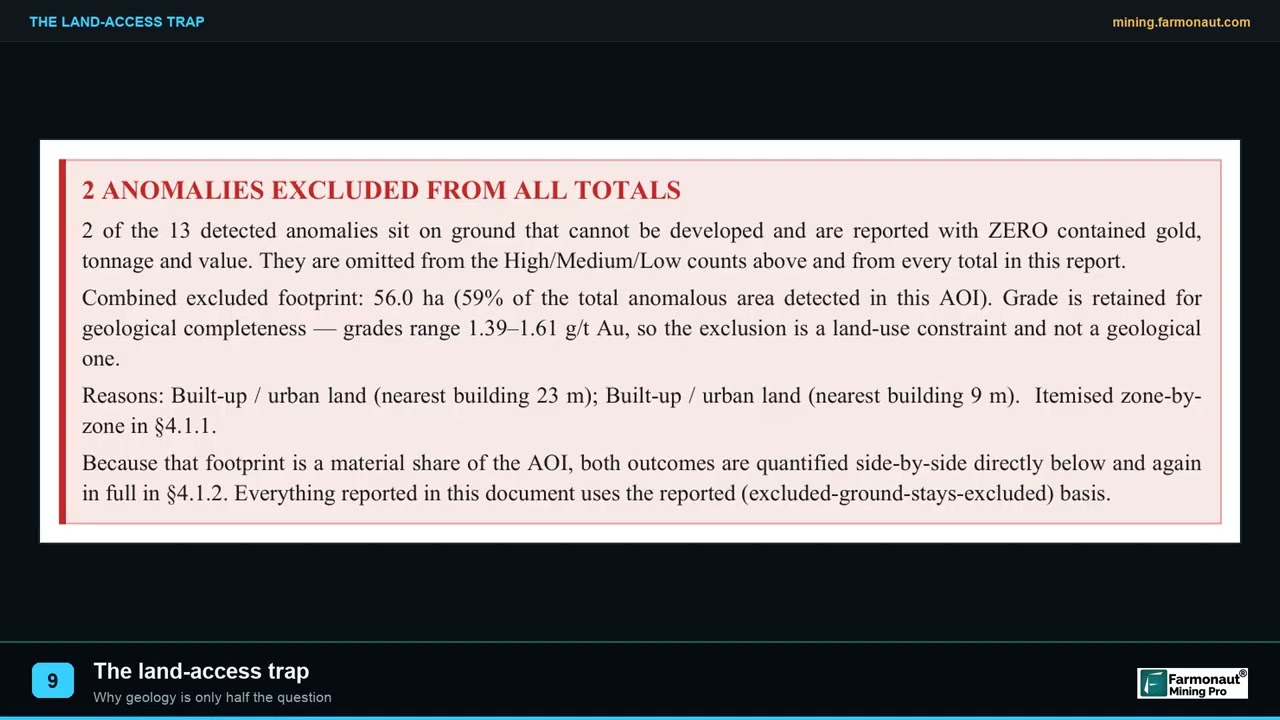
▶ When the gold is under a town: the mining land access trap · 2:05
Permits: what you can do on a claim without telling the BLM
Federal surface rules sort activity into three levels. Casual use is negligible disturbance. Under federal rules it generally includes hand tools, hand panning, non-motorized sluicing and metal detectors and does not include mechanized earth-moving equipment, truck-mounted drilling, chemicals or explosives. The next level is a notice: you must send the BLM a complete notice 15 calendar days before exploration that disturbs 5 acres or less, and you cannot split a project into several notices to avoid a plan. Anything larger, and mining itself, needs a plan of operations and a financial guarantee for reclamation.
On national forest land the Forest Service has its own notice and plan rules, and on State Trust Land you need a state exploration permit or lease, and recreational mining is prohibited. Check with the land manager before you move equipment onto the ground.
Prospecting safety and rules on the ground
Get written permission before you enter private ground, and know the boundaries of public land. Do not use mercury to catch gold; it is toxic to people and to water. Stay out of old workings. The Mine Safety and Health Administration warns that vertical shafts can be hundreds of feet deep and hidden by vegetation, and abandoned mines may hold unstable explosives. Tell someone where you are going and when you will be back, carry water, and treat Arizona summer heat as a hazard in its own right.
Where to find claims and how to read a listing
Claims are advertised by their owners, by brokers and on classified sites, and the listing rarely shows the BLM serial number first. Ask for it, then run the five checks above. If you are comparing Arizona with other states, our guide to placer gold claims for sale in Arizona covers the placer side, our Nevada gold mines for sale list shows how an operating mine differs from a bare claim, and our affordable gold mines for sale page lists lower-priced options. New Mexico, next door, has its own rules, set out in our New Mexico claims guide.
Warning signs in a listing: no serial number, “patented” claimed without a patent number, vague phrases such as “high-grade assays” without a certificate, and pressure to pay before you see the ground.
Screening a claim from space before you pay
Satellite images cannot see gold. They map the rock around it, such as iron staining, clay and faults. That can show whether a claim sits on altered ground or on barren cover, and it also shows roads, washes and land cover. Farmonaut’s satellite-based mineral detection works from a boundary file such as KML or KMZ and produces exploration targets, which are not a resource estimate.
We cover a connected topic in Low Priced Gold Stocks: 7 Checks Before You Judge One.
For a closer look at a related question, see our guide: How to Identify Real Tiger’s Eye: 7 Checks.
Frequently asked questions
Can I buy a gold claim in Arizona?
Yes. You buy the claimant’s interest by quitclaim deed or bill of sale, and file the transfer with the BLM. The BLM schedule lists US$15 per claim per transferee for that filing.
How much does an Arizona gold claim cost?
Asking prices vary widely and are set by sellers, not by a fixed rule. The federal costs are fixed: US$25 processing, US$49 location and US$200 maintenance for a new lode claim, and US$200 each year after, unless a small miner’s waiver applies.
Do I own the land if I buy a claim?
No. The claim covers minerals on public land. Patents are under a moratorium, so surface title cannot be obtained.
How big is a mining claim in Arizona?
A lode claim may be up to 1,500 by 600 feet, about 20 acres. A placer claim may be up to 20 acres per locator, with up to 8 locators, according to the BLM Arizona permitting guide. The BLM charges the placer maintenance fee for each 20 acres or part of that.
When is the maintenance fee due?
By 1 September each year, according to the BLM. Waiver papers are also due by that date, with proof of work by 30 December.
Can I live on my claim?
No. The Arizona Geological Survey states that claims cannot be used as a residence or home site.
Can I pan or use a metal detector without a permit?
Federal rules treat hand tools, hand panning and metal detecting as casual use on BLM land, which needs no notice. Rules differ on State Trust Land, national forest and private land, so check with the manager first.
Where do I record a new claim in Arizona?
The BLM permitting guide says to file the location notice in the county where the claim lies and with the BLM State Office, each within 90 days of location.
Is it safe to enter old mine workings on a claim?
No. Shafts can be hundreds of feet deep and hidden, and old explosives can be unstable. Stay out of old workings.
What if the seller stops paying the fee?
The claim can be forfeited, and the claim you bought would then be worthless. Check the maintenance record in MLRS before you pay and again before each September deadline.
This page is for information only. It is not legal advice or investment advice. Confirm the rules and fees with the BLM, the county recorder and the land manager. Get permission before you enter land, stay out of old mine workings, and never use mercury.
Farmonaut mining
Get a quote to screen your claim area from space
Send a KML or KMZ boundary and request a quote for a satellite screen of the ground.

Mining Pro sample view, synthetic data
Keep reading
Sources
- Arizona Geological Survey, Mineral Rights: azgs.arizona.edu
- Arizona Geological Survey, Gold Prospecting in Arizona: azgs.arizona.edu
- BLM, Annual Maintenance and Assessment: blm.gov
- BLM, Mining Claim Filing and Fee Requirements (9 Feb 2026): blm.gov
- BLM, Arizona Mining and Minerals: blm.gov
- BLM, Arizona Mining Permitting Guide: blm.gov
- Arizona Wildlife Conservation Strategy, ch. 4 (land ownership table): awcs.azgfd.com
- USGS, Mineral Commodity Summaries 2026, Gold: pubs.usgs.gov
- Kitco, Gold, silver rebound (AM Report, 15 Oct 2026): kitco.com
- Cornell LII, 43 CFR 3809.5 (casual use definition): law.cornell.edu
- Cornell LII, 43 CFR 3809.21 (notice): law.cornell.edu
- MSHA, Stay Out – Stay Alive: msha.gov
Discussion
Questions, corrections or field experience? Share them below. First-time comments are reviewed before they appear, and your email is never published.
No comments yet. Be the first to add a question or your experience.

 Critica Metals Limited
 Congo Mining Solutions
 Mining SARL
 SenGold Invest SAS
 Sania Corporation
 Sean Mining Limited
 NTS Group (Pty) Ltd
 Mine4Africa
 Lithspo Minerals Limited
 Tintina Mining Group
 Dalgety Minerals Pty Ltd
 Vortex Minerals Pty Ltd
 Faith At Work (Pty) Ltd
 Geotech Mining Solutions plc
 Vulcan International Limited
 Kidepo Associates
 GKY Mining
 Alkimy SARL
 Double A Trading
 GemSprout Metals Limited
 Qader Group
 Ileys General Trading











