

Table of Contents
- Summary: The Strategic Importance of Iron Ore and Manganese – A 2026 Perspective
- Trivia #1
- Foundations of Modern Industry: Iron Ore and Manganese
- Sandur Manganese Iron Ore: India’s Strategic Resource
- 2026 Industry Trends: Demand, Production & Growth
- Defence and Infrastructure: Critical Roles of Iron Ore and Manganese
- Strategic Role Comparison Table
- Sustainability & Innovation: The Future of Mining in Sandur and Beyond
- Satellite, AI, and Digital Transformation in Mining: The Farmonaut Lens
- Trivia #2
- Future Outlook: Sandur, India, and the Global Stage in 2026 & Beyond
- Frequently Asked Questions
- Farmonaut Subscriptions
Iron Ore and Manganese: Sandur’s Strategic Edge for 2026
Summary: The Strategic Importance of Iron Ore and Manganese – A 2026 Perspective
Iron ore and manganese ore are the cornerstone minerals in shaping global industry, infrastructure, and future defence advancement. The significance of these two minerals extends far beyond being mere raw materials. Sandur manganese iron ore, a unique deposit located in Karnataka, India, exemplifies the immense strategic potential and value of indigenous minerals for 2025 and beyond. As the world pivots towards sustainable growth and national resilience, understanding the evolving roles of iron ore and manganese in manufacturing, defence, and infrastructure is pivotal—with Sandur at the epicenter of this transformation.
“By 2026, India’s manganese demand is expected to reach 4.5 million tonnes driven by infrastructure and defence expansion.”



Foundations of Modern Industry: Iron Ore and Manganese
The foundations of 21st-century industrial society rest upon the availability and use of iron ore and manganese. As cornerstone materials, iron ore and manganese ore are not only essential for producing steel—the backbone of modern infrastructure—but also critical for technological advancement, from manufacturing components to the construction of buildings, railways, bridges, and defence hardware.
Iron ore is primarily the chief raw material used for the production of steel. Without it, the immense global network of transportation systems, industrial plants, and civil projects would simply not exist. The worldwide demand for iron ore and manganese remains robust, continually driven by burgeoning urbanization, technological expansion, and modernization initiatives.
- Manganese is equally important—serving as a vital alloying element in steel-making processes, enhancing steel’s tensile strength, toughness, and resistance to wear and corrosion.
- Both iron ore and manganese ore are often found together, especially in unique deposits like those in Sandur, Karnataka.
- The importance of these two minerals is integral for industries spanning construction, defence, and automotive sectors.
As countries worldwide seek to balance economic growth with sustainability, ensuring steady supplies of these minerals remains a priority, particularly for industrial autonomy and national security.

Sandur Manganese Iron Ore: India’s Strategic Resource
The Sandur region, located in Karnataka, India, possesses one of the world’s most significant manganese-rich iron ore deposits. The unique geological composition of the Sandur manganese iron ore region offers producers two essential metals—iron and manganese—from a single mining operation. This dual benefit yields:
- High iron content—necessary for large-scale steel production in India and worldwide
- Substantial manganese concentrations—critical for producing advanced alloy steels and special hardware
This rare combination enables producers to streamline supply chains, reducing dependence on imported ores and improving cost efficiencies. The Sandur manganese iron ore operations are at the crux of India’s Atmanirbhar Bharat initiative, aimed at building indigenous mineral autonomy.
Modern mining techniques in Sandur in 2025-2026 embrace sustainable practices, with a focus on:
- Precision extraction—to minimize environmental impact
- Waste reduction and recycling of by-products
- Biodiversity stewardship to maintain local ecology
The region’s evolving commitment to environmental responsibility positions Sandur manganese iron ore as a model for balancing resource development with sustainability.

2026 Industry Trends: Demand, Production & Growth
Globally, the iron ore and manganese demand is set to grow at substantial rates, particularly in emerging markets like India. Infrastructure growth, defence modernization, and increased steel production will continue to drive mining and supply strategies through 2026.
- Urbanization & Industrial Projects: Rapid city expansion and large-scale construction projects mean the need for iron-based products and alloys will remain high.
- Sustainable Development: There’s an increasing emphasis on resource efficiency and circular economy principles, especially in technologically-advanced mining regions.
- National Security: Control of domestic iron ore and manganese ore reserves gives countries a critical edge in times of global uncertainty.
India, with the Sandur region at its heart, is expected to see the strongest demand growth, outpacing many traditional producers. Notably, Sandur’s integrated operations offer a competitive advantage for domestic steel and defence sectors by lowering costs and ensuring continuous supply chains—even during external market fluctuations.
“Sandur’s iron ore output grew over 20% from 2021 to 2023, spearheading India’s steel industry growth.”

Farmonaut’s satellite-based API and developer documentation empower mining businesses to integrate real-time resource tracking and environmental monitoring into their operations.
For mining lenders and insurers, our crop loan and insurance verification platform offers secure satellite-based validations—reducing fraud risk and accelerating credit access.

Defence and Infrastructure: Critical Roles of Iron Ore and Manganese
The role of iron ore and manganese in defence and infrastructure is impossible to overstate. The hardness, toughness, and corrosion resistance imparted by manganese-alloyed steels are vital for modern defence capabilities. Bridges and highways constructed of these advanced alloys can withstand heavy traffic and harsh environments, reducing maintenance costs and improving safety.
- Military Hardware: Everything from armored vehicles to ships and weapons systems relies on manganese-enhanced steel for performance.
- Strategic Autonomy: Local access to resources like Sandur manganese iron ore ensures uninterrupted defence production, insulating vital sectors from supply disruptions.
- Infrastructure Impact: Projects in Karnataka using regionally sourced ores contribute to India’s national security and rapid infrastructure buildout.
In 2026, as geopolitical realities dictate national priorities, nations that control substantial iron ore and manganese deposits possess a true strategic edge—ensuring economic resilience and independent defence development.

Strategic Role Comparison Table: Iron Ore and Manganese 2023-2026
Understanding the evolving strategic importance of iron ore and manganese is best achieved through direct comparison across their key applications and impact factors. This table outlines how each resource shapes industry, defence, and sustainability trajectories from now through 2026.
| Resource | Main Application | Estimated Global Demand Growth (2023-2026, %) | Strategic Importance in Defence | Infrastructure Impact Score (1-10) | Sustainability Measures Adopted | Outlook 2026 |
|---|---|---|---|---|---|---|
| Iron Ore | Steelmaking, Construction | 6–8% | High (Armor, Vehicles, Weapons Platforms) | 10 | Yes – Focus on reduced emissions, digital monitoring, waste recycling | Positive |
| Manganese | Steel Alloying, Batteries | 8–10% | Very High (Hardness for Military Steel, Battery Tech) | 8 | Yes – Focus on eco-friendly beneficiation, circular supply chain | Positive |
*Scores and projections are estimated for industry insights. “Sustainability Measures Adopted” includes digitization, rehabilitation, traceability, and ESG compliance, with regional variation.

Sustainability & Innovation: The Future of Mining in Sandur and Beyond
The sustainable extraction of iron ore and manganese is no longer an option—it’s a necessity. The Sandur manganese iron ore operations exemplify an industry shift toward balancing economic development with environmental stewardship. Some major techniques and practices shaping the future include:
- Eco-Friendly Extraction: Using precision drills, controlled blasting, and digital mapping to minimize habitat loss and footprint.
- Resource Circularity: Recycling of mining tailings; recovering valuable by-products for reuse in steel and battery industries.
- Carbon Footprint Reduction: Adopting smart fleet management, low-emission vehicles, and real-time monitoring to lower greenhouse gas intensity.
Discover how Farmonaut’s carbon footprinting service enables mining and industrial companies to track their impact, stay compliant, and adopt best sustainability practices. - Traceability & Blockchain: Ensuring that every batch of ore is traced through the supply chain—vital for both regulatory compliance and international trade.
Explore Farmonaut’s product traceability solution for secure mining resource flows and to build consumer & governmental trust. - Innovation in Beneficiation: Increasing ore grade and recovery rates via AI-driven ore sorting, smart water usage, and on-site processing advancements.
Moreover, the shift toward green steel production—using hydrogen and renewables instead of carbon-intensive coking coal—will be pivotal for climate goals, with manganese’s role in stabilizing new steel formulations even more important in 2026.

Satellite, AI, and Digital Transformation in Mining: The Farmonaut Lens
In the fast-evolving landscape of mining, satellite technology, and AI-powered analytics drive smarter, safer, and more sustainable operations.
-
Satellite-Based Monitoring:
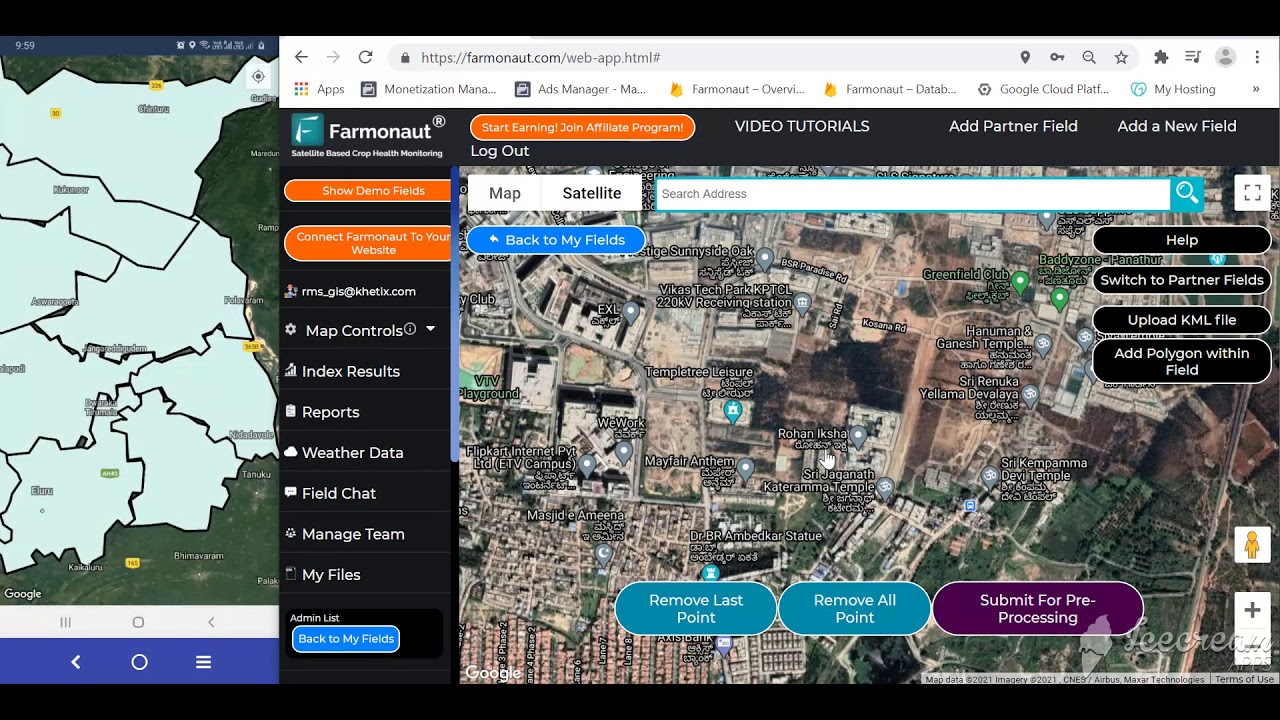
We at Farmonaut empower mining companies, government agencies, and infrastructure developers to monitor Sandur manganese iron ore sites in real time. Our solutions utilize high-resolution, multispectral imagery for vegetation, water, and land-use monitoring. -
AI-Driven Advisory:
Farmonaut’s Jeevn AI system delivers tailored insights for resource allocation, weather risk, and extraction planning—boosting output and sustainability. -
Blockchain & Traceability:
By integrating blockchain into our platform, we ensure transparency and security in ore provenance—a key requirement for international market access, and compliance. -
Fleet and Resource Management:
Our digital tools for fleet management help optimize mining logistics, reduce equipment downtime, and increase overall mining operation efficiency. -
Environmental Regulators:
Real-time carbon footprinting, soil erosion detection, and reclamation monitoring allow for adaptive stewardship of Sandur and other critical mining regions, supporting long-term viability. -
Large Scale Project Decision Makers:
Farmonaut’s large scale management solutions are ideal for topographical mapping, impact analysis, and operational oversight across vast mining concessions.
Our mission is to make these advanced technologies and insights accessible and affordable for all—delivering greater productivity, transparency, and sustainability to the iron ore and manganese mining sectors.
Future Outlook: Sandur, India, and the Global Stage in 2026 & Beyond
The journey of iron ore and manganese from raw materials in the Sandur region to finished steel beams in skyscrapers and high-tech defence equipment mirrors the evolution of both industry and national capability.
- Sandur manganese iron ore will remain a critical input for India’s continued industrialization and infrastructure modernization through 2026 and beyond.
- Leadership in Sustainability: Sandur’s foresight in adopting environmental standards and circularity will become the norm for global mining regions.
- Innovation as Differentiator: New mineral extraction and beneficiation technologies will further improve efficiency, reduce costs, and meet escalating international sustainability standards.
- Strategic Security: As international competition over critical minerals intensifies, India’s ability to harness indigenous resources becomes more valuable—and Sandur is at the center of this push for strategic autonomy.
India, by leveraging Sandur manganese iron ore and allied advanced digital practices, stands poised to not only meet domestic demand but also to emerge as a global leader in critical mineral stewardship for industry, defence, and environmental responsibility in 2026 and well into the future.
Frequently Asked Questions: Iron Ore and Manganese in 2026
1. Why are iron ore and manganese so vital to India’s industrial and defence sectors?
Iron ore and manganese ore are the primary inputs for steel, the backbone of India’s construction, defence, and transport sectors. Manganese additionally boosts steel hardness and longevity—crucial for high-tensile military and infrastructure applications.
2. What makes Sandur manganese iron ore deposits unique?
The Sandur region offers exceptionally high content of both iron and manganese in close proximity, allowing cost-effective, sustainable extraction for multiple industries and reducing reliance on imports.
3. How is sustainability being managed at Sandur’s mines?
Sandur operations prioritize balanced extraction, biodiversity, and waste reduction techniques to minimize environmental impact, using real-time digital monitoring and eco-friendly technologies.
4. Will the demand for iron ore and manganese continue to grow after 2026?
Yes. As infrastructure, urbanization, and defence needs expand—not just in India but worldwide—these critical minerals will remain highly sought after.
5. How do satellite and AI tools benefit mining and resource sectors?
Advanced satellite and AI-driven tools—such as those provided by Farmonaut—enable real-time mine monitoring, yield prediction, environmental compliance, fleet optimization, and risk reduction. This boosts productivity and sustains compliance for mining operators and governments.
6. How does traceability impact supply chain security?
Traceability, particularly when powered by blockchain, authenticates the origin, journey, and ESG standards of each batch of iron or manganese ore. This combats illicit trading, builds trust, and is vital for international trade—see details on Farmonaut’s traceability solution here.
Smart Subscription Options for Advanced Mining, Infrastructure, and Defence Insight
We provide a scalable, cost-effective subscription model for businesses, institutional users, and governments to access advanced satellite, AI, and blockchain tools for mining, infrastructure, and resource strategy. Choose the plan that meets your operational, security, or sustainability goals:
Conclusion: Navigating 2026 with Iron Ore and Manganese – Sandur’s Enduring Strategic Legacy
As we move toward 2026, iron ore and manganese are at the heart of industrial development, defence modernization, and infrastructure growth. The Sandur manganese iron ore deposits in Karnataka will continue to shape sectors from construction to strategic security—bolstering both India’s and the global economy’s resilience. Strategic mining, advanced digital tools, and sustainable innovation will ensure that this legacy not only fuels growth but also preserves environmental stewardship for generations to come.
Ready to optimize your mining, infrastructure, or defence resource management? Explore the power of Farmonaut’s Satellite & AI Platform today.
Discussion
Questions, corrections or field experience? Share them below. First-time comments are reviewed before they appear, and your email is never published.
No comments yet. Be the first to add a question or your experience.

 Imperial Impex FZE
 Congo Mining Solutions
 Mining SARL
 SenGold Invest SAS
 Sania Corporation
 Sean Mining Limited
 NTS Group (Pty) Ltd
 Mine4Africa
 Lithspo Minerals Limited
 Tintina Mining Group
 Dalgety Minerals Pty Ltd
 Vortex Minerals Pty Ltd
 Faith At Work (Pty) Ltd
 Geotech Mining Solutions plc
 Vulcan International Limited
 Kidepo Associates
 GKY Mining
 Alkimy SARL
 Double A Trading
 GemSprout Metals Limited
 Qader Group
 Ileys General Trading
 SG Gold Mining LLC
