

Mining partnerships · Structures and checks
Mining Joint Venture: Structures, Terms, Partner Checks
A mining joint venture splits cost, risk and output by percentage. Pick a contract, company or partnership, agree dilution and deadlock rules, and check the partner’s owners, funds and record before you sign.
Key takeaways
- Nevada Gold Mines is split 61.5% Barrick and 38.5% Newmont; a 10 August 2026 deal added three projects and a US$1.95 billion cash payment without changing the split (Barrick, 2025; Skillings, 2026).
- Of 130 mining deals SRK documented for 2020 to 2025, 5 were JV formations and 10 were farm-ins or earn-ins; the database may undercount small deals (SRK, February 2026).
- Canadian law firm McCarthy Tétrault calls the unincorporated JV the simplest and cheapest form, suited to early exploration, with the highest bankruptcy exposure (2019).
- At Gold Point, Nevada, an earn-in climbs 25%, 45%, 65% and 90% against US$3,000,000 of exploration spend over 36 months (GGL Resources, March 2026).
- OFAC’s 50 Percent Rule looks at ownership, not control, so screen a partner’s owners, not just the partner (OFAC FAQ 398).
In this article
- What a mining joint venture is and why companies form one
- Types of mining joint venture structure
- Earn-in and farm-in joint ventures: how stages work
- Key terms in a mining joint venture agreement
- Mining joint ventures compared: five public examples
- How to check a mining joint venture partner
- Why land access can end a mining joint venture before it starts
- A joint venture with a local licence holder or a state partner
- What satellite data adds before you sign
- Setting up a mining joint venture in seven steps
- Common mistakes in mining joint ventures
- Frequently asked questions
A mining joint venture (JV) is an agreement in which two or more parties pool money, ground, skills or a market to find, build or run a mine, and each holds a stated percentage of the project. The split is usually set by who pays and who brings the asset. At Nevada Gold Mines, for example, Barrick reports a 61.5% share, and the other 38.5% belongs to Newmont (Barrick Annual Report, 2025). This guide is for licence holders, consultants and investors who are weighing a partner. It covers the structures, the terms that decide who wins or loses, worked examples from filings, and how to check a partner before you sign.
Everything here is general information. A JV agreement is a long legal document, and the rules differ by country, so have a mining lawyer review yours.
What a mining joint venture is and why companies form one
Mining is slow, expensive and uncertain, so few owners can fund every stage alone. A JV splits that burden. The most common pairings are these:
- Owner of ground plus a funder. A junior company or private licence holder has a promising area but no money to drill. A larger company pays for exploration in return for a share of the project.
- Two producers next door. Neighbouring operators combine their tenements to share one mill, one pit or one set of infrastructure.
- Company plus a state partner. Many governments hold a minority stake in large mines, usually through a state-owned company.
- Technical partner plus local licence holder. The licence holder knows the district and the permitting route, and the partner brings engineering and capital.
JVs are a small slice of the deals SRK tracked. SRK’s database of 130 documented public transactions (many of them large) from 2020 to 2025 records only 5 new JV formations (4%), plus 10 farm-in or earn-in deals (8%). SRK warns that the database may undercount smaller farm-ins and private sales, so the real number is higher (SRK Consulting, M&A Trends 2020 to 2025, February 2026). The deals that stand out are the big ones, where a JV is the only way to share a very large capital bill.
Types of mining joint venture structure
The legal vehicle matters more than most first-time partners expect. It decides who is liable, how profits are taxed and what happens if a partner goes bankrupt. A 2019 guide by the Canadian law firm McCarthy Tétrault lists three forms used in Canada: unincorporated, incorporated and limited partnership. Other countries use similar choices under different names (McCarthy Tétrault via Legal 500, 4 March 2019).
Chart
JV formations are a small share of SRK’s 130 tracked deals
Number of deals by type, 130 documented transactions, 2020 to 2025
Unincorporated joint venture
This is a contract. The partners hold undivided interests in the project assets, and legal title sits with one partner or a title-holding company. The authors call it the simplest, quickest and usually cheapest form, with the most room to write your own rules. The cost of that flexibility is gaps: if the agreement is silent, corporate law does not fill the hole. Partners can also face joint liability for third-party claims, and a partner’s bankruptcy is the main worry because a court may disregard the JV agreement. For tax, each partner is taxed directly on its share. This form suits early exploration best.
Incorporated joint venture
A separate company holds the project, and the partners are its shareholders. Liability should stay inside the company. Disputes are often easier to manage under company law, but you lose some contractual flexibility, directors appointed by a partner may struggle to balance their duties to the company with that partner’s interests, and the company is taxed separately, which can trap losses inside it.
Limited partnership
A statutory hybrid with one or more general partners and limited partners. Limited partners who stay out of management are liable only up to what they put in. The partnership passes profits and losses through to the partners, which gives tax flexibility, but it is probably the most complicated and expensive form to set up.
| Factor | Unincorporated | Incorporated | Limited partnership |
|---|---|---|---|
| Set-up cost and speed | Lowest, fastest | Statutory filings needed | Most complex and costly |
| Contract freedom | Greatest | Limited by company law | Substantial, through agreements |
| Liability | Can be joint | Generally limited to the company | Limited for limited partners |
| Tax | Partners taxed directly | Company taxed separately | Pass-through |
| Partner bankruptcy risk | Highest exposure | Lower | Lower |
| Typical fit | Early exploration | Where partner interests may diverge | Where limited liability and pass-through tax both matter |
Source for the table: McCarthy Tétrault via Legal 500, 4 March 2019. Check the current law of your own country, because tax rules change.
Real large projects often use a company or LLC. Nevada Gold Mines, for instance, is described in the August 2026 deal reports as a venture to which projects are contributed under an amended LLC agreement, which is a company-style vehicle (Skillings Mining Review).
Earn-in and farm-in joint ventures: how stages work
An earn-in (or farm-in) is the usual first step for ground that is not yet drilled. The funder does not buy an interest. It earns one by spending a set amount of money in a set time. If it stops, it earns nothing more, and the owner keeps the ground. Two public examples show the pattern.
Chart
Gold Point earn-in: interest earned by month
Nelson Resources’ cumulative interest, percent
Gold Point, Nevada: a staircase to 90%
GGL Resources (TSX Venture: GGL) signed an option with ASX-listed Nelson Resources over its Gold Point gold-silver project in Nevada. The deal was first announced on 11 December 2025, revised on 16 March 2026 and closed on 24 March 2026 (GGL Resources, 24 March 2026). Under the March terms, Nelson takes 25% on signing for cash and shares and can then earn further interests:
- Stage 1, to 45%: within 12 months, US$250,000 of exploration spending plus cash payments.
- Stage 2, to 65%: within 24 months, a further US$750,000 of exploration spending.
- Stage 3, to 90%: within 36 months, a further US$2,000,000 of exploration spending and US$500,000 cash to GGL.
Total earn-in spending is US$3,000,000. If a stage is not completed, GGL may buy back Nelson’s interest for US$1.00. A 2% net smelter return (NSR) royalty applies, and Nelson may buy back half of it for up to US$1,000,000. Once Nelson holds 90%, the project becomes a JV with each party paying its pro-rata share of costs (GGL Resources, 16 March 2026). An NSR royalty is a share of revenue from sales, paid after smelting and refining charges and without a share of the costs.
Drummond, Queensland: earn-in with a dilution clause
In September 2018 Andromeda Metals signed a binding earn-in and exploration JV on its Drummond gold project with Evolution Mining. Evolution paid A$300,000 on signing and could earn 51% by sole funding A$2.0 million within two years. It could then elect to reach 80% by paying A$200,000 and spending A$4.0 million over a further two years. Under the 2018 terms, Evolution was to act as manager and operator while it sole funded the work. After the sole-funding period, any party that does not contribute is diluted under a standard industry formula, and a party diluted below 10% has its interest converted into a 2% NSR royalty capped at A$10 million (ASX announcement, Andromeda Metals, 3 September 2018).
The two deals look different but share one idea: money buys equity in steps, and each step is a decision the funder can walk away from. If you own the ground, you give up control in stages and you should price each step against what the data could be worth if the work succeeds.
Key terms in a mining joint venture agreement
Most disputes trace back to a handful of clauses. Read each one as if the project had just gone badly, because that is when the clauses get used.
Chart
Exploration spend the funder must add at Gold Point
Cumulative exploration spending required, US$ thousand
Contributions, programmes and cash calls
Each partner funds its share of an agreed work programme and budget. The operator sends a cash call, a written request for each partner’s share of the next period’s cost. The agreement should say how fast a partner must pay, which costs the operator may charge, and who approves a budget increase. Without a cap on overruns, the operator can commit the partners to spending they did not vote for.
Dilution when a partner stops paying
If a partner does not pay its share, its percentage falls. Dilution clauses usually work from a formula based on each party’s contributions, and many deals also state a floor. In the 2018 Drummond terms, that floor is 10%, below which the interest turns into a royalty. The calculator below shows the common straight-line approach: your new interest is your past contribution plus your new contribution, divided by the total contributed. Each agreement defines its own formula, so treat the result as an estimate and read the clause.
Operator, manager and the management committee
One partner normally acts as operator, running the field work and paying the bills, and a management committee votes on budgets and major decisions. Check three things: how votes are weighted (by percentage or one vote each), what needs a unanimous vote or a super-majority (a sale of the project, a change of plan, a debt facility), and how the operator can be replaced. At Oyu Tolgoi in Mongolia, Rio Tinto holds 66% of Oyu Tolgoi LLC and the Government of Mongolia holds 34% through Erdenes Oyu Tolgoi. A 30 June 2026 Rio Tinto release says the Shareholders Agreement requires periodic review of the shareholder loan interest rate, and mentions an agreement in principle on management fees reached in May (Rio Tinto, Form 6-K exhibit, 30 June 2026). Fees, loans and their review dates are things worth writing down early.
Deadlock, pre-emption and transfers
A deadlock happens when partners with equal votes cannot agree. Agreements handle it through escalation to senior executives, mediation or arbitration, and sometimes a buy-sell clause where one partner names a price and the other must either buy or sell at it. A pre-emption (right of first refusal) clause lets a partner buy any interest the other wants to sell before an outsider can. A change-of-control clause covers the case where a partner is itself taken over. In August 2026 Barrick and Newmont agreed that three projects would join Nevada Gold Mines, with Newmont paying Barrick US$1.95 billion in cash. The ownership split stayed at 61.5% and 38.5%, the companies said the deal ended all outstanding disputes about the venture, and governance terms were revised (Skillings Mining Review). Even a long-running venture between two large producers needed its terms reset.
Royalties and buy-backs on the ground
Old royalties follow the ground into any JV. Gold Point lists several existing NSRs on its claim blocks, each with different holders and buy-back rights, and the GGL release spells each one out. Before you enter a JV, list every royalty, option and lien on the tenure and ask who pays them. If you are weighing royalty income instead of a JV, see our guide to gold royalty companies.
Exit, sale and decommissioning
Plan the exit when you sign. Can a partner sell to a third party, and does the other partner get a first offer? Who pays for closure and reclamation (cleaning up and restoring the site) if the JV ends? What happens to the data? If you later want to sell your interest or the whole property, our guide on how to sell a mine covers valuation and deal types.
Calculator
How far does my interest fall if I skip a cash call?
Enter your own numbers. This uses a simple straight-line formula; your agreement may differ.
- Partner interest after the programme: 78.6
- Percentage points lost: 8.6
- Points above the royalty threshold: 11.4
Example values only, not a benchmark. Many agreements dilute by contributions: new interest = (old interest x spend to date + new contribution) / (spend to date + new budget). The 10% line is the conversion threshold used in the Drummond deal (ASX, 3 September 2018); yours may differ. Amounts in US$.
Mining joint ventures compared: five public examples
The table below puts public terms side by side. Every row comes from a company filing or a news report opened for this guide, with the date of the source. Percentages and terms change, so check the latest filing before you rely on any of them.
Chart
Lead partner holds 55% to 66% in these ventures
Percentage held by the larger partner
| Venture | Partners and split | Type | Detail worth noting |
|---|---|---|---|
| Nevada Gold Mines, USA | Barrick 61.5%, Newmont 38.5% | Contributed assets in a company-style venture | Aug 2026 deal adds three projects, US$1.95 billion cash to Barrick, ownership unchanged |
| Oyu Tolgoi, Mongolia | Rio Tinto 66%, Mongolia 34% via Erdenes Oyu Tolgoi | Company with state partner | Shareholders Agreement requires periodic review of the shareholder loan rate (June 2026) |
| Resolution Copper, USA | Rio Tinto 55%, BHP 45% | Joint venture between two majors | Land exchange completed in 2026: about 2,400 acres received, more than 5,000 acres transferred |
| Drummond, Australia | Evolution could earn 51%, then up to 80% (2018 terms) | Earn-in | Dilution below 10% converts to a 2% NSR royalty capped at A$10 million (2018 terms) |
| Gold Point, USA | Nelson earns 25%, then 45%, 65%, 90% | Option and earn-in | US$3,000,000 of exploration spend in three stages; US$1.00 buy-back if a stage is missed |
Sources: Barrick Annual Report 2025 and Skillings Mining Review (Nevada Gold Mines); Rio Tinto Form 6-K, 30 June 2026 (Oyu Tolgoi); North American Mining, April 2026 (Resolution Copper); ASX announcement, 3 September 2018 (Drummond); GGL Resources, March 2026 (Gold Point).
Resolution Copper shows how a JV between two majors can also depend on land. The partners received roughly 2,400 acres next to the historic Magma mine and transferred more than 5,000 acres of land to be held in National Conservation Areas. Further technical studies and permitting are still ahead (North American Mining, April 2026). A JV partner can share cost and risk, but it cannot remove the need for the permits themselves.
How to check a mining joint venture partner
A JV lasts for years, often longer than a marriage in practice, so the partner matters as much as the terms. Use the checklist below before you exchange data or sign.
- Who really owns the partner. Ask for the ownership chain to the individuals or listed parent. In the US, the Treasury’s OFAC 50 Percent Rule looks at ownership rather than control, so a company owned 50% or more in total by sanctioned persons is itself restricted. OFAC may also designate an entity it considers controlled on other grounds (OFAC FAQ 398). Screen the partner and its owners against the sanctions lists of every country you trade in.
- Money. Can the partner fund its share of the next two budgets? For a listed company, read the latest accounts and cash position on SEC EDGAR, SEDAR+ or the ASX announcements platform. For a private company, ask for bank confirmation or audited accounts.
- Track record. Has it built or run a mine of this type and size? Ask for named references and find out whether previous partners stayed in the venture.
- Legal standing. Search litigation, insolvency records and past disputes with former partners or regulators.
- Licences and land. Confirm who holds title, whether fees are paid and whether the surface land is accessible. A strong grade on a map does not help if the ground is blocked.
- Community and environment. Look at the partner’s record with local communities, water and reclamation, since problems at the site will fall on every JV partner.
- Technical honesty. Ask whether its public statements use recognised reporting standards, such as JORC in Australia or NI 43-101 in Canada, and who the named qualified persons are.
For buyers of small properties, our checklist on checking title, geology and risk before buying a gold mine covers the same ground from the other side of the table.
Why land access can end a mining joint venture before it starts
Owning a licence or claim does not always give you the right to mine the surface. In the US, a claim on federal land gives a right to the minerals, not title to the land, and other users may hold rights on top. In Europe, Africa and Australia, landowners, permits and local approvals decide the same question. The video below uses a survey in which about 59% of the anomalous ground sat under a town, which the narrator calls a land access trap. Raise this with a prospective partner before you spend on drilling.
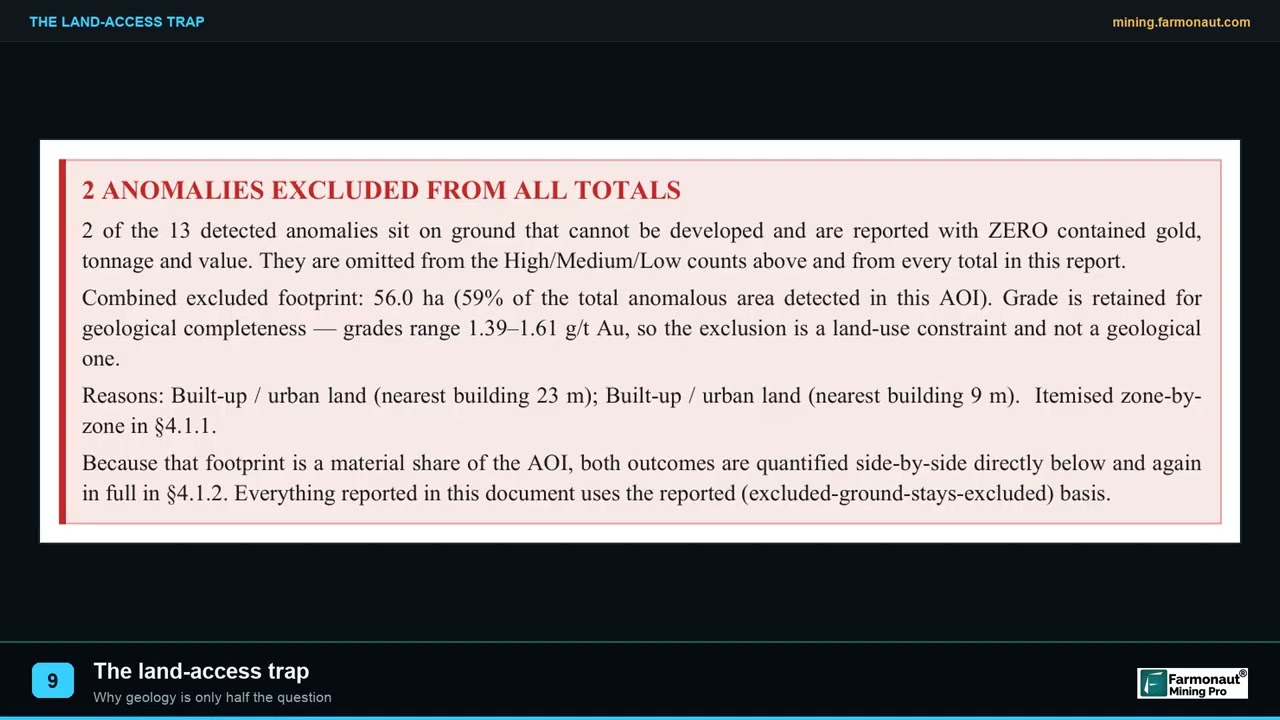
▶ A survey where 59% of the anomalous ground sat under a town, blocked by land access. · 2:05
A joint venture with a local licence holder or a state partner
In many countries a foreign company cannot hold certain licences directly, or the rules favour local ownership. A common route is a JV with a local holder. In other places the state expects a minority stake, paid for or carried by the partner, as in the Mongolian example above. Before you agree, check the rules in the country’s mining act and cadastre (the official licence register) on three points: who may hold the licence, whether a transfer or a JV share needs ministry approval, and what share of revenue goes to royalties and taxes. Our guide to the mining concession explains the rights a concession gives and the terms it carries.
If you are a licence owner looking for a funder rather than a buyer, a JV or earn-in can also be a bridge to a larger raise. Funds that back mining projects have their own selection criteria, which we summarise in our guide to mining private equity and venture funds.

▶ Explains how foreigners can reach small-scale mining licences in Africa. · 5:16
What satellite data adds before you sign
A JV partner pays for the right to explore your ground, so the evidence about that ground sets the price. Satellite screening can map alteration, structure and surface changes across a licence before any drilling, and it can give both sides the same picture at the start. Farmonaut Mining Pro turns a licence boundary into exploration-target maps from satellite data. These are targets that sit ahead of a resource estimate, not a reserve or a resource under JORC or NI 43-101. Ground-checking and drilling are still needed. Our guide to types of ore deposits helps you match the deposit style to the data.
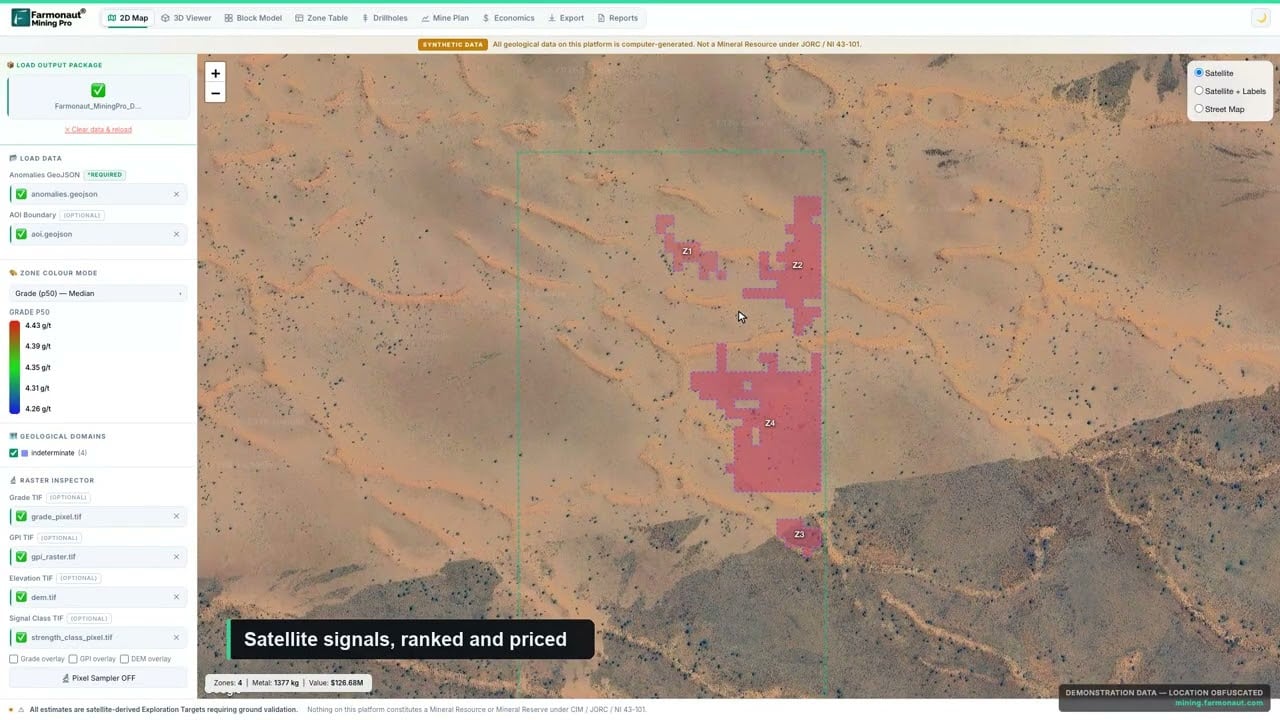
▶ A quick look at Farmonaut Mining Pro and how it screens a licence boundary from satellite data. · 4:56
Setting up a mining joint venture in seven steps
Most JVs follow the same sequence, whether the partners are a junior and a major or two family licence holders.
Infographic
Setting up a JV in seven steps
- 1Define the assetTenements, permits, data, royalties.
- 2Agree contributionsGround, cash, services, market.
- 3Sign a term sheetWith confidentiality and exclusivity.
- 4Run due diligenceBoth sides check each other.
- 5Choose the structureContract, company or partnership.
- 6Negotiate termsDilution, operator, deadlock, exit.
- 7Close and registerApprovals, recording, data transfer.
- Define the asset. List tenements, permits, data, royalties and liabilities.
- Agree what each side brings. Ground, cash, technical services, market access.
- Sign a non-binding term sheet with exclusivity for a fixed number of weeks and a confidentiality agreement.
- Run due diligence both ways: the funder checks the ground, and the owner checks the funder.
- Choose the structure. Contract, company or partnership, using the tax and liability points above.
- Negotiate the long-form agreement. Contributions, dilution, operator, deadlock, exit.
- Close and register. Get regulator approvals, record the transfer where needed and transfer the data.
For US unpatented claims, a transfer of interest is filed with the Bureau of Land Management (a quit claim deed or other legal document), and state law decides when the transfer takes effect, so a JV that gives a partner an interest in claims triggers those filings (BLM, Transfers of Interest).
Common mistakes in mining joint ventures
- Vague dilution wording. Agree the exact formula and give a worked example in a schedule.
- No cap on operator costs. Without a budget limit, one partner can run up costs for all.
- Ignoring older royalties. Existing NSRs reduce what every partner receives.
- No deadlock route. A 50/50 JV without a tie-break can freeze for years.
- Weak exit terms. If you cannot sell your interest, you hold a share you cannot cash in.
- Skipping partner checks. A partner’s money problem becomes everyone’s problem, especially in an unincorporated JV.
Nothing on this page is advice about buying or selling any listed company. Companies named here are examples taken from public filings.
Frequently asked questions
What is a mining joint venture?
It is an arrangement in which two or more parties share the cost, risk and output of a mineral project in set percentages. It can be a simple contract, a shared company or a partnership, as set out in the McCarthy Tétrault guide.
What is the difference between a joint venture and an earn-in?
In a plain JV each party already holds an interest. In an earn-in, the funder earns its interest by spending money in stages. At Gold Point, Nelson Resources moves from 25% to 45%, 65% and 90% by meeting spending and time targets.
What is dilution in a mining joint venture?
Dilution is the fall in a partner’s percentage when it does not fund its share of a programme. The 2018 Drummond agreement used a standard industry formula, and a party below 10% was to convert to a 2% NSR royalty.
Which structure is best for a small exploration project?
An unincorporated JV is usually quickest and cheapest, and McCarthy Tétrault suggests it suits early exploration. A weaker partner raises bankruptcy risk, so consider a company or partnership if the partner’s finances are uncertain.
What is a typical split in a mining joint venture?
There is no standard split. Published examples include 61.5% and 38.5% at Nevada Gold Mines, 66% and 34% at Oyu Tolgoi and 55% and 45% at Resolution Copper. In earn-ins, 51% is a common first target, as in the Drummond deal.
Who operates a mining joint venture?
One partner is usually named operator, often the majority holder. Under the 2018 Drummond terms, Evolution was to manage and operate while it sole funded the work. The agreement should say how an operator can be replaced.
How do you resolve a deadlock?
Typical routes are escalation to senior executives, mediation, arbitration or a buy-sell clause. Agree the route in advance. In August 2026, Barrick and Newmont reported ending their outstanding Nevada disputes as part of a wider deal.
How do I check whether a joint venture partner is sanctioned?
Map its owners and screen them against the official lists. OFAC’s 50 Percent Rule applies to ownership of 50% or more in total by blocked persons, and OFAC says the rule does not look at control. Take legal advice for any cross-border deal.
Can I do a joint venture on unpatented mining claims in the US?
Yes. Partners sign an agreement, and any transfer of an interest in claims is filed with the BLM. State law sets when a transfer takes effect, so ask a mining lawyer.
What happens to royalties when a joint venture starts?
Existing royalties stay with the ground. A JV can also add new ones, such as the 2% NSR on Gold Point. List all royalties before you sign, since they reduce what the partners share.
Is a joint venture better than selling the project?
It depends on your goal. A JV keeps you exposed to future value but needs you to share control and costs. A sale gives cash now. Our guide on how to sell a mine compares the deal types.
This page is for information only. It is not legal, tax or investment advice, and the companies named are examples from public filings. Get a mining lawyer to review any agreement and confirm rules with the regulator.
Farmonaut mining
Show a partner your ground from space
Request a quote to have your licence area screened with satellite data before you open JV talks.

Mining Pro sample view, synthetic data
Sources
- Barrick Mining Corporation, Annual Report 2025: s25.q4cdn.com
- Skillings Mining Review, Newmont and Barrick expand Nevada Gold Mines joint venture: skillings.net
- Rio Tinto, Form 6-K exhibit, Oyu Tolgoi shareholder loan rate (30 June 2026): sec.gov
- North American Mining, Resolution Copper land swap finalized (April 2026): northamericanmining.com
- McCarthy Tétrault, Form Over Substance: Structuring a Mining Joint Venture (Legal 500, 4 March 2019): legal500.com
- GGL Resources, earn-in update, Gold Point (16 March 2026): gglresourcescorp.com
- GGL Resources, closing of earn-in with Nelson Resources (24 March 2026): gglresourcescorp.com
- Andromeda Metals, Drummond joint venture with Evolution Mining, ASX announcement (3 September 2018): announcements.asx.com.au
- SRK Consulting, M&A Trends 2020 to 2025 (February 2026): cdn-web-content.srk.com
- OFAC, FAQ 398, the 50 Percent Rule: ofac.treasury.gov
- BLM, Transfers of Interest: blm.gov
Discussion
Questions, corrections or field experience? Share them below. First-time comments are reviewed before they appear, and your email is never published.
No comments yet. Be the first to add a question or your experience.

 Mineral Gulf Transhipment DMCC
 G.I.T.T.
 Jaunita Erss Ltd
 Almosi SARL
 SRK Consulting
 Berks Gold Limited
 Mwerezi Minerals Company Limited
 Mining SARL
 SenGold Invest SAS
 Sean Mining Limited
 NTS Group (Pty) Ltd
 Mine4Africa
 Lithspo Minerals Limited
 Tintina Mining Group
 Dalgety Minerals Pty Ltd
 Vortex Minerals Pty Ltd

 Licence holder · Nigeria · Gold + lithium










