

South Africa · Licensing guide
Mining License in South Africa: Rights, Permits and SAMRAD
South Africa grants five titles under one law, and each DMR mining permit application, prospecting right or mining right is lodged online. Here are the terms, the rand fees, how to check status, and the systems.
Key takeaways
- South Africa has five MPRDA titles: reconnaissance permission, prospecting right, retention permit, mining right and mining permit.
- The application fee is R100 for a mining permit, R500 for a prospecting right and R1,000 for a mining right (MPRDA regulation 75).
- A mining permit covers up to 1.5 hectares for up to two years, plus three one-year renewals, and cannot be transferred.
- The regional manager confirms or returns a mining right application within 14 days (gov.za).
- SAMRAD is being replaced by the Indwe cadastre, which began its pilot in the Western Cape.
In this article
- Who issues a mining license in South Africa
- Types of mining license in South Africa under the MPRDA
- The mining permit in South Africa: small-scale mining up to 1.5 hectares
- Prospecting rights and mining rights: what the DMPR requires
- How to apply for a mining license in South Africa, step by step
- SAMRAD, the Indwe mining cadastre and where to apply for a mining license in South Africa
- Transfers, Section 11 and the draft Mineral Resources Development Bill
- Before you apply: check the ground is worth the application
- Frequently asked questions
South Africa’s mining titles are granted under one national law, the Mineral and Petroleum Resources Development Act, and applied for online. Each type of title, what the Department of Mineral and Petroleum Resources asks for, how SAMRAD and the Indwe cadastre work, and where the regional offices are.
Law MPRDA (Act 28 of 2002)
Regulator DMPR (formerly DMRE)
Systems SAMRAD · Indwe
Getting a mining license in South Africa means applying for one of a small set of titles under the Mineral and Petroleum Resources Development Act, 2002 (MPRDA): a reconnaissance permission, a prospecting right, a retention permit, a mining right or a mining permit. South African law does not actually use the word “licence” for these titles. People search for a mining license in South Africa, but the law grants rights and permits, and the difference affects what you can do, for how long, and what you must prove.
All of these are administered by the Department of Mineral and Petroleum Resources (DMPR), formerly the Department of Mineral Resources and Energy (DMRE). Applications are made online, and the national system is moving from the long-running SAMRAD platform to the Mining Licensing System built under Project Indwe, which began its pilot in the Western Cape in 2025. Below: each title, the requirements, the application step by step, the systems and the regional offices, with an official source for each point. If you are comparing South Africa with other countries, our guide to mining licence types and fees worldwide puts the MPRDA titles on the same ladder as claims, leases and concessions elsewhere.
“South Africa’s Indwe mining cadastre registered its first 37 rightholders in its Western Cape pilot.”
In South Africa the application for a mineral title and the application for environmental authorisation run side by side. gov.za tells applicants for both prospecting and mining rights to apply for environmental authorisation at the same time. Plan both from day one, or the title will stall.
Who issues a mining license in South Africa
One law, one regulator. The MPRDA is national, so there is no provincial licensing system to work out. The DMPR’s Mineral Regulation Branch administers prospecting rights, mining rights, permits and environmental compliance under the Act. Its work is organised into Central, Western and Northern regions plus an Enforcement and Compliance unit, each overseeing regional offices and a licensing and legal compliance directorate.
- Regional managers receive and process applications, instruct applicants to consult affected parties, and pass complete applications to the Minister.
- The Minister of Mineral and Petroleum Resources grants or refuses rights and permits. When people search for the “ministry of mines South Africa”, this is the office they mean.
- The Mineral and Petroleum Titles Registration Office (MPTRO) registers mineral titles and related transactions, which gives the holder legal security of title.
- The Directorate: Empowerment Transactions evaluates and monitors Black Economic Empowerment compliance and ownership transactions.
Environmental matters for mining sit under the National Environmental Management Act (NEMA). Under the “One Environmental System”, which took effect on 8 December 2014 (explained in this University of Cape Town MERLIA article), mining right holders need an environmental authorisation under NEMA, and the Minister responsible for mineral resources acts as the competent authority for it.
Looking for a “mining licence” form wastes time. There isn’t one. A mining license in South Africa is either a mining right (large scale) or a mining permit (up to 1.5 hectares). Choosing the wrong instrument means starting the application again.
Types of mining license in South Africa under the MPRDA
The MPRDA sets out a ladder of titles, each with its own purpose and term. The regulations under the Act (regulations 75 and 76) prescribe fees for reconnaissance permissions, prospecting rights, mining rights, mining permits, retention permits and appeals.
| Title | What it allows | Term | Key condition |
|---|---|---|---|
| Reconnaissance permission | Regional reconnaissance only | 1 year, not renewable | Short, early-stage look at an area |
| Prospecting right | Survey or investigate land to find a deposit | 5 years + one renewal of up to 3 | Finance, expertise and a financing plan |
| Retention permit | Hold a found deposit that cannot yet be mined | Renewable once, for up to 2 years | Confirm terms with the DMPR |
| Mining right | Mine a defined area | Up to 30 years; renewable up to 30 at a time | Social and labour plan; Mining Charter |
| Mining permit | Small-scale mining | Up to 2 years + three 1-year renewals | Max 1.5 ha; mineral minable in 2 years; not transferable |
For most readers, the choice is between a prospecting right, a mining right and a mining permit. A mining license in South Africa for a new greenfield project usually starts with a prospecting right; a small operator on a known deposit may go straight to a mining permit. The Act has also been interpreted by the courts on questions such as whether a prospecting right is a prerequisite for a mining right, so take legal advice on the route for your project.
The terms differ far more than the names suggest. A reconnaissance permission is gone after one year, while a mining right can run for three decades and be renewed.
“A South African reconnaissance permission lasts one year and cannot be renewed.”
The mining permit in South Africa: small-scale mining up to 1.5 hectares
The mining permit is the small-scale route to a mining license in South Africa. According to gov.za’s mining permit page, no person may mine without the appropriate authority, and a mining permit is aimed at controlling prospecting and mining with regard to health and safety, environmental management and the responsible extraction of minerals.
- Area: no more than 1.5 hectares.
- Mineral test: the mineral must be capable of being mined optimally within two years.
- Term: as specified on the permit, but no more than two years, renewable for three further periods of no more than one year each.
- ⚠ Not transferable: a mining permit cannot be sold or transferred to someone else.
How the mining permit application works
- Apply online and pay the prescribed, non-refundable fee.
- The system accepts the application if all requirements are met, and tells you immediately.
- The regional manager asks you to submit an environmental management plan and to consult the landowner, lawful occupier and other affected parties.
- You submit the written outcome of consultation to the regional manager within 30 days.
- The Minister issues the permit if all requirements are met.
gov.za does not print the fee, but regulation 75 sets it at R100 for a mining permit, non-refundable. Because the permit is so small and so short, the placement of the 1.5 hectares matters enormously. A mining permit in South Africa that sits just off the richest ground cannot simply be enlarged later.
If you plan to work a deposit for longer than the permit allows, map the wider area early. After the third renewal a mining permit cannot be extended again, and the step up to a mining right needs far more evidence about the deposit.
Before choosing a route, test your plan against the terms. Pick a title, enter how long you expect to work and the area you need, and the tool shows the renewals you would need and whether the title can carry the plan.

▶ Can foreigners get a small-scale mining license in Africa? Three doors that are open · 5:16
Prospecting rights and mining rights: what the DMPR requires
Prospecting right requirements
A prospecting right is granted only if you have access to financial resources and expertise to prospect optimally, have a financing plan compatible with the programme, can comply with the Mine Health and Safety Act, 1996, are not in breach of the MPRDA, and will not cause unacceptable pollution or environmental damage. Critically, no other person may already hold a prospecting right, mining right, mining permit or retention permit for the same mineral and land. For how South Africa’s five-year prospecting term compares with exploration titles in Australia, Canada and other African countries, see our exploration licence terms and rent comparison.
Mining right requirements
For the larger title, a mining right, gov.za lists these conditions: the mineral can be mined optimally; you have the funds and expertise to do so; your financing plan fits the operation; no unacceptable pollution or environmental damage will occur; you have made financial and other provision for the prescribed social and labour plan; you are not contravening the MPRDA; and the operation is in line with the Mining Charter.
- Mining Charter 2018: it sets a minimum 30% Black Economic Empowerment shareholding for a new mining right, split between qualifying employees, host communities and a BEE entrepreneur. A court has held that the 2018 Charter is policy rather than law, and parts of it have been challenged, so take legal advice on how it applies to your application.
- Environmental authorisation: under the One Environmental System, an environmental authorisation under NEMA is needed before mining operations start.
- Water: water use is regulated separately under the National Water Act, and the environmental system was designed to align mining, environmental and water approvals.
When assessing a South African project, check that the right, the environmental authorisation and any water use licence all exist and cover the same area. A mining right without a matching environmental authorisation cannot lawfully start operations. This is general information, not investment advice.
Can foreign companies get a mining license in South Africa?
The conditions gov.za lists for prospecting and mining rights focus on capacity, finance, safety, environmental impact and compliance with the MPRDA, not on the applicant’s nationality. The difference comes at the mining-right stage: the Mining Charter’s ownership target means a new mining right is expected to carry a minimum 30% BEE shareholding. Foreign investors therefore usually structure the project through a local company with empowerment partners from the outset, rather than trying to add them later. Take specialist legal advice on the structure before you lodge.
Gold licence and small-scale mining in South Africa for foreigners
The gov.za service pages list no separate gold title. The titles are the same for any mineral: a prospecting right to look for it, a mining right for a full operation and a mining permit for a small one on up to 1.5 hectares (gov.za, apply for a mining permit). It lasts up to two years and can be renewed three times, and it cannot be transferred. The gov.za permit page says a permit is issued only if the mineral can be mined optimally for two years and the area is no more than 1.5 hectares, and it asks for an environmental management plan and landowner consultation. It does not mention nationality. Check the Act and the department before you apply, because ownership rules, such as the Mining Charter, can apply. Rules in other countries differ, so read each country’s law before you plan a project there. Our mining cadastre portal guide by country lists the portals.
How to apply for a mining license in South Africa, step by step
The steps below follow gov.za’s service pages for prospecting and mining rights. The DMPR also publishes a guideline and document templates for its online application system. Timelines are the Act’s and the department’s targets; real processing often takes longer.
Chart
Application fees by title
South African rand, paid when you lodge
A practical DMR mining permit application checklist
- Register on SAMRAD (or on the Indwe Mining Licensing System if your province is live) and download the DMPR guideline and templates.
- Confirm the area is free for your mineral. SAMRAD’s public information is limited, but it shows whether rights already exist over an area.
- Prepare the boundary accurately, and keep a copy of the coordinate file.
- Assemble the core documents: company and identity documents, the work or mining programme, financing plan, proof of technical capacity, and for a mining right the social and labour plan.
- Start the environmental application at the same time as the mineral application.
- Lodge and pay. Keep proof of payment and the lodgement reference.
- Consult and report within the deadline in your acceptance letter.
- Track the file with the regional office and, once granted, register the right at the MPTRO.
Why a mining license in South Africa gets delayed or refused
The published rules make clear where applications tend to trip up. Most delays have nothing to do with geology and everything to do with the file.
- Overlapping rights. A prospecting right cannot be granted where someone else already holds a right or permit for the same mineral and land. South African courts have repeatedly dealt with overlapping-rights disputes and the “first in time” principle.
- Missed consultation deadlines. The 30-day reporting window for prospecting rights and mining permits is short, and the regional manager will not wait indefinitely.
- A weak financing plan. Both rights need a financing plan compatible with the proposed operation and its duration.
- Environmental gaps. Without an environmental authorisation (or, for a permit, an approved environmental management plan), the title cannot move forward.
- Social and labour plan and Charter issues. For a mining right, missing or unrealistic social and labour commitments are a common reason for delay.
The deadlines themselves are worth knowing by heart. They are short at the start and long only for mining-right consultation, as the chart shows. Getting the file right before you lodge is the best way to shorten the path to the title.
What to budget for beyond the application fee
The prescribed fee is only the start. A realistic budget for a South African title includes the environmental application and specialist studies, public participation and consultation meetings, surveying the boundary, legal review of the corporate structure, and, for a mining right, the cost of delivering the social and labour plan. Mine closure financial provision is also regulated. None of these amounts are fixed by gov.za, so get quotes early and include contingency for a long review.
If you have a boundary ready, you can get a satellite read on it while the paperwork moves. Draw it on mining.farmonaut.com (Map Your Mining Site), or send the coordinates through our mining query form.
Mining permit cost and mining license price: what the DMPR charges to apply
The government service pages do not print the amounts, but regulation 75 of the MPRDA regulations does (MPRDA regulation 75). The fees are small and are paid when you lodge. They are not refundable, except an appeal fee that is returned if the appeal is upheld.
| Application | Fee (South African rand) |
|---|---|
| Mining permit | R100 |
| Reconnaissance permission | R100 |
| Prospecting right or renewal | R500 |
| Mining right or renewal | R1,000 |
| Retention permit or renewal | R5,000 |
| Lodging an appeal | R500 |
These figures are the amounts in the regulation text as published by a legal database. Sub-regulation 75(2) was replaced by a 2024 notice (R.4789, 7 May 2024), but it sets only the fees for onshore and offshore petroleum permits and rights, which rise each 1 April with consumer price inflation. The fees in the table above are in 75(1). Check the department’s online system for the amount due when you pay. The rand fee is a small part of the real cost. A mining permit still needs an environmental management plan and consultation with the landowner, and a mining right needs a social and labour plan. The calculator below adds up the application fees for your own plan.
How to check mining permit status after you apply online
You find out about your file in three ways. First, the online system tells you at once whether the application meets the requirements. Second, for a mining right the regional manager confirms acceptance in writing within 14 days of receipt, or returns the application within 14 days, and a refusal by the Minister comes with written reasons within 30 days (gov.za, apply for a mining right). Third, the new Mining Licensing System has a dashboard where registered users track progress (Business Report, June 2026, describing the Western Cape pilot). We found no official page that describes status checks in SAMRAD, so ask your regional office if you use it. For help with a login or a stuck application, the DMPR Online Systems page links to SAMRAD and the new Mining Licensing System and gives the department’s general contact details ([email protected], 012 444 3000).
Two rules explain most status surprises. Applications are processed first come, first served, and a second application for the same mineral on the same land cannot be accepted while an earlier one is under consideration, according to the department’s director-general (reported by Business Report, June 2026). If your province has moved to the new cadastre, your status sits in that system instead of SAMRAD. Write down the lodgement reference on the day you apply, because the regional office will ask for it.
Calculator
What will your South African application fees add up to?
Enter how many applications and renewals you expect to lodge.
- Same total in US$ at your rate: $33
- Applications lodged: 2
Fees are the regulation 75(1) amounts (MPRDA regulations). Counts and the exchange rate are examples, so use today’s rate. Studies, consultation and legal costs are not included.
SAMRAD, the Indwe mining cadastre and where to apply for a mining license in South Africa
SAMRAD Online
The South African Mineral Resources Administration Database (SAMRAD) is the DMPR’s platform for prospecting and mining right applications, renewals and data submissions under the MPRDA. You reach it from the department’s Online Systems page. SAMRAD support is handled by a helpdesk at [email protected]. From some networks the portal can be slow or blocked, so if it will not load, use the Online Systems page link rather than an unofficial copy.
The Indwe mining cadastre in South Africa
Project Indwe built an integrated online Mining Licensing System to replace SAMRAD. Registered industry users applying for a title can view a map, use search and report functions, and lodge applications on a digital grid, including online payment. The rollout started in the Western Cape, where Mining Weekly reported the first 37 rightholders had registered by October 2025. The Eastern Cape is next, then other provinces before a national launch. Migrating data from SAMRAD has been a major challenge, and a DMPR deputy director-general said the department was being methodical. Industry bodies were still complaining about delays in May 2026. Until your province goes live, expect to use SAMRAD, and check the Online Systems page for the rollout status when you apply.
During the move from SAMRAD to Indwe, check which system your province uses before you lodge, and keep your own copies of every document and receipt. Data migration between systems has been the rollout’s main difficulty.
Department of Mineral Resources offices: Pretoria, Johannesburg, Klerksdorp, Durban and Cape Town
For help in person, start with the department. The DMPR’s head office is at the Trevenna Campus in Pretoria (Building 2C, corner of Meintjies and Francis Baard streets). Its general line is 012 444 3000 and its general email is [email protected]. Regional offices handle licensing, compliance and enforcement queries. A government procurement document dated November 2024 lists regional offices in:
- Gauteng: Pretoria (head office) and Braamfontein, Johannesburg.
- North West: Klerksdorp and Rustenburg.
- KwaZulu-Natal: the Department of Mineral Resources Durban office, which serves the province’s applicants.
- Western Cape: the Department of Mineral Resources Cape Town office. The Western Cape is also where the Indwe pilot started in 2025.
- Other provinces: the DMPR publishes regional enquiry addresses such as [email protected] (Eastern Cape), [email protected] (Free State) and [email protected] (Northern Cape).
Those locations come from a November 2024 tender document, and offices do move, so confirm the address and phone number on dmpr.gov.za before you visit.
Transfers, Section 11 and the draft Mineral Resources Development Bill
Buying or selling a right
Under Section 11 of the MPRDA, a prospecting or mining right, an interest in one, or a controlling interest in a company holding one, may not be transferred or otherwise disposed of without the Minister’s written consent, except for a change of controlling interest in listed companies. Mining permits cannot be transferred at all. Anyone buying into a title therefore needs to plan for ministerial consent in the deal timetable.
Renewals: keeping the title alive
Every title has a renewal ceiling, and it pays to know it before you start work. A prospecting right can be renewed once, for no more than three years, after its first five. A mining permit can be renewed three times, for no more than a year each. A mining right can be renewed for further periods of up to 30 years at a time. SAMRAD handles renewals as well as new applications, so keep your account and documents current, apply well before expiry, and make sure reports and payments are up to date, because an outstanding compliance issue can hold up a renewal.
The draft Bill
On 25 May 2025 the DMPR gazetted a draft Mineral Resources Development Bill to replace or amend much of the MPRDA, with public comments due by 13 August 2025. Commentators highlight proposals to formalise artisanal and small-scale mining, including an artisanal mining right of up to 1.5 hectares for up to two years, stronger consultation duties, clearer rules for associated minerals, and a revised definition of “controlling interest” that would affect Section 11 transactions. None of the sources we checked in September 2026 showed it enacted. Check its status with the DMPR before relying on any of its provisions.
- Funding for juniors: the DMPR’s Online Systems page, checked in September 2026, carried a notice that the Industrial Development Corporation, with the DMPR and the Council for Geoscience, had re-opened applications for its Junior Mining Exploration Fund.
Before you apply: check the ground is worth the application
Every route to the title asks you to show that the mineral can be found or mined optimally, and to back that with a work programme and financing plan. A regional manager will not accept “we hope it is there”. The better your picture of the ground before you apply, the stronger your programme, and the less time and money you spend on areas that turn out to be barren.
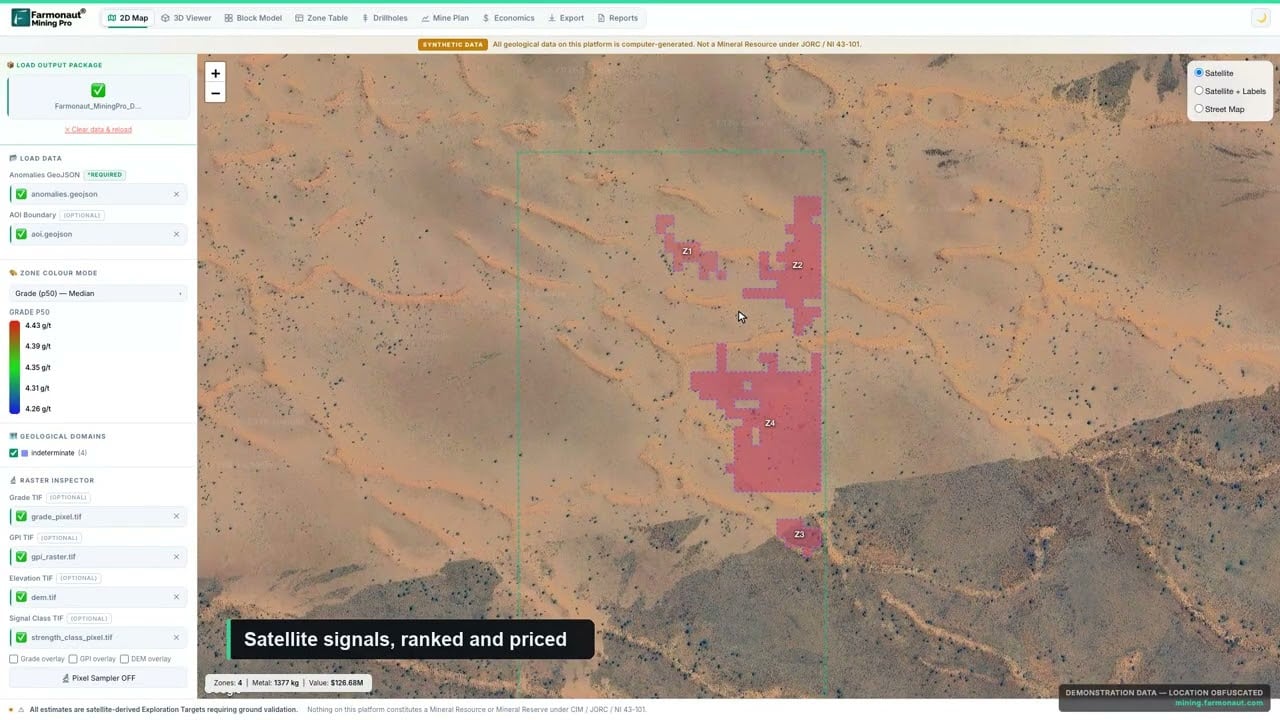
Our satellite-based mineral detection analyses multispectral and hyperspectral imagery of your proposed area. Each mineral and alteration zone reflects energy in a distinctive spectral signature, which lets us flag likely mineralised target zones, alteration halos, faults and fractures, without disturbing the ground or entering anyone’s land before consultation.
- ✔ Input: the boundary you plan to lodge (coordinates, KML/KMZ or polygon), plus the target mineral.
- ✔ Turnaround: 5–20 business days, depending on area and mineral complexity.
- 📊 Deliverables: prospectivity heatmaps, high-potential zones with estimated location and depth ranges, geological interpretation, and PDF plus georeferenced GIS files. Premium+ adds TargetMax™ drilling intelligence and 3D subsurface models, useful when designing a prospecting work programme.
- 📊 Savings: up to 80–85% lower early-exploration cost, with timelines cut from months to days.
- ⚠ Limits: satellite targets are exploration targets, not a Mineral Resource. They guide where to sample and drill.
Satellite screening involves no ground disturbance, which suits the South African process: you can assess the ground before consultation starts, and then show landowners and communities a focused, smaller programme rather than a blanket one.
For licensing portals in other African countries, see our mining cadastre portal guide by country. The satellite-driven 3D mineral prospectivity mapping overview shows a typical deliverable. We have scanned 100,000+ hectares for 20+ mineral types across 25+ countries.
Preparing a prospecting right or mining permit application?
Send us the boundary. We’ll return a satellite prospectivity read, with ranked target zones and next steps, to strengthen your work programme before you lodge.
▶ What Farmonaut Mining Pro does with a licence boundary · 4:56
Frequently asked questions
How do I get a mining license in South Africa?
Decide which title you need: a prospecting right, a mining right or a mining permit (up to 1.5 hectares). Apply online through SAMRAD, or the Indwe Mining Licensing System where your province is live, pay the non-refundable fee, apply for environmental authorisation at the same time, then consult affected parties and report back within the deadline you are given.
What is the difference between a mining permit and a mining right in South Africa?
A mining permit is for small-scale mining on no more than 1.5 hectares, for up to two years plus three one-year renewals, and cannot be transferred. A mining right is for larger operations, lasts up to 30 years, can be renewed, and requires a social and labour plan and alignment with the Mining Charter.
How long does a mining license in South Africa take?
SAMRAD tells you immediately whether an application is accepted, and the regional manager should notify you within 14 days. After that, consultation (up to 180 days for a mining right), environmental authorisation and ministerial review usually take many months. Build that into your plans.
How much does a mining permit cost in South Africa?
Fees are prescribed in regulations 75 and 76 of the MPRDA regulations and are non-refundable. gov.za does not list the amount, but regulation 75 sets it: R100 for a mining permit, R500 for a prospecting right and R1,000 for a mining right. Budget separately for the environmental management plan, consultation and any specialist reports.
Where are the Department of Mineral Resources offices?
The DMPR head office is at the Trevenna Campus in Pretoria (012 444 3000). Regional offices include Johannesburg (Braamfontein), Klerksdorp, Rustenburg, Durban and Cape Town, among others. Check dmpr.gov.za for the address before visiting.
Can I buy an existing mining right?
Yes, but only with the Minister’s written consent under Section 11 of the MPRDA, which also covers transfers of a controlling interest in a company that holds a right (except listed companies). Mining permits cannot be transferred. Take legal advice on any transaction.
Can Farmonaut apply for a South African mining right for me?
No. We are not a licensing agent, law firm or broker. We provide the geological side: a satellite prospectivity analysis of the area you plan to apply for, which you can use to shape your work programme.
Information in this guide comes from gov.za’s service pages for mining permits, prospecting rights and mining rights; the DMPR’s Online Systems and Mineral Regulation pages; the MPRDA and its regulations; published legal commentary on Section 11, the Mining Charter, the One Environmental System and the draft Mineral Resources Development Bill; Mining Weekly’s reporting on the Indwe rollout; and our verified cadastre research. The DMPR is migrating from SAMRAD to Indwe and a draft bill is before the department, so confirm with the DMPR before you apply or pay. Nothing here is legal or investment advice.
This page is for information only. It is not legal advice. Confirm the rules with the regulator.
Farmonaut mining
Screen your licence area from space
Request a quote to rank satellite targets inside the boundary you plan to lodge.

Mining Pro sample view, synthetic data
Keep reading
Sources
- MPRDA regulations, regulation 75: application fees: acts.co.za
- gov.za, Apply for a mining right: gov.za
- DMPR, Online Systems: dmpr.gov.za
- Business Report, New mining cadastre system nears national rollout (June 2026): businessreport.co.za
- Farmonaut, Mining cadastre portal guide by country: farmonaut.com
- UCT MERLIA, One Environmental System and the mining industry: law.uct.ac.za
- gov.za, Apply for a mining permit: gov.za
Discussion
Questions, corrections or field experience? Share them below. First-time comments are reviewed before they appear, and your email is never published.
No comments yet. Be the first to add a question or your experience.

 Mwerezi Minerals Company Limited
 Congo Mining Solutions
 Mining SARL
 SenGold Invest SAS
 Sania Corporation
 Sean Mining Limited
 NTS Group (Pty) Ltd
 Mine4Africa
 Lithspo Minerals Limited
 Tintina Mining Group
 Dalgety Minerals Pty Ltd
 Vortex Minerals Pty Ltd
 Faith At Work (Pty) Ltd
 Geotech Mining Solutions plc
 Vulcan International Limited
 Kidepo Associates
 GKY Mining
 Alkimy SARL
 Double A Trading

 Licence holder · Nigeria · Gold + lithium










