

Mine weather · Independent guide
Weatherzone Mining: Login, Alerts and 7 Safety Tips
Weatherzone mining usually means Miningzone, the mine-site weather and lightning alert service from DTN APAC, whose mining pages sit on the Weatherzone business site. This independent guide covers access, features, rivals and seven site safety rules.
Key takeaways
- Miningzone is a log-in service for mines. DTN says it is IP-restricted and deployed at more than 400 mines (vendor figure, read November 2026).
- A log-in that fails away from site may be blocked by the IP restriction. Try the site network, then your account holder.
- MSHA named the lack of an adequate early warning system as the root cause of a 2019 lightning death at a Texas quarry.
- At Moranbah Airport in Queensland, about 73% of mean yearly rain falls from November to March (Bureau of Meteorology, record from 2012).
- Distance triggers are site decisions. One Queensland mine used 60, 30 and 16 km levels, and the regulator’s directives on part of that plan were appealed in court by the operator.
In this article
- What is Weatherzone mining?
- Weatherzone mining login: what to try when it fails
- Why weather forecasting matters in mining
- How a mine weather service works
- Weatherzone mining vs other mining weather services
- 7 weather safety tips for mine sites
- What a weather alert system can and cannot do
- Benefits for environmental management
- Where satellite data fits
- Frequently asked questions
Weatherzone mining usually refers to Miningzone, the weather tracking and alert service for mine sites sold by DTN APAC, whose mining pages sit on the Weatherzone business site. DTN APAC describes lightning and severe weather alerts, site forecasts and blast dispersion modelling, and DTN says it runs at more than 400 mines (vendor figure, read November 2026).
This is an independent guide. Farmonaut does not run the service and cannot reset your account. It explains what the service includes, what to try when the log-in fails, how it compares with two rivals, and seven safety rules that apply whichever weather provider a site uses. The readers we had in mind are mine employees: shift supervisors, safety officers, blast crews and environmental staff.
What is Weatherzone mining?
Weatherzone is an Australian weather brand. Its business arm now appears under the DTN APAC name, and the product pages for mines use the name Miningzone. Searches for “mining weatherzone” and “mining.weatherzone” often come from people looking for the customer log-in, which sits at mining.weatherzone.com.au, but we could only confirm that it opens a log-in page, so ask your administrator which address your site uses.
It is not a general term for mine weather technology, although some websites use it that way. If a colleague says “check Weatherzone”, they most likely mean the dashboard or the app your site pays for.
| Part | What the vendor says it does | Who on site uses it |
|---|---|---|
| Miningzone dashboard | Custom dashboard with GIS storm tracking, alerts and analytics | Control room, supervisors |
| Opticast forecasts | Site forecasts on a 6 km global grid, with short-range updates and an outlook of up to 14 days | Planners, shift leaders |
| Total Lightning Network | Ground sensors that detect cloud-to-ground and in-cloud strikes | Safety officers, control room |
| Stormtracker | Thunderstorm tracking on a map | Control room |
| Weatherguard app | Alerts and weather data on a phone | Supervisors, field crews |
| WZBob | On-site beacons and sounders, which can link to radio networks | All crews |
| Blast dispersion modelling | Predicted blast plume path and pollutant levels, up to 14 days ahead | Blast and environmental teams |
All of these are the vendor’s descriptions from DTN’s Miningzone page and the DTN APAC storm-season note. They are not independent test results.
Weatherzone mining login: what to try when it fails
We cannot see your account, so these are general checks based on what DTN publishes. DTN says Miningzone is IP restricted and secured by a log-in and password, and that the customer chooses who has access. That explains the most common surprise: a password that works at site may not work from home.
- Check the address. Type the address yourself rather than following a link in a message, and only enter your password on the page your site administrator gave you.
- Try the site network. If it works on the mine network or VPN but not on mobile data, an IP restriction is the likely reason.
- Ask your site administrator. Your company controls who has access, so new starters and contractors usually need to be added.
- Contact the vendor. Your administrator can raise an account problem with the DTN APAC support contact in your contract.
- Keep a backup plan. A log-in problem must never leave a crew without warnings. Name the person who watches official warnings and radar while access is down.
Why weather forecasting matters in mining
Weather reaches almost every mining task. Lightning threatens people and explosives, rain floods pits and haul roads, fog stops trucks, wind limits cranes and carries dust, and heat harms workers. The effects also last longer than the storm.
Chart
Storm-season rain at Moranbah Airport, Bowen Basin
Mean monthly rainfall, mm, October to April, record from 2012
Queensland shows the scale. In 2011 the Queensland Resources Council estimated that state coal exports for 2010-11 would fall about 40 Mt short of a record 200 Mt or more, worth about A$7 billion by its count, and that water equal to the volume of Sydney Harbour was still hampering mines. That is an industry body’s estimate. A year later, the council said many mines still held water from the previous wet season, while one coal producer in eastern Australia shut four mines because of new heavy rain.
The season is also predictable enough to plan for. At Moranbah Airport in the Bowen Basin, mean yearly rainfall is 592.8 mm on a record starting in 2012, and about 73% of it falls from November to March. Mean maximum temperature reaches 34.9°C in December at the same station.
Hazards by department
| Weather | Main risk on site | Typical decision |
|---|---|---|
| Lightning | Injury to people outdoors, tyre explosion, explosives risk | Stand down, clear the pit, restart |
| Heavy rain | Flooded pits, damaged haul roads, water storage limits, wet blast holes | Move crews, pump, change the blast plan |
| Fog | Low visibility for trucks and mobile plant | Slow haulage or stop until it clears |
| High wind | Crane limits, flying debris, dust | Stop lifts, secure gear, add dust controls |
| Heat | Heat illness, more errors | Change work and rest cycles, add water and shade |
Dust control is closely tied to wind and humidity; our guide to dust control in mining covers the equipment side. For the wider picture, see environmental issues in mining and the disadvantages of open-pit mining. Blocked roads and closed rail lines can also delay deliveries, which links to wider supply chain challenges in gold mining.
How a mine weather service works
A mine weather service combines four things: sensors that measure, models that predict, rules set by the site, and a way to reach people. DTN APAC says its network detects cloud-to-ground and in-cloud strikes and issues alerts when real-time detections fall within thresholds the site defines.
Infographic
From lightning strike to all-clear in 5 steps
- 1DetectSensors locate strikes and on-site instruments read local weather.
- 2CompareThe service checks each reading against the site’s limits.
- 3AlertDashboard, SMS, app, sirens and radio reach the crews.
- 4ActNamed people follow the action in the site’s TARP.
- 5RecordThe all-clear and restart times go into the log for review.
The published lightning accuracy differs by page and date: a 2021 Weatherzone article says strike accuracy down to 100 m, and the current DTN page says under 200 m. Ask the vendor for the figure at your site, because sensor spacing affects performance.
A forecast with a 6 km grid cannot show every bench or ramp. Vendors therefore combine models with local observations, and a weather station at the site can help tune them. A deep pit can also behave differently from the surrounding land. Weatherzone notes that fog can sit in an open pit while the air above it is clear.
Fog alerts as an example
Fog shows how forecast data becomes a site rule. In its 2021 article, Weatherzone describes a traffic-light forecast out to 7 days and alerts up to 36 hours ahead. It says sites generally halt at about 99-100% fog density, while at 97-98% trucks may slow to 40 km/h. Those are the vendor’s general examples, not a legal limit. Your own traffic management plan decides the numbers.
▶ Remote sensing for mining in plain words: what measuring ground from a distance means. · 2:01
Weatherzone mining vs other mining weather services
Weatherzone is not the only choice. The table below uses each company’s own product page, read in November 2026, and we did not test any of them. It is a starting list of three services with published mining pages, not a ranking.
| Service | Best for | Stated features | Check before signing |
|---|---|---|---|
| DTN Miningzone | Sites that want lightning alerts and blast modelling from one vendor | Lightning alerts, Opticast forecasts, blast dispersion, SMS, email and app delivery, control system links | Network coverage at your site, and whether blast modelling is accepted by your regulator |
| Xweather | Sites that want on-site sensors and alarms in one package | Lightning detection, tiered alarm levels, on-site Vaisala sensors for rain, wind, temperature and visibility | Sensor costs and upkeep at remote camps |
| UBIMET | Teams that want access to a meteorologist | Own lightning detection, Weather Cockpit portal, 24/7 meteorologists, warnings 48 hours to 15 minutes ahead | Local detection density and warning lead time at your site |
Ask each vendor for the same evidence: a trial alongside your current system, a log of alerts against actual strikes, sensor coverage at your site, uptime terms, and what happens when a sensor or link fails. A side-by-side trial answers more than a brochure can.
7 weather safety tips for mine sites
These rules apply whichever provider you use. They support your site’s safety management plan and your regulator’s requirements, and do not replace them.
Chart
Heat limits by workload: new vs acclimatized workers
Effective WBGT limit in °C, unacclimatized action limit vs acclimatized threshold limit value
1. Do not rely on eyesight or personal phones
This is the clearest lesson from the record. On 27 August 2019 a worker at a Texas sandstone quarry was killed by lightning. MSHA’s final report found miners relied on what they could see and on personal phones, and it named the lack of an adequate early warning system as the root cause. The National Weather Service had issued an outlook that morning saying thunderstorms were likely. Small operations need a written warning procedure just as large ones do.
2. Write distance triggers into a TARP
A Trigger Action Response Plan (TARP) sets out who does what at each alert level. Peak Downs mine in Queensland used three lightning levels: 60 to 30 km, 30 to 16 km, and under 16 km. These figures belong to one site and are not a standard, so set yours by risk assessment, storm speed and the time it takes to clear each area.
3. Treat large vehicles as a question for your regulator
Do not assume a haul truck is a safe shelter. The Peak Downs directives from the Queensland regulator concerned heavy mobile equipment in lightning, and the operator argued the machines act as Faraday cages. Proctor reported in November 2024 that the court kept stays in place and asked for submissions on final orders, and it identified tyre explosion as a risk that nitrogen filling may address. Check the current position and the latest safety notices before you rely on this.
4. Build explosives into the storm plan
Queensland’s regulator warned that wet conditions can cause a misfire and that explosives management belongs in emergency plans. Decide in advance what happens to a charged pattern when a storm approaches, who has authority to clear the area, and how long crews wait before returning. Follow your explosives regulations and the shotfirer’s procedures.
5. Plan for water before the wet season
Rain is a tailings risk as well as a pit risk. A 2015 paper citing Rico and colleagues reports unusual rain or snow as the most common factor in the tailings failures that database covered, at 26% of factors. Before the season, the engineer of record should confirm storage capacity, pump readiness, spillways and the rainfall levels that trigger each action. A forecast helps only if each number leads to an action.
6. Measure heat at the work area
Regional forecasts can miss site conditions. OSHA recommends wet bulb globe temperature (WBGT), a heat measure that accounts for temperature, humidity, radiant heat and wind, and says to take it close to the work location. It also treats workers as unacclimatized if they have done the job for less than 1 to 2 weeks. Pay particular attention to new starters, returning workers and anyone in protective clothing.
7. Drill the alert and the restart
Run drills so crews know what each sound and light means, where to go, and who gives the all-clear. Include contractors and night shift. Test sirens and radios before the season, and give one named role the authority to stop work. After each event, compare the alert log with what happened and fix any gaps. Queensland’s chief inspector of mineral mines made a similar point: having strategies ready before a storm can reduce harm and help sites recover faster.
Calculator
What do weather stoppages cost your site each season?
Enter your own alert log and costs. The result supports a review; it never justifies weakening a safety limit.
- Hours lost per season: 40
- Hours lost to false alarms: 4.0
- Cost of false alarms (US$): $40,000
Example values only, not a benchmark or forecast. All figures are your inputs. Use your own stoppage log and cost per hour in US$.
What a weather alert system can and cannot do
A good system buys time, but it does not make the decision. It cannot move people, and a lightning strike can occur with little warning. Treat every alert service as one layer, along with training, shelter, communications and a person with authority to stop work.
Chart
How much clothing adds to a heat reading
°C added to the measured WBGT, by garment
Alerts also need tuning. In a DTN APAC case study, an Australian gold mine’s single-site sensor triggered several red alerts and a two-hour shutdown, while the network placed the lightning more than 30 km away. A manager quoted by Weatherzone estimated about 70 hours of downtime saved so far that year. These are vendor accounts from unnamed sites. Use them as reasons to run your own trial, and review any change to a limit through your risk process, not on cost alone.
Heat is a good example of why one reading is not enough. OSHA’s adjustment factors show that the same air can pose very different risks depending on the clothing a worker wears and how hard they work.
Benefits for environmental management
Weather data also supports environmental work. Rainfall forecasts help teams prepare water treatment and storage before runoff arrives. Wind forecasts help plan dust suppression and blast timing. DTN says its blast modelling shows the expected plume path and pollutant levels, and that time-stamped storm reports can support risk analysis and insurance claims. Check with your regulator whether a given model or report meets your permit conditions.
Keep records simple: forecast, alert, action taken and result. That log helps with audits and shows where the plan needs to change. Companies that also track wider sustainability measures may look at tools for carbon footprinting and product traceability, though these are separate from safety alerts.

▶ The seven environmental impacts of mining, explained in clay animation. · 2:31
Where satellite data fits
Satellite imagery is useful for slower questions, not for a lightning alarm. Images taken before and after a wet season can show changes in flooded areas, water storages, disturbed ground and vegetation around a site. Farmonaut offers satellite mapping of mining sites, and its site also lists a satellite weather API and fleet management tools. None of these replace a certified alert system or your safety plan.
Frequently asked questions
What is mining.weatherzone?
It is the web address of a Weatherzone customer log-in for mining users. DTN now describes its mine weather product as Miningzone, and access is controlled by the customer.
Why can’t I log in to Weatherzone mining?
DTN says Miningzone is IP restricted, so a log-in may fail outside the approved network. Try the site network or VPN, then ask your site administrator, who manages access.
What does the Weatherzone mining dashboard show?
DTN lists GIS storm tracking, alerts, analytics and forecasts, and sites can choose which weather items appear. The exact view depends on what your company bought and configured.
Is Miningzone the same as Weatherzone?
They are closely linked. Miningzone is the product name used by DTN and DTN APAC, while Weatherzone is the brand many Australian users know, including on the separate public weather site.
How far away should lightning stop work at a mine?
There is no single figure on this page that applies everywhere. One Queensland coal mine used levels at 60, 30 and 16 km, the regulator issued directives on part of its plan, and the operator appealed them. Set your distances through risk assessment and your regulator’s requirements.
Is a haul truck safe during lightning?
Do not assume so. The issue was contested in a Queensland court, including the risk of tyre explosion. Follow your site’s plan and the regulator’s current notices.
What is weather forecasting for the mining industry used for?
Mines use it to protect crews, plan blasts, manage water, schedule haulage and prepare for storms, floods, fog, wind and heat.
Do mining weather stations replace a forecast service?
No. A station measures conditions at one point, while a forecast looks ahead and a lightning network covers a wider area. Many sites benefit from having both, since OSHA also notes that distant weather readings may not match the worksite.
What is a TARP in mining?
A Trigger Action Response Plan links a measured condition to set actions. For example, lightning within a chosen distance can trigger a stop to specific work and a move to shelter.
How much does Weatherzone mining cost?
DTN does not publish a price on the pages we read, and it asks buyers to contact its team. Ask for a quote covering sensors, sites, users and support, and use the calculator above to compare it with your stoppage costs.
More from Farmonaut: crop loan and insurance, geologic ai stock ai geology 7 breakthroughs for 2026.
This page is for information only. It is not legal or safety advice. Follow your site’s safety management system and confirm the rules with your regulator. Weatherzone, Miningzone, Xweather and UBIMET are the names of their owners, and this guide is independent of them.
Farmonaut mining
Map your mining site from space
Mine teams and consultants can request satellite mapping of a site boundary to review surface targets ahead of field work. It does not replace a weather alarm.
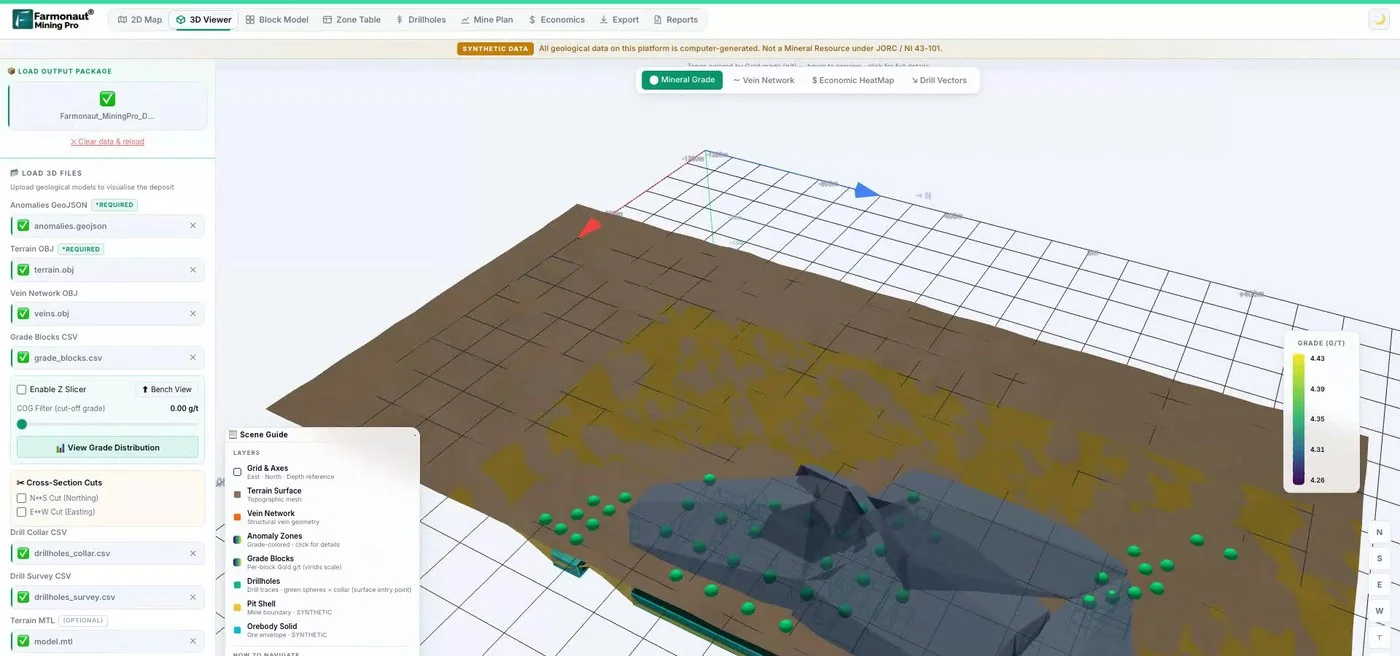
Mining Pro sample view, synthetic data
Keep reading
Sources
- DTN, Miningzone product page (read November 2026): dtn.com
- DTN APAC, Mining solutions and case study (read November 2026): business.weatherzone.com.au
- Weatherzone mining customer log-in page (checked November 2026): mining.weatherzone.com.au
- DTN APAC, Stay ahead with Weatherzone this storm season (2022): apac.dtn.com
- Weatherzone, Lightning in business and mining (2021): weatherzone.com.au
- Weatherzone, How does fog affect mining? (2021): weatherzone.com.au
- MSHA, Final report on the 27 August 2019 fatality: msha.gov
- OSHA, Heat Hazard Recognition (read November 2026): osha.gov
- Bureau of Meteorology, Climate statistics, Moranbah Airport 034035: bom.gov.au
- Natural Hazards and Earth System Sciences, tailings flood paper (2015) citing Rico et al. (2008): nhess.copernicus.org
- Proctor, Bid to strike deal on mine lightning rules (November 2024): qlsproctor.com.au
- Safe To Work, Warning for Queensland mines (October 2024): safetowork.com.au
- International Mining, Queensland budget and mine flood water, Queensland Resources Council (2011): im-mining.com
- Claims Journal, Coal mines shut as Australia evacuates flooded towns (2012): claimsjournal.com
- Xweather, Mining weather solutions (read November 2026): xweather.com
- UBIMET, Mining weather forecasting solutions (read November 2026): ubimet.com
Discussion
Questions, corrections or field experience? Share them below. First-time comments are reviewed before they appear, and your email is never published.
No comments yet. Be the first to add a question or your experience.

 Rains of Favour
 Tintina Mining Group
 Dalgety Minerals Pty Ltd
 Vortex Minerals Pty Ltd
 Faith At Work (Pty) Ltd
 Geotech Mining Solutions plc
 Vulcan International Limited
 Kidepo Associates
 GKY Mining
 Alkimy SARL
 Double A Trading
 GemSprout Metals Limited
 Qader Group
 Ileys General Trading
 SG Gold Mining LLC
 VRV Global Pte Ltd
 Omsri International FZE
 G.I.T.T.
 Jaunita Erss Ltd
 Almosi SARL
 SRK Consulting
 Berks Gold Limited
 Mwerezi Minerals Company Limited

 Exploration consultancy · South Africa · Gold










