

California rare earths · Mine data guide
Mountain Pass Rare Earth Mine: Output and Reserve Data
The Mountain Pass mine in California produced 50,692 tons of rare earth oxide in concentrate in 2025, almost all US output. This page gives its output, grade, reserves, mine life, cost inputs and NdPr price floor, with sources.
Key takeaways
- Mountain Pass produced 50,692 metric tons of rare earth oxide in concentrate in 2025 (+12%) and 2,599 tons of NdPr oxide (+101%); USGS puts total US output at about 51,000 tons (MP Materials, Feb 2026; USGS, 2026).
- Proven and probable reserves are 28.96 million short tons at 5.89% total rare earth oxide, above a 2.50% cut-off grade, for about 28 years of remaining mine life (MP Materials 10-K, 31 Dec 2025 estimate).
- The concentrate is about 50% cerium, 32% lanthanum and 15.7% neodymium-praseodymium (NdPr), the magnet metals that carry most of the value (MP Materials 10-K).
- A 10-year US Department of Defense price floor of US$110 per kilogram covers MP’s NdPr; Benchmark assessed ex-China NdPr oxide at US$95 per kilogram in its report of 21 August 2026 (MP Materials; Benchmark Mineral Intelligence).
- County permits run to 2042; the company expects an extension to at least 2053, which its mine plan assumes (MP Materials 10-K).
In this article
- Where the Mountain Pass mine is and who owns it
- How much rare earth Mountain Pass produces
- What is mined: carbonatite ore and bastnaesite
- Reserves, grade and mine life at Mountain Pass
- How ore becomes NdPr oxide, and what it costs
- Seven facts that set Mountain Pass apart
- Rare earth prices and the Pentagon price floor
- Mountain Pass mine history and ownership
- From concentrate to magnets: what MP is building next
- Environment, water and permits at the site
- MP Materials shares: facts only
- How satellites help screen a rare earth site
- Frequently asked questions
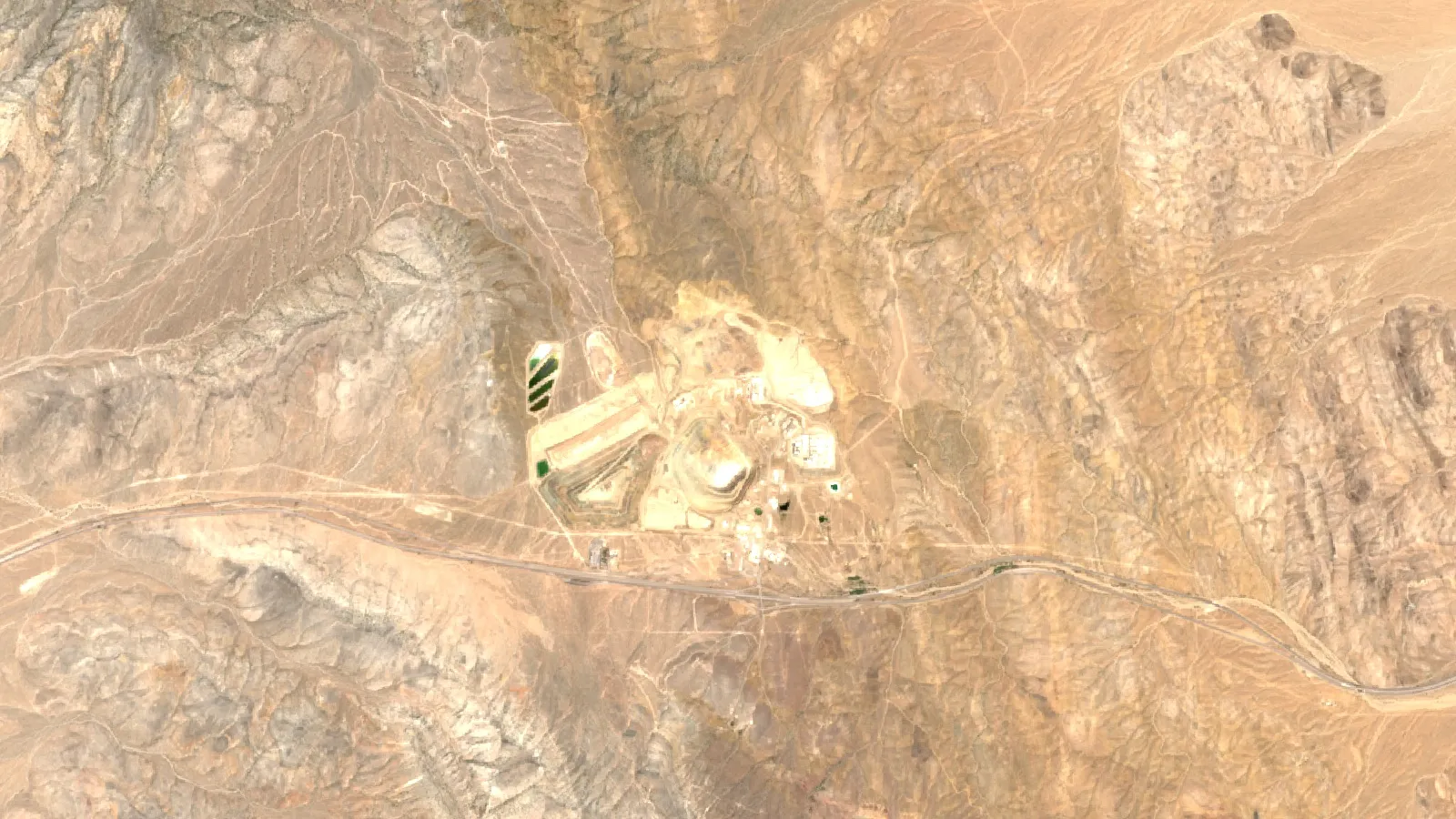
The Mountain Pass rare earth mine is an open pit in San Bernardino County, California, owned and run by MP Materials (NYSE: MP). It produced 50,692 metric tons of rare earth oxide (REO) in concentrate in 2025, up 12% on 2024, and 2,599 tons of separated neodymium-praseodymium (NdPr) oxide, up 101% (MP Materials, 26 February 2026). The US Geological Survey (USGS) puts total US mine output at about 51,000 tons for 2025, so this one site supplies almost all of it (USGS Mineral Commodity Summaries, February 2026).
This guide collects the numbers that mining consultants, investors and licence owners ask about: output, ore grade, reserves, mine life, cost inputs, the price floor, permits and the history of the site. Every figure carries its source and date, and the page includes a calculator that turns ore tonnage into NdPr oxide.
Where the Mountain Pass mine is and who owns it
The mine sits near the town of Mountain Pass, about 50 miles (80 km) south-west of Las Vegas, Nevada, right beside Interstate 15. MP Materials owns 2,232 acres there in fee simple, meaning outright freehold title, and 1,128 acres were in use at the end of 2025. The company also holds 1,020 unpatented lode claims and mill sites under the Mining Law of 1872 and has claims over a further 15,000 acres of surrounding land, which is mostly public land managed by the Bureau of Land Management and the National Park Service (MP Materials annual report, filed with the US Securities and Exchange Commission, FY2025).
The site is more than a pit. It includes a crusher, a flotation mill, hydrometallurgy and separation plants, a water treatment plant and a natural-gas combined heat and power unit, so ore goes in at one end and separated oxides come out at the other. In July 2025 the company signed a partnership with the US Department of War, formerly the Department of Defense, which is covered below. For a wider view of US projects, see our guide to rare earth mining in the USA.
How much rare earth Mountain Pass produces
MP Materials reports two production numbers. REO in concentrate measures the rare earth content of the mined and floated ore. NdPr oxide measures the finished magnet-metal product made from part of that concentrate at the on-site separation plant. In 2025 the first number rose 12% and the second doubled as the separation circuits ramped up; the company also ceased all sales to China in July 2025 (FY2025 annual report).
Chart
NdPr oxide made at Mountain Pass, by quarter
Metric tons of separated NdPr oxide, seven consecutive quarters
| Measure | 2024 | 2025 | Change |
|---|---|---|---|
| REO in concentrate (metric tons) | 45,455 | 50,692 | +12% |
| NdPr oxide produced (metric tons) | 1,294 | 2,599 | +101% |
| NdPr oxide sold (metric tons) | 1,142 | 1,994 | +75% |
The pattern continued into 2026. In the second quarter NdPr production was 840 tons, against 597 tons a year earlier (+41%), and sales were 1,006 tons (+127%, on the company’s NdPr oxide-equivalent basis, which changed for metal sales in 2026 and was not restated for earlier periods). REO in concentrate was 11,072 tons, down 16% from 13,145 tons in the second quarter of 2025. Revenue was US$108.5 million, with a further US$17.6 million of price protection income, and the company reported a net loss of US$20.3 million (MP Materials, 6 August 2026).
Against the world picture, USGS lists about 390,000 tons of mine output in 2025, of which China mined 270,000 tons (69%), the United States 51,000 tons (13%) and Australia 29,000 tons. Net import reliance for rare earth compounds and metals was 67% of US apparent consumption in 2025 (USGS, 2026). Mining is only the first step: the US still imports most separated oxides and nearly all magnets.
The company has a stated goal, its “Upstream 60K” strategy announced in November 2023, to raise annual REO production to about 60,000 tons through better beneficiation and use of lower-grade ore. Treat that as a company target, not a forecast; the 2025 figure was 50,692 tons.
What is mined: carbonatite ore and bastnaesite
Mountain Pass is a carbonatite deposit. Carbonatites are unusual igneous rocks made mostly of carbonate minerals rather than silicates, and they host many of the world’s light rare earth deposits. At Mountain Pass the rare earths sit mainly in bastnaesite, a rare earth carbonate-fluoride mineral. The deposit lies in an uplifted block of Proterozoic metamorphic and igneous rocks beside the Ivanpah Valley. The company describes the ore body as about 2,750 feet long along strike and 3,000 feet deep down dip, with a zone above 2% total rare earth oxide (TREO) that is between 15 and 250 feet thick (FY2025 annual report).
Chart
What is in the Mountain Pass concentrate
Estimated share of total rare earth oxide content, per cent
The deposit was found by prospectors searching for uranium. A USGS history says that on 23 April 1949 a group carrying Geiger counters located the Birthday claim on a radioactive vein, and a US Bureau of Mines test showed the heavy mineral was bastnaesite (USGS Professional Paper 261). Rare earth ores usually contain traces of thorium and uranium, which is why they register on radiation detectors.
The typical split of rare earths in the Mountain Pass concentrate explains why the mine is called a light rare earth source. Cerium and lanthanum make up more than 80% of the content, and the magnet metals neodymium and praseodymium about 16%. The company describes the ore body as dominated by light rare earths, which is one reason MP Materials plans to extend its heavy rare earth separation capacity.
Reserves, grade and mine life at Mountain Pass
Reserves are the part of a deposit that a qualified person judges can be mined at a profit with current plans. Resources are a broader category with only “reasonable prospects” of extraction. MP Materials reports both under the US Securities and Exchange Commission’s Regulation S-K 1300, using a pre-feasibility technical report by SRK Consulting with an effective date of 1 October 2025, depleted to 31 December 2025.
Chart
Cut-off grade against average grade
Per cent total rare earth oxide (TREO), at 31 December 2025
A cut-off grade is the lowest grade that still pays for mining and processing; rock below it is waste. For the reserves it is 2.50% TREO. The company reports 1.03 million short tons of stockpiled proven reserves at 4.22% TREO and 27.93 million short tons of in-ground probable reserves at 5.95%, together 28.96 million short tons at 5.89%. On that basis it expects about 28 years of remaining mine life, from 2026 to the first quarter of 2053, to finish processing stockpiles and separations (FY2025 annual report).
| Category | Million short tons | Average grade (TREO) | Cut-off grade |
|---|---|---|---|
| Proven reserves (stockpiles) | 1.03 | 4.22% | 2.50% |
| Probable reserves (in ground) | 27.93 | 5.95% | 2.50% |
| Indicated resources, outside reserves | 5.29 | 3.50% | 2.15% |
| Inferred resources, outside reserves | 14.16 | 4.65% | 2.15% |
Two cautions apply. First, resources are reported in addition to reserves, so the two should not be added without care, and inferred resources inside the mine plan are treated as waste because they are too uncertain to count. Second, the resource statement covers only the five light rare earths (cerium, lanthanum, praseodymium, neodymium and samarium); heavy rare earths are present but left out because of historic data limits. The reserve pit design assumes a PrNd oxide price of US$134.49 per kilogram and the resource pit design US$154.66, 15% higher. Both are well above the USGS 2025 average of US$69 and the US$95 ex-China assessment of August 2026, so the tonnages depend on prices staying high (see the price section).
The same filing says an ore-sorting plant, which upgrades ore in the 2.5% to 5.0% TREO range, was expected to be installed during 2026, with sorting and separations both at full design capacity in the first quarter of 2027, as of the February 2026 filing. These figures follow the US S-K 1300 rules, not JORC or Canadian NI 43-101.
How ore becomes NdPr oxide, and what it costs
The route at Mountain Pass has five stages. Open-pit mining delivers ore to a crusher. A mill grinds it to a slurry, and froth flotation lifts the bastnaesite away from waste rock. The concentrate, which averages about 60% TREO, then goes through hydrometallurgy and solvent separation into four products: NdPr oxide, a samarium-europium-gadolinium precipitate, lanthanum carbonate and cerium chloride. Waste is stacked as dry tailings, and process water is recycled.
Infographic
From pit to NdPr oxide in 5 steps
- 1MineOpen-pit ore is hauled to the crusher.
- 2GrindA mill makes a slurry from crushed ore.
- 3FloatFroth flotation lifts bastnaesite from waste rock.
- 4SeparateHydrometallurgy and solvent separation split the concentrate into four products.
- 5FinishNdPr oxide is packed, or turned into metal for magnets.
The recoveries in the 10-K show where the value sits. At the on-site separation plant, applied to concentrate of about 60% TREO, MP assumes it recovers 89.7% of the NdPr oxide, 97.9% of the samarium-europium-gadolinium precipitate, 75.0% of the lanthanum carbonate but only 11.5% of the cerium. Cerium is about half of the rare earth content and the plant recovers little of it, so most of the value rests on the 15.7% that is NdPr.
Cost inputs in the resource pit design give a feel for the economics. These are model assumptions, not reported operating costs.
| Step | Assumed cost (US$ per short ton) | Basis |
|---|---|---|
| Mining at pit exit | 1.50, plus 0.05 per 15 ft bench | Per ton mined |
| Ore rehandling | 2.96 | Per ton of ore |
| Crushing | 4.68 | Per ton crushed |
| Ore sorting | 1.57 | Per ton fed to sorters |
| Concentrating (flotation) | 51.28 | Per ton of ore fed |
| General and administrative | 24.52 | Per ton of ore fed |
| Separations, variable part | 1,080.59 | Per ton of concentrate processed |
| Sustaining capital | 32.38 | Per ton of ore fed |
Source for the table and recoveries: the resource notes in the FY2025 annual report. Per ton, separating concentrate costs far more than mining or milling ore, but the bases differ (concentrate against ore), so compare the lines with care.
Calculator
How much NdPr oxide could ore yield?
Enter your own ore tonnage, grade and recoveries.
- REO in concentrate: 37,403 t
- NdPr oxide before separation losses: 5,872 t
- Gross NdPr value at your price: 500.4 US$ m
Simplified model with example values. Grade (5.89%), NdPr share (15.7%) and separation recovery (89.7%) are from MP Materials’ FY2025 annual report; flotation recovery is an example (70%), close to the roughly 69% implied by the reserve table’s 6.76% mass yield. Price is an input: example, use today’s price (US$ per kilogram). Costs, sales timing and losses are left out, so results will not match reported output.
Seven facts that set Mountain Pass apart
Seven facts, each from a company filing or the USGS, set the site apart from other rare earth projects.
- Scale in a thin market. The United States ranked second among producing countries in 2025 at about 51,000 tons, and MP Materials reported 50,692 tons from this one mine (USGS, 2026; MP Materials, 2026).
- Grade well above cut-off. Reserves average 5.89% TREO against a 2.50% cut-off grade (FY2025 annual report).
- A magnet-metal share of about 16%. NdPr is 15.7% of the TREO in the concentrate, the part that feeds permanent magnets (FY2025 annual report).
- Mine and separation on one site. Separation of concentrate into four products resumed in the second half of 2023, so concentrate no longer has to be shipped abroad for separation (FY2025 annual report).
- Land tenure. Owning 2,232 acres in fee simple, with claims over 15,000 acres nearby, gives the operator room for infrastructure and expansion, and the mining claims on federal land carry their own rules (FY2025 annual report).
- A government price floor. A 10-year US$110 per kilogram NdPr floor sits under the main product (MP Materials, 10 July 2025).
- Long remaining life. About 28 years of planned processing, with permits for now running to 2042 and an extension to at least 2053 expected (FY2025 annual report).
The same filings list the risks: dependence on one site, an earthquake-prone location near active faults, heavy reliance on government agreements, and an unfinished permit extension. A fair reading keeps both lists in view.
Rare earth prices and the Pentagon price floor
NdPr oxide is the price that matters for Mountain Pass. USGS reports an average of US$55 per kilogram in 2024 and an estimated US$69 per kilogram in 2025, after US$124 in 2022 (USGS, 2026). On 10 July 2025 MP Materials announced that the Department of Defense had agreed a 10-year price floor of US$110 per kilogram for MP’s NdPr products that are stockpiled or sold. If the market price falls below the floor, the government pays the quarterly shortfall. Once the second magnet plant reaches full capacity, MP will pass 30% of any price above US$110 per kilogram back to the government (MP Materials, 10 July 2025; FY2025 annual report).
Chart
US average price of NdPr oxide
US dollars per kilogram, annual average; 2025 is an estimate
The floor has been in use. The company booked US$17.6 million of price protection income in the second quarter of 2026. Benchmark Mineral Intelligence reported on 21 August 2026 that ex-China NdPr oxide had fallen 7.3% in two weeks to US$95,000 per tonne (US$95 per kilogram) delivered to Europe and North America, below the floor, while Chinese PrNd oxide was assessed at RMB 721,500 per tonne (about US$107,500) (Benchmark Mineral Intelligence, 21 August 2026). Later, the China Rare Earth Industry Association index of 9 October 2026 put neodymium-praseodymium oxide in China’s domestic market at RMB 729.8 to 749.8 per kilogram (Rare Earth Exchanges, 9 October 2026), a different basis from the ex-China figure above. See our NdPr price trend guide for the drivers.
China’s export controls shape the backdrop. The International Energy Agency notes that China introduced export controls on seven heavy rare earth elements in April 2025 and widened them in October 2025 (IEA, Global Critical Minerals Outlook).
Mountain Pass mine history and ownership
The mine has changed hands several times. Its production history helps explain why the 2017 restart and the 2023 separation start-up matter.
| Date | Event | Source |
|---|---|---|
| April 1949 | Prospectors with Geiger counters find the radioactive Birthday vein; a test identifies bastnaesite | USGS Professional Paper 261 |
| 1952 | Molybdenum Corporation of America begins rare earth mining | MP Materials 10-K |
| 1977 | Unocal buys Molybdenum Corporation of America; mining, milling and separation continue until 1998 | MP Materials 10-K |
| 2005 and 2008 | ChevronTexaco acquires Unocal (2005); Molycorp Minerals buys Mountain Pass from Chevron Mining (2008) | MP Materials 10-K |
| Mid-2015 | Operations placed in cold idle under Molycorp | MP Materials 10-K |
| July 2017 | MP Materials buys the site from the Molycorp estate; flotation restarts in late 2017 | MP Materials 10-K |
| Second half of 2023 | Separated rare earth products start | MP Materials 10-K |
| July 2025 | Department of War agreements; sales to China stop | MP Materials 10-K |
Beginning in the early 1990s, repeated spills from wastewater pipelines put small amounts of lead and trace radioactive barium, uranium and thorium into the Mojave National Preserve, and federal and state authorities took legal action against Molycorp in 1997, according to High Country News. MP Materials’ filing adds that the site is under an order from the Lahontan Regional Water Quality Control Board over contamination from earlier on-site impoundments, with groundwater monitoring, extraction and treatment under way, and that the extent of the groundwater contamination is still being mapped (FY2025 annual report). A rebuilt plant opened in 2012 with a closed-loop water system and dry tailings, according to the same article, and MP Materials’ filing describes a dry-stack tailings process today.
From concentrate to magnets: what MP is building next
The next phase moves downstream of the mine. At its Independence plant in Fort Worth, Texas, MP began making neodymium-iron-boron permanent magnets on commercial equipment at the end of 2025, with a planned 3,000 tons a year. A second plant, the “10X Facility” in Northlake, Texas, is due to begin commissioning in 2028 and, with Independence, would lift US magnet capacity to an estimated 10,000 tons a year (FY2025 annual report). The company has supply agreements with Apple, which includes magnets made from recycled material processed at Mountain Pass, and with General Motors.
On heavy rare earths, MP says it will extend heavy rare earth separation at Mountain Pass, backed by a US$150 million Department of Defense loan announced in July 2025. In the second quarter of 2026 it signed a long-term separated gadolinium supply agreement with a new US aerospace and defense customer (MP Materials, 6 August 2026). These are plans and contracts, not output yet.
For other producers and projects that compete with or complement the site, our guide to rare earth mining companies compares them by filing.
Environment, water and permits at the site
MP Materials holds conditional use and minor use permits from San Bernardino County, plus an environmental impact report, all issued in 2004. They allow operation through 2042. The company says it expects to extend them to at least 2053, and its mine plan runs to 2053 (FY2025 annual report). Until the county approves an extension, the 2053 date is an expectation, not a permit.
On water and waste, the company says it uses a dry-stack tailings process that allows recycling of mill water and avoids wet tailings ponds and conventional impoundment dams. It also states that it generates hazardous materials and radioactive by-products and is subject to rules on naturally occurring radioactive material, and that under California’s Surface Mining and Reclamation Act it must restore the property after mining. Readers who want a plain overview of land, water, dust and waste effects across mine types can watch the short video below.

▶ A plain-language claymation on the seven environmental impacts of mining. · 2:31
MP Materials shares: facts only
MP Materials common stock trades on the New York Stock Exchange under the ticker MP. Under the July 2025 agreement the Department of Defense agreed to buy US$400 million of convertible preferred stock and receive a warrant; on an as-converted, as-exercised basis these represented about 15% of the company’s shares on 9 July 2025, with a conversion price of US$30.03 per share (MP Materials, 10 July 2025). We give no share price or target, because they change daily. This section is not investment advice.
How satellites help screen a rare earth site
A pit like Mountain Pass is visible from orbit, but the useful work is earlier, when a licence area is only a boundary on a map. Multispectral and hyperspectral satellite data can flag alteration zones, faults and fractures before field crews arrive. Our rare earth map and exploration guide shows where deposits sit and how explorers screen ground.
Farmonaut works with area-of-interest files (KML, KMZ or a polygon) and delivers satellite mineral detection reports in 5 to 20 business days. Results are exploration targets that sit ahead of a resource estimate, not reserves, and they do not replace drilling. See satellite-based mineral detection for the service.
▶ Remote sensing for mining in about two minutes: what the instruments measure and why agreement between them matters. · 2:01
For a closer look at a related question, see our guide: Round Mountain Gold Mine Nevada: Output and Phase X Plan.
If this topic matters to you, read Thacker Pass Lithium Mine: Capex, Output, Court Status next.
Frequently asked questions
Where is the Mountain Pass rare earth mine?
It is in San Bernardino County, California, near the town of Mountain Pass, about 50 miles south-west of Las Vegas and next to Interstate 15. The company gives the coordinates as 35°28’56” N, 115°31’54” W (MP Materials 10-K, FY2025).
Who owns Mountain Pass?
MP Materials Corp. owns and operates the mine and processing facility. It bought the site from the Molycorp bankruptcy estate in July 2017. Under the July 2025 agreement the US Department of War agreed to buy convertible preferred stock and a warrant in the company.
How much rare earth does Mountain Pass produce each year?
In 2025 it produced 50,692 metric tons of rare earth oxide in concentrate and 2,599 tons of NdPr oxide (MP Materials, 26 February 2026). NdPr production in the second quarter of 2026 was 840 tons.
What rare earths come from Mountain Pass?
The concentrate is mostly light rare earths: about 50.2% cerium, 32.3% lanthanum, 15.7% neodymium and praseodymium and 1.8% samarium, europium, gadolinium and similar elements. The plant sells four products: NdPr oxide, a samarium-europium-gadolinium precipitate, lanthanum carbonate and cerium chloride.
How long will the Mountain Pass mine last?
MP Materials estimates about 28 years of remaining mine life from 2026, to the first quarter of 2053, based on 28.96 million short tons of proven and probable reserves at 5.89% TREO. The estimate depends on assumed prices and on extending the county permits beyond 2042.
Is Mountain Pass the only rare earth mine in the United States?
It is the only mine USGS names as a primary rare earth producer in 2025. USGS also records monazite produced from heavy-mineral-sand concentrates in the south-eastern states, and rare earth compounds made elsewhere in the western states (USGS, 2026). Other US projects are at the permitting or study stage.
Does MP Materials still sell rare earths to China?
No. The company says it ceased all sales of its products to China in July 2025, which ended concentrate sales to its former Chinese distributor; no concentrate revenue was recorded in the fourth quarter of 2025.
What is the NdPr price floor?
It is a 10-year agreement under which the Department of War pays MP Materials the difference when the market price of its stockpiled or sold NdPr products is below US$110 per kilogram. MP shares part of any upside above US$110 per kilogram with the government once its second magnet plant is at full capacity.
Is the Mountain Pass mine radioactive?
Rare earth ores contain small amounts of naturally occurring thorium and uranium, and the mine was found because of that radioactivity. MP Materials states that it generates radioactive by-products and manages them under federal and state rules for naturally occurring radioactive material.
How big is the Mountain Pass site?
The company owns 2,232 acres at the mine, of which 1,128 acres were in use at the end of 2025, and holds claims over a further 15,000 acres of surrounding land. The ore body is about 2,750 feet long and 3,000 feet deep.
What is bastnaesite?
Bastnaesite is a rare earth carbonate-fluoride mineral and the main ore mineral at Mountain Pass. It is rich in cerium and lanthanum, which is why the mine yields mostly light rare earths.
Can satellite data find deposits like Mountain Pass?
Satellite data can screen large areas for alteration, faults and rock patterns, which narrows where to send field crews. It produces exploration targets, which must be tested by sampling and drilling before any resource estimate.
This page is for information only. It is not investment advice. It gives no share price or target. Reserve, price and permit figures come from the sources and dates shown and can change; check the latest filing.
Farmonaut mining
Map your mining site from space
Consultants can see how satellite data screens a licence area for mineral targets ahead of any resource estimate.

Mining Pro sample view, synthetic data
Keep reading

Sources
- MP Materials, Form 10-K for FY2025 (SEC): sec.gov
- MP Materials, fourth quarter and full year 2025 results (26 February 2026): mpmaterials.com
- MP Materials, second quarter 2026 results (6 August 2026): mpmaterials.com
- MP Materials, Department of Defense partnership (10 July 2025): mpmaterials.com
- USGS, Mineral Commodity Summaries 2026: Rare Earths: pubs.usgs.gov
- USGS Professional Paper 261, Rare-earth mineral deposits of the Mountain Pass district: pubs.usgs.gov
- Benchmark Mineral Intelligence, ex-China NdPr prices slip below the US$110/kg floor (21 August 2026): source.benchmarkminerals.com
- IEA, Global Critical Minerals Outlook, executive summary: iea.org
- High Country News, Why rare-earth mining in the West is a bust: hcn.org
- Rare Earth Exchanges, China Rare Earth Price Index (9 October 2026): rareearthexchanges.com
Discussion
Questions, corrections or field experience? Share them below. First-time comments are reviewed before they appear, and your email is never published.
No comments yet. Be the first to add a question or your experience.

 Timestream Mining
 Lithspo Minerals Limited
 Tintina Mining Group
 Dalgety Minerals Pty Ltd
 Vortex Minerals Pty Ltd
 Faith At Work (Pty) Ltd
 Geotech Mining Solutions plc
 Vulcan International Limited
 Kidepo Associates
 GKY Mining
 Alkimy SARL
 Double A Trading
 GemSprout Metals Limited
 Qader Group
 Ileys General Trading
 SG Gold Mining LLC
 VRV Global Pte Ltd
 Omsri International FZE
 G.I.T.T.
 Jaunita Erss Ltd
 Almosi SARL
 SRK Consulting
 Berks Gold Limited
 Mwerezi Minerals Company Limited

 Exploration consultancy · South Africa · Gold










