

Rio Tinto · What is proven
Rio Tinto Group AI Business Transformation: 8 Uses
Komatsu says Rio Tinto runs about 300 driverless trucks, and Palantir says 53 driverless trains and a Perth control centre in the Pilbara, with newer AI for data, exploration and documents. Its 2026 half-year results credit an operating system, not AI.
Key takeaways
- Komatsu said in August 2024 that it had delivered 300 autonomous trucks to Rio Tinto, spread across 10 Australian sites.
- Palantir said in November 2024 that Rio coordinates 53 driverless trains of 240 wagons each, and extended its AI platform contract by four years.
- Pilbara shipments were 326.2 million tonnes in 2025 against 328.6 million in 2024 (Rio Tinto 20-F), about one third of Australia’s estimated 980 million tonnes (USGS, 2026).
- Rio Tinto’s July 2026 half-year results credit its productivity programme (US$1.3 billion annualised run rate) and a new operating system, and do not mention AI.
- Rio’s own annual report names AI as a cyber, privacy and security risk as well as a tool.
In this article
- Rio Tinto AI and automation: 8 uses and the evidence behind each
- What counts as AI here, and how we checked
- Autonomous trucks, drills and trains in the Pilbara
- Remote operations centres and the data platform behind them
- AI for exploration and subsurface imaging
- Generative AI, archives and conservation
- What Rio Tinto's results credit for the gains
- Risks Rio Tinto names about AI
- Can a smaller mine copy this? A downtime break-even calculator
- Five checks before buying a mining AI tool
- Frequently asked questions
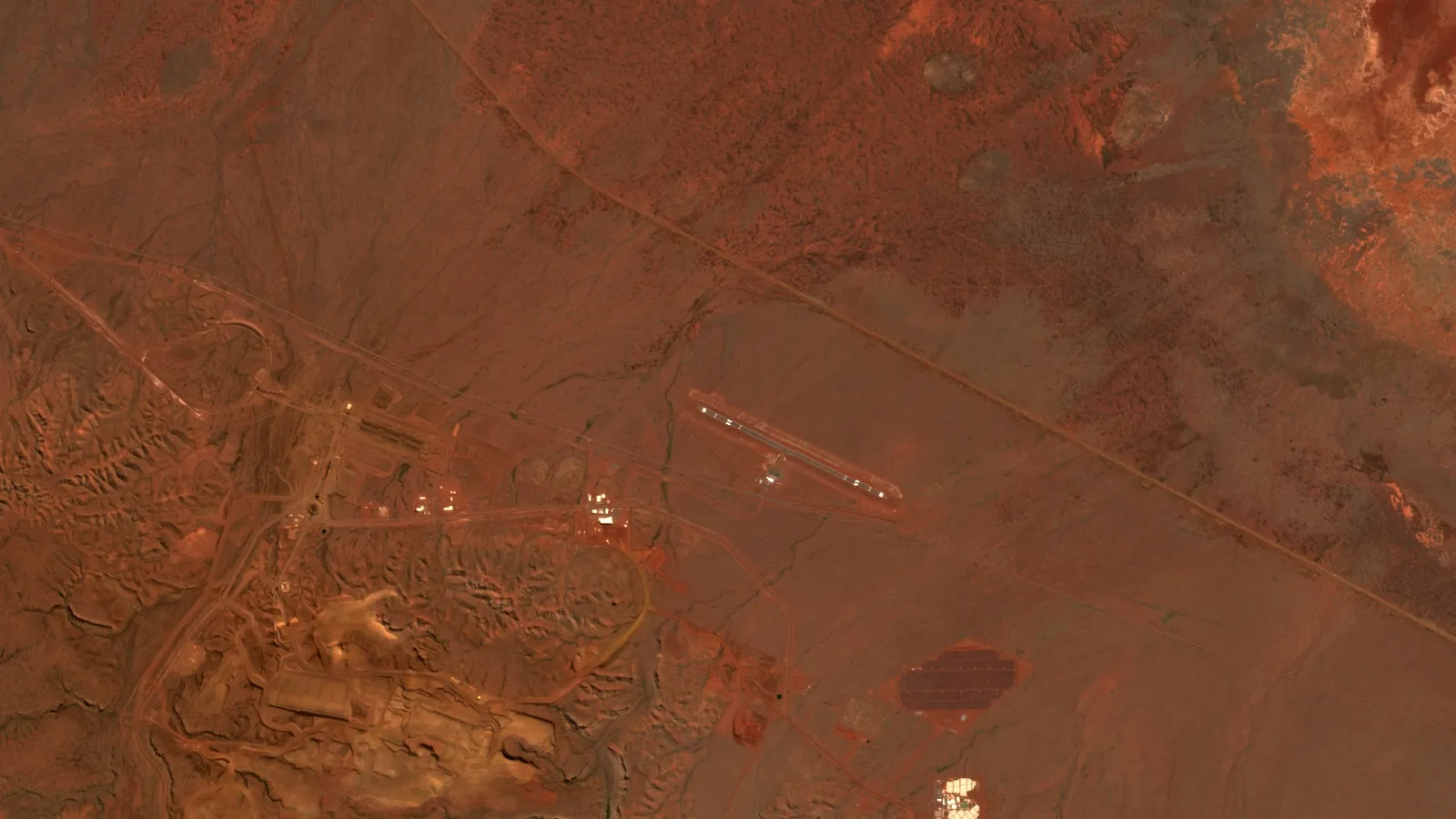
The Rio Tinto Group AI business transformation is, on the public record, a long automation programme with a newer AI layer on top. The core is the Pilbara iron ore system in Western Australia: about 300 autonomous haul trucks (Komatsu, August 2024), 53 driverless trains on nearly 2,000 km of rail, and mines run from an operations centre in Perth. On top sit a Palantir data platform renewed in November 2024, AI subsurface-imaging partners for exploration, and generative AI tools for documents. Rio Tinto’s own half-year results of 29 July 2026 credit a new operating system for its productivity gains and do not mention AI at all.
This page lists the eight uses that carry a dated public source, shows the numbers behind each one, separates company claims from partner press releases, and ends with a break-even calculator for a smaller mine. Every figure has its source and date. Where a number is a company claim, we say so.
Rio Tinto AI and automation: 8 uses and the evidence behind each
We ordered the eight uses from the largest, best-documented deployments to the smallest. The last column shows who published the evidence. A mine is a site where ore is dug from the ground. Rio Tinto runs 18 iron ore mine sites in the Pilbara alone, joined by rail to two ports (Rio Tinto 20-F, 2025).
| Rank | Use | What is deployed | Latest public figure | Evidence |
|---|---|---|---|---|
| 1 | Driverless haul trucks | Komatsu and Caterpillar trucks run by a central controller, no driver | 300 Komatsu trucks on 10 Australian sites (August 2024) | Komatsu, via trade press |
| 2 | Driverless trains (AutoHaul) | Remote-controlled iron ore trains | 53 trains of 240 wagons each (November 2024) | Palantir release, trade press |
| 3 | Autonomous drills | Blast-hole drills planned and run remotely | 26 drills; one operator can run up to 8 (2021) | Rio Tinto case study |
| 4 | Remote operations | Control rooms that run mines, ports and rail | Perth centre about 1,500 km from Gudai-Darri (June 2022) | Rio Tinto release |
| 5 | Data and AI platform | Palantir Foundry and Artificial Intelligence Platform (AIP) | Contract extended four years (November 2024) | Palantir release, trade press |
| 6 | Digital twins and robotics | 3D plant replica, robotic assay lab, warehouse vehicles | Gudai-Darri opened June 2022 | Rio Tinto release |
| 7 | Exploration imaging | Satellite-linked seismic imaging, cosmic-ray muons | Rincon lithium (October 2024); six sites with Ideon (October 2025) | Partner releases |
| 8 | Generative AI and conservation | Document chatbot, archive search, image recognition | 35,000 cockatoos found in 2.6 million images | CIO interview, partner release |
This table covers the uses that have a dated source. It is not a full inventory of every AI project in a company this size. None of the eight comes with a published spend or saving, so we do not give a group-wide AI saving.
What counts as AI here, and how we checked
Three terms get mixed up. Automation means a machine follows rules set by people, for example a train that stops at a signal. Machine learning means software that learns patterns from data, such as spotting when a bearing will fail. Generative AI means software that writes or summarises text, the kind used in chatbots. Rio Tinto uses all three. Its chief information officer told Mining Technology in late 2024 that the company applies predictive asset health, smart mine planning and safety analytics, and that it has recently added generative AI and computer vision (Mining Technology interview with Dan Evans).
For each use we opened the company’s own release or filing where one exists. Where only a partner has published, we say “the partner said”. For a wider look at the sector, see our overview of AI in the mining industry.
▶ What an AI mining app does, who makes one, and four questions to ask before choosing. · 3:52
Autonomous trucks, drills and trains in the Pilbara
The Pilbara is the part of the business where automation is oldest and best documented. Rio Tinto began trialling autonomous trucks in 2008. By December 2017 the fleet had moved its one-billionth tonne of material, and Rio reported 15% lower unit costs and 700 more operating hours per truck than manned trucks that year (Mining.com, 30 January 2018, citing Rio Tinto). Those are company figures from nearly nine years ago, so treat them as a starting point, not a current benchmark.
Chart
Autonomous haul trucks at Rio Tinto in the Pilbara
Number of trucks reported; 2011 is the first deliveries, 2018 and 2021 are ‘more than’ figures
The fleet has grown since. A 2021 Rio Tinto case study put it at more than 220 autonomous trucks, about half the Pilbara truck fleet, plus 26 autonomous drills that one operator in Perth can plan for a full shift (Global Mining Guidelines Group case study, March 2021). In August 2024 Komatsu said it had delivered its 300th autonomous truck to Rio Tinto. The same fleet had logged 8.9 million operating hours, moved over 4.8 billion tonnes and lifted effective utilisation by 15%, according to Komatsu as reported by AlCircle. Komatsu has since commissioned its 1,000th autonomous ultra-class truck worldwide (International Mining, 21 April 2026), so Rio is one customer among many.
AutoHaul, the driverless rail system, reached full operation in June 2019. It runs on Rio Tinto’s Pilbara railway, which the company describes as the largest privately owned and operated railway in the world, with nearly 2,000 km of track linking 18 mine sites to two ports (Rio Tinto Annual Report on Form 20-F, 2025).
The Pilbara matters for the world iron ore market as well as for Rio. Its 2025 shipments were 326.2 million tonnes on a 100% basis, against estimated Australian mine output of 980 million tonnes in 2025 (USGS Mineral Commodity Summaries, 2026). That is about one third of the national figure, though the two numbers are measured on different bases, so read the ratio as a rough guide. For the safety systems that go with machines like these, see our guide to mine safety solutions.
Remote operations centres and the data platform behind them
Driverless machines need people watching them. Rio Tinto’s operations centre in Perth controls assets about 1,500 km away at Gudai-Darri, the company’s 17th Pilbara iron ore mine, which opened in June 2022 with a stated capacity of 43 million tonnes a year (Rio Tinto, 21 June 2022). The 2021 case study adds that Rio runs operations centres in Perth, Brisbane and the Saguenay region of Canada.
Chart
Autonomous machines Rio Tinto has counted in public
Units, with the year of each figure in the label
The data layer under those rooms is Palantir Foundry, whose digital twin Rio had built over the three years before the November 2024 renewal. Palantir said this digital twin (a software model that mirrors real assets) was the base for AI use cases, and that the new contract gives access to Palantir’s AI platform for four more years. In the Perth centre, network specialists use Foundry to route 53 driverless trains of 240 wagons each. At Oyu Tolgoi in Mongolia, one of the deepest block-cave mines (a mine that lets ore collapse under its own weight and draws it from below), it combines data from thousands of sensors into one view of cave health and geotechnical risk (International Mining, 14 November 2024). These are Palantir’s statements, quoted with a Rio Tinto executive.
Gudai-Darri also shows the “digital twin” idea at plant scale. The mine has a full digital replica of its processing plant used for monitoring and virtual-reality training, a robotic ore-sampling laboratory, 23 Caterpillar 793F autonomous trucks, three autonomous drills and four automatic guided vehicles in the warehouse (Rio Tinto, June 2022).
AI for exploration and subsurface imaging
Exploration is the stage before a mine exists, when teams decide where to drill. The AI claims here come from partners, not from Rio’s results, so they deserve more caution. In October 2024 Fleet Space Technologies announced a collaboration with Rio Tinto to map the Rincon lithium project in Argentina in 3D across 100 square kilometres of salt flat, using Fleet Space’s ExoSphere system, which combines ambient-noise seismic sensors, a satellite network and AI to image the reservoir, basement depth and brine-controlling structures (Fleet Space, 24 October 2024).
In October 2025 Ideon Technologies announced a partnership with Rio Tinto across six of its largest operations, using cosmic-ray muons (particles from space that pass through rock and show density) with other sensors and AI. Ideon said an earlier deployment at Bingham Canyon, a large copper mine in Utah, improved geological models and reconciled production tonnage (Ideon Technologies, 6 October 2025). Neither announcement reports a drilling result, so these are tools in use, not discoveries.
The same caution applies across the industry. AI ranks places to drill; only a drill hole proves metal. Our guide to mining technology and equipment covers other tools of this kind.

▶ How AI is used in mineral exploration, where it fails, and how to check a claim. · 4:37
Generative AI, archives and conservation
The newest layer is software that reads documents. Rio Tinto’s CIO said the company built a knowledge chatbot, similar to GPT, that pulls key points from hundreds of documents and cites its sources, used in research and annual planning. In August 2025 Aspermont, an Australian publisher, signed an agreement worth about A$550,000 with Rio Tinto Ltd to digitise roughly 200 years of Mining Journal and Mining Magazine archives for a large language model search tool, with Rio getting six months of exclusive access (Sharecafe, 21 August 2025).
Conservation is a smaller use with clear numbers. At Weipa in Queensland, Rio built an image model that found 35,000 palm cockatoos in more than 2.6 million images, in the two years before a late-2024 interview (Mining Technology). Its 20-F also says Rio has been trialling AI-driven workflows with remotely operated platforms to track mine rehabilitation and predict when closure completion criteria will be met. The word “trialling” matters: that is not yet a company-wide system.
What Rio Tinto’s results credit for the gains
If AI had delivered large, measured savings, a company this size would say so in its results. It does not. Rio’s 2025 annual report credits the Safe Production System, an operating method now used at all Rio-managed sites, and a new operating model that moves decisions to the point of impact. It announced US$650 million of annualised productivity benefits in December 2025. The half-year results of 29 July 2026 report a US$1.3 billion annualised run rate, US$870 million already banked, and a target of US$1.8 billion by the end of 2026. The new Management Operating System launched on 1 July 2026. The half-year results do not mention AI, and the annual report names it mainly in its risk, people and sustainability sections.
Chart
Rio Tinto productivity programme, annualised run rate
US$ million per year; the last bar is the company’s target
The Pilbara numbers point the same way. Production was 327.3 million tonnes in 2025 against 328.0 million in 2024, and shipments were 326.2 million against 328.6 million, with four cyclones in the first quarter. Unit cost was US$23.5 per tonne, US$0.5 higher than in 2024, mainly because of inflation, harder ore (a higher work index) and cyclone recovery (Rio Tinto 20-F, 2025). Group safety was flat, with an all-injury frequency rate of 0.37 in 2025 and 0.37 in 2024, and that company-wide figure mixes every cause. Our reading: automation is a base the system stands on, and the visible gains now come from how the work is managed.
Risks Rio Tinto names about AI
The same 20-F treats AI as a risk as well as a tool. It says AI can bring data-privacy breaches, intellectual-property problems, misinformation and security gaps, and that generative AI vendors often put new features ahead of security. It rates cyber risk as stable against 2024, and says the attack surface is growing as industrial systems connect and as it adopts autonomous technologies, which may include AI. It also lists autonomous train and haulage operations among the areas where a control failure would be a major hazard. A buyer thinking of copying Rio should plan for security and for people who can take over when the system stops.
Can a smaller mine copy this? A downtime break-even calculator
Few mines run 300 driverless trucks. Many can still ask whether sensors and predictive maintenance (fixing a machine before it fails, based on data) would pay. The calculator below does not use Rio’s results, because Rio has not published a downtime saving for its AI. You enter your own fleet, your own cost of an hour of lost production and the saving a vendor has promised, then see what you would need to believe for the programme to break even.
If you are earlier in the cycle and still choosing where to explore, Farmonaut maps licence areas with satellite data and AI: you send a KML, KMZ or polygon file and receive a report in 5 to 20 business days, depending on size. Our Fleet Management, Carbon Footprinting and Product Traceability pages describe our other satellite tools. A look at deep gold mine technology shows how far the same ideas reach underground.
More from Farmonaut: the Farmonaut app, satellite-verified loan and insurance and the satellite and weather API docs.
Calculator
Would predictive maintenance pay for your fleet?
Enter your own fleet, downtime and the saving a vendor promises.
- Downtime hours avoided per year: 600
- Gross saving (US$ per year): $480,000
- Downtime cut needed to break even (%): 5.2
Examples only, not benchmarks, and not Rio Tinto results. Cost of a downtime hour is the production you lose in US$ per hour: example, use today’s price and your own margin. Programme cost covers sensors, software and staff time per year.
Five checks before buying a mining AI tool
- What decision does it change? A tool that only produces a dashboard changes nothing until someone acts on it.
- What is the baseline? Ask for downtime, cost per tonne or injury rate before and after, on the same mine.
- Who holds the data? Rio’s own filing flags data privacy and security as the main AI risks.
- What happens when it is wrong? AI exploration tools rank likely places; drilling decides.
- Who maintains it? Models drift as ore and equipment change, so check the support plan and the price after year one.
Frequently asked questions
What is the Rio Tinto Group AI business transformation?
It is the mix of automation, data platforms and AI tools that Rio Tinto has built across its mines, rail and ports. The best documented part is the Pilbara iron ore system with autonomous trucks, drills and trains run from Perth. Newer layers include Palantir’s AI platform, AI subsurface imaging for exploration and generative AI for documents.
How many autonomous trucks does Rio Tinto have?
Komatsu said in August 2024 that it had delivered 300 autonomous trucks to Rio Tinto’s Pilbara operations across 10 Australian sites. Rio’s 2021 case study gave more than 220, and Mining.com reported more than 80 in January 2018. Caterpillar trucks also run autonomously at Gudai-Darri, so the total is higher than the Komatsu count alone.
Does Rio Tinto use AI in mineral exploration?
Yes, through partners. Fleet Space Technologies announced a collaboration with Rio to build 3D subsurface maps at the Rincon lithium project in Argentina, and Ideon Technologies announced a deal in October 2025 to apply muon imaging and AI at six of its large operations. Neither announcement reports a drilling result.
Which company supplies Rio Tinto’s AI platform?
Palantir supplies the data and AI platform used for rail control and mine risk monitoring. It renewed its multi-year agreement with Rio Tinto in November 2024 for four more years. Rio also works with other firms, including Komatsu and Caterpillar for machines, Fleet Space and Ideon for exploration imaging, and Aspermont for archive search.
Has AI raised Rio Tinto’s iron ore output?
The published numbers do not show it. Pilbara production was 327.3 million tonnes in 2025 and 328.0 million in 2024, and four cyclones hit in the first quarter of 2025. Rio’s results credit its operating system and productivity programme, not AI, so any AI effect cannot be separated from the figures.
Where is Rio Tinto’s operations centre?
The iron ore operations centre is in Perth, Western Australia, about 1,500 km from Gudai-Darri. A 2021 Rio Tinto case study also lists centres in Brisbane and in the Saguenay region of Canada, which together allow mines, ports and rail to be run from a few locations.
Does Rio Tinto run driverless trains?
Yes. AutoHaul became fully operational in June 2019 on the Pilbara railway, which has nearly 2,000 km of track. In November 2024 Palantir said Rio coordinates 53 driverless trains of 240 wagons each from the Perth centre.
What AI risks does Rio Tinto report?
Its 2025 Form 20-F names data-privacy breaches, intellectual-property challenges, misinformation, regulatory uncertainty and cyber security. It says generative AI vendors often prioritise new features over security and that its cyber attack surface is growing with connected industrial systems and new technologies such as AI, and that its greatest exposures are third-party suppliers.
Can a small mining company use the same technology?
Parts of it, yes. Sensor-based maintenance, fleet tracking and satellite screening are sold to mines of every size, and a break-even check like the calculator above shows whether a quote makes sense. Driverless trains and trucks need a large, uniform operation to pay back.
How can I check a claim that AI found a deposit?
Ask for the drill results, the assay certificates and the independent technical report. AI can rank likely ground, but a deposit is only proven by drilling and assays. Treat percentages without a named source and date, such as “20% more accurate”, as marketing until a filing or study backs them.
This page is for information only. It is not investment advice. Company figures are the companies’ own claims, quoted with their dates.
Farmonaut mining
Get a quote to map your licence area from space
Licence owners can send a boundary as KML, KMZ or polygon and request a quote for a satellite mineral report.

Mining Pro sample view, synthetic data
Keep reading
Sources
- Rio Tinto, Annual Report on Form 20-F 2025 (SEC): sec.gov
- Rio Tinto, 2026 half year results (29 July 2026): riotinto.com
- Rio Tinto, Gudai-Darri opening release (21 June 2022): riotinto.com
- Global Mining Guidelines Group, Rio Tinto automation case study (March 2021): gmggroup.org
- Mining.com, Rio Tinto autonomous trucks (30 January 2018): mining.com
- AlCircle, 300th Komatsu autonomous truck at Rio Tinto (19 August 2024): alcircle.com
- International Mining, Komatsu 1,000 autonomous trucks (21 April 2026): im-mining.com
- International Mining, Rio Tinto extends Palantir AI use (14 November 2024): im-mining.com
- Fleet Space, collaboration with Rio Tinto at Rincon lithium (24 October 2024): fleetspace.com
- Ideon Technologies, partnership with Rio Tinto (6 October 2025): ideon.ai
- Sharecafe, Aspermont and Rio Tinto AI archive agreement (21 August 2025): sharecafe.com.au
- Mining Technology, Rio Tinto CIO interview on AI: mining-technology.com
- USGS, Mineral Commodity Summaries 2026: Iron Ore: pubs.usgs.gov
Discussion
Questions, corrections or field experience? Share them below. First-time comments are reviewed before they appear, and your email is never published.
No comments yet. Be the first to add a question or your experience.

 Energy and Resources Ltd
 Mwerezi Minerals Company Limited
 Congo Mining Solutions
 Mining SARL
 SenGold Invest SAS
 Sania Corporation
 Sean Mining Limited
 NTS Group (Pty) Ltd
 Mine4Africa
 Lithspo Minerals Limited
 Tintina Mining Group
 Dalgety Minerals Pty Ltd
 Vortex Minerals Pty Ltd
 Faith At Work (Pty) Ltd
 Geotech Mining Solutions plc
 Vulcan International Limited
 Kidepo Associates
 GKY Mining
 Alkimy SARL

 Licence holder · Nigeria · Gold + lithium










