

Materials and mining tools · Explainer with data
What Is Tungsten Carbide Used For? Mining Tool Guide
About 65% of world tungsten goes into carbide products (ITIA). This guide covers what the material is made of, its key numbers, mining uses, where the tungsten is mined and what its price does to bit costs.
Key takeaways
- Tungsten carbide (WC) has a density of 15.6 g/cm3, a Mohs hardness of about 9.0 to 9.5 and a melting point of 2,785 to 2,830 °C (references in Wikipedia’s WC entry).
- Carbide products take 65% of world tungsten use, and mining accounts for 62% of the mining and construction segment, which is 26% of end use (ITIA).
- China produced 67,000 of the 85,000 tonnes of tungsten mined in 2025, about 79% (USGS, 2026).
- Rotterdam concentrate prices rose from US$266 to US$551 per mtu during 2025 after tariffs and export controls (USGS, 2026).
- Mincon reported a significant tungsten carbide price rise squeezing drill-bit margins in its half-year results of 4 August 2026.
In this article
- What tungsten carbide is made of
- Tungsten carbide properties: density, hardness and melting point
- What is tungsten carbide used for?
- Tungsten carbide in mining: tools and wear parts
- How a carbide insert is made in four steps
- Tungsten carbide in construction and tunnelling
- Where the tungsten comes from
- Tungsten price and what it does to tool costs
- How much tungsten is in one carbide bit?
- Recycling and substitutes
- Health and handling
- Where satellites fit
- Frequently asked questions
Tungsten carbide is a hard grey compound of tungsten and carbon. In industry it is used mostly as cemented carbide: carbide grains held together by a metal binder, usually cobalt. About 65% of the world’s tungsten goes into carbide products, according to the International Tungsten Industry Association (ITIA), and much of it ends up in cutting and wear parts such as rock drill bits and cutter picks. The ITIA puts mining at roughly 16% of all tungsten end use (62% of the 26% mining and construction segment, 2021 data). The rest of this page covers what the material is made of, its density, hardness and melting point, where mines use it, where the tungsten comes from and why its price moves tool costs.
What tungsten carbide is made of
The chemical formula is WC: one tungsten atom for each carbon atom. The pure compound is a grey-black powder that is pressed and heated to make solid shapes, as described in the Wikipedia entry on tungsten carbide. The powder is made by reacting tungsten metal and carbon at 1,400 to 2,000 °C.
It is not a simple alloy. An alloy is a mix of metals. Tungsten carbide is a ceramic-like compound, and the tool material is a composite of that compound and a metal binder. That is why industry also calls it a hard metal or cemented carbide. Cobalt is the usual binder; nickel and iron are alternatives, and the mix is pressed and then sintered (heated until the binder melts and locks the grains together) at roughly 1,400 to 1,600 °C. The binder is tougher than the carbide grains, so it absorbs shock that would otherwise crack the ceramic. The cemented carbide article gives the same account of grains, binder and sintering.
In the powder form the compound was first made by the French chemist Henri Moissan in 1893. Industrial production of the cemented form began between 1913 and 1918, according to the same Wikipedia entry.
Tungsten carbide properties: density, hardness and melting point
Most searches about this material are about a single number. The table gives the main values for the pure compound (WC), as listed in the references behind Wikipedia’s tungsten carbide entry, which cites the GESTIS substance database for density and the CRC handbook for the melting range.
| Property | Value for WC | What it means in practice |
|---|---|---|
| Density | 15.6 g/cm³ | About twice as dense as steel, so a carbide insert feels heavy for its size |
| Hardness (Mohs) | about 9.0 to 9.5 | Close to corundum; diamond is 10 on the same scale |
| Hardness (Vickers) | about 2,600 | Steels sit far lower, which is why carbide cuts them |
| Melting point | 2,785 to 2,830 °C | Grains stay solid while the cobalt binder melts during sintering |
| Young’s modulus | about 530 to 700 GPa | Roughly three times as stiff as steel |
| Thermal conductivity | 110 W/(m·K) | Moves heat away from a hot cutting edge |
Hardness is a scratch resistance scale, so it does not measure toughness. Our guide to the Mohs hardness scale explains the 1 to 10 ranking and its limits. In a drill bit, hardness resists wear while the cobalt binder gives the toughness. Makers adjust the binder to balance the two, so grades differ by application.
Note that the density of cemented carbide is slightly lower than 15.6 g/cm³ because the binder is lighter than tungsten carbide. Check the data sheet of the grade you plan to buy.
What is tungsten carbide used for?
The ITIA splits world tungsten use by the first product made from it. Cemented carbide is the largest slice by far.
Chart
Where world tungsten goes, by first-use product
Per cent of global tungsten consumption
Within end uses, the ITIA reports (2021 industry data) that mining and construction account for 26% of consumption, level with transport at 26%, and that mining makes up 62% of the mining and construction segment. That means the mining sector is a major buyer but not the only one. Metalworking and oil and gas drilling are other large uses. In the United States, the USGS estimates that about 60% of tungsten used in 2025 went into cemented carbide parts for cutting and wear-resistant uses, mainly in construction, metalworking, mining and oil and gas drilling (USGS Mineral Commodity Summaries, 2026).
Other uses of the same material:
- Metal cutting and forming: turning and milling inserts, drills, and dies for forming wire and metal parts.
- Wear and corrosion parts: the tungsten carbide entry lists corrosion- and wear-resistant parts such as inlet control for well screens, seal rings and bushings in oil and gas drilling.
- Ammunition and jewellery: hard cores in armour-piercing rounds and scratch-resistant rings are listed among its uses in the tungsten carbide entry cited above.
Tungsten carbide in mining: tools and wear parts
Mines use carbide where rock wears steel away fastest. According to the cemented carbide and tungsten carbide entries on Wikipedia, typical mining uses include:
- buttons and inserts on top-hammer rock drill bits and down-the-hole hammer bits;
- roller-cutters and tricone bit teeth;
- longwall shearer picks and plough chisels in coal mining;
- raise-boring reamers and tunnel boring machine cutters.
Sandvik, a rock-tool maker, groups its range into down-the-hole, top-hammer and rotary drilling tools. The Wikipedia entries above describe carbide buttons and inserts fitted to the cutting surface of mining and tunnelling tools.
A tool that lasts longer does not only save the price of a bit. Each bit change stops a drill rig, and hours of idle machine time often cost more than the bit. That is why mines track metres drilled per bit and downtime together, and why fleet tracking systems log drill hours; see Farmonaut’s fleet management page for one example of that kind of tracking.
▶ Explains what mining contributes to economies and why the world needs mined minerals. · 5:03
How a carbide insert is made in four steps
The flow below summarises the powder-metallurgy route that the sources above describe.
Infographic
A carbide insert in 4 steps
- 1Make the powderTungsten metal and carbon react at 1,400 to 2,000 °C to form WC powder.
- 2Mix with binderThe powder is mixed with cobalt, or sometimes nickel or iron.
- 3PressThe mix is pressed into the shape of the insert.
- 4SinterHeating to about 1,400 to 1,600 °C melts the binder, which locks the grains together.
Tungsten carbide in construction and tunnelling
The same wear problem appears in civil work. Tunnel boring machines and raise-boring reamers use carbide cutters, as noted above. Mincon, a drilling-tool maker, reports that mining and waterwell and geothermal drilling both grew in the first half of 2026, so the same bit types serve mines, water wells and geothermal wells.
Where the tungsten comes from
Carbide starts as tungsten ore. China dominates supply: the USGS estimates world mine output at 85,000 tonnes of contained tungsten in 2025, of which China produced 67,000 tonnes, about 79%. It also holds the largest reserves, at 2.5 million tonnes of a world total above 4.7 million tonnes (USGS, 2026). The chart shows six selected producers outside China (several other producers are left out); their combined output is a small fraction of China’s.
Chart
Tungsten mine output outside China
Tonnes of contained tungsten, selected countries
The United States has not mined tungsten commercially since 2015 and relies on imports for more than half of what it uses, the USGS reports. In 2025 the USGS also notes the start of production at the Boguty deposit in Kazakhstan and several Defense Production Act awards for projects in Nevada, New Brunswick and Yukon. For tungsten projects and mines in Canada, see our guide to Mactung, Sisson and Cantung, and for the ore side, our list of high-grade tungsten mines.
Because tungsten sources are few, buyers ask where a lot came from. Traceability tools that record the origin of each batch, such as Farmonaut’s product traceability, address that question for any commodity chain.
Tungsten price and what it does to tool costs
Tungsten is a small, thinly traded market, and its price jumped in 2025. The USGS says the US and Chinese trade measures were a main cause: the US raised tariffs to 50% on several tungsten products from China at the end of 2024, and China put export controls on selected tungsten items in February 2025. Over 2025, Rotterdam prices rose from US$266 to US$551 per metric ton unit (mtu, 10 kg of contained tungsten trioxide) for 65% concentrate, and from US$331 to US$675 per mtu for ammonium paratungstate (APT, the intermediate that is turned into metal and carbide powder).
Chart
Tungsten concentrate price, annual average
US$ per metric ton unit of WO3, Rotterdam in-warehouse
The cost reaches tool makers fast. Mincon reported in its half-year results on 4 August 2026 that mining revenue grew 18%, and also described “exceptional cost inflation” in tungsten carbide that squeezed margins on drill bits because part of the increase had not yet been passed on to customers (Mincon Group half-yearly report, 4 August 2026). Price lists and framework contracts lag the raw material, so bit prices tend to follow tungsten up with a delay.
China’s APT spot price closed at RMB 760,000 per tonne, including 13% VAT, on 5 June 2026 by Shanghai Metals Market (SMM). Check a live source such as SMM, Fastmarkets or Argus on the day you plan a purchase; weekly assessments move quickly and no single quote on this page should be treated as today’s price.
How much tungsten is in one carbide bit?
The calculator below turns a bit’s carbide mass into tungsten metal, contained trioxide and a raw-material value. Pure WC is 93.9% tungsten by mass (183.84 divided by the molar mass of 195.85), and one kilogram of tungsten corresponds to 1.261 kilograms of tungsten trioxide, the unit in which concentrate is priced. The result is only the value of the contained tungsten at the concentrate price. It leaves out conversion to powder, pressing, sintering, cobalt, steel, labour and margin, so it is not the price of the bit.
Calculator
How much tungsten is in a carbide bit?
Enter your bit’s carbide mass, binder share, price and metres drilled.
- Contained WO3: 0.21 mtu
- Raw tungsten value at your price: $117
- Bit cost per metre drilled: $0.27
- Raw tungsten as share of bit price: 14.6 %
Example values only, not a benchmark. Constants: WC is 93.9% tungsten by mass (183.84 / 195.85) and tungsten metal to WO3 is a factor of 1.261, from atomic and molar masses; one mtu is 10 kg of WO3 (USGS unit). Prices are inputs: example, use today’s price in US$ per mtu. The result excludes conversion, pressing, sintering, cobalt, steel and margin.
Recycling and substitutes
A 2021 paper in the International Journal of Refractory Metals and Hard Materials calls recycling an essential part of the global tungsten flow. Official numbers are hard to get: the USGS says the quantity of secondary tungsten produced and consumed in 2025 was withheld to avoid disclosing company data, so no official global recycling share is published in its summary.
Substitutes exist but do not remove tungsten. The USGS lists cemented carbides based on molybdenum, niobium or titanium carbide, ceramics, cermets and tool steels, and notes that most of these options reduce rather than replace tungsten use. Mines that want to cut tungsten use more often extend bit life: better rock-to-tool matching, regrinding and monitoring of wear.
Operators that count the emissions of drilling and haulage can combine tool life with fuel and energy data; Farmonaut’s carbon footprinting tool is one example of software for that.
▶ A plain-language claymation on the seven environmental impacts of mining. · 2:31
Health and handling
Solid carbide is chemically inert, but grinding it makes dust. The tungsten carbide entry cited above notes that the main health risk is inhaling dust, which can cause a silicosis-like lung condition, and the US National Toxicology Program lists cobalt–tungsten carbide powders and hard metals as reasonably anticipated to be a human carcinogen (Report on Carcinogens, 13th edition). Regrinding workshops need dust extraction and respiratory protection under local rules.
Where satellites fit
Satellite data does not measure carbide. It helps at the other end of the chain, the ore. Farmonaut screens licence areas from satellite imagery as an exploration target, ahead of any resource estimate, with reports in 5 to 20 business days from a KML, KMZ or polygon. The service is described at the Farmonaut app, and developers can read the API page and the developer documentation. For earlier price history, see our tungsten price drivers guide.
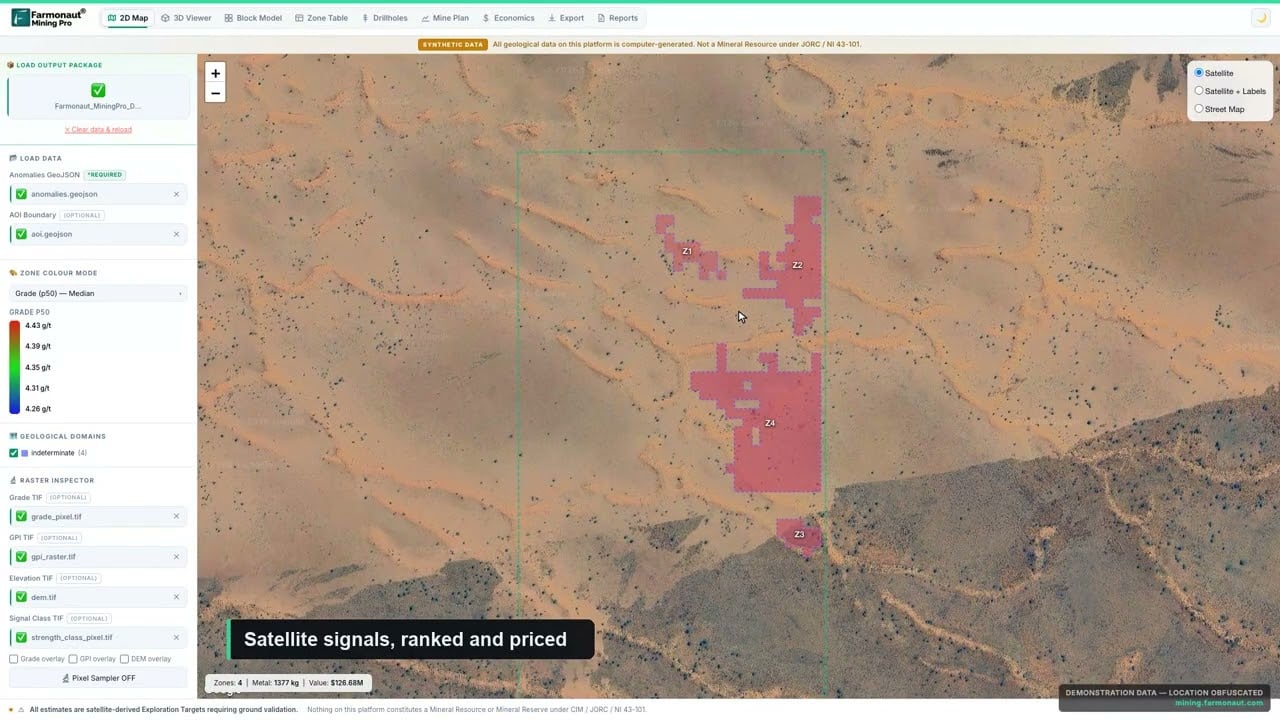
▶ A quick look at Farmonaut Mining Pro, which screens a licence boundary from satellite data. · 4:56
If this topic matters to you, read Thoriated Tungsten: Safety, Color Codes, Alternatives next.
Frequently asked questions
What is tungsten carbide made of?
Tungsten and carbon in equal atomic parts (WC). Tools are made by mixing the powder with a metal binder, usually cobalt, and sintering it into a solid piece.
What is tungsten carbide used for?
Mainly cutting and wear parts. The ITIA puts carbide products at 65% of world tungsten use, with mining, construction, metalworking and wear parts as the main markets.
What is the density of tungsten carbide?
Pure WC has a density of 15.6 g/cm³, about twice that of steel. Cemented grades with a cobalt binder come out slightly lower, so use the grade’s data sheet.
How hard is tungsten carbide on the Mohs scale?
About 9.0 to 9.5, below diamond at 10. Its Vickers hardness is around 2,600.
What is the melting point of tungsten carbide?
Between 2,785 and 2,830 °C for pure WC, according to the references cited in the Wikipedia entry. The cobalt binder melts at a lower temperature, which is what lets sintering bind the grains.
Is tungsten carbide an alloy?
Not strictly. WC is a compound, and tool grades are composites of that compound and a metal binder. People still call the material a hard metal.
Why is tungsten carbide used in mining drill bits?
Rock is abrasive, and carbide wears far more slowly than steel while the binder gives enough toughness to survive impact. Inserts sit at the cutting surface of the bit.
Which country produces most tungsten?
China, with 67,000 of the world’s estimated 85,000 tonnes of mine output in 2025, according to the USGS.
Why did tungsten carbide get more expensive?
Tungsten prices rose sharply through 2025 after US tariffs on Chinese tungsten products and Chinese export controls. Tool makers such as Mincon reported higher carbide costs in 2026.
Can tungsten carbide be recycled?
Yes. Recycling is described as an essential part of the global tungsten flow in a 2021 peer-reviewed paper. The USGS withheld its 2025 secondary-tungsten figures, so check any percentage you see against its source.
Is tungsten carbide dangerous?
The solid is not, but dust from grinding is a lung hazard and cobalt-bonded carbide dust is a recognised health concern. Use dust control when regrinding.
This page is for information only. It is not investment advice. Prices change daily; check a live source before buying or selling.
Farmonaut mining
Map your mining site from space
Consultants can screen a licence area from satellite data as an exploration target, ahead of any resource estimate.
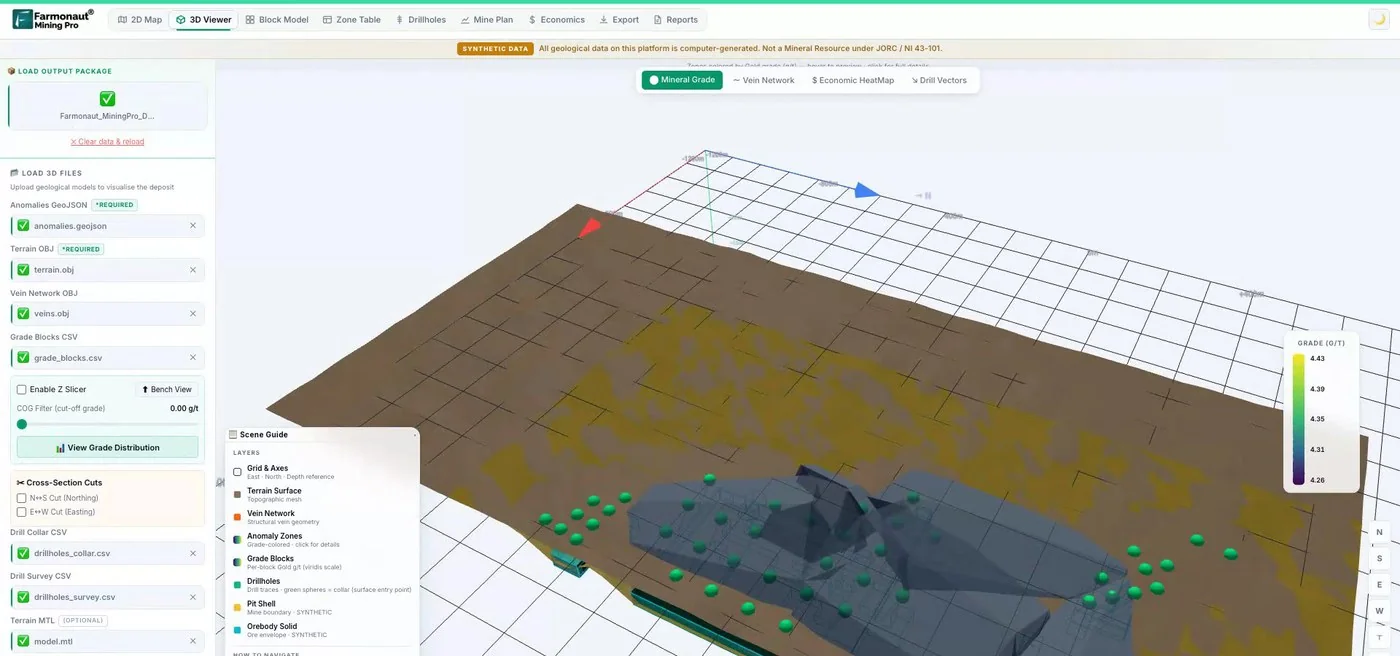
Mining Pro sample view, synthetic data
Keep reading
Sources
- USGS, Mineral Commodity Summaries 2026: Tungsten: pubs.usgs.gov
- USGS, Mineral Commodity Summaries 2026 (full volume): pubs.usgs.gov
- ITIA, Applications and Markets: itia.info
- Wikipedia, Tungsten carbide: en.wikipedia.org
- Wikipedia, Cemented carbide: en.wikipedia.org
- Wikipedia, Tungsten: en.wikipedia.org
- Sandvik Rock Tools, product range: rocktechnology.sandvik
- Mincon Group, Half Yearly Report (4 August 2026): investegate.co.uk
- SMM, Tungsten prices rally on long contract prices (June 2026): news.metal.com
- TU Wien, Recycling of tungsten (Zeiler, Bartl, Schubert, 2021): repositum.tuwien.at
- NTP, Report on Carcinogens 13th ed.: Cobalt-tungsten carbide powders and hard metals: ntp.niehs.nih.gov
Discussion
Questions, corrections or field experience? Share them below. First-time comments are reviewed before they appear, and your email is never published.
No comments yet. Be the first to add a question or your experience.

 Lithspo Minerals Limited
 Tintina Mining Group
 Dalgety Minerals Pty Ltd
 Vortex Minerals Pty Ltd
 Faith At Work (Pty) Ltd
 Geotech Mining Solutions plc
 Vulcan International Limited
 Kidepo Associates
 GKY Mining
 Alkimy SARL
 Double A Trading
 GemSprout Metals Limited
 Qader Group
 Ileys General Trading
 SG Gold Mining LLC
 VRV Global Pte Ltd
 Omsri International FZE
 G.I.T.T.
 Jaunita Erss Ltd
 Almosi SARL
 SRK Consulting
 Berks Gold Limited
 Mwerezi Minerals Company Limited
 Exploration consultancy · South Africa · Gold










