

Rare earths · Price guide
NdPr Oxide Price and Meaning: China vs Ex-China
NdPr is a neodymium–praseodymium oxide blend for magnets. SMM’s China average was 721,500 yuan/t on 26 October 2026; Benchmark put ex-China oxide at US$95/kg on 20 August 2026. Dates, bases and a converter below.
Key takeaways
- NdPr is a neodymium–praseodymium blend, usually about 75/25 oxide by mass (about 85% contained metal), sold as oxide, metal, alloy or in magnets; it is not a mineral.
- SMM, 26 October 2026: Pr-Nd oxide in China averaged 721,500 yuan per tonne, range 720,000–723,000, down 0.28% on the day; SMM’s US dollar series excludes 13% VAT.
- Benchmark Minerals, 21 August 2026: ex-China oxide US$95,000 per tonne CIF Europe and North America, below the US$110/kg MP Materials floor; ex-China fell 7.3% and China domestic 3.5% from 6 to 20 August.
- USGS: the US NdPr oxide annual average price was US$69/kg in 2025, US$55 in 2024 and US$124 in 2022.
- MP Materials reported 2,599 t of NdPr oxide produced in 2025 and 840 t in the second quarter of 2026; the floor pays the gap to an undisclosed benchmark, so PPA income divided by tonnes is not a price.
In this article
- NdPr oxide price: China domestic vs ex-China
- How to turn a China yuan quote into a US dollar price
- NdPr oxide price history from USGS annual averages
- What NdPr means: why neodymium and praseodymium are sold together
- Is NdPr a mineral?
- Four products sold as NdPr: oxide, metal, alloy and magnet
- The US$110 per kilogram floor and what MP Materials reports
- Who produces NdPr oxide outside China
- From rock to magnet: the eight steps NdPr passes through
- Screening ground for NdPr-bearing hosts
- A checklist for checking any NdPr number
- Frequently asked questions
NdPr is a neodymium–praseodymium blend, usually sold as a mixed oxide of about 75% neodymium oxide and 25% praseodymium oxide by mass. It is the raw material for NdFeB permanent magnets. On 26 October 2026 the Shanghai Metals Market (SMM) average for Pr-Nd oxide in China was 721,500 yuan per tonne, and a Benchmark Minerals assessment on 21 August 2026 put ex-China oxide at US$95,000 per tonne, below the US$110 per kilogram floor in MP Materials’ U.S. Department of Defense agreement.
Those two numbers sit on different bases, which is why NdPr prices confuse people. This page gives the dated prices with their basis, shows how to convert a China quote to US dollars, and explains what the name means, what is and is not a mineral, who produces the oxide outside China, and how to check any NdPr figure you are shown.
NdPr oxide price: China domestic vs ex-China
There is no exchange contract for NdPr. No LME or COMEX listing exists, so there is no single public spot price. Prices come from price-reporting agencies (SMM, Benchmark Minerals, Argus, Fastmarkets, S&P Global Platts), most of them behind subscriptions, plus producer filings. Always ask three things before using a number: the date, the basis (China domestic or delivered outside China) and the unit (yuan per tonne, US$ per tonne or US$ per kilogram). A tonne is 1,000 kg, so US$95,000 per tonne is US$95 per kilogram.
Chart
NdPr oxide price anchors, US$ per kg (each bar has its own date and basis)
Not directly comparable: bars differ in date, basis and tax
China quotes are normally given in yuan per tonne including 13% value-added tax (VAT), the tax added to domestic sales in China. SMM states that its US dollar series for Pr-Nd oxide excludes 13% VAT, which implies the yuan quote is the VAT-inclusive figure (SMM’s page states only that its USD price excludes 13% VAT). Ex-China prices are delivered prices (CIF means cost, insurance and freight to a port) and carry no Chinese VAT.
| Date | Product and basis | Price | Source |
|---|---|---|---|
| 26 Oct 2026 | Pr-Nd oxide, China domestic, yuan per tonne (average; range 720,000–723,000) | 721,500 yuan/t | SMM |
| 23 Jul 2026 | Pr-Nd oxide, China domestic, yuan per tonne | 753,000–758,000 yuan/t | SMM weekly review |
| 23 Jul 2026 | Pr-Nd metal, China domestic, supplier quotations | 910,000–920,000 yuan/t | SMM weekly review |
| 20 Aug 2026 | NdPr oxide, ex-China, CIF Europe and North America | US$95,000/t (US$95/kg) | Benchmark Minerals, 21 Aug 2026 |
| 20 Aug 2026 | PrNd oxide, China domestic, as converted by Benchmark | 721,500 yuan/t = US$107,504/t | Benchmark Minerals, 21 Aug 2026 |
| Contract level | MP Materials NdPr floor, 10-year agreement signed July 2025 | US$110/kg | MP Materials |
| 2025 average | NdPr oxide, 99% minimum, United States, annual average | US$69/kg | USGS MCS 2026 |
Read the table as a spread, not a single price. Benchmark reported that between 6 and 20 August 2026 ex-China prices fell 7.3% and China domestic prices fell 3.5%, and that Chinese domestic prices stayed above ex-China levels. Its analyst’s explanation was oversupply outside China: producers are competing for a limited pool of non-China buyers and are avoiding sales into China. SMM’s notes for 19 and 20 October 2026 describe Pr-Nd oxide offers moving lower and order intake still thin, and the 26 October average of 721,500 yuan per tonne was 0.28% lower on the day.
One coincidence is worth stating plainly: the SMM average on 26 October 2026 and the China figure Benchmark used for 20 August 2026 are both 721,500 yuan per tonne. They are separate observations from separate publishers, so treat them as two data points that happen to match, and read the daily SMM page for the day you need.
How to turn a China yuan quote into a US dollar price
To compare a China quote with an ex-China one, remove the 13% VAT, then divide by the exchange rate. The arithmetic for the SMM quote of 721,500 yuan per tonne: 721,500 ÷ 1.13 = 638,496 yuan per tonne excluding VAT. At the roughly 6.71 yuan per US dollar that Benchmark’s own conversion implies for 20 August 2026 (not a 26 October rate) (721,500 yuan = US$107,504), that is about US$95.1 per kilogram. Benchmark does not say whether its US$107,504 figure includes VAT; because it is a straight conversion of SMM-style yuan quotes, it probably does, so it is not directly comparable with a delivered ex-China price until the VAT is taken out. This is our arithmetic, not a published assessment: it ignores export licences, freight, insurance and any contract discount, and a different exchange rate changes the answer. Use the calculator below with today’s rate.
Calculator
What is a China NdPr quote in US$ per kg?
Enter a yuan-per-tonne quote, the VAT rate and today’s exchange rate.
- Gap to ex-China price (US$/kg): 0.2
- Price per kg of contained metal at 0.850 (US$): 111.9
- Value of volume at ex-VAT price (US$): $9,515,582
Example values only. The yuan quote default is the SMM average for 26 October 2026; the 13% VAT is the rate SMM states for its US dollar series; the exchange rate of 6.71 yuan per US$ is the rate implied by Benchmark’s 21 Aug 2026 conversion (721,500 yuan = US$107,504), an example: use the 26 Oct 2026 or today’s CFETS/PBOC rate. The 0.850 contained-metal factor is the 75/25 oxide blend worked out from atomic weights. Excludes freight, licences and contract discounts.
NdPr oxide price history from USGS annual averages
For a longer view, the U.S. Geological Survey publishes annual average prices for NdPr oxide (99% minimum) in its Mineral Commodity Summaries. The 2025 average of US$69 per kilogram was up from US$55 in 2024 but still below the 2021 and 2022 levels. These are annual averages, so they smooth out the spikes and troughs that traders see in a single week. They also sit below the US$110 per kilogram floor in every year shown.
Chart
US NdPr oxide annual average price, US$ per kg
NdPr oxide, 99% minimum, annual averages 2021–2025
What NdPr means: why neodymium and praseodymium are sold together
Neodymium is element 60 (symbol Nd) and praseodymium is element 59 (Pr). Both are light rare earth elements in the lanthanide row. According to the Royal Society of Chemistry, Carl Auer von Welsbach obtained both from the material then called didymium in Vienna in 1885, and the names mean “new twin” and “green twin”. When you see “Nd Pr”, “Nd-Pr” or “Nd/Pr” it is the same pairing written as two symbols.
The two elements behave almost identically in chemistry, so splitting them needs many extra solvent-extraction stages, and for the main end use they do not need to be split. NdFeB magnets (neodymium–iron–boron, the strongest commercial permanent magnets) work with praseodymium substituting for part of the neodymium. Refiners therefore stop at the combined NdPr product. Praseodymium on its own is still separated for uses that need it, such as didymium glass for glassblowers’ goggles. Separation methods are covered in our guide to rare earth separation and hydrometallurgy.
Both elements are named individually on the U.S. critical minerals list. The Final 2025 List of Critical Minerals, published in the Federal Register on 7 November 2025, names 60 minerals and includes neodymium and praseodymium as separate entries, alongside other rare earths such as cerium, dysprosium and terbium.
Is NdPr a mineral?
No. There is no mineral called NdPr. NdPr is a refined product. What exists in the ground are minerals and clays that hold neodymium and praseodymium among other rare earths:
- Bastnäsite, a rare earth fluorocarbonate, is the ore mineral at Mountain Pass, California. The U.S. Geological Survey says bastnaesite was mined there as a primary product in 2025.
- Monazite, a rare earth phosphate, is recovered from heavy-mineral-sand concentrates (the USGS reports it from the southeastern United States). It carries thorium, which brings radiological handling rules.
- Xenotime, an yttrium phosphate, leans towards the heavy rare earths and is a minor source of NdPr.
- Ion-adsorption clays are weathered granite soils where rare earths cling to clay surfaces and can be leached without crushing hard rock. The Lynas offer for Meteoric Resources, announced on 1 October 2026, centres on one such deposit, Caldeira in Brazil.
When you read an exploration announcement, an assay reported as TREO (total rare earth oxide) says little about NdPr value. Ask for the NdPr-to-TREO ratio. Cerium and lanthanum, the cheapest rare earths, make up most of a typical light rare earth basket, so two deposits with the same TREO grade can earn very different revenue per tonne depending on how much of it is NdPr. For the wider picture of where these deposits sit, see our roundup of rare earth deposits in the US and our overview of rare earth mining investment.
Four products sold as NdPr: oxide, metal, alloy and magnet
When someone quotes an NdPr number, find out which row of this table they mean before comparing it with anything.
| Product | What it is | Contained Nd+Pr | Usual unit | Where the price comes from |
|---|---|---|---|---|
| NdPr oxide | Mixed Nd and Pr oxides, commonly about 75/25 by mass (check the supplier’s specification) | About 85% by mass (worked out below) | US$ per kg or yuan per tonne of oxide | Price-reporting agencies; producer filings |
| NdPr metal | Reduced metal, made from oxide by molten-salt electrolysis | Close to 100% | Yuan per tonne or US$ per kg of metal | Agency quotes (SMM publishes China metal quotes) |
| NdPr alloy (didymium) | Co-reduced Nd–Pr metal, ready for magnet makers | Close to 100% | Per kg of alloy | Supplier quotation, not a public benchmark |
| NdFeB magnet | Sintered Nd₂Fe₁₄B block or part, often with dysprosium or terbium | Depends on grade | Per kg or per part | Supplier datasheet; SMM lists blank prices by grade |
The oxide-to-metal factor, so you can check it
This is arithmetic from standard atomic weights (Nd 144.242, Pr 140.908, O 15.999), not a market view, so it does not go stale. Nd₂O₃ weighs 336.481 g per mole and holds 288.484 g of neodymium, which is 85.74% metal. Pr₆O₁₁ weighs 1,021.437 g per mole and holds 845.448 g of praseodymium, which is 82.77% metal. A 75/25 blend gives (0.75 × 0.8574) + (0.25 × 0.8277) = 0.850, or 85.0% contained metal. Oxide price ÷ 0.850 is the oxide cost per kilogram of metal, a factor of 1.176, before reduction cost and yield loss.
Two real-world checks agree with this. SMM’s China quotes on 23 July 2026 were 753,000–758,000 yuan per tonne for oxide and 910,000–920,000 for metal, a ratio of about 1.21, which is above 1.176 by the cost of turning oxide into metal. And MP Materials, in its quarterly releases, counts sales of NdPr metal in oxide-equivalent tonnes using an assumed conversion ratio of 1.25 (raised from 1.20 in the first quarter of 2026), which builds yield loss into the 1.176 minimum.
The US$110 per kilogram floor and what MP Materials reports
On 10 July 2025 MP Materials (NYSE: MP) announced a partnership with the U.S. Department of Defense (now styled the Department of War). In MP’s release, the department agreed a 10-year price floor of US$110 per kilogram for MP’s NdPr products that are stockpiled or sold, bought US$400 million of convertible preferred equity, made a US$150 million loan for heavy rare earth separation, and agreed to a 10-year offtake for all magnets from a planned “10X” magnet facility, taking MP’s capacity to an estimated 10,000 metric tons a year. The company says the floor commenced on 1 October 2025.
Chart
MP Materials price protection income, US$ million
Income from the US$110/kg NdPr floor, by quarter
The floor pays MP the difference between US$110 and a “Benchmark Quarterly Average Volume Weighted Price”, which MP does not name or publish. Price protection agreement income (PPA income) in the results was US$51.0 million in the fourth quarter of 2025, US$42.3 million in the first quarter of 2026 and US$17.6 million in the second quarter of 2026, according to MP’s results releases.
It is tempting to divide PPA income by tonnes and subtract from US$110 to back out a benchmark price. That does not work reliably. For the fourth quarter of 2025, US$51.0 million over the 718 tonnes of NdPr produced is about US$71 per kilogram, which would imply a benchmark near US$39 per kilogram, far below any price in the table above or the USGS average of US$69. MP says PPA income covers products sold or produced and stockpiled, and its disclosed volumes and the benchmark definition are in its Form 10-Q, so use the filing and not a quick division.
The fall in PPA income between the first and second quarters of 2026 is still informative in direction: the floor paid out less as market prices rose above the quarter-one level. MP also reported that the second-quarter 2026 revenue of US$108.5 million was 89% higher than a year earlier, helped by higher NdPr volumes and, in the company’s words, stronger market pricing. Benchmark’s August 2026 observation that ex-China prices were back under US$110 per kilogram is the reason the contract matters again. This is a description of public filings, not a forecast and not investment advice.
Who produces NdPr oxide outside China
The list is short. MP Materials’ Mountain Pass mine and separation plant in San Bernardino County, California reports in US dollars every quarter. For 2025 the company reported 2,599 metric tons of NdPr oxide produced (up 101% on 2024), 1,994 tons sold (up 75%) and 50,692 tons of rare earth oxide in concentrate (up 12%), with revenue of US$224.4 million. It also stated that it ceased all sales of its products to China to align with the July 2025 agreements.
Chart
MP Materials NdPr: produced vs sold, tonnes
Quarterly NdPr oxide production against NdPr sales volume (oxide-equivalent)
In 2026 the picture is uneven. Production was 917 tons in the first quarter and 840 tons in the second, while sales were 1,006 tons in each quarter, so MP sold more than it made in both quarters. Concentrate output (REO production) fell from 13,145 tons in the second quarter of 2025 to 11,072 tons in the second quarter of 2026. Separated oxide and concentrate move on different schedules, which is why the headline numbers should be read together.
Lynas Rare Earths (ASX: LYC) operates in Western Australia and Malaysia. On 1 October 2026 it announced to the ASX a binding agreement to acquire Meteoric Resources (ASX: MEI) by scheme of arrangement, which would add the Caldeira ionic clay project in Brazil. In that announcement Lynas describes Caldeira as the largest known ionic clay JORC rare earth resource outside China and says Meteoric’s reported resource contains an estimated 802 kt of NdPr oxide. Benchmark also reports that Lynas has a price floor with the U.S. Department of Defense at the same level as MP’s. The deal is a proposal subject to the scheme process, so check the ASX announcements for its status.
China remains far ahead on mine output. The USGS estimates 2025 rare earth mine production at 270,000 tons of rare earth oxide in China, 51,000 in the United States and 29,000 in Australia. The USGS also estimates that the United States relied on imports for 67% of its apparent consumption of rare earth compounds and metals in 2025.
From rock to magnet: the eight steps NdPr passes through
Each step is a separate business with its own economics, which is why a country can mine rare earths and still import its magnets.
- Mine and crush bastnäsite or monazite ore so the minerals are freed from the rock.
- Beneficiate by flotation, magnetic and gravity separation into a mixed rare earth concentrate. MP’s 50,692 tons of REO in 2025 is a figure from this stage.
- Crack and leach with acid or caustic to put rare earths into solution; thorium and uranium are managed here.
- Solvent extraction, group split, which removes cerium and lanthanum from the mid and heavy fraction.
- Solvent extraction, NdPr cut, the stage that yields NdPr oxide, where MP’s quarterly oxide tonnages are counted.
- Optional Nd/Pr split for the few uses that need one element alone.
- Metal reduction and strip casting turn oxide into NdPr metal or alloy, where the 1.176 factor applies.
- Sinter, machine and coat to make NdFeB blocks and finished parts.
The 10X facility in the July 2025 release addresses the last steps, magnet manufacturing, not the first. That makes the NdPr price at step five the number that links the mine to the magnet maker.
Screening ground for NdPr-bearing hosts
Carbonatites, alkaline intrusive complexes and weathered granite regolith are the main hard-rock and clay settings for light rare earths. Satellite data cannot see NdPr itself. It can map alteration, structure and soil cover that point to where these rocks may sit, so that field crews sample the best ground first. Farmonaut’s satellite mineral detection service screens licence blocks this way and ranks targets for follow-up sampling. Results are exploration targets, not a resource estimate. Our own overview of how to request a screening explains the inputs.

▶ What AI in mineral exploration really does, where it fails and how to check any claim. · 4:37
A checklist for checking any NdPr number
- Fix the product. Oxide, metal, alloy or magnet block? Divide the oxide price by 0.850 to compare it with metal.
- Fix the date, the assessor and the basis. A number with no date and no named source is unusable. China domestic and ex-China delivered prices are different markets.
- Fix the unit and tax. Yuan per tonne in China includes 13% VAT; US$ per kilogram ex-China does not.
- For a floor contract, read the filing. Find how the benchmark is defined and whether the floor applies to sold, stockpiled or all tonnes.
- For a deposit, ask for the NdPr-to-TREO ratio, not only the TREO grade.
- Ask which of the eight steps the project performs and who does the rest.
- Check the policy list. Re-read the current Federal Register notice, because the critical minerals list is revised.
If you need a map-based view of a specific licence block, send your coordinates and target commodity through our contact page. This page is for information only and is not investment advice.
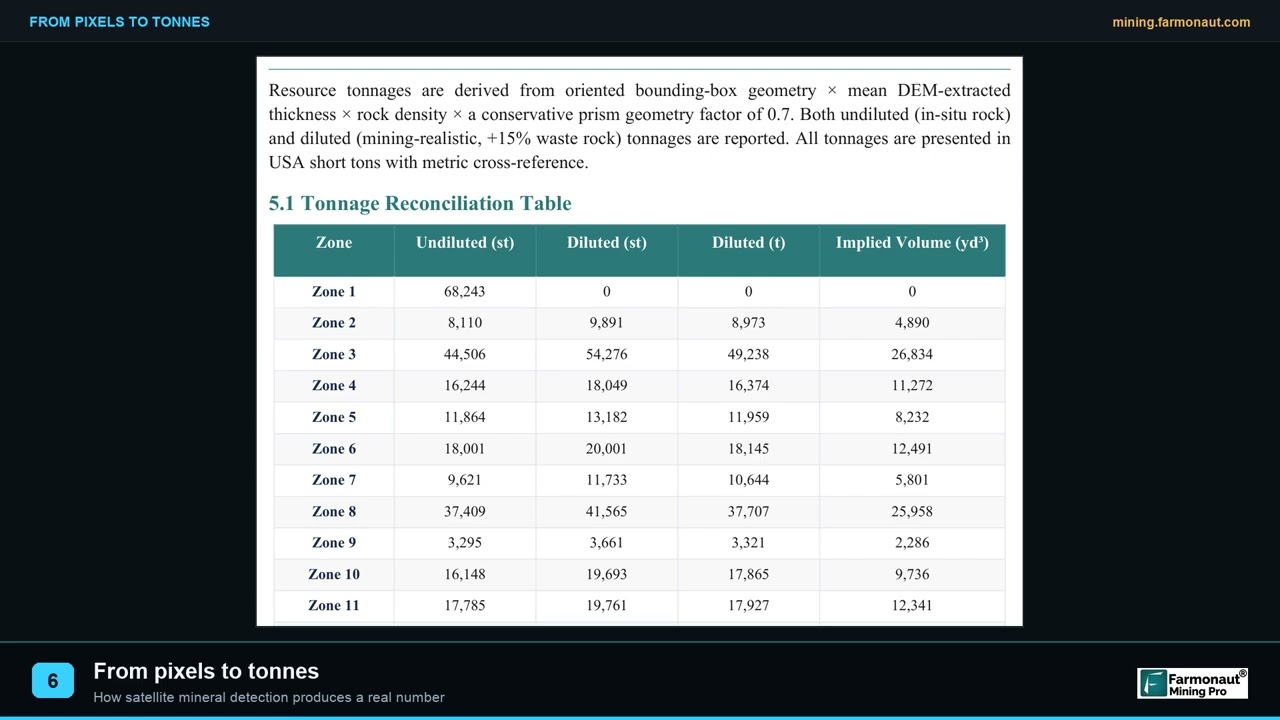
▶ How a satellite picture becomes tonnes and grade, and which inputs are measured versus assumed. · 2:54
Frequently asked questions
What does NdPr stand for?
Neodymium (Nd) and praseodymium (Pr), sold together. The usual product is a mixed oxide of about 75% neodymium oxide and 25% praseodymium oxide by mass, which holds about 85% rare earth metal.
What is the NdPr oxide price?
There is no exchange price. On 26 October 2026 SMM’s China domestic average was 721,500 yuan per tonne including VAT, and on 20 August 2026 Benchmark Minerals assessed ex-China oxide at US$95,000 per tonne CIF Europe and North America. Compare them only on one basis, as the calculator shows.
What is the NdPr oxide price per kg?
Divide the price per tonne by 1,000. US$95,000 per tonne is US$95 per kilogram. The SMM quote of 721,500 yuan per tonne is about US$95.1 per kilogram once 13% VAT is removed and 6.71 yuan per dollar is used, our own conversion.
What is NdPr used for?
Mainly NdFeB permanent magnets in electric vehicle motors, wind turbine generators, hard drives, robots and defence equipment. Neodymium and praseodymium also colour didymium glass used in glassblowers’ goggles.
Is NdPr a mineral?
No. It is a refined product. The minerals that carry it include bastnäsite, monazite and xenotime, and it also occurs in ion-adsorption clays.
What is the difference between NdPr oxide and NdPr metal?
Oxide is the intermediate that refiners sell. Metal is made from it by electrolysis. The metal holds about 1.176 times as much rare earth per kilogram, and its price also covers the cost of reduction.
What does “Nd Pr” or “Nd/Pr” mean?
The same product written as two element symbols: neodymium and praseodymium.
Why are neodymium and praseodymium not separated?
They are chemically very similar, so splitting them is costly, and for magnets the praseodymium can stand in for neodymium. The separation only pays when a buyer needs one element alone.
Why is NdPr cheaper outside China than inside China?
Benchmark’s August 2026 analysis points to oversupply outside China and to producers avoiding sales into China, while domestic Chinese prices stayed higher. Some of the gap on paper is China’s 13% VAT, so remove it before comparing.
Does the US$110 per kilogram floor set the market price?
No. It is a contract level between MP Materials and the U.S. government for MP’s own NdPr products. The market price can sit above or below it, and Benchmark reported ex-China oxide below it in August 2026.
Where can I find a fresher NdPr price?
Check the SMM Pr-Nd oxide page for China, Benchmark Minerals, Argus or Fastmarkets for ex-China, and the latest MP Materials results release for what the US producer reports.
This page is for information only. It is not investment advice. Prices change daily; confirm the current figure with the named source.
Farmonaut mining
Screen rare earth ground from space
Farmonaut maps alteration and structure inside a licence area to help rank exploration targets before sampling.

Mining Pro sample view, synthetic data
Keep reading

Sources
- SMM, Pr-Nd oxide price page, 26 Oct 2026: metal.com
- SMM, Rare Earth Weekly Review, 23 Jul 2026: news.metal.com
- SMM, Rare Earth Morning Meeting Summary, 20 Oct 2026: news.metal.com
- SMM, Afternoon Trading Comment, 19 Oct 2026: news.metal.com
- Benchmark Minerals, ex-China NdPr prices slip below US$110/kg floor, 21 Aug 2026: source.benchmarkminerals.com
- MP Materials, Department of Defense partnership release, 10 Jul 2025: mpmaterials.com
- MP Materials, fourth quarter and full year 2025 results, 26 Feb 2026: mpmaterials.com
- MP Materials, first quarter 2026 results, 7 May 2026: mpmaterials.com
- MP Materials, second quarter 2026 results, 6 Aug 2026: mpmaterials.com
- USGS, Mineral Commodity Summaries 2026, Rare Earths: pubs.usgs.gov
- Federal Register, Final 2025 List of Critical Minerals, 7 Nov 2025: federalregister.gov
- Lynas Rare Earths, acquisition of Meteoric Resources (ASX), 1 Oct 2026: announcements.asx.com.au
- Royal Society of Chemistry, Periodic Table: Neodymium: periodic-table.rsc.org
Discussion
Questions, corrections or field experience? Share them below. First-time comments are reviewed before they appear, and your email is never published.
No comments yet. Be the first to add a question or your experience.

 Rains of Favour
 Tintina Mining Group
 Dalgety Minerals Pty Ltd
 Vortex Minerals Pty Ltd
 Faith At Work (Pty) Ltd
 Geotech Mining Solutions plc
 Vulcan International Limited
 Kidepo Associates
 GKY Mining
 Alkimy SARL
 Double A Trading
 GemSprout Metals Limited
 Qader Group
 Ileys General Trading
 SG Gold Mining LLC
 VRV Global Pte Ltd
 Omsri International FZE
 G.I.T.T.
 Jaunita Erss Ltd
 Almosi SARL
 SRK Consulting
 Berks Gold Limited
 Mwerezi Minerals Company Limited

 Exploration consultancy · South Africa · Gold










