

Publicly Traded Farmland REITs & Agriculture: 2026 Trends
“By 2025, global investments in publicly traded farmland REITs are projected to surpass $50 billion, reflecting rising investor interest.”
“Over 60% of public agriculture companies plan to increase agritech adoption by 2026, driving sector-wide innovation.”
Table of Contents
- Introduction
- Public Farmland and Agriculture Markets: The 2026 Landscape
- Publicly Traded Farmland REITs: Structure, Trends, and Value
- Focus on Farmland REIT Australia and Asia-Pacific
- Publicly Traded Agriculture Companies: From Seed to Plate
- Vertical Farming Public Companies & Modern Agritech
- Key Investment Factors in Public Agriculture & Farmland REITs
- Key Trends in Publicly Traded Farmland REITs & Agritech Companies: 2025-2026 (Table)
- How Farmonaut Empowers Modern Investment
- The Future: Investing in Sustainable Food Production
- FAQs: Public Farmland and Agriculture Trends for 2026
- Conclusion
Introduction: A New Era for Public Farmland and Agriculture Investment
In recent years, publicly traded farmland REITs, publicly traded agriculture companies, and vertical farming public companies have become prominent players at the intersection of finance, sustainability, and food security. In 2025 and beyond, these entities are not just vehicles for investment—they are engines of growth, innovation, and climate adaptation across the global agriculture value chain.
This comprehensive guide explores the evolving landscape of public agriculture companies, with a strong focus on trends shaping the markets in 2026. From the unique defensive characteristics of farmland to the cutting-edge proliferation of agtech, we dive into the metrics, value drivers, and decision-making processes that modern investors, agribusinesses, and policymakers should be watching.
Whether you’re fascinated by sustainable farming, seeking exposure to productive land in Australia, or tracking climate-resilient vertical farming innovations, this post is your go-to resource for understanding the publicly traded agricultural investment landscape.
Public Farmland and Agriculture Markets: The 2026 Landscape
The 2025 and 2026 agricultural investment landscape is characterized by a dynamic convergence of capital markets, sustainable management practices, and technological disruption.
Let’s break down the major themes:
- ✔ Diversification: Modern investors seek exposure across crops, pastures, regions, and agribusiness functions.
- ✔ Defensive Qualities: Farmland and ag companies tend to be less correlated with equity market swings and commodity shocks.
- ✔ Sustainability: Water, soil, and carbon monitoring are essential metrics guiding investment flows and regulatory compliance.
- ✔ Digital & Remote Sensing: Satellite, AI, and IoT solutions are transforming efficiency, risk assessment, and supply chain traceability.
- ✔ Transparency: Investors and end-users increasingly demand public reporting, ESG scoring, and governance from listed entities.
Publicly Traded Farmland REITs: Structure, Trends, and Value Drivers
Publicly traded farmland REITs sit at the core of the global “agriculture as an asset class” movement. These REITs pool a range of properties—crop fields, pastures, timberland—into scale portfolios, offering crucial liquidity and professional management previously unavailable in direct ownership models.
In 2025-2026, we expect amplified focus on:
- 📊 Tenant Stability: Long-term lease arrangements ensure regular rental income streams and low vacancy rates compared to other real estate.
- 📊 Soil and Water Stewardship: Governance standards, soil carbon metrics, and irrigation efficiency audits are increasingly embedded in reporting.
- 📊 Inflation Hedging: Farmland asset values and lease payments often trend upwards with inflation and real asset scarcity.
- 📊 ESG Alignment: REITs are aligning with global ESG benchmarks, making them attractive for impact-focused portfolios.
- 📊 Diversification: A single REIT can offer exposure across regional climates, crop types, and market cycles.
Compared to direct farmland ownership, publicly traded farmland REITs provide:
- Liquidity: Shares can be bought and sold easily on public exchanges.
- Governance: Enhanced transparency and compliance due to listing requirements.
- Scale Efficiencies: Large managed pools can lower operational costs per acre or unit.
- Diversified Exposure: Spanning different crops, regions, water entitlements, and climate risks.
- 📈 Appreciation Potential: Long-term land price appreciation.
- 📉 Lower Correlation: With equity and commodity market swings.
- 🌱 Sustainable Management: Strong focus on soil health, pasture optimization, and irrigation upgrades.
- 🌎 Global Footprint: Access to markets in Australia, North America, Europe, and beyond.
In Focus: Farmland REIT Australia and Asia-Pacific Market Opportunities
Australia is a powerhouse in publicly traded farmland. Farmland REIT Australia entities hold a unique position globally due to:
- 🌏 Export Orientation: Australia’s REITs manage export-oriented assets, major crop outputs, and high-value pasture and timber portfolios.
- 🚰 Water Rights: Control and efficient management of irrigation water underpins lease and asset valuations.
- 🛡 Regulatory Clarity: Australia’s clear land access and environmental disclosure norms make it a favoured destination for international capital.
- 🌿 Sustainability Stewardship: Australian REITs emphasize soil health, sustainable ranching, and drought resilience.
- 🏭 Scale & Governance: Large, diversified portfolios and professional management deliver both risk reduction and compliance.
This makes Farmland REIT Australia vehicles a prominent inflation hedge and a practical path for capital formation for:
- Modernizing irrigation systems
- Implementing regenerative pasture management
- Undertaking environmental restoration
- Upgrading regional logistics and storage

Publicly Traded Agriculture Companies: From Seed to Plate
The spectrum of public agriculture companies on stock exchanges globally covers a vast domain. These firms touch every aspect of the value chain:
- 🌱 Seed and Genetics Firms: Innovators in crop genetics, patented hybrids, and disease-resilient strains.
- 🧪 Agrochemical Majors: R&D into more targeted, lower-footprint inputs and crop protection.
- 🛰 Precision Agtech Companies: Leaders in sensors, satellite-remote sensing, and AI-driven farm advisory.
- 🛠 Equipment, Input, and Storage Firms: From smart tractors to cold-chain logistics and silo management.
- 🛒 Processing, Marketing, and Export Giants: Integration across supply chain traceability, storage, and global trade.
2025-2026 sees the rise of new demand drivers in the public agriculture sector:
- 🌍 Rising global population and food demand trends
- 🌡 Climate-adaptive farming and crop R&D
- 📉 Low-chemical, high-yield input solutions
- 📱 Digitization: AI-driven irrigation, soil and crop monitoring, blockchain traceability
- 🔍 Transparency: Recurring revenue models, visible scale and margin leverage
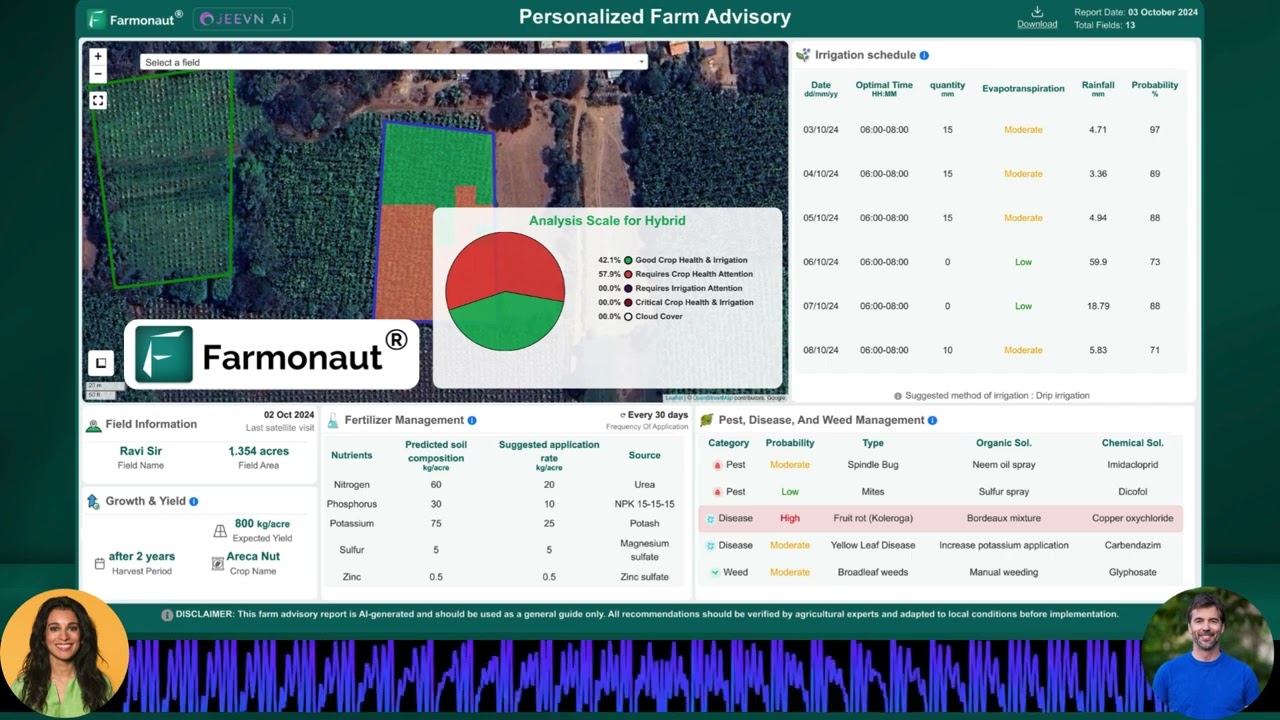
📈 Visually Mapping Agtech Innovation (2025-2026)
- 🌱 Plant Genetics: Fast-tracking climate-resilient, high-yield crop varieties
- 🛰 Remote Sensing: Satellite and drone data to manage soil health, water stress, and pest outbreaks
- 🔒 Blockchain Traceability: Ensuring food authenticity and supply chain transparency (learn more about Farmonaut’s blockchain traceability)
- 🖥 AI & SaaS: Predictive platforms that optimize irrigation, fertilization, and logistics
- 🌱 Carbon Tracking: Monitoring of on-farm carbon sequestration (see Farmonaut’s carbon footprint solutions)



Farmonaut’s platform delivers critical APIs for developers (Farmonaut Public API), and comprehensive developer documentation is available (Developer Docs).
Vertical Farming Public Companies & Modern Agritech
A rapidly growing subset of public agriculture companies includes those specializing in vertical farming and controlled environment agriculture. These vertical farming public companies often list on major stock exchanges, offering transparency about:
- 🍃 Margins & Economics: Detailed reporting on unit economics, energy use, and scale-up costs.
- 🏙 Urban Food Security: Year-round, resilient production close to urban populations.
- 💡 Modular Farm Design: Innovations for energy and water efficiency, with fast installation capacity.
- 🌍 Global Reach: Expanding through partnerships with major retailers & food service providers.
- 🔬 Plant Science Breakthroughs: Deployment of high-tech growth chambers, robotics, and precision environment control.

Challenges in the vertical sector include capital intensity, scaling profitably, and optimizing resource use per unit output. Yet by 2026, publicly listed vertical farming companies are closing the gap with traditional outdoor farming on cost and year-round supply.
🌆 Key Advantages
- 🏙 Urban Proximity: Reduces logistics cost & carbon footprint
- 💧 Water Efficiency: Up to 95% less water use via closed-loop irrigation (Track water and carbon with Farmonaut)
- 📅 Year-Round Harvests: Eliminate seasonal volatility
- 📦 Supply Chain Certainty: Contracts with supermarket chains and foodservice for steady offtake
- 🧬 Data-Driven Plant Science: Faster crop innovation cycles

Key Investment Factors in Public Agriculture & Farmland REITs
- 🤝 Geographic and Crop Diversification: Critical to hedge weather, regulatory, and pest/disease risk, ensuring predictable yields and income streams across portfolios.
- ⚙️ Capital Intensity and Unit Economics: Investors evaluate capex cycles, yield per acre, irrigation upgrades, and operational margins.
- 🌎 ESG and Sustainability Metrics: Soil carbon, biodiversity, water efficiency, and climate disclosures directly inform valuations.
- 📋 Regulatory Environment: From foreign investment rules in Australia and US, to strict environmental compliance in Europe and Asia-Pacific.
- 💡 Valuation Methods: Combination of discounted cash flow (DCF), cap rate-like yield metrics (for REITs), and peer multiples (for agtech and vertical companies).


When evaluating public farmland REITs and adjacent infrastructure, seek real-time remote sensing and blockchain traceability integrations. These enhance transparency, reduce fraud in financing, and ensure compliance with environmental norms—critical for mining and agriculture intersections.
Key Trends in Publicly Traded Farmland REITs & Agritech Companies: 2025-2026
| Company/REIT Name | Market Cap (Est. 2025, USD Billion) | Dividend Yield (%) | ESG/Sustainability Rating (Est. 2025) | Agritech Focus or Innovation | Projected Revenue Growth (2025-26, %) | Geographic Focus |
|---|---|---|---|---|---|---|
| Rural Funds Group (Australia Farmland REIT) | 1.2 | 4.5 | High | Yes | 6-9% | Australia |
| Gladstone Land (US Farmland REIT) | 0.9 | 3.0 | Medium-High | Yes | 5-8% | US, Select LatAm |
| Farmland Partners (US Farmland REIT) | 1.6 | 2.9 | Medium | No | 4-6% | US |
| InFarm (Vertical Farming Public Company) | 1.5 | 0 | High | Yes | 15-25% | EU, North America, Asia |
| Plenty (Vertical Farming Public Company) | 1.3 | 0 | High | Yes | 18-28% | US, Asia |
| Corteva Agriscience (Agrochemical & Seed Major) | 47 | 1.2 | Medium-High | Yes | 7-10% | Global |
| Deere & Co (Precision Ag Equipment) | 150 | 1.1 | Medium | Yes | 5-7% | Global |
| Bayer Crop Science | 70 | 3.2 | Medium | Yes | 6-8% | EU, Global |
| Sundrop Farms (Vertical Farming, Listed Division) | 0.2 | 0 | High | Yes | 12-20% | Australia, Asia |
| Adecoagro (Diversified Agriculture, Public Co.) | 3.5 | 2.8 | Medium | No | 4-7% | South America |
“By 2025, global investments in publicly traded farmland REITs are projected to surpass $50 billion, reflecting rising investor interest.”
“Over 60% of public agriculture companies plan to increase agritech adoption by 2026, driving sector-wide innovation.”
🛰 Modern Agritech Features Driving Public Investment
- 🛰 Satellite-based monitoring — Real-time field health and yield prediction from space
- 🤖 AI-driven advisory systems — Smart, context-sensitive recommendations for crop and water management
- ⛓ Blockchain-enabled traceability — Secure, transparent supply chains end-to-end (Explore Farmonaut’s Traceability)
- 🚜 Fleet and resource management — Data-driven logistics and equipment efficiency (Fleet Management Platform)
- 🌾 Environmental impact tracking — Tools for compliance, emissions measurement, and sustainable investment targeting (Carbon Footprint Solutions)
How Farmonaut Empowers the Future of Public Farmland & Agriculture Investment
We at Farmonaut are committed to democratizing satellite insights for agriculture, mining, infrastructure, and government stakeholders worldwide. Our mission aligns directly with the future of publicly traded farmland REITs and agriculture companies who are seeking scalable, sustainable, and transparent growth.
Here’s how Farmonaut supports publicly traded entities, agribusinesses, and investment managers:
- 🌍 Geospatial Monitoring: Regular, actionable field, pasture, and crop health alerts using satellite data (NDVI, soil moisture, carbon footprint, and more).
- 📈 AI-Powered Advisory: Jeevn AI offers real-time weather forecasts, crop strategies, and risk analysis at scale.
- ⛓ Blockchain Traceability: Transparent, fraud-resistant supply chain authentication, critical for public markets.
- 🚛 Logistics and Fleet Optimization: Tools for efficient equipment/resource management (Fleet Management Platform).
- 🌱 Environmental Stewardship: Monitoring for carbon footprint, water usage, and ESG compliance—core reporting needs for listed agriculture companies and REITs.
Our modular, subscription-based model (see pricing table) scales from individual farmers to the world’s largest agribusiness and public listed entities.
- ✔ Scalable platform: From one farm plot to thousands, with automated reporting flows
- 📊 Data integration: APIs for developers, public companies, and approved third-parties (API Documentation)
- ⚠️ Risk alerts: Real-time notifications for crop stress, pest infestation, or anomalous water use
- 📈 Yield optimization: Insights that help maximize output per unit and improve margins
- 🌱 Customizable reporting: Aligning with the regulatory and market demands of 2025-2026
Large-scale managers or investors in publicly listed farmland can monitor entire portfolios’ health, water consumption, and compliance with Farmonaut’s large scale farm management tools. Efficient, smart, and mobile-first: See how it works.
The Future: Investing in Sustainable Food Production—2026 and Beyond
The world is rapidly converging toward a model where publicly traded farmland REITs, public agriculture companies, and vertical farming public companies set the pace for food system evolution. Investors, businesses, and end-users will benefit from:
- 🌏 Global diversification and risk-balanced portfolios
- 🌱 Verified ESG credentials and sustainable production metrics
- 🛰 Digital-first management and reporting processes
- 💧 Precision irrigation and soil carbon tracking at scale
- 📊 Transparent earnings and recurring revenue models that reward innovation
FAQs: Public Farmland and Agriculture Trends for 2026
What are publicly traded farmland REITs and how do they differ from private farmland ownership?
Publicly traded farmland REITs are listed real estate investment trusts that own and manage diversified farmland portfolios, providing investors with liquidity, transparency, and professionally managed assets. Unlike private ownership, REIT shares can be traded on exchanges, and they often offer broader diversification, regulatory oversight, and exposure to emerging ESG practices.
Why is Australia considered a leader in the farmland REIT sector?
Farmland REIT Australia vehicles benefit from robust export markets, regulatory clarity, sustainable management, and advanced water rights practices. The country’s governance structures make these REITs a preferred choice for global investors seeking defensive, productive asset exposure.
What makes vertical farming public companies attractive for 2026 investment?
Vertical farming public companies excel in offering year-round, climate-independent output, urban proximity for food security, and documented gains in water/energy efficiency. With rising food demand and unpredictable climate patterns, these companies offer disruption potential and growth not found in conventional agriculture.
How important is technology in evaluating publicly traded agriculture companies?
Critical. Technology underpins everything from operational efficiency to sustainability metrics and transparency. Advanced tech—from satellites and AI to blockchain—is now embedded in leading public agriculture companies across the world, driving both productivity and investor confidence.
How can stakeholders engage with Farmonaut’s solutions?
Anyone can utilize Farmonaut’s multi-platform tools (web, Android, iOS), access developer APIs, or take advantage of logistics/resource management solutions—enabling data-driven oversight for single farms, portfolios, or public companies.
- ✔ Public farmland REITs, agtech firms, and vertical farming public companies dominate as 2026 investment themes.
- 📊 Renewed focus on ESG, traceability, and water/soil stewardship amplifies valuation premiums.
- ⚠ Regulatory environments and regional climate risks impact portfolio strategies across continents.
- ✔ AI, satellite, and blockchain technology adoption differentiates leaders from laggards.
- 💡 Publicly traded entities offer scale, liquidity, governance, and transparent reporting options crucial for modern global investors.
Conclusion
The momentum behind publicly traded farmland REITs, publicly traded agriculture companies, and vertical farming public companies is unmistakable. As we move into 2026 and beyond, integrated technology, diversified risk management, robust governance, and transparent sustainability metrics are transforming the global food production system from soil to shelf.
For institutional and individual investors alike, these public entities offer a distinctly modern way to access the world’s most critical sector—food production—without the complexities of direct farmland or operational ownership. The winners will be those who effectively harness the intersection of finance, science, and digital innovation while maintaining a sharp focus on environmental and community outcomes.
At Farmonaut, our mission continues: making affordable, scalable, and advanced satellite solutions available to everyone, so agriculture, mining, and infrastructure can thrive in a data-driven, sustainable future.
The best investment in 2026? Data-driven, transparent, and sustainable food systems—empowered by technology, governed by robust public frameworks, and shaped by publicly traded farmland REITs and agriculture innovators.
Ready to explore more or integrate advanced satellite, AI, and blockchain tech into your ag or mining operations? Get started with Farmonaut:
Additional Resources:
- API for Enterprise & Developers: sat.farmonaut.com/api
- API Docs: farmonaut.com/developer-docs
- End-to-end traceability: Product Traceability
- Carbon tracking & emissions insight: Carbon Footprinting
- Large-scale farm management: Agro Admin App

 Cazlv
Cazlv HIPSAC
 ZOL Zimbabwe
 Juligerm
 AdBio
AdBio MISE Maroc
 Drift-Sense
 NWNS
NWNS Red August Group
 Farm Inc
 WeMe Global
 Agrotoken
 Blue BearX
 Insignito
 Croptimum
 DnCubed
 Field Capacity
 Indosistim Teknologi
