

UK vertical farming · Company guide
Vertical Farming UK Companies: Who Operates, Who Closed
Of thirteen vertical farming companies we checked in October 2026, seven still trade as UK growers or suppliers and four have closed their UK farms. Jones Food Company has been in administration since April 2025. Here is each company’s status, why energy costs matter, and a cost calculator.
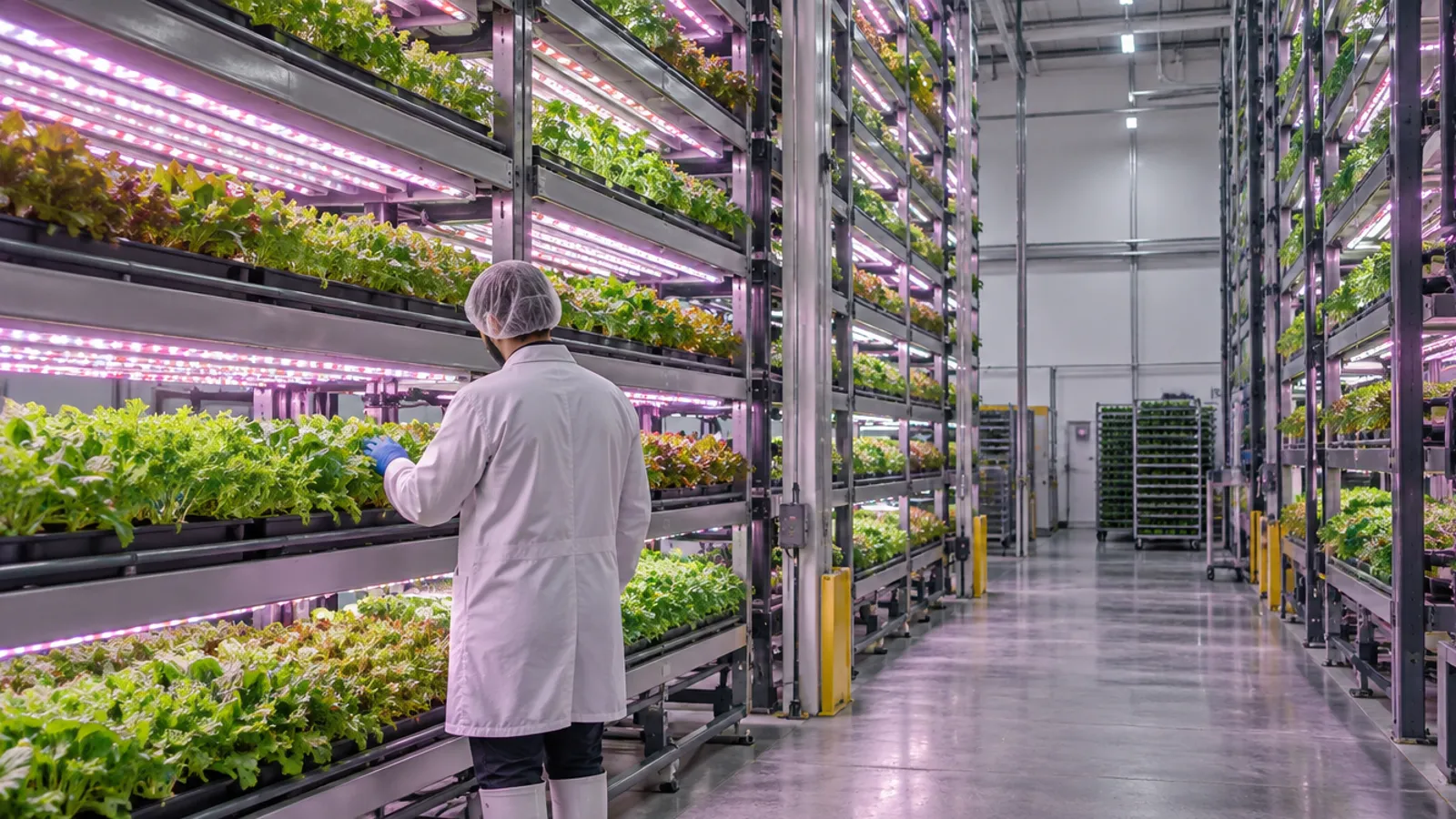
Key takeaways
- Still trading (October 2026): GrowUp Farms, Fischer Farms, Harvest London, Square Mile Farms, IGS, LettUs Grow and Light Science Technologies.
- Jones Food Company has been in administration since April 2025; Vertical Future moved into liquidation in January 2026; Zero Carbon Farms (Growing Underground) has been in liquidation since 2023.
- GrowUp’s parent group went into administration in December 2025, but its Kent farm was sold for £1.9m and still trades.
- UK businesses paid an average 23.81p per kWh for electricity in 2025, almost double the 12.26p of 2019 (DESNZ, excluding Climate Change Levy).
- UK farms supplied 47.9% of the lettuce used in the UK in 2025, up from 32.7% in 2020 (Defra).
In this article
- Vertical farming UK companies at a glance
- How we checked each company
- Growers you can buy from
- Technology suppliers for growers
- UK vertical farms that closed or went into administration
- Why so many UK vertical farms struggled: energy costs
- Does indoor-grown salad compete on cost?
- What the UK grows and imports
- How to choose a vertical farming partner or supplier
- Where satellite monitoring fits
- FAQ
Several of the best-known vertical farms in the UK have closed since 2022. Of the thirteen vertical farming companies we checked in October 2026, seven still trade as UK growers or technology suppliers, four have closed their UK farms (three British firms now in administration or liquidation, plus Infarm, which left the UK), and two that older lists call British are based in France and Australia. The survivors include GrowUp Farms in Kent, Fischer Farms, Harvest London, Square Mile Farms, Intelligent Growth Solutions (IGS), LettUs Grow and Light Science Technologies.
Below you will find each of the vertical farming companies we checked, what it does, who it suits, and what the public record says about it. We also show why energy prices hurt this sector, what salad the UK grows and imports, and a calculator to work out the electricity cost per kilogram of an indoor crop.
Note on method: we read the official company record at Companies House for every British business here, the company’s own website, and trade press reports. We do not give scores or rankings, because no public data lets anyone compare these firms fairly. Where we could not confirm something, we say so.
Vertical farming UK companies at a glance
| Company | What it does | Where | Status (October 2026) |
|---|---|---|---|
| GrowUp Farms | Grows salad leaves for retail | Sandwich, Kent | Trading; sold out of its parent’s administration in December 2025 |
| Fischer Farms | Grows leafy greens; plans other crops | Norfolk farm; Staffordshire office | Active company; we could not load its website |
| Harvest London | Grows herbs and salads for restaurants | Canada Water, London | Active company (Harvest Farms Ltd); farm open |
| Square Mile Farms | Installs and runs hydroponic farms in offices | London, UK-wide | Active company |
| IGS | Builds vertical farm towers for other growers | Scotland | Active company |
| LettUs Grow | Makes aeroponic growing benches | Bristol | Active company |
| Light Science Tech. | Makes grow lights and crop sensors | Derby | Active company |
| Jones Food Company | Grew herbs and salad | Lydney and Scunthorpe | In administration since April 2025 |
| Vertical Future | Built vertical farm equipment | London | In liquidation since January 2026 |
| Infarm (UK) | Ran in-store farms and a Bedford site | Bedford | Left the UK; UK company faces strike-off (action suspended February 2025) |
| Growing Underground | Grew microgreens in old tunnels | Clapham, London | Operating company in liquidation since 2023 |
| Agricool, Stacked Farm | Container farm; packaged greens | France; Australia | Not UK companies |
Company records change. Check the Companies House entry and the firm’s own site before you sign a supply deal, buy equipment, or invest.
How we checked each company
For each name we looked up the UK company number on Companies House and noted its status: active, in administration, or in liquidation. We then read the latest filings, such as the appointment of an administrator or a move to liquidation, and the date of the last accounts. Next we opened the company’s own website to see whether it still sells a product, and read trade press such as The Grocer, Fruitnet and Vertical Farm Daily for dates and numbers.
We left out businesses that only appear in older marketing lists and that we could not tie to a company record or a working website. We also did not use the “capacity” and “investment” figures from the older version of this page, because we could not find a source for them.
Growers you can buy from
These businesses grow and sell food. They suit retailers, restaurants and food-service buyers who want salad or herbs grown in Britain all year.
1. GrowUp Farms (Kent)
Best for: retailers and food-service buyers who want bagged salad leaves grown in the UK all year.
GrowUp runs a farm it calls Pepperness at Sandwich in Kent and sells salad under the brand Unbeleafable. Its website says the farm grows leaves without pesticides and runs on 100% renewable energy; these are the company’s own claims. The business has been through a hard time. Its parent, GrowUp Group, appointed administrators in December 2025. According to Vertical Farm Daily, citing the administrators’ report, creditors were owed almost £120m, and the farming company was sold the same day in a pre-pack deal for £1.9m to buyers backed by Sun Capital Partners and advised by former chief executive Marcus Whately.
Companies House lists GrowUp Farms Ltd as active, while GrowUp Group Limited, the parent, is in administration. So the farm still trades under new owners, but the group that raised most of the money did not survive.
Pros: large, working farm with a retail brand. Cons: new ownership since late 2025, so long-term plans are not yet public.
2. Fischer Farms (Norfolk and Staffordshire)
Best for: buyers who want large volumes of leafy greens and herbs, and partners interested in trials of new indoor crops.
In November 2023, The Grocer reported that Fischer Farms had finished a 25,000 sq m vertical farm in Norfolk, built by Clegg Food Projects as a £25m project. In October 2024 Fruitnet reported that the company had named Chris Kirke, former chief executive of Moy Park, as CEO, with founder Tristan Fischer moving to group CEO. The company said it wants to move beyond leafy greens to soft fruit, rice, wheat, soy and peas.
Companies House lists Fischer Farms Ltd as active, with accounts filed for the year to March 2025. When we checked in October 2026, the company’s website did not load because of a security certificate error, so we could not confirm its current product range.
Pros: one of the largest indoor farms built in Britain. Cons: little recent public detail on output or customers.
3. Harvest London (Canada Water)
Best for: London restaurants and chefs who want herbs and specialist leaves grown in the city.
Harvest London opened a farm inside the Corner Corner food hall at Canada Water in February 2025. Fruitnet reported a capacity of 30 tonnes of herbs, salads and specialist crops a year, supplying the venue’s food hall and café as well as other London buyers. About a year after opening, its operations manager told Vertical Farm Daily the site uses about 190 sq m of floor space and, because the racks are stacked, about 400 sq m of growing space. The farm runs all year, behind glass walls that visitors can see.
Its founders, Chris Davies and Matt Chlebek, are directors of Harvest Farms Ltd (10880642), which Companies House lists as active, with accounts filed for the year to July 2025.
Pros: small, visible city farm close to its buyers. Cons: small volume; not a supplier for large retail orders.
4. Square Mile Farms (London and UK-wide)
Best for: employers, landlords and schools that want a small hydroponic farm in a building for staff, events or teaching.
Square Mile Farms designs, installs and maintains hydroponic “Farmwalls” and smaller stands in offices and other buildings, then helps staff plant and harvest. Its website says it runs more than 120 farms across the UK. Companies House lists Square Mile Farms Limited as active, with accounts filed for 2025.
Pros: a service you can buy at small scale. Cons: it grows food for the people in the building, not for sale in volume.
Technology suppliers for growers
These firms do not sell salad. They sell the towers, irrigation, lights and sensors that indoor and greenhouse growers use, so they suit farm businesses planning a new site or an upgrade. When you compare UK agri-tech startups in this field, ask each one for trial data on your own crop.
5. Intelligent Growth Solutions (Scotland)
Best for: large growers and investors planning an industrial indoor farm.
IGS designs and builds vertical farming “Growth Towers” that control light, temperature, humidity and nutrients. In January 2024 the company announced £22.5 million in Series C funding, led by COFRA Holding, DC Thomson and S2G Ventures. Its biggest project is a planned 200-tower “GigaFarm” in Dubai with partner ReFarm; a June 2026 company release said the first phase was moving toward completion. Companies House lists Intelligent Growth Solutions Limited as active.
Pros: established supplier with recent funding. Cons: built for large projects; most recent growth is outside the UK.
6. LettUs Grow (Bristol)
Best for: greenhouse and vertical farm growers who want to try aeroponic irrigation without rebuilding a site.
LettUs Grow makes the Aeroponic Rolling Bench, which uses ultrasonics to deliver a nutrient mist to plant roots. The company says the bench fits into existing glasshouses and vertical farms, and that it runs two research sites in Bristol. Yield claims on its website come from the company and its customers, not from independent trials, so ask for trial data on your own crop. Companies House lists LettUs Grow Ltd as active.
Pros: works in greenhouses as well as indoor farms. Cons: yield gains are vendor claims until you test them.
7. Light Science Technologies (Derby)
Best for: growers who want LED grow lights and crop or climate sensors, including polytunnel and greenhouse users.
Light Science Technologies designs LED lights and sensor systems for vertical farms, greenhouses and polytunnels. It says it makes products at its own UK factory in Manchester and runs a test lab for light recipes. Companies House lists Light Science Technologies Ltd as active.
Pros: equipment useful beyond vertical farms. Cons: energy savings it quotes are its own figures.
▶ How precision agriculture, satellite imagery and AI help farmers make decisions · 23:42
UK vertical farms that closed or went into administration
Several of the best-known names in older lists, including the earlier version of this page, have failed. Buyers and job seekers should know this before relying on them.
Jones Food Company
Jones Food Company (JFC) ran a farm in Scunthorpe that opened in 2018 and a larger one, JFC2, in Lydney, Gloucestershire, opened in February 2024. The Grocer reported that the business closed on 7 April 2025 and that 61 staff lost their jobs; Ocado had been a shareholder. Companies House lists Jones Food Company Limited as in administration, with the administration period extended in March 2026. The administrators, from RSM UK, invited offers from buyers; we found no report of a completed sale.
Vertical Future
Vertical Future was a London company that designed and built vertical farm equipment. Its filings show an administrator was appointed in August 2025, and in January 2026 the case moved from administration to creditors’ voluntary liquidation. Companies House now lists the company as in liquidation.
Infarm (UK operations)
Infarm, from Berlin, put small farms in supermarkets and opened a large growing centre in Bedford in 2022 with more than 5,500 sq m of growing space. In December 2022 The Grocer reported that Infarm was cutting about half its staff and planned to downsize in the UK, blaming energy prices, inflation and tough financial markets. Its UK company, now renamed MAY XYZ Limited, received a compulsory strike-off notice in January 2025 that was suspended a month later, and the German parent’s UK branch is listed under insolvency proceedings: it went into administration in November 2023 and moved to dissolution in September 2025.
Growing Underground (Zero Carbon Farms)
Growing Underground grew microgreens and herbs in wartime tunnels under Clapham. Its operating company, Zero Carbon Farms Ltd, passed a resolution to wind up on 28 April 2023 and remains in liquidation. We found no evidence that the Clapham farm trades today.
Two names that are not British
Agricool is a French container-farm company from La Courneuve near Paris; it was placed in receivership (redressement judiciaire) at the end of January 2022, the French site Maddyness reported, and The Grocer listed it in April 2025 among vertical farming firms that had to stop production. Stacked Farm sells packaged greens and its website points to Australia. Neither should appear in a list of UK companies.
Why so many UK vertical farms struggled: energy costs
A vertical farm replaces sunlight with LED lights and controls heat and humidity with air handling. The USDA Agricultural Research Service puts it simply: growers give up free sunlight, and lighting and climate control are costly. In a 2025 paper in Plant Physiology, researchers cite a commercial farm that used about 10 kWh of electricity per kilogram of lettuce. A 2026 modelling study in Frontiers in Sustainable Food Systems found 2.31 to 7.83 kWh per kg of lettuce across its scenarios.
That makes the price of power the main risk. According to the DESNZ non-domestic energy price tables, the average price paid by UK businesses for electricity, excluding the Climate Change Levy, rose from 12.26p per kWh in 2019 to 26.68p in 2023 and was 23.81p in 2025. Infarm named rising energy prices when it cut its UK plans in 2022.
Every extra penny per kWh adds about 10p to the cost of a kilogram of lettuce at 10 kWh per kg. Use the calculator below to test your own numbers.
Chart
UK business electricity prices roughly doubled
Average price by annual-use band, pence per kWh, excluding Climate Change Levy, 2019 vs 2025
Does indoor-grown salad compete on cost?
The same 2026 Frontiers study modelled a vertical farm under Dutch conditions and compared it with Dutch greenhouse benchmarks. Its total cost for lettuce ranged from €3.26 to €1.67 per kg across scenarios, against a Dutch greenhouse total cost of €2.35 per kg. All lettuce scenarios came in below the greenhouse cost except those based on current crop performance with low light-use efficiency, and the authors treat the cheapest ones as design targets, not results from working farms. For tomatoes the range was €5.84 to €2.04 per kg, against €1.82 in a greenhouse, so even the best scenario cost about 12% more. The authors found that costs fall mainly when the farm turns more light into plant growth, which spreads the fixed cost of equipment over more produce.
This helps explain why the UK companies that survive tend to sell premium herbs and leaves, sell to restaurants close by, or sell equipment to greenhouse growers rather than compete with field and glasshouse produce on price.
Chart
Modelled vertical farm cost vs greenhouse
Total cost price, euros per kg of fresh produce; vertical farm modelled for Dutch conditions, highest- and lowest-cost scenarios (the lowest are design targets, not current farms)
Try the numbers for your own farm below.
Calculator
What does electricity add to each kilo you grow indoors?
Enter your own output, electricity use per kg, power price and selling price.
- Electricity bill per year: 250,000 £
- Electricity as a share of selling price: 41.7%
- Electricity used per year: 1,000 MWh
- Extra cost per kg for each 1p rise in power price: 0.10 £
Example values only, not benchmarks or forecasts. The 10 kWh per kg default is the figure a 2025 Plant Physiology paper (Lovat et al.) cites for one commercial lettuce farm; a 2026 Frontiers model found 2.31 to 7.83 kWh per kg. The 25p per kWh default is a round example between the DESNZ 2025 averages for medium users (25.36p) and small/medium users (27.67p), excluding Climate Change Levy; the default 1,000 MWh a year falls in the small/medium band. The selling price is a placeholder; use your own contract price. The calculator counts electricity only, not labour, rent, seeds or equipment.
What the UK grows and imports
Lettuce and other salad leaves are the main crops for UK vertical farms. Defra horticulture statistics show that UK home production of lettuce (field and protected) was 115.8 thousand tonnes in 2025, while imports were 130.6 thousand tonnes. Imports fell sharply after 2021, from 201.7 thousand tonnes that year to 132.8 thousand tonnes in 2022, and home production supplied 47.9% of UK lettuce in 2025, up from 32.7% in 2020. Defra valued all protected vegetables, a group that includes glasshouse lettuce and tomatoes, at £431 million in 2025.
Chart
UK lettuce: home production and imports
Thousand tonnes a year, field and protected lettuce combined, UK
The figures do not separate vertical farms from greenhouses or fields, so they show the size of the market, not the share held by indoor farms.
How to choose a vertical farming partner or supplier
- Check the company record. Search the name on Companies House. Look for “active” status, recent accounts and no administration or liquidation notices.
- Ask who owns it now. GrowUp Farms shows that a farm can keep trading after its parent fails, but under new owners and new terms.
- Ask for energy figures. Ask how many kWh the farm or system uses per kg of crop and what electricity price the plan assumes.
- Ask for independent trial data. Treat yield and saving claims on websites as marketing until you see trial results on your crop.
- Match the business to your need. Retail volumes point to large growers; restaurants may suit a city farm; your own greenhouse may suit an equipment supplier.
- Plan for supply gaps. If you buy from one indoor farm, keep a second supplier, since several UK farms closed at short notice.
▶ Ten small farm businesses you can start without land, including hydroponic herbs and lettuce and microgreens · 6:03
Where satellite monitoring fits
Vertical farms grow indoors, so satellites cannot see their crops. Satellite monitoring helps outdoor field growers, who produce most of the UK’s home-grown vegetables (Defra). Farmonaut offers satellite crop monitoring for open fields, which is the part of farming where this method applies.
Related pages on our site: large-scale farm management app, satellite weather API, API developer docs, product traceability, carbon footprinting, crop loan and insurance, fleet management, web app and app download page.
▶ Seven green farming technologies, from drip irrigation to satellite crop monitoring, explained simply · 2:24
FAQ
Which vertical farming companies still operate in the UK?
Among the companies we checked in October 2026, growers GrowUp Farms, Fischer Farms, Harvest London and Square Mile Farms, and suppliers Intelligent Growth Solutions, LettUs Grow and Light Science Technologies still trade. Check Companies House for the latest status before you deal with any of them.
Which UK vertical farms have closed?
Jones Food Company went into administration in April 2025. Vertical Future went into administration in August 2025 and liquidation in January 2026. Infarm left the UK after 2022, and Zero Carbon Farms, the company behind Growing Underground, has been in liquidation since 2023. GrowUp’s parent group went into administration in December 2025, but its farm was sold and still trades.
What is the largest vertical farm in the UK?
Fischer Farms’ Norfolk site was reported at 25,000 sq m when it was finished in 2023. Jones Food Company called its Lydney farm the most advanced vertical farm in the world, but it has been closed since April 2025.
Why do vertical farms fail?
The main reasons given are high electricity use, high equipment costs and the need for constant new funding. Infarm named energy prices, inflation and difficult financial markets in 2022, and GrowUp was reported to have struggled to raise new money before its parent went into administration.
Can I invest in UK vertical farming companies on the stock market?
Most companies in this list are private limited companies, funded by venture capital, private equity or their owners. The parent of Light Science Technologies, Light Science Technologies Holdings plc, is quoted on London’s AIM market (ticker LST); check its latest announcements before you look further. This page is not investment advice; speak to a regulated adviser before investing.
Farmonaut crop monitoring
Watch your field crops from space
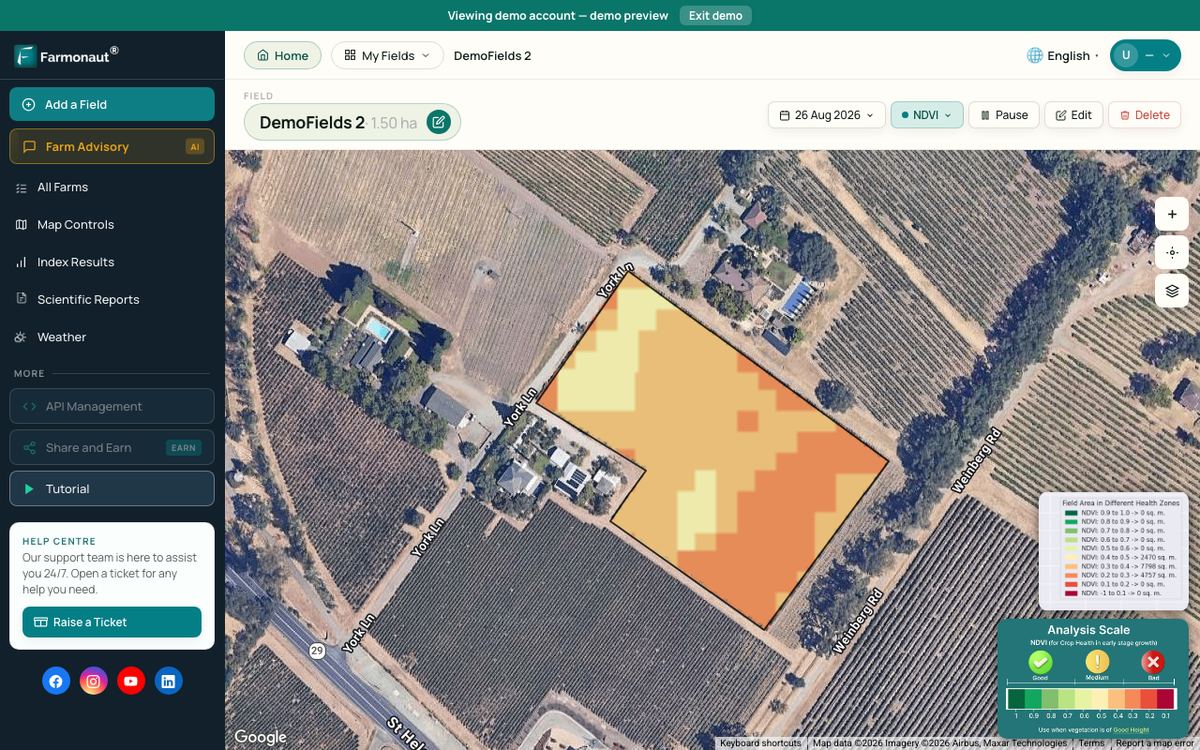
Farmonaut maps crop health across outdoor fields from satellite images, so field growers can see which areas need a visit.



Keep reading
 Farm guideAerophonic Tower Latest: 7 Key Aerophonics Benefits
 BlogsAquaculture Examples: 7 Sustainable Systems (US, UK, Canada)
 Farm guideAI Satellite Imagery Applications: 7 Real Farm & Land Uses
Sources
- Defra, Horticulture statistics 2025 (published 25 June 2026) and dataset Table 23: gov.uk
- DESNZ, Prices of fuels purchased by non-domestic consumers in the UK, Table 3.4.1 (published 29 September 2026): gov.uk
- Lovat, Noor and Milo, Vertical farming limitations and potential demonstrated by back-of-the-envelope calculations, Plant Physiology (2025): pmc.ncbi.nlm.nih.gov
- Meeuws et al., Vertical farming economics: crop performance targets for cost-competitive vertical farming, Frontiers in Sustainable Food Systems (July 2026): frontiersin.org
- USDA Agricultural Research Service, Vertical Farming: No Longer a Futuristic Concept: ars.usda.gov
- Companies House, GrowUp Farms Limited (08544592), company overview: find-and-update.company-information.service.gov.uk
- Companies House, GrowUp Group Limited (11468710), filing history: find-and-update.company-information.service.gov.uk
- Companies House, Fischer Farms Ltd (10499190), company overview: find-and-update.company-information.service.gov.uk
- Companies House, Square Mile Farms Limited (11628016), company overview: find-and-update.company-information.service.gov.uk
- Companies House, Intelligent Growth Solutions Limited (SC440534), company overview: find-and-update.company-information.service.gov.uk
- Companies House, LettUs Grow Ltd (09893012), company overview: find-and-update.company-information.service.gov.uk
- Companies House, Light Science Technologies Ltd (12194715), company overview: find-and-update.company-information.service.gov.uk
- Companies House, Harvest Farms Ltd (10880642), company overview: find-and-update.company-information.service.gov.uk
- Companies House, Jones Food Company Limited (10504047), filing history: find-and-update.company-information.service.gov.uk
- Companies House, Vertical Future Limited (10379325), filing history: find-and-update.company-information.service.gov.uk
- Companies House, MAY XYZ Limited, formerly Infarm – Indoor Urban Farming UK Limited (11656588): find-and-update.company-information.service.gov.uk
- Companies House, Infarm – Indoor Urban Farming GmbH UK establishment (FC040818): find-and-update.company-information.service.gov.uk
- Companies House, Zero Carbon Farms Ltd (08067659), filing history: find-and-update.company-information.service.gov.uk
- Vertical Farm Daily, GrowUp creditors owed £120m in vertical farming administration (2026): verticalfarmdaily.com
- GrowUp Farms, company website: growupfarms.co.uk
- The Grocer, World’s biggest vertical farm completed in Norfolk (29 November 2023): thegrocer.co.uk
- Fruitnet, Fischer Farms appoints former Moy Park boss Chris Kirke as CEO (4 October 2024): fruitnet.com
- Fruitnet, Harvest London launches Canada Water vertical farm (4 February 2025): fruitnet.com
- Vertical Farm Daily, Delivering vertical produce to the heart of London (2026): verticalfarmdaily.com
- Square Mile Farms, company website: squaremilefarms.com
- Intelligent Growth Solutions, Investors back IGS with £22.5 million in Series C fundraise (18 January 2024): intelligentgrowthsolutions.com
- LettUs Grow, company website: lettusgrow.com
- Light Science Technologies, company website: lightsciencetech.com
- The Grocer, Vertical farming giant Jones Food Company appoints administrators (10 April 2025): thegrocer.co.uk
- The Grocer, Infarm halves workforce and plans to downsize UK operations (7 December 2022): thegrocer.co.uk
- Maddyness, L’AgriTech Agricool placée en redressement judiciaire (28 March 2022): maddyness.com
- Stacked Farm, company website (Australia): stackedfarm.com
Discussion
Questions, corrections or field experience? Share them below. First-time comments are reviewed before they appear, and your email is never published.
No comments yet. Be the first to add a question or your experience.

 HIPSAC
 ZOL Zimbabwe
 Innomick
 Juligerm
 AdBio
AdBio MISE Maroc
 Drift-Sense
 NWNS
NWNS Red August Group
 Farm Inc
 WeMe Global
 Agrotoken
 Blue BearX
 Insignito
 Croptimum
 DnCubed
 Field Capacity
 Indosistim Teknologi
 Liquify Digital
 Licence holder · Niger · Gold
 Licence holder · Nigeria · Gold + lithium










