

Bean seed germination · Planting guide
Bean Seed Germination Day by Day: What Happens and When
Bean seedlings usually reach the surface 6 to 8 days after sowing in warm soil and up to 16 days in cool soil. This guide gives the day-by-day timeline from extension data and adds a calculator for how many seeds to sow.
Key takeaways
- Soil temperature sets the schedule: seedlings took 16 days to appear at 15°C, 11 days at 20°C, 8 days at 25°C and 6 days at 30°C (Oregon State Extension, 2013).
- Do not sow beans into soil below about 15.5°C (60°F) at seed depth. Best germination is near 24 to 27°C (University of Georgia, 2013).
- Ontario’s dry bean guide puts emergence near day 8 and the first trifoliate leaf near day 10 (OMAFRA, Publication 811).
- Garden and snap beans go 2.5 to 4 cm deep. Dry beans are often seeded 4 to 6 cm deep into moist soil.
- Sow more seeds than the stand you want: divide the target plants by germination and by field survival.
In this article
- Introduction to Bean Seed Germination and Day-by-Day Monitoring
- The Impact of Modern Technology & Sensor Innovation
- Day 0: Seed Sowing and Initial Conditions
- Day 1: Imbibition — The First Step of Germination
- Day 2: Activation and Radicle Emergence
- Days 3–6: Hypocotyl Growth Toward the Soil Surface
- Days 7–10: Emergence, Leaf Unfolding and Photosynthesis
- Day-by-Day Bean Seed Germination Progress Table with Sensor Data Insights
- Agronomic Implications: Monitoring for Precision & Sustainable Yields
- Farmonaut Links & Tools for Advanced Precision Germination Monitoring
- Frequently Asked Questions: Bean Germination and Precision Agriculture
- Conclusion
Summary:
Day-by-Day Progression of Bean Seed Germination: A Detailed Overview
Understanding the bean seed germination day by day process is increasingly crucial as farmers and agronomists strive to optimize yields in a climate-conscious, technology-driven agricultural landscape. With real-time monitoring, advanced sensor systems, and precise moisture control now available, it’s possible to transform the entire bean germination sequence—enabling early detection of growth issues and fostering prompt interventions.
Introduction to Bean Seed Germination and Day-by-Day Monitoring
Bean seeds, known for their relatively rapid and observable germination, belong to the Fabaceae family and are a core staple across agricultural systems worldwide. The bean seed germination day by day journey unfolds through critical physiological phases—each highly sensitive to soil conditions, temperature ranges, moisture levels, and agricultural management practices.
With newer sensors, agronomists and farmers can now use real-time sensor technology and precision monitoring to optimize every stage of the germination process. This not only enhances crop yields—but also aids in early detection and prompt interventions for plant growth issues arising from variable climate conditions.
Let’s explore the bean seed germination day by day phases, from sowing to seedling establishment, using the latest precision agriculture and sensor technologies. This progression will offer a detailed and practical understanding to everyone—from field operators to modern agricultural technology adopters.
The Impact of Modern Technology & Sensor Innovation
The synergy of precision irrigation systems, satellite-based monitoring apps, and AI-powered advisory now redefines bean seed germination tracking. Some farms use:
- Multispectral satellite imagery for soil, moisture, and crop health analysis
- AI-driven advisory systems to enhance management decisions
- Blockchain-based traceability tools ensuring transparency and authenticity
- Advanced resource management tools for fleet efficiency and sustainability
Farmonaut, as an advanced satellite technology company, delivers these major solutions across multi-platform apps and APIs. Our commitment is to make satellite-driven crop monitoring and real-time data advisories globally accessible, supporting users ranging from smallholder farmers to large agricultural businesses and government agencies.
This environment means the day-by-day progression of bean seed germination is no longer guesswork. Instead, it’s a measurable process, although the timing shifts with soil temperature—thanks to sensor integration and data-driven advisory.
Day 0: Seed Sowing and Initial Conditions
The first step in any successful germination process is setting the optimal initial conditions. Here’s how Day 0 typically unfolds:
- Soil is prepared through tilth and fertility management, ideally at least 15.5°C (60°F) at seed depth, with 24–27°C (75–80°F) best for fast emergence.
- Pre-sowing seed checks: Extension guides advise gently handled seed (rough handling cuts germination) and fungicide-treated seed in cool soil, to reduce seed rot (follow the product label and local rules).
- Sowing depth and spacing: Precision planters deposit seeds at uniform depths (typically 2.5–4 cm for garden and snap beans, and 4–6 cm for dry beans seeded into moisture) to ensure synchronized emergence.
- Moisture control: Drip or subsurface irrigation systems deliver adequate moisture content—the soil should be moist but not waterlogged.
Modern sensor technologies now allow real-time monitoring of soil moisture and temperature (see our large-scale farm management app), so every seed begins its germination within a precisely managed environment.
Key Takeaways:
- The success of the entire bean seed germination day by day process is heavily influenced by Day 0 preparations—especially soil moisture and even sowing.
- Modern sensors provide actionable data for immediate corrections—preventing overwatering, dry spots, and uneven seedling development.
Soil temperature sets the clock. Oregon State Extension (data from J. F. Harrington, UC Davis, published 2013 and reviewed 2024) lists 15.5°C (60°F) as the minimum soil temperature for beans, 15.5 to 29°C (60 to 85°F) as the good range and 35°C (95°F) as the maximum. University of Georgia Extension (2013) puts the best germination at 24 to 27°C (75 to 80°F). Check the soil at seed depth, not the air. Clemson Extension (2023) waits until the soil is at least 60°F at 10 cm (4 in).
Depth and spacing. Garden and snap beans go about 2.5 to 4 cm (1 to 1.5 in) deep. Georgia gives a rule of twice the seed length, a little deeper in light soil and shallower in heavy soil. Ontario’s guide for dry beans (OMAFRA, Publication 811) says 4 to 6 cm is normal, with the seed at least 1.2 cm into moist soil, and warns that deeper seed is more likely to emerge poorly or be held back by crusting. For bush snap beans, Georgia gives 5 to 7 seeds per foot (about 16 to 23 per metre) in rows 76 to 91 cm apart.
The calculator below turns these numbers into a seed order for your own rows.
Chart
Bean seedlings come up faster as soil warms
Days until seedlings appear, by soil temperature (seed sown 1.3 cm deep)
Try the numbers for your own farm below.
Calculator
How many bean seeds should I sow?
Enter your own rows, spacing, seed germination and expected field loss.
- Plants wanted in the final stand: 400 plants
- Seeds to sow per metre of row: 13.1 seeds
- Share of sown seeds that become plants: 76.5%
- Final plants per square metre: 16.7 plants
- Seed to buy: 130.7 g
Example values only, not a benchmark. The method follows the seeding-rate formula in OMAFRA Publication 811 (final plants wanted divided by survival, then by seeds per kg). OMAFRA tables assume 90% germination and 90% emergence, so use the germination on your seed tag or your own test, and your own stand counts from past years for field loss. Field loss means seeds that germinate but never become plants, for example from rot, crusting or pests.
Day 1: Imbibition — The First Step of Germination
“Imbibition” literally means soaking up water. On Day 1 of bean seed germination:
- Bean seeds begin to absorb water from the soil—you can track soil wetness around the seed with soil moisture sensors (our apps let users set custom thresholds).
- The seed coat softens, metabolically reactivating the embryo inside. Enzymes are triggered, which mobilize stored food reserves for rapid cellular growth.
- Respiration speeds up, as oxygen intake begins to support the germinating tissue.
- Precision moisture management is crucial: Farmers are advised to keep soil moisture consistent, avoiding drying out or oversaturation.
It’s this early phase that often dictates germination success rates. Even the smallest moisture deviations can impact the start of the entire process.
Modern Monitoring: Moisture sensors, coupled with satellite data, alert users to micro-changes in soil hydration (such as a seedbed that is drying out). This means prompt corrective interventions—such as micro-irrigation or drainage—can be made before critical thresholds are lost.
Why Day 2 is not fixed. A study of dry bean seed in Brazil (Shioga and da Silva, Scientia Agricola, 1998) found that the seed must reach a water content of about 48 to 50% before the root tip breaks through the coat. Drier surroundings slowed early seedling growth more than they delayed the first root. How many days that takes depends on how fast the soil can feed water to the seed, so it shifts with soil temperature and moisture. Bean seed is also fragile. Ontario’s agronomy guide warns that rough handling can damage the growing point inside the seed. The result is slow emergence, distorted growth or plants with no true leaves, called bald heads.
Day 2: Activation and Radicle Emergence
Day 2—too early to see shoots, but a day to check a few seeds by hand for early detection and intervention—marks the phase when cell division accelerates in the bean embryo. Here’s what happens:
- Activation of metabolic pathways ramps up, breaking down stored starches and proteins to fuel cellular expansion.
- The radicle—the embryonic root—emerges through the now-softened seed coat. This is the first visible external sign of germination and anchors the seedling to the soil for stable water and nutrient uptake.
- Root growth can be monitored using non-invasive imaging tools and soil health sensors (e.g., as seen in AI remote-sensing for precision agriculture).
Practical Note: If radicle emergence is delayed, soil compaction, low temperatures, or nutrient deficiencies may be responsible. Sensor-guided detection makes it possible to alert for such issues in real time.
Key Insights
- Radicle health in bean seed germination day by day models is a primary indicator of overall seedling vigor.
- Modern monitoring enables responsive correction, supporting optimal root establishment from the very beginning.
Days 3–6: Hypocotyl Growth Toward the Soil Surface
By Days 3 to 6, the bean seedling shifts to upward growth. The hypocotyl—the stem region below the cotyledons (embryonic leaves)—elongates, pushing the shoot toward the soil surface.
- Hypocotyl elongation breaks through soil crusts, enabling seedling emergence. The exact timing depends on soil conditions, temperature, and moisture—all of which are closely tracked in modern systems.
- Shoot tips usually appear above the soil 6 to 8 days after sowing in warm soil (25–30°C) and up to 16 days at about 15°C, depending on soil temperature.
- Automated growth trackers project emergence timing, assisting farmers in fine-tuning fertilization, irrigation, and weed control schedules.
Emergence uniformity is vital. Non-uniform emergence can be an early indicator of variable seed quality or microclimatic variations across large fields. Satellite-driven platforms help detect outlier zones, so targeted corrective actions can be taken instantly (learn how our large-scale solutions optimize this process).
Tips for this stage:
- Continuous sensor tracking allows for prompt irrigation adjustments and fast response to environmental stressors—improving overall seedling survival rates.
- Farmonaut’s AI-driven field apps (see quick access here) conveniently group data for both large and small farms.
When do seedlings really come up? Later than Day 4 in most soils. Ontario’s dry bean growth table (OMAFRA, Publication 811) lists emergence, when the bent stem pushes through the surface, at about 7 to 8 days after planting. The cotyledons unfold at 8 to 9 days and the first trifoliate leaf follows near day 10. These figures are approximate and change with season and variety. In cool soil it takes longer: University of Georgia says up to two weeks at 16°C (60°F) and seven days or less at 29°C (85°F), and LSU AgCenter (2025) quotes 7 to 14 days for snap beans. Slow seedlings often grow a thick stem, leaf out underground or get seedling blight, so dig up a few and look at the roots. Healthy roots are bright white (OMAFRA).
Days 7–10: Emergence, Leaf Unfolding and Photosynthesis
Days 7 to 10 mark the bean’s transition from heterotrophic to autotrophic growth:
- The cotyledons fully unfold, rising above soil level. These first leaves begin photosynthesis, gradually reducing reliance on stored food reserves.
- The first true leaves emerge, and the roots spread rapidly, boosted by precise moisture and temperature controls.
- Seedling vigor now becomes highly apparent. Climate-smart practices, such as using shading nets or dynamic irrigation, minimize stress during this sensitive phase.
If sensor data detects temperature spikes, excessive sunlight, or drought risk, targeted countermeasures are applied immediately. This includes shaded tunnel covers or boosted micro-drip irrigation to ensure survival and optimal growth rates.
Crop management solutions like satellite-based verification for crop insurance and loans benefit from this real-time tracking, as they provide concrete data for financial risk mitigation and support for farmers.
Day-by-Day Bean Seed Germination Progress Table with Sensor Data Insights
| Day | Key Observations | Seedling size (no reliable figure) |
Rec. Soil Moisture Target |
Sensor Data Usage |
Action Steps |
|---|---|---|---|---|---|
| Day 0 | Seed sowing, soil preparation, initial moisture calibration |
— | Moist, not wet | Yes (Moisture, Temp Sensors) | Calibrate sensors, ensure even moisture, start monitoring |
| Day 1 | Imbibition (water absorption), seed coat softens |
— | Moist, not wet | Yes (Real-time Moisture Tracking) | Monitor water content, avoid oversaturation |
| Day 2 | Activation; radicle emergence (root pierces coat) |
— | Moist, not wet | Yes (Moisture, Imaging Sensors) | Check for early root signs; adjust moisture as needed |
| Day 3 | Hypocotyl elongates, initial seedling movement upward |
— | Moist, not wet | Yes (Growth Trackers) | Optimize light exposure; monitor temp |
| Day 4 | Hypocotyl still growing up; emergence is usually Day 6 to 8 in warm soil |
— | Moist, not wet | Yes (Satellite, Field Sensors) | Check uniformity, begin targeted fertility |
| Day 5 | Hypocotyl hook nears the surface; cotyledons open only after emergence |
— | Moist, not wet | Yes (Photosynthetic Sensors) | Adjust for light, start micro-nutrient support |
| Days 6–10 | Emergence (VE) at Days 7 to 8 in warm soil; cotyledons open Days 8 to 9, first trifoliate near Day 10 |
— | Moist, not wet | Yes (AI-Guided Advisory) | Initiate crop management, climate adjustments as indicated |
*Timing is approximate. Seedlings took about 6 days to appear in 30°C soil and about 16 days in 15°C soil (Oregon State Extension, 2013). Adjust for your own soil temperature.
Chart
Emergence comes near day 8, not day 4
Days from planting to each growth stage in dry beans (Ontario guide)
Agronomic Implications: Monitoring for Precision & Sustainable Yields
A detailed, day-by-day understanding of bean seed germination makes precision interventions possible. In real-world 2025 farm management systems, we routinely see applications such as:
- Early detection of irregular germination patterns—enabling prompt interventions for issues like sub-optimal temperature, excessive/depleted moisture, or emerging nutrient deficiencies.
- Real-time data for AI-based crop management planning—optimizing planting schedules and resource allocation to maximize crop yields.
- Validation for financial insurance and crop loan products—protecting investment and reducing fraud risk.
- Environmental impact tracking—including carbon footprinting for sustainable certification and compliance.
- Blockchain-based traceability—guaranteeing authentic, traceable bean seed supply chains.
Farmers, agronomists, and agritech companies alike are now equipped with an innovative suite of tools that not only optimize bean germination but serve as a foundation for sustainable agriculture in our variable-climate, data-driven world.
Check the seed before you blame the soil. Patchy emergence can start in the seed bag. In the United States, seed sold across state lines must meet minimum germination standards. They are 70% for garden bean and lima bean, 75% for runner bean and 80% for pea (7 CFR 201.31). Seed also loses vigour with age. Oregon State Extension (2003, reviewed 2024) places bean seed in a 3 to 4 year group when it is stored cool and dry, and Iowa State Extension (2024) gives snap bean the same 3 to 4 years. To test an old lot, Oregon State suggests rolling 25 to 50 seeds in damp paper towels inside a bag, keeping them warm and checking every two days.
Chart
How long seed stays good in storage
Years of useful life when stored cool and dry
Chart
US minimum germination standards for vegetable seed
Lowest germination percent allowed for seed in interstate commerce
Farmonaut Links & Tools for Advanced Precision Germination Monitoring
-
Ready to try real-time bean germination monitoring?
Launch the Farmonaut web and mobile app instantly: -
Want to integrate advanced satellite-based soil and seed germination analytics into your own system?
Explore the Farmonaut API for custom solutions. Developer documentation here. - For large farm operators: Discover the Agro Admin App—an enterprise-ready platform to manage irrigation, monitor seed germination, schedule tasks, and boost efficiency at scale.
- Resource management or fleet tracking? Our Fleet Management Solution helps optimize on-ground operations and ensures timely interventions during sensitive growth phases.
- Verifying supply chain authenticity? Traceability platform supports blockchain-secured, transparent seed and crop movement from planting to harvest.
Farmonaut Subscription Plans for Agriculture
Choose a bespoke data package to power your bean seed germination and farm monitoring:
Frequently Asked Questions: Bean Germination and Precision Agriculture
What are the main stages of bean seed germination day by day?
The process begins with imbibition (Day 1), followed by radicle emergence (Day 2), hypocotyl elongation and seedling emergence (Days 3-6, with emergence at about Day 6 to 8 in warm soil), and finally, cotyledon unfolding and leaf development (about Days 7-10).
How does precision moisture control impact bean seed germination?
Maintaining optimal moisture ensures rapid and uniform emergence. Sensors integrated into modern precision agriculture systems help avoid waterlogging, excessive drying, or erratic germination.
Why is early detection of germination issues so important?
Early detection allows for prompt intervention (adjusting irrigation, applying micronutrients, modifying temperature), minimizing irreversible yield losses due to diseases, pests, or suboptimal conditions.
Which technologies support real-time germination monitoring?
Satellite imagery, multispectral sensors, AI-based advisory platforms, blockchain traceability, and field-level IoT devices all enable real-time, actionable insights for bean seed germination day by day.
Are Farmonaut’s solutions only for large-scale farms?
No! Our technologies cater to all users—from individual farmers seeking hands-on field insights, to businesses running expansive operations, to government agencies pursuing sustainable and productive agriculture.
How can blockchain traceability benefit my bean crop?
Blockchain traceability provides end-to-end transparency—verifying seed authenticity, documenting every step in cultivation, and ensuring buyers can trust your crop’s journey from seed to storage.
Where can I find scalable, real-time monitoring tools for my own operation?
Visit the Farmonaut Web and Mobile App for easy onboarding and comprehensive data-driven support, or check out our API for custom integrations.
Conclusion
The bean seed germination day by day journey offers a model for modern agricultural innovation. As we step into more data-driven farming, the integration of advanced sensor technologies, AI-powered analytics, and real-time monitoring systems is no longer optional—it’s essential for maximizing seedling potential, optimizing yields, and building resilience to variable climates.
By closely managing each stage of germination—from sowing through leaf emergence—and harnessing the power of satellite data and advisory platforms, farmers, agronomists, and agricultural businesses gain actionable insights. These support sustainable practices and ensure a strong crop establishment.
At Farmonaut, we’re dedicated to making these modern monitoring tools accessible to all, helping the entire agricultural community with precision, insight, and real-world impact.
Start using bean seed germination day by day intelligence—gain the potential of every seed, every season.
Farmonaut crop monitoring
See how evenly your fields emerge
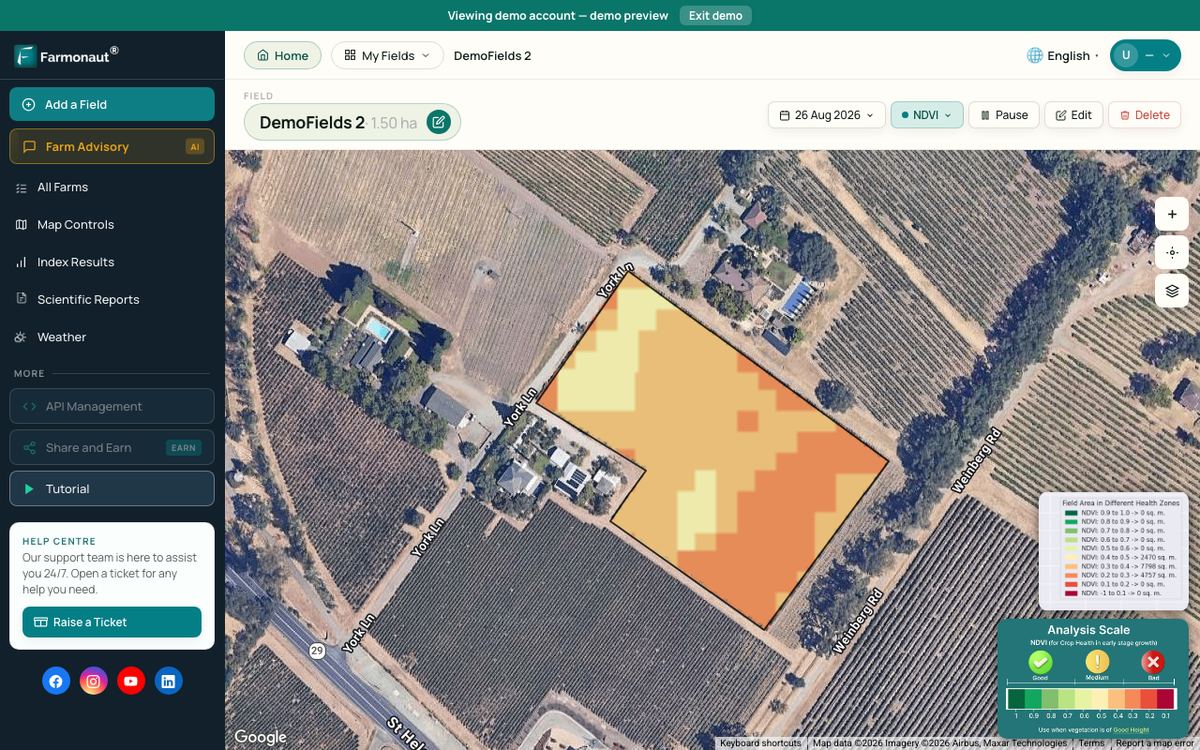
Farmonaut Satellite + AI Farm Monitoring System shows satellite crop health maps of your fields, so you can spot uneven stands after emergence.



Keep reading


Sources
- Oregon State University Extension, Soil temperature conditions for vegetable seed germination (2013, reviewed 2024): extension.oregonstate.edu
- University of Georgia Extension, Commercial snap bean production in Georgia, Bulletin 1369 (2013): fieldreport.caes.uga.edu
- Ontario Ministry of Agriculture, Food and Rural Affairs, Agronomy Guide for Field Crops, Publication 811, chapter 5 Dry edible beans (2022 web edition): ontario.ca
- OMAFRA Field Crop News, Planting dry beans (2025): fieldcropnews.com
- Clemson Cooperative Extension, Bush and pole-type snap beans, HGIC 1302 (2023): hgic.clemson.edu
- LSU AgCenter, Snap beans can be planted in March (2025): lsuagcenter.com
- University of Maryland Extension, Mid-Atlantic commercial vegetable recommendations: Beans, snap and lima (2026): extension.umd.edu
- US Code of Federal Regulations, 7 CFR 201.31 Minimum germination standards for vegetable seeds (current October 2026): ecfr.gov
- Oregon State University Extension, Collecting and storing seeds from your garden (2003, reviewed 2024): extension.oregonstate.edu
- Iowa State University Extension, Can you use vegetable seeds from last year? (2024): yardandgarden.extension.iastate.edu
- Shioga and da Silva, Scientia Agricola 55(1), Seed hydration control and early seedling development of dry bean (1998): scielo.br
Discussion
Questions, corrections or field experience? Share them below. First-time comments are reviewed before they appear, and your email is never published.
No comments yet. Be the first to add a question or your experience.

 Teledarbas
 Dreamz Tech
 Wild Oak Farm
 SFX
SFX BACF Africa
 Doodlakine
 Exurbia Geospatial
 FieldZero
 Indico Company
 Kubota
 FFBS
FFBS Jontra
 Tucor
Tucor
 Licence holder · Niger · Gold
 Licence holder · Nigeria · Gold + lithium










