

Contour Plowing vs Terrace Farming: Proven 2025 Guide
Meta description: Contour Plowing vs Terrace Farming — a proven 2025 guide to sloping farmland management. Learn how contour farming and strip cropping work, when terraces are needed, and how digital, precision design and modern conservation practices reduce erosion, improve water retention, and stabilize yields.
Primary focus keyword: Contour Plowing vs Terrace Farming
URL suggestion: yoursite.com/contour-plowing-vs-terrace-farming-2025-guide
“Contour plowing can cut soil erosion by up to 50% on 2-10% slopes”
“Well-designed terraces can reduce runoff by 30-60% and soil loss by 50-80% in rainstorms”
Contour farming is a method for plowing across the slope of steep hills., contour farming is a method for plowing across the slope of steep hills. In 2025, this proven technique remains foundational for sustainable hillside agriculture. By performing tillage and seedbed preparation along lines that run perpendicular to the direction of maximum slope, contour furrows and contours create small barriers that slow runoff, enhance infiltration, reduce topsoil loss, and stabilize yields on sloping farmland. For moderate slopes, contour plowing and strip farming are methods designed to protect soil, water, and biodiversity while keeping systems flexible and compatible with mechanization. Where slopes are steep, terraces are the engineered answer with higher retention but also higher cost and maintenance.
In the sections below, we compare contour plowing vs terrace farming, outline the benefits, show how to design and layout contours with digital and precision tools, explain how strip cropping strengthens the system, and share 2025 best practices that are often combined with cover crops, residue management, agroforestry, and policy support.



Farmonaut API | API Developer Docs
Table of Contents
- Introduction: Why Slopes Need Smart Farming
- What Is Contour Farming and How It Works
- How Contour Plowing Works in 2025
- Strip Farming and Its Role on Slopes
- Contour Plowing vs Terrace Farming
- 2025 Comparison Matrix: Contour, Terraces, and Strip Cropping
- Design and Layout: Digital Best Practices
- Conservation Agriculture Synergies
- Policy, Finance, and Adoption Support
- Constraints, Limits, and Risk Management
- Implementation Checklist & Timeline
- FAQ
- Conclusion
Introduction: Why Slopes Need Smart Farming
Farming on slopes exposes soil to intense erosion, runoff, and nutrient loss. During storms, surface water accelerates down a hillside, cutting rills and sheet erosion that move valuable topsoil and sediment into downstream rivers and reservoirs. The outcome is lower yields, more fertilizer and irrigation demand, and degraded ecosystems. In the 2025 climate, with heavier rain events in many regions and rising input prices, the need for conservation measures that are cost-effective and resilient has never been greater.
Two cornerstone approaches address these issues: contour plowing and terrace farming. Each has unique strengths and limits. Contour systems manage water with furrows and strips that follow natural land contours, while terraces create level benches to slow and store water. Both can be further improved with digital tools, precise design, and best practice maintenance.
What Is Contour Farming and How It Works
Contour farming is a method for plowing across the slope of steep hills, managing crops along the natural contour lines of a field. Specifically, contour plowing means performing tillage and seedbed preparation on lines that run perpendicular to the direction of maximum slope. The shallow furrows formed by plowing and planting act as miniature terraces, interrupting surface flow and promoting storage of water in the root zone. This simple layout reduces sheet and rill erosion, stabilizes yields on marginal slopes, and cuts sediment delivery to downstream rivers and reservoirs.
How the contour system works
- Furrows and beds follow contour lines, so water is slowed rather than channeled straight downslope.
- Small ridges form along the crop rows, acting like miniature terraces to enhance infiltration and reduce runoff.
- By promoting storage in the root zone, soil moisture is retained longer, reducing supplemental irrigation needs.
- With cover crops and residue, organic matter builds up, helping to sequester carbon and improve soil structure.
Benefits we can quantify
- Improved soil moisture: Greater retention sustains crops between rain events and can lower the need for irrigation.
- Higher nutrient retention: Less runoff means fewer dissolved nutrients are lost, lifting yields and trimming fertilizer waste.
- Reduced erosion: Contour furrows disrupt the slopewise flow, reducing sheet and rill erosion and protecting topsoil.
- Resilience: A resilient approach for moderate slopes and mixed smallholder systems, especially when combined with strip cropping.
- Climate benefits: With residue management and cover crops, organic matter rises and systems can sequester carbon.

Note: In 2025, contour farming remains a mainstay on gentle to moderate slopes (generally up to 10–15% — though real-world limits depend on rainfall, soil type, and machinery). It is flexible and widely compatible with mechanization, making it accessible for many farms.
At Farmonaut, we provide satellite-based monitoring, real-time environmental insights, and AI advisory to help growers make slope-aware decisions. Our Jeevn AI Advisory System brings weather-aware recommendations and operational strategies into one place, so farming practices fit the terrain and the season.
Carbon Footprinting — understand and track on-farm emissions and sequester carbon gains from conservation practices like contour systems and cover cropping.
Traceability — use blockchain-backed product records to demonstrate sustainable management and build buyer trust.
Large-Scale Farm Management — integrate digital maps, NDVI, and operations oversight for many fields across varied slopes.

How Contour Plowing Works in 2025
Today’s contour plowing blends traditional technique with modern tools. A practical workflow uses high-resolution imagery, elevation data, weather insights, and in-field checks to design contours that keep water on the field and prevent erosion.
Step-by-step overview
- Base mapping: Map the slope directions and lines of equal elevation. In 2025, farmers commonly consult digital elevation sources and in-field surveying to trace contour lines.
- Set safe spacing: Choose vertical interval and cross-slope width so that furrows safely slow water without overtopping. Spacing depends on soil, rainfall intensity, and slope.
- Layout and planting: Guide machinery to follow contour lines for tillage, seedbed preparation, and sowing. On steep segments, include grassed strips or hedgerows.
- Cover and residue: Keep the ground covered with living crops or mulch to shield soil and enhance infiltration.
- Maintenance: Inspect furrows after heavy rains to remove silt, repair breaks, and maintain outlets to water-safe areas.
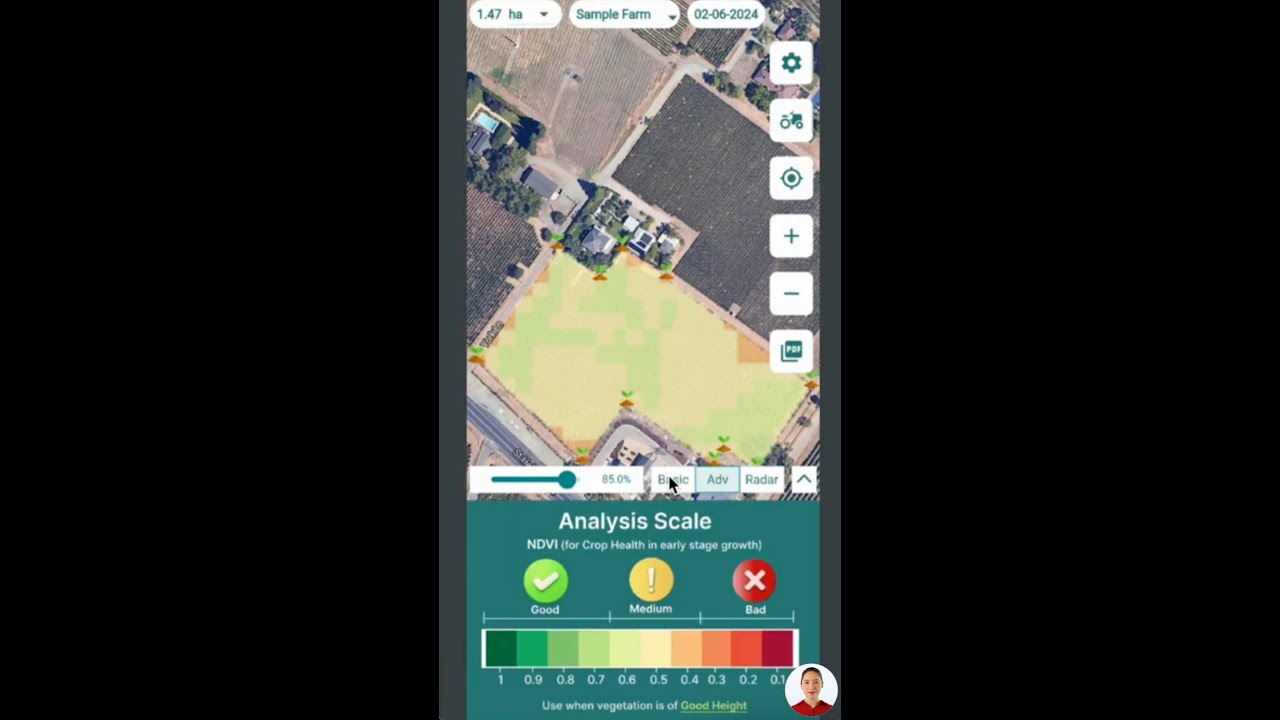
At Farmonaut, we support this process with satellite imagery (NDVI for crop vigor), environmental signals, and AI-based advisory through our web and mobile apps. We help users spot erosion hotspots, monitor moisture dynamics, and time planting windows under local weather patterns.

Strip Farming and Its Role on Slopes
Strip farming (or strip cropping) alternates strips of different crops or cover — for example, a row crop strip alternating with grass or legume — placed across the slope and aligned with the contour. These strips provide structural resistance to overland flow, promote biodiversity, and can interrupt pest cycles. When used plus a contour layout, they give a low-cost, resilient approach for moderate gradients and mixed smallholder systems.
- Runoff control: Dense-grass or legume strips slow flow and trap sediment.
- Soil protection: Continuous cover reduces raindrop impact and erosion.
- Rotation benefits: Rotating crops across strips helps disrupt pest cycles and supports nutrient balance.
- Biodiversity: Habitat diversity invites beneficial insects and improves system stability.

At Farmonaut, we make it easy to monitor strip-cropped fields with NDVI, moisture cues, and timely advisories that align with contour management. This ensures planting windows, irrigation timing, and residue decisions fit real-field conditions rather than averages.
Fleet Management — coordinate machinery across contour-aligned fields to minimize compaction and keep lines clean.
Crop Loan & Insurance — satellite-based verification can streamline access to finance for conservation improvements on slopes.
Contour Plowing vs Terrace Farming
Choosing between contour plowing vs terrace farming depends on slope angle, rainfall intensity, soil erodibility, and budget. Contour plowing is less capital- and labor-intensive and suits gentle to moderate slopes — generally up to 10–15%, though actual limits depend on climate and soil. Terrace farming provides standout erosion control and water storage on steep terrain but requires earthworks, potential outlet design, and long-term maintenance. Many landscapes benefit from a hybrid: contour systems on mild slopes, terraces where gradients and erosion risk are extreme.
| Practice | Ideal slope range (%) | Soil erosion reduction (% est.) | Surface runoff reduction (% est.) | Infiltration/retention gain (mm est.) | Yield impact after 2 seasons (% est.) | Capex ($/ha est.) | Annual O&M ($/ha est.) | Implementation timeframe (weeks) | Machinery requirement | Labor intensity (person-days/ha) | Carbon benefit (tCO2e/ha/yr) | Rainfall zone suitability | Smallholder fit | Digital design aids (Farmonaut) | Risk factors | Maintenance frequency (per yr) | ROI payback (years) | Policy/subsidy eligibility (region est.) | |
|---|---|---|---|---|---|---|---|---|---|---|---|---|---|---|---|---|---|---|---|
| Contour Plowing | 2–15 (best ≤10) | 25–50 | 15–35 | 5–20 mm/event | 2–8 | $20–$80 | $5–$25 | 1–3 | Light–Medium | 3–10 | 0.1–0.4 (with cover/residue) | Low–High (adjust spacing) | Yes | Imagery, NDVI, moisture signals, AI advisory | Channeling if misaligned; silt clogging | 2–4 | 1–3 | Common in many ag programs globally | |
| Terrace Farming | 10–50+ (engineered) | 50–80 | 30–60 | 20–60 mm/event (storage) | 5–15 (crop/region-specific) | $500–$3,000+ | $30–$150+ | 4–12+ | Heavy (earthworks) | 20–60 | 0.3–0.7 (with perennials/cover) | Medium–High (drainage critical) | Conditional (cost/skills) | Imagery, advisory for monitoring and maintenance planning | Landslide, overtopping, spillway failure if misdesigned | 2–6+ | 3–8+ | Often eligible in soil/water conservation schemes | |
| Strip Cropping | 2–20 (best with contours) | 20–55 (with grass/legume strips) | 15–40 | 5–25 mm/event | 2–10 (system-dependent) | $30–$120 (seed/establishment) | $10–$40 | 2–6 | Light–Medium | 6–18 | 0.1–0.5 (with legumes/residue) | Low–High (tunable) | Yes | Imagery and advisory for strip vigor and layout checks | Channeling at strip boundaries if misaligned | 2–4 | 1–3 | Common in conservation incentive programs | |
| Best-for scenarios |
Contour Plowing: gentle–moderate slopes; quick adoption; mechanized or animal-drawn. Terrace Farming: steep hillsides; high-intensity rainfall; perennial or high-value crops. Strip Cropping: mixed farms; biodiversity goals; erosion reduction with low capital. |
||||||||||||||||||
| 2025 best-practices checklist | Target contour spacing for ≤10% slopes; maintain ≥30% residue cover; include grassed waterways; inspect after every major rain; integrate cover crops; use digital monitoring for NDVI and moisture; plan outlets to safe drainage; sequence crops to alternate deep/shallow roots; track carbon outcomes. | ||||||||||||||||||

“Contour plowing can cut soil erosion by up to 50% on 2-10% slopes”
“Well-designed terraces can reduce runoff by 30-60% and soil loss by 50-80% in rainstorms”
Design and Layout: Digital Best Practices
Good design keeps water where it belongs — inside the field, in the soil, and away from gullies. In 2025, best practice blends field-level judgment and digital insight. Ask: Which areas are prone to rills? Where does water accumulate? What outlet is safest?
Key principles for contour lines and furrows
- Follow natural contours closely; avoid abrupt curves that cause channeling.
- Set vertical intervals so furrows can handle peak runoff without overtopping or concentrating flow.
- Provide safe outlets: guide excess water to grassed waterways or stable edges.
- Combine with strips: alternate row crops and dense cover to add friction.
- Maintenance is non-negotiable: after storms, repair breaks and remove deposited silt.
At Farmonaut, we deliver satellite-based monitoring to help users see problem spots, evaluate cover effectiveness, and time planting or tillage to minimize erosion risk. Our platform brings NDVI and environmental signals into one experience, and our Jeevn AI Advisory provides real-time guidance.

Small field and garden adaptation
- Use raised beds aligned to contour for micro-terrace effect.
- Mulch heavily to keep continuous cover.
- Add hedgerows or grass strips as wind and water breaks.
Conservation Agriculture Synergies
Contour systems deliver more when they’re combined with conservation agriculture: minimal soil disturbance, permanent cover, and diversified rotations. These practices increase aggregate stability, enhance infiltration, and raise organic matter, which in turn can reduce fertilizer losses and support higher nutrient availability.
- Cover crops: Rye, vetch, clovers, and grasses add residue and root biomass that feeds soil life.
- Residue management: Keep residues on the surface to shield soil from raindrop impact and reduce runoff.
- Diverse rotations: Alternate deep-rooted and shallow-rooted crops to build structure and cycle nutrients.
- Agroforestry: Contour hedgerows or alleys add permanent cover, reduce wind and water speed, and deliver long-term carbon benefits.

Farmonaut Carbon Footprinting helps quantify how contour farming combined with cover crops and residue management can sequester carbon while protecting soil and water.
Policy, Finance, and Adoption Support
Countries are increasingly deploying policy instruments that reward conservation and climate adaptation. From payments for ecosystem services to erosion-control subsidies, funding often exists to offset adoption costs for contour plowing, strip cropping, and terraces. Extension services commonly support training for design and maintenance.
At Farmonaut, we operate on a subscription model accessible via Android, iOS, and web apps. With real-time monitoring, AI-based advisory, and resource management tools, we help users prove practice adoption and manage operations efficiently. Our platform also aids financial access:
Crop Loan and Insurance — satellite-based verification supports lenders and insurers by validating field conditions, reducing fraud, and improving access to finance.
Traceability — verifiable sustainability data can complement subsidy or certification programs.
Constraints, Limits, and Risk Management
Contour farming isn’t a cure-all. On very steep or highly erodible slopes, contouring alone may fail. Design mistakes (e.g., misaligned lines, insufficient outlets) can cause channeling. Poor maintenance leads to silt blockage and breakouts. To manage risk:
- Respect slope limits: Use terraces when gradients exceed contour safety margins.
- Engineer outlets: Always direct excess water to stable, vegetated waterways.
- Inspect after storms: Keep furrows clear and strips dense.
- Calibrate machinery: Ensure equipment follows contour guidance without drift.
- Use cover aggressively: Continuous ground cover prevents bare soil exposure.
Implementation Checklist & Timeline
For a typical moderate slope, implementation can be staged over a few weeks:
Week 1: Assessment and Design
- Map slope directions and identify erosion hotspots.
- Trace preliminary contour lines and plan layout of grassed waterways.
- Select crops, cover species, and choose strips widths.
Week 2: Field Marking and Preparation
- Stake contour lines and mark furrow positions.
- Prepare seedbed following contours; avoid deep tillage on vulnerable soils.
- Build or reinforce outlets to safe drainage.
Week 3–4: Planting and Establishment
- Planting row crops, cover species, and grass/legume strips.
- Mulch or retain residue to maintain continuous cover.
- Set monitoring checkpoints; schedule maintenance after first major rain.
At Farmonaut, we offer a range of subscription plans to match farm size and monitoring needs. Use the secure pricing table below to choose the right plan for your operation.
FAQ
Which is better on moderate slopes: contour plowing or terrace farming?
For gentle to moderate slopes (often up to 10–15%, though limits depend on rainfall and soil), contour plowing is usually more cost-effective, faster to implement, and compatible with mechanization. Terraces are preferred on steep slopes where contour systems alone would fail.
How do contour furrows reduce erosion and runoff?
By following contour lines, the furrows act like miniature terraces, interrupting surface flow so water slows down and infiltration increases. This reduces sheet and rill erosion and protects topsoil.
Can strip farming be combined with contour plowing?
Yes. Strip farming plus a contour layout provide extra friction and resistance to overland flow, help promote biodiversity, and interrupt pest cycles. It’s a resilient approach for mixed smallholder systems.
What maintenance is required after heavy rainfall?
Inspect furrows and inlets/outlets, remove deposited silt, fix breaks, and reseed damaged strips. Regular maintenance preserves conservation performance.
What are the primary benefits for water and nutrient management?
Contour farming improves water retention, raises infiltration, and reduces nutrient runoff, leading to improved yields, higher nutrient efficiency, and lower fertilizer inputs.
Which of the following is a modern farming method?
In the context of slopes, contour plowing with digital design, strip cropping, cover crops, and data-driven management are all modern methods. Remote sensing and AI advisory strengthen adoption in 2025.
Is contour farming suitable for all soils?
No. Highly erodible or shallow soils on steep slopes may require terraces, grassed waterways, or even alternative land use. Always match the practice to site conditions.
How can digital tools help farmers design contour layouts?
Digital mapping, satellite monitoring, and AI advisory support precision design, identify hotspots, and guide maintenance scheduling. At Farmonaut, we deliver these insights through accessible apps and API services.
Reference phrase for clarity: “contour plowing and strip farming are methods designed to reduce erosion, control runoff, and improve soil moisture on sloping farmland.”
Reference phrase variants included: “contour farming is a method for plowing across the slope of steep hills., contour farming is a method for plowing across the slope of steep hills.”
Conclusion
Contour farming — managing crops along the natural contour lines — remains a foundational technique for sustainable hillside agriculture in 2025 and beyond. By creating furrows that act as miniature terraces, we slow runoff, increase infiltration, and reduce topsoil loss. When combined with strip cropping, cover crops, and residue management, contour systems provide durable benefits: better moisture retention, higher nutrient efficiency, and greater resilience.
Where slopes exceed contour limits or where rainfall intensity is extreme, terrace farming is the needed engineering solution. The optimal landscape strategy is often hybrid: contours on gentle to moderate ground and terraces on the steep segments, with grassed waterways and agroforestry as stabilizing allies.
At Farmonaut, we focus on making satellite-driven insights accessible to all growers. Through our Android, iOS, and web apps — and the Farmonaut API with developer docs — we bring digital monitoring, AI advisory, and resource management into day-to-day decisions on sloping fields. This empowers better design, timely maintenance, and a smoother path to policy incentives and climate adaptation.
Final notes on readability and adoption
- Keep paragraphs short and scannable to aid training and extension efforts.
- Use images and maps with descriptive ALT text (e.g., “Contour Plowing vs Terrace Farming design map”).
- Document best practice steps; track results, maintenance, and ROI.
Contour plowing vs terrace farming is not an either-or choice — it’s a terrain-aware continuum. With the right design, precision tools, and support, hillside farming can be productive, sustainable, and climate-resilient in 2025 and beyond.
Discussion
Questions, corrections or field experience? Share them below. First-time comments are reviewed before they appear, and your email is never published.
No comments yet. Be the first to add a question or your experience.

 FCF India
 Rashail Infotech
 Unifrutti Gulf
 Deluxe Conseil
 TVS Electronics
 BW Pipelines
 WICO
WICO Gen Chayat
 Chimera Innovation
 SkyHarvest
 Polaris Digitech
 Teledarbas
 Wild Oak Farm
 SFX
SFX Doodlakine
 Exurbia Geospatial
