

Reviewed against USDA NASS Census of Agriculture (2022), USDA ERS, PS Market Research, and SARE cover crop economics data.
Try it: Run your own numbers →
Custom Farming Equipment: 7 Sustainable Farm Solutions
Introduction: The Next Generation of Custom Agriculture Industry Equipment
Custom farming equipment is not a separate product category you shop for — it’s a set of modifications, retrofits, and add-on modules that adapt standard tractors, planters, sprayers, and harvesters to a specific farm’s soil profile, field shape, and crop rotation. For US row-crop and specialty growers, the driver behind this shift is measurable: USDA’s 2022 Census of Agriculture found 26% of US crop operations, covering 35% of cropland acres, now practice no-till — a management shift that itself depends on custom or modified equipment such as no-till drills, residue managers, and adaptive-depth planters that a stock implement can’t handle.
This guide answers the practical question behind searches for custom farm equipment, custom farming industry equipment, and sustainable farming equipment: what these solutions actually cost, what data backs their efficiency claims, and how to evaluate whether a given retrofit is worth it for your acreage. We cover seven categories of custom farming industry equipment, a cost comparison table, and a calculator you can run with your own field’s numbers — not generic marketing ranges.
Why Custom Farming Equipment Matters
The case for custom farming equipment rests on adoption data, not just engineering promises. USDA’s 2022 Census of Agriculture shows conservation-tillage equipment is now mainstream on the crops that dominate US acreage: 76% of corn acres, 74% of soybean acres, and 68% of wheat acres were managed under conservation or no-till practices that year. That’s not a niche — it’s most of the Corn Belt and Wheat Belt, and none of it runs on unmodified stock equipment.
- ✔ Fit for Unique Landscapes: Bespoke designs accommodate irregular field shapes, uneven terrain, and diverse soil profiles across US growing regions, from the Palouse to the Mississippi Delta.
- ✔ Boost Productivity: Precision-engineered attachments extend the functional life of standard tractors, sprayers, and combines rather than replacing them.
- ✔ Reduce Input Use: Sustainable farming equipment leverages VRT kits, targeted irrigation modules, and adaptive crop protectors to reduce fertilizer, water, and pesticide volumes applied per acre.
- ✔ Enhance Sustainability: Residue management and site-specific planting protect soil structure and reduce runoff into local watersheds.
- ✔ Enable Seamless Integration: Modular attachment interfaces let custom solutions retrofit into existing workflows, minimizing downtime and new capital outlay.
The Growth and Relevance of the Custom Agriculture Industry Equipment Sector
- 📊 Market size: The US precision agriculture technologies market was $2.1 billion in 2024, projected to reach $4.3 billion by 2032 — a doubling in eight years, per PS Market Research.
- 🌱 Cover crops: US farmers planted 18 million acres to cover crops in 2022, up 17% from 2017, though adoption remains at just 4.7% of crop operations — meaning most of the growth opportunity for custom seeding equipment is still ahead, not behind, per USDA NASS Quick Stats.
- 🌱 Emissions tracking: Sustainability gains from custom equipment support carbon footprint monitoring, increasingly required for supply-chain reporting.
- 🔄 Adaptability: Custom systems incorporate field-level feedback and real-time data to evolve with changing rotation and weather patterns.
- 💡 Innovation: Advances in AI, IoT sensors, and satellite imagery — as used by Farmonaut — are driving more targeted retrofit decisions than blanket equipment upgrades.
Custom Farming Equipment: 7 Sustainable Farm Solutions
Here are seven categories of custom farming equipment solutions, each addressing a distinct field problem, with the adoption and cost data available for each.
1. Precision Variable-Rate Technology (VRT) Modules
VRT retrofits adjust seed, fertilizer, and water application rates in real time using yield maps, soil zone data, and terrain sensors, instead of applying one blanket rate across a field. These are the most common entry point into custom farming industry equipment because they bolt onto planters and sprayers a farm already owns.
- 📈 Adaptive input application: Matches seed and fertilizer rate to zone-level yield potential rather than a whole-field average.
- 🌱 Sustainability: Reduces the over-application that drives nutrient runoff into waterways — a core concern under state nutrient management rules across the Corn Belt.
- 📉 Retrofit path: Most VRT kits are sold as add-on rate controllers and monitors compatible with existing planter and sprayer hitches, not standalone machines.
2. Adaptive Depth-Controlled Planters and Seed Drills
Soil variability is a persistent issue on sloped, stony, or mixed-texture fields. Custom planters with adaptive depth control use down-force sensors and hydraulic actuators to hold seed depth constant even as soil resistance changes across a field — the same class of equipment behind USDA’s 35%-of-cropland no-till figure, since no-till drills must cut through residue at a controlled depth that stock planters struggle with.
- ⚠ Limitation: Stock planters can “bounce” or misplace seed on sloped or lumpy ground; depth-controlled units use real-time down-force adjustment to hold placement steady.
- ✔ Key benefit: More uniform emergence supports more even stands and simplifies later-season input decisions.
- 📊 Context: No-till and reduced-till depend on this equipment class — hence the 76% corn / 74% soybean / 68% wheat conservation-tillage rates cited above (USDA NASS 2022).

3. Sensor-Driven Fertilization and Crop Protection Systems
Multi-sensor arrays detect canopy stress via NDVI and related indices, enabling variable-rate fertilization and targeted spraying instead of blanket chemical application across a field.
- 🤖 Technological advantage: NDVI-based stress mapping supports traceability and resource management by tying input decisions to documented field conditions.
- ⚠ Gap to flag honestly: There is no comprehensive federal survey tracking sensor-equipped sprayer adoption by state or farm size in the US — that data is fragmented across private dealer networks. If you need a regional adoption estimate, ask your equipment dealer or state extension office for local uptake figures rather than relying on a national number, because none exists yet.
- 💦 Where the real number lives: Chemical-use reduction from sensor-driven spraying is documented crop-by-crop in university extension trials rather than as one national percentage — check your state land-grant university’s precision ag extension program for trial results specific to your crop.
4. Targeted Irrigation Modules and Smart Water Management
With 54.9 million acres of irrigated cropland counted in the 2022 USDA ERS data, custom irrigation retrofits — moisture sensors, weather-linked scheduling controllers, and precision dripper modules — represent one of the largest addressable categories in sustainable farming equipment.
- 💧 Retrofit scope: Moisture-sensor and scheduling-controller kits typically attach to existing center-pivot or drip infrastructure rather than replacing it.
- 📈 Where to verify local savings: Water-use reduction from sensor-based scheduling is documented by state water-management agencies and USDA ERS regional reports (USDA ERS Data Products) — check your state’s irrigation district or extension office for a figure specific to your soil type and crop, since national averages mask large regional differences between, say, the arid Southwest and the humid Southeast.
- 🌱 Sustainability: Supports large-scale farm management and land restoration on depleted or drought-stressed soils.
5. Autonomous Multi-Tasking Harvesters & Integrated Crop Handling
Custom-built harvesters offer multi-crop heads, in-cab sensor monitoring, and automated sorting to reduce labor hours per acre — a priority given persistent seasonal labor shortages in specialty-crop regions.
- 🌾 Labor savings: Reduces manual harvesting hours per acre versus single-crop stock headers.
- 📈 Performance: Custom interfaces allow plug-and-play head swaps for different crop types and field conditions within a single season.
- ♻ Residue management: Integrated choppers or balers address post-harvest stubble, supporting the same conservation-tillage practices tracked at 26% of US operations by USDA NASS.

6. Site-Specific Weeding and Smart Cultivation Implements
Robotic and vision-guided weeders use machine vision and mechanical actuators to target weeds row-by-row instead of blanket herbicide application — most relevant on the high-value fruit, vegetable, and organic acreage where herbicide-resistant weed pressure is costliest to manage.
- 🧮 Precision: Camera-guided cultivators reduce the number of herbicide passes required per season versus blanket spraying, with the exact reduction dependent on weed pressure and crop row spacing.
- 💰 Cost savings: Lowers labor and chemical input costs, particularly on organic-certified acreage where synthetic herbicide use is restricted or prohibited.
- 🐞 Supporting biodiversity: Reduced broad-spectrum herbicide use supports beneficial-insect populations in and around treated fields.
7. Forestry & Agroforestry Solutions: Custom Skidders, Rigs, and Brush Cutters
Farms integrating forest stands or agroforestry buffers need equipment built for narrow rows, sloped terrain, and sensitive soils — custom skidders, logging attachments, and tree-planting rigs fill that gap alongside row-crop production.
- 🌲 Forest health: Enables selective thinning, brush removal, and replanting without disrupting surrounding soil structure.
- 🦺 Safety: Custom rigs must meet the same operator-safety standards as row-crop equipment, an essential requirement in rugged or sloped terrain.
- ⭐ Broader impact: Ties into carbon footprinting modules for timber and land-restoration projects seeking to document sequestration.
The Collaborative Customization Process
Custom farming equipment is built through direct collaboration between farmers, manufacturers, and independent fabricators — translating specific field problems into bespoke retrofits. The process includes:
- 🎯 Identifying needs: Assess crop type, soil profile, terrain, climate, and operational workflow before specifying any module.
- 🔗 Compatibility checks: Confirm custom parts and controllers integrate with existing tractors, sprayers, and combines via ISOBUS/CAN-bus standards.
- 🔍 Iterative design: Prototypes are field-tested across at least one full season; feedback loops refine function and reduce downtime.
- 🛠 Quality control: Wear-resistant materials, safety guards, and hydraulic certifications are non-negotiable specification points.
- 🎛 Modular options: Builders design for future upgrades — multi-crop heads, autonomous modules, software interfaces — to avoid stranding the initial investment.
Durability, Modularity & Lifecycle Management
Long-term value in custom farming equipment depends on durability and modular design. Builders specify robust frames, corrosion-resistant metals, and field-serviceable parts to withstand seasonal use across variable weather.
- 🔩 Long-life construction: Custom frames, reinforced joints, and high-grade bearings extend machine service life beyond stock equivalents.
- 🧩 Modular upgrades: Incremental additions — autonomous navigation kits, new VRT controllers — keep older equipment relevant without a full replacement purchase.
- ⚙ Multi-function implements: Combining cultivation, crop protection, and harvest handling reduces the number of separate machines an operation must store and maintain.
- 🕑 Reduced downtime: Field-serviceable parts and diagnostic interfaces limit costly interruptions during planting and harvest windows.

Automation and Data Integration in Custom Equipment
Modern custom farming industry equipment ships with CAN-bus or Ethernet connections, IoT sensors, and software interfaces that turn a retrofit into a data source, not just a mechanical upgrade.
- 🖥 Fleet management: Digital dashboards track fuel use, tool wear, and live performance across multiple machines — save costs with real-time equipment management.
- 📡 Adaptive management: Implement-level data feeds into precision fertilization and irrigation plans, surfacing productivity bottlenecks earlier in the season.
- 🗂 Plug-and-play controls: Software upgrades support calibration, batch tracking, and integration with on-farm agronomy plans.
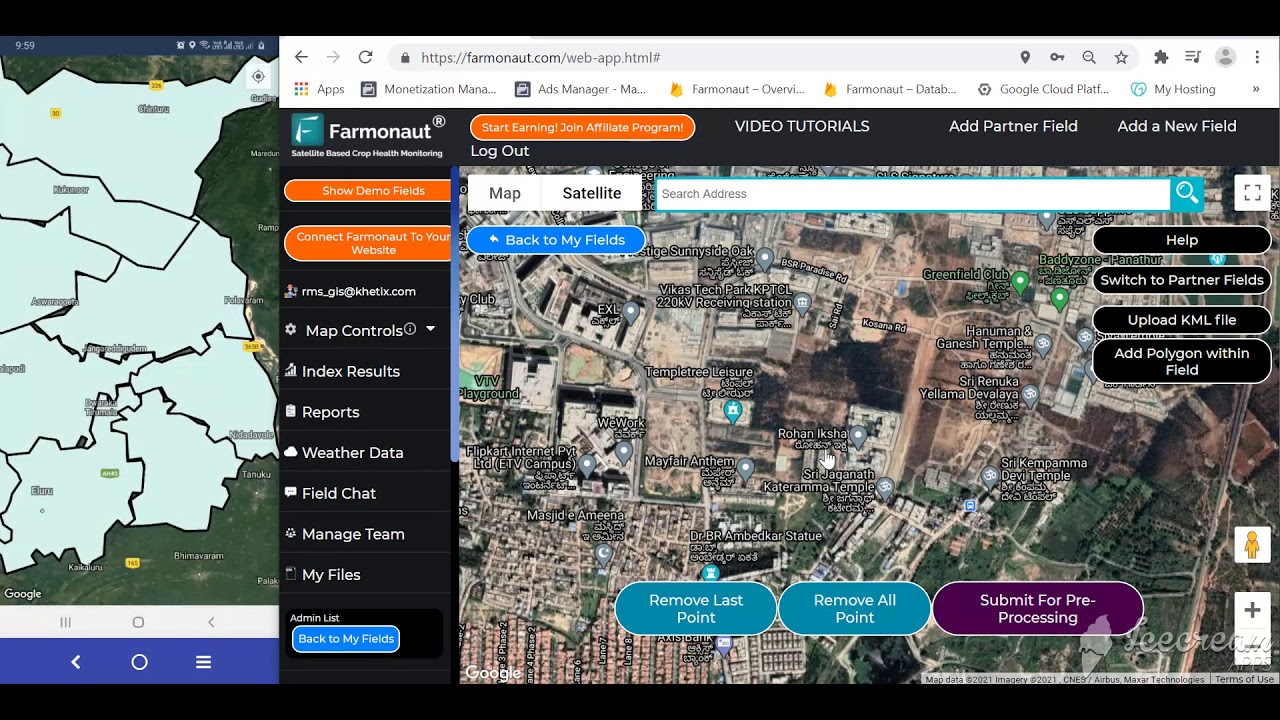
- 📲 Mobile access: Smartphone and cloud-based controls extend flexibility — the Farmonaut mobile apps below provide field data integration alongside your equipment’s own telemetry.



For businesses and developers, Farmonaut’s API enables integration of satellite-driven insights into your own farm management, traceability, and resource allocation systems.
Farmonaut Agriculture API |
API Developer Docs

Quality, Safety, and Support in Custom Machines
- 🦺 Safety Framework: Compliance with agricultural equipment safety standards is non-negotiable — guarded powertrains, certified hydraulics, and robust operator platforms are baseline requirements for any customization.
- 🔧 Maintenance Ease: Field-serviceable designs, with locally available spare parts and diagnostic modules, reduce downtime during planting and harvest windows.
- 🛡 Risk Mitigation: Real-time diagnostics and mobile alerts help prevent equipment failures and protect both labor and capital assets.
Economic Impact and Return on Investment
Custom farming equipment usually costs more upfront than stock equivalents, but published cost data for specific components lets you build a realistic per-acre comparison rather than relying on vendor marketing.
The clearest published example is cover crop seeding, tracked by the Sustainable Agriculture Research & Education program’s 2012 SARE/CTIC survey: the median cost to seed a cover crop was $37 per acre for seed alone, plus a median $12 per acre to hire the seeding labor and equipment where a farm doesn’t own a drill — a combined $49 per acre baseline you can compare against your own custom-drill ownership costs.
- 💵 Precision input = reduced expenditure over time versus blanket application rates.
- ⏰ Labor efficiency: Fewer labor-hours per acre lowers recurring seasonal labor costs.
- 📈 Yield protection: More uniform emergence and targeted inputs reduce the risk of yield-limiting stand gaps.
- 🔄 Extended machine life: Robust, field-adapted parts extend usable service life versus stock equivalents pushed beyond spec.
- 🌏 Documented sustainability gains — no-till acreage, cover-crop acreage, water-use reduction — increasingly matter to lenders assessing conservation-linked loan terms.

Did you know? Farms increasingly use satellite-driven verification to secure crop loans and insurance, presenting field-level data as evidence for lenders and insurers.
Calculator: Cover Crop Seeding Cost Per Acre
Use the SARE/CTIC baseline costs above with your own acreage and any custom-drill ownership cost to estimate your total cover-crop seeding budget.
Run your own numbers
Assumes SARE/CTIC 2012 survey medians as defaults; excludes cover crop termination cost, seed treatment, and any cost-share or conservation program payment you may be eligible for through your local USDA NRCS office. Adjust the seed cost field for your species mix — cereal rye, clover, and multi-species blends price differently per acre.
Comparative Overview: 7 Sustainable Custom Equipment Solutions
| Custom Equipment Name | Key Technological Features | Retrofit or New Build | Sustainability Benefit | Suitable Crops/Farm Types |
|---|---|---|---|---|
| VRT Modules | Variable-rate dispensing, real-time sensor integration | Retrofit onto existing planter/sprayer | Lower chemical/fertilizer volume, minimized runoff | Row crops, cereals, mixed-use farms |
| Adaptive Depth-Controlled Planter | Dynamic seed placement, soil probes, terrain mapping | Retrofit kit or purpose-built no-till drill | Improved emergence, soil structure preserved | Cereals, specialty crops, uneven fields |
| Sensor-Driven Fertilization Sprayer | NDVI mapping, mobile calibration, IoT-enabled | Retrofit onto existing sprayer boom | Decreased chemical input, enhanced crop health | All crop types, especially value crops |
| Targeted Smart Irrigation Module | Moisture sensors, weather-adaptive scheduling | Retrofit onto center-pivot or drip system | Lower water use, reduced erosion | Vegetables, high-value, drought-prone crops |
| Autonomous Multi-Crop Harvester | AI navigation, multi-head, residue management | New build or head-swap retrofit | Enhanced labor efficiency, improved soil recovery | Grains, root crops, mixed-use farms |
| Smart Robotic Weeder/Cultivator | Machine vision, selective actuation, field mapping | New build implement | Reduces herbicide passes, preserves microflora | Vegetables, orchards, organic/specialty |
| Forestry Skidders/Agroforestry Rigs | Custom attachments, soil/stand health probes | New build or attachment retrofit | Protects soil, supports land restoration | Silviculture, forest-integrated, reclamation |
📋 Visual List: What to Assess for Custom Equipment Integration
- 🔎 Field Variability: Measure differences in topography, soil structure, and microclimate before specifying custom modules.
- ⚙️ Operational Workflows: Map out all routine activities — custom implements must fit these without adding steps.
- 🖥 Data Needs: Identify key metrics (yield, soil moisture, machine hours) worth tracking for adaptive management.
- ⏱ Downtime Tolerance: Plan for maintenance with easily replaceable parts and confirmed local support.
- ♻ Sustainability Goals: Prioritize features that document water/chemical efficiency gains, since these increasingly support conservation-linked financing.
🌱 Visual List: Benefits of Sustainable Custom Agriculture Industry Equipment
- 🌍 Environmental Impact Reduction: Lower input loads, chemical runoff, and carbon footprint per acre.
- 🚜 Enhanced Machine Versatility: Modular attachments serve different crops and seasons from one base machine.
- 💧 Water Savings: Targeted irrigation systems conserve local water resources on the 54.9 million irrigated US acres tracked by USDA ERS.
- 💡 Precision Production: Data-driven modules support zone-specific input application rather than whole-field rates.
- 🛡 Worker & System Safety: Meets demanding agricultural safety standards for guarded powertrains and certified hydraulics.
Farmonaut: Empowering the Custom Farming Equipment Revolution
Farmonaut provides satellite-based agricultural insights that inform how and where custom farming equipment gets deployed — turning field data into the specification sheet for a retrofit decision.
Multispectral satellite imagery assesses soil health and vegetation vigor, while the Jeevn AI Advisory System layers in weather and yield analytics, translating field data into action. This accelerates the value of custom equipment by helping farms choose, calibrate, and target implements to their specific field conditions rather than guessing.
- ✔ Real-time Monitoring: Live updates on crop health, soil moisture, and field anomalies from anywhere via web and mobile platforms.
- ✔ AI-Powered Advisory: Tailored recommendations for fertilization, irrigation, and harvesting timing that inform how a custom module should be calibrated.
- ✔ Blockchain Traceability: Transparency across the agricultural supply chain — relevant for compliance, export documentation, and consumer trust.
- ✔ Fleet Management: Integrates machine usage, input application, and logistics for optimal efficiency and cost tracking.
- ✔ Environmental Impact Tools: Tracks carbon emissions and sustainability metrics over time, aligning with conservation practice documentation.
The platform is accessible via web, Android, and iOS apps, with API support for developers and businesses, scaling across farms, agribusinesses, mining sites, or restoration projects.
Get Started with Farmonaut’s Affordable, Scalable Subscription Model
Upgrade the way you manage data, sustainability, and equipment on your farm with our easy subscription plans:
FAQs: Custom Farming Equipment
What is custom farming equipment?
Custom farming equipment refers to machines and implements modified or engineered for an individual farm’s specific soil, terrain, crop rotation, and workflow needs — usually as retrofits onto existing tractors, planters, sprayers, and harvesters rather than entirely new machines.
What is custom farming industry equipment used for specifically?
It covers the seven categories in this guide: VRT modules, depth-controlled planters, sensor-driven sprayers, smart irrigation, multi-crop harvesters, robotic weeders, and forestry/agroforestry attachments — each solving a distinct field problem rather than one generic upgrade.
How does custom farming equipment promote sustainability?
Sustainable farming equipment incorporates variable-rate input application, targeted irrigation, residue management, and sensor-driven controls that reduce chemical volume, conserve water, and protect soil structure — directly supporting the no-till and cover-crop practices USDA tracks nationally (26% no-till adoption, 35% of cropland acres, 2022 Census).
Can small and medium-sized farms benefit from customized machines?
Yes. Most custom modules are designed to retrofit standard tractors or implements, offering incremental improvements without requiring replacement of an entire machine — this is precisely why cover crop and no-till adoption has grown across US farms of all sizes since 2017.
What forms of data integration are available for custom agriculture equipment?
Many implements ship with mobile connectivity, sensor arrays, and software modules that integrate with farm management systems. Farmonaut’s platform, for example, provides live crop and machine performance monitoring accessible remotely by growers, managers, or agronomists.
What are the main risks or limitations of custom farming industry equipment?
Upfront cost is typically higher than stock equipment, and local support or replacement parts may be less widely available for highly specialized machines. Retail pricing for specific modifications is set by individual dealers and manufacturers — USDA does not publish equipment-specific costs, so get itemized quotes from at least two fabricators before budgeting.
How do I decide which custom solutions are right for my farm?
Start with a field assessment of soil, crop, workflow, and sustainability needs, then compare the retrofit cost against a documented baseline — such as the SARE/CTIC cover crop seeding costs used in the calculator above — rather than a vendor’s marketed efficiency percentage.
Conclusion
Custom farming equipment is best understood as a set of targeted retrofits — VRT controllers, depth sensors, irrigation modules, sensor sprayers, harvester heads, robotic weeders, forestry attachments — layered onto equipment a farm already owns, not a wholesale equipment replacement. USDA’s 2022 Census data shows this shift is already mainstream on the crops that matter most: 76% of corn, 74% of soybean, and 68% of wheat acres under conservation tillage, alongside 18 million acres of cover crops and 54.9 million irrigated acres that are candidates for the retrofits covered here.
The durable method for deciding whether a specific retrofit is worth it doesn’t change year to year: assess your field variability, get itemized quotes from at least two fabricators, check compatibility via ISOBUS/CAN-bus standards, and compare the retrofit’s cost against a documented baseline for your practice — such as the SARE/CTIC cover crop figures used in the calculator above — rather than a vendor’s marketed efficiency percentage. For adoption and cost data, USDA NASS Quick Stats and the Census of Agriculture update annually and every five years respectively; check them directly for the current figures on your crop and region.
Ready to match your custom equipment decisions to real field data? Explore Farmonaut’s satellite technology, AI tools, and management platforms to drive your operations forward. Get started with Farmonaut for actionable insights and smarter farm management!

 SFX
SFX BACF Africa
 Nivia
Nivia Doodlakine
 Exurbia Geospatial
 FieldZero
 Indico Company
 Kubota
 FFBS
FFBS Jontra
 Tucor
Tucor Hayleys Agriculture
