

Farming AI & Crop Farming: 7 Transformative Trends for 2026
“**By 2026, AI-powered crop monitoring is projected to improve farm yields by up to 20% globally.**”
“**Precision farming tech could reduce fertilizer usage by 15% on average by 2025, according to industry forecasts.**”
Table of Contents
- The Transformative Role of AI in Modern Crop Farming: A 2025 Perspective
- Introduction: Farming AI & Crop Farming in the Age of Rising Food Demands
- Seven Transformative AI Trends in Crop Farming for 2026
- Comparison Table of Transformative AI Trends in Crop Farming for 2026
- Farmonaut: Empowering Data-Driven Agri Farming Solutions
- Visual Insights: YouTube Videos on AI Farming & Precision Agriculture
- Navigating Challenges & Future Opportunities in AI Farming
- Frequently Asked Questions (FAQ)
- Conclusion: The Path Forward for Crop Farming AI
The Transformative Role of AI in Modern Crop Farming: A 2025 Perspective
As the world’s population surge continues, the demand for reliable and abundant food production intensifies, placing unprecedented pressure on traditional farming methods. By 2025, artificial intelligence (AI) has emerged as a pivotal force in revolutionizing crop farming, enabling farmers to meet these challenges with enhanced precision, efficiency, and sustainability.
At the heart of this transformation is AI farming, which harnesses data-driven decision-making to optimize every stage of crop production. By leveraging datasets from satellite imagery, sensors, weather forecasts, and historical yield records, advanced machine learning models provide actionable insights that tailor practices to the unique conditions of each farm.
Platforms integrating Internet of Things (IoT) sensors, robotic machinery, and AI-driven analytics are driving smart land management and real-time monitoring in agri farming. These systems enable precise irrigation, early pest and disease detection, and targeted interventions—all while conserving resources and minimizing environmental impact.
The following comprehensive guide explores seven transformative trends that will continue to redefine farming AI and crop farming through 2026 and beyond.
Introduction: Farming AI & Crop Farming in the Age of Rising Food Demands
The agricultural sector, particularly crop farming, is facing the dual challenge of feeding a growing global population while promoting sustainability in the face of climate change. AI farming and precision technology now stand at the intersection of these needs, driving a new era of food production that prioritizes efficiency, analysis, and data-based insights.
Why is the adoption of AI and smart technology a game-changer?
- Enhanced Decision-Making: Automated detection, analysis, and actionable recommendations empower farmers to make tailored decisions according to individual conditions on their farms.
- Resource Optimization: Data-driven platforms reduce wastage (water, fertilizer, chemicals) while boosting yields.
- Sustainable Practices: Environmental monitoring, disease detection, and traceability help address food safety and climate impact concerns.
- Access and Scalability: Tools like Farmonaut’s satellite technology make cutting-edge services accessible to smallholders and large-scale commercial agriculture.
With technology continuously evolving, the landscape of agri farming in 2026 points to more integrated systems, intelligent automation, and connected farming land platforms—all enabling increased productivity, resilience, and traceability across supply chains.
Seven Transformative AI Trends in Crop Farming for 2026
1. Smart Satellite Crop Monitoring and Analysis
Satellite-driven crop monitoring sits at the heart of the AI revolution in modern farming. Advanced satellites capture multispectral imagery over farming land, generating critical insights into soil conditions, crop health, and productivity. With the application of machine learning algorithms and AI-based advisory systems, this data is transformed into actionable recommendations for farmers.
- Benefits: Real-time detection of crop stress, nutrient deficiencies, pest infestations, and drought risk.
- Tools: Platforms like Farmonaut offer users affordable satellite crop monitoring with integrated weather forecasts and AI-driven advisory.
- Use Case: Farmers receive instant alerts on NDVI (Normalized Difference Vegetation Index) drops, helping them act before visible crop damage occurs.

Satellite intelligence supports everything from farming land management and fleet management to blockchain-based traceability.
2. AI-Powered Precision Irrigation and Moisture Management
Precision irrigation harnesses AI and IoT sensors to analyze soil moisture, predict exact watering requirements, and automate water delivery. These systems integrate vast datasets—including weather forecasts and ground sensor readings—to determine optimal irrigation schedules, minimizing water wastage and reducing crop stress caused by over- or under-irrigation.
- AI farming maximizes efficiency and reduces input costs, especially in water-scarce regions.
- Pro Tip: Satellite moisture monitoring solutions, such as those provided by Farmonaut, offer actionable intelligence for both smallholder and large-scale farms. Farmonaut’s Agro Admin App delivers field monitoring, irrigation mapping, and alerts.

3. Autonomous Drones and Robotic Crop Monitoring
Autonomous drones and ground robots are now integral to farming AI, scanning fields for early pest detection, disease outbreaks, and growth analytics. Through deep learning-enabled image recognition, drones pinpoint infestations and fungal infections with higher accuracy and speed compared to human scouts.
An overview of the main types of farm robots groups these machines by type and shows what they do and cost in practice.
- Benefits: Drones deliver precision treatments (spraying or fertilizing specific areas), reducing blanket pesticide use and promoting environmental sustainability.
- Smart Practices: Automated data collection for crop analysis, mapping plant health, and assessing yield potential over vast agricultural lands.


4. Predictive Analytic Models for Yield Forecasting and Farm Planning
Predictive analytics is revolutionizing how farmers plan, invest, and respond to farm challenges. By utilizing historical yield records, weather patterns, current soil data, and satellite imagery, machine learning models forecast expected crop yields and suggest strategic actions to optimize production.
- Practice: Platforms generate tailored recommendations for seed selection, planting timelines, and resource allocation across individual farms.
- Outcome: Farmers are empowered to mitigate risks, maximize profits, and adapt to unpredictable climate conditions.
- Example: Using Farmonaut’s Carbon Footprinting, users monitor environmental impact while forecasting yield improvements via satellite-aided AI.



5. AI-Driven Crop Breeding and Seed Selection
AI models now analyze vast genetic information alongside environmental data to identify high-performing crop varieties. This technology accelerates the selection and development of resilient seeds that adapt to specific farming conditions and climate fluctuations.
- Benefit: Farming land becomes more productive with varieties chosen for drought resistance, pest tolerance, and yield potential.
- Smart Selection: Informed seed choices improve food security for both rural farmers and commercial operations.
6. Blockchain-Based Supply Chain Traceability
Blockchain technology is transforming agricultural supply chains by embedding traceability and transparency at every stage. AI-powered systems record actions from planting and harvest to distribution, ensuring data integrity and food authenticity.
- Result: Enables instant recall in cases of contamination and builds consumer trust.
- For advanced traceability, see: Farmonaut Blockchain Traceability Solution to combat fraud and improve compliance in global agriculture.
7. AI-Enabled Advisory Systems & Rural Knowledge Access
AI-driven mobile apps and platforms have bridged the knowledge gap for smallholder farmers in remote or rural areas. Using chatbots, real-time satellite imagery, and tailored advisory, these systems provide specific, actionable advice—from crop care to market updates and weather warnings.
- Impact: Democratized expertise leads to better farm productivity and helps rural communities keep pace with modern agricultural innovations.
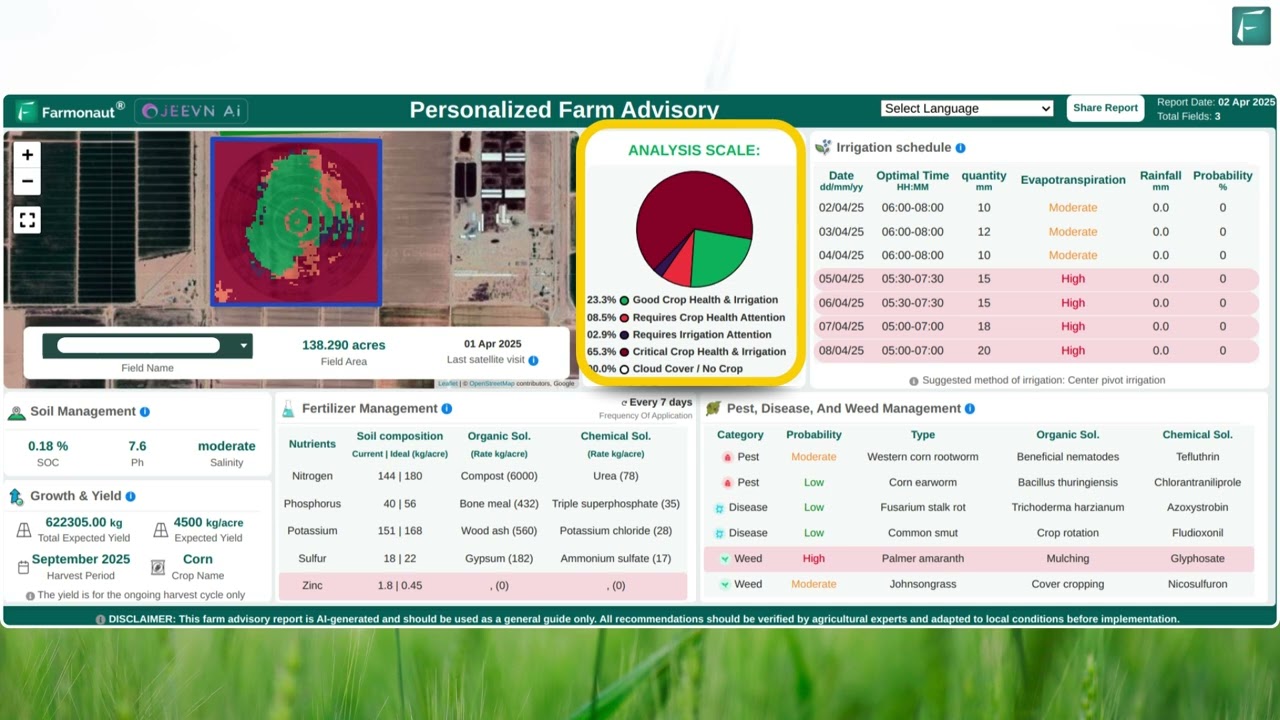
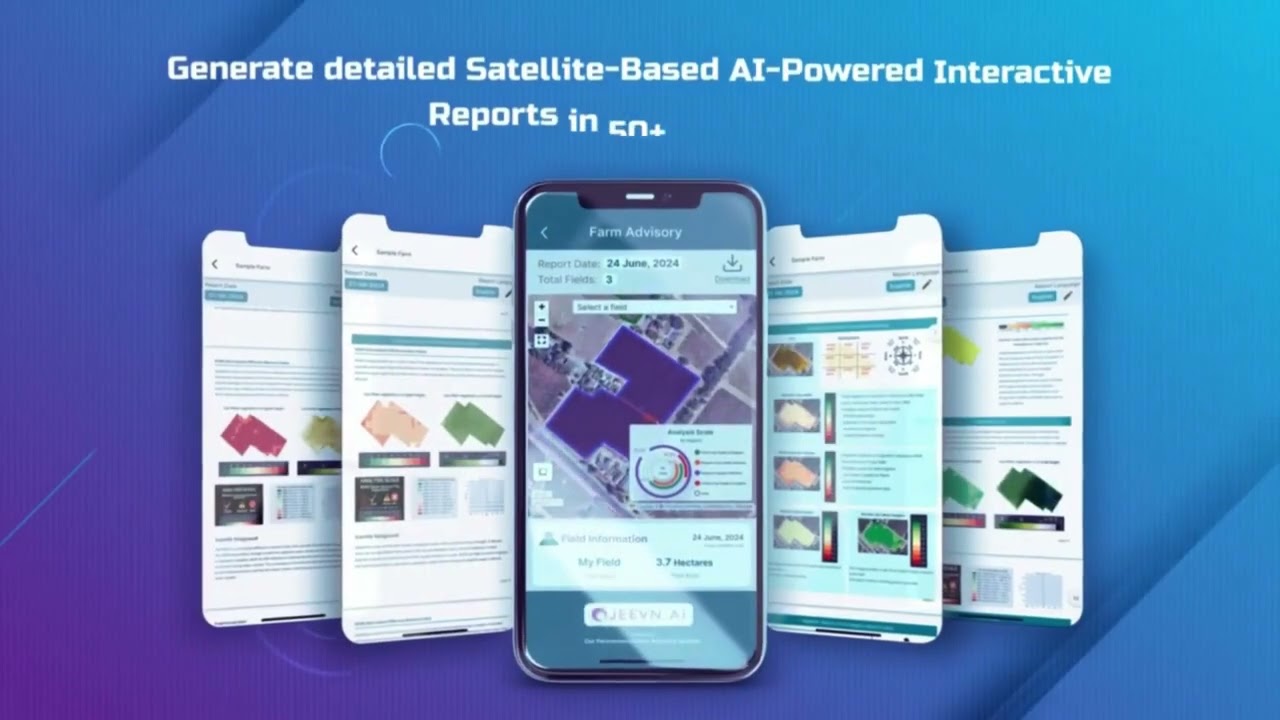
- Example Platform: Farmonaut’s Jeevn AI Advisory delivers insights via satellite tech for smarter decisions at every farm stage.

Comparison Table of Transformative AI Trends in Crop Farming for 2026
| Trend Name | Description | Estimated Adoption Rate by 2026 (%) | Crop Yield Impact (% increase) | Sustainability Benefit | Example Application |
|---|---|---|---|---|---|
| Smart Satellite Crop Monitoring | Use of multi-spectral satellite imagery and AI analytics to monitor soil & crop health | 75% | 10–15% | Reduces input waste, early stress detection | Real-time NDVI alerts for drought warning |
| AI-Powered Precision Irrigation | IoT sensors and AI adjust irrigation tailored to soil/data analysis | 60% | 12–18% | Saves water & energy, reduces fertilizer runoff | Automated irrigation triggers based on moisture |
| Autonomous Drones & Robotics | AI-enabled drones/robots for crop monitoring & precise interventions | 55% | 10–12% | Reduces chemical/pesticide usage | Drone-spraying for localized pest/disease management |
| Predictive Analytics for Yield | ML models forecast yield and farm conditions using big data | 65% | 8–14% | Improves planning, cuts losses from climate impact | Yield forecasts inform planting/tillage |
| AI-Driven Crop Breeding | Genomic selection using AI to breed climate-resilient varieties | 45% | 6–10% | Enhances varietal resilience to drought and pests | Selecting drought-tolerant wheat via genomic AI |
| Blockchain Traceability | Distributed ledgers for authenticating and tracing food supply chain | 38% | Not directly | Boosts transparency, reduces fraud | Verifying harvest origin & movement |
| AI-Enabled Advisory Access | Mobile/SaaS platforms that deliver tailored advisories via AI | 70% | 7–12% | Enables rural access to expertise | Push notifications on pest outbreaks/weather |
Farmonaut: Empowering Data-Driven Agri Farming Solutions
At Farmonaut, we recognize that modern agriculture thrives on accessible, actionable information and affordable technology.
Our mission is to bridge the gap between satellite science and everyday farming by offering a modular, scalable platform—accessible on web, Android, and iOS devices as well as via API integrations.
- Satellites & AI Combined: We deliver multispectral imagery and real-time monitoring for crops, helping users analyze soil health and anticipate crop stress or disease onset.
- Jeevn AI Advisory: Our system provides tailored recommendations, weather forecasts, and strategic planning for farmers and agri businesses.
- Fleet & Resource Management: Optimize field logistics, monitor equipment movement, and save operation costs using tools on Farmonaut Fleet Management.
- Blockchain-Traceable Harvests: Secure food authenticity and trace produce origin with our Traceability platform.
- Environmental Impact Tracking: Built-in tools for carbon footprint monitoring (see: Farmonaut Carbon Footprinting) help users comply with regulations and advance sustainability initiatives.
- Financing Verification: Our satellite-based verification supports agricultural loans and insurance for minimal fraud and smoother processing.
- Scalability: Our platform is modular—equally powerful for individual users, large agribusinesses, and government agencies pursuing national food security. Large Scale Farm Management features facilitate district or statewide oversight.

Learn more about our developer API at https://sat.farmonaut.com/api or see API documentation for custom integrations: Farmonaut Satellite API Developer Docs.
Visual Insights: YouTube Videos on AI Farming & Precision Agriculture
-
Farmonaut Web System Tutorial: Monitor Crops via Satellite & AI
-
JEEVN AI: Smart Farming with Satellite & AI Insights
-
How AI Drones Are Saving Farms & Millions in 2025 ? | Game-Changing AgriTech You Must See!
-
Smart Farming Future : Precision Tech & AI: Boosting Harvests, Enhancing Sustainability
-
Satellite Soil Moisture Monitoring 2025 – AI Remote‑Sensing for Precision Agriculture
-
Farmonaut – Revolutionizing Farming with Satellite-Based Crop Health Monitoring
-
The Future of Farming: Satellites, AI, and Geotagging – Farmonaut’s Bold Vision!
-
JEEVN AI: The Future of Smart Farming with Satellite & AI Insights
“**By 2026, AI-powered crop monitoring is projected to improve farm yields by up to 20% globally.**”
“**Precision farming tech could reduce fertilizer usage by 15% on average by 2025, according to industry forecasts.**”
Navigating Challenges & Future Opportunities in AI Farming
While AI farming delivers substantial benefits, several challenges remain to be addressed for full-scale transformation:
- Data Privacy and Security: With more data comes increased risk, requiring robust protocols for protecting farmer data and agricultural records.
- The Digital Divide: Rural areas may lack infrastructure for digital farming platforms. Solutions must be accessible to smallholders worldwide.
- Changing Skillsets: Comprehensive education, digital literacy, and ongoing extension support are essential to help farmers adopt and trust AI-driven practices.
- Integration: Legacy farm equipment and fragmented digital systems may hinder seamless rollout; harmonizing these requires industry-wide standards.
Nonetheless, the market outlook for farming AI is robust. As hardware costs drop, data networks expand, and software platforms become user-friendly, the prospects for crop farming through 2026 and beyond are undeniably bright.
Frequently Asked Questions (FAQ)
-
How does AI benefit traditional crop farming practices?
AI enables data-driven monitoring, predicting, and resource management, optimizing each stage of the farming process. From recognizing nutrient deficiencies in soil to deploying targeted irrigation and pest control, AI enhances yield, reduces wastage, and empowers farmers with actionable insights. -
What role do drones and robots play in AI farming in 2026?
Drones and robotic machinery automate tasks like crop health assessment, pest detection, and precision spraying, decreasing labor reliance and increasing operational efficiency. The use of deep learning and image analytics helps in faster, more accurate decision-making on vast farms. -
Can smallholder farmers access these advanced technologies?
Yes, platforms like Farmonaut make satellite-driven insights and AI-advisory services accessible via affordable subscriptions and mobile devices, narrowing the technology gap between smallholders and large agri-farming enterprises. -
How does blockchain improve transparency in food supply chains?
Blockchain records each transaction or change of state in the supply chain, providing traceability for food products, reducing fraud, and increasing consumer trust in food origin and safety. -
Are there sustainable benefits to AI-driven crop farming?
Absolutely. AI farming optimizes the use of water, fertilizer, and chemicals, reduces wastage, and supports early interventions—leading to more environmentally sustainable agricultural practices. -
How secure is my data on modern AI-powered agriculture platforms?
Leading platforms implement industry-standard encryption and follow strict privacy policies to secure user, operational, and farm data. Always verify the privacy protocols of any provider you select. -
Where can I try or deploy Farmonaut’s Platform?
You can get started on web, Android, or iOS via Farmonaut’s unified app platform and explore APIs for custom integrations.
Conclusion: The Path Forward for Crop Farming AI
The landscape of farming, farming land, agri farming, farming ai, ai farming, crop farming is transforming at an unprecedented pace. With the ongoing population surge, intensifying pressure on global food demand, and climate volatility, artificial intelligence has emerged as the pivotal force in creating data-driven, sustainable, and efficient agricultural systems.
Seven transformative trends—from satellite-driven crop monitoring and autonomous drones to AI-powered precision irrigation and blockchain traceability—are redefining how farmers interact with the land, manage resources, safeguard food systems, and adapt to future challenges.
At Farmonaut, our commitment is to make these innovations affordable, accessible, and actionable for every farmer, business, and government seeking smarter, more resilient agriculture. By integrating satellite insight, AI advisory, and sustainable resource tools, we help you optimize yields, reduce costs, and ensure food security—today and for generations to come.
Seize the future of farming—discover the power of satellite, AI, and data-driven agriculture in 2026!

 Nivia
Nivia Doodlakine
 Exurbia Geospatial
 FieldZero
 Indico Company
 Kubota
 FFBS
FFBS Jontra
 Kalustyan
 Tucor
Tucor Geno
Geno Hayleys Agriculture
 Linx Agritech
 Adinet
