

GPS Guidance Systems for Farm Tractors: Data, Costs, ROI
Reviewed August 2026 against USDA Economic Research Service (ERS) charts-of-note, USDA Agricultural Research Service (ARS) precision-agriculture reporting, and agricultural GPS retailer pricing data.
Try it: Run your own numbers →
Agricultural GPS guidance systems steer tractors along satellite-tracked lines so passes don’t overlap or skip — hardware runs from about $1,500–$8,000 for a basic visual (lightbar) guidance unit to $18,000–$35,000 for automatic RTK steering (AllyNav), and USDA’s Economic Research Service found 70% of large-scale U.S. crop farms were already using autosteer guidance as of 2023. This page answers what the systems cost, what they save, and how RTK compares with WAAS/SBAS correction — with the USDA and retailer figures behind each number, not just averages.
If you searched for an ag gps guidance system, a tractor gps guidance upgrade, or the best gps guidance system for tractors for your acreage, the sections below cover adoption data, accuracy tiers, correction-service pricing, and a payback calculator built from USDA and retailer figures — not marketing copy.
Table of Contents
- How Many U.S. Farms Actually Use GPS Guidance
- RTK vs. WAAS/SBAS: Accuracy, Cost, and When Each Makes Sense
- What a Farm Tractor GPS Guidance System Actually Costs
- Payback Calculator: Is a Guidance System Worth It on Your Acreage?
- How the System Works on the Tractor
- Documented Benefits: Yield, Input Savings, Field Efficiency
- Feature Comparison: Leading Tractor GPS Guidance Systems
- Where Satellite Data Fits Alongside In-Cab Guidance
- Adoption Checklist for 2026 and Beyond
- FAQs on Agricultural GPS Guidance Systems

How Many U.S. Farms Actually Use GPS Guidance
USDA’s adoption numbers are the closest thing to a market census for agricultural gps guidance systems, and they answer the “is this normal for my farm size” question better than any vendor page. According to USDA’s Economic Research Service, 70% of large-scale U.S. crop farms were using autosteer guidance systems as of 2023, a figure ERS tracks through its charts-of-note series (USDA ERS, 2023). Corn-specific data shows the same trend accelerating over a longer window: autosteer guidance on corn acres grew from 5.3% in 2001 to 58% by 2016 (USDA ERS, 2016), and a separate ERS chart put GPS guidance specifically at 67% of corn acres that same year (USDA ERS, 2016).
Adoption rises with farm size: of farms growing corn in 2016, 73% of those in the largest size category (1,725 acres or more) used guidance (USDA ERS). Read together, these numbers show adoption concentrated on large row-crop operations; smaller farms use guidance far less, as the farm-size figures below show.
None of this is current-year data — USDA farm surveys lag 12 to 18 months behind publication, so there is no published 2025 or 2026 adoption rate yet. ERS updates its charts-of-note annually using NASS farm survey data; check ers.usda.gov/data-products/charts-of-note directly after Q2 each year for the newest corn, soybean, wheat, and cotton adoption figures once USDA releases them.
Key Insight
If you farm row crops, GPS guidance is now the majority practice, not an early-adopter bet — USDA found auto-steer or guidance on more than half of U.S. corn, soybean, winter wheat and cotton acres (USDA ERS). The open question for smaller or diversified operations is payback period, not whether the technology works.

Guidance use by crop and farm size
USDA also tracks the share of planted acres run with auto-steer or guidance. In the latest survey year for each crop, it covered most row-crop acreage (USDA ERS Chart of Note):
| Crop | Share of planted acres with guidance | Survey year |
|---|---|---|
| Cotton | 64.5% | 2019 |
| Corn | 58.4% | 2016 |
| Winter wheat | 55.9% | 2017 |
| Soybeans | 54.5% | 2018 |
By farm size, the 2023 survey found autosteer on 9% of small farms, 52% of midsize farms and 70% of large-scale crop farms (USDA ERS, America’s Farms and Ranches at a Glance 2024).
RTK vs. WAAS/SBAS: Accuracy, Cost, and When Each Makes Sense
Every ag guidance system starts with a GNSS receiver, but the correction method determines both the accuracy you get and the subscription you pay for. There are two tiers in commercial use:
- ✔ RTK (Real-Time Kinematic): a network of base stations delivers centimeter-level accuracy — USDA’s Agricultural Research Service documents planting and application accuracy down to 1 centimeter with tractor guidance systems using this correction method (USDA ARS, 2023). This is the tier row-crop farms running variable-rate input application need for pass-to-pass repeatability.
- ✔ SBAS/WAAS corrections: satellite-based, sub-meter accuracy, no local base station required. SBAS correction is free to receive (WAAS in North America, EGNOS in Europe), gives roughly ±30 cm accuracy (AllyNav), and suits less input-intensive tasks or smaller plots where centimeter precision isn’t the limiting factor.
- Try it: Run your own numbers
The subscription costs diverge sharply between the two. SBAS correction is free, while subscription RTK correction services delivered over cellular networks cost about $600–$1,800 a year depending on coverage and accuracy, according to AllyNav. If your quote doesn’t break hardware and correction service apart, ask the dealer what portion is the network fee versus the receiver itself.

What a Farm Tractor GPS Guidance System Actually Costs
Pricing splits into three tiers based on how much steering automation and correction accuracy you need. A basic visual guidance system — a lightbar that shows the operator how far off-line they are, with no automated steering — starts at roughly $1,500 (AllyNav, 2024). Assisted steering, which physically turns the steering wheel along the guidance line, runs about $8,000–$18,000, and automatic RTK steering with hydraulic or motor steering about $18,000–$35,000, per the same source. On top of hardware, budget for correction: SBAS is free, while RTK subscriptions run about $600–$1,800 a year.
AllyNav puts typical payback at 1–2 years for operations over 1,000 acres, factoring in fuel, input, and labor savings against hardware and subscription costs. Payback is slower on smaller acreage, so the calculator below lets you check what payback looks like on your specific acres, input costs, and system price rather than relying on someone else’s average farm.
Pro Tip
Get the hardware price AND the correction subscription price quoted separately before buying. An RTK subscription at $600–$1,800 a year adds $3,000–$9,000 over five years on top of the hardware — run both scenarios through the numbers below before deciding.
Payback Calculator: Is a Guidance System Worth It on Your Acreage?
Enter your acreage, system cost, correction subscription and an assumed production gain to see an estimated payback period. The defaults are illustrative, not USDA figures.
Run your own numbers
Assumptions: production gain applies to total crop revenue on all acres entered; the calculation excludes financing costs, trade-in value of existing lightbar equipment, maintenance, and any yield variation by soil type or crop, which USDA has not published in a single comparative study. The default production gain is an assumption, not a published USDA figure; replace it with your own records or local trial data.
Source: hardware and correction-subscription ranges from AllyNav tractor GPS price guide (SBAS free; RTK $600–$1,800/yr), cross-checked against RTKdata published NTRIP pricing ($400/yr).

How the System Works on the Tractor
Automated Steering and Guidance Lines
A guidance system for tractors follows a prescribed line the operator uploads or draws in the cab display, automatically executing headland turns and holding the pass line whether the field is a straight cornfield, a curved contour, or an irregular orchard row. USDA ARS says tractor guidance can improve field efficiency by up to 20% (USDA ARS); an ARS field study found guidance cut overlaps by up to 6% of field area and gaps by up to 16% (USDA ARS, 2020).
⚠ Common Mistake
Skipping steering calibration at the start of the season is the single most common cause of input waste on a guided pass — recalibrate for row width, implement offset, and terrain before first use each year, not just after a hardware swap.
Pro Tip
Map field boundaries, obstacles, and prescription lines before the season starts, not during planting. Guidance accuracy depends on the map quality as much as the receiver.
Sensors, Fleet Management, and Data Flow
Guidance systems increasingly link to spray booms, planters, and harvesters for machine-to-machine coordination, feeding a central fleet management platform when a farm runs more than one guided vehicle. For operations coordinating multiple tractors, sprayers, or grain carts, Farmonaut's Fleet Management Solutions track vehicle usage, maintenance timing, and cost per acre across the fleet rather than machine by machine.

Documented Benefits: Yield, Input Savings, Field Efficiency
USDA has published three separate figures on the return from guidance systems, and it's worth keeping them distinct rather than blending them into one vague "saves money" claim:
- ✔ Profit: guidance systems raised operating profit on corn farms by an estimated 2.5% and net returns by 1.5%, per a 2016 USDA ERS study of 2010 corn data (USDA ERS).
- ✔ Field efficiency: up to 20%, from reduced overlap and skip, per USDA ARS.
- ✔ Net return from mapping: yield and soil mapping raised corn farms' net returns by almost 2%, in the same 2016 ERS study (USDA ERS).
Note the mapping figure is about yield and soil maps — a data layer, not the steering hardware itself — and both ERS profit estimates rest on 2010 survey data, so treat them as indicative rather than current benchmarks.
What USDA has not published: a single peer-reviewed study directly comparing yield impact across soil types, crop types, or U.S. regions using the same methodology. The figures above are aggregate numbers, not a state-by-state or soil-type breakdown — if you need a number specific to your soil and crop, your state's land-grant extension service or your equipment dealer's local trial data is the more precise source than a national USDA average.
Reading the Numbers Correctly
The 1.5% net-return gain from guidance, the up-to-20% field efficiency gain and the almost-2% net return from mapping are three different measurements of three different things — steering, pass efficiency, and data-driven input decisions. Don't add them together as a single "guidance saves you X%" claim; USDA reports them separately because they measure separate mechanisms.

Why farmers buy GPS guidance
USDA asked farms that use autosteer why they adopted it. Labor, not yield, came first (USDA ERS, 2023 ARMS data):
| Reason given (2023) | Share of autosteer users |
|---|---|
| Reduce operator fatigue | 64% |
| Save labor time | 50% |
| Increase yields | 31% |
| Reduce purchased input costs | 28% |
| Came standard on equipment | 21% |
| Improve soils or reduce environmental impacts | 14% |
The 21% figure matters if you are shopping for tractors with GPS. About one in five users got guidance because it came with the machine. If you are buying new, ask the dealer what receiver and correction level are included. Then compare that with an aftermarket kit for the tractor you already own.
Feature Comparison: Leading Tractor GPS Guidance Systems
In short: visual lightbar guidance ($1,500–$8,000) usually runs on free SBAS correction, while assisted steering ($8,000–$18,000) and automatic RTK steering ($18,000–$35,000) need an RTK subscription of about $600–$1,800 a year for centimeter-level pass-to-pass accuracy (AllyNav).
Request an itemized quote from your dealer to confirm current figures for your region.

Where Satellite Data Fits Alongside In-Cab Guidance
GPS guidance handles where the tractor drives. It doesn't tell you what's happening in the crop between passes — that's a separate data layer, and it's where Farmonaut fits alongside, not in competition with, your in-cab guidance hardware.
- 🌐 Satellite-Based Monitoring: field-level crop and soil status via NDVI and spectral indices, tracked between guided passes.
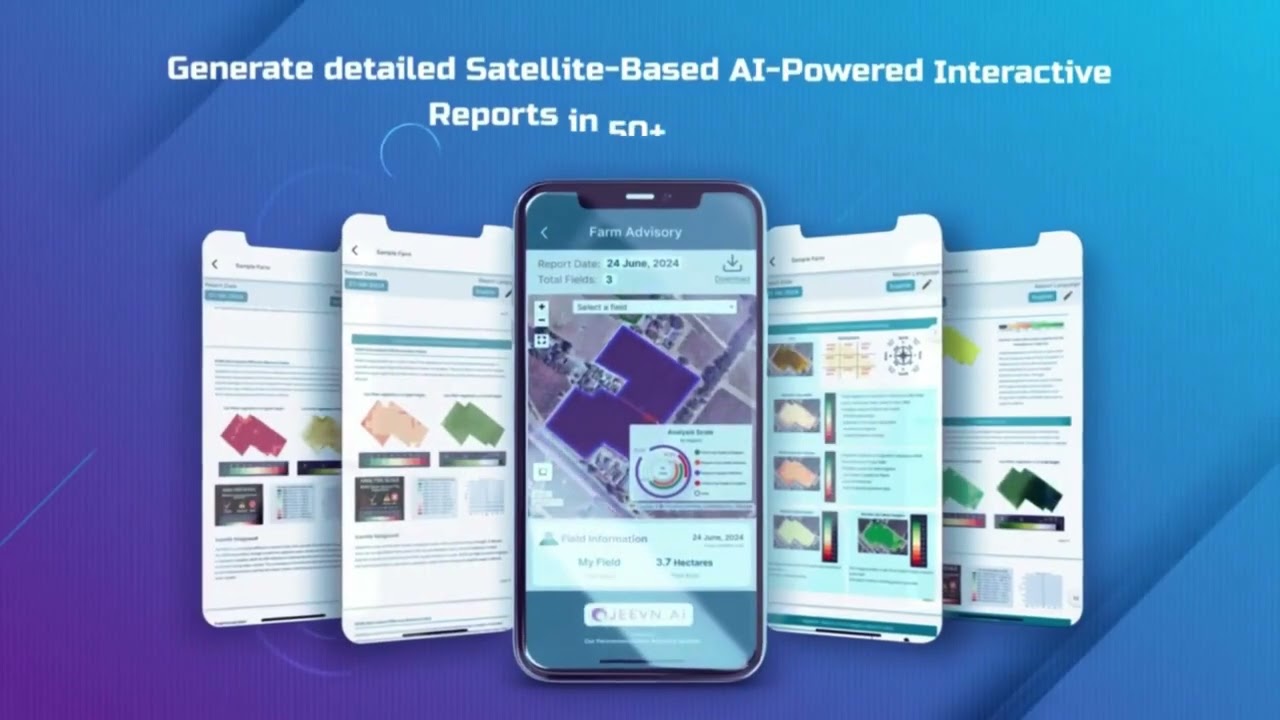
- 🤖 Jeevn AI Advisory: input-timing and pest-risk recommendations layered on top of satellite data.
- ⛓ Blockchain Traceability: digital supply chain records connecting field-level guidance data to downstream buyers.
- 🚚 Fleet & Resource Management: coordinate multiple guided tractors via fleet management tools.
- 🌍 Environmental Impact Monitoring: track input use and emissions via Carbon Footprinting services.
None of this replaces the GNSS receiver in the cab — it's the data layer that makes the guided passes worth analyzing after the fact.



Explore our API for custom integration: https://sat.farmonaut.com/api
Developer Docs: API Developer Documentation
Need to coordinate guidance data across multiple fields or a large operation? See the Large-Scale Farm Management Platform.
Adoption Checklist for 2026 and Beyond
Whether you're comparing a first lightbar or replacing an aging RTK receiver, the decision sequence is the same regardless of what year it is:
- ✔ Match correction type to task: RTK's 1 cm accuracy for variable-rate input application and row-crop precision; WAAS/SBAS's sub-meter accuracy for lower-intensity tasks.
- ✔ Price hardware and subscription separately: an RTK subscription of $600–$1,800 a year adds up over a 5-year horizon.
- ✔ Run your own payback numbers using your acreage and crop revenue rather than the retailer-quoted 1–2 year payback, which applies to operations over 1,000 acres.
- ✔ Calibrate every season for row width, implement offset, and field-specific terrain — factory defaults miss unique conditions.
- ✔ Check USDA ERS charts-of-note annually after Q2 for updated adoption figures by crop, since the numbers in this article are 2023–2024 vintage and will be superseded as new NASS survey data is released.
Durable Method, Not Just This Year's Numbers
The specific adoption percentages and prices in this article will age. The method won't: check USDA ERS charts-of-note for your crop's current adoption rate, get an itemized hardware-versus-subscription quote from at least two dealers, and run your own acreage and crop revenue through a payback calculation before committing capital. That sequence answers "is this worth it for me" regardless of what the market average looks like in any given year.
FAQs on Agricultural GPS Guidance Systems
What is the difference between RTK and SBAS/WAAS guidance?
RTK uses a network of base stations to deliver 1 centimeter accuracy, documented by USDA ARS (USDA ARS, 2023). WAAS/SBAS uses satellite-based corrections for sub-meter accuracy, sufficient for less input-intensive tasks. SBAS correction is free; RTK subscriptions run about $600–$1,800 a year, per AllyNav.
How much does a GPS guidance system for a farm tractor cost?
Visual guidance systems run about $1,500–$8,000, assisted steering $8,000–$18,000 and automatic RTK steering $18,000–$35,000, based on AllyNav retailer pricing. RTK correction adds about $600–$1,800 a year; SBAS correction is free.
What's the payback period on a tractor GPS guidance system?
AllyNav puts typical payback at 1–2 years for operations over 1,000 acres. Smaller farms should expect longer — use the calculator above with your own acreage and crop revenue for a number specific to your operation.
Are GPS guidance systems only worthwhile for large farms?
USDA's 2023 data show autosteer on 70% of large-scale crop farms, 52% of midsize farms and 9% of small farms (USDA ERS). Basic visual guidance systems at the $1,500 price point are the lower-cost entry point for smaller operations testing the technology before an autosteer investment.
What yield or efficiency gain can I expect from GPS guidance?
USDA ARS reports field efficiency gains of up to 20% from tractor guidance, and a 2016 USDA ERS study of 2010 corn data found guidance raised net returns by about 1.5% and yield and soil mapping by almost 2% (USDA ERS). These are national aggregate figures — USDA has not published a single study breaking results out by soil type, crop, or region.
Where can I find updated adoption and pricing figures?
USDA ERS publishes updated precision-agriculture adoption data annually via its charts-of-note series at ers.usda.gov/data-products/charts-of-note, sourced from NASS farm surveys. Hardware and subscription pricing is best confirmed directly with dealers, since retailers revise rate schedules seasonally.







Summary: Choosing a GPS Guidance System on the Numbers
The adoption data is unambiguous for row-crop farms: 70% of large-scale U.S. operations use autosteer (USDA ERS, 2023), and auto-steer or guidance covers more than half of U.S. corn, soybean, winter wheat and cotton acres (USDA ERS). The financial case rests on USDA-documented figures — up to 20% field efficiency and about 1.5% higher net returns from guidance, almost 2% from yield mapping — plus retailer hardware pricing from about $1,500 for a lightbar to $35,000 for automatic RTK steering, and RTK subscriptions of about $600–$1,800 a year.
None of those numbers are static. USDA revises its adoption figures annually; retailers revise pricing seasonally. The way to stay current isn't to bookmark this article's numbers — it's to check ERS charts-of-note each year and get an itemized quote before buying. Run your own acreage and revenue through the calculator above rather than relying on the retailer's 1–2 year payback estimate, and treat correction-tier selection (RTK vs. WAAS) as a task-fit decision, not a default.
Take the Next Step:
- Explore our API for integrating satellite and fleet data in your digital management suite: https://sat.farmonaut.com/api
- Unlock affordable, advanced crop monitoring—try the Farmonaut App today!
- Read more about sustainability tools: Carbon Footprinting, Digital Traceability
Discussion
Questions, corrections or field experience? Share them below. First-time comments are reviewed before they appear, and your email is never published.
No comments yet. Be the first to add a question or your experience.

 Geno
Geno Godrej Agrovet
 Hayleys Agriculture
 Linx Agritech
 Adinet
 Save Your Soils
 Grandstream Algérie
 XOS Realty
 Geospatial Lab Africa
 Agro La Gándara
 HIPSAC
 ZOL Zimbabwe
 Juligerm
 AdBio
AdBio MISE Maroc
 NWNS
NWNS Red August Group
 Farm Inc
 WeMe Global
