

Precision Farming Systems: GPS Tractors & Battery Guide
Reviewed August 2026 against USDA Economic Research Service farm-technology surveys and BloombergNEF’s annual battery price survey.
Try it: Calculator: Lithium-Ion vs. Lead-Acid Battery Cost Over Time →
A precision farming system is the combination of GPS guidance, variable-rate application, and yield mapping that lets a tractor hold a line to within a couple of centimeters and adjust seed, fertilizer, or spray rate as it moves. In the United States, guidance autosteering was used on 70% of large-scale crop-producing farms and 52% of midsize farms in 2023, per USDA’s Economic Research Service (ERS). None of that hardware runs without a battery built for vibration, dust, and temperature swings, which is the second half of this guide.
What Counts as a Precision Farming System
The term covers four layers of hardware and software that stack on top of a conventional tractor, combine, or sprayer:
- GPS/GNSS guidance — steers the machine along a pre-set line (autosteer)
- Variable-rate technology (VRT) — changes seed, fertilizer, or pesticide rate by zone within a field
- Yield and soil mapping — records output and soil conditions in georeferenced layers
- Telematics and remote monitoring — feeds machine and crop data back to a farm management platform
For a broader walkthrough of the sensors, drones, and mapping tools involved, see our roundup of precision farming equipment technology. This guide focuses on the two components most farms actually budget for first — GPS tractor guidance and the battery systems that keep it powered.
Farming GPS Systems and GPS Tractors: How Autosteer Guidance Works
A standalone GPS receiver resolves a tractor’s position to within 1-3 meters. That is not tight enough to avoid overlap on a 30-foot planter pass, so farming GPS systems layer correction signals on top of the raw satellite fix. Real-Time Kinematic (RTK) correction compares the tractor’s receiver against a fixed base station and narrows that error to roughly 2-3 centimeters, which is what makes pass-to-pass autosteer usable on GPS tractors for planting, spraying, and tillage. Satellite-based correction services (the U.S. Coast Guard’s WAAS being the free baseline) sit in between, at sub-meter to decimeter accuracy, and cost less than a subscription RTK network.
Adoption of this hardware is no longer a niche behavior. USDA ERS reports that automated guidance is now applied on well over 50% of the acreage planted to corn, cotton, rice, sorghum, soybeans, and winter wheat, based on its Precision Agriculture in the Digital Era report (EIB-248, published February 2023). The specific by-crop figures, drawn from USDA’s Agricultural Resource Management Survey (ARMS), are in the table below.
GPS Tractors in Precision Farming: US Adoption by Crop and Farm Size
| Crop | Auto-steer guidance (% of planted acres) | Variable-rate technology (% of planted acres) | ARMS survey year |
|---|---|---|---|
| Corn | 58.4% | 37.4% (up from 11.5% in 2005) | 2016 |
| Winter wheat | 55.9% | 18.8% | 2017 |
| Soybeans | 54.5% | 25.3% | 2018 |
| Cotton | 64.5% | 22.7% (up from 5.4% in 2007) | 2019 |
| Sorghum | not separately reported | 13.9% | 2019 |
| All large-scale crop farms (aggregate) | 70% | not broken out by input | 2023 |
| All midsize farms (aggregate) | 52% | not broken out by input | 2023 |
Source: USDA ERS, auto-steer and guidance adoption by crop; USDA ERS, variable rate technology adoption; USDA ERS, 2023 farm-size adoption.
Farm size is the single biggest predictor of whether a given operation runs GPS tractors at all. USDA ERS’s farm-size breakdown sorts farms into five equal groups by size and finds a wide gap between the largest and smallest quintile on every crop it tracks. Winter wheat shows the widest spread: 82% of the largest wheat farms used guidance in 2017 versus 7% of the smallest.
Precision Planting: GPS and Guidance Equipment for Seeders
Guidance on a planter does more than keep rows straight. Section control shuts off individual row units on point rows and headlands, and downforce or population control adjusts seed rate zone by zone using the same VRT layer that drives fertilizer maps. That is why VRT-for-seed adoption has climbed alongside autosteer rather than trailing it: corn VRT usage went from 11.5% of planted acres in 2005 to 37.4% in 2016, and cotton went from 5.4% in 2007 to 22.7% in 2019, per the same USDA ERS VRT chart cited above. For farms weighing heavier planting and tillage iron alongside guidance upgrades, see our notes on heavy-duty tractor and machinery trends, and on scaling guidance to a full GPS-tractor precision agriculture program.
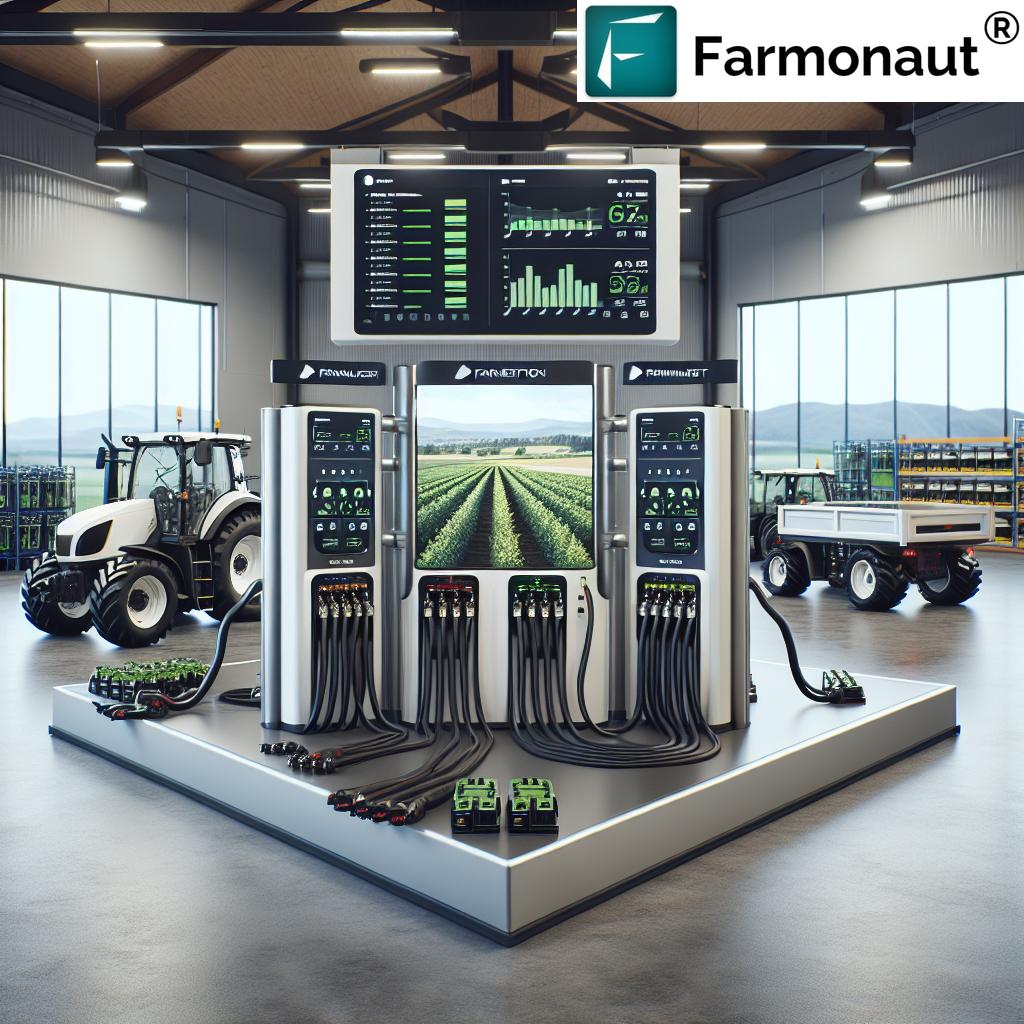
Battery Systems for Agriculture: What GPS Tractors and Heavy Equipment Need
A GPS tractor’s receiver, display, and steering actuator draw continuously off the same 12V or 24V circuit that starts the engine, so a weak starting battery shows up first as guidance drift, not just a slow crank. Cold weather is the real stress test: the industry standard for rating a battery’s starting power, SAE J537, chills the battery to -18°C (0°F) and requires it to hold at least 7.2 volts (1.2 volts per cell) for 30 seconds under load. Two other standards test the same cold-start scenario with different pass thresholds, which is why battery specs from different suppliers are not always directly comparable.
| Standard | Test temperature | Load duration | Minimum voltage to pass |
|---|---|---|---|
| SAE J537 (Cold Cranking Amps) | -18°C / 0°F | 30 seconds | 7.2V (1.2V/cell) |
| IEC | -18°C / 0°F | 60 seconds | 8.4V |
| DIN | -18°C / 0°F | 30s, then 150s | 9V, then 6V |
Source: Battery University, “How to Measure CCA”. When you compare a battery for agricultural machinery by its printed CCA number, confirm which of these three test protocols the manufacturer used — a DIN-rated pack and an SAE-rated pack of the same nominal CCA are not interchangeable in practice.
Lithium-Ion Batteries for Agricultural Equipment: Chemistry and Cost
Lead-acid remains the default starting battery on most tractors because it is cheap, universally stocked, and easy to recycle through existing collection networks. Lithium-ion — usually lithium iron phosphate (LFP) chemistry in equipment applications, rather than the nickel manganese cobalt (NMC) chemistry common in passenger EVs — is the chemistry behind newer compact utility vehicles, sprayer auxiliary power, and the first electric tractor platforms reaching U.S. dairies and orchards. Pack pricing has moved fast enough that a quote from two years ago is no longer a reliable planning number. BloombergNEF’s 2025 lithium-ion battery price survey put the global average pack price at $108 per kWh, down 8% from 2024, with LFP packs averaging $81/kWh against $128/kWh for NMC.
None of that data covers lead-acid pricing directly, so the calculator below leaves both prices open for you to enter from your own supplier quotes. It also asks for pack lifespan separately by chemistry, because that is where the two technologies diverge most in total cost, not necessarily in sticker price. On the equipment side, both John Deere and Monarch Tractor have publicly announced battery-electric tractor programs; because pack capacity and pricing on those platforms are still being revised between pilot and production runs, check each manufacturer’s current spec sheet rather than a number printed in this article.

Calculator: Lithium-Ion vs. Lead-Acid Battery Cost Over Time
Maintenance That Extends Battery Life in the Field
Chemistry and price only set the ceiling; field practice determines whether a pack reaches it. The checklist below applies to both lead-acid and lithium-ion packs unless noted:
- Inspect terminals and case for corrosion or swelling before each season, not just when a machine fails to start
- Clean terminal connections to prevent voltage drop under the heavy load a starter motor or hydraulic pump demands
- Match the charger to the chemistry — a lead-acid charge profile will overcharge and shorten the life of an LFP pack, and vice versa
- Store equipment in a temperature-buffered space where possible; SAE J537's 0°F cold-start benchmark exists precisely because starting current draw is hardest in the conditions batteries are least efficient
- Avoid deep discharge on lead-acid batteries specifically — repeated full discharge is the single fastest way to shorten a flooded or AGM battery's working life
These same duty cycles apply whether you are running a single utility tractor or a full fleet; for fleets handling used harvesting equipment alongside newer machines, battery condition is one of the cheaper things to audit before a breakdown during harvest forces the issue. The same applies whether that fleet includes imported agricultural machinery running on 12V systems or newer platforms with integrated lithium packs.
How to Get Fresher Numbers Than This Page
Every adoption figure above will be superseded. USDA's Agricultural Resource Management Survey (ARMS) — the source behind the ERS charts cited throughout — is fielded on a rotating schedule by crop, and ERS republishes topline precision-agriculture figures in its annual America's Farms and Ranches at a Glance release each December; search "ARMS precision agriculture" on ers.usda.gov for the current release. BloombergNEF publishes its lithium-ion battery price survey annually, also in December; the $108/kWh figure cited above is the 2025 edition, and a 2026 edition will replace it on the same page cited earlier in this guide. For SAE J537 or related battery testing standards, SAE International's own standards catalog is the authoritative source if a supplier's spec sheet cites a revision you don't recognize.
FAQ
Q: What is the difference between a farming GPS system and a full precision farming system?
A: A farming GPS system is just the positioning and guidance layer — the receiver and correction signal that steers the machine. A full precision farming system adds variable-rate application and yield/soil mapping on top of that guidance layer, so the machine is not just steering straight but also changing input rates as it moves.
Q: How accurate do GPS tractors need to be for precision planting?
A: For planting and spraying, pass-to-pass accuracy in the low single-digit centimeters is standard, which is why RTK correction — rather than uncorrected GPS or even WAAS — is the baseline for precision planting GPS and guidance equipment on modern planters.
Q: Why do small farms adopt GPS tractors at much lower rates than large farms?
A: USDA ERS's farm-size data shows the gap is largest on winter wheat (7% of the smallest farms versus 82% of the largest in 2017) and narrowest on cotton (50% versus 67% in 2019). Equipment cost relative to acreage farmed is the main driver — a guidance system and RTK subscription cost close to the same dollar amount whether a farm has 200 acres or 20,000.
Q: Is lithium-ion worth the higher upfront cost for agricultural machinery?
A: It depends on how long you keep the equipment and your local pricing for both chemistries — use the calculator above with your own supplier quotes rather than a generic rule of thumb, since BloombergNEF's cited $81-128/kWh range for lithium-ion chemistries is a global average, not a farm-gate price.
Q: Are these battery and guidance standards the same for equipment used outside the United States?
A: The SAE J537 cold-cranking standard and RTK/WAAS correction methods are used internationally, but adoption rates differ by country and by the mix of farm sizes and types of farming operations in a given region, so the USDA figures in this guide should be treated as U.S.-specific rather than global.
Explore Farmonaut's Services:

Access our API: Farmonaut API
API Developer Documentation: API Docs


Discussion
Questions, corrections or field experience? Share them below. First-time comments are reviewed before they appear, and your email is never published.
No comments yet. Be the first to add a question or your experience.

 LACOS Geoinformation
 Pulsar Supernova
 Magrifly
 LatConnect 60
 Disease Free Life
 WebsEdge
 Blickwinkel
 Agricultural Credit Policy Council
 MCSOD
MCSOD Marei Nursery
 eKGIS
eKGIS Mostas Tech
 Andex
Andex FCF India
 Unifrutti Gulf
 Deluxe Conseil
 WICO
WICO
